Home › D › Dill (Elt t f Pluk t f Sloane t f)
Dill (Elt t f Pluk t f Sloane t f)
elt. 4.t.3. f.2 Pluk. t. 74. f. 7 Sloane t. 139. f. 3 L'Her.stir.1.t.58 L'Her.stir.1.t.59 India 1691. S co Ceylon Sco ...
W. Indies Sco ...
Peru 1731. C co many-flowered un 3 my.jn Y 1821. C co ...... eared un 3 my.jn Y Bengal 1823. C co triangular un 2 jl.au Y.P hoary un 3 jl.au Y umbelled un 1 jl.s Y W. Indies 1775. C co Sandw. Is. 1818. C co Jamaica 1788. S co Jac. vind. 2.t.118 reflex-flowered un 3 jl.au R curled un 1 jl.au Y gréat-flowered un 6 jl.au Y un 2 jl.s Y large-leaved lime-leaved 오디 un 20 n.d Y un 2 jl.au Y un 1 jl.au Y broad-leaved 2 un 1 jn.au Y small-flowered un 1 jl.au Y Sonnerat's un 2 jn.jl Y 9915 populifólia W.
Poplar-leaved un 1 jl.au Y 9916 mollíssima W. soft-leaved un 2 jn.jl Y 9917 orbiculáta Dec. orbicular un 3 jn.jl Y 1820. C co Peru 1799. C co Carolina 1726. S co Peru 1772. C co Mauritius 1789. S co 1816. C co China 1821. S co Jamaica 1730. S co India 1596. S co E. Indies 1768. Sco C. G. H. 1806. C co E. Indies 1796. S co Peru 1789. C co China Jac. vind. 1. t. 16 L'Her.stir.1.t.64 Ca.dis.5.t.135.f.2 L'Her.stir. 1.t.63 Jac. ic. 1. t. 137 Bot. reg. 360 Houtt. syst. t. 61 Cav.diss.1.t.7.f.2 Cav.diss.1.t.6.f.4 Cav.diss.1.t.7. f.9 Cav.dis.2.t.14.f.1 9918 índica W. rough-capsuled un 14 jl.au Y India 1731. S co Cav.dis.1.t.7.f.10 9919 vesicária W. bladdery un 3 jl.au Y Mexico 1822. C co Cav.dis.2.t.14.f.3 9920 álbida W. whitish ☐ un 3 jl.au W.y Canaries 1822. C co 9921 acerifólia Lag.
Maple-leaved un 3 jl.au B N. Spain 1822. C co 9922 Milléri Dec. 9923 vimínea Fisch. 9924 semicrenáta Link. 9925 acrántha Link. 9926 spiræifólia Link. 9927 brasiliensis Cav.
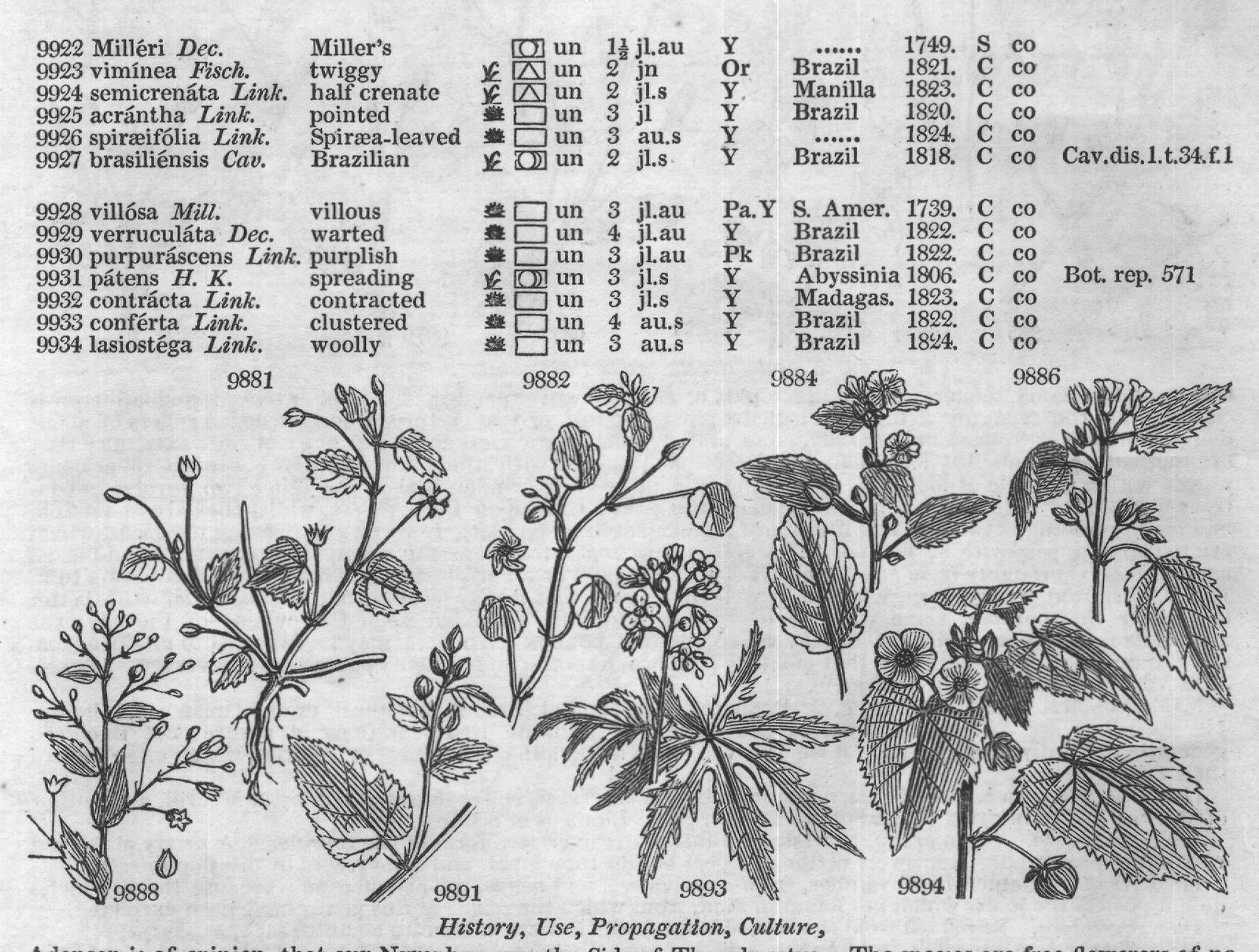
Miller's un 1 jl.au Y ...... 1749. S co twiggy ☑ un 2 jn Or Brazil 1821. C Co half crenate pointed un 2 jl.s Y Manilla 1823. C co un 3 jl Y Brazil 1820. C co Spiræa-leaved un 3 au.s Y .. 1824. C co Brazilian un 2 jl.s Y Brazil 1818. C co Cav.dis. 1.t.34.f.1 9928 villósa Mill. villous un 3 jl.au Pa.Y S. Amer. 1739. C co 9929 verruculáta Dec. warted un 4 jl.au Y Brazil 1822. C co 9930 purpuráscens Link. purplish un 3 jl.au Pk Brazil 1822. C co 9931 pátens H. K. spreading un 3 jl.s Y 9932 contrácta Link. contracted un 3 jl.s Y 9933 conférta Link. clustered un 4 au.s Y 9934 lasiostéga Link. woolly un 3 au.s Y Brazil Abyssinia 1806. C co Bot. rep. 571 Madagas. 1823. C co Brazil 1822. C co 1824. C co 9881 9882 9884 9886 History, Use, Propagation, Culture, Adanson is of opinion, that our Nymphæa was the Sida of Theophrastus. The species are free-flowerers of no ORDER VII.
MONADELPHIA POLYANDRIA. 9881 Leaves roundish cordate hairy above serrated, Pedicels subsolitary longer than petiole 9882 Leaves roundish cordate bluntish crenate softly velvety, Pedic. solitary 1-fl. longer than petiole 9883 Leaves cordate serrate attenuated at end downy on the edge of the petiole and the nerves beneath 9884 Leaves ovate cordate toothed somew. angular bluntish downy, Pedic. sol. 1-fl. a little shorter than petiole 9885 Leaves cord, somewhat angular blunt serrate cren. downy on each side, Pedic. shorter than petiole 1-5-fl 9886 Leaves ovate cordate acuminate toothed, Pedunc. 3-4-flowered very short 9887 Leaves cordate ovate acuminate serrate smooth on each side, Peduncles many-fl. 9888 Leaves ovate cordate toothed acuminate downy, Pedunc. loosely panicled capillary **** Leaves palmate, divided into 3-5-7-9 lobes. 9889 Leaves cordate toothed 3-lobed; middle lobe acute long, Pedicels solitary nearly equal to the leaf 9890 Leaves subpeltate 7-lobed: lobes lanceolate acuminate pinnatifid toothed, Peduncles many-fl. 9891 Leaves subpeltate 5-lobed: lobes ovate acute toothed undivided, Peduncles about 1-flowered 9892 Leaves palmate 5-lobed smooth: lobes oblong acuminate toothed, Peduncles many-fl. 9893 Leaves palmate 7-lobed rough: lobes lanceolate cut-toothed, Pedunc. many-fl. bracteate corymbose 2. Capsules 15-40, 1-seeded, bladdery. 9894 Leaves oblong cordate toothed somewhat lobed, Pedicels solitary shorter than petiole 9895 Lvs. cord, ovate acute toothed downy on each side, Petioles and pedicels hairy, Stip. setaceous spreading 9896 Lvs. cord. roundish acumin, tooth. velvety, Petioles and branches with spreading hairs, Pedic. very short 3. Capsules 5-10, many-seeded, often bladdery. * Capsules 5-8. 9897 Leaves cord. lanc. acuminate entire downy beneath, Pedicels divided slender longer than petiole B Leaves narrow rough above Leaves more cordate smooth and a little rugose above 9898 Leaves subpeltate cordate ovate acuminate entire downy, Pedic. 1-fl. shorter than petiole 9899 Leaves roundish cordate acuminate entire downy beneath, Panicle terminal racemose 9900 Leaves cordate shortly acuminate subcrenate slightly downy and green on each side, Panicle leafless 9901 Lvs. deeply cord. with a narr. base acumin, serrul, hairy above hoary beneath, Stips. broad-eared acumin. 9902 Leaves cordate acuminate serrulate velvety on each side, Pedicels solitary 1-flowered 9903 Leaves hoary cordate acuminate acutely crenate, Pedicels 1-fl. longer than petiole 9904 Leaves roundish cordate toothed angular acuminate, Pedicels 4-fil. umbelled axillary ** Capsules 9 or more. 9905 Leaves roundish cordate acuminate crenate downy, Pedicels sol. longer than petiole 9906 Leaves cordate acuminate crenate velvety; upper sessile, Pedicels sol. longer than petiole 9907 Leaves round cordate acuminate crenate downy, Pedicels longer than petiole 9908 Leaves roundish cordate acuminate toothed downy beneath, Pedicels longer than petiole 9609 Leaves roundish cordate unequally toothed soft, Pedunc. 2-3-fl. shorter than petiole, Capsules acuminate 9910 Leaves roundish cordate with a broad sinus acuminate toothed soft, Pedicels shorter than petiole 9911 Leaves cordate oblong undivided downy, Pedicels shorter than leaf 9912 Leaves roundish cordate acuminate toothed downy, Peduncles shorter than petiole 9913 Leaves cordate ovate oblong toothed velvety on each side, Pedicels longer than petiole 9914 Leaves roundish cordate acuminate loothed downy, Peduncles longer than leaves 9915 Leaves roundish cordate acuminate unequally repand toothed downy, Peduncles longer than petiole 9916 Leaves roundish cordate acuminate toothed velvety, Peduncles 2-flowered shorter than petiole 9917 Leaves ovate orbicular reniform toothed hoary beneath, Pedicels longer than petiole 9918 Leaves cordate somewhat lobed soft, Stipules reflexed, Pedicels erect 3 times as long as petiole 9919 Leaves ovate cordate toothed tricuspidate, Pedicels twice as long as petiole 9920 Leaves roundish cordate acuminate toothed hoary on each side, Pedicels length of petiole 9921 Leaves cordate subpeltate 3-5-lobed unequally toothed villous, Pedicels 1-flowered longer than petiole 4. Uncertain species. * Leaves linear, oblong, ovate, or lanceolate. 9922 Leaves linear lanceolate toothed villous beneath, Pedicels axillary 1-fl. 9923 Leaves lanceolate very long entire hairy, Racemes terminal very short 9924 Leaves broad lanceolate obtuse crenate entire at base 3-nerved; younger downy beneath 9925 Middle leaves oblong blunt acutely crenate in front; upper lanceolate acute serrated in front 9926 Leaves oblong lanceolate serrated entire at base smooth, Pedunc. axillary solitary longer than petiole 9927 Leaves ovate acuminate 5-nerved scarcely toothletted; beneath and branches downy, Stipules filiform ** Leaves cordate, undivided. 9928 Leaves subcordate sessile serrate subvillous, Flowers axillary clustered 9929 Stem warted, Leaves cordate lanceolate acuminate acutely crenate downy 9930 Leaves cordate acuminate crenate toothletted, and stems green and downy, Pedic. axillary 1-fl. 9931 Leaves cordate acuminate cut serrate, Peduncles solitary longer than petiole 9932 Leaves cordate acuminate repand rarely crenate hoary, Panicle contracted bracteate 9933 Leaves cordate acute crenate rugose and stems yellow with down, Flowers subsessile aggregate 9934 Leaves cordate acuminate hoary beneath, Pedicels axillary 1-flowered longer than petiole 9897 9904 9902 9913 and Miscellaneous Particulars. great beauty. They are increased by seeds, which they produce freely, or by cuttings in sand under a hand-glass. 1488. LAGUNE'A. W.
LAGUNEA. 9935 lobáta W.
Mapel-leaved 1489. RUI'ZIA W RUIZIA. 9936 variábilis W. various-leaved 1490. CAROLINEA. W. CAROLINEA. 9937 álba Lodd. white 9938 prínceps W. digitated spl 20 9939 mínor H. K. lesser 9940 insígnis W. great-flowered spl 20 1491. ADANSO'NIA. W. 9941 digitáta W. 9942 eriánthos Cav.
W. ADANSONIA.
Sour Gourd 오 ec 60 W 1492. BOM'BAX. W.
SILK-COTTON-TREE. woolly-fl. 9943 pentándrum W. five-stamened tm 60 tm 60 W ... ...
Y.w 9944 Ceíba W. five-leaved tm 100 W ... 9945 heptaphýllum W. seven-leaved tm 50 W ... 1493. MYRO'DIA. W. MYRODIA.
MONADELPHIA POLYANDRIA. 어어어어 호오오 Malvaceæ. Sp. 1-4. un 3 jl.au W Bourbon 1787. S co or Byttneriaceæ. Sp. 1-3.
CLASS XVI.
Ca. dis.5.t.136.f.1 6 my W Bourbon 1792. C p.l Jac.schœ. 3.t.295 Bombacee. Sp. 4-5. ... spl 20 jl.au W W W R spl 20 jl.au ...
Bombaceæ. ...
Bombaceæ.
Brazil 1817. C p.l W. Indies 1787. C p.l Guiana 1798. C p.l W. Indies 1796. C p.1 Senegal 1724. C p.l Sp. 4-7.
Bot. cab. 752 Aub. gui. t.291.2 Bot. mag. 1412 Cav. diss. 5.t. 154 Cav. diss. 5. t.157 Brazil 1818. C p.1 Ca.dis.5.t.152.f.1 E. Indies 1739. C p.l Jac.am.pic.t. 176 India 1692. C p.1 Ca.dis.5.t.152.f.2 America 1699. C p.l Plu.alm.t. 188.f.4 Bombaceæ. Sp. 1-3.
Sp. 1. 9946 turbinata W. short-flowered or 6 W ...
W. Indies 1793. C p.l 1494. GORDO'NIA. W. GORDONIA. 9947 Lasiánthus W. smooth Ternstromiacea. Sp. 2-4. or 6 au.n 9948 pubéscens W. pubescent or Y 4 au.n W N. Amer. 1739. L p.l Carolina 1774.
Bot. mag. 668 L s.p Vent. malm. t. 1 Lacathéa flórida P. L. 56. 1495. STUARTIA. W. STUARTIA. 9949 Malachodendron W. Common Ternstromiacea. Sp. 2. or 10 my.au W N. Amer. 1742.
L l.p Bot. rep. 397 9950 pentágyna W. curled or 9 jl.au W N. Amer. 1785.
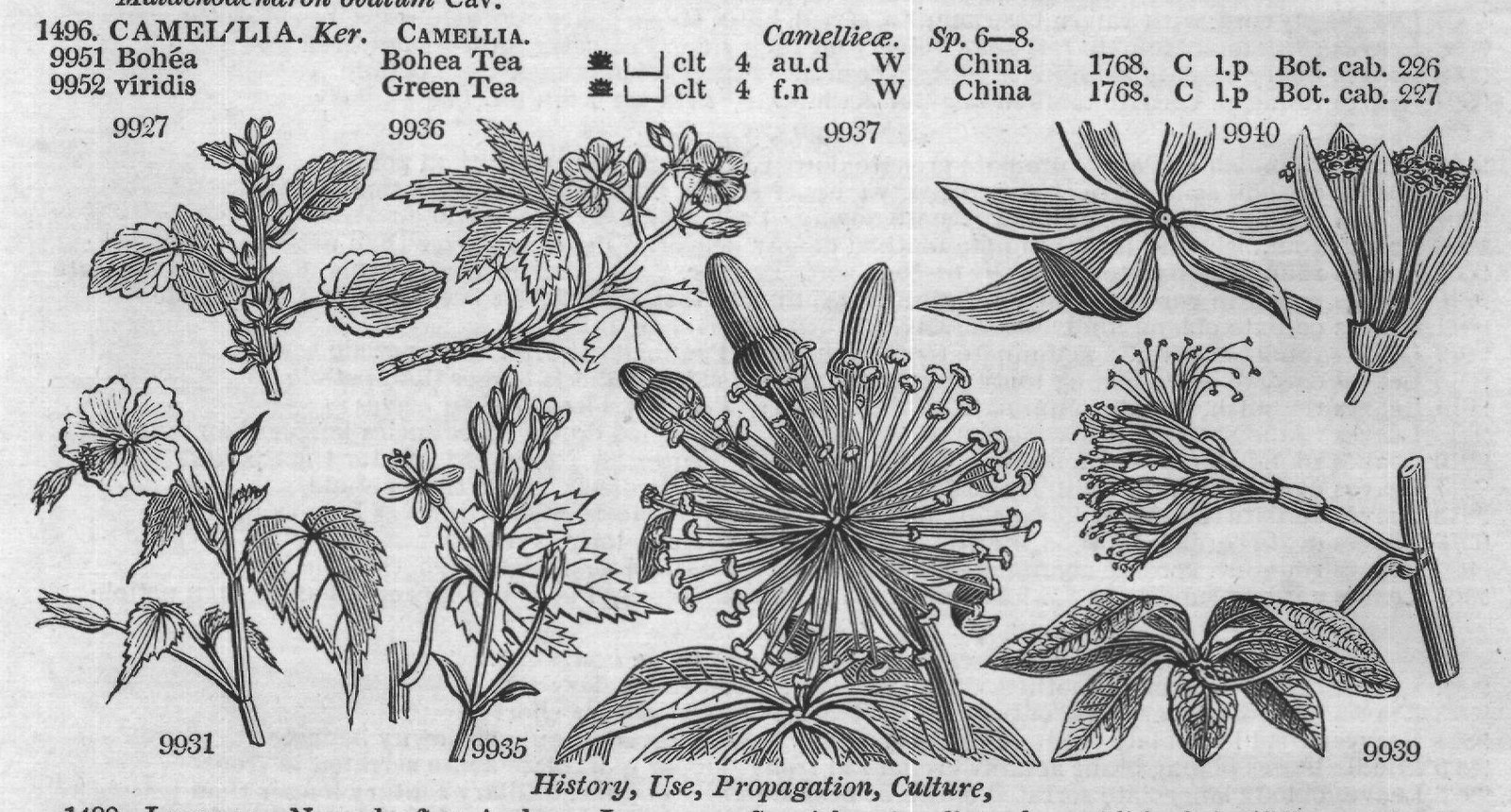
L 1.p Exot.bot.2. t. 110 Malachodendron ovátum Cav. 1496. CAMEL/LIA. Ker. CAMELLIA. 9951 Bohéa 9952 víridis 9927 Bohea Tea Green Tea clt 4 au.d W clt 4 f.n Camellieæ. Sp. 6-8.
China W China 9936 9937 1768. C l.p 1768. C 1.p 9940 Bot. cab. 226 Bot. cab. 227 9931 9935 9939 History, Use, Propagation, Culture, 1488. Lagunea. Named after Andreas Laguna, a Spanish naturalist, who published, in 1543, a work upon plants. It may be treated like other tender annuals. 1489. Ruizia. In honor of Don Hippolito Ruiz, author of Quinologia, Madrid, 1792, and other works, and, in conjunction with Pavon, of the famous Flora Peruviana. A plant of easy culture, but of little merit. 1490. Carolinea. Named by the younger Linnæus, in honor of the Princess Sophia Caroline, of Baden; a name which, he says, will always be cherished by botanists. A splendid family, which thrive in loam; and large cuttings, well clothed with leaves, root in sand under a hand-glass. 1491. Adansonia. In honor of Michel Adanson, a famous French botanist, born in 1727, and author of various works, of which his voyage into Senegal, and Familles des Plantes, are the most remarkable. He was an eccentric man, but certainly far more learned for his time than many of his modern detractors. Monkies'bread, or Boabab, is considered the largest or rather broadest tree in the world. Several measured by Adanson were from sixty-five to seventy-eight feet in circumference, but not extraordinarily high. The trunks were from twelve to fifteen feet high, before they divided into many horizontal branches, which touched the ground at their extremities; these were from forty-five to fifty-five feet long, and were so large, that each branch was equal to a monstrous tree; and where the water of a neighbouring river had washed away the earth, so as to leave the roots of one of these trees bare and open to the sight, they measured one hundred and ten feet long, without including those parts of the roots which remained covered. It yields a fruit which resembles a gourd, and which serves for vessels of various uses; the bark furnishes a coarse thread, which they form into ropes, and into a cloth , with which the natives cover their middle from the girdle to the knees; the small leaves supply them with food in a time of scarcity, while the large ones are used for covering their houses, or, by burning, for the manufacture of good soap. At Sierra Leone this tree does not grow larger than an orchard apple-tree.
The ligneous part of this tree appears to be of little or no use as timber. In our stoves it grows in rich soil in heat, and cuttings root in sand, covered and plunged. 1492. Bombax. From βoμβuξ, one of the Greek names of the cotton; the seeds of the plants now so called are enveloped in a cottony substance. B. pentandrum bears oval fruit larger than a swan's egg, having a thick woody cover, which, when ripe, opens in five parts, and is full of a short dark cotton, inclosing many roundish seeds as large as small peas.
B. Ceiba has a spiny trunk, and is one of the tallest trees of both Indies; but the wood is very light, and not much valued, except for canoes. Their trunks are so large as, when hollowed, to make very large ones. In the West Indies they frequently carry from fifteen to twenty hogsheads of sugar, and from six to twelve hundred weight each. When sawn into boards, and then well saturated with lime-water, the wood bears exposure to the weather many years; it is also formed into laths for roofs, curing-pots, and hogshead-heading. When the tree decays, it becomes a nest for the Macaca beetle, the caterpillar of which, gutted and fried, is esteemed by many persons one of the greatest delicacies. The down which is enclosed in the seed-vessels is seldom used, except by the poorer inhabitants to stuff pillows or chairs; and it is generally thought unwholesome to lie upon. ORDER VII.
MONADELPHIA POLYANDRIA, 9935 Leaves cordate 3-lobed: lobes oval oblong acuminate toothed with a very narrow base 9936 Leaves of the flowering branches palmatifid; of the sterile palmate 9937 Leaves digitate, Filaments numérous forked united at base into a tube 9938 Leaflets 5-8 ovate-lanceolate acuminate 9939 Leaflets 7 elliptical-oblong acute at each end, Calyx truncate, Petals erect 9940 Leaflets 5-7 obovate oblong, Calyx sinuated, Petals erect spreading at end 9941 A tree with a very thick trunk with a diameter of 25 feet 9942 Anthers rectilinear, Leaflets 7, Corolla large woolly outside, Trunk prickly 9943 Anthers anfractuose, Leaflets entire, Trunk generally prickly 9944 Stem prickly, Leaves palmate, Leaflets 5, Fruit turbinate concave at end 9945 Stem prickly, Leaves palmate, Leaflets 7 entire acuminate, Fruit oblong blunt 9946 Leaves ovate-oblong, Calyxes turbinate, Column of stamens shorter than petals 9947 Pedicels axillary half as short as leaves, Leaves oblong coriaceous smooth serrated 9948 Fls. subsessile, Leaves obov. lanc. downy beneath subserrate membranous, Petals and sepals silky outside 9949 Flowers large white, Filaments purple, Anthers blue 9950 Leaves ovate acute, Flowers solitary subsessile 9951 Leaves elliptical oblong subrugose twice as broad as long 9952 Leaves lanceolate flat three times as broad as long 9941 9942 9943 9944 9945 9946 9947 9948 and Miscellaneous Particulars. 1493. Myrodia. From μuρov, myrrh, and oσμη, smell. A tree which emits an odor similar to myrrh. (Linn.) 1494. Gordonia. In memory of James Gordon, an eminent nurseryman at Mile-End, near London, a correspondent of Linnæus and other eminent botanists, and the introducer and successful cultivator of many new plants. G. Lasianthus (woolly flower, from λaσioς and avθoς), the loblolly-bay, is said to grow naturally in water or very moist situations. Miller, on that account, was unsuccessful in keeping the plant. Gordon and Lee, who, as Ellis relates, (Corres. with Linnæus) were better cultivators than Miller, were probably more successful. Sweet says, the species are hardy enough to bear our winters in the open air; but the young shoots often get injured, and the summer is not long enough to flower them in perfection; it is therefore better to treat them as greenhouse plants. Peat soil suits them best, and a little loam mixed with it: they are readily propagated by layers, or ripened cuttings may be struck in sand under a hand-glass. (Bot Cult. 199.) enhouse plants 1495. Stuartia. So named by Linnæus, in honor of the Marquis of Bute, in memory of whom there also exists another genus named Butea, by Roxburgh. The species are handsome shrubs, grow in peat soil, and are most readily increased by layers. 1496. Camellia. In honor of George Joseph Kamel, (or Camellus) a Jesuit. His Syllabus Stirpium in Insula Luzone Philippinarum, forms the appendix to the third volume of Ray's History. This is a remarkable genus, as at once furnishing the domestic drug tea, in universal use, and flowering trees and shrubs as universally admired. The seeds of all the species are crushed for oil, which is used like that of hemp or poppy in cookery.
C. Bohea and viridis are the species which chiefly furnish the tea; but C. Sasanqua is also used, and sometimes the leaves of the other species are taken, though that practice is rather to be considered in the light of adulteration. The tea districts of China extend from the twenty-seventh to the thirty-first degree of north latitude. According to the missionaries, it thrives in the more northern provinces; and from Kæmpfer, it appears to be cultivated 'in Japan as far north as latitute 45. It seems, according to Dr. Abel's observation, to succeed best on the sides of mountains, where there can be but little accumulation of vegetable mould. The soils from which he collected the best specimens consisted chiefly of sandstone, schistus, or granite. The plants are raised from seeds sown where they are to remain. Three or more are dropped into a hole four or five inches deep; these come up without further trouble, and require little culture, except that of removing weeds, till the plants are three years old. The more careful stir the soil, and some manure it; but the latter practice is seldom adopted. The third year the leaves are gathered, at three successive gatherings, in February, April and June, and so on till the bushes become stinted or tardy in their growth, which generally happens in from six to ten years. They are then cut in to encourage the production of fresh roots.
The gathering of the leaves is performed with care and selection. The leaves are plucked off one by one: at the first gathering only the unexpanded and tender are taken; at the second those that are full grown; and at the third the coarsest. The first forms what is called in Europe imperial tea; but as to the other Qq A 9953 Sasánqua W.
ẞ pléna 9954 japónica W.
MONADELPHIA POLYANDRIA CLASS XVI.
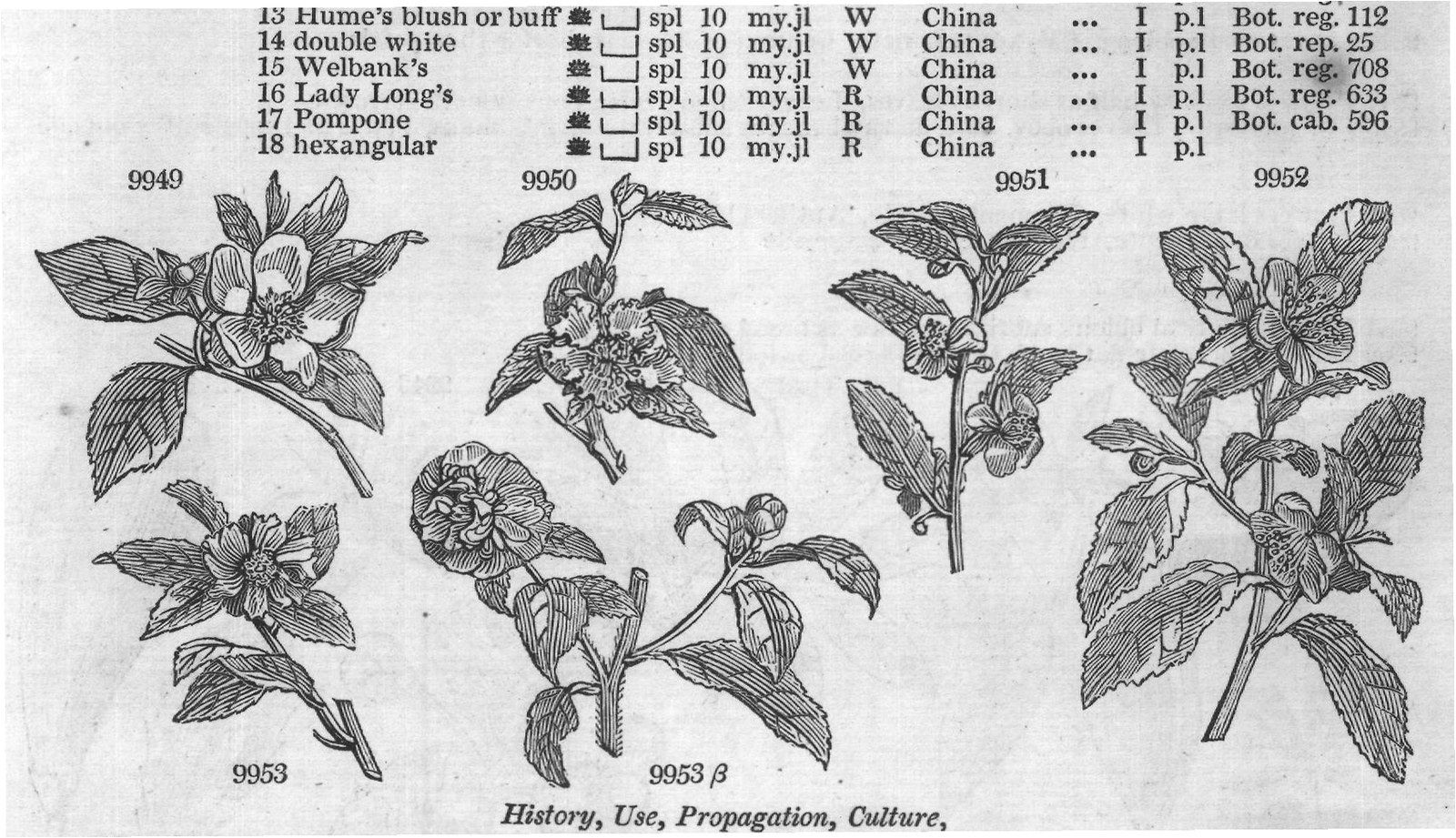
Lady Banks's double pr 4 f.n W China 1811. I p.l Bot. reg. 12 ☐ pr 4 f.n Pk China 1818. I p.l Bot. reg. 547 common spl 10 my.jl R China 1739. C p.l Garden Varieties. 1 single red spl 10 my.jl R China 1739. C p.1 Bot. mag. 42 2 single white spl 10 my.jl W China ... 1 p.l Bot. cab. 633 3 semi-double red spl 10 my.jl R China ...
I p.l Bot. rep. 559 4 double red spl 10 my.jl R China ... 5 Middlemist's red spl 10 my.jl R China ...
I p.l Bot. rep. 199 I p.l 6 Myrtle-leaved spl 10 my.jl R China ... 7 Loddiges' red spl 10 my.jl R China ...
I p.1 Bot. mag. 1670 I p.l 8 Waratah spl 10 my.jl R China ...
I p.l Bot. cab. 537 9 variegated Waratah spl 10 my.jl St China ...
I p.1 Bot. reg. 887 10 Pæony-flowered spl 10 my.jl Bl China ...
I p.1 11 double-striped spl 10 my.jl Bl China ...
I p.1 Bot. rep. 91 12 Kew blush spl 10 my.jl Bl China ...
I p.l Bot. reg. 22 13 Hume's blush or buff spl 10 my.jl W China ...
I p.1 Bot. reg. 112 14 double white spl 10 my.jl W China ..
I p.l Bot. rep. 25 15 Welbank's spl 10 my.jl W China ...
I p.l Bot. reg. 708 16 Lady Long's spl. 10 my.jl R China ...
I p.l Bot. reg. 633 17 Pompone spl 10 my.jl R China ...
I p.l Bot. cab. 596 18 hexangular spl 10 my.jl R China ...
I p.l 9949 9950 9951 9952 9953 9953 β History, Use, Propagation, Culture, names by which tea is known, the Chinese know nothing; and the compounds and names are supposed to be made and given by the merchants at Canton, who, from the great number of varieties brought to them, have an ample opportunity of doing so. Formerly it was thought that green tea was gathered exclusively from C. viridis; but that is now doubtful: though it is certain there is what is called the green tea district, and the black tea district; and the varieties grown in the one district differ from those grown in the other. Dr. Abel was told by competent persons, that either of the two plants will afford the black or green tea of the shops, but that the broad thin-leaved plant (C. viridis) is preferred for making the green tea. The tea leaves being gathered, are cured in houses which contain from five to ten or twenty small furnaces, about three feet high, each having at the top a large flat iron pan. There is also a long low table covered with mats, on which the leaves are laid, and rolled by workmen, who sit round it: the iron pan being heated to a certain degree by a little fire made in the furnace underneath, a few pounds of the fresh-gathered leaves are 'put upon the pan; the fresh and juicy leaves crack when they touch the pan, and it is the business of the operator to shift them as quick as possible with his bare hands, till they become too hot to be easily endured. At this instant he takes off the leaves with a kind of shovel resembling a fan, and pours them on the mats before the rollers, who, taking small quantities at a time, roll them in the palm of their hands in one direction , while others are fanning them, that they may cool the more speedily, and retain their curl the longer. This process is repeated two or three times, or oftener, before the tea is put into the stores, in order that all the moisture of the leaves may be thoroughly dissipated, and their curl more completely preserved. On every repetition the pan is less heated, and the operation performed more closely and cautiously. The tea is then separated into the different kinds, and deposited in the store for domestic use or exportation. The different sorts of black and green arise not merely from soil, situation, or the age of the leaf; but after winnowing the tea, the leaves are taken up in succession as they fall; those nearest the machine being the heaviest, are the gunpowder tea; the light dust the worst, being chiefly used by the lower classes. That which is brought down to Canton then undergoes a second roasting, winnowing, packing, &c., and many hundred women are employed for these purposes.
As more select sorts of tea, the blossoms of the C. sasanqua appear to be collected; the buds also appear to be gathered in some cases. By far the strongest tea which Dr. Abel tasted in China, was that called yutien, gathered in some cases.
By far the strongest tea which Dr. Abel tasted in China, was that called yutien, used on occasions of ceremony. It scarcely colored the water, and on examination was found to consist of buds and half expanded leaves of the plant.
As substitutes for tea used by the Chinese, may be mentioned a species of moss common to the mountains of Shan-tung, an infusion of ferns of different sorts, and Dr. Abel thinks the leaves of the common camellia Shan-tung, an infusion of ferns of different sorts, and Dr. Abel thinks the leaves of the common camellia and oil camellia may be added. Du Halde observes, that all the plants called tea by the Chinese, are not to oil camellia may be added. Du Halde observes, that all the plants called tea by the Chinese, are not to be considered as the true tea plant; and Kæmpfer asserts, that in Japan a species of Camellia, as well as the Olea fragrans, is used to give it a high flavor.
The oil-bearing Camellia, C. oleifera, is cultivated for its seeds, from which an oil is expressed, in very general use in the domestic economy of China. It grows best in a red sandy soil, attaining the height of six use in the domestic economy of China. It grows best in a red sandy soil, attaining the height of six or eight feet, and producing a profusion of white blossoms and seeds. These seeds, as well as those of any of the other species, are reduced to a coarse powder, which is stewed or boiled in bags, and then pressed, when the oil is yielded. (Dr.
Abel's Nar. 176.) The culture of the tea Camellias in our greenhouses is very simple. The plants are very hardy, and may be preserved in a pit without fire-heat; they grow in loamy soil, or loam and peat well drained, and increase freely by layers, or cuttings of the young wood taken off when it begins to ripen, planted in sand, and covered with a hand-glass in a cool frame or pit.
C. japonica, in the groves and gardens of Japan, is a lofty tree, much admired for its fine form, rich clothing of shining deep green foliage, and elegant red or white flowers, single or double. It is equally admired in shining deep green foliage , and elegant red or white flowers, single or double. It is equally admired in ORDER VII.
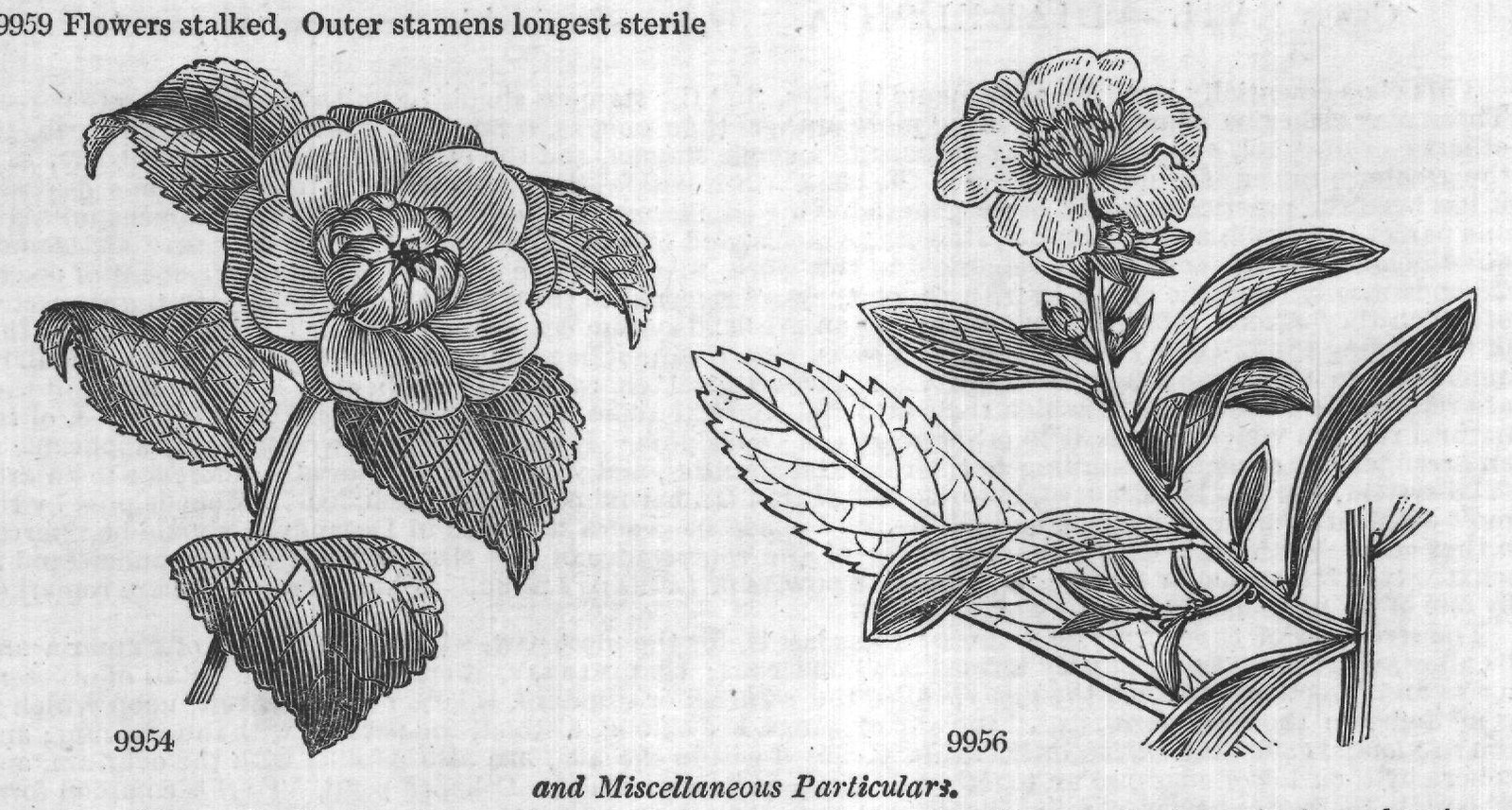
MONADELPHIA POLYANDRIA. 9953 Leaves ovate-oblong bluntly serrated, Flowers terminal subsolitary, Petals obcordate 9954 Leaves ovate acuminate acutely serrate, Flowers terminal subsolitary 11 1 2 12 3 6 8 4 and Miscellaneous Particulars China as in Japan, and much cultivated in both countries. It is of frequent occurrence in Chinese paintings, with Hibiscus and Chrysanthemum, two of their great favorites. There are several varieties of C. japonica in China, most of which have been imported here, and their number considerably increased, and daily increasing, from seedlings raised in this country. The double white, double striped, and double Waratah, (from the central petals resembling those of the Waratah plant of New Holland, Telopea speciosissima,) are considered the grandest and most marked varieties, and are also free -growers and flowerers; the pæony-flowered and fringed white, are also standard beauties; but all are much admired.
The single red Camellia is propagated by cuttings, layers, and seeds, for stocks; and on these the other sorts are generally inarched, and sometimes budded or grafted. The cuttings are formed of ripened or ripening shoots, taken off in August, cut smoothly across at a joint or bud, two or three of the lower leaves only taken off, and the cuttings then planted and made firm with a small dibber, in pans of sand or loam, or, by some cultivators, sand and peat, or sand alone. The pans are kept in a pit or cold frame, without being covered with glass, but shaded during powerful sunshine; and in the following spring such as are struck will begin to push, when they are to be placed in a gentle heat. In September or October following, the rooted plants will London be fit following, the rooted plants will be fit to pot off; and in the second or third spring they may be used as stocks. Such is the practice in the the be used as stocks. Such is the practice in the London nurseries. Henderson, of Woodhall, near Edinburgh, puts in Camellia cuttings at any time of year, in Camellia cuttings at any time of the year, excepting when they are making young wood. He puts fifty cuttings in a pot of sand eight inches in diameter, sets them in a cool place in the back of a vinery or peach-house for a month or six weeks, and then plunges them to the brim in a hot-bed where is a little bottom heat. A speedy mode of obtaining stocks is by planting stools in a pit devoted to that purpose, and laying them in autumn ; the following autumn most of the layers will have produced roots, when they may be taken off and potted, and used as stocks in the succeeding spring. is , and used as stocks in the succeeding spring.
Inarching or grafting is performed early in spring, when the plants begin to grow ; the chief care requisite the the plants begin to grow; the chief care requisite is so to place and fix the pot containing the stock, as that it may not be disturbed during the connection of the scion with the parent plant. The graft being clayed over, is then covered with moss to prevent its cracking.
When independent grafting is resorted to, the mode called side grafting is often used; but the operation scion of side grafting is often used; but the operation of tongueing is generally omitted, as weakening the stock and unnecessary, with a view to prevent the scion from being blown off. A few seeds are sometimes obtained from the single red and semi-double Camellias, and from the single Waratah; these require two years to come up, but make the best stocks of any. Before they are grafted they are often allowed to come into flower, in case some new variety should be produced; but the best cultivators, as Messrs. Loddiges, Sweet , and Mackay, regularly cross-impregnate the blossoms in Knight's manner, by cutting out the stamens before the anthers are mature, and when the stigma is in a proper state, dusting it with the pollen of the species or variety intended as the male parent.
C. Sasanqua seeds most readily, and is mostly employed as the female parent for raising new varieties. The plants, if well treated, flower in four or five years, and if nothing new is produced they still make excellent stocks.
Some cultivators grow the Camellias chiefly in peat. Messrs. Loddiges, who have the most numerous collection of this genus, formerly used loam, with a little sand and peat; and they are grown in a similar soil in Hammersmith nursery. Of late, Messrs. Loddiges find light loam alone to answer as well or better. In the Comte de Vandes garden at Bayswater, rotten dung is mixed with loam and peat. Sweet recommends sandy loam and peat. Henderson of Woodhall is one of the most successful growers of the Camellia in Scotland: his compost is as follows: take one part of light-brown mould, one part of river-sand, one part of peat-earth, one half part rotten leaves; mix them all well together, and when the Camellias require shifting, Mem. together, and when the Camellias require shifting, put some broken coal-char in the bottom of the pots, and some dry moss or hypnum over it. (Caled. some dry moss or hypnum over it. (Caled. Mem. iii. 316.) Camellias have the best effect, and are grown to most advantage in a house entirely devoted to them. Such Qq2 MONADELPHIA POLYANDRIA.
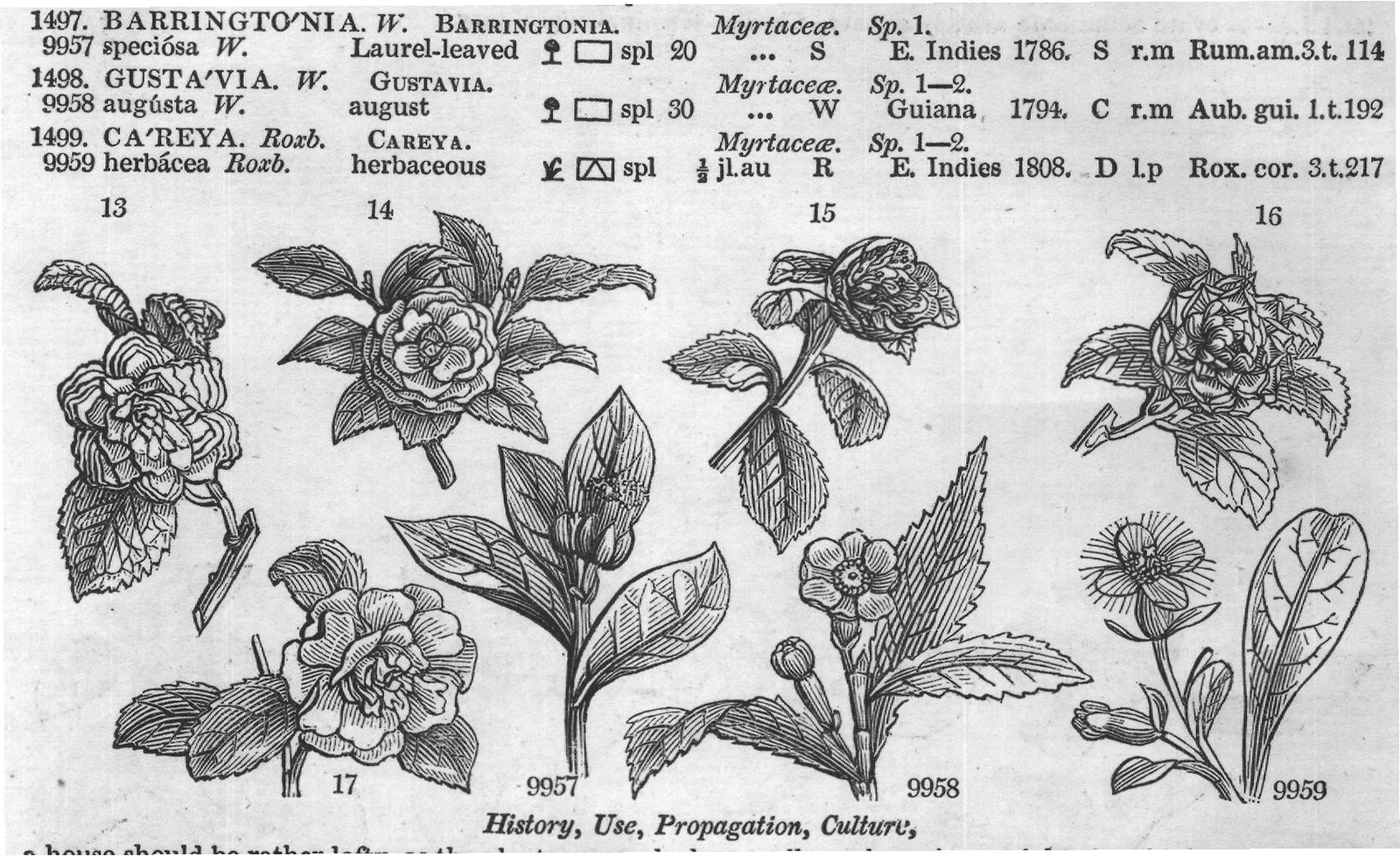
CLASS XVI. 9955 oleífera Abel. oil-seed pr 3 9956 axilláris Sims. - axillary W pr 3 f.mr W China 1890. Cr.m E. Indies 1818. Cr.m 1497. BARRINGTO'NIA. W. BARRINGTONIA.
Myrtaceæ. Sp. 1. 9957 speciósa W.
Laurel-leaved spl 20 S 1498. GUSTA'VIA. W.
GUSTAVIA. 9958 augústa W. august 오 spl 30 1499. CA'REYA. Roxb.
CAREYA. 9959 herbácea Roxb. herbaceous ... ...
W Myrtaceæ. Sp. 1-2.
Myrtaceæ. Sp. 1-2. spl jl.au R E. Indies 1808. Dl.p Rox. cor. 3.t.217 E. Indies 1786. Sr.m Rum.am.3.t. 114 Guiana 1794. Cr.m Aub. gui. 1.t.192 13 14 15 16 17 9957 9958 History, Use, Propagation, Culture, 9959 a house should be rather lofty, as the plants never look so well as when six or eight feet high, trained in a conic form, and clothed with branches from the root upwards. The plants should be raised near to the glass by means of a stage, which should be so contrived, that, as they advance in height, it may be lowered in proportion: only the very best crown or patent glass should be used; because it is found from experience, that the least inequality of surface or thickness of material, so operates on the sun's rays, as to concentrate them, and burn or produce blotches on the leaves of the plants. Every cultivator must have observed that leathery shining leaves, like those of the orange, myrtle, &c. are more or less subject to this solar injury; but the leaves of the Camellia are particularly so. Some nurserymen recommend a roof which will not admit much light; others the use of green glass; of an opaque roof, with glass in front only; or of a house facing the north. Our opinion is, that a light house facing the south, or, better still, glass on all sides, is essential to the perfect growth of the plants; and that all solar accidents may be avoided, or at least rendered of no consequence, by using the best glass, and placing the plants as near it as possible. To grow the Camellia to a high degree of perfection, considerable care is requisite. The roots are very apt to get matted in the pot, and, by the space they occupy, so to compress the ball of mould, as after a time to render it impervious to water. Hence frequent attention should be had, to see that the water poured on the pots moistens all the earth, and does not escape by the sides of the pot, moistening only the web of fibres. When the plants are in flower and in a growing state, they require to be liberally watered, and also a degree of heat somewhat greater than is usually given to greenhouse plants. If this heat is not given in November and December, the plants will not expand their blossoms freely; and if both water and heat are not regularly applied after the blossoming season, vigorous shoots and flower-buds will not be produced. To form handsome plants, they should be trained with single stems to rods, and pruned so as to make them throw out side branches from every part of the stem: to encourage these, the plants should not be set close together on the stage. In summer they may either be set out of doors on a stratum of scoriæ, or on a pavement, in a sheltered but open situation; or the glass roof may be taken off. The hardier sorts, as the double red, blush, pæonyflowered , &c. answer very well when planted in the bed or border of a conservatory, provided the roof or entire superstructure can be removed in summer to admit the full influence of the weather. When this cannot be done, the Camellia and most other plants are better in portable utensils, which admit both of examining their roots, and placing them in the open air, or in a greater degree of heat at pleasure. The single and double red Camellia will endure the open air when trained against a south wall, and protected by mats in winter; and there can be no doubt that in time these and other species will be more perfectly inured to our climate.
Henderson of Woodhall gives the following account of his mode of treating the Camellia. "The best time for a regular shifting of the Camellias is the month of February or beginning of March. After shifting all a regular shifting of the Camellias is the month of February or beginning of March. After shifting all those that require it, put them into the peach-house or vinery, when there is a little heat; if there be no peach-house, vinery, nor pinery, set them in the warmest part of the greenhouse. They will soon begin to make young wood. From the time they begin to make their young shoots, till they have finished their growth, give them plenty of water They may be kept in the vinery or peach-house till they have formed their flower-buds at the extremity and sides of the young growths, when a few of them may be removed to a colder place , say behind the stage of the greenhouse; for the Camellias are fond of being shaded during ORDER VII.
MONADELPHIA POLYANDRIA. 9955 Leaves thin ovate finely serrate pale-green, Branches slender twiggy 9956 Leaves obovate oblong serrulate; upper entire, Flowers solitary subsessile subaxillary 9957 Leaves oblong blunt large fleshy stalked shining tinged with red 9958 Sepals 4 roundish petaloid, Petals 4, Leaves oblong acuminate toothed 9959 Flowers stalked, Outer stamens longest sterile 9954 9956 and Miscellaneous Particulars. strong sunshine. In three or four weeks after, a few more of the Camellias may be brought from the vinery or peach-house, and put into a cooler situation. This may be repeated three or four times, which will make as many different successions of flowering. Those that are wanted to come into flower early, may remain in the warm house till they are beginning to flower, when they should be taken to a cold place, say the coldest place of the greenhouse; then give them plenty of light only, and they will open their flowers well, and stand long. A Camellia cannot stand heat when in flower, indeed they seldom open their flowers fine when in heat, and, at all events, the flowers soon fall off. Those that are kept all the summer in the vinery, will come into flower by the first or middle of October, and a pretty large plant, having perhaps fifty or a hundred flower-buds, will continue in flower till the month of January. Those plants that are removed early from the vinery, will now be in flower, to succeed those that were in flower in October, and have now done flowering. These last should be immediately taken into the heat. They will make their young wood early, and they may remain in heat till they come into flower, which will perhaps be a month earlier next year. By attending to shifting the Camellia plants from the warm-house to the cold, a regular succession of flowers may thus be had from the first of October to the middle of July. I have even had them all the summer, but the flowers are best in the winter. Those produced in summer are far from being so fine, and do not stand half the time of those that come into flower in November, December, January, February, March and April. Camellias delight to be kept damp all the summer months, and a little shaded from the strong sun. Give them plenty of water while they are making their young shoots; they may also get a gentle sprinkling over the leaves once every week during the summer season, except when they are in flower. Camellias will stand a great deal of cold without being much injured, but they will not form many flower-buds without some artificial heat." (Caled. Mem. iii. 316.) 1497. Barringtonia. In memory of the Hon. Daines Barrington, F. R. S., an active Fellow of the Society of Antiquaries, and author of several papers in their Transactions. A lofty tree, the handsomest in the equinoctial flora. It has thick shady bunches of long wedge-shaped coriaceous leaves, and large handsome purple and white flowers, which open at night, and fall at sunrise. They are succeeded by a reddish brown drupe, the seed of which mixed with the bait, inebriates fish in the same manner as Cocculus indicus. It grows on the sea shore and at the mouths of rivers, and is cultivated in the governor's garden at St. Helena. It is very rare in our stoves, though not difficult to manage. Sweet says, " a mixture of two-thirds loam and one-third peat, is a good soil for it. Cuttings taken off at a joint, when the wood is ripe, and put in a pot of sand under a hand-glass in moist heat, will strike root readily: : none of the leaves should be taken off or shortened." (Bot. Cult. 21.) 1498. Gustavia. In memory of Gustavus III., king of Sweden, who presented a great collection of Indian plants to the elder Linnæus. A tree remarkable for its large white flowers, larger than those of the waterlily, but with a large naked bald receptacle between the corolla and the style. The flowers smell sweet, but the wood is extremely fetid. In Surinam it is used for hoops. In the stove it grows in sand and loam, and roots in sand under a hand-glass. 1499. Careya. Named after Dr. William Carey, the editor of Roxburgh's Flora Indica, and an English physician and botanist residing at Serampore. Beautiful Indian plants, with long red stamens. Qq 3 DIADELPHIA.
CLASS XVII.
CLASS XVII. - DIADELPHIA. STAMENS united in two separate parcels. THIS class essentially requires, as its name implies, that the stamens should be united in two separate parcels. These may either be equal, each bearing more anthers than one, as in Smithia, Æschynomene, Fumaria, and others; or unequal, one parcel being reduced to a single stamen, and the other bearing several anthers, as in the greater number of genera included in the class. But besides the plants whose stamens are thus disposed, it has been the practice to admit other genera having papilionaceous flowers, but with their stamens united in one parcel only, such as Platylobium, Bossiæa, Arachis, and others. The propriety of this measure is extremely questionable. It has been before remarked in this work, that the value of an artificial arrangement of objects depends wholly upon the precision with which they are referred to those heads or divisions with the characters of which they agree. If this does not obtain, an artificial system ceases to be useful, and its only merit, that of facilitating the discovery of the name of a given object, cannot be said to exist. This principle is particularly applicable to the genera just mentioned. Their artificial character refers them to Monadelphia, but they are retained in Diadelphia, to which their artificial character does not refer them, because, as is alleged, of the natural relation which they bear to other genera in Diadelphia. If this reasoning, which is only applicable to an arrangement of plants according to their natural affinities, and which has no allowable reference to an artificial system, were to be admitted, it would follow that Tamarindus, actually included in Monadelphia by the most eminent Linnean botanists, and all the papilionaceous genera stationed in Decandria, should be referred hither also. With such objections attaching to the contrivance of this class, it is not easy to understand in what way it "does honor to the comprehensive powers of Linnæus's mind," as has been somewhere remarked by one of his most distinguished panegyrists.
The structure of the corolla of plants of this class is, for the most part, with the exception of Fumaria and its allies, what has been popularly termed papilionaceous; that is to say, it consists of five petals of different allies, what has been popularly termed papilionaceous; that is to say, it consists of five petals of different forms and direction, of which the upper, called the vexillum or standard, is larger than the rest, upon which it is incumbent; the two lateral, called the alæ or wings, are oblong, distinct, and parallel with the ovarium; and the two lower, called the carina or keel, are enclosed within the alæ, are also parallel with the ovarium, and two lower, called the carina or keel, are enclosed within the alæ, are also parallel with the ovarium, and cohere by their lower edges, so as together to form, as it were, one boat-shaped petal. To this common form of corolla there are, however, some exceptions, as in Amorpha, where the alæ and carina are absent, and in Erythrina , where the alæ are in some cases almost obliterated. In Trifolium the petals all cohere by their claws into an undivided tube.
With regard to the importance of Diadelphous plants as applicable to the purposes of mankind, they may be said to hold the very highest rank. All the numerous varieties of pulse, whether eaten by men or cattle, peas, to hold the very highest rank. All the numerous varieties of pulse, whether eaten by men or cattle, peas, beans, haricots, caravances, lentils, and others, are all produced by Diadelphous plants. The best of our artificial grasses, such as clover, nonesuch , cow-grass, lucerne, saintfoin, serradilla, &c. &c., belong to various Diadelphous genera . A large proportion of the class also consists of useful and ornamental trees and herbs, which will be noticed in their respective places.
Order 1. PENTANDRIA. Stamens 5. 1500. Monnieria. Cal. 5-parted, with the upper segment long. Cor. ringent. Stamens 2: upper with two anthers; lower with three. Caps. 5, 1-seeded. 1501. Petalostemum. Petals 4, between the stamens, all united into a slit tube. Vexillum none, but in its place a fifth petal. Legume surrounded by calyx, 1-seeded. a fifth petal. Legume surrounded by calyx, 1-seeded.
Order 2. HEXANDRIA.
Stamens 6. 1502. Corydalis. Pet. 4, 1-spurred at base. Pod 2-valved, compressed, many-seeded. 1503. Cysticapnos. Petals 4, one gibbous at base. Capsule bladdery, many-seeded; the placentas connected by a membranous net work. 1504. Diclytra. Petals 4, two outer equally spurred or gibbous at base. Pod 2-valved, many-seeded. 1505. Adlumia. Petals 4, united in a fungous monopetalous corolla, persistent, and with two protuberances at base. Pod 2-valved, many-seeded. 1506. Sarcocapnos. Petals 4, 1-spurred at base. Caps. 2-valved, not opening, 2-seeded. Valves 3-nerved, flattish. 1507. Fumaria. One petal gibbous or spurred at base. Cariopsis indehiscent, 1-seeded, not pointed with a style .
Order 3. OCTANDRIA.
Stamens 8. 1508. Polygala. Cal. of 5 leaves, two of them wing-shaped and colored. Caps. compressed, obcordate. 1509. Muraltia.
Sepals 5 , glumaceous, nearly equal. Petals 3, united, the middle bifid with blunt lobes. Ovary with 4 horns or tubercles, 2-valved, 2-celled. 1510. Mundia. Sepals 5, glumaceous, persistent, the two inner wing-shaped. Petals 3, scarcely united at base; the middle one cucullate, beardless. Stamens 7-8, somewhat villous, monadelphous at base, with a tube divided in front. 1511. Securidaca. Sepals 5, the two inner petaloid. Petals 5, united at base: three united into a 3-lobed keel; two oblong. Stamens 8, diadelphous.
Order 4. DECANDRIA. 90000 Stamens 10. 1512. Nissolia. Cal. 5-toothed. Legume 1-seeded, ending in a ligulate wing. 1513. Dalbergia. Cal. obsoletely 5-toothed. Legume leafy, flat, not opening. Seeds solitary or twin. 1514. Pongamia. Cal. colored, cyathiform, obliquely truncate, 5-toothed. Petals clawed. Vexillum spreading. Alæ and carina conniving. Legume substipitate, compressed, flat, rostrate, valveless, 1-2-seeded. Anthers ciliate, glandular at end. . Alæ and carina conniving. Legume substipitate, compressed, flat , rostrate, valveless, 1-2-seeded. Anthers ciliate, glandular at end. 1515. Pterocarpus. Cal. 5-toothed. Legume falcate, foliaceous, varicose, indehiscent, encompassed by a wing. Seeds a few, solitary. 1516. Ecastaphyllum. Cal. campanulate, sub-bilabiate: upper segment emarginate; lower trifid. Filaments equally diadelphous. Legume roundish, valveless, 1-seeded. diadelphous.
Legume roundish, valveless, 1-seeded.
CLASS XVII.
DIADELPHIA. 1517. Geoffroya. Cal. 5-fid. Drupe ovate. Kernel compressed. 1518. Dipterix. Segm. of cal. 2, wing-shaped. Legume 1-celled, 1-seeded, coriaceous, 2-valved. 1519. Parivoa. Cal. 3-4-fid. Vexillum ample. Alæ and carina O. Legume compressed, 1-seeded. 1520. Amerimnum. Cal. sub-bilabiate. Legume compressed, leafy, 2-valved, dehiscent. Some seeds, solitary. 1521. Erythrina. Cal. bilabiate, 1. Vexillum very long, lanceolate. Legume torulose. 1522 Butea. Cal. sub-bilabiate. Vexillum very long, lanceolate. Legume compressed, membranous, oneseeded at end. 1523. Viborgia. Cal. 5-toothed, with rounded recesses. Legume turgid, sulcate, wingea. 1524. Piscidia. Stigma acute. Legume with four wings. 1525. Platylobium. Cal. bracteate, 2-lipped, upper lip round, large, bifid. Stam. all united. Legume stalked, compressed, winged at back, many-seeded. 1526. Borbonia. Stigma emarginate. Calyx acuminate, spiny. Legume mucronate. 1527. Rafnia. Cal. ringent: upper lip bifid; lower spreading trifid; the middle tooth narrowest. Legume lanceolate, compressed. 1528. Aspalathus. Cal. 5-fid, upper segment largest. Legume ovate, blunt, about 2-seeded. 1529. Sarcophyllum. Cal. campanulate, 5-parted, regular. Legume acinaciform, acute. 1530. Crotalaria. Legume turgid, inflated, stalked, Filaments united with a dorsal fissure. 1531. Bossiœa. Cal. 2-lipped, upper lip largest, half bifid, obtuse. Stam, all united. Legume plano-compressed, stalked, many-seeded, thickened at each edge. Seeds strophiolate. 1532. Scottia. Cal. imbricated with bractes, 5-toothed, with nearly equal teeth. Vexillum complicate, shorter than alæ, which are as long as carina. Stam. all united. Legume stalked, compressed, thickened at each edge. Seeds 3-4, strophiolate. 1533. Templetonia. Cal. ebracteate, with 5 nearly equal teeth. Carina oblong. Stamens all united, with uniform anthers. Legume pedicellate, plano.compressed, many-seeded. Seeds strophiolate. 1534. Goodia. Cal. with 2 nearly equal lips, upper half bifid, acute. Vexillum unfurled, large. Stamens all united. Legume stalked, compressed, about 2-seeded. Seeds strophiolate. 1535. Loddigesia. Vexillum much shorter than alæ or carina. 1536. Hovea. Cal. bilabiate, the upper lip half bifid, retuse. Stamens all united. Carina blunt. Legume sessile, roundish, ventricose, 2-seeded. Seeds strophiolate. 1537. Spartium. Stigma longitudinal, villous above. Filaments adhering to ovary. Cal. lengthened at the base. 1538. Genista. Cal. 2-lipped: upper one with 2; lower one with 3 teeth. Vexillum bent backwards from the rest of the flower. 1539. Lebeckia. Cal. 5-parted, with acute segments and rounded recesses. Legume cylindrical, manyseeded. 1540. Ulex. Cal. of 2 leaves, with a small scale at the base on each side. Legume turgid, scarcely longer than the calyx. 1541. Ononis. Cal. 5-cleft, its divisions linear. Vexillum striated. Legume turgid, sessile. Filaments in one undivided set. 1542. Anthyllis. Cal. inflated, 5-toothed, inclosing the small roundish 1-3-seeded legume. 1543. Arachis. Cal. 2-lipped. Cor. resupinate. Filaments united. Legume gibbous, torulose, veiny, coriaceous. 1544. Lupinus. Cal. 2-lipped. Anthers, 5 oblong, 5 round. Legume coriaceous, torulose, compressed. 1545. Amorpha. Cal. campanulate, 5-fid. Vexillum ovate, concave. Ale O. Carina O. Legume 2-seeded, falcate. 1546. Abrus. Cal. obsoletely 4-lobed, the upper broader. Filaments 9, united at base, opening at back. Stigma blunt. Seed spherical. 1547. Phaseolus. Carina with the stamens and style twisted spirally. 1548. Teramnus. Carina very small, inclosed in the calyx. Five alternate stamens fertile. Stigma sessile, capitate. 1549. Carpopogon. Vexillum not callous. Flowers capitate. Pods short, broad, 1-seeded. 1550. Dolichos. Vexillum with two calli at base, parallel, oblong, compressing the wings beneath. 1551. Stizolobium. Cal. campanulate, 2-lipped: upper lip entire, erect; lower trifid, with the middle segment longest. Vexillum ascending. Alæ dolabriform, lunate at base, the length of carina. Anthers 2-formed, hairy. Legume torose, 1-celled, with partitions. Seeds round, with a crested hilum. 1552. Glycine. Cal. 2-lipped. Carina pushing back the vexillum with its end. 1553. Kennedia. Cal. 2-lipped: upper emarginate; lower trifid, equal. Vexillum reflexed, recurved. Alæ pressed to the carina. Carina remote. Stigma blunt. Legume oblong. 1554. Cylista. Cal. 4-fid, larger than cor.: upper segment bifid at end, or emarginate; lower very large. Cor. persistent. Legume about 2-seeded. 1555. Galactia. Cal. 4-toothed, with 2 bractes. Petals all oblong; the vexillum broadest and incumbent upon the others. Stigma obtuse. Legume round. Seeds roundish. 1556. Clitoria. Cor. resupinate, with a large spreading vexillum overshadowing the wings. 1557. Orobus. Style linear, cylindrical, downy above. Cal. obtuse at the base, its upper segments deeper and shorter. 1558. Lathyrus. Style plane, downy above, broader upwards. Cal. with its two upper segments shortest. 1559. Ochrus. Cal. with the two upper segments conniving. Vexillum with two teeth at the sides .
Style flat, villous above. Legume having a membranous wing upon the seed-bearing suture. 1560. Pisum. Style triangular, keeled above, downy. Two upper segments of calyx shorter than the rest. 1561. Vicia. Style bearded beneath the stigma. 1562. Ervum. Stigma capitate, hairy all over on the outside. 1563. Ervilia. Like Vicia, but the ovary is plaited in folds. 1564. Cicer. Cal. 5-parted, length of cor; four upper segments incumbent on the vexillum. Legume turgid, 2-seeded. 1565. Liparia. Cal. 5-fid, with the lower segment long. Alæ 2-lobed below. Three teeth of the larger stamen shorter than the rest. Legume ovate. 1566. Cytisus. Cal. 2-labiate, 2-3. Legume attenuated at base. 1567. Mullera. Cal. 4-toothed. Loment moniliform, with fleshy 1-seeded globules cohering by a thread. 1568. Robinia. Cal. 4-fid; upper segment 2-parted. Legume gibbous, long. Leaves unequally pinnate. 1569. Caragana. Cal. subcampanulate. Stigma smooth, truncate. Legume cylindrical. Leaves abruptly cal. Leaves abruptly pinnated. 1570. Swainsonia. Cal. 5-toothed. Vexillum unfurled, larger than the blunt carina. Stigma terminal. Style bearded lengthwise in front, not bearded at back. Legume turgid, not bladdery. 1571. Sutherlandia. Cal. 5-toothed. Vexillum without callosities, folded back at edge, shorter than oblong carina. Stigma terminal. Style with a longitudinal beard behind, a transverse one before. Legume inflated , scariose. 1572. Lessertia. Cal. half 5-fid. Vexillum unfurled. Carina blunt. Stigma capitate. Style bearded transversely at end in front, beardless behind. Legume scariose without valves (compressed or inflated). 1573. Colutea. Cal. 5-toothed. Vexillum with two callosities, unfurled, larger than the blunt carina. Stigma lateral under the hooked end of the style, which is longitudinally bearded behind. Legume inflated, scarious. 1574. Glycyrrhiza. Cal. bilabiate, 3-1. Legume ovate, compressed. 1575. Liquoritia. Cal. tubular, equal, 5-parted. Vexillum erect, reflexed at sides. Alæ spreading. Carina bifid. Legume oblong, smooth, 3-4-seeded.
Qq 4 DIADELPHIA.
CLASS XVII. 1576. Coronilla. Cal. 2-lipped, 2-3. Upper teeth connate. Vexillum scarcely longer than alæ. Loment round, jointed, straight. 1577. Hippocrepis. Loment compressed, with many notches on one edge, curved. 1578. Ornithopus. Legume jointed, curved, cylindrical. 1579. Scorpiurus. Loment intercepted by divisions, revolute, round. 1580. Smithia. Stamens divided into two equal bundles. Legume jointed, plaited, included in the bifid calyx. 1581. Sesbania. Cal. 5-toothed. Legume long (round or linear), 2-valved, many-celled, with transverse partitions. 1582. Æschynomene. Stamens divided into two equal bundles. 2-parted, with toothed lips. 1583. Stylosanthes. Cal. tubular, very long, bearing the corolla. Ovarium below the corolla. Loment one or two-jointed, hooked. 1584. Hallia. Cal. 5-parted, regular. Legume 1-seeded, 2-valved. 1585. Lespedeza. Cal. 5-parted, nearly equal. 1-seeded. 1586. Flemingia. Cal. 5-fid. Vexillum striated. spherical.
Legume jointed, straight, exserted. Cal.
Carina transversely blunt. Legume lenticular, unarmed, Legume sessile, oval, turgid, 2-valved, 2-seeded. Seeds 1587. Zornia. Cal. campanulate, 2-lipped. Cor. inferior. Vexillum cordate, revolute. Anthers alternately oblong and round. Legume jointed, hispid. 1588. Hedysarum. Cal. 5-fid. Carina transversely blunt. Loment with 1-seeded compressed joints. 1589. Indigofera. Cal. spreading. Carina with a spreading subulate spur on each side. 1590. Tephrosia. Cal. with subulate nearly equal teeth. Stamens monadelphous. Legume compressed, subcoriaceous. 1500. MONNIERIA. W. MONNIERIA. 9959 trifólia W. three-leaved PENTANDRIA.
Rutaceæ. Sp. 1. un 1 jl.au W Guiana 1792. S s.l Aub. gui.2. t.293 1501. PETALOSTE MUM. Mi. PETALOSTEMUM. Leguminosa. Sp. 4-5. 9960 cándidum Ph. white Apr 1 jl.au W 9961 cárneum Ph. flesh-colored prjl.au Pk N. Amer. 1811.
N. Amer. 1811.
Dl.p Mi. am. 2.t.37.f.1 D l.p 9962 violáceum Ph. purple Apr 1 jl.s V N. Amer. 1811.
D l.p Bot. mag. 1707 9963 corymbósum Ph. corymbose Apr 1 jl.s W N. Amer. 1811.
D l.p Dálea Kuhnistéra W.
HEXANDRIA. 1502. CORY'DALIS. Vent. CORYDALIS.
Fumariacea. Sp. 10-31. 9964 nóbilis P.S. great-flowered or 1 my L. Y Siberia 1783. D p.l Bot. mag. 1953 9965 tuberósa Dec. hollow-rooted or fap Pu. W Europe 1596. D co Bot. m. 232.2340 9966 fabácea W. en.
Bean-leaved 9967 sólida Smith solid-rooted 9968 sempervirens P. S. glaucous 9969 aúrea W. en. golden 9970 lútea P.S. yellow 9971 uralénsis Fisch.
Ural 9972 capnoídes P. S. white-flowered 9973 claviculáta W. climbing পপপল OOODOODD or f.ap Pu or f.my Pk or 2 jl.au or 1 my.jl Y or 1½ ap.o Y or 1 au or 2 my.o or 6 jn.jl Germany 1815. D co Britain groves. D co Y.Pu N. Amer. 1683. D co N. Amer. 1812. D co England old w. D co Pa.Y Altai 1824. S co R.Y S. Europe 1596. S co Britain thick. S co Fl. dan. 1394