Home › D › Desf (Atl t Bot mag A'RACHIS W)
Desf (Atl t Bot mag A'RACHIS W)
atl. 2. t.194 Bot. mag. 676 1543. A'RACHIS. W.
EARTH-NUT.
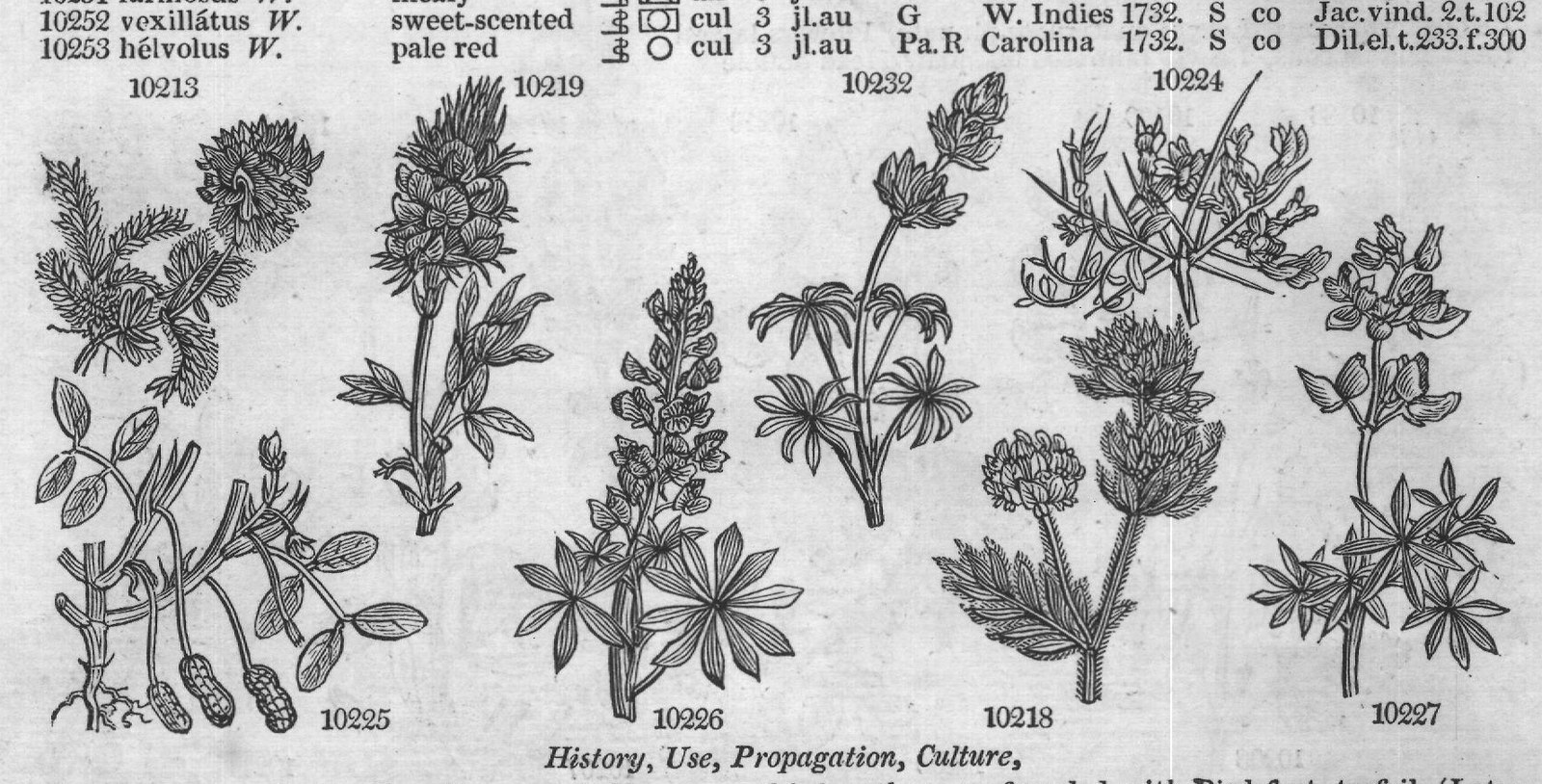
Leguminosæ. Sp. 1-2. 10225 hypogæ'a W.
American clt 2 my.jn Y S. Amer. 1712. O s.l Trew.pl.rar.3.t.3 1544. LUPINUS. W.
LUPINE.
Leguminosæ.
Sp. 14-16. 10226 perénnis Ph. 10227 nootkaténsis Ph. 10228 álbus W. 10229 Thérmis W. smooth-perenn. or 2 my.jl B N. Amer. 1658. D p.1 Bot. mag. 202 hairy-perennial or 6 jn.au Pu NootkaSo.1794. D p.l Bot. mag. 1311 white ☐ ag 3 jl.au W Levant 1596. S co Egyptian or 3 jn.jl W Egypt 1802. S co 10230 várius W. small-blue or 3 jl.au B.w S. Europe 1596. S co 10231 hirsútus W. great-blue or 2 jl.au B 10232 microcárpus B. M. small-fruited or 1½ ap B 10233 mexicánus Lag.
Mexican or 2 f B 10234 pilósus W. rose or 3 jl.au F 10235 angustifólius W. 10236 linifólius W. narrow-leaved or 2 jl.au B Flax-leaved or 2 jl.au B 10237 lúteus W. yellow or 2 jl.au Y 10238 villósus W. villous or jl.au Pk 10239 arbóreus H. K. tree or 6 jl.au Y ......
S. Europe 1629. S co Chili 1821. S co Mexico 1819. S co S. Europe 1710. S co Spain 1686. S co 1799. S co Sicily 1596. S co Carolina 1787. R. s.l 1793. R s.l ......
Knor.del.2.t. L.7 Roth. abh. 14. t.5 Bot, mag. 140 Bot. mag. 2413 Bot. reg. 457 Bot. mag. 682 1545. AMORPHA. W. BASTARD-INDIGO.
Leguminosæ.
Sp. 6. 10240 fruticosa W. shrubby or 6 jn.jl Pu Carolina 1724. S s.p Bot. reg. 427 ẞ emarginata emarginate-lvd. or 6 jn.jl Pu Carolina 1724. C s.p 10241 microphýlla Ph. dwarf ft 2 jl.au Pu Missouri 1811. C s.p 10242 pubéscens Ph. pubescent or 3 jn.jl B Carolina 1803. C s.p Bot. cab. 689 10243 canéscens Ph. canescent or 3 jl.au B Missouri 1812. C s.p 10244 nána Nutt. pygmy or 1½ jl.au B Missouri 1811. C s.p 1546. A'BRUS. W. 10245 cróceo-lanáta Wats. yellow-haired业 WILD-LIQUORICE. or 5 jl.au Pu N. Amer. 1820. C s.p Bot. mag. 2112 Bot. mag. 2112 Dend, brit. 139 Leguminosæ.
Sp. 1. 10246 precatórius W.
Jamaica or 12 mr.my 1547. PHASE OLUS.
W. KIDNEY-BEAN.
Leguminosæ. 10247 vulgáris W. common cul 1 jn.s W 10248 multiflórus W. mealy pale red 10259 lunátus W. 10250 inamœ'nus W. 10251 farinósus W. 10252 vexillátus W. 10253 hélvolus W. 10213 scarlet scymetar-podded various-colored sweet-scented ☑ cul 3 jl.au cul 12 jl.s S cul 12 jn.jl G un 6 jl.au G un 3 jl.au Pk G cul 3 jl.au 10219 10232 W. Indies 1680. S s.p Rhee. mal.3. t.39 Sp. 20-55.
India 1597. S co S. Amer.? 1633. S co E. Indies 1779. S co Africa 1794. S co E. Indies 1759. C co W. Indies 1732. Sco Pa.R Carolina 1732. S co 10224 Lob. ic. 2. p. 59 Sch.ha.2. t. 199. a H.n.h.10.t.63.f. 1 Jac. vind. 1. t.66 N.ac.p.1730. t.42 Jac.vind. 2.t.102 Dil.el.t.233.f.300 10225 10226 10218 History, Use, Propagation, Culture, 10227 plant by some agricultural writers, as A. Young; and is by others confounded with Birdsfoot trefoil (Lotus corniculata, and major), major), and with the Liquorice-vetch (Astragalus glycyphyllos), to which, to a cursory observer, it bears considerable resemblance. Linnæus observes, that in Oeland, where the soil is a red calcareous clay, the flowers of Anthyllis vulneraria are red; but that in Gothland, where the soil is white, the flowers also are white: ours are yellow.
A. Barba Jovis is a silvery looking bush, with white and hairy leaves, pale yellow flowers, and woolly pods. Like most of the Leguminose, this genus seeds freely; but in default of seeds, increase may be effected by "young cuttings planted under a bell-glass in sand, which are not difficult to root: the glasses must be kept wiped, or the dew is apt to make them mouldy, which destroys them." (Bot. Cult. 135.) 1543. Arachis. Aracos, or Aracidna, is a name applied by Pliny to a plant which had neither stem nor leaves, but was all root. The moderns have applied it to a plant, the fruit of which is borne underground. The specific name hypogæa (uπo γη, below ground), is in allusion to the curious circumstance of the pods, as they increase in size, forcing themselves into the earth, where they ripen their seeds, thence called earthnuts. The plant is generally cultivated in the warmer parts of North and South America, but is supposed to be originally from Africa. In South Carolina the seeds are used as chocolate; in the eastern countries as almonds, and in Cochin-China they furnish an oil used for lamps, and as a substitute for oil of olives. About Paris it is raised on hotbeds and transplanted into the open garden, where it ripens its seeds, which are used as other legumes. It has also been brought to maturity in a stove in England, and proved very prolific. (See Hort. Trans. vol. v. p. 372.) 1544. Lupinus. Said to be derived from lupus, a wolf, because this plant devours, as it were, all the fertility ORDER IV.
DIADELPHIA DECANDRIA. 10213 Herbaceous, Leaves pinnated equal, Head terminal 1-sided, Flowers oblique 10214 Herbaceous, Leaves pinnated equal silky, Spike peduncled ovate 10215 Herbaceous, Leaves pinnated unequal, Head solitary stalked, Pods hooked blunt shorter than calyx 10216 Herbaceous, Cauline leaves ternate: radical pinnate unequal trifid or simple 10217 Herbaceous, Leaves pinnated unequal, Pedunc. lateral longer than leaf, Heads leafless 10218 Shrubby, Leaves pinnated equal silky, Bractes as long as globose many-flowered head 10219 Shrubby, Leaves pinnated equal and ternate villous, Flowers spiked 10220 Shrubby, Leaves pinnated: floral ternate 10221 Shrubby, Leaves ternate unequal, Calyxes woolly lateral 10222 Shrubby, Leaves ternate linear-cuneate somewhat stalked, Calyxes campanulate, Branches spiny 10223 Shrubby, Petioles spiny, Leaves pinnated, Flowers axillary subsessile, Cal. inflated 10224 Shrubby spiny, Leaves simple 10225 Leaves in fours cuneate rounded, Stipules undivided, Stem nearly smooth 10226 Cal. altern. without appendage: upper lip emarginate; lower entire 10227 Cal. whorled without appendage: lower lip entire, Stem and leaves hairy 10228 Cal. altern. without appendage: upper lip entire; lower 3-toothed 10229 Cal. altern. with an appendage: upper lip entire; lower 3-toothed 10230 Cal. half-whorled with an appendage: upper lip bifid; lower about 3-toothed 10231 Cal. altern. with an appendage: upper lip 2-parted; lower 3-toothed 10232 Leaves digitate, Cal. whorled without append. Upper lip emarg.; lower bifid, Pods 2-seeded' 10233 Cal. altern. with an appendage: upper lip half-bifid; lower obscurely 3-toothed 10234 Cal. whorled with an appendage: upper lip 2-parted; lower entire 10235 Cal. altern, with an appendage: upper lip 2-fid; lower entire, Leaflets linear-lanceolate flat 10236 Cal. altern. with an appendage: upper lip 2-fid; lower subtrifid, Leaflets linear channelled 10237 Cal. whorled with an appendage: upper lip 2-parted; lower 3-toothed 10238 Cal. half-whorled with an appendage: upper lip 2-fid; lower undivided, Leaves simple obl. villous 10239 Shrubby, Cal. whorled without appendage stalked: lips acute entire 10240 Teeth of calyx 4 blunt, one acuminate ẞ Leaflets emarginate, Calyxes hoary 10241 Smoothish, Leaves on short stalks blunt at each end, Spikes solitary short, Pods 1-seeded 10242 Leaves on short stalks without a point obtuse smooth, Spikes long panicled downy 10243 Hoary, Leaflets subsessile ovate-elliptical acute mucronate, Spikes panicled hoary 10244 Said to be the same as A. microphylla 10245 Ferruginous, Spikes simple clustered, Leaflets ovate-lanceolate downy mucronate 10246 The only species 10247 Raceme solitary shorter than leaves, Pedunc. 2, Bractes less than cal. spreading, Pods pendulous 10248 Raceme solitary length of leaves, Pedunc. 2, Bractes less than cal. appressed, Pods pendulous 10249 Pods scymetar-shaped somewhat lunate smooth 10250 Vexillum of flowers revolute, Calyxes whole colored 10251 Peduncles subcapitate, Seeds 4-cornered cylindrical powdery 10252 Peduncles thicker than petiole capitate, Wings subfalcate deformed, Pods linear straight 10253 Flowers capitate, Cal. bracteate, Vexill. short, Wings expanded very large, Leaflets deltoid oblong 10246 10240 10250 10242 10244 10252 10245 10253 and Miscellaneous Particulars. of the soil: but this is a very doubtful explanation. The species are border flowers, in much esteem for their velvet-like leaves and fine large flowers. They are vigorous growing plants, and most of them would afford the agriculturist a considerable bulk of herbage.
L. albus is supposed to be the species that was cultivated for this purpose by the Romans; though L. luteus is what is at present grown in the fields in the south of Italy as human food. In the south of France, it is grown in poor dry extensive plains, as a meliorating crop to be ploughed in where no manure is to be had, and the ground is too sterile for clover or other better plants. (Villars.) The perennial and ligneous species may be increased by pieces of the root, but they all seed freely. 1545. Amorpha. From a, privative, and μoρφη, form, in allusion to the deformity of the corolla, which has neither alæ or carina. A. fruticosa was once used in Carolina as an indigo plant, but is now neglected. All the species are of easy cultivation, and increase by seeds or cuttings in sand. 1546. Abrus. From aβρoς, elegant. The roots are used in the West Indies similarly to those of our liquorice, and the seeds are strung and worn as beads for ornaments, and also as rosaries, whence the specific name precatorius. They are frequently thrown, with other West Indian seeds, on the north-west coast of Scotland. Linnæus affirms, that they are very deleterious; but they are eaten in Egypt, though the hardest and most indigestible of the pulse tribe. In our stoves the plant requires a good deal of room and heat in order to flower freely. It is generally raised from seed, but cuttings will root in sand plunged in heat. 1547. Phaseolus. From phaselus, a little boat, which the pods may easily be supposed to resemble. P. vulgaris and multiflorus, Haricot, Fr., Schminkbohne, Ger., Faginolo, Ital., are well known culinary legumes. The dwarf kidney bean is earlier than the other, and better adapted for forcing; but much the largest crop Rr4 10254 semieréctus W. dark red pr 2 jl R 10255 alátus W. un 3 jl Pu 10256 Caracalla W. cul 1 au.s G 10257 aconitifólius W. cu 2 jn.au Pk 10258 trílobus W. un 2 jl.au G 10259 stipuláris W. large-stipuled un 2 jl.au DIADELPHIA DECANDRIA. winged Snail-flower Aconite-leaved three-lobed W. Indies 1732. Sco Carolina 1732. C s.l India 1690. Sr.m E. Indies 1731. S s.1 E. Indies 1777. S s.1 Y.Br Peru 1805. S s.l CLASS XVII.
Bot. reg. 743 Dil.el.t.235.f.303 Bot. rep. 341 Jac. obs. 3. t. 52 Bur.ind. t.50. f.1 10260 nánus W. common dwarf un 1 jn.s W India ...
S s.l 10261 radiátus W rayed un 1 jn.jl Pu China 1732. S s.l Dil.el.t.235.f.304 10262 Max W. hairy-podded Ocul 1 jn.jl G India 1758. S s.l Rum.am.5. t. 140 10263 Múngo W. small-fruited cul 11 jn.jl Y India 1790. S s.l 10264 diversifólius P. S. various-leaved Oun 1 jn.jl Pu N. Amer. 1806. S s.l trílobus Ph. 10265 lathyroídes W.
Lathyrus-like or 2 jl.au Sc 10266 subtrílobus Link. three-lobed un 1 jl.au Y Jamaica 1786. S s.1 Slo. ja. 1. t.116.f.1 Brazil 1824. S co 1548. TERAM'NUS. Browne. TERAMNUS.
Leguminosæ. Sp. 1-2. 10267 volúbilis Sw.z. hook-podded & ☐ or 10 ...
Jamaica 1824. Cr.m 1549. CARPOPO'GON. Rox. CARPOPOGON.
Leguminosæ. Sp. 2. 10268 gigantéus Rox. gigantic or 20 Pu ...
E. Indies 1815. C 1.p 10269 imbricátus Rox. imbricated Σ or 10 Pu ...
E. Indies 1815. C 1.p 1550. DO'LICHOS. W. DOLICHOS..
Leguminosæ. Sp. 23-76. 10270 Láblab W. black-seeded un 8 jn.jl Pu 10271 sinensis W.
Chinese pr 6 jl.au Pu 10272 lutéolus Ph. yellow un 4 jl.au Y 10273 unguiculátus W.
Bird's-foot un 3 jn.jl Y 10275 10274 tranquebáricus W. 10275 gladiátus W. Tranquebar un 3 jn.jl Y sabre-podded pr 6 au 10276 tetragonólobus W. square-podded ☐ un 4 s.n 10277 sesquipedális W. 10278 hirsútus W. long-podded ✗ un 6 au hirsute or 10 jn Pu 10279 pilósus W. hairy-podded ☑ ☑ un 3 au 10280 mínimus W. small un 1 jl.au Pa Y 10281 tetraspérmus W. four-seeded Egypt 1694. S s.l India 1776. S s.l America 1805. S s.l W. Indies 1780. S s.l E. Indies 1801. S s.l Pk E. Indies 1790. S s.1 Y E. Indies 1816. S s.l Pa.pk W. Indies 1781. S s.1 China 1802. C s.1 E. Indies 1790. S s.l Jamaica 1776. S s.l un 3 my.au Pa.Y E. Indies 1816. S s.l Jac. vind. 1. t. 67 Kæmpf. ic. t. 41 Bot. mag. 896 Bot. mag. 2232 Jac. hort. t. 90 Jac. vind. 1. t. 23 Jac. vind. 3. t. 70 Jac. ic. 3. t. 560 Jac. obs. 1. t. 22 10282 scarabæoídes W, silver-leaved un 2 jn.jl Pa 10283 reticulátus W. net-leaved un 3 jn.jl 10284 bulbósus W. bulbous un 4 jl 10285 purpúreus W. purple or 12 au.s 10286 lignósus W woody or 12 jl.au 10287 lúteus W. yellow-flowered ☐ un 8 jl.au 10288 ensifórmis W. scymetar-podded un 3 jl.au 10289 Sója W.
Soy cul 3 jl.au 10290 Cat iang W. small-fruited cul 3 jl.au 10291 biftórus W. two-flowered un 3 jl.au 10292 róseus W.
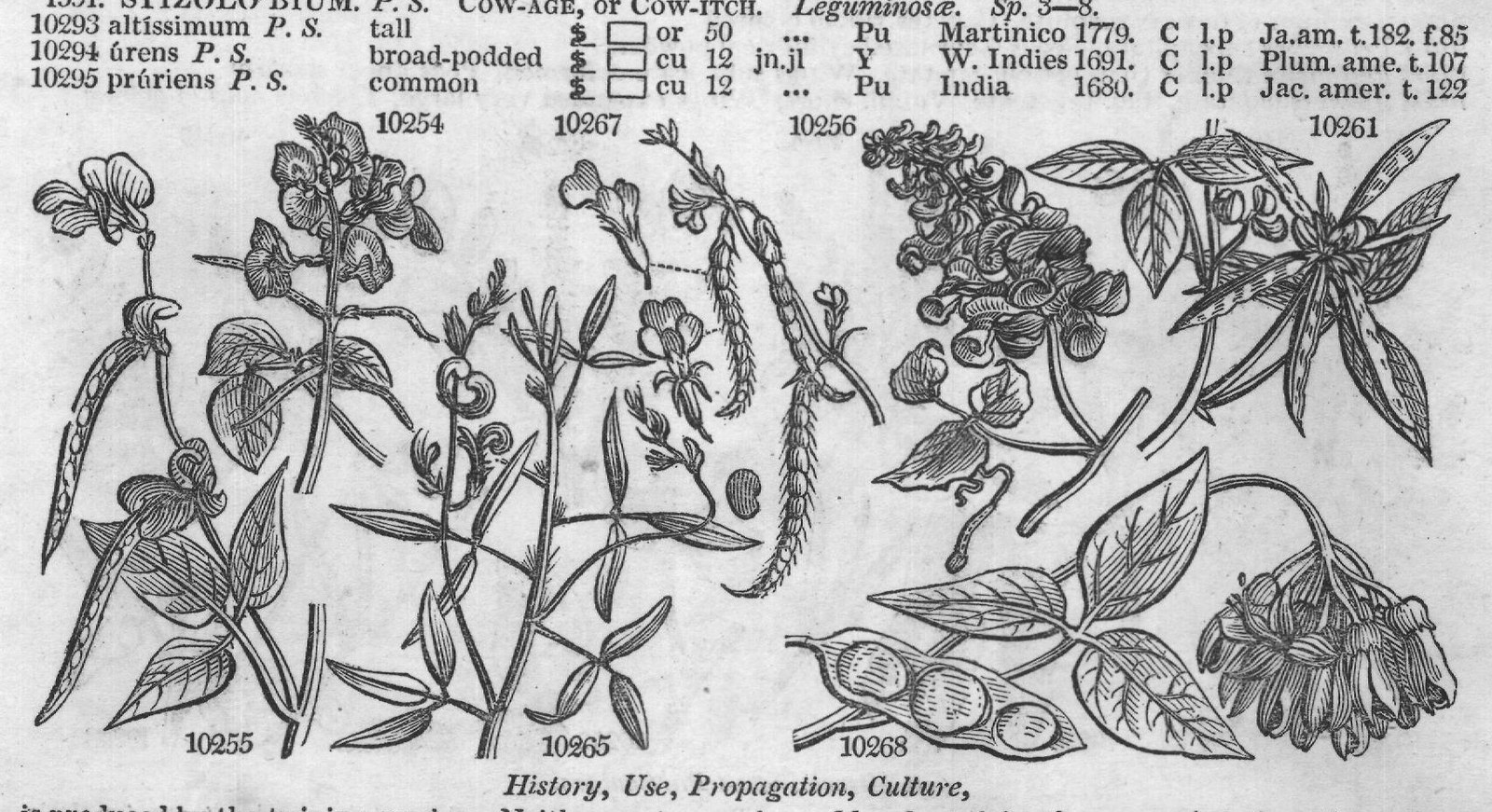
Rose-colored pr 3 jl.au E. Indies 1790. S s.l E. Indies 1776. S p.l Jamaica 1812. S $.1 E. Indies 1778. S s.1 E. Indies 1790. S s.1 E. Indies 1793. S s.1 Pa.Y E. Indies 1776. S s.l Pk Jamaica 1812. S s.l 1551. STIZOLOBIUM. P. S. COW-AGE, or Cow-ITCH. Leguminosa. Sp. 3-8. 10293 altíssimum P. S. tall / 10294 úrens P. S. broad-podded 10295 prúriens P. S. common 10254 10267 ...
Pu Y Pu or 50 cu 12 jn.jl cu 12 ... 10256 Martinico 1779. C 1.p W. Indies 1691. C l.p India 1680. C l.p Rum.am.5. t. 132 Bot. reg. 830 Bot. mag. 380 Jac. ic. 3. t. 559 Jac. ic. 1. t. 145 Rhee.mal.8. t.41 Plu.alm.t.213.f.4 Ja.am. t. 182. f.85 Plum. ame. t.107 Jac. amer. t. 122 10261 Pa Pu E. Indies 1773, S s.1 N. S. W. 1781. C s.l W. Indies 1781. S s.l Plu. alm.t.53. f.3 Pu Pu Y Pu Pk Pa 10255 10265 10268 History, Use, Propagation, Culture, is produced by the twining species. Neither sorts can be safely planted in the open air before the end of April, or first week of May, and the leaves are blackened by the first frosts of autumn. But in a stove or pit, green pods of the dwarf kinds may be gathered all the winter, and with this advantage over forced productions of the fruit kind required to be ripened, that the pods are as good from plants in the stove in midwinter, as from those in the open garden in midsummer. The garden culture of both species is so easy and universally known, that we shall not occupy ourselves with details. Though in this country the green pods only are used, on the continent the ripened seeds are as much the object of culture. In Holland, the twiner is grown in every cottage garden for both purposes; and in France and Switzerland, it is grown chiefly for the ripened seeds: in the latter countries it grows on very poor dry soil. On the first blackening of the leaves with frost, the plants are pulled up, dried like tobacco leaves under the dripping eaves of the houses; and in winter threshed out for the seeds, to be boiled and eaten with cream or butter, stewed in haricots, or put in soups. According to the analysis of Einhoff, 3840 parts of kidney bean afforded 1805 parts of matter analogous to starch, 857 of vegeto-animal matter, and 799 parts of mucillage: from which is to be inferred, that it is the most nourishing of all the legumes.
The perennial stove species thrive best in a light rich soil, and may be propagated readily from cuttings or from seed. P. caracalla, or Snail-flower, is a very curious species, and will grow and flower freely, if kept clear from the red spiders. This species was so named by the Portuguese, who first brought it from South America, in consequence of its hooded flower. Caracalla (from the Celtic words car, a head, and cal, a covering) was the name of a hooded dress much worn by the Gauls, and gave his nickname to the Emperor Marcus Aurelius Antoninus, who was accustomed to wear the dress. ORDER IV.
DIADELPHIA DECANDRIA. 10254 Flowers spiked, Cal. without bractes, Wings expanded larger, Leaflets ovate 10255 Flowers loosely spiked, Wings the length of vexillum 10256 Vexillum and keel spirally twisted together 10257 Stem hairy, Lateral leaflets 3-lobed: terminal 5-parted, Segm. lanceol. Peduncles 3-fl. shorter than petiole 10258 Stem smooth, Lateral leafl. 2-lobed; terminal 3-lobed: segments ovate, Pedunc. 3-fl. longer than petiole 10259 Stem smooth, Leafi, blunt: lateral sinuose; terminal hastate 3-lobed, Peduncles longer than leaf spiked 10260 Stem smooth, Bractes larger than calyx, Pods pendulous compressed rugose 10261 Stem round, Flowers capitate, Pods cyl cylindrical horizontal 10262 Stem angular hispid, Pods pendulous hairy 10263 Stem flexuose round hairy, Pods capitate hairy 10264 Downy, Lower leaves rhomboid oval: upper 3-lobed, Heads on long stalks, Pods round subulate 10265 Leaflets oblong acuminate, Peduncles elongated, Pods round subulate 10266 Leaflets about 3-lobed, Lobes acuminate, Racemes axillary 10267 Leaflets ovate-lanceolate downy 10268 Leaflets ternate smooth, Flowers in heads, Calyxes hairy campanulate 10269 Flowers imbricated 10270 Pods ovate acinaciform, Seeds ovate with a hilum curved towards one end 10271 Pods pendulous cylindrical torulose, Peduncles erect many-flowered 10272 Pods capitate many cylindrical, Seeds rounded 10273 Pods capitate subcylindrical with a recurved concave end 10274 Pods capitate few cylindrical with a mucronate straight point 10275 Pods racemose ensiform with 3 keels at back straight at point, Seeds with an arillus 10276 Pods membranous quadrangular 10277 Pods subcylindrical smooth very long 10278 Pods racemose compressed hairy, Outer leaflets 2-lobed 10279 Pods subracemose linear hairy, Leaflets ovate-lanceolate downy 10280 Pods racemose compressed 4-seeded, Leaflets rhomboid 10281 Pods racemose acinaciform 4-seeded, Leaflets rhomboid smooth 10282 Leaves ovate downy, Flowers solitary, Seeds 2-horned 10283 Leaves ovate acute rugose netted villous, Racemes few-flowered 10284 Leaves smooth toothed with many angles 10235 Stem smooth, Petioles downy, Wings of corolla spreading 10286 Peduncles capitate, Pods straight linear 10287 Flowers.somewhat spiked, Pods subcylindrical smooth, Leaves roundish rhomboid blunt entire smooth 10288 Pods acinaciform with 3 keels 10289 Racemes axillary erect, Pods pendulous hispid about 2-seeded 10290 Pods twin linear nearly erect 10291 Stem smooth, Peduncles 2-flowered, Outer leaflets somewhat angular 10292 Stem creeping, Leaflets roundish shining, Fl. racemose, Pods with 3 keels at back 10293 Pods racemose hairy equal, Seeds surrounded by the nilum, Leaves smooth on each side 10294 Pods racemose with transverse lamellæ hairy, Seeds surrounded by the hilum 10295 Pods racemose: valves keeled hairy, Peduncles in threes 10270 10271 10274 10275 10273 10295 and Miscellaneous Particulars. 10289 10290 1548. Teramnus. So called by Browne, apparently in allusion to its delicately-shaped legume, τεςaμvότης being used particularly to express the tenderness of eatable pulse; aτεράμvoς was a weed hostile to leguminous plants. 1549. Carpopogon. From κaρπoς, fruit, and πωγωv, a beard; the pods being bearded. Rapid growing climbers of the easiest culture. 1550. Dolichos. A name under which Dioscorides describes a plant supposed to have been the kidney bean of the moderns. The species are climbers, some of them to the height of the highest trees. The pods of most of them are eatable, but far inferior to the kidney bean. Some of them have tuberous roots which may be eaten. The seeds of D. Soja (Sooja, Jap.), which are usually called Miso in Japan, are put into soups, and are the most common dish there, insomuch that the Japonese frequently eat them three times a day. The Soja of the Japonese, which is preferred to the Kitjap of the Chinese, is prepared from these seeds, and is used in almost all their dishes instead of common salt. The Chinese also have a favorite dish made of these seeds, called Teu hu or Tau hu, which looks like curd, and though insipid in itself, yet with proper seasoning is agreeable and wholesome. (Thunb. and Loureiro.) The perennial kinds are easily increased by cuttings, and all the species seed freely. D. purpureus and lignosus have the handsomest flowers, but none of them can be considered of much beauty. 1551. Stizolobium. From 5ίζω, to prick, and λoβoς, a pod. S. urens and pruriens produce on the outside of their pods the irritating substance used in medicine as a vermifuge, under the name of Cowhage. The species are twining shrubs of the West Indies, with long bunches of yellow scentless flowers. The seeds of S. urens are often seen in cabinets of curiosities: many qualities are attributed to them by the superstitious Creoles. The French settlers call them Yeux bourrique, asses' eyes. S. pruriens is considered a powerful diuretic. 1552. GLYCINE. L.
GLYCINE. 10296 sarmentósa W. 10297 monóica W. 10298 angustifólia W. 10399 débilis W. 10300 comósa W. sarmentose un 2 jn.au Pa pale-flowered cu 4 s F narrow-leaved & ☐ un 6 jn.au Y hairy un 1 jn.jl Pa tufted un 1 jl.s B 10301 tomentósa Ph. downy Aun 1 jn.s Y 10302 renifórmis Ph.
Kidney-leaved Apr 2 jl.au Y DIADELPHIA DECANDRIA.
Leguminosæ. Sp. 19-55.
CLASS XVII.
Carolina 1805. S s.1 Sch.bo.an.12. t.2 N. Amer. 1781. Cs.p W.inRœ. A.3.t.2 C. G. H. 1795. C p.l Jac.schœ.2.t.231 E. Indies 1778. S p.l N. Amer. 1812. C p.1 N. Amer. 1732. C p.l Dill.elt. t.26.f.29 Carolina 1806. C p.l 10303 suavéolens W. sweet-scented or 3 jl.s Y.R E. Indies 1816. C p.1 10304 reticulata W. 10305 caribæ'a W. 10306 bituminósa W. 10307 parviflóra P. S. 10308 sagittáta W. en. 10309 rhombifólia W. 10310 vincentína Ker. 10311 phaseoloídes Swz. 10312 sinensis B. M. small-flowered & un 3 jl rhomb-leaved Kidn.-bean-likes Chinese net-leaved or 6 jl.s Y Jamaica 1779. C p.l trailing clammy pr 2 s.O Y W. Indies 1742. C p.1 Bot. reg. 275 pr 4 ap.s Y C. G. H. 1774. C p.1 Bot. reg. 261 Pa arrow-leaved un 4 my.au Y un 6 my.au E. Indies 1812. C p.1 Havannah1815. C p.l ...
E. Indies 1815. C p.l St. Vincent's pr 2 my.au Y St. Vincen. 1822. C co Bot. reg. 799 un 2 jn.jl Br $ 10313 A'pios W. tuberous-rooted 10314 frutéscens Ph. shrubby $ 1553. KENNE/DIA. Vent. KENNEDIA. 10315 rubicúnda V. 10316 coccínea V. 10317 prostráta. H. K. single-flowered dingy-flowered & or 10 mr.au Br many-flowered 10318 Comptoniána B. R. Compton's Lr.m N. Amer. 1640. C s.p N. Amer. 1724. or 15 my.jn B ft 6 au.s Pk Jamaica 1818. C p.l China 1818.
Bot. mag. 2284 Bot. mag. 2083 Bot. mag. 1198 or 10 jn.s Pu R s.p Bot. mag. 2103 Leguminosæ.
Sp. 6.
N. S. W. 1788.
S s.p Bot. mag. 268 or 10 my.au S or N. Holl. 4 mr.jn S N. S. W. or 12 mr.jn B N. Holl. 10319 monophýlla V. simple-leaved ☐ or 10 mr.jn Pu N. S. W. 1803. S s.p 1790. C s.p 1803. C s.p 1790. S s.p Vent. malm. 105 Bot. mag. 270 Bot. rep. 298 Bot. mag. 263 10320 ováta B. M. ovate or 6 my.au Pu N. Holl. 1818.
C s.p Bot. mag. 2169 1554. CYLISTA. W CYLISTA.
Leguminosæ.
Sp. 3. 10321 villósa H. K.
Cape or or 6 ap.my Y C. G. H. 1776. S p.1 10322 albiflóra B. M. white-flowered or 6 ap.my W Mauritius ...
Cp.l 10323 scariósa W.
Coromandel or 4 ...
Y E. Indies 1806. S p.l Bot. rep. 446 Bot. mag. 1859 Rox. cor. 1. t. 92 1555. GALACTIA. Mi. GALACTIA. 10324 péndula Pers. pendulous 1556. CLITO'RIA. W. CLITORIA.
Leguminosæ.
Sp. 1-5. pr 6 jl.au R Jamaica 1794. C l.p Bot. reg. 269 Leguminosæ. Sp. 8-16. 10325 Ternátea W. wing-leaved $ or 4 jl.au B 10326 heterophylla Lam. various-leaved 10327 brasiliana W. Brazilian or 1 jl.au B or 4 jl.au Pu 10328 virginiána W. small-flowered or 6 jl.au B 10329 mariána W.
Maryland Aor 3 au B 10330 arborescens H. K. tree or 8 au.s Pk 10331 Plumiéri Pers.
Plumier's 10332 mexicána Link.
Mexican $ $ or 6 s.n W.R E. Indies 1739. C s.p E. Indies 1812. S s.p Brazil 1759. S s.p America 1732. C s.p N. Amer. 1759. C s.p Trinidad 1804. C s.p W. Indies Bot. mag. 1542 Bot. mag. 2111 Breyn. cent. t. 1 Par. lond. 51 ...
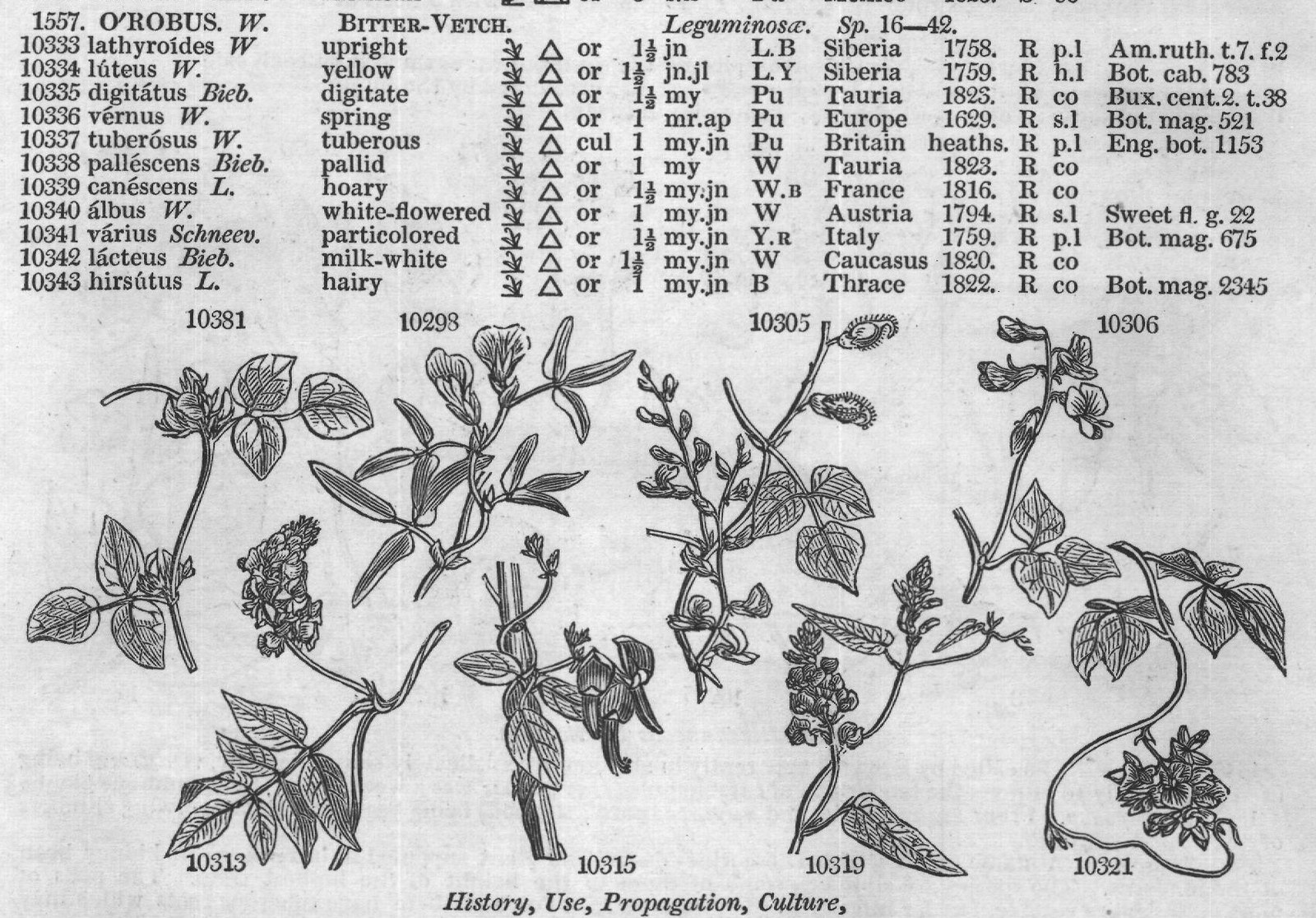
Cs.p Bot. reg. 268 or 3 s.n Pu Mexico 1823. S. co 1557. O'ROBUS. W.
BITTER-VETCH.
Leguminosæ. Sp. 16-42. 10333 lathyroídes W upright or 1½ jn L.B Siberia 1758. R p.1 Am.ruth. t.7. f.2 10334 lúteus W. yellow or 1 jn.jl L.Y 10335 digitátus Bieb. digitate or 1 my Pu 10336 vérnus W. spring 2 or 1 mr.ap Pu Tauria Europe 10337 tuberósus W. tuberous 2 cul 1 my.jn Pu Britain 10338 palléscens Bieb. pallid or 1 my W Tauria Siberia 1759. R h.l 1825. R co 1629. R s.l heaths. R p.l 1823. R co Bot. cab. 783 Bux, cent.2. t.38 Bot. mag. 521