Breyn
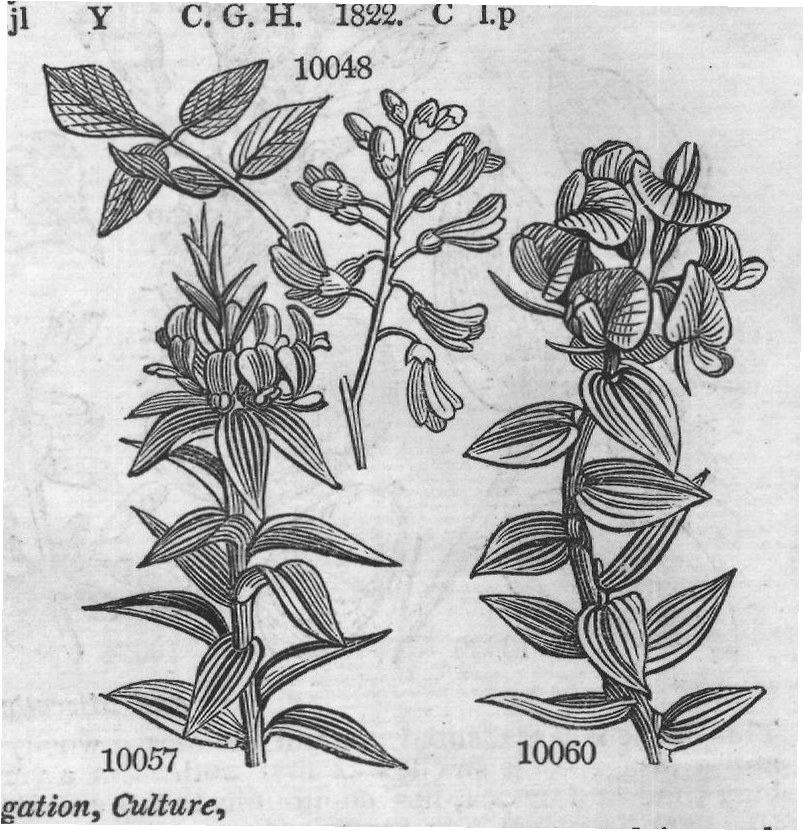
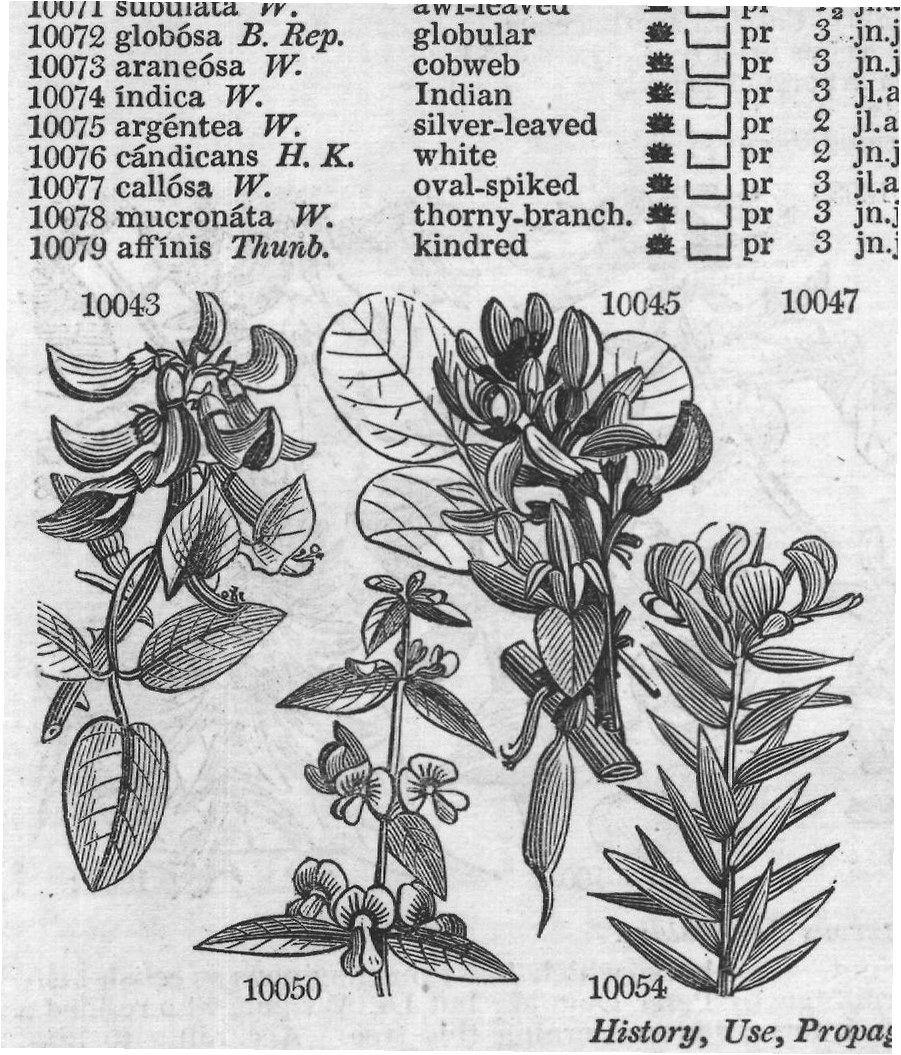
cent. t. 11 10063 álbens W. silky pr 4 jl.au W C. G. H. 1774. C p.l 10064 pedunculáta H. K. small-leaved pr 6 jl.au Y C. G. H. 1775. S p.l Bot. mag. 344 10065 ericifólia W.
Heath-leaved pr 2 jl.au Y C. G. H. 1789. C p.l Pl.man. t.413.f.6 10066 asparagoídes W.
Asparagus-lvd. pr 3 jl.au Y C. G. H. 1812. 10067 carnósa W. fleshy-leaved pr 3 my.jn Y C. G. H. 1795. C p.1 C p.l Bot. mag. 1289 10068 crassifólia B. Rep. bristle-pointed pr 2 jl.au Y C. G. H. 1800. S p.1 Bot. rep. 353 10069 ciliáris W. ciliated pr 2 jl.au Y C. G. H. 1799. C p.l Bot. mag. 2233 10070 uniflóra W. single-flowered pr 3 jl.au Y C. G. H. 1812. C p.l Pl.man. t.414.f.7 10071 subuláta W. awl-leaved pr 1 jl.au Y C. G. H. 1789. C p.l 10072 globósa B. Rep. globular * pr 3jn.jl Or C. G. H. 1802. S p.1 Bot. rep. 510 10073 araneósa W. cobweb pr 3 jn.jl Y C. G. H. 1795. S p.l Bot. mag. 829 10074 índica W. 10075 argentea W. 10076 cándicans H. K. 10077 callósa W. 10078 mucronáta W. 10079 affinis Thunb. 10043 Indian white oval-spiked thorny-branch. kindred pr 3 jl.au R E. Indies 1759. S p.l Rhee. mal.9. t.37 silver-leaved pr 2 jl.au Y C. G. H 1759. C p.l pr 2 jn.jl Y C. G. H. 1774. C l.p pr 3 jl.au Y C. G. H. 1812. C 1.p Bot. mag. 2329 pr 3 jn.jl Y C. G. H. 1796. C 1.p pr 3 jn.jl Y C. G. H. 1822. C 1.p 10045 10047 10048 10050 10054 10057 10060 History, Use, Propagation, Culture, would be, if the plants stay out till they are in bloom. Cuttings taken off at a joint, and planted in sand, without being deprived of any of their leaves, strike root readily under a hand-glass in moist heat." (Bot. Cult. 54.) 1522. Butea. Named in honor of the late Earl of Bute, a munificent patron of botanical science. This splendid genus, though of free growth and easy propagation, is yet rare in British collections. From B. frondosa is obtained the Gum lac of commerce. Infusions of the flowers dye cotton cloth, previously impregnated with a solution of alum, or of alum and tartar, of a beautiful yellow color. The plant grows in loam and peat, and " cuttings should be taken off at a joint, and planted in a pot of sand, without being deprived of any of their leaves: one pot is enough under a hand-glass, as the leaves take up much room, and, if too confined, are apt to damp off. They should be plunged in a moist heat." (Bot. Cult. 30.) 1523. Viborgia; usually written Wiborgia, received its name after M. Eric Viborg, a learned and acute Danish botanist, author of several botanical treatises in his own language in the end of the eighteenth century. The species, like those of the four preceding genera, may be treated as Scottia . 1524. Piscidia. From piscis, a fish; the inhabitants of America use the bark as a fish poison. This tree has spreading branches and pinnate leaves, and is very common in Jamaica, where it is reckoned one of the best timber-trees in the island. The wood is very hard and resinous, and lasts almost equally in or out of water. It is of a light-brown color, coarse, cross-grained, and heavy. (Browne.) It makes excellent piles for wharfs. The stakes soon form a good live fence. The bark of the trunk is very astringent a decoction of it stops the immoderate discharge of ulcers, especially when it is combined with the mangrove bark ; it cures the mange in dogs, and would probably answer well for tanning leather. (Long, 824.) The bark of the root is used for the same purposes and with the same effects as the leaves and branches of Surinam poison it is pounded and mixed with the water in some deep and convenient part of a river or creek, when ce it may spread itself; ORDER IV.
DIADELPHIA DECANDRIA. 10043 Leaves ternate, Petioles prickly glandular, Stem arboreous unarmed 10044 Leaves ternate oblong oval blunt 10045 Branches downy, Leaflets roundish emarginate 10046 Branches smooth, Leaflets obovate roundish blunt 10047 Leaflets and twiggy branches pubescent 10048 Leaves unequally pinnate, Leaflets ovate 10049 Leaves cordate ovate, Ovary hairy 10050 Leaves lanceolate ovate, Ovary smooth 10051 Leaves deltoid or hastate with spiny angles 10052 Leaves sublinear acute villous beneath, Heads terminal 10053 Leaves lanceolate 3-nerved entire 10054 Leaves lanceolate many-nerved entire 10055 Leaves amplexicaul. entire netted 10056 Leaves amplexicaul. wavy with a reflexed mucro 10057 Leaves cordate many-nerved entire 10058 Leaves cordate many-nerved toothletted 10059 Leaves ovate cordate acuminate pungent, Stem hirsute 10060 Leaves rigid pointed pungent oblong dense 10061 Leaves ovate smooth, Branches angular, Peduncles 3 lateral 1-flowered 10062 Leaves fascic.ed 3-angular mucronate stiff hairy, Heads hairy 10063 Leaves fascicled filiform silvery blunt, Racemes leafy, Flowers not hairy 10064 Leaves fascicled subulate smooth, Pedunc. filiform twice as long as leaf 10065 Leaves fascicled filiform blunt hairy, Flowers somewhat racemose 10066 Leaves fascicled 3-cornered mucronate hairy, Flowers lateral 10067 Leaves fascicled fleshy round smooth, Fl. lateral and terminal, Flowers smooth 10068 Leaves fascicled fleshy round smooth setaceous at end, Fl. capitate terminal 10069 Leaves fascicled scabrous somewhat hairy, Heads terminal 10070 Leaves fascicled filiform mucronate smooth, Flowers lateral 10071 Leaves fascicled 3-cornered mucronate smooth 10072 Leaves linear downy imbricated, Heads terminal crowded 10073 Leaves fascicled filiform lax hairy, Heads hairy 10074 Leaves quinate sessile, Peduncles 1-flowered 10075 Leaves ternate and fascicled ovate silky, Heads downy, Stem dichotomous 10076 Leaves ternate and fascicled filiform silky, Fl. somewhat lateral, Vexillum naked 10077 Leaves three 3-cornered smooth, Spikes ovate 10078 Leaves ternate, Leaflets blunt, Branches spiny 10079 Leaves fascicled fleshy round smooth, Flowers lateral without bractes, Branches twiggy 10061 10073 10064 10067 10068 10077 10072 10069 and Miscellaneous Particulars. in a few minutes the fish that lie hid under the rocks or banks rise to the surface, where they float as if they were dead; most of the large ones recover after a time, but the smaller fry are destroyed. The eel is not intoxicated with common doses, though it is affected very sensibly; for the moment the particles spread where it lies, it moves off with great agility. Jacquin observes that this quality of intoxicating fish is found in many other American plants.
It is a very free grower in our stoves, but is seldom allowed to grow large enough to flower. Cuttings root in sand under a hand-glass. sand under a hand-glass. 1525. Platylobium. From πλaτuς, broad, and λoβoς, a pod, in allusion to the form of the pod. Handsome free -flowering plants, which grow in sandy loam and peat; and are increased by cuttings in sand under a hand-glass, or by seeds. 1526. Borbonia. In memory of Gaston Bourbon, Duke of Orleans, son of Henry IV. of France, a great lover and patron of botany. See Gastonia. Shrubs of easy culture and propagation. and patron of botany. See Gastonia. Shrubs of easy culture and propagation. 1527. Rafnia. Named, according to Sir James Smith, after Mr. C. G. Rafn of Copenhagen, author of a Flora of Denmark and Holstein, published in 1796 and 1800, in two octavo volumes. A genus of Cape plants, sepa- Denmark and Holstein, published in 1796 and 1800, in two octavo volumes. A genus of Cape plants, separated from the Linnean Crotalaria and Liparia. 1528. Aspalathus. A native of the island Aspalathus on the coast of Lycia. It was a common practice with the ancients to fix the names of places upon certain plants, as Cytisus, Lycium, and others. It is not cerancients to fix the names of places upon certain plants, as Cytisus, Lycium, and others. It is not certain what plant the ancients intended by their Aspalathus. Shrubs and under-shrubs, with fasciculate linear leaves, and yellow flowers, all of which grow freely in a mixture of sandy loam and peat; and young cuttings, planted in sand under bell-glasses will strike root freely, if the glasses are wiped occasionally, otherwise they are liable to damp off. Some species ripen seeds freely, by which young plants are readily produced. (Bot. Cult. 140.) DIADELPHIA DECANDRIA. 1529. SARCOPHYLLUM. Th. SARCOPHYLLUM. 10080 carnósum Th.
Leguminosæ. Sp. 1.
CLASS XVII. jointed-leaved cu 3 my.au Y C. G. H. 1812. C s.l Bot. mag. 2502 1530. CROTALA'RIA. W. CROTALARIA.
Leguminosæ. Sp. 40-87. 10081 sagittális W.
Virginian un 1 jn.jl Y America 1731. S co Plu.am.t.169.f.6 10082 prostráta W. en. prostrate un jl Y E. Indies 1804. S co 10083 floribúnda B. C. many-flowered pr 2 jl.au Y C. G. H. 1810. C co Bot. cab. 509 10084 rubiginósa W. ferrugineous unjl Or E. Indies 1807. S co 10085 platycárpa Link. flat-podded un jl Y N. Amer. 1823. S co 10086 anthylloides H. K. large-fl.-cupped or 4 au.s Y E. Indies 1789. C s.l 10087 tetragóna H. K. square-stalked un 2 o.n Y E. Indies 1806. S s.l Bot. rep. 593 10088 paulína Schranck.
St. Pauls un 2 au.s Y Brazil 1823. S co 10089 parviflóra Roth. small-flowered un 2 au.s Y E. Indies 1817. S co 10090 benghalénsis P. S.
Bengal un 2 jn.jl Y E. Indies 1806. S s.1 Plu.alm.t.169.f.5 10091 júncea W. striated-stalked ☑☑☑ un 1 jn.jl Y E. Indies 1700. S p.1 Bot. rep. 422 10092 diffúsa Link. diffuse un jn.jl Y Sco ... 10093 nepalénsis Link.
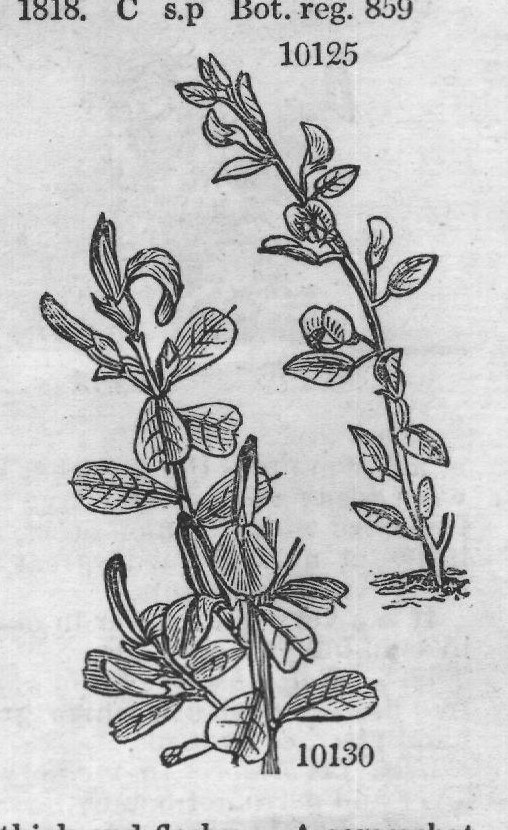
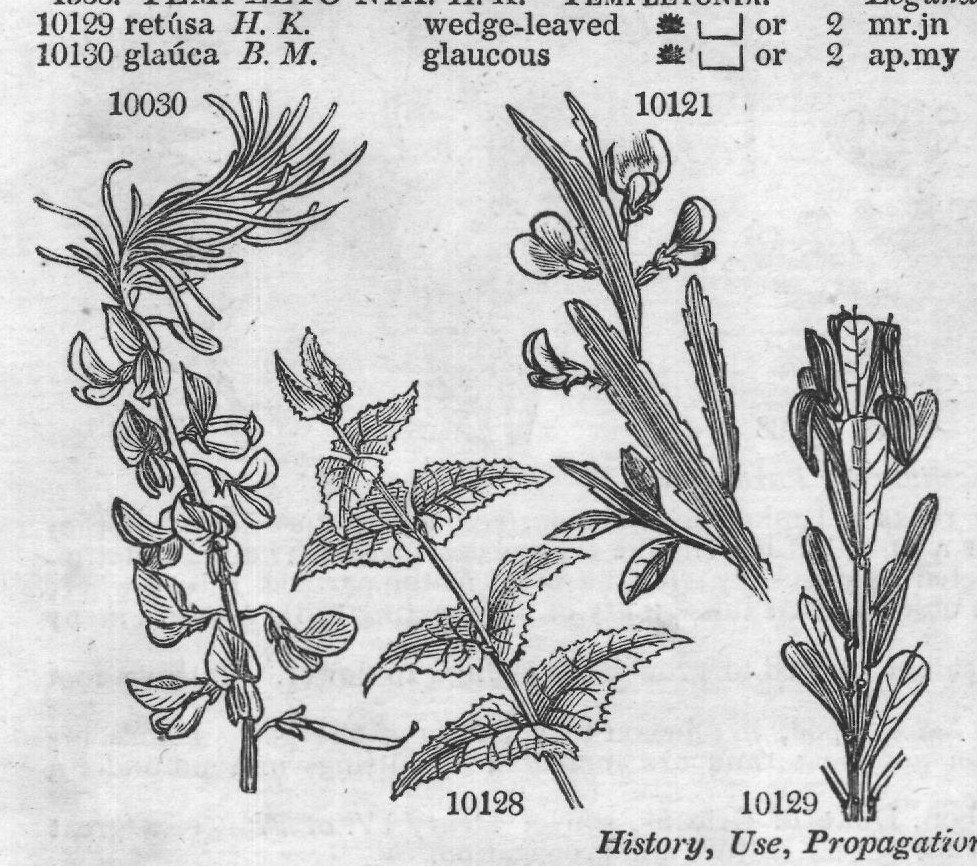
Nepal un 1 jn.jl B Nepal 1823. S co 10094 fenestráta B. M. window-calyxed ☐ un 2 jn.jl Y E. İndies 1815. S p.l Bot. mag. 1933 10095 serícea W. silky un 1 jn.jl Y E. Indies 1807. S p.1 10096 retúsa W. wedge-leaved un 1 jn.jl Y.Pu E. Indies 1731. S p.1 Bot. reg. 253 10097 verrucósa W. blue-flowered un 1 jl.au B 10098 mícans Link. glittering un 2 jl.au Pa.Y ...... 10099 curtáta Link. short-keeled un 1 ap.my Y E. Indies 1731. Cr.m Bot. rep. 308 1820. C co S co .. 10100 púlchra H. K. short-podded 10101 semperflórens P. S. ever-blowing un 2 mr.my Y un 3 mr.s Y E. Indies 1800. S p.1 E. Indies 1816. S p.1 Bot. rep. 601 Vent. cels. t. 17- 10102 hírta W. en. hairy un 1 jn.au Y E. Indies 1816. S p.l 10103 biflóra W. two-flowered un jl.au Y 10104 micrántha Link. small-flowered un 1 jl.au Y 10105 vitellína Ker.
Yolk of egg un 2 my jn Y E. Indies 1790. S p.l Ceylon 1823. S co Brazil 1819. C co