Home › B › Byttneriaceæ (Sp suberif lium W)
Byttneriaceæ (Sp suberif lium W)
Sp. 3-4. 9704 suberifólium W. various-leaved 9705 acerifólium W. or 10 s.o W E. İndies 1783. C p.l Bot. mag. 1526 Maple-leaved or 10 jl.s W E. Indies 1790. C p.l Bot. mag. 620 9706 semisagittatum Rox.half-sagittate 호 or 10 W ...
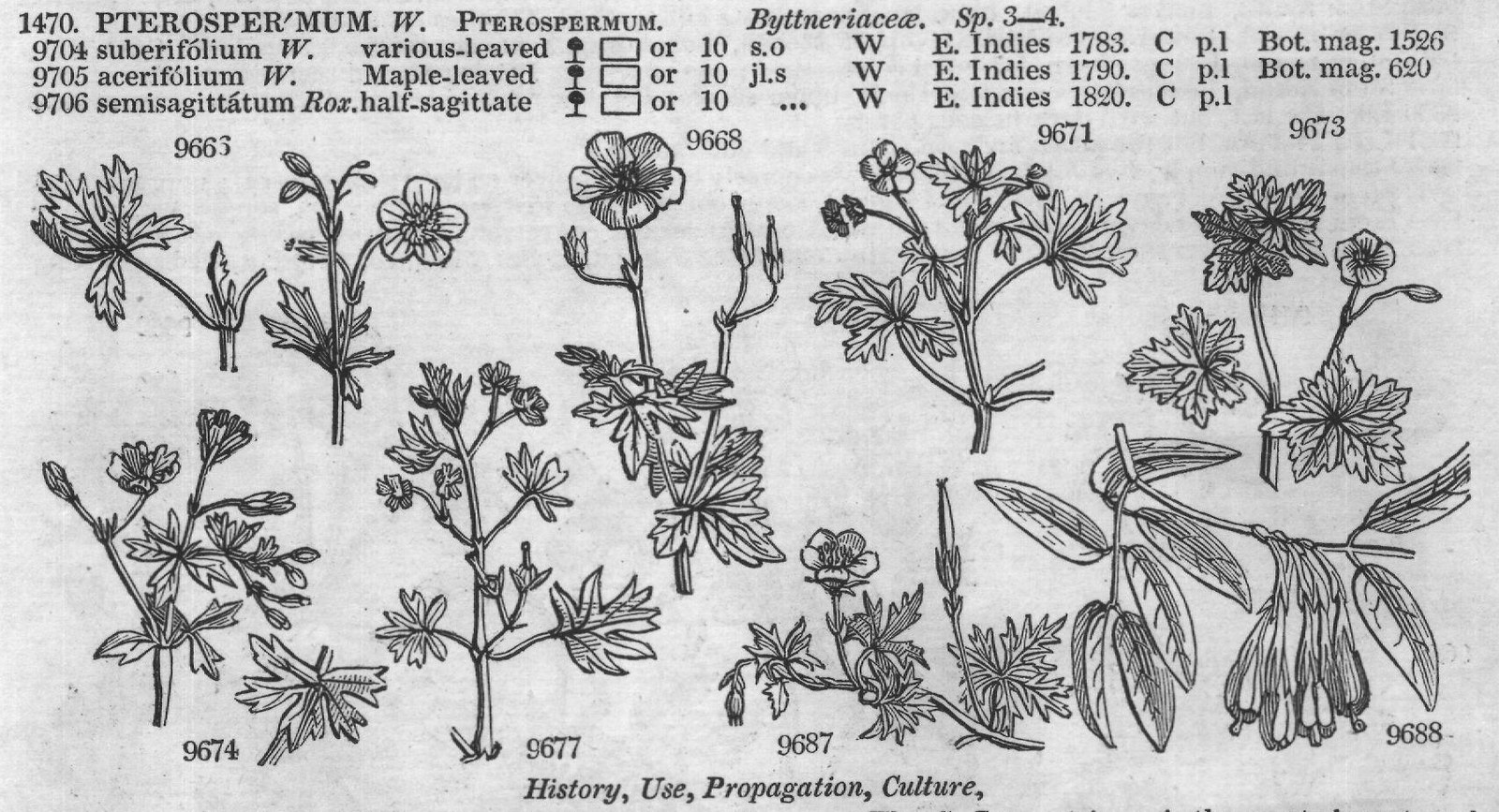
E. Indies 1820. C p.l 9663 9668 9671 9673 9674 9677 9687 9688- History, Use, Propagation, Culture, interest, and in others, being extremely shewy border-flowers. The G. Lancastriense is the most elegant, and G. sanguineum the most ornamental of our British kinds. G. anemonifolium, a Cape species, is singularly beautiful, on account of its fine caulescent stem, loaded with large fern-like glossy leaves of the most delicate green, and its fine red rich blossoms broader than half a crown. 1464. Brownea. Named after Dr. Patrick Browne, an English physician, who published a Natural History of Jamaica, in 1756, illustrated with figures from the pencil of Ehret. A splendid genus, as yet rare in British gardens. Loamy soil best suits rooted plants; and ripened cuttings root in sand in close moist heat. 1465. Monsonia. In memory of Lady Ann Monson, a lady of eminent botanical acquirements, who resided for many years in the East Indies, and is said to have assisted in compiling Lee's Introduction to Botany. The species are curious and beautiful plants: they grow well in turfy loam and rotten leaves, and are increased by cuttings of the shoots or roots.
ORDER V.
MONADELPHIA DECANDRIA. 9666 Stem somew, angul. erect dichotomous pubesc. backw. Lvs. 3-5-part. cut-toothed: radic. on very long stalks 9667 Stem angular diffuse pubesc. backw. Lvs. palmate 5-part.: lobes 3-lobed cut serrate, Ped, and cal. vill. viscid 9668 Stem decumbent villous with spreading hairs, Leaves 5-7-lobed: lobes cut-toothed, Ped. very long hairy 9669 Stem ascending smoothish, Leaves peltate 7-parted: lobes cut, Peduncles and calyx villous 9670 Stem naked at base erect smooth, Caul. lvs. opposite 3-5-part.: lobes cut acute, Ped. 3 times as long as leaf 9671 Stems decumbent branched, Petioles and peduncles hispid, Leaves 3-5-parted lobes linear blunt trifid 9672 Stems decumbent, Petioles pedunc. and calyx smoothish, Caul. lvs. opp. 3-5-parted: lobes trifid toothed 9673 Stem prostrate compressed, Lvs. opp. 5-lobed: lobes oblong unequally toothed, Ped. elong. and cal. hairy 9674 Stem erect branched, Leaves reniform 7-lobed: segm. oblong obtuse trifid; lobes 3-toothed 9675 Stem more flaccid and nearly naked, Grains nearly smooth. Otherwise like the last 9676 Leaves ren.: rad. 9-lobed; caul. 7-lobed: lobes 3-fid, Pet. bifid length of pointless cal. Fruit smooth rugose 9677 Leaves subreniform 7-lobed: lobes 3-fid, Petals emarg. length of pointless cal. Fruit downy not rugose 9678 Radic. Ivs. reniform 7-lobed; caul. roundish trunc. at base 5-lobed: lobes trifid, Pet. length of awned cal. 9679 Leaves 5-parted: lobes multifid linear, Petals emarginate length of awned calyx, Fruit smooth 9680 Leaves 5-parted: lobes trifid linear, Petals emarginate length of awned calyx, Fruit hairy 9681 Lvs. 5-lob. beyond middle: lobes cut 3-5-fid, Ped. clustered at end, Petals emargin. length of awned calyx 9682 Lvs. 5-lobed: lobes cuneate ovate cut-tooth. Hair of stem spread. hispid, Pet emarg. length of awned calyx 9683 Lvs. 5-lob.: upp. 3-lob.: lobes obl. coarsely and irreg. tooth. Hair of stem spread. hisp. Pet. shorter than cal. 9684 Very smooth, Leaves rounded 5-lobed, Calyx pyramidal angular transversely wrinked, Fruit muricate 9685 Leaves 3-5-parted: lobes trifid pinnatifid, Petals entire twice as long as the angular awned calyx 9686 Like the last, but the petals only a little longer than calyx 9687 Stem prostrate nodose, Leaves opposite deeply 5-lobed 9688 Stamens length of cor. Pedunc. aggregate, Branches smooth DODECANDRIA. 9689 Leaves palmate 5-parted, Segm. finely bipinnatifid, Petioles and calyxes smooth 9690 Leaves palmate 5-parted, Segm. 3-parted pinnatifid; beneath calyxes and petioles hairy 9691 Leaves cordate 5-7-fid: lobes blunt serrated; beneath petioles and calyxes somewhat hairy 9692 Leaves ovate oblong subcordate crenate wavy, Stipules rigid, Pedunc. 1-fl. with 2 bractes 9693 Leaves ovate mucronate entire, some subsessile, some on long stalks 9694 Decandrous, Leaves cordate finely serrate downy beneath, Peduncles 2-flowered, Calyxes sub-bilabiate 9695 Decandrous, Leaves cordate crenate velvety with down on each side, Flowers subterminal few corymbose 9696 Decandrous, Leaves cordate ovate tooth-serrate acuminate rough, Flowers axillary 9697 Leaves cordate acuminate serrate downy green, Peduncles axillary few-flowered, Fruit-stalk very long 9698 Leaves cordate lanceolate crenulate downy beneath rusty, Fl. terminal subracemose 9699 Young leaves downy, adult smoothish cordate 7-nerved crenate, Corymb bifid 9700 Leaves downy beneath smooth above ovate oblong 7-nerved subcordate-peltate toothed 9701 Leaves hastate lanceolate serrate 9702 Leaves ovate serrated 9703 Leaves roundish cordate acuminate very large, Stipules large persistent ovate wavy 9704 Leaves oblong acuminate coarsely somewhat toothed at end, Pedicels scarcely longer than petiole 9705 Leaves cordate blunt toothed 9706 Leaves oblong acuminate entire cordate at base sagittate on one side 9699 9660 9702 9689 9703 9704 9694 and Miscellaneous Particulars. 1466. Helicteres. Derived from έλiξ, a screw, in allusion to the manner in which the fruit is twisted. Freeflowering plants of easy culture, and increased in sand closely covered. They have little or no merit. 1467. Dombeya. Named after Joseph Dombey, a famous French botanist, who travelled in Peru with Ruiz and Pavon, in 1777. Ripened cuttings root in sand in moist heat. 1468. Pentapetes. One of the names given by the Greeks to the Cinquefoil; but having no reference to the present genus, except that the calyx and capsules are in five. The species are of easy culture in any rich light soil, and are readily increased by cuttings in sand. 1469. Astrapæa. So called from aςρaπη, lightning, in allusion to the splendid colors of the flowers. A noble genus, remarkable for the large heads of flowers, and the great dilated stipules at the base of the leaves 1470. Pterospermum. From πτερov, a wing, and σπερμη, a seed. Light soil suits the plants, and cuttings with their leaves on root in sand covered close.
Pp 3 1471. MA'LOPE. W. 9707 malacoídes W.
MALOPE.
Barbary 9708 trífida W.
Malvaceæ. Sp. 2-4. un 1 jn.jl Pu CLASS XVI. trifid un 1 jl Pu 1472. MAL/VA. W.
MALLOW.
Malvaceæ. 9709 tricuspidáta H. K. Jamaica pr 1 jl.au Y 9710 americána W.
American pr 1 jn.jl Y 9711 scábra W. rough-stemmed pr 4 jn.jl Y 9712 scopária W.
Birch-leaved姓 pr 6 au.s Y 9713 borbónica W. en.
Bourbon pr 4 jl.au Y 9714 polystáchya W. many-spiked pr 6 jl.au Y 9715 spicáta W. simple-spiked pr 2 s.O 0 9716 tomentósa L. downy pr 3 s.o Y 9717 Waltherifólia Link. soft-leaved pr 1 Y ... 9718 trachélifólia Link. pointed Oun 1 jl.au Y 9719 gangética L. 2 Ganges un 1 jl.au Y 9720 domingénsis Spr.
Domingo pr 2 jl.au Y Barbary 1710. C s.l Cav.dis.2.t.27.f.1 Barbary 1808. S s.l Cav.dis.2.t.27.f.2 Sp. 56-82.
W. Indies 1726. C co Cav.dis.2.t.22.f.2 W. Indies 1756. S co Peru 1798. C co Peru 1782. C co Mauritius 1816. C co Peru 1798. C co Jamaica 1726. C co E. Indies 1820. C co Java 1824. D co ...... 1821. S co Ca.dis.5.t.138.f.1 Jac. ic. 1. t. 139 Ca.dis.5.t.138.f.3 Cav.dis.2.t.20.f.4 Pluk. t. 356. f. 1 E. Indies 1823. S co Plu.alm. t.74. f.6 St. Domin. 1824. S co 9721 leprósa W. en. leprous un 2 my.jl Pu Cuba 1815. C co 9722 crética Cav.
Candian un 1 my.jl Pu Candia 1825. S co Ca.dis.5.t.138.f.2 9723 hispánica W.
Spanish O un 1 jl F Spain 1710. S co Desf. atl. 2. t.170 9724 stipulácea W.. long-stipuled un 1 jn.au Pu Spain 1815. S co Cav.dis.2.t.15.f.2 9725 ægyptia W.
Egyptian un 1 jn.jl L.B Egypt 1739. S co Cav.dis.2.t. 17.f.1 9726 trífida W. large-flowered Oun 1 jn.jl Pu Spain 1815. S co Ca.dis.5.t.137.f.2 9727 Tournefortiána W. Tournefort's 9728 Alcéa W. 9729 moscháta L.
ẞ unduláta Sims. 9730 althæoídes Cav. 9731 mauritiána W. 9732 sylvéstris W. 9733 rotundifólia W.
B pusílla Sm. 9734 braziliénsis Dec. 9735 microcárpa Desf. 9736 parviflóra W. 9737 verticilláta W. 9738 críspa W. 9739 amœ'na Sims. 9740 virgáta W. 9741 capénsis W. 9742 balsámica W. wavy Althæa-like Ivy-leaved common dwarf Brazil small-fruited small-flowered whorl-flowered curled un 1 jl.au B Spain 1759. S co Cav.dis.2.t.17.f.3 Vervain musk পপপ un 3 jl.o Pu Germany 1597. D co Bot. mag. 2297 Apr 2 jl.au F Britain bor.fi. D co Eng. bot. 754 pr 2 jl.au W ☐ un 2 jl.au Pu or 6 jn.jl Pk m 4 my.o Pu round-leaved W 1 jn.s F Britain ro. sid. S co OW 3 jn.s Pu O un jn.s Pu ...... ...
Spain 1822. S co S. Europe 1768. S co Britain was.pl. D co Britain ro. sid. S co R.Janeiro 1824. S co Eng. bot. 1092 D co Bot. mag. 2298 Cav. diss.2. t. 135 Sweet fl. gard.81 Eng. bot. 671 Eng. bot. 241 un 2* jn.s Pu Egypt 1823. D co un 2 jn.jl Pu Barbary 1779. C co Cav.dis.2.t.26.f.1 O un 2 jn.jl Pu China 1683. S co Cav.dis.2.t.25.f.3 or 5 jn.au W Syria 1573. S co Cav.dis.2.t.23.f.1 pleasant or 3 ap.my Pu C. G. H. 1796.
Bot. mag. 1998 twiggy Cape or 6 my.jl Pu C. G. H. 1727. C co Cav.dis.2.t. 18.f.2 or 10 ja.d R C. G. H. 1713. C p.1 Bot. reg. 295 balsamic or 4 my.s Pu C. G. H. 1800. C co Jac. ic. 1. t. 140 9743 tridactýlites W. reflex-flowered or 3 jn.au Pk C. G. H. 1791. C p.l Bot. rep. 135 9744 divaricáta H. K. straddling or 3 jn.s W.vy C. G. H. 1792. C co Bot. reg. 182 9745 retúsa W. blunt-leaved or 9746 calycína W. 9747 frágrans W. 9748 strícta W. 9749 bryonifólia W. 9750 grossulárifolia W. 9751 aspérrima W.en. 9752 láctea W. 9753 miniáta W. 9754 operculáta W. 9755 peruviána W. 9756 liménsis W. 9757 capitáta W. 4 mr.my Pk C. G. H. 1803. C p.l Cav.dis.2.t.21.f.1 large-calyxed or 4 my.au RC. G. H. 1812. S co Bot. reg. 297 fragrant or 3 my.jl Sc C. G. H. 1759. C co Bot. reg. 296 upright or 3 my.au W.vy C. G. H. 1805. C co Jac.schœ.3.t.294 Bryony-leaved or 4 jl.au Pu C. G. H. 1731. C co W. hor. ber.1.t.4 Gooseberry-lv. or 3 my.s Pk C. G. H. 1732. C p.l Bot. reg. 561 roughest or 3 jn.s R C. G. H. 1796. C co Jac.schœn.2.t.39 panicled white or 4 ja.f W Mexico 1780. C co Cav. ic. 1. t. 20 painted or 4 my.jl Ve S. Amer. 1798. C p.l lid-capsuled or 3 jl.au R Peru 1795. C co Cav. ic. 3. t. 278 Cav.dis.2.t.35.f.1 Peruvian un 2 jn.au Pu Peru 1759. S co Jac.vind. 2. t.156 blue-flowered un 4 jl B Peru 1768. S co Jac.vind. 2. t.141 various-leaved or n.d R Peru 1798. S co Ca.dis.5.t.137.f.1 9758 umbelláta Cav. umbelled or 4 ja.mr Cr 9759 abutiloídes W.
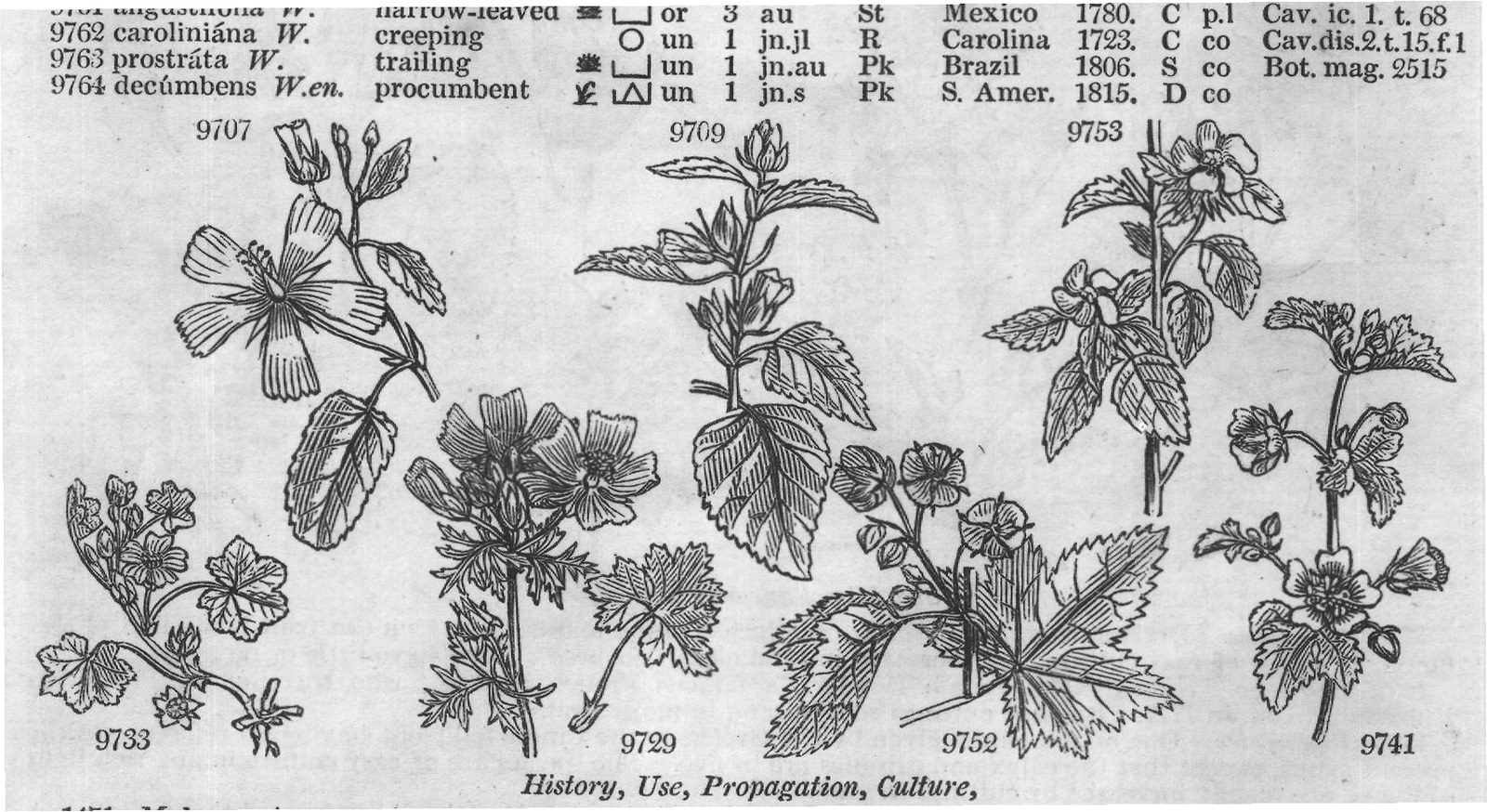
Bahama or 4 jn.s W 9760 élegans W. elegant or 3 my.au R 9761 angustifólia W. narrow-leaved or 3 au St 9762 caroliniána W. creeping 9763 prostráta W. trailing 9764 decúmbens W.en. procumbent un 1 jn.jl R un 1 jn.au Pk un 1 jn.s Pk S. Amer. 1814. C co Bahama C co C. G. H. 1791. C co Mexico 1780. C p.l Carolina 1723. C co Brazil 1806. S co S. Amer. 1815. D co Bot. cab. 222 Bot. mag. 2544 Jac. col.4. t.6. f.1 Cav. ic. 1. t. 68 Cav.dis.2.t.15.f.1 Bot. mag. 2515 9707 9709 9753 History, Use, Propagation, Culture, 1471. Malope. A name given by the Greeks to the Tree Mallow. 1472. Malva. Altered by the Latins from the Greek word, μaλaχη, soft, in allusion to the soft mucilaginous qualities of the species. Some of the species are shewy plants, and M. capensis is valued in small greenhouses as flowering all the year. M. sylvestris, Mauve, Fr., has still a place in the Materia Medica, on account of its ORDER VII.
MONADELPHIA POLYANDRIA. 9707 Leaves ovate crenate, Stipules oblong-linear 9708 Leaves 3-nerved trifid toothed smooth: lobes acuminate 9709 Leaves oblong or ovate acute serrate, Flowers axillary clustered 9710 Leaves ovate acute crenate serrate hairy, Fl. axillary subsolitary 9711 Leaves ovate-lanceolate doubly toothed obsoletely 3-lobed beneath rough, Peduncles axillary 2-flowered 9712 Leaves ovate crenate-serrate beneath velvety, Fl. axillary clustered 9713 Leaves ovate acute coarsely toothed pubescent; upper cuneate at base, Fl. axillary and terminal spiked 9714 Leaves ovate acuminate serrate rough, Fl. axillary and terminal spiked 9715 Leaves ovate or subcordate rough above downy beneath, Flowers in ovate spikes 9716 Leaves cordate crenate blunt and branches downy, Flowers lateral heaped 9717 Leaves subcordate acute toothed downy beneath, Fl. sessile, Lobes of calyx ovate 9718 Leaves cordate acuminate serrated rough; lower lobed, Pedunc. axillary, Flowers in heads 9719 Leaves cordate blunt smooth, Flowers sessile heaped 9720 Dwarfs, Leaves ovate toothed: adult smoothish; younger hairy, Fl. axillary solitary on short stalks 9721 Leaves reniform broadly crenate and branches leprous, Stems prostrate 9722 Leaves cordate roundish 5-angled crenate villous, Pedicels longer than petiole 9723 Leaves half orbicular crenate; upper rhomboid, Stem erect hairy 9724 Lower leaves 3-lobed entire; upper multifid, Segm. trifid toothed at end 9725 Leaves 3-parted, Segm. trifid ciliated toothed at end, Cor. less than calyx 9726 Leaves 3-parted, Segm. trifid linear blunt, Cor. 3 times as large as calyx 9727 Leaves many-parted: lobes trifid linear, Stem decumbent, Hairs stellated 9728 Lower leaves angular; upper 5-parted cut, Stems and calyxes velvety 9729 Lower leaves reniform cut; cauline many-parted, Segments linear, Stems and calyxes hairy 9730 Leaves palmated: lobes lanceolate toothed, Hairs simple, Pedicels longer than leaf 9731 Stem erect, Leaves 5-lobed blunt, Pedicels and petioles smoothish or downy on the upper side 9732 Stem erect, Leaves 5-7-lobed acute, Pedicels and petioles hairy 9733 Stem prostrate, Leaves cord. orbic. bluntly 5-lobed, Pedicels in fruit drooping and petioles downy 9734 Stem diffuse, Lvs. cord. orbicular 7-lobed soft: lobes acute, Fls. aggreg. stalked, Leaves of involucre bristly 9735 Stem erect, Leaves cordate roundish about 5-lobed crenate smooth, Fl. axillary sessile clustered 9736 Stem spreading, Leaves roundish bluntly angular crenate smoothish, Fl. axillary sessile clustered 9737 Stem erect, Leaves cordate roundish bluntly angular, Fls. axill. clustered sess. Cal. rough somew. inflated 9738 Stem erect, Leaves angular toothed crisp smooth, Flowers axillary sessile 9739 Pedicels 1-flowered aggregate shorter than leaf, Invol. ovate acuminate, Leaves 5-lobed hairy rugose 9740 Pedicels 1-flowered solitary or twin longer than petiole, Invol. linear, Leaves cut crenate smooth rigid 9741 Pedicels 1-fl. solitary or twin longer than petiole, Inv. ov. lanc. Lvs. 5-lobed or 3-lobed cren. toothed glutin. 9742 Pedicels 1-fl. solitary longer than petiole, Invol. obl. linear, Lvs. sub-three-lobed acute unequally toothed 9743 Pedicels 1-flowered solitary length of leaves, Leaves subsessile cuneiform trifid entire solitary 9744 Pedicels solitary longer than petiole, Leaves lobate plaited toothed roughish, Branches divaricating 9745 Pedicels solitary longer than petiole, Invol. lanceolate, Leaves oblong very blunt 3-lobed toothed 9746 Pedicels solitary 1-fi. twice as long as petiole, Invol. ovate acute very large, Leaves cordate crenate hairy 9747 Pedicels solitary 1-fl. length of petiole, Invol. lanc. Leaves cordate 5-lobed toothed, Branches glutinous 9748 Pedicels solitary 1-fl. length of petiole, Invol. nearly linear, Leaves ovate about 3-lobed toothed hairy 9749 Pedicels solitary 1 or 2-fl. shorter than petiole, Leaves cordate about 5-lobed blunt rough with stellat. hair 9750 Pedicels solitary 1-3-fl. length of petiole, Invol. obl. linear, Leaves sinuate lobed serrate rugose hairy 9751 Pedicels 1-2-fl. solitary longer than petiole, Invol. linear, Leaves 5-lobed blunt rugose very rough 9752 Leaves angular acute cordate villous, Petals obcordate shorter than calyx, Pedunc. panicled 9753 Leaves ovate 3-lobed toothed downy, Pedunc. axillary racemose few-flowered 9754 Leaves angular 5-lobed; middle lobe largest, Pedunc. axillary racemose, Flowers 1-sided 9755 Leaves palmate, Spikes axillary 1-sided, Fruit toothletted 9756 Leaves 7-lobed rugose, Spikes axillary 1-sided, Fruit smooth 9757 Leaves 5-lobed: lobes pinnatifid sinuate toothed, Pedunc. corymbose capitate, Fruit with two beaks 9758 Leaves subpeltate 5-lobed blunt, Pedunc. axillary umbelled, Invol. obovate stipitate deciduous 9759 Leaves 5 angular downy, Pedunc. axillary bifid few-flowered, Invol. oblong small 9760 Leaves 3-parted hoary, Segm. toothed at end; middle trifid, Pedunc. axillary 1-flowered 9761 Leaves lanceolate toothed downy, Pedunc. axillary 2 few-fl. Invol. setaceous deciduous 9762 Leaves palmate 5-lobed cut toothed, Pedicels solitary longer than petiole, Fruit villous 9763 Leaves palmate 5-lobed cut toothed, Pedicels solitary longer than petiole, Fruit smooth, Petals entire 9764 Leaves ovate cut toothed lobed, Pedicels longer than petiole, Fruit villous, Petals entire 9724 9727 9736 9737 and Miscellaneous Particulars. demulcent properties; but it is greatly inferior to Althæa, and therefore little used. Malva was an excellent vegetable among the Romans, but what species is uncertain. A tree of the mallow kind is said, by Prosper Alpinus, to afford food to the Egyptians; and the Chinese use some sort of mallow as food. All the species are of the easiest culture and propagation. Pp 4 MONADELPHIA POLYANDRIA. 1473. KITAIBELIA. W. KITAIBELIA.
Malvacea. Sp. 1.
CLASS XVI.
Bot. mag. 821 S. Europe 1780. D co S. Europe 1597. D co S. Europe 1683. S co Cav.dis.2.t.29.f.1 Sicily 1791. S co Cav.dis.2.t.30.f.3 Aleppo 1680. S co Cav.dis.2.t.27.f.3 China 1573. S co Hungary 1805. S co W. Indies 1816. S co E. Indies 1803. D co Levant 1597. S co Cav.dis.2.t.28.f.1 Eng. bot. 1841 Mo.his.1. t. 17.f.9 Cav.dis.2.t.32.f.2 9765 vitifólia W.
Vine-leaved or 5 jl.s W Hungary 1801. D p.l 1474. ALTHÆ'A. W.
MARSH MALLOW.
Malvaceæ. Sp. 11-20. 9766 officinális W. common 6 jl.s F Britain salt m. D co Eng. bot. 147 9767 narbonen'sis W.
Narbonne or 6 au.s Pk Cav.dis.2.t.29.f.2 9768 cannabína W.
Hemp-leaved or 6 jn.jl Pu Cav.dis.2.t.30.f.1 9769 hirsúta W. hairy or 6 jn.jl Pu 9770 Ludwígii W.
Ludwig's or 6 jn.jl Pk 9771 acaúlis W. stemless or 1½ jn.jl Pu 9772 rósea W.
Hollyhock 9773 pállida W. pale-flowered 9774 caribæ'a B. M.
West Indian 9775 flexuósa B. M.
Seringapatam 9776 ficifólia W.
Antwerp Hollyh. or 1475. LAVATERA.
W. LAVATERA. 9777 arbórea W.
Tree Mallow পপপপপপ or 8 jl.s R or 6 jlau W or 3 mr.ap Pk or 3 jn.au Pk 6 jn.s 0 Bot. mag. 1916 Bot. mag. 892 Cav.dis.2.t.28.f.2 Malvaceæ.
Sp. 13-26. or 6 jl.o Pu Britain 9778 mícans W. glittering or 3 jn.jl Pu Spain sea cl. S co 1796. Cco 9779 Olbia W. downy-leaved or 3 jn.o 9780 unguiculáta P. S. clawed or 6 jl.s R.Pu France Li 1570. C s.l 1807. C co 9781 híspida P. S. hispid or 6 jn.jl Pk Algiers 1804. C co 9782 tríloba W. three-lobed or 3 jn.jl Bot. mag. 2226 9783 lusitánica W.
Portugal or 3 au.s Pu 9784 plebéia Sims. vulgar or 2 s Pa 9785 marítima W. sea-side or 2 ap.jn W 9786 thuringíaca W.. large-flowered or 4 jl.s 9787 crética W.
Cretan 9788 punctáta W. spotted-stalked 9789 triméstris W. common annual 4000 L.B or 1 jl.s L.B or 2 jl.s Pa or 2 jl.s F 1476. MALA CHRA. W. MALACHRA.
Malvacea.
Sp. 3-14. 9790 capitáta W. headed 9791 alceæfólia W.
Hollyhock-lvd. 9792 radiáta W. rayed 1477. URENA. W.
URENA.
L.Pu Spain 1759. C s.l un 1 au.s W. 1 au.s Y un un 1 jl.au W Malvaceæ. un 2 jn.jl F un 2 W un 3 jl.au F ... un 2 ja.o Pu Malvaceæ. jn.au W un 2 jl.au W Portugal 1731. C s.l N. Holl. 1820. D co S. Europe 1597. S s.l Germany 1731. D co Candia 1723. S co Italy 1800. S co S. Europe 1633. S co W. Indies 1759. S lt.l Caraccas 1805. S lt.l St. Domin. 1794. S lt.l Sp. 4-21.
China 1731. C p.1 Surinam 1816. C p.l E. Indies 1759. C p.1 E. Indies 1817. C p.1 Sp. 7-24.
C. G. H. 1774. C s.l W. Indies 1778. C s.l E. Indies 1807. C s.l St. Domin. 1816. C s.l W.pu Bourbon 1807. C s.l W Mauritius 1801. C.s.l E. Indies 1790. S s.l Sp. 3-15. 9793 lobáta W. 9794 americána W. 9795 sinuáta W. 9796 multífida W. 1478. PAVO'NIA. W. 9797 præmórsa W. 9798 spínifex W. 9799 odoráta W. angular-leaved American cut-leaved multifid 姓 PAVONIA. bitten-leaved un prickly-seeded fragrant un R ... 9800 coccínea W. scarlet un Sc ... 9801 columélla W. angular-leaved 9802 úrens W. stinging un 2 jl un 2 ... 9803 zeylánica W.
Ceylon un 3 jl.s W 1479. ACHA'NIA. W.
ACHANIA.
Malvaceæ. 9804 Malvavíscus W. scarlet 9805 móllis W. woolly 9806 pilósa W. hairy or 12 ja.d S or 12 au.s S or 12 o.n R 1480. HIBISCUS. W.
HIBISCUS. 9807 Moscheútos Ph. swamp 9808 palústris Ph. marsh 9809 Patersónii H. K.
Lagune'a-Patersonia B. M. 769.
Norfolk Island 9765 9767 Malvacee. or 2 au.o Pu Aor 3 jl.s Pk or 15 jn.au Pu 9769 Jamaica 1714. C p.l America 1780. C p.1 Jamaica 1780. C p.l ...
Bot. mag. 2541 Bot. mag. 2269 Cav.dis.2.t.32.f.3 Bot. mag. 517 Jac. vind. 1. t. 41 Bot. mag. 109 C.dis.2.t.33. f.1,2 Jac. ic. 3. t. 549 Cav.dis.2.t.33.f.3 Ca.dis.6.t.185.f.1 Sloane 1.
Ca.dis.6.t.185.f.2 Ca.dis.6.t.184.f.2 Bot. mag. 436 Jac.vind. 2. t. 103 Cav.dis.3.t.47.f.1 Cav.dis.3.t.48.f.3 Jac. ic. 3. t. 522 Cav.dis.3.t.48.f.2 Bot. mag. 2305 Bot. reg. 11 Bot. cab. 829 Sp. 46-125.
N. Amer.
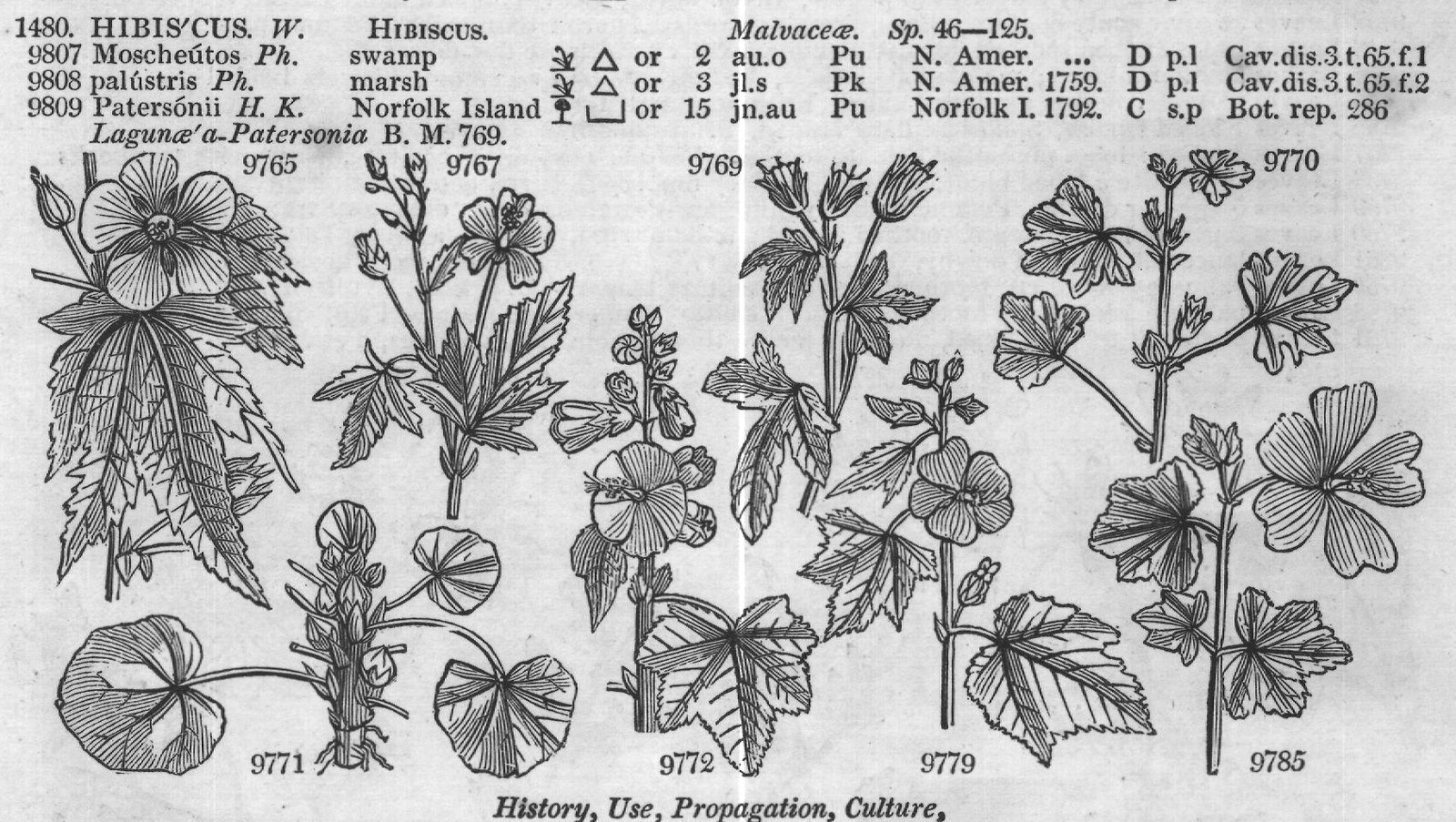
D p.l Cav.dis.3.t.65.f.1 N. Amer. 1759. D p.l Cav.dis.3.t.65.f.2 Norfolk I. 1792. C s.p Bot. rep. 286 9770 9771 9772 9779 History, Use, Propagation, Culture, 9785 1473. Kitaibelia. Named after Dr. Paul Kitaibel, professor of botany at Pest, in Hungary, and author, in conjunction with Count Waldstein, of a noble work upon the plants of that country. A tall mallow-like plant with vine-like leaves, and white flowers. 1474. Althea. From aλθω, to cure. The salutary effects of the mucilaginous root, are well known in medicine. Guimauve, Fr. A. officinalis has long been in repute as a demulcent. Its roots are sometimes used as an emollient suppurative cataplasm; and a decoction of the leaves forms a useful fomentation in external abrasions, and in cutaneous eruptions, accompanied with a sharp ichorous discharge. A. rosea is the parent of nearly twenty splendid varieties of border flowers, which seed readily, and the offspring generally resembles the parent variety. All the species are of the easiest culture in common garden soil. 1475. Lavatera. In memory of two Lavaters, physicians of Zurich, neither the physiognomist, but two friends of Tournefort. The species resemble those of Malva, in general appearance and culture: much the handsomest is L. arborea, which is a magnificent plant in shrubberies, or in the back of wide borders. ORDER VII.
MONADELPHIA POLYANDRIA. 9765 Leaves 5-lobed acute toothed 9766 Leaves soft on each side cordate or ovate toothed undivided or 3-lobed, Pedunc. axillary many-fl. 9767 Leaves pubescent lower 5-7-parted; upper trifid, Peduncles many-fl. longer than leaf 9768 Leaves downy hoary beneath lower palmate upper 3-parted lobes narrow coarsely toothed : lobes narrow coarsely toothed 9769 Leaves cordate rough with hairs smooth above: lower blunt; upper 5-lobed, Stem hispid 9770 Leaves smooth cordate roundish lobed toothed, Pedicels axillary clustered 1-flowered 9771 Leaves roundish cordate 5-angled crenate, Pedicels 1-fl. much shorter than petiole 9772 Stem upright hairy, Leaves cordate 5-7-angled crenate rugose, Flowers axillary sessile Flowers axillary sessile 9773 Stem erect hispid, Leaves roundish cordate, Invol. as long as calyx 9774 Stem upright smoothish, Leaves rounded lobed crenulate serrate, Flowers solitary subsessile 9775 Stem subflexuose hispid, Leaves cordate about 7-lobed blunt on long stalks, Flowers axillary solitary on long stalks, Flowers axillary solitary 9776 Stem erect hairy, Leaves palmate 7-lobed beyond the middle : lobes oblong blunt irregularly toothed 9777 Leaves 7-angied downy plicate, Pedicels axillary 1-fl. clustered much shorter than petiole 9778 Leaves 7-angled acute crenate plaited downy, Racemes terminal 9779 Leaves soft hoary 5-lobed; upper 3-lobed: middle lobe elongated; upper oblong undivided 9780 Leaves downy on each side acutely 5-lobed; upper 3lobed, Flowers solitary on short stalks 9781 Stem hispid, Leaves hoary 5-lobed; upper 3-lobed or undivided, Flowers subsessile 9782 Stem and leaves downy subcordate sub-three-lobed round crenate, Pedicels aggregate, Calyxes acuminate 9783 Leaves 7-angular downy plaited, Racemes terminal 9784 Stem rough, Leaves 5-lobed downy beneath, Pedunc. axillary aggregate, Petals emarginate 9785 Stem and leaves downy roundish bluntly angular crenate, Pedicels axillary solitary 9786 Leaves somewhat downy lower angular; upper 3-lobed middle lobe longer than the rest middle lobe longer than the rest 9787 Stem herbaceous hispid, Leaves 5-lobed acute, Pedicels axillary 1-flowered aggregate 9788 Stem rough, Leaves somewhat downy: lower round cordate ; upper 3-lobed, Pedicels solitary 1-fl. 9789 Stem herbaceous, Leaves smoothish roundish cordate upper angular, Pedicels solitary 9790 Leaves cordate roundish bluntly angular toothletted, Invol. stalked 3-leaved 7-flowered, Stem rough 9791 Leaves cordate palmate 5-lobed, Heads stalked 5leaved 10-flowered, Stem with scattered hairs 9792 Leaves palmate-lobed, Heads stalked 5-leaved many-flowered, Invol. acuminate, Calyxes and stems hairy Invol. acuminate, Calyxes and stems hairy 9793 Leaves roundish very bluntly 3-lobed velvety on each side 7-nerved 1-glanded, Cal. oblong lanceolate 9794 Lower leaves 3-lobed; upper lanceolate panduriform beneath hoary netted with one gland 9795 Leaves trifid downy pale beneath with 3 glands: lobes angular toothletted blunt 9796 Leaves broad ovate cut lobed with narrow recesses: lobes acute coarsely and unequally toothed 9797 Leaves broadly obovate truncate crenate at end, Pedic. axillary 1-fl. longer than leaf 9798 Leaves ovate acuminate subcordate doubly toothed, Pedicels axillary 1-fl. toothed, Pedicels axillary 1-1. 9799 Leaves ovate subcordate 3-pointed somewhat toothed and branches covered with viscid hairs 9800 Leaves cordate 3-lobed serrate, Pedicels axillary 1fl. ascending, Involucre 3-leaved 9801 Leaves 5-angular lobes toothed acuminate, Pedic. axillary 1-fl. much shorter than petiole Pedic. axillary 1-fl. much shorter than petiole 9802 Leaves 7-angular acuminate toothed hairy, Fl. axillary subsessile clustered 9803 Lower leaves roundish cord, crenate others 3-5-lob, Pedicels axillary 1-fl. Inv. 10-leaved setaceous ciliated 9804 Leaves cordate 3-5-lobed acuminate roughish, Leaflets of invol. erect 9805 Leaves cordate about 3-lobed acuminate soft downy, Leafl. of invol. somewhat spreading 9806 Leaves cordate crenate blunt or acuminate, Branches and petioles hairy 9807 Leaves ovate acuminate serrate downy beneath, Invol. and cal. downy 9808 Leaves ovate toothed somewhat 3-lobed hoary with down beneath 9809 Leaves lanceolate oblong entire white with scales beneath 9803 9790 9795 9804 9793 9806 9800 9808 and Miscellaneous Particulars. 1476. Malachra. A name under which Pliny speaks of a tree from the north of Persia, producing a certain gum. It had no reference to the plant called Malachra by the moderns. Sow in light rich soil, and transplant as with other stove annuals. 1477. Urena, the vernacular name in Malabar. The species are of easy culture, seed freely, or may be propagated by cuttings in sand under a hand-glass. 1478. Pavonia. In honor of Don José Pavon, the companion of Dombey, in his voyage to Peru, and one of the authors of Flora Peruviana. The species are free -growers, and seed readily: they are also increased by cuttings in sand under a hand-glass. 1479. Achania. From aχavης, closed; so called because the corolla does not open out as in most Malvaceous plants, but remains always rolled together. 1480. Hibiscus. One of the Greek names of the mallow. The species are for the most part shewy plants, and not difficult of culture. All of them abound in mucilage, like many of the same natural family, and the 9810 incánus Ph. hoary 9811 militáris Ph. smooth 9812 popúlneus W.
Poplar-leaved 9813 tiliáceus W.
Lime-tree-lvd. 9814 elátus Sw. tall 9815 Lámpas W. three-pointed 9816 Rósa Malabarica Ker. Malabar 9817 membranáceus W. leafy-calyxed or_10 Pk ... 9818 lunarifólius W.
Lunaria-leaved or 10 Pu ... 9819 Rósa-sinénsis W.
Chinese or 10 jl.au ẞ rubro-plénus double red or 10 jl.au MONADELPHIA POLYANDRIA. 어어어 or 3 s Y or 3 au.s Pu or 15 W Pu or 10 jl.au or 20 Pu or 10 ...
Pk or 2 au.s Sc Carolina 1806. D s.p Louisiana 1804. D s.p E. Indies 1770. C p.1 E. Indies 1739. C p.l Jamaica 1790. C p.1 CLASS XVI.
W.hort.ber. t.24 Bot. mag. 2385 Rhee.mal.1. t.29 Bot. reg. 232 E. Indies 1806. C p.l Cav.dis.3.t.56.f.2 E. Indies 1818. C p.l Bot. reg. 337 1816. C s.1 Cav.dis.3.t.57.f.2 D.R E. Indies 1731. C p.l Bot. mag. 158 D.R E. Indies ...
C s.1 ...
Cp.l Bot. cab. 519 flavo-plénus double buff § variegatus plénus or 10 jl.au Y E. Indies double striped ...
C p.l or 10 jl.au St E. Indies ...
Cp.l Bot. cab. 963 E luteus double yellow or 10 jl.au Y E. Indies 1823. C p.l Bot. cab. 932 9820 phœníceus W. purple-flowered or 8 jl.au Pu E. Indies 1796. C p.1 Bot. reg. 230 9821 micranthus H. K. small-flowered or 6 Pu ...
E. Indies 1794. C p.l Cav.dis.3.t.66.f.1 9822 æthiópicus W. dwarf wedge-lv. or 6 au Pu C. G. H. 1774. C p.l Cav.dis.3.t.61.f.1 9823 mutábilis W. changeable or 15 o.d W E. Indies 1690. C p.1 Bot. rep. 228 ẞ flore pléno 9824 syríacus W. a purpúreus ẞ rúber álbus variegatus albo-plénus E purpúreo-plénus double-flowered호 or 15 o.d W E. Indies ...
C p.l Althæa frutex or 8 au.s Pu purple-flowered or 8 au.s Pu Syria 1596. Lco L co Bot. mag. 83 ..... ... red-flowered or 8 au.s R ......
L co ... white-flowered or 8 au.s W L co ...... ... striped-flowered or 8 au.s St ......
L co ... double white or 8 au.s W ...... ...
L co double purple or 8 au.s Pu ......
L co ... 9825 acerifólius P. L. 9826 diversifólius W. different-leaved吕 Maple-leaved or 5 mr.jn Pk China 1798. C s.l Par. lond. c. ic. or 6 jn.jl Y E. Indies 1798. C s.l Bot. reg. 381 9827 ficúlneus W.
Fig-leaved or 4 jn.jl W 9828 Sabdaríffa W.
Indian or 2 jn.s Y 9829 speciósus W. superb or 2 jn.au S 9830 prúriens B. R. stinging or 3 jl.s 4 Y 9831 heterophýllus H. K. various-leaved or 6 au.s W.R 9832 cannabínus W.
Hemp-leaved or 5 jn.jl Y 9833 suratténsis W. prickly-stalked or 2 jl.s Y 9834 radiátus W. rayed or 2 jn.au Y 9835 Mánihot W. palmated or 3 jl.s Y 9836 scáber Ph. scabrous or 2 jl.s Y 9837 furcátus W. en. forked-calyxed or 2 jl.s Y 9838 digitátus Cav. digitate or 2 jl.s W.R 9839 Abelmóschus W. 9840 pedunculátus W. 9841 esculéntus W.
Musk Okro or 3 jl.s Y long-peduncled or 2 my.d R eatable cu 4 jn.jl Y 9842 strigósus Lindl. 9843 clypeátus W. 9844 únidens Lindl. 9845 tubulósus W. 9846 vitifólius W. strigose or 6 jn.jl Pk shield-capsuled or 6 jl.au Y one-toothed or 3 jl Y tubular or 2 jl.o Y Vine-leaved or 2 jl.o Y 9847 virgínicus W.
Virginian or 2 jl.s Y 9848 pentacárpos W. 9849 vesicárius W. angular-fruited or 3 jl.s L.R African or 1½ jl.au Y.Br Africa 9850 Triónum W. 9851 híspidus Mill.
Bladder Ketmia or 2 jn.s Y.Br Italy hispid or 1½ jn.s 9852 Richardsóni Lindl. rough-leaved 9815 or 3 jn.s Y.Br C. G. H.
Y ... 1713. S co 1596. S co Sco Ceylon 1732. C p.1 E. Indies 1596. C p.1 Carolina 1778. C s.l E. Indies 1804. C s.l N. S. W. 1803. C s.p E. Indies 1759. C s.I E. Indies 1731. S s.l E. Indies 1790. S s.1 China 1712. C p.l Carolina 1810. D s.l E. Indies 1816. C s.l Brazil 1816. Sco India 1640. Cr.m C. G. H. 1812. C s.l W. Indies 1692. Sr.m Peru 1820. C s.l Jamaica 1759. C p.l Brazil 1822. C co E. Indies 1796. C s.l E. Indies 1690. C p.1 Virginia 1798. D s.l Bot. mag. 360 Bot. rep. 498 Bot. reg. 29 Rox. cor. 2.t.190 Bot. mag. 1356 Bot. mag. 1911 Bot. mag. 1702 Bot. reg. 608 Rhee.mal.2. t.38 Bot. reg. 231 Cav.dis.3.t.61.f.2 Bot. reg. 860 Cav.dis.3.t.58.f.
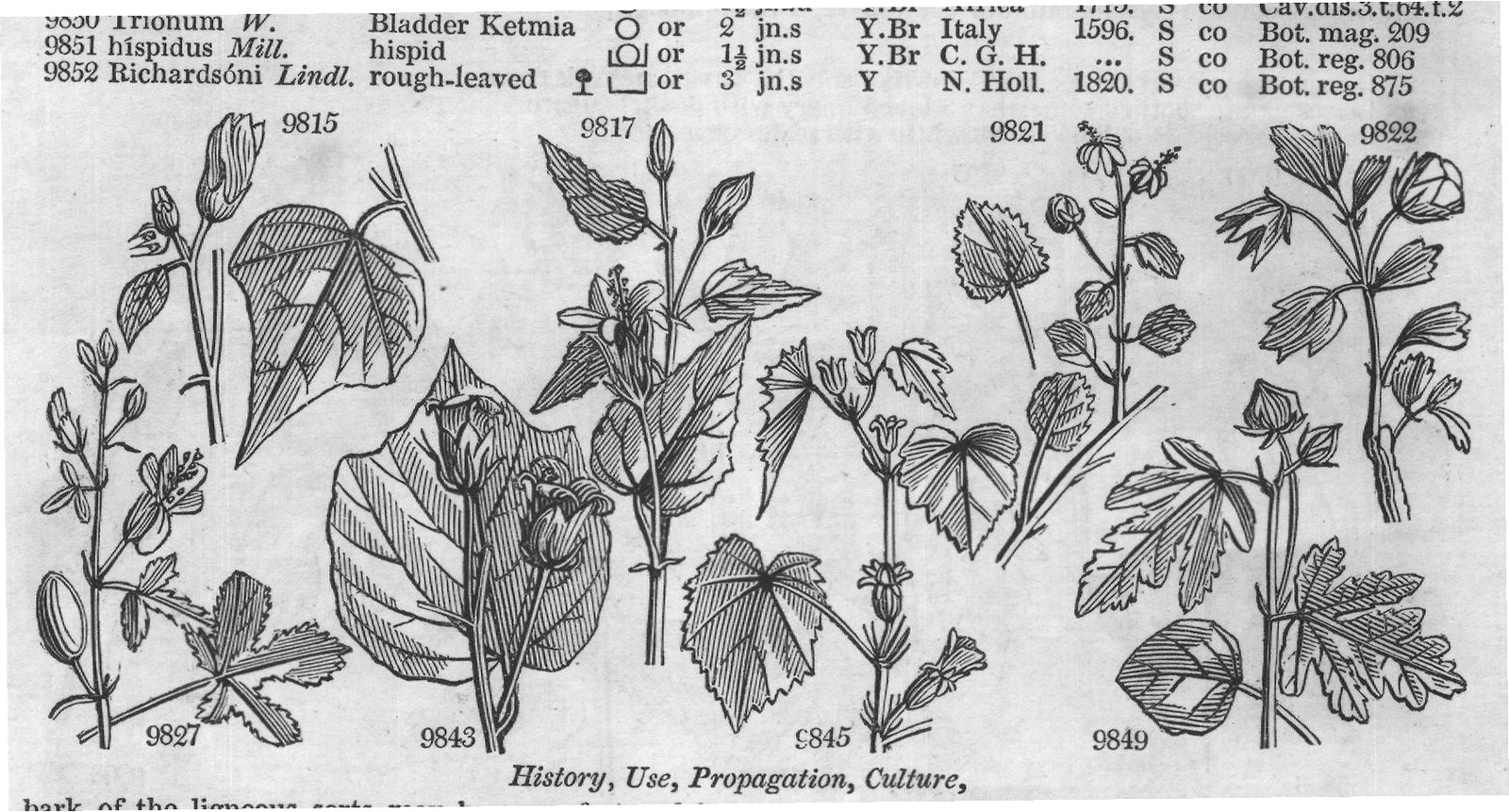
Bot. reg. 878 Cav.dis.3.t.68.f.2 Rhee.mal.6.t.46 Jac. ic. 1. t. 142 Venice 1752. S s.l Jac. ic. 1. t. 143 N. Holl. 1820. S co Bot. mag. 209 Bot. reg. 806 Bot. reg. 875 Cav.dis.3.t.52.f.2 Ca.dis.6.t.198.f.1 Cav.dis.3.t.64.f.2 9817 9821 9822 9827 9843 9845 History, Use, Propagation, Culture, 9849 bark of the ligneous sorts may be manufactured into mats or cordage. Of H. tiliaceus, in the island of Otaheite, they make matting of the bark, as fine as our coarse cloth; also ropes and lines, from the size of an inch to that of a small packthread; and fishing nets. (Hawks. Voy. ii. 217.) Forster informs us, they also suck this bark for food, when the bread-fruit fails them and in New Caledonia, the inhabitants frequently subsist on it, though it is an insipid food, affording very little nourishment.
H. Rosa-sinensis is extremely common in the gardens of China, and the East Indies; but its native country is unknown. Loureiro, however, affirms, that it is spontaneous as well as cultivated both in China and unknown. Loureiro, however, affirms, that it is spontaneous as well as cultivated both in China and Cochin-China; and that it is so common in the latter, that they have entire hedges of it to their gardens. It has been long known from its appearance on Chinese screens and paper hangings. The variety with double flowers is most frequently cultivated, both in the East and in European hothouses: the plant is, indeed, rarely seen with single flowers. (Smith, spicil.) H. syriacus is one of our most beautiful hardy shrubs, the more valuable as it is a free-flowerer, will grow in common garden soil, and propagates freely by seeds, layers, and even by cuttings. common garden soil, and propagates freely by seeds, layers, and even by cuttings.
H. Sabdariffa (the Turkish name) in the West Indies is called Red Sorrel. The calyxes and capsules, freed ORDER VII.
MONADELPHIA POLYANDRIA. 9810 Leaves ovate acuminate bluntly serrate hoary on each side, Pedicels axillary 1-fi. 9811 Leaves 3-lobed hastate acuminate serrate smooth on each side, Pedicels jointed in the middle 9812 Leaves roundish cordate acuminate (Thespesia Dec.) 9813 Leaves roundish cordate acuminate crenate hoary beneath, Invol. 10-toothed 9814 Leaves roundish cordate entire hoary beneath, Pedunc. very short 1-flowered 9815 Leaves cordate 3-pointed smooth dotted beneath, Pedicels solitary 1-fl. longer than petiole 9816 Leaves cordate acutely serrate, Branches somewhat hairy 9817 Leaves cordate ovate-lanceolate acuminate toothed, Pedicels twice as long as petiole 9818 Leaves roundish cordate acuminate finely toothed hairy beneath, Pedicels thick villous 9819 Leaves ovate acuminate smooth entire at base coarsely toothed at end, Pedicels length of leaf 9820 Leaves ovate acuminate serrate; lower subcordate 3-pointed, Pedicels jointed at end 9821 Leaves ovate or roundish undivided serrated rough, Pedic. longer than leaf, Cor. reflexed 9822 Leaves cuneiform about 5-toothed hairy, Pedicels longer than leaf, Invol. 8-10-leaved hispid 9823 Leaves cordate angular 5-lobed acuminate toothed downy, Pedicels nearly as long as leaf 9824 Leaves cuneiform ovate 3-lobed toothed, Pedic. scarcely longer than petiole, Invol. 6-7-leaved 9825 Leaves cordate 5-lobed hairy: lobes acuminate subrepand, Inv. 6-7-leaved setaceous [undivided 9826 Stem and petiol. prickly, Pedic. short unarmed very hairy, Lvs. 3-5-lobed blunt toothed; upper obl. lanc. 9827 Stem prickly, Leaves palmate 5-lobed; upper 3-lobed: lobes blunt unequally toothed narrowed at base 9828 Leaves toothed: lower ovate undivided; upper 3-lobed cuneate at base, Flowers subsess. Invol. 12-toothed 9829 Leaves palmate 5-parted: lobes lanceolate acuminate subserrate at end, Pedicels jointed under the end 9830 Stem hairy, Leaves on long stalks ovate about 3-lobed serrate membranous smoothish, Pedic. very short 9831 Stem prickly, Leaves linear lanceolate acuminate usually lobed prickly-serrate, Inv. 10-leaved 9832 Stem prickly, Leaves palmate 5-parted with 1 gland beneath, Fl. subsess. Cal. covered with glandul. hairs 9833 Stem rough with recurved prickles, Stipules-cord. Leaves palmate 5-lobed, Pedicels length of petiole 9834 Stem rough with recurved prickles, Stipules ſanc. Leaves 5-7-parted with lanc. acuminate serrated lobes 9835 Leaves smoothish palmate: lobes 5-7-acuminate coarsely toothed, Inv. hispid 4-6-leaved, Fls. declinate 9836 Stem rough, Leaves rough roundish truncate at base; upper palmate-lobed: lobes dilat. crenate upwards 9837 Stem petioles and calyx muricate, Leaves ovate at base trifid; lower 5-fid: lobes acuminate serrate 9838 Leaves palmated: lobes lanceolate serrate, Petioles muricate, Fl. subsessile solitary, Inv. 7-fid 9839 Leaves subpeltate cordate 7-angular acuminate serrate, Stem hispid, Pedicels longer than petiole 9840 Leaves 3-5-lobed blunt crenate hairy, Pedic. twice as long as leaf, Inv. many-leaved, Cor. campanulate 9841 Leaves cord. 5-lobed blunt toothed, Petioles longer than fi. Inv. 10-leaved decidu. Cal. bursting lengthwise 9842 Stem strigose, Leaves 3-lobed angular cordate toothed downy, Peduncle longer than petiole 9843 Leaves cord. angular sparingly toothed nearly smooth, Branches velvety, Caps. turbinate truncate hispid 9844 Stem prickly, Leaves smoothish coarsely toothed without glands, Leaves of the invol. with a tooth inside 9845 Leaves cordate unequally toothed beneath hoary: lower about 5-lobed; upper acum. Pedic. 1-fl. very short 9846 Stem somew. prickly, Leaves smoothish toothed 5-angular acuminate, Fls. cernuous, Caps. 5-winged hairy 9847 Leaves acuminate unequally toothed subvillous: lower undivided cordate; upper ovate-cordate 3-lobed 9848 Leaves cordate oblong toothed bluntish angular slightly 3-lobed smooth, Pedicels longer than petiole 9849 Lvs. toothed: lower undivided; upper 5-fid: lobes oblong nearly equal blunt, Cal. inflat. membran. nerved 9850 Lvs. toothed: lower undivided; upper 3-parted: lobes lanc. middle one very long, Cal. infl. membr. nerved 9851 Leaves toothed: lower leaves 3-lobed; upper 5-parted blunt, Stem hispid 9852 Leaves hairy 5-lobed: lobes linear oblong coarsely toothed, Cal. very villous longer than involucrum 9811 9830 9812 9840 9819 β 9852 9828 and Miscellaneous Particulars. from the seeds, make very agreeable tarts; and a decoction of them, sweetened and fermented, is commonly called sorrel cool drink. It is a small diluting liquor, much used in our sugar colonies, and reckoned very refreshing in those sultry climates. (Browne's Jam.) The bark of this species, and also of H. cannabinus, is full of strong fibres, which the inhabitants of the Malabar coast prepare and make into cordage; and it seems as if it might be wrought into fine strong thread of any size. The leaves of H. surattensis are gratefully acid, and eaten in salads. The mucilage of the root of H. manihot is used in Japan for giving consistence to paper. H. Abelmoschus, from the Arabic Ab-el-Mosch, grain or seed of musk, has large seeds of a very musky odor, and are frequently used as a substitute for animal musk in scenting powders and pomatums. In Arabia and Egypt they are ground and mixed with coffee, to render it more agreeable to the head and stomach. H. esculentus, the Okro of the West Indies, is cultivated there, and in some parts of France, for the pods, which are gathered green and used in soups, or pickled like capers. They are full of a nutritive mucilage, and buttered and spiced make a very rich dish.
MONADELPHIA POLYANDRIA. 1481. GOSSY PIUM. W. COTTON. 9853 herbáceum W. common 9854 arbóreum W. tree 오 9855 vitifólium W. 9856 hirsútum W.
Vine-leaved hairy 9857 religiósum W. 9858 barbadénse W. spotted-barked Barbadoes 1482. REDOUTE'A. Vent. REDOUTEA. 9859 heterophylla Vent. various-leaved 1483. PALA'VIA. W. PALAVIA. 9860 malvifólia W. 1484. CRISTA'RIA. Cav. CRISTARIA. 9861 coccínea Ph. 1485. ANO'DA. Cav. 9862 hastáta W. 9863 cristáta W. 9864 Dilleniána W. 1486. PERIPTERA. 9865 punícea Dec. 1487. SI'DA W. 9866 linifólia Cav. 9867 angustifólia W. 9868 spinósa W. 9869 álba W. 9870 bracteoláta Dec. 9871 carpinifólia W. 9872 erósa Link. 9873 ciliáris W.
Malvaceæ.
Y ag 3 jl or 12 jl.au ag 3 jl.au ag 3 ag 3 jl ag 5 s Y Sp. 6-16.
E. Indies 1594. S s.1 E. Indies 1694. Cs.p YE. Indies 1805. C s.p Y S. Amer. 1731. C s.p India 1777. C s.p Barbadoes1759. C s.p Y Y Malvaceæ. Sp..1-2. or 3 jn Y S. Amer. 1822. S co Sp. 1-4.
Malvacea.
Mallow-leaved Oun 1 jn.au Pu Sp. 1-2.
Peru scarlet pr ANODA.
Malvacea. jl.s S Malvaceæ. halberd-leaved crested * Dillenius's Dec. PERIPTERA. un 1 jn.jl B un 1 jl.s Pu un 1 jn.n B Malvacece. pr 3 my.jn Cr 1794. C co Missouri 1811. D p Sp. 3-7.
Mexico 1799. S s.p Mexico 1720. S s.p Mexico 1725. C co Sp. 1.
N. Spain 1814. C co Sp. 69-195.
Guiana 1822. C co Brazil 1726. C co E. Indies 1680. C co E. Indies 1732. S co Chili 1824. C co Canaries 1774. C co Brazil 1824. C co Jamaica 1759. C co CLASS XVI.
Ca.dis.6.t.164.f.2 Cav. dis. 6. t. 193 Cav. dis. 6. t. 166 Cav. dis. 6. t. 167 Ca.dis.6.t.164.f.1 Bot. reg. 84 Vent. cels. t. 11 Cav.dis.1.t.11.f.4 Bot. mag. 1673 Bot. mag. 1541 Cav.dis.1.t.10.f.3 Bot. mag. t. 330 Bot. mag. 1644 L'Her. stirp.t.52 Cav.diss.1.t.1.f.9 Dil.el.t.171.f.210 Jac. ic. 1. t. 135 Cav.diss.1.t.3.f.9 Shuttlecock SIDA.
Malvaceæ. flax-leaved un 3 jl Pk narrow-leaved un 1 jl.s Y prickly un 1 jl.s Y white-flowered un 2 jn.jl W bracteolate un 2 jn.jl Y Hornbean-lvd. un 3 jl.s Y bitten un 2 jl.s Y ciliated un 1 jn.s Y Alder-leaved un 2 jl.s Y 9875 compréssa Dec. 9876 canariénsis W. compressed un 2 jn.s Y Nepal 1823. S co Canary Lun 2 jn.s W E. Indies 1820. S co 9877 rhombifólia W. 9878 recísa Link. 9879 mícans Cav. 9880 pilósa W. pilose 9853 rhomboid-lvd. un 2 jn.au Y cut un 2 jn.au Y 1823. C co India 1732. C co Cav.dis.1.t.3.f.12 Brazil glittering un 1 jn.au Y E. Indies 1820. C co Cav.diss.1.t. 3.f.1 un 1 jl.s Y St. Domin. 1793. C co Cav.diss.1.t.1.f.8 9857 9874 alnifólia W.
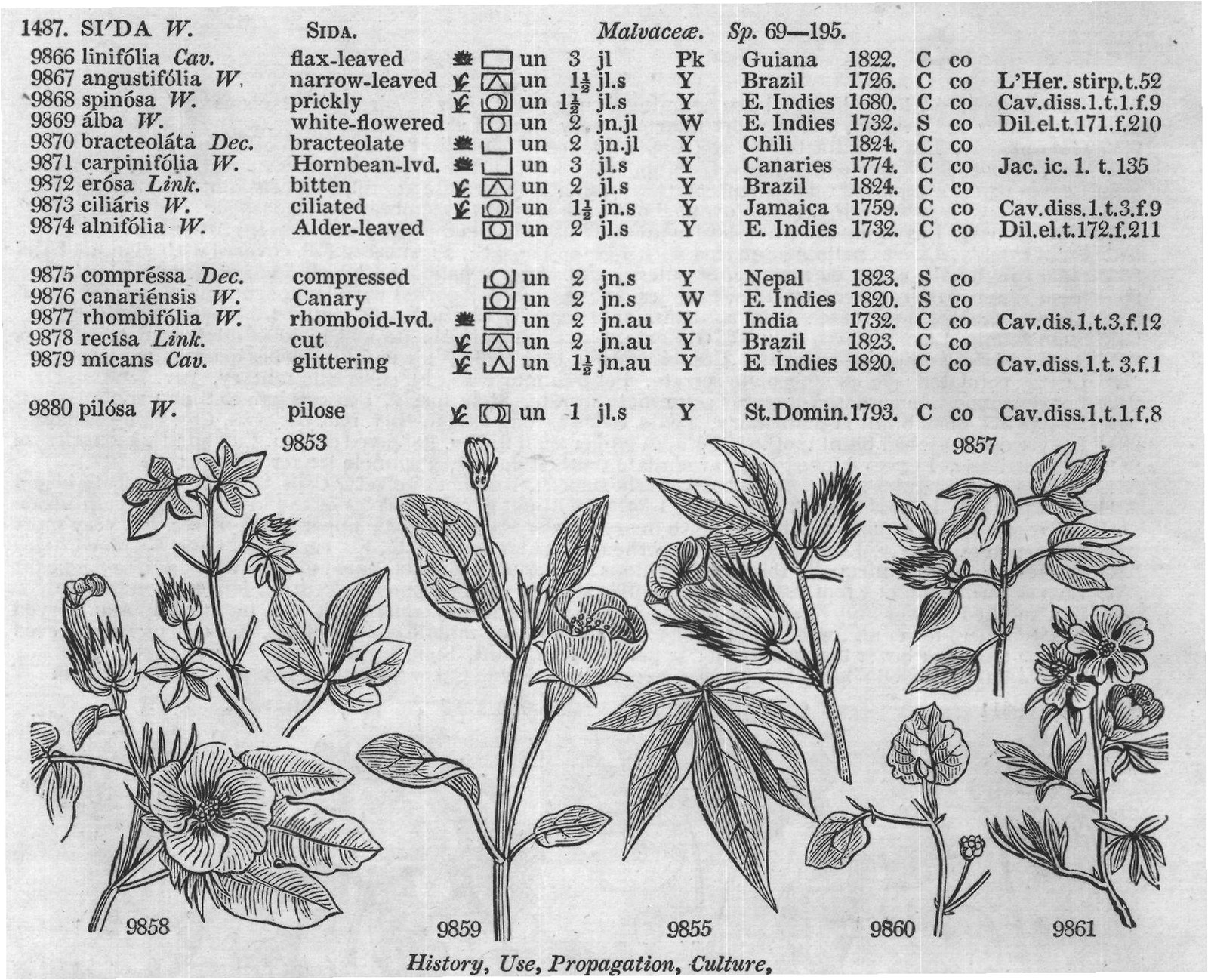
E. Indies 1732. C co Dil.el.t.172.f.211 9858 9859 9855 9860 9861 History, Use, Propagation, Culture, 1481. Gossypium. Pliny says, that in Upper Egypt, on the borders of Arabia, grew a shrub called gossypion or xylon. Its fruit enclosed a sort of soft white wool, of which the garments of the Egyptian priests were manufactured. Golius remarks, that goz, which expresses in Arabia, a silky substance, may be the root of the word. An important genus, as furnishing the down used in the cotton manufacture. This down is found lining the capsules which contain the seeds. There are several species cultivated for this purpose in different parts of the world. G. herbaceum is the only species cultivated in Europe, especially in the Levant, and in Malta, Sicily, and Naples: it is also grown in many parts of Asia. G. hirsutum is occasionally grown in the West Indies; but G. barbadense is the prevailing species there. In the East Indies and China, G. herbaceum and arboreum are cultivated, and some other species, especially the East Indies and China, G. herbaceum and arboreum are cultivated, and some other species, especially that which produces the nankeen-colored down, not yet introduced to Europe. An oil is obtained from the which produces the nankeen-colored down, not yet introduced to Europe. An oil is obtained from the seeds of all the species, while those of the G. herbaceum are eaten in the Levant, and esteemed wholesome and nutritive.
In the Levant, the herbaceous cotton is sown in well prepared land in March, in lines at three feet distance, and the patches of seeds two feet apart in the lines. The plants are thinned out to two or three in a place, the patches of seeds two feet apart in the lines. The plants are thinned out to two or three in a place, and the earth is stirred by a one-horse plough, or by manual labor with hoes, and irrigated once or twice a week by directing the water along the furrows between the rows. The flowering season is generally over about the middle of September, and then the ends of the shoots are pinched off to determine the sap to the capsules. The capsules are collected by hand as they ripen, a tedious process, which lasts till the end of Nevember. The cotton and the seeds are then separated by manual labor, and the former packed in bales or bags for sale. The seeds are bruised for oil or eaten, and a portion kept for sowing. The Barbadoes cotton plant is sown in the West Indies in rows, about five feet asunder, at the end of September, or the beginning of October; at first but slightly covered, but after it is grown up, the root is well moulded.
The soil should not be stiff nor shallow, as this plant has a tap-root. The ground is hoed frequently , and kept very clean about the young plants, until they rise to a moderate height. It grows from four to six feet high, and produces two crops annually; the first in eight months from the time of sowing the seed; the second, within four months after the first; and the produce of each plant is reckoned about one pound weight.
The branches are pruned or trimmed after the first gathering; and if the growth is over luxuriant, ORDER VII.
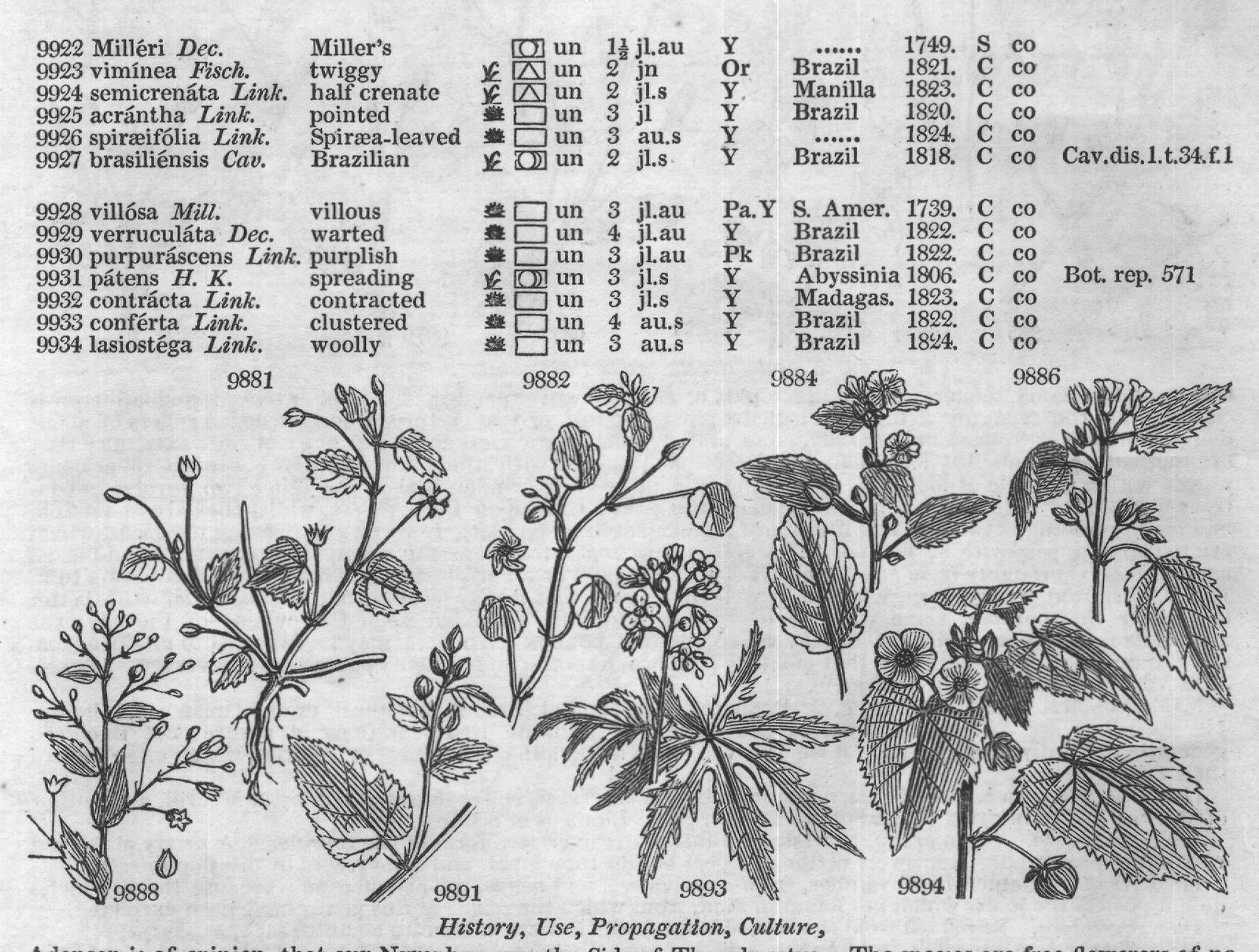
MONADELPHIA POLYANDRIA. 9843 Leaves 5-lobed 1-glandular beneath: lobes round mucronate, Invol. serrate, Stem smooth 9854 Leaves 5-lobed palmate: lobes lanceolate blunt mucronate with 1 gland beneath, Invol. nearly entire 9855 Lower leaves 5-lobed palmate; upper 3-lobed with 1 gland beneath, Inv. tern. Cal. with 3 glands at base 9856 Upper leaves undivided cordate; lower 3-5-lobed with 1 gland beneath, Branches and petioles hirsute 9857 Upper leaves 3-lobed; lower 5-lobed with 1 gland beneath, Branches and petioles spotted with black 9858 Upper leaves 3-lobed; lower 5-lobed with 3 glands beneath, Stem smoothish 9859 Leaves ciliated elliptical entire rarely trifid 9860 Smoothish prostrate, Peduncles nearly as long as petiole 9861 Leaves very cæsious, Stem very short 9862 Lower leaves cordate acuminate 5-angled somewhat toothed blunt; upper hastate acuminate 9863 Leaves all crenate: lower roundish cordate blunt 5-angled; upper round hastate acuminate 9864 Lower leaves triangular hastate crenate; upper ovate lanc. nearly entire, Ped. sol. axill. length of leaves 9865 Lower leaves cord. about 5-lobed hastate: upper hastate, Petals erect spatulate somewhat toothed at end 1. Capsules 5-12, 1-seeded, not bladdery. * Flower-stalks not longer than the leafstalk. Leaves oblong or ovate 9866 Leaves linear entire much longer than the diameter of the flower, Racemes terminal 9867 Leaves linear-lanceolate toothed, A spiny tubercle at the base of the leaves, Pedic. axill. subsolitary 9868 Leaves ovate-lanceolate toothed, A spiny tubercle at the base of the leaves, Pedic. axillary solitary 9869 Leaves oblong ovate subcordate blunt tooth, Pedicels as long as petiole 9870 Leaves ovate-lanceolate acuminate toothed smooth, Branches round downy, Rac. very short bracteolate 9871 Leaves ovate-oblong doubly serrate, Pedunc. axillary very short about 4-flowered, Branches flattened 9872 Leaves rhomboid narrowed at base serrate-toothed forwards beneath downy, Pedicels shorter than petiole 9873 Lvs. ellipt. subov. blunt toothed at end, Pedic. axill. solitary very short, Stipules ciliated longer than flow. 9874 Lower lvs. roundish ov.; upp, obl. toothed cun. and nearly ent. at base, Pedic. axill. many shorter than pet. ** Flower stalks elongated, distinctly jointed. Leaves oblong or ovate 9875 Lvs. ovate lanc. acumin. toothed hoary beneath, Branches compr. dotted, Pedic. thrice as long as petiole 9876 Leaves lanceolate toothed smooth, Pedic. axillary 1-fl. length of leaf 9876 Leaves oblong-lanceolate toothed cuneate at base hoary beneath, Pedic. axillary 1fl. shorter than leaf 9878 Leaves somewhat rhomboid retuse crenate towards the end hoary beneath, Pedic. longer than petiole 9879 Leaves ovate blunt serrated downy shining, Pedic, axillary solitary much longer than petiole *** Flower-stalks elongated. Leaves cordate at base, toothed, not lobed. 9880 Leaves ovate cordate blunt toothed, Pedicels solitary 1-flowered longer than petiole 9863 9869 9871 9865 9874 9877 9879 9880 and Miscellaneous Particulars. this should be done sooner. When great part of the pods are expanded, the wool is picked, and afterwards cleared from the seeds by a machine called a gin, composed of two or three smooth wooden rollers of about one inch diameter, ranged horizontally, close and parallel to each other, in a frame; at each extremity they are toothed or channelled longitudinally, corresponding one with the other; and the central roller being moved with a treaddle or foot-lath, resembling that of a knife-grinder, makes the other two revolve in contrary directions. The cotton is laid in small quantities at a time upon these rollers, whilst they are in motion, and readily passing between them, drops into a sack placed underneath to receive it, leaving the seeds, which are too large to pass with it, behind. The cotton thus separated from the seeds, is afterwards hand-picked and cleansed thoroughly from any little particles of the pods or other substances which may be adhering to it. It is then stowed in large bags, where it is well trod down, that it may be close and compact; and the better to answer this purpose, some water is every now and then sprinkled upon the outside of the bag; the marketable weight of which is usually three hundred pounds. An acre may be expected to produce from two hundred and forty pounds to that quantity; or two hundred and seventy pounds on an average. (Long's Jam. vol. iii. p. 686. &c. and Browne. 1482. Redoutea. Named after P. J. Redouté, a celebrated French botanical draughtsman, still living. His drawings are inferior to those of the Bauers as accurate representations of nature; but they are generally tastefully arranged and please the eye, notwithstanding a coldness of coloring which often injures their effect. 1483. Palavia. In honor of Don Antonio Palau y Verdera, second professor of botany at Madrid, and author of an excellent translation of the Species Plantarum of Linnæus in Spanish. 1484. Cristaria. From crista, a crest, in allusion to the crested form of the capsules. A pretty plant, not very easily preserved. It answers better in a peat border than a pot, and is increased by division or seed. 1485. Anoda. Named by Cavanilles, from a, privative, and nodus, an articulation; because the peduncles do not possess the joints which are found in Sida, from which the plants of this genus have been extracted. 1486. Periptera. So named from the resemblance of the flowers in form to a shuttlecock, περiπτερa. 1487. Sida. A name of Theophrastus, said by some to have been applied to a Malvaceous plant; but 9881 húmilis W. 9883 argúta W. dwarf un jl.au Y 9882 supína L'Her. 9884 cordifólia W. 9885 althæ'ifólia Swz. un jl.au Y smth. sharp-lvd. un 3 jl.au Y un 1½ jn.s Y un 3 jn.s Or 9886 úrens W. un 1 jl.s Y 9887 dumósa Swz. bushy un 2 jl.s Y 9888 paniculáta W. panicled un 1 jl.s Pu 9889 tríloba W. three-lobed un 3 jl.s W 9890 jatrophoídes W. 9891 ricinoídes L'Her.
Physic-nut-like Ricinus-like un 4 au V un 4 au W 9892 Napæ'a Cav. smooth Aun 4 au.s W 9893 dioíca Cav. rough un 6 au.s W 9894 occidentális W. downy un 1 jl.au Y 9895 fœ'tida W. stinking un 1 jl.au Y 9896 brévipes Dec. short-stalked un 1 jl.au Y 9897 períplocifólia W B zeylánica y caribæ'a 9898 hernandioídes W. 9899 nudiflóra W. 9900 polyántha Link. 9901 auríta Wall. 9902 tríquetra W. 9903 incána Link. 9904 umbelláta W. 9905 refléxa W. 9906 críspa W. 9907 arbórea W. 9908 mauritiána W. 9909 grandifólia W. 9910 tiliæfólia Fisch. 9911 americána W. 9912 Abútilon W. 9913 asiática W. 9914 Sonneratiána W.
Mauritius woolly Periploca-lvd.
Ceylon Caribbee un 2 jl.au Y un 2 jl.au Y Hernandia-lvd. un 2 jl.au Y un 6 Y ... naked-flowered un 3 my.jn Y MONADELPHIA POLYANDRIA. procumbent heart-leaved Althæa-leaved stinging un E. Indies 1800. S co Jamaica 1821. S co W. Indies 1732. C co C. G. H. 1732. S co Jamaica 1820. C co Jamaica 1781. C co Jamaica 1818. C co Jamaica 1795. C co C. G. H. 1794. C co S. Amer. 1787. S co Peru' 1818. S co Virginia 1748. D co Virginia 1759. D co America 1732. S co Peru 1795. S co St. Martha 1822. S co Hispanio. 1798. C co CLASS XVI.
Cav.dis.5.t 134f.2 Ca.dis.6.t.196.f.2 Dil.el.t.171.f.209 Sloane 1.t.136.f.2 Cav.diss. 1.t.2.f. 7 Cav.dis.1.t.12.f.5 Jac.schœ.2.t. 142 L'Her.stir.1.t.56