Home › B › Bot (Mag Nepal or ap my Y heteroph)
Bot (Mag Nepal or ap my Y heteroph)
mag. 2396 Nepal or 6 ap.my Y 4931 heterophýlla Juss. various-leaved or 4 ap.my Y Nepal 1820. C co Magellan 1805. L co Hook. ex. fl. 98 Hook. ex. fl. 14 830. NANDI'NA. W.
NANDINA.
Berberideæ.
Sp. 1. 4932 doméstica W garden or 831. COSSIG NIA. Juss. COSSIGNIA. 4933 pinnáta Lam. 6 jn.jl G.Br China Sapindaceæ. Sp. 1. 1804. C p.l Bot. mag. 1109 pinnated or 10 ... ** Mauritius 1824. C p.l 832. HIL/LIA. W.
HILLIA.
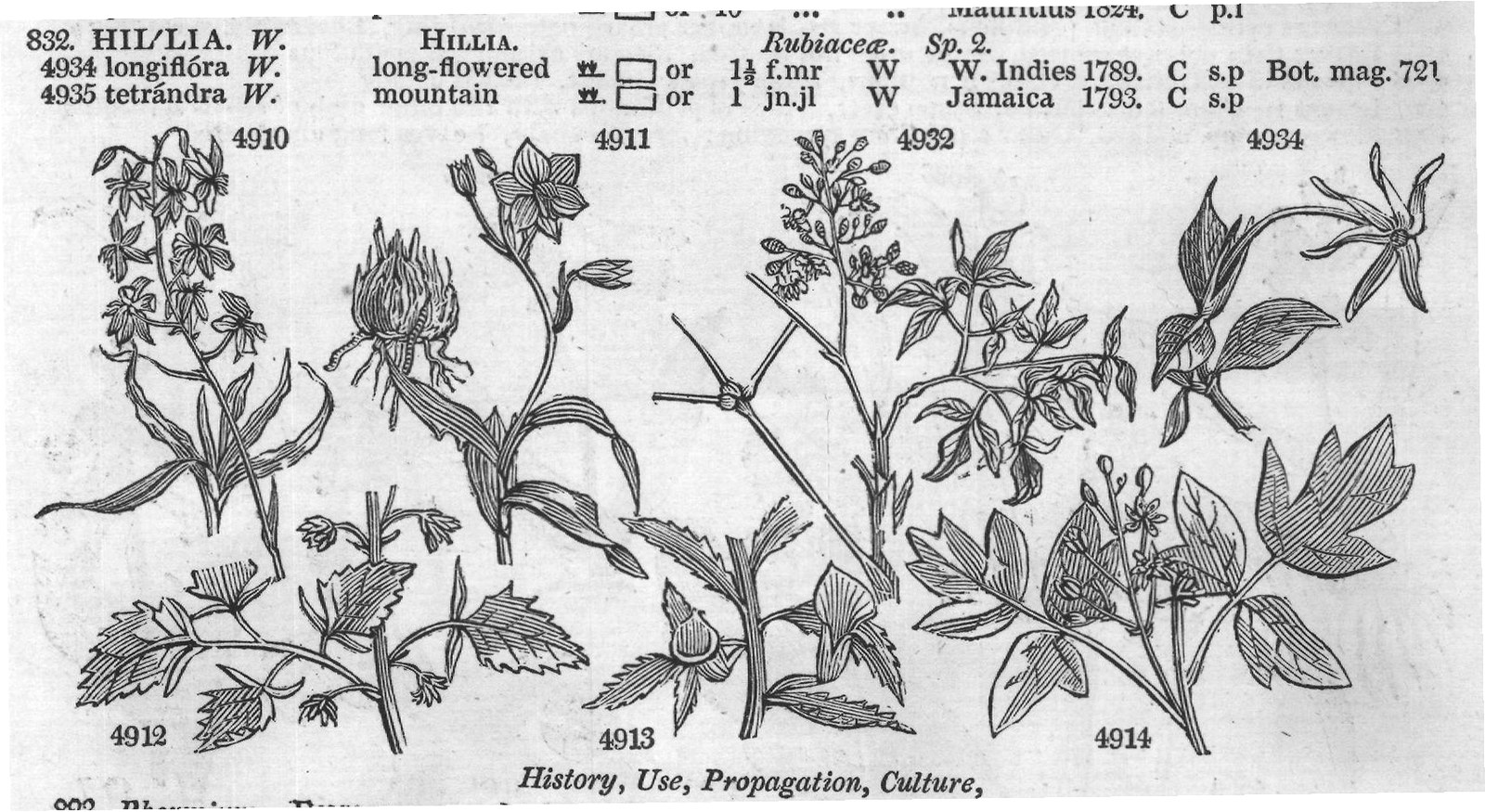
Rubiaceæ. Sp. 2. 4934 longiflóra W. long-flowered or 1 f.mr W 4935 tetrándra W. mountain 业 or 1 jn.jl W W. Indies 1789. C s.p Bot. mag. 721 Jamaica 1793. C s.p 4910 4911 4932 4934 4912 4913 History, Use, Propagation, Culture, 4914 823. Phormium. From φoρμoς, a basket. This plant sends up numerous leaves, which in New Zealand and Norfolk Island are manufactured into matting or a coarse thread is separated from them and made Zealand Norfolk Island are manufactured into matting; or a coarse thread is separated from them and made into cordage and coarse linen, as is done from different species of Aloe, Agave, and Liliaceæ in the Levant and south of Europe. The plant thrives in any rich light soil, increases readily by offsets, and is said to stand the open air about Cork, where thoughts are entertained of using it as a substitute for flax. The experiments, however, which have been made in New Holland by some spirited individuals respecting its cultivation, have all failed. 824. Cyanella. Derived from zvavos, blue, in allusion to the color of the flowers of some species; all are very pretty and easily cultivated. 825. Leontice. An abridgment of Leontopetalum, its ancient name ; from λεωv, a lion, and πετaλov, a leaf, because the shape of the leaves was thought to resemble the print of a lion's foot. 826. Caulophyllum. From κauλov, a stem, and φuλλov, a leaf. Its leaves are so terminated by the stalk, as to appear a mere continuation of a stem. 827. Diphylleia. From dis, two, and φuλλov, a leaf. The plant has never more than two leaves. 828. Prinos. This was the Greek name of the evergreen oak; from πρiω, to saw, on account of the strongly toothed leaves of that plant. The species are low shrubs of little beauty; but of the easiest culture in any light soil. 829. Berberis. Berbêrys, according to Golius, (p. 246), is the Arabic name of this plant. B. vulgaris is at once an ornamental shrub, a fruit tree, a hedge plant, a dye, a drug, and a reputed enemy to the corn farmer.
When covered with flowers in spring, or with fruit in autumn , it is a fine object. The leaves are of a yellowish or bluish green, and gratefully acid to the taste. The smell of the flowers is offensive when near, but pleasant at a certain distance. The berries are so very acid, that birds seldom touch them. The berberry, however, is cultivated for the sake of these, which are pickled and used for garnishing dishes; and being boiled with sugar, form a most agreeable rob or jelly; they are used likewise as a sweetmeat, and are put into sugar-plums or comfits. As a medicine the fruit is considered a mild restringent acid, agreeable to the stomach, and of efficacy (like other vegetable acids) in hot bilious disorders, and in a putrid disposition of the humours. The roots boiled in a lye yield a yellow colour: and in Poland they dye leather of a fine yellow ORDER I.
HEXANDRIA MONOGYNIA. 4909 The only species, resembling an Agave 4910 Stem leafy panicled, Racemes divaricating, Leaves lanceolate wavy 4911 Scape naked branched, Racemes erect, Leaves linear lanceolate flat 4912 Leaves pinnated, Leaflets whorled lanceolate acute 3-pointed 4913 Radical leaves biternate; cauline ternate, Fruit ovate 4914 Cauline leaf triternate; floral biternate 4915 Quite smooth, Leaves palmate angular lobed serrated with taper-pointed lobes 4916 Leaves obovate lanceolate acuminate doubly serrated, Veins beneath hairy 4917 Leaves oval pointed at each end mucronate serrulate pubescent beneath, Female flowers solitary 4918 Leaves lanceol. serrated acuminate smooth on each side, Flowers all 6-cleft 4919 Leaves lanceol. very finely and distantly serrated acute at each end quite smooth, Male flow. 3-androus 4920 Leaves lanceol. obt. smooth serrated at end 4921 Leaves elliptical acuminate smooth somewhat serrated at end 4922 Racemes simple pendulous, Leaves obovate ciliate-toothed 4923 Branches dotted, Prickles in 3s, Lvs. simple obovate remotely toothed, Racemes short, Fruit globular 4924 Spines 3-parted, Leaves oval with a few large spiny teeth, Ped. short 4-fl. Pedicels elongate corymbose 4925 Spines 3-5-parted, Leaves oval-oblong entire or serrated, Racemes 3-8-flow. almost shorter than leaves 4926 Spines 3-7-parted, Leaves lanceolate obovate ciliate-toothed, Peduncles 1-flowered shorter than leaf 4927 Spines 3-parted, Leaves lanceolate obovate ciliate serrate, Racemes pendulous, Petals emarginate 4928 Spines 3-parted very few, Leaves obl. obtuse entire or a little toothed, Racemes many-fl. nodding 4929 Lvs. pinnated in 4 or 5 pairs, Leaflets ovate lanceolate spreading toothed, Racemes erect much clustered 4930 Spines simple scarcely two-toothed at base, Lvs. obl. with 4 or 5 spiny teeth, Racemes spreading many-fl. 4931 Spines 3-parted, Lvs. ovate lanceolate smooth some entire some three-toothed, Pedicels solitary one-flow. 4932 Leaves supra-decompound with lanc. entire leaflets 4933 Leaves pinnate lanceolate emarginate 4934 Cor. 6-cleft, Segments lanceolate revolute, Leaves ovate acute 4935 Cor. 4-cleft, Segments ovate, Leaves obovate 4915 4926 4922 4916 4928 4917 4918 4929 and Miscellaneous Particulars. with the bark of the root. The inner bark of the stems also will dye linen of a fine yellow, with the assistance of alum. Kine, sheep, and goats are said to eat it; horses and swine to refuse it. This species varies with red, purple, pale yellow, and stoneless fruit.
Insects of various kinds are remarkably fond of the flowers of the barberry; and the Ecidium Berberidis, its particular inhabitant, is supposed to generate the dust which, carried from the bush by winds, and lighting on wheat and other growing corns, gives rise to the Puccinia, a minute fungus, which closes up the pores of the leaves, and appears like rust or mildew. (Sir J. Banks on Blight, &c.) Many highly respectable authorities in Britain, on the continent, and in America, are in favor of and against this opinion. Willdenow, Withering, and Dwight have stated various remarkable cases on good authority. Sir J. Banks and his draughtsman Bauer proved the fact of the mildew being a fungus.
Linnæus observed, that when bees in search of honey touch the filaments, the anthers approximate to the stigma and explode the pollen. Sir J. Smith ascertained that the same effect is produced by touching the inside of the filaments with a small bit of stick. (Phil. Trans. vol. lxxviii. 1. 158.) All the other species are much esteemed as ornamental plants. B. aristata is a fine hardy evergreen shrub. B. ilicifolia and emarginata are also hardy, but less ornamental. B. fascicularis is a beautiful ornamental nearly hardy shrub, remarkable for its pinnated leaves. 830. Nandina. Nandin is the name of this shrub in Japan, where it is a garden shrub: the flowers are in panicles, and succeeded by berries of the size of a pea. In the greenhouse it grows freely in loam and peat, and ripened cuttings, with their leaves on, root in sand under a hand-glass. 831. Cossignia. Named by Commerson, after M. de Cossigny, a French naturalist, then living at Pondicherry. Fine plants with handsome pinnated leaves. 832. Hillia. So named by Jacquin, in honor of Sir John Hill, author of many large works on botany and other parts of natural history, as well as general literature. Owing to some differences with his contemporaries, and writing against the Royal Society, after being rejected as a fellow, his memory in England has not met with much respect; in truth it was but little that it deserved. The species are of easy culture, and cuttings root readily in sand.
RICHARDIA. rough W 834. CANARI'NA. W.
CANARINA.
Canary smooth cu Cape cu hairy cu 833. RICHARDIA. L. 4936 scábra L. 4937 Campánula W.
HEXANDRIA MONOGYNIA. 835. FRANKE'NIA. W. SEA-HEATH. 4938 lævis W. 4939 Nóthria W. 4940 hirsúta W.
Rubiaceæ. Sp. 1. 2 s W Vera Cruz