Home › B › Bot (Reg History Use Propagation)
Bot (Reg History Use Propagation)
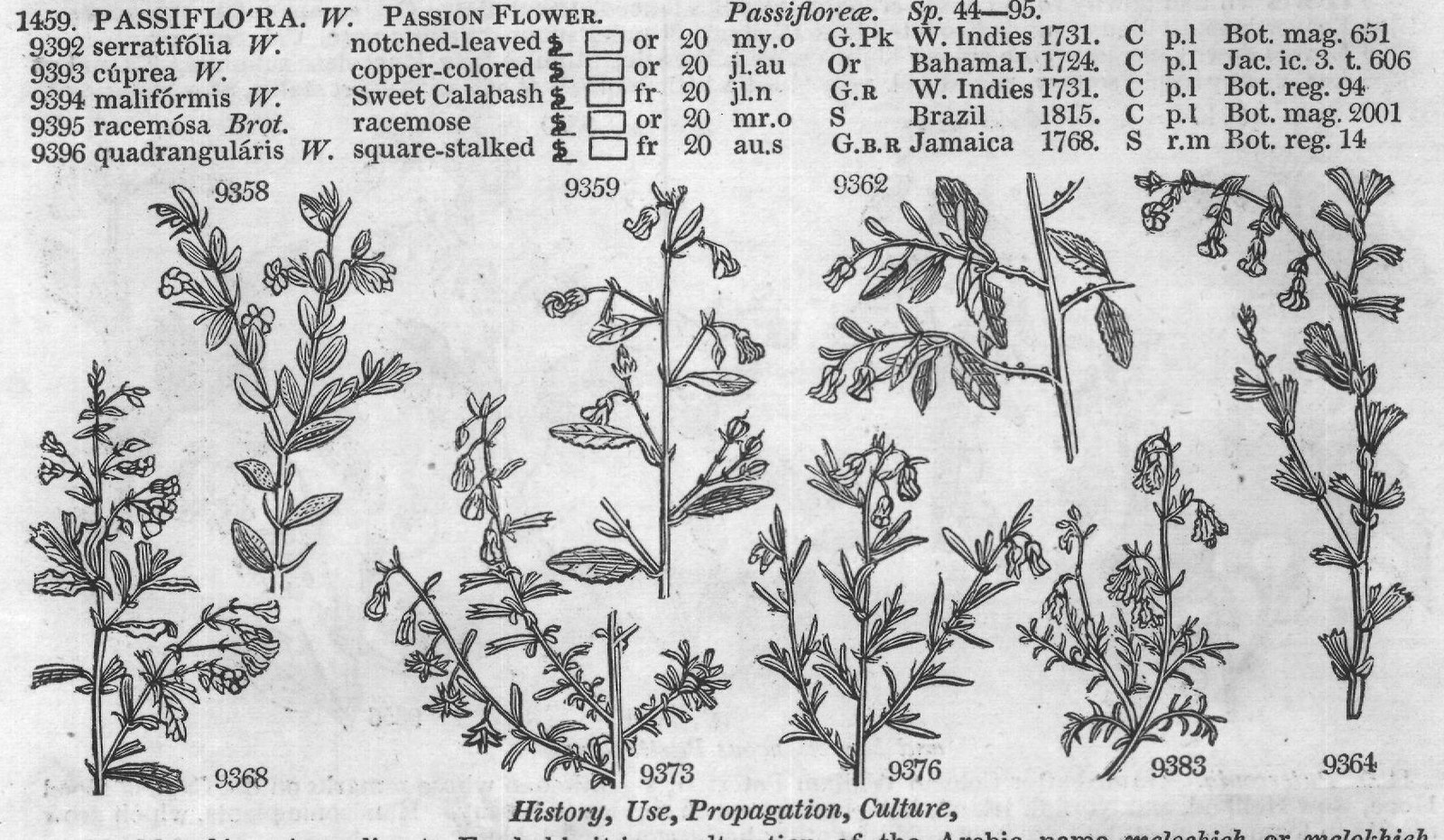
reg. 14 9358 9359 9362 9368 9373 9383 9364 9376 History, Use, Propagation, Culture, 1456. Melochia. According to Forskahl, it is an alteration of the Arabic name melochich, or melokhich. Light rich soil suits all the species, and they strike readily in moist heat. 1457. Melhania. A plant which grows upon Mount Melham, in Arabia. Pretty plants, which grow in sandy loam, and root in sand under cover. Sweet observes, that "they are very apt to become covered with insects." 1.458. Ochroma. From ωχρoς, yellow, the flowers being of that color, according to Schreber. O. Lagopus is a very large tree, with divaricating branches, and leaves more than a foot long. The wood is white, tender, and so light, that it is used instead of corks to nets. The capsules contain a very soft fine rufous down, in which the seeds are involved, and which down is said to be used in the manufacture of English beavers. (Desportes Plantes de S. Domingue, iii. 16.) 1459. Passiflora. This genus has been so named, on account of its being supposed to represent, in the appendages of its flower, the passion of Jesus Christ. A beautiful genus of climbers, partly herbaceous, but chiefly suffrutescent or woody; and all of them exotics and very ornamental. Some species are odoriferous; others bear edible fruits, fleshy juicy berries of considerable size, though not rich in flavor. Of late, a number of hybrid sorts have been raised, some of which, as P. cæruleo-racemosa, are considered more beautiful than almost any of the natural species.
P. maliformis, the sweet calabash of the West Indies, produces large flowers, red, white, and blue, but of short duration. They are succeeded by fruit, roundish, the size of a large apple, yellow when ripe, having a thicker rind than any of the other sorts; inclosing a sweetish pulp, in which are lodged many oblong black seeds, of a brownish color, a little rough to the touch. It grows naturally in the West Indies, where the inhabitants call it Granadilla. The fruit is served up there in desserts. It has borne fruit in the garden of the Bishop of Durham in Oxfordshire, and at Vere's, Kensington Gore. (Hort. Trans. iii. 101.) P. quadrangularis, the Granadilla vine of the French, has leaves five or six inches long, and luxuriant four- ORDER II.
MONADELPHIA PENTANDRIA. 9357 Leaves stalked oval blunt wavy crenate and stem hairy, Stipules lanceolate 9358 Leaves downy hispid oblong acutish entire subsessile, Stipules lanceolate subulate, Flowers aggregate 9859 Leaves downy beneath oblong blunt crenate stalked, Stipules subulate, Pedic. 1-2-fi. Calyxes spreading 9360 Leaves soft with down whitish obl. blunt toothed cuneate at base entire, Pedunc. 2-ff. Cal. campan. velvety 9361 Leaves smooth lanceolate serrate at end acute, Stipules ovate acuminate, Pedic. 2-4-flowered 9362 Leaves white with down lanceolate serrate bluntish wavy at edge, Stipules subul. Pedunc. 1-fl. very short 9363 Leaves smooth broadly obovate cuneiform very blunt crenate emarginate plicate, Stip. lanc. subulate 9364 Leaves pubescent obovate cuneiform truncate emarginate toothed, Stipules ovate acute 9365 Leaves soft white with down oblong cuneiform rounded at end toothed, Stipules lanceolate 9366 Leaves pubescent downy oblong unequally toothed rounded at each end, Stipules ovate somew. toothed 9367 Leaves beneath white with down oblong obov. cuneiform unequally toothed at end, Stip. cord. acum. 9368 Leaves rough above downy beneath cuneif. obl. unq. toothed entire at base, Stip. half cordate acuminate 9369 Leaves smoothish cuneiform oblong truncate toothed at end, Stipules oblong acute, Racemes few-flow. 9370 Leaves smooth cuneiform lanceolate truncate toothed at end, Calyxes reflexed 9371 Leaves smooth above hairy beneath cuneiform lanceolate truncate toothed at end 9372 Leaves pubescent cuneiform lanceolate blunt toothed at end, Calyx inflated downy 9373 Leaves velvety cuneiform linear blunt entire or 3-toothed at end, Cal. campanulate 9374 Leaves velvety cuneiform lanceolate blunt: upper entire; lower 3-5-toothed at end, Stipules lin. subul. 9375 Leaves velvety lanceolate blunt entire, Stipules linear subulate, Calyxes angular 9376 Leaves smooth rough at edge linear 3-cornered entire, Stipules large lanceolate 9377 Leaves white with down sess. cuneate obcord. somew. crenate at end, Stip. obl. blunt resembling lat. lvs. 9378 Leaves smoothish oblong toothed pinnatifid: lower ovate; upper elongate, Stem procumbent 9379 Leaves rough with scattered down linear-cuneiform coarsely toothed, Stipules linear entire 9380 Leaves roughish white bipinnatifid, Pedunc. 2-flowered very long 9381 Leaves pinnatifid with linear lanceolate entire segments, Petals cut-toothed 9382 Leaves linear pinnatifid fleshy smoothish, Stem pubescent 9383 Leaves pinnatifid with linear entire acute lobes 9384 Leaves ovate lanc. toothed smooth, Pedunc. 5-6-fl. longer than petiole, Branches downy in decurrent lines 9385 Lvs. uneq. sided ovate obl. acutely crenate plaited hoary on each side, Umbels 3-8-fl. longer than petiole 9386 Leaves cordate crenate downy beneath, Fl. capitate subsessile axillary and opposite the leaves 9387 Leaves ovate somewhat lobed serrated smooth, Flowers subterminal capitate sessile 9388 Leaves ovate cordate subpeltate acuminate crenulate beneath downy and reticulated 9389 Leaves cordate entire downy on each side 9390 Leaves cordate somewhat 3-lobed repand subtomentose 9391 Leaves cordate 5-angled somewhat lobed toothletted pubescent beneath 9392 Leaves ovate veiny subserrulate, Petioles with 2 glands, Invol. 3-leaved 9393 Leaves elliptical entire blunt 3-nerved, Petioles without glands, Invol. O. 9394 Leaves oblong ovate cordate 3-nerved veiny entire, Petioles with 2 glands, Invol. 3-leaved larger than fl. 9395 Leaves 3-lobed peltate, Petioles with 4 glands, Flowers terminal racemose 9396 Leaves obl. ovate subcord. entire veiny, Petioles with 6 glands, Stipules roundish ovate, Invol. 3-leaved 9392 9385 9387 9395 9388 9396 9391 and Miscellaneous Particulars. cornered ligneous stems. The flowers are red within, and white outside; they are odoriferous, and generally the plant is covered with fruits and flowers at the same time, which makes a fine appearance. The fruit, Sabine describes (Hort. Trans. iii. 100.) as very large, of an oblong shape, about six inches in diameter, from the stalk to the eye, and fifteen inches in circumference. It is externally of a greenish-yellow when ripe, soft and leathery to the touch, and quite smooth; the rind is very thick, and contains a succulent pulp of a purple color (which is the edible part), mixed with the seeds in a sort of sack, from which it is readily separated. Wine and sugar are commonly added to it when used. The flavor is sweet and slightly acid, and it is very grateful to the taste, and cooling in a hot climate. It has been successfully cultivated for its fruit in a few places, as at Lord Harewood's, Farnley Hall, &c. (Hort. Trans. iv. 60.) P. laurifolia, the water lemon, Pomme de Liane, Fr., has a suffrutescent stem, with divaricating filiform branches, oval smooth leaves, and very long tendrils. Flowers red and violet, sweet-scented; the fruit about the size of a hen's egg, but rather more elongated, and tapering equally at both ends; when ripe, it is yellow and dotted over with white spots; it contains a whitish watery pulp, which, in the West Indies, is usually sucked through a small hole made in the rind; the rind is tough, soft, and thin; the juice has a peculiar aromatic flavor, is delicately acid, and allays thirst agreeably. It is grown in our stoves, but has not yet been cultivated for its fruit.
P. normalis has berries about the size of small grapes. The root has been extolled as a counterpoison and diuretic.
P. Murucuja produces fruit of an oblong oval form, about the size of a large olive, and flesh-colored when ripe. Both the syrup and decoction of the plant are much used in the leeward parts of Jamaica, where it is frequent; and they are said to answer effectually all the purposes for which syrup of poppies and liquid laudanum are generally administered. The flowers are most in use they are commonly infused in, or pounded and 9397 aláta W. 9398 laurifólia W. 9399 multiflóra W. 9400 Murucúja W. 9401 perfoliáta W. 9402 rúbra W. 9403 normális W. 9404 lunáta W. fr 20 jn.jl; or 20 jn.s fr 12 jl.au S Pu or 15 ap.s R or 15 my.jn .... crescent-leaved cu 10 jn.au W MONADELPHIA PENTANDRIA. wing-stalked $ ☐ fr 20 ap.au laurel-leaved many-flowered & purple Σ perfoliate-leav. & ☐ or 15 jl.au red-fruited linear-lobed G.Pu W. Indies 1690. C p.l VeraCruz 1731. C p.l W. Indies 1739. C p.l W. Indies 1806. C p.1 W. Indies 1731. C p.l VeraCruz 1771. C p.l Jamaica 1733. C p.l CLASS XVI.