Class XII
-ICOSANDRIA.
STAMENS many, perigynous, or inserted into the Calyx. To gardeners this is one of the most interesting of the Linnean classes, containing a greater proportion than any other of objects which come within their observation and management. It also consists of genera for the most part naturally allied; and comprises not only the most remarkable portion of Ficoideæ, all Cacti, and the chief of the Myrtaceæ, but almost every genus of the beautiful and hardy tribes of Rosaceae. Its characters are well defined, and depend upon the insertion of a number of distinct stamens, exceeding twenty, into the inner surface of the calyx; modifications of which organ are here found to be of more than ordinary importance in characterising the genera.
The genera are extremely natural, and have been all studied with unusual attention. Some difference of opinion exists among botanists as to the limits which ought to be assigned to them, and great diversity of nomenclature has thence arisen. "But," as has been observed by a modern author, " in a class so strictly natural as this is, greater difficulty is always to be expected in finding characters for genera, than in those of which our knowledge is more imperfect, and whose series of individuals may therefore be considered less complete." In the apple and pear tribe, Pomaceæ, where the greatest difficulty is thought to exist, we adopt Mr. Lindley's arrangement, as published in the Transactions of the Linnean Society, which we find admitted by all botanists of authority.
But if it is difficult to ascertain the definite limits of the genera of Icosandria, it is yet more perplexing to arrive at a satisfactory conclusion respecting the species of which the genera are constituted. Having all been, as long a satisfactory conclusion respecting the species of which the genera are constituted. Having all been, as long as gardens have existed, the objects of cultivation, it has happened that many individuals have, under the action of domestication, wandered so far from their original types, as to have acquired new characters for themselves, of so peculiar a kind as to have rendered it impossible at the present day to refer them with certainty to the source from which they originally sprung. To remedy this confusion, which has been thus increasing for ages, some persons have thought it necessary to distinguish the species by such artificial characters as they are now found to possess, without reference to any changes the genera may have undergone; but it has been found that no facilities of discrimination have been gained by multiplying distinctions in consideration of differences no facilities of discrimination have been gained by multiplying distinctions in consideration of differences which are neither permanent or remarkable, nor connected with natural habit, but purely artificial. To others it has appeared proper to endeavour to reduce the aberrant forms which now exist to those from which, upon mature consideration, they may be presumed to have been derived, and to simplify the arrangement and discrimination of the species by confining them within their primitive limits. As we think the latter to be the most simple principles of arrangement, and as they are certainly the most philosophical, we shall here follow those authors who have adopted them.
It is usual in this class to distinguish the orders with two and three styles from that with five: but the different species vary so much in the same genus in this respect, that we have only separated the genera into those with one style, Monogynia; with two, three, or five styles, Di-Pentagynia; and with many styles, Polygynia. Order 1. MONOGYNIA.
Many perigynous Stamens. 1 Style. §1. Ovary inferior. 1111. Cactus. Cal. imbricated. Petals numerous, in many rows the inner the largest. Stigma many-cleft. Berry many-seeded. 1112. Rhipsalis. Cal. 3-4-parted, very short. Teeth acuminate, membranous, very fine. Berry 1-celled, pellucid. Seeds 12, in the centre. 1113. Bartonia. Cal. 5-cleft. Petals many.
Caps. cylindrical, 1-celled at the end with 3-5 lid-like valves. Placentas 3-5, parietal, bearing seeds in a double row. ORDER VI.
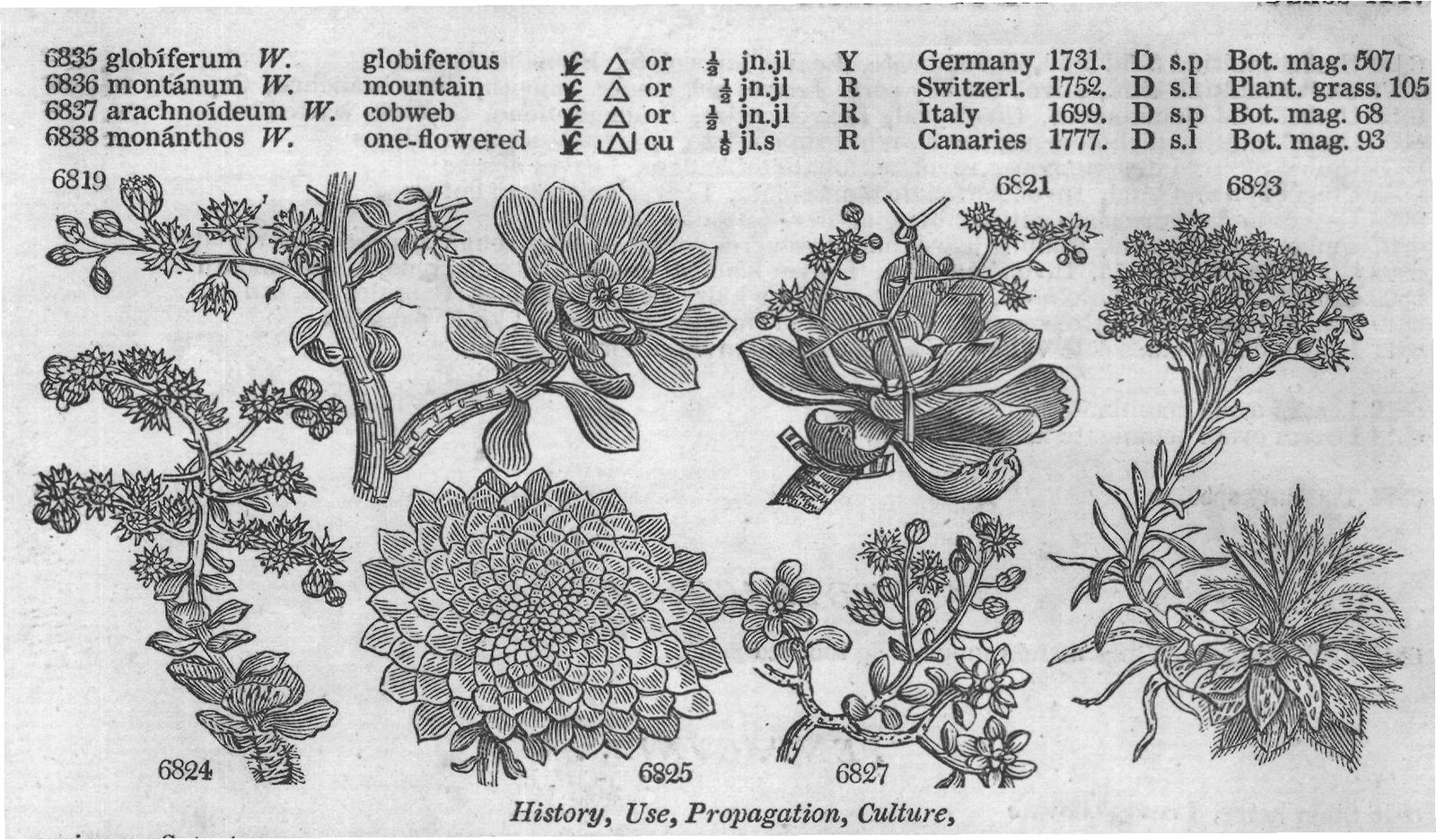
DODECANDRIA DODECAGYNIA. 6835 Leaves ciliated, Offsets globose 6836 Leaves entire, Offsets spreading 6837 Leaves with entangled hairs, Offsets round 6838 Leaves rounded clavate clustered, Pedunc. naked 1-fl. Nects. obcordate 6828 6835 6830 6836 6837 6834 6838 and Miscellaneous Particulars. leek is a preservative to the coverings of houses in Smoland. It may easily be made to cover the whole roof of a building, whether of tiles, thatch, or wood, by sticking the offsets on with a little earth or cow dung. 1114. Philadelphus. Cal. 4-5-parted. Petals 4-5. Style 4-cleft. Caps. half-superior, 4-5-celled, many-seeded. Seeds with an arillus. 1115. Leptospermum. Cal. persistent at base, 5-cleft, half-superior. Petals 5, clawed, round, longer than stamens. Stigma capitate. Caps . depressed, 4-5-celled. Seeds angular, slender. 1116.. Fabricia. Cal. 5-cleft, half-superior. Petals 5, sessile. winged.
Stigma capitate. Capsule many-celled. Seeds 1117. Metrosideros. Cal. 5-cleft, half-superior. Petals 5. Stamens very long, separate. Stigma simple. Caps. 3-4-celled. 1118. Psidium. Cal. 5-cleft. Petals 5. Berry soft, pulpy, many-seeded. Cotyledons leafy, very small. Radicle very large, arcuate. Testa bony. 1119. Eugenia. Cal. 4-5-parted, superior. Petals 4-5. Fruit fleshy, 1-celled, 1-seeded. Cotyledons halfcylindrical. Radicle very small. Testa membranous. 1120. Caryophyllus. Cal. funnel-form. Fruit dry, 1 or 2-celled. Otherwise like Eugenia. 1121. Myrtus. Cal. 5-cleft. Petals 5. Berry 2 or 3-celled, many-seeded. Radicle and cotyledons distinct. . Petals 5. Berry 2 or 3-celled, many-seeded. Radicle and cotyledons distinct. 1122. Calyptranthus. Cal. truncate, before flowering covered with an hemispherical deciduous lid. Cor. O. , before flowering covered with an hemispherical deciduous lid. Cor. O.
Berry 1-celled, 4-seeded. 1123. Pimenta. Cal. 5-fid. Petals 5. Ovary 2-celled. Ovules solitary, appense. Style straight. Stigma somewhat capitate. 1124. Olynthia. Cal. 5-cleft. Petals 5. Stigma hooked. Berry 1-celled. Seeds angular. Embryo conferruminate. 1125. Stravadium. Cal. 4-cleft. Petals 4. Fruit 4-cornered, 1-seeded. Flowers in terminal racemes. Leaves alternate. 1126. Eucalyptus. Cal. truncate, covered with an entire deciduous lid. Cor. O. Capsule 4-celled, opening at end, many-seeded. 1127. Punica. Cal. 5-cleft. Petals 5. Berry many-celled, many-seeded. Seeds berried, Placentas parietal. §2. Ovary superior. 1128. Amygdalus. Cal. 5-cleft. Petals 5. Drupe with a nut perforated on its surface. 1129. Prunus. Cal. 5-cleft. Petals 5. Drupe with a hard smooth nut. 1130. Chrysobalanus. Cal. 5-cleft. Petals 5. Style lateral. Drupe with a 5-furrowed, 5-valved nut. Order 2. DI-PENTAGYNIA.
Many perigynous Stamens. 2 to 5 Styles. §1. Ovary inferior 1131. Mespilus. Cal. 5-parted, with leafy divisions. Disk arge, honey-bearing. Styles smooth. Apple turbinate, open, 5-celled, with a bony putamen . 1132. Cratægus. Cal. 5-toothed. Petals spreading, orbicular. Ovary 2-5-celled. Styles smooth. Apple fleshy, oblong, closed by the teeth of the cal., or by the thickened disk. Putamen bony. 1133. Pyrus. Cal. 5-toothed. Petals roundish. Apple closed, 5-celled, with a cartilaginous putamen. Cells 2-seeded. Testa cartilaginous. 1134. Cydonia. Cal. 5-parted, with leafy divisions. Apple closed, many-seeded. Testa mucilaginous. 1135. Photinia. Cal. 5toothed. Petals reflexed. Ovary half-superior, villous, 2-celled. Styles 2, smooth.
Pericarp 2-celled, included in the fleshy calyx. Testa cartilaginous. 1136. Raphiolepis. Cal. with a funnel-shaped deciduous limb. Filaments filiform. Ovary 2-celled. Apple closed by the thickened discus, with a papery putamen. Seeds gibbous. 1137. Eriobotrya. Cal. woolly, bluntly 5-toothed. Petals bearded. Stamens erect, the length of teeth. Styles 5, filiform, included, hairy. Apple closed, 3-5-celled. Chalaza none. Radicle included between the hairy. Apple closed, 3-5-celled. Chalaza none. bases of cotyledons. 1138. Amelanchier. Cal. 5-toothed. Petals lanceolate. Ovary 10-celled. Ovules solitary. Apple 3-5-celled, with a cartilaginous putamen.
ICOSANDRIA.
CLASS XII. 1139. Cotoneaster. Flowers polygamous. Cal. turbinate, bluntly 5-toothed. Petals short, erect. Stamens length of teeth. Styles smooth, shorter than stamens. Achenopses parietal, included in calyx. §2. Ovary superior. 1140. Waldsteinia. Cal. 10-cleft; the alternate segments smaller. Petals 5. Styles clavate, deciduous. Grains 2, obovate. 1141. Spiræa. Cal. spreading, 5-cleft. Petals 5. Caps. 1-celled, 2-valved, opening inwards, 1-3-seeded. . Capsule 5-celled. 1143. Sesuvium.
Cal. 5-parted, colored. Petals O. Caps. ovate, 3-celled, cut round, many-seeded. 1144. Aizoon . Cal. 5-parted. Pet. O. Caps. 5-celled, 5-valved.
Order 3. POLYGYNIA.
Stamens many, perigynous. Styles many. 1145. Tetragonia. Cal. 3-5-parted. Petals O. Drupe inferior, with a 3-8-celled nut. 1146. Mesembryanthemum. Cal. 5-cleft. Petals many , linear. seeded. 1147. Hymenogyne. Styles about 12, united in a delicate tube. Caps. 1-celled, many-seeded. Otherwise like Mesembryanthemum.
Capsule turbinate, fleshy, inferior, many- MONOGYNIA. 1111. CACTUS. W.
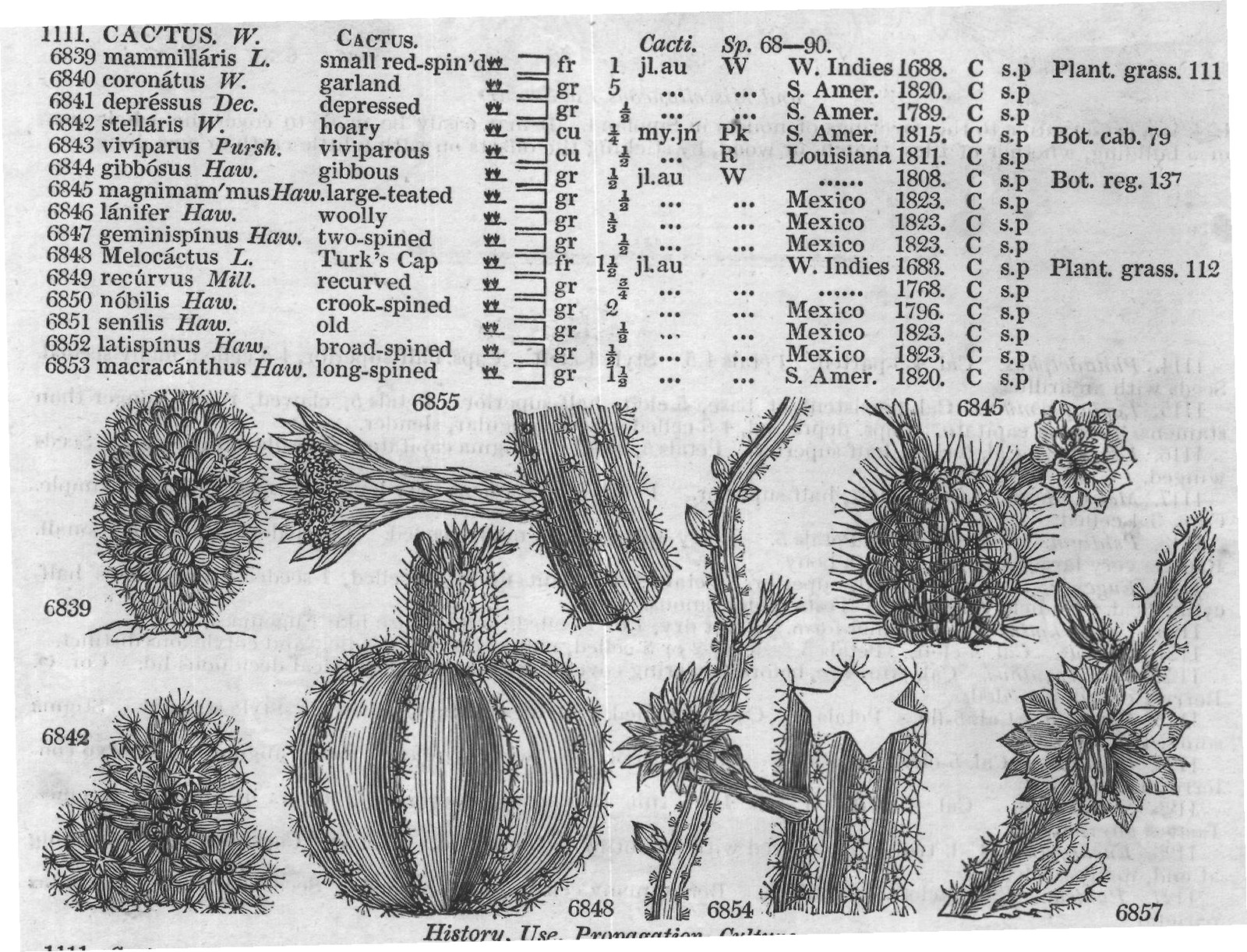
CACTUS. 6839 mammilláris L.
Cacti. Sp. 68-90. 6840 coronátus W. 6841 depréssus Dec. 6842 stelláris W. hoary 6843 vivíparus Pursh. viviparous small red-spin'd garland depressed 业 cu fr gr 5 gr 1 jl.au W W. Indies 1688. C s.p Plant. grass. 111 ... ...
S. Amer. 1820. C s.p ... ...
S. Amer. 1789. C s.p my.jn Pk cu R 6844 gibbósus Haw. ... gibbous S. Amer. 1815. C s.p Louisiana 1811. C s.p Bot. cab. 79 6845 magnimam'mus Haw.large-teated 业 gr jl.au W ...... 1808. C s.p Bot. reg. 137 6846 lánifer Haw. 业 gr ... ...
Mexico 1823. C s.p woolly 6847 geminispínus Haw. gr ... ...
Mexico 1823. C s.p two-spined gr 6848 Melocactus L. ... ...
Turk's Cap Mexico 1823. C s.p 6849 recúrvus Mill. fr 1 jl.au recurved 6850 nóbilis Haw. gr ... ... crook-spined 6851 senílis Haw. gr 2 ... old 6852 latispínus Haw. gr ... 6853 macracánthus Haw. long-spined broad-spined姓 gr ... gr 1 Mexico ...
S. Amer. 6855 W. Indies 1688. C s.p Plant. grass. 112 1768. C s.p Mexico 1796. C s.p 1823. C s.p Mexico 1823. C s.p 1820. C s.p 6845 6839 6842 6848 6854 6857 History, Use, Propagation, Culture, 1111. Cactus. A name under which Theophrastus describes a spiny plant, an article of food, which grew in Sicily. This genus consists of succulent plants, permanent in duration, singular and various in structure; generally without leaves , and having the stem or branches jointed; for the most part armed with spines in bundles, with which, in many species, bristles are intermixed. These bundles of spines are placed on the top of the tubercles in the smaller melon thistle, which is tubercled all over, and produces its flowers between the tubercles. In the great melon thistle the spines are ranged in a single row on the ridge of the ribs. These are of an ovate or globular form. The torch thistle, on the contrary, are slender, rise up high, are jointed and branched; many of them are almost cylindrical, with from five to ten shallow ribs ; some, however, are square or three cornered.
The structure of the creeping Cereuses is the same with these, except that the steins are weak and cannot support themselves; they therefore seek support from trees, and throw out roots from the stem, like ivy. In the Indian figs the branches are jointed, and flatted like the sole of a shoe; the bundles of spines or bristles are scattered over the surface, and the flowers are produced from the edge of the extreme branches. In the Phyllanthus the branches are thinner, they are indented along the edge, and the flowers come out singly from the indentures. This seldom has any spines. Pereskia has a round stalk with leafy branches; the leaves alternate, flat, and thick; the prickles are large and stiff, and come out in bundles on the stalk and branches, chiefly at the axils; the flowers are produced several together from the axils also.
In this and the Indian figs the flowers are pitcher-shaped; in the other species they are subcylindrical and longer; in Phyllanthus very long. The fruit in some of the sorts is small, like currants ; but in most it is larger, and shaped like a fig, whence their name of Indian fig.
C. melocactus, the great melon thistle or Turk's cap, appears like a large fleshy green melon, with deep ribs, set all over with strong sharp thorns. When it is cut through the middle, the inside is found to be a soft, all over with strong sharp thorns. When it is cut through the middle, the inside is found to be a soft, green , fleshy substance, very full of moisture. The flowers and fruit are produced in circles round the upper part of the cap. Some of those which have been brought to England, have been more than a yard in circumference, and two feet and half high including the cap. But in the West Indies there are plants near twice as large. Linnæus observes , that this plant resembles a hedge-hog in its form and spines; and on the top has a discoid, convex, villous body, from which the flowers proceed.
CLASS XII.
ICOSANDRIA. 1148. Rosa. Cal. urceolate, 5-cleft, fleshy, contracted at orifice. Petals 5. Grains bony, hairy, included in the fleshy tube of calyx. 1149. Rubus. Cal. 5-cleft. dry.
Petals 5. Berry composed of many cohering fleshy grains. Receptacle nearly 1150. Dalibarda. Cal. 5-cleft. 1151. Fragaria. Cal. 10-cleft. 1152. Comarum. Cal. 10-cleft. 1153. Potentilla. Cal. 10-cleft.
Petals 5. Berry dry. Styles 5, long, deciduous.
Pet. 5. Grains inserted upon a fleshy deciduous receptacle. Petals 5, less than calyx. Receptacle ovate, spongy, persistent. Petals 5. Grains rugose, roundish, naked, fixed to a small dry receptacle. 1154. Tormentilla. Like Potentilla, but cal. 8-cleft. Petals 4. 1155. Geum. Cal. 10-cleft. Sepals unequal. Petals 5. Grains generally with a jointed awn. 1156. Kerria.
Cal. 5-cleft. Pet. 5, orbicular. Ovaries 5-8, smooth, globose. Ovules solitary. Styles filiform. Capsules globose. 1157. Calycanthus. Stamens unequal, deciduous; the 12 outer fertile. Grains many. 1158. Chimonanthus. Stamens equal, persistent; the 5 outer fertile, in maturity closing the orifice of the calyx by their united bases. 1159. Dryas. Cal. simple, 8-cleft. Petals 8. Grains with a hairy tail. 1160. Coluria. Like Sieversia, but the style jointed with the top of ovarium and deciduous, and the achenia glandular, included in the long turbinate tube of the calyx. , included in the long turbinate tube of the calyx. 1161. Sieversia. Cal. 10-cleft. Petals 5. Stamens indefinite. Ovaries indefinite, with an ascending ovule. Styles terminal, continuous. Achenia awned with the persistent style. Embryo erect. terminal, continuous. Achenia awned with the persistent style. Embryo erect. MONOGYNIA. 6839 Roundish covered with ovate bearded tubercles 6840 Simple clavate, Tubercles ovate with woolly spines at end, Wool shorter than spines 6841 Roundish depressed with ten angles 6842 Proliferous, Warts small cylindrical, Spines fine whitish the lowest like hairs 6843 Roundish multiplex, Warts cylindrical bearded above furrowed proliferous 6844 Roundish deeply 16-angled, Angles with a remarkable swelling below each parcel of spines 6845 Warts large very green downy at end, Spines about 4 strong expanded 6846 Simple rounded obovate, Warts woolly at end with more than 20 spines 6847 Columnar, Warts small very numerous with little spines between, 2 in each parcel much longer than rest 6848 Roundish with about 14 angles 6849 Roundish with 15 angles, Spines broad recurved numerous 6850 Oblong with many angles, Angles and spines middle-sized straight 6851 Oblong with about 20 angles, Rays of spines capillary long 6852 Depressed spheroidal with about 21 angles, Rays of spines variable the lowest very broad fiat defiexed 6853 Rounded bright green with 14 angles, Ribs straight with long thick white spines 6880 6873 6879 6870 6861 6875 6862 and Miscellaneous Particulars.
C. melocactus, mammillaris, and proliferus, by many thought to be but one species, grow upon the steep sides of rocks in the hottest parts of America, where they seem to be thrust out of the apertures, having little or no earth to support them: their roots shooting down into the fissures of the rocks to a considerable depth, so that it is troublesome to get the plants up. As they delight in such rocky places, they seldom live long when transplanted into a better soil. In times of great drought the cattle repair to the barren rocks where these plants grow, rip them up with their horns, tear off the outside skin, and greedily devour all the fleshy moist part. The fruit is frequently eaten by the inhabitants of the West Indies. It is about three quarters of an inch in length, of a taper form, drawing to a point at the bottom, but blunt at the top: the taste is an agreeable acid.
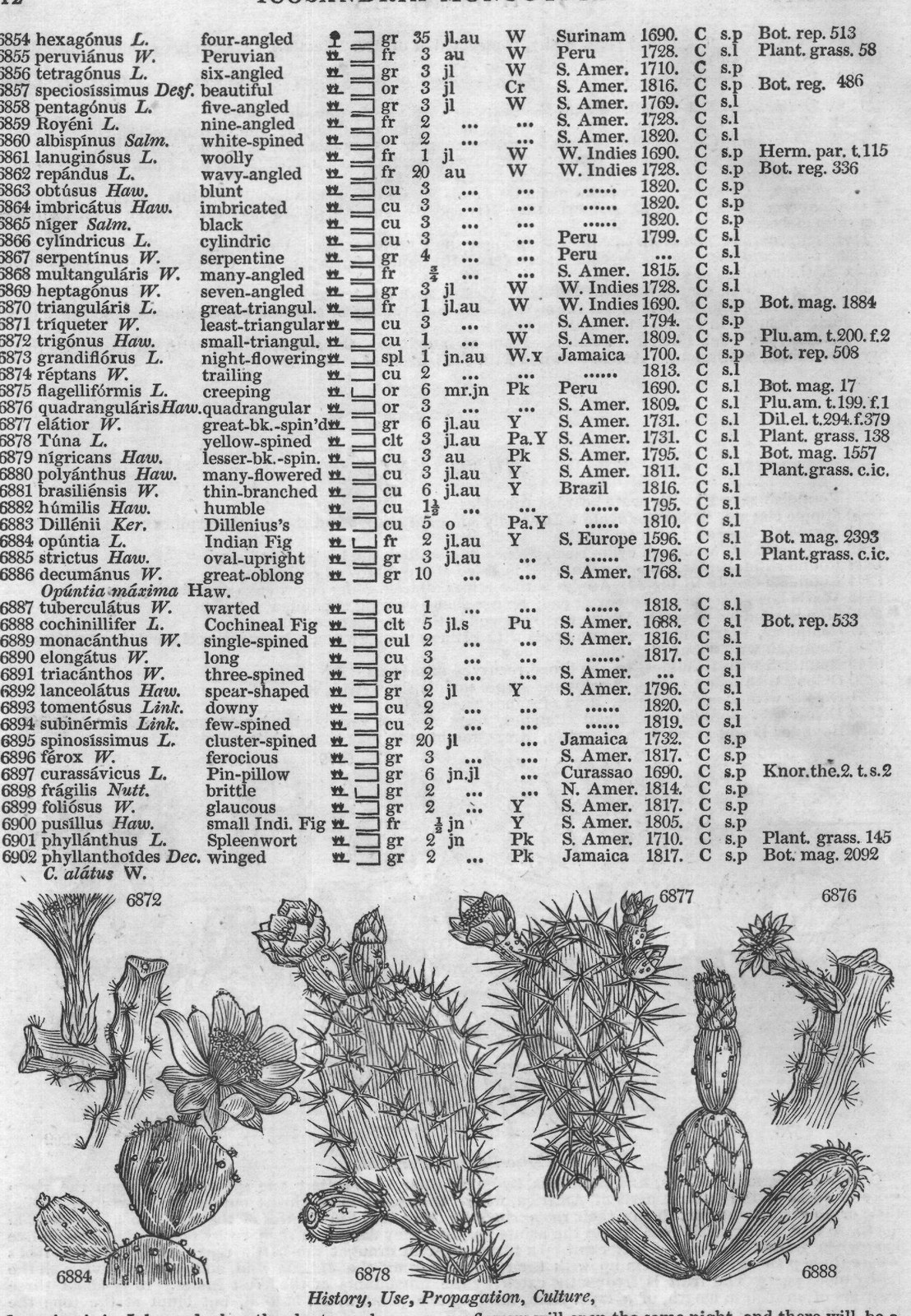
C. repandus has a fruit about the size and shape of a Bergamot pear, having many soft spines on the skin; the outside is a pale yellow, the inside very white, full of pulp, having a great number of small black seeds lodged in it. It frequently flowers in July, and in warm seasons will perfect its fruit, which has very little flavor in this country, but is frequently served up at table in the West India islands. The fruit of lanuginosus and peruvianus are also occasionally eaten where they are natives. C. grandiflorus and flagelliformis have flowers remarkable for their beauty and sweetness. C. grandiflorus, when arrived to a sufficient strength, will produce many exceeding large, beautiful, sweet scented flowers, like most of this kind, of very short duration , scarcely continuing six hours full blown: nor do the flowers ever open again when once closed. They begin to open between seven and eight of the clock in the evening, are fully blown by eleven, and by three or four in the morning they fade, and hang down quite decayed; but during their short continuance, there is scarcely any flower of greater beauty, or that makes a more magnificent appearance; for the calyx of the flower, when open, is near a foot diameter; the inside of which, being of a splendid yellow color, appears like the rays of a bright star; the outside is of a dark brown; the petals being of a pure white add to the lustre; the vast number of recurved stamens surrounding the style in the centre of the flower make a fine appearance: add to all this the fine scent of the flower, which perfumes the air to a considerable distance . There is scarce any plant which deserves a place in the hothouse so much as this, especially as it may be trained against the wall, where it will not take up any room. The usual season of its 6854 hexagónus L. four-angled gr 35 jl.au W 6855 peruviánus W.
Peruvian fr 3 au W 6856 tetragónus L. six-angled gr 3 jl W 6857 speciosíssimus Desf. beautiful or 3 jl Cr 6858 pentagónus L. five-angled gr 3 jl W 6859 Royéni L. nine-angled fr 2 ... ... 6860 albispínus Salm. white-spined or 2 ... ... 6861 lanuginósus L. woolly fr 1 jl 6862 repándus L. wavy-angled fr 20 au W ICOSANDRIA MONOGYNIA.
Surinam 1690. C s.p Peru 1728. C s.I S. Amer. 1710. C s.p S. Amer. 1816. C s.p S. Amer. 1769. C s.l S. Amer. 1728. C s.l S. Amer. 1820. C s.l W W. Indies 1690. Cs.p W. Indies 1728. C s.p CLASS XII.
Bot. rep. 513 Plant. grass. 58 Bot. reg. 486 Herm. par. t.115 Bot. reg. 336 6863 obtúsus Haw. blunt cu 3 ... ... 6864 imbricátus Haw. imbricated cu 3 ... ... 6865 níger Salm. black cu 3 ... ... ...... 1820. C s.p ...... ...... 1820. C s.p 1820. C s.p 6866 cylíndricus L. 6867 serpentínus W. 6868 multanguláris W. 6869 heptagónus W. 6870 trianguláris L. 6871 tríqueter W. cylindric cu 3 ... ... serpentine gr 4 ... ... many-angled fr ... ... seven-angled gr 3 jl W great-triangul. fr 1 jl.au W least-triangular cu 3 ... ... 6872 trigónus Haw. small-triangul. cu 1 W ... 6873 grandiflórus L. night-flowering spl 1 jn.au W.Y 6874 réptans W. trailing cu 2 ... 6875 flagellifórmis L. 6876 quadranguláris Haw.quadrangular creeping or 6 mr.jn Pk Peru or 3 ... ... 6877 elátior W. great-bk.-spin'd gr 6 jl.au Y 6878 Túna L. yellow-spined clt 3 jl.au 6879 nígricans Haw. lesser-bk.-spin. cu 3 au Pk 6880 polyánthus Haw. many-flowered cu 3 jl.au Y 6881 brasiliensis W. 6882 húmilis Haw. 6883 Dillénii Ker. thin-branched humble Dillenius's cu 6 jl.au Y 业 cu 1 ... ... 业 cu 50 Pa. Y ...... ...... 6884 opúntia L. 6885 strictus Haw.
Indian Fig oval-upright fr 2 jl.au Y gr 3 jl.au ... ...... 6886 decumánus W.
Opúntia máxima 6887 tuberculátus W. great-oblong 业 gr 10 ... ...
Haw. warted cu 1 ... ... ...... 1818. C s.l 6888 cochinillifer L. 6889 monacánthus W.
Cochineal Fig clt 5 jl.s Pu Peru 1799. C s.l Peru S. Amer. 1815. C s.l W. Indies 1728. C s.l W. Indies 1690. C s.p S. Amer. 1794. C s.p S. Amer. 1809. C s.p Jamaica 1700. C s.p 1813. C s.l 1690. C s.l ..
S. Amer. 1809. C s.l S. Amer. 1731. C s.l Pa.Y S. Amer. 1731. C s.1 S. Amer. 1795. C s.l S. Amer. 1811. C s.l Brazil 1816. C s.l 1795. C s.l 1810. C s.l S. Europe 1596. C s.1 1796. C s.l S. Amer. 1768. C s.l Bot. mag. 1884 Plu.am. t.200. f.2 Bot. rep. 508 Bot. mag. 17 Plu.am. t. 199. f.1 Dil.el. t.294.f.379 Plant. grass. 138 Bot. mag. 1557 Plant.grass. c.ic.
Bot. mag. 2393 Plant.grass. c.ic.
S. Amer. 1688. C s.1 Bot. rep. 533 C s.l ... single-spined cul 2 ... ...
S. Amer. 1816. C s.l 6890 elongátus W. long 业 cu 3 1817. C s.l ... ... 6891 triacánthos W. three-spined 业 gr 2 S. Amer. ... ... ...
C s.l 6892 lanceolátus Haw. spear-shaped gr 2 jl Y S. Amer. 1796. C s.l 6893 tomentósus Link. downy cu 2 ... ... ...... 1820. C s.l 6894 subinérmis Link. few-spined cu 2 ... ... ... 1819. C s.l 6895 spinosíssimus L. cluster-spined gr 20 jl ... 6896 férox W. ferocious gr 3 6897 curassávicus L.
Pin-pillow 6898 frágilis Nutt. brittle gr 6899 foliósus W. 6900 pusíllus Haw. 6901 phyllanthus L. 6902 phyllanthoides Dec. winged C. alátus W. glaucous gr small Indi. Fig fr Spleenwort gr gr 3622 22 ... ... gr 6 jn.jl ...
Jamaica 1732. C s.p S. Amer. 1817. C s.p Curassao 1690. C s.p Knor.the.2. t. s.2 ... 12 ...
N. Amer. 1814. C s.p Y S. Amer. 1817. C s.p Y S. Amer. 1805. C s.p Pk S. Amer. 1710. C s.p Plant. grass. 145 ...
Pk Jamaica 1817. C s.p Bot. mag. 2092 6872 6877 6876 6884 6878 History, Use, Propagation, Culture, 6888 flowering is in July, and when the plants are large, many flowers will open the same night, and there will be a succession of them for several nights together. Sometimes six, six, eight, or ten flowers open at the same time on one plant, making a most magnificent appearance by candle-light: but none of them are succeeded here by any appearance of fruit, Č. flagelliformis produces a greater number of flowers than the foregoing sort: they come out in May, and sometimes earlier, when the season is warm. The petals are of a fine pink color both within and without; they are not so numerous, and the tube of the flower is longer than that of the other. These flowers keep open three or four days, provided the weather, or the place where the plants stand, be not too warm; and during their continuance they make a fine appearance. This sort has very slender trailing branches, which require a support: they are not jointed, nor do they extend so far as those of the other sort. Fruit sometimes succeeds the flowers, but seldom ripens.
C. triangularis, the strawberry pear, Poirer de Chardon, Fr., bears the best flavored fruit of any of the sorts; it is slightly acid, and at the same time sweet, pleasant, and cooling; in Martinique and other West India islands it is much esteemed.
C. opuntia, native of the country of the Opuntiani, whose chief town was Opus, in the vicinity of Phocis, though like the others a native of America, is now found growing wild on the sides of the roads between Rome and Naples and other parts of Italy, and even in the Valais. Gerarde says, it was brought from Virginia into England, and Collinson had it from Newfoundland. It was fruited in Scotland in a stove by ORDER I.
ICOSANDRIA MONOGYNIA. 6854 Erect with deep furrows long with 6 distant angles 6855 Erect with deep furrows long with about 8 obtuse angles 6856 Erect with deep furrows long with 4 compressed angles 6857 Erect with deep furrows long slightly quadrangular with toothed angles 6858 Erect with deep furrows long jointed with about 5 angles 6859 Erect slender with shallow furrows jointed with 9 angles, Joints ovate, Spines as long as wool 6860 Erect slender with shallow furrows jointed with 9 angles not glaucous, Spines white; a variety of the last 6861 Erect slender with shallow furrows long with 9 obsolete angles, Spines shorter than wool 6862 Erect slender with shallow furrows long with 8 compressed wavy angles, Spines longer than wool 6863 Erect slender with shallow furrows, Branches jointed few bluntly triangular 6864 Erect slender with shallow furrows, Scarcely ang. Surface covered with variously imbric. lobed divisions 6865 Erect slender with shallow furrows black with numerous brown spines longer than the wool 6866 Erect slender with shallow furrows weak cylindrical, Surface covered with netted crossing furrows 6867 Erect rounded below long elegant with about 9 angles, Spines snow-white weak, Wool very short 6868 Erect with 18 close obtuse angles with bristly yellowish spines longer than the wool 6869 Erect with deep furrows oblong with 7 angles 6870 Creeping triangular rooting 6871 Decumbent rooting 3-cornered, Spines fascicled divaricating seven two or three lines long 6872 Creeping rooting 3-cornered with scarcely channelled angles, Spines 5-7 in stellate fascicles 6873 Creeping rooting with about 5 angles 6874 Creeping 5-cornered with subulate spines longer than the wool 6875 Creeping rooting hispid with 10 angles 6876 Creeping with 3 or 4 angles which are scarcely channelled, Spines 5-7 in stellate parcels 6877 Erect, Joints broadly ovate-oblong, Spines subulate very long blackish 6878 Erect, Joints broadly ovate-oblong, Spines subulate long yellow 6879 Erect, Joints oblong and lanceolate, Spines of various shapes brownish black 6880 Joints oblong and ovate, Spines of various shapes yellow, Fl. numerous solitary 6881 Stem rounded, Branches ovate compressed flat, Spines solitary or 3 together subulate strong 6882 Joints cuneate obovate decumbent, Spines variously shaped yellow 6883 Erect, Joints obovate roundish glaucous, Stigma 6-lobed 6884 Creeping prostrate, Joints ovate, Spines even numerous hair-shaped 6885 Erect, Joints ovate elliptical, Spines even numerous short 6886 Joints ovate oblong very thick, Spines unequal 6887 Jointed proliferous, Joints oval, Warts with a cluster of spines the length of the wool 6888 Joints ovate oblong unarmed 6889 Erect, Joints lanceolate-oblong, Clusters of spines fuscous weak with one strong white spine 6890 Erect, Joints oblong or oval, Spines numerous variable brown; one very long straw-colored 6891 Jointed proliferous, Joints ovate oblong with strong white spines longer than wool 6892 Nearly erect, Joints lanceolate with even short spines, Leaves 3 lines long 6893 Branches oblong with short soft hairs, Spines small 6894 Branches oblong scarcely spiny 6895 Joints very long slender compressed, Spines very long slender clustered white 6896 Joints oblong with numerous stiff spines of which one is very long and white at base 6897 Joints brittle cylindrical ventricose compressed much divaricating 6898 Joints brittle compressed short, Spines numerous variable white erect 6899 Jointed proliferous, Joints lanceolate-glaucous, Spines bristly longer than wool Spines unequal 6900 Joints brittle linear-lanceolate divaricating, Spines unequal 6901 Proliferous smooth branched ensiform compressed serrated with a central woody rib 6902 Branches ensiform compressed obovate with spreading teeth, Spines few setaceous longer than wool 6897 6904 6901 6907 6902 6908 6903 and Miscellaneous Particulars.
Justice, in 1750, and recently by Braddick, near London, in the open air. This active horticulturist, having eaten with pleasure of the prickly pear in Virginia, was desirous of cultivating it here. He recollected that the plant in its wild state delighted in a dry soil, amongst rocks, near the skirts of the sunny sides of the forests; and having heard that it would stand the open air in this country, he planted it in the compost described below, placed in a sheltered situation open to the sun. "The first plant that I turned out has lived in the open ground of this country for six or seven years, during which period it has endured one exceeding hard winter, and several trying springs; and in all, except the two first years, it has never failed to ripen its fruit and seeds, so that it may be now considered decidedly acclimated. The compost used by me for growing the Cactus Opuntia, is the following: one half is carbonate of lime, for which lime-rubbish from old buildings will answer; the remaining half consists of equal portions of London clay and peat-earth, having the acid neutralised by barilla: these are intimately blended and sifted. One square yard of this compost I conceive to be sufficient for one plant, which must be placed in the middle of a small artificial hillock, raised eighteen inches above the surface of the ground, which ground should be rendered perfectly dry, if not naturally so, by under-draining. Neither the leaves, flowers, nor fruit should ever be suffered to touch the ground, but they should as constantly as they are produced be kept from the earth by placing stones, pebbles, flints, or bricks under them, in imitation of artificial rock-work." (Hort. Trans. ii. 238.) C. Ficus indica is very common in Jamaica, and on it feed the wild sort of cochineal insect. The fruit is large and of a deep purple color, and when eaten dyes the urine of a bloody color. 6903 truncátus Link. 6904 Pereskia L. truncate gr 1 jn gr 5 o.n 6912 ornáta Ph. 6913 núda Ph. 6905 grandifólius Haw. large-leaved 6906 longispinus Haw. long-spined 1112. RHIP'SALIS. Gært. RHIPSALIS. 6907 Cassútha G.
Cáctus péndulus W. 6908 parasíticus Haw. parasitic 6909 grandiflorus Haw. large-flowered 6910 fasciculátus W. en. bundled 6911 salicornoídes Haw. salt-wort 1113. BARTONIA. Ph. naked-seededor 1114. PHILADEL/PHUS. W. SYRINGA. gr 3 gr 2 ICOSANDRIA MONOGYNIA.
Barbad. Gooseb. 业 ΠOΠ Pk W Brazil CLASS XII. 1818. C s.p Bot. reg. 695 W. Indies 1696. C s.p Dil.el.t.227.f.294 Brazil 1818. C s.p S. Amer. 1808. C s.p Cacti.
Sp. 5. naked cu 1 s Y W. Indies 1758. C s.p Hook. ex. fl. 20 ΠΠΠΠ cu 1 ...
Y S. Amer. 1800. C s.p Plant. grass. 59 cu 1 jl W ...... 1818. C s.p cu 1 ... cu 1 jn Y Y S. Amer. 1817. C s.p E. Indies 1817. C s.p Bot. mag. 2461 BARTONIA.
Loaseæ. Sp. 2. 2 jl.s W Missouri 1811. C s.p Bot. mag. 1487 winged-seeded or 2 jl.s W Missouri 1811. C s.p Myrtaceæ.
Sp. 4-6. 6914 coronárius W. common or 8 my.jn W ẞ nánus dwarf or 2 my.jn W ...... 6915 inodórus W. scentless or 2 jn.jl W 6916 grandiflórus Ph. large-flowered or 6 jn.jl W S. Europe 1596. L co Carolina 1738. L co Carolina 1811. L co Bot. mag. 391 Bot. mag. 1478 Bot. reg. 570 6917 hirsútus Nutt. hairy or 3 jn W N. Amer. 1820. L co