Home › B › Bot (Reg ac tus W great sharp seaec)
Bot (Reg ac tus W great sharp seaec)
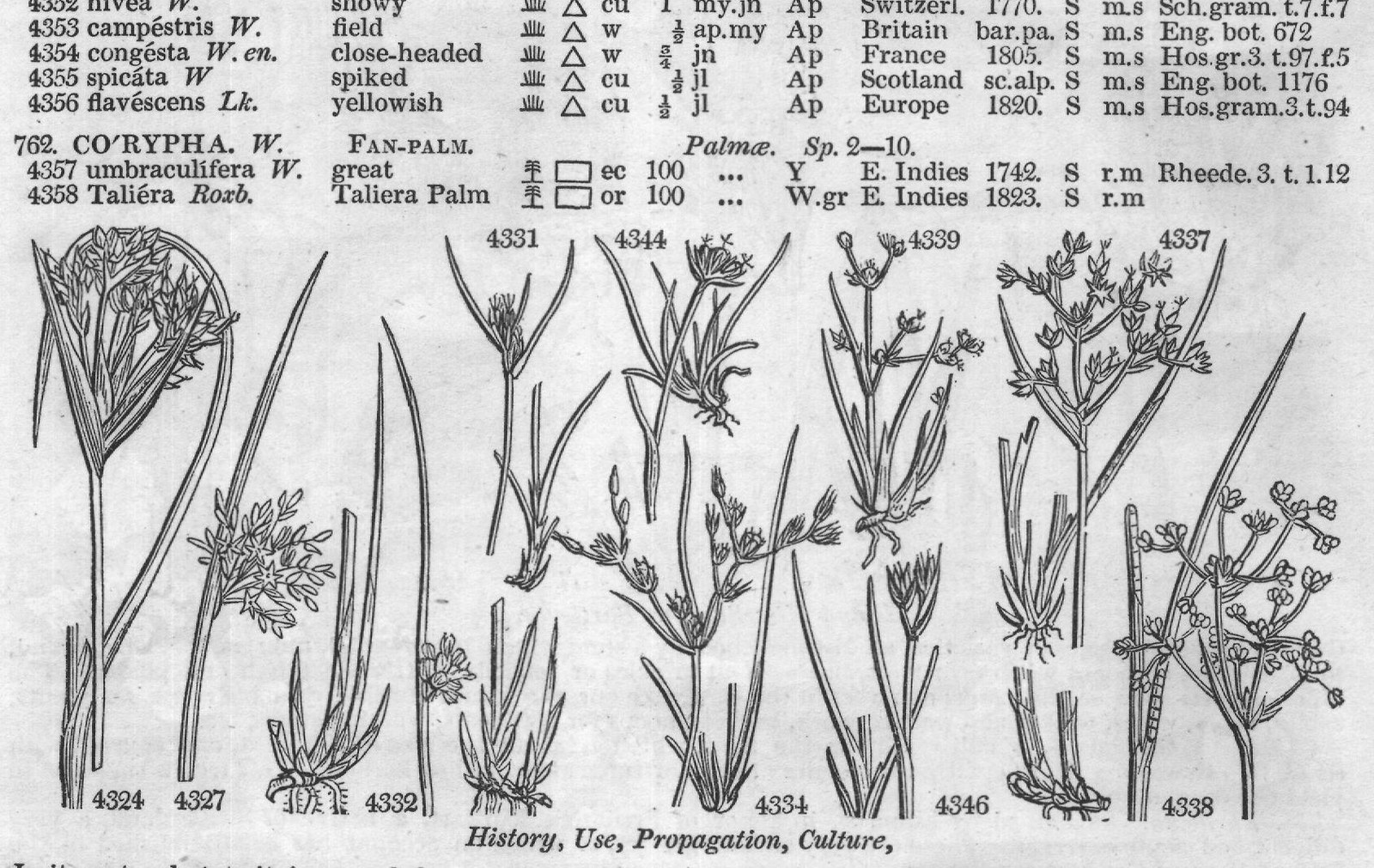
reg. 628 4324 acútus W. great sharp seaec 6 jl.au 4325 marítimus P. S. lesser sharp sea ec 4 au Ap Britain Ap Britain sal. m. S sea co. S S s Eng. bot. 1614 Eng. bot. 1725 4326 conglomerátus W. common ec 2 jn.jl Ap Britain moi.p. S m.s Eng. bot. 835 4327 effúsus W. soft 4328 glaúcus W. hard ec Дec. 3 my.au Ap 2 jl Ap Britain moi.p. S England moi.p. S m.s Eng. bot. 836 m.s Eng. bot. 665 4329 bálticus W. coast cu 1 jl Ap Europe 1820. S s 4330 árcticus L. arctic cu 1 my Ap 4331 filifórmis W. least cu au Ap 4332 trífidus W. three-leaved cu 1 jl Ap 4333 squarrósus W.
Goose-corn W jn.jl Ap 4334 grácilis E. B. slender cu jl.au Ap 4335 capitátus W. headed O cu jl.au Ap 4336 lampocárpus L. T. 4337 acutiflórus L. T. shining-fruited W 2 jn.au Ap sharp-flowered w 2 jl.au Ap 4338 obtusiflórus L. T. blunt-floweredw 1 2 au Ap 4339 uliginósus H. K. little-bulbous Aw 1 jn.jl Ap 4340 aristátus Mich. bearded cu 1 jl Ap 4341 subverticillátus W. half-whorled cu jl.au Ap 4342 bulbósus W. bulbous-rooted W 1 jl.au Ap Britain 4343 bufónius W. toad W jl.au Ap 4344 triglúmis W. three-flowered cu jl Ap 4345 biglúmis W. two-flowered cu au Ap 4346 castáneus H. K. black-spiked cu 1 jl Ap 761. LU ZULA. Dec.
LUZULA.
Junceæ. Sp. 4347 pilósa W. hairy 4348 Forstéri E. B.
Forster's A عائلا A للاد mr.my Ap Ap 4349 máxima W. 4350 lútea W. 4351 álbida W 4352 nívea W. 4353 campéstris W. 4354 congésta W.en. 4355 spicáta W 4356 flavéscens Lk. 762. CO'RYPHA. W. 4357 umbraculífera W. 4358 Taliéra Roxb. yellowish FAN-PALM. great Taliera Palm wood 2 my Ap yellow cu 1 my.jn Ap white-headed cu 1 my.jn Ap snowy field close-headed A cu للاد A W علا A عاد 1 my.jn Ap ap.my Ap 4 jn Ap spiked cu Ap Ap jl cujl Norway 1822. S m.s Flor. Dan.t.1094 Britain tur.bo. S m.s Eng. bot. 1175 Scotland sc.alp. S m.s Eng. bot. 1482 Britain sa.hea. S m.s Eng. bot. 933 Scotland sc.alp. S m.s Eng. bot. 2174 Europe Britain moi.p. S m.s Eng. bot. 2143 Britain moi.p. S m.s Eng. bot. 238 Britain mar. Sm.s Eng. bot. 2144 England tur.he. S m.s Eng. bot. 801 N. Amer. 1823. S s Europe 1821. S m.s Sm.s Eng. bot. 934 Britain w.s.gr. S m.s Eng. bot. 802 Britain bgs.m. Sm.s Eng. bot. 899 Scotland bgs.m. S m.s Eng. bot. 898 Scotland sc.alp. S m.s Eng. bot. 900 10-25.
Britain groves. S m.s Eng. bot. 736 England woods. S m.s Eng. bot. 1293 Britain woods. S m.s Eng. bot. 737 Switzerl.
Switzerl.
Switzerl. 1770. S m.s Sch.gram. t.7.f.7 Britain bar.pa. S m.s Eng. bot. 672 France 1805. S m.s Hos.gr.3. t.97.f.5 Scotland sc.alp. S m.s Eng. bot. 1176 Europe 1820. S m.s Hos.gram.3.t.94 Sm.s Leer.her.t.13.f.6 Palma. Sp. 2-10. ... 4331 ec 100 or 100 4344 ...
X Y E. Indies 1742.
W.gr E. Indies 1823. 4339 Sr.m Rheede. 3. t. 1.12 Sr.m 4337 1823. S s ... ...
Sm.s ... 4324 4327 推庆 4332 4334 4346 History, Use, Propagation, Culture, 4338 In its natural state it is one of the most bitter and acrid, but loses something of these qualities by culture. The raw root is rasped, and washed frequently in water, when a white meal falls to the bottom like starch; this is again washed twice or thrice, till no more acrimony can be perceived in the water. The meal is then dried in the sun. The first infusions are thrown away carefully, being looked upon as noxious and even deadly. In Otaheite and the other Society isles, they make of this meal a tasteful, nourishing, gelatinous cake-like salep. In Banda, where sago bread is not common, they use this as a succedaneum, and it is even preferable to the other. They also apply it as a plaster to deep wounds. The petioles and stalk boiled a long time lose their acrimony, and are rendered fit for food, as well as the roots, in China and Cochin-China. 759. Aspidistra. From aσπiς, a little round shield, on account of the form of the flower. A plant with the same habit as Tupistra, but with solitary radical flowers half buried in the earth. 760. Juncus. From the Latin, jungo, to join the first ropes were made of rushes. The Junceæ and Cyperaceæ form intermediate links between the Gramineæ and the Liliaceæ; some of the latter, as Anthericum, bearing considerable resemblance to the Junceæ.
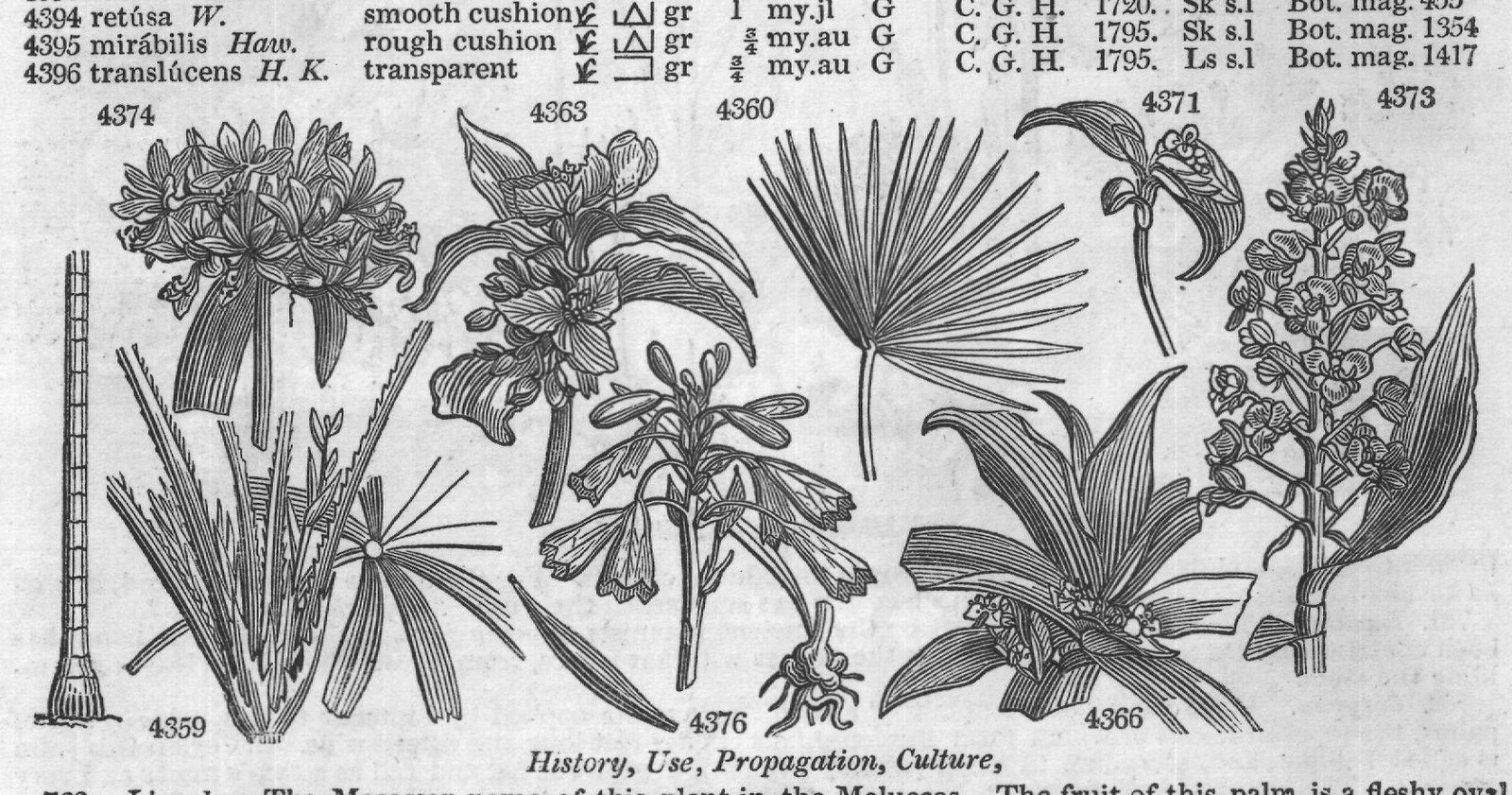
J. acutus and maritimus are planted on the sea-embankments of Holland, and also in some parts of our own coasts, and in America. The roots run deep into the sand, and form a matted body which holds it together. In Holland, when the plants are fully grown and in flower, they are cut down down, dried, and bound up like corn. The J. acutus, being very rough, is used for scouring copper and other vessels, and is one of the plants imported into this country for that purpose, under the name of the Dutch rush. The other species, and often both, are plaited into mats, baskets, chair-bottoms, ropes, &c. J. conglomeratus and effusus are used when green for making little baskets and children's ornaments; and the pith of this and other species is used as wicks for watch-lights, and children's toys. J. glaucus and conglomeratus are bad weeds in wet-bottomed clayey pastures. The best way of removing them is to dig them out, and to prevent their growth, to lay the land dry by surface and under-drainage. These species, and some others, are gathered green by the Dutch gardeners, and used when dry as tyes for fruit-trees. Sir J. E. Smith says, "they both, probably, served for strewing floors in England, as mentioned by Shakspeare and Sir Thomas More, about the time of Edward IV., and later; till more refined manners wrought ORDER I. 4323 The only species HEXANDRIA MONOGYNIA. 4324 Culm rounded mucronate, Panicle terminal, Invol. 2-leaved spiny 4325 Panicle terminal proliferous, Involucre 2-leaved spiny, Caps. obl. acute as long as sepals 4326 Culm upright, Pan. lateral globose, Caps. retuse, Flowers triandrous 4327 Culm upright, Pan. lateral decompound effuse, Caps. clavate truncate at end glaucous 4328 Culm glaucous at the end bent inwards and rounded, Pan. lat. erect, Caps. oblong acute 4329 Culm pungent, Panicle effuse 4330 Culm erect, Umbel lateral, Pedunc. many-fl. Flowers sessile 4331 Culm filiform nodding, Panicle lateral 4332 Leaves and flowers ternary terminal 4333 Leaves setaceous, Heads clustered leafless 4334 Leaves linear flat, Stem dichotomous racemose higher than leaves, Flowers solitary 4335 Culm filiform, Head terminal sessile solitary in an involucre 4336 Leaves jointed compressed, Culm not jointed, Panic. erect, Caps. colored shining 4337 Leaves jointed compressed, Culm not jointed, Panic. compound dichotomous, Sepals acute 4338 Leaves and stem jointed round, Panic. divaricating, Sepal obtuse as long as capsule 4339 Leaves bristly somewhat knotty, Heads 3-flowered proliferous, Culm bulbous rooting 4340 Bulbous, Culm leafy crect compressed, Flowers 3-androus and bracteæ bearded 4341 Culm procumbent, Leaves setaceous jointed, Corymb dichotomous divaricating, Head 5-fl. sessile 4342 Leaves linear channelled, Culm leafy at base, Pan. cymose, Caps. obtuse 4343 Leaves linear channelled, Culm dichotomous racemose, Flowers solitary 4344 Leaves flat, Head 3-flowered terminal erect leafless with bracteæ 4345 Leaves flat, Head 2-flowered terminal one-sided leafy at base 4346 Leaves flat stem-clasping, Head terminal double many-flowered leafy at base, Bractes acute 4347 Leaves pilose, Panic. cymose divaricating, Flowers solitary, Caps. obtuse 4348 Leaves pilose, Panic. cymose erect, Flowers solitary, Caps. pointed 4349 Leaves pilose taper-pointed, Panic. cymose decompound, Flowers in bundles 4350 Leaves and sheaths smooth, Corymb comp. close, Pedunc. many-flowered, Sepals acute shining 4351 Leaves pilose, Corymb decomp. spreading shorter than leaves, Sepals mucronate equal, Root fibrous 4352 Leaves pilose , Corymb comp. contracted shorter than leaves, Sepals acute unequal, Root creeping 4353 Leaves pilose, Spikes terminal, Capsules obtuse 4354 Like the last, but the culm is panicled cled with ovate spikes 4355 Leaves flat, Spike racemose nodding compound at base, Capsules acute 4356 Like Luzula pilosa, but heads are yellower, Leaves broader, Flowers and capsules larger 4357 Fronds pinnate palmate with a thread between the segments, Spadix erect 4358 Seeds roundish dark-colored rugose the size of a nutmeg 4323 4347 4349 4353 4348 4354 4357 and Miscellaneous Particulars. them into mats, and foreign commerce at length introduced carpets. For the former purpose, indeed, as well as for chair-bottoms and hassocks, Scirpus lacustris has superseded their use. (English Flora, p. 162.) 761. Luzula. These plants were called by the ancient botanists Gramen Luzule; whence this name has been contrived by Decandolle to distinguish the rushes with flat leaves, from those which have leaves resem- bling the stem. contrived by Decandolle to distinguish the rushes with flat leaves, from those which have leaves resembling the stem. 762. Corypha. From κoρuφη, the summit of any thing; a name applied by Linnæus to this noble genus of palms, the topmost leaves of which form immense fans twenty feet long and fifteen wide. In Ceylon this palm , the topmost leaves of which form immense fans twenty feet long and fifteen wide. In Ceylon this palm is called Tallipot , and, according to Knox (Hist. of Ceylon.), it grows as big and tall as a ship's mast, and very straight. The leaves are of great use, one being so broad and large, that it will cover fifteen or twenty men. Being dried it is very strong and limber; and though it be very broad when open, yet it will fold close like a fan, and then is no bigger than a man's arm. The whole leaf spread is round, but is cut into triangular pieces for use: these they lay upon their heads as they travel, with the narrow end foremost, to make their way through thickets. Soldiers all carry them, not only to shade them from the sun, and to keep them dry in case of rain on their march, but to make their tents for them to lie under. These leaves all grow on the top of the tree. It bears no fruit until the last year of its life, and then yellow blossoms, most lovely to behold, but smelling very strongly, come out on the top, and spread abroad in great branches; these come to a fruit, round and very hard, as big as our largest cherries; in such abundance, that one tree will yield seed enough for a country; but not good to eat. The flowers smell so strong, that they cut down the trees when they are near houses . The trunk within is a pith only, which they beat in a mortar to flour, and bake cakes of it, which taste much like white bread. The leaves also serve for covering their houses, and for writing on with an iron style. Most of the books which are shown in Europe for the Egyptian papyrus, are made from the leaves of this palm. In Malabar it is called Codda-pana. Rumphius, Loureiro, and Adanson mention several other species of this palm The C. taliera is a fine tree of prodigious use in the northern provinces of India for covering houses and for other useful purposes. useful purposes.
S2 763. LICUA'LA. W.
LICUALA. 4359 spinósa W. spiny ec 6 764. THRI'NAX. W.
THRINAX.
HEXANDRIA MONOGYNIA.
Palma. Sp. 1-2.
CLASS VI.
W.gr E. Indies 1802. Sr.m Rump.amb.1. t.9 Palma. Sp. 1-3. 4360 parviflóra W. small 手 ec 15 W.gr Jamaica 1778. S r.m 765. TRADESCAN'TIA. W. SPIDERWORT.
Commelineæ. Sp. 12-29. 4361 virgínica W. common or 1 my.o B N. Amer. 1629.
D p.1 Bot. mag. 105 4362 rósea Ph. rose-flowered or 1 my.o Pk Carolina 1802.
Dr.m Bot. cab. 370 4363 subáspera B. M.
Lyon's. or my.o Pu N. Amer. 1812.
Dr.m Bot. mag. 1597 4364 crassifólia W. thick-leaved or 3 jl.o B Mexico 1796.
Ls.p Bot. mag. 1598 4365 erécta W. upright or 2 jl.au B Mexico 1794.
Sr.m Bot. mag. 1340 4366 díscolor W. purple-leaved or 1 ap.s W S. Amer. 1783.
Sk s.p Bot. mag. 1192 4367 malabárica W.
Grass-leaved or 1 jl.au Pu E. Indies 1776.
Sk r.m Rheed.ma.9.t.63 4368 fuscáta Lodd. rusty or S.O B S. Amer. 1820.
Lr.m. Bot. reg. 482 4369 parviflóra Fl. per. small-flowered or 1 au.s B Peru 1822.
Lr.m Fl. per. t. 272 4370 geniculáta W. knotted or 1 jl.au B W. Indies 1783.
Ls.p Jac. amer. t. 64 4371 cristáta W. crested or 1 jl.s B Ceylon 1770.
Dr.m Bot mag. 1435 4372 Zanónia Red.
Gentian-leav'd or 1½ jl.d B W. Indies 1759.
Sr.m Red. lil. 192 766. DICHORIZAN DRA. Vand. DICHORIZANDRA.
Commelineæ.
Sp. 1-4. 4373 thyrsiflóra Vand. thyrsoid or 4 au B Brazil 1822. Rr.m Bot. reg. 682 767. AGAPAN'THUS. W. AFRICAN LILY.
Hemerocallideæ. Sp.2-3. 4374 umbellátus W.
ẞ variegatus striped-leaved large-flowered or or 2 ja.au B 3 ja.au B C. G. H. 1692.
Rr.m Bot. mag. 500 ...
Rr.m 4375 præ'cox W. en. small-flowered or 4 ja.au P.BC. G. H.
Rr.m Bot. cab. 42 ... 768. BLANDFOR DIA.
R. Br. BLANDFORDIA.
Hemerocallideæ. Sp. 2-3. 4376 nóbilis R. Br. noble or 4377 grandiflóra R. Br. large-flowered or 2 jl.au Or N. S. W. 1803. S s.l.p Ex. bot. 1. t. 4 2 jl.au Cr N. S. W. 1812. S s.l.p Lab. no. ho.t.111 769. HEMEROCAL/LIS. W. DAY LILY.
Hemerocallideæ. Sp.7-9. 4378 gramínea H. K. narrow-leaved or 1 jn.jl L.Y Siberia 4379 fláva H. K. yellow or 2 jn Y Siberia 4380 dísticha Donn. fan-like or 2 my.jl Or China 4381 fúlva W. copper-colored or + jn.au Ful Levant 4382 Liliástrum W.en. Savoy-Spiderw.or 1½ my.jn W 1759. R. s.l 1596. R s.l 1798. R s.l 1596. R s.1 Switzerl. 1629. Rs.1