Home › B › Bot (Mag History Use Propagation) (II)
Bot (Mag History Use Propagation) (II)
mag. 1488 4304 4305 4512 4311 4313 History, Use, Propagation, Culture, 751. Curculigo. From Curculio, the weevil, one of the Coleopterous insects; the seed having a process resembling the rostrum or beak of that animal. The species are of the easiest culture and increase, but of little beauty. They in most respects resemble Hypoxis. 752. Bambusa. Latinized from the Indian name Bambos. B. arundinacea has a woody, hollow, round, straight culm, forty feet high and upwards, simple and shining; the internodes a foot in length and circumference; sheaths thick, hairy, rough, convolute, deciduous; branches alternate, slender, solid, spiny, reclining, springing out from the base to the very top; the lower ones being usually cut off. Panicle of flowers diffused in spikes It grows naturally almost every where within the tropical regions. Over a great part of Asia it is very common; in China, Cochin-China, Tonquin, Cambodia, Japan, Ceylon, the peninsula of India, and the islands. It has been long introduced into the West Indies, and is said to flourish likewise in South Carolina. There is, perhaps, scarcely any plant that serves for such a variety of domestic purposes. In the East Indies great use is made of it in building, and the houses of the meaner people are almost entirely composed of it. Dr. Patrick Brown mentions, that it was yet strong and perfect in some of the houses which had been built by the Spaniards in Jamaica above a hundred years before. Bridges also are made of it, masts for their boats, boxes, cups, baskets, mats, and a great variety of other utensils and furniture, both domestic and rural. Paper also is made from it, by bruising and steeping it in water, and thus forming it into a paste. It is the common fence for gardens and fields; and is frequently used as pipes for conveying water. The leaves are generally put round the chests of tea which are sent to Europe from China, as package, fastened together so as to form a kind of mat. The tops of the tender shoots are frequently pickled in the West Indies. In the cavities or tubular parts of the bamboo is found at certain seasons a concrete white substance, called Tabasheer or Tabachir, an article which the Arabian physicians hold in high estimation. It is commonly found in what are called the female or large bamboos. The bamboos which contain this concrete are found on shaking to contain a fluid, which, after some time, gradually lessens, and then they are opened in order to extract the Tabasheer. The nature of this substance is very different from what might have been expected in the product of a vegetable. Its indestructibility by fire, its total resistance to acid, its uniting by fusion with alkalies in certain proportions into a white opaque mass, into a transparent permanent glass, and it being again separable from these compounds entirely unchanged by acids, &c. seem to afford the strongest reasons for considering it as very nearly identical with common siliceous earth. As to its medical virtues, though the drug be, as before observed, in much esteem with the orientalists, yet they are not such as to cause it to have any regard paid it in the modern practice of physic in Europe. The bamboos grow rapidly to a great height in our stoves in moist loamy soil, and they are readily increased by suckers. 753. Calamus. From κaλaμoς, a reed, in Greek; qalem, in Arabic; calam, in Sclavonic; calamus, and culmus, in Latin. This genus seems to form the connecting link between the palms and the gramineous plants, having the inflorescence of the former, and the habit of the latter. It furnishes the rattan canes, of which ORDER I.
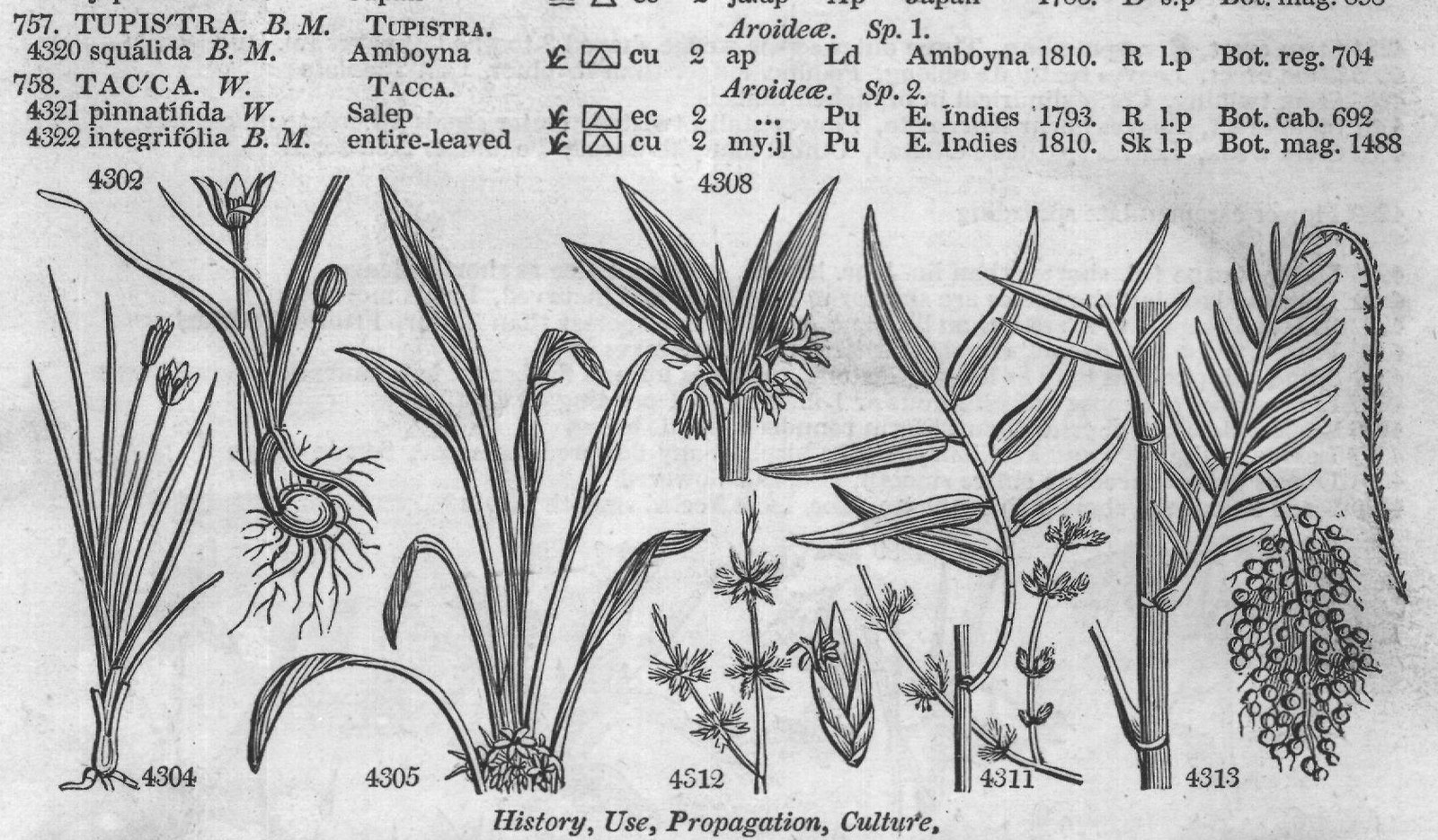
HEXANDRIA MONOGYNIA. 4300 Leaves radical numerous white beneath with stellate hairs, Umbel few-flowered 4301 Scape 1-fl. shorter than the oblong elliptical smooth plaited leaves 4302 Leaves linear smooth channelled, Flower solitary green outside 4304 Leaves channelled hairy entire, Scapes 1-fl. 4303 Scape 1-fl. shorter than the linear ciliate serrate keeled leaves, Flowers out of flower reflexed 4305 Leaves lanceolate on long stalks, Head sessile, Flowers shorter than bractes 4306 Leaves linear subulate, Flowers sessile 4307 Leaves linear subulate, Flowers stalked 4308 Leaves lanceolate, Tube of flower very long 4309 Leaves elliptical, Head sessile, Tube of flower scarcely longer than limb 4310 Leaves elliptical recurved, Head stalked cernuous, Tube of flower very short 4311 Panicle branched divaricating 4312 Spike terminal simple whorled 4313 Prickles of stem reflexed, Spadix divaricating straight 4314 Prickles spreading, Spadix radical 4315 Culm divided, Panicle branched, Flowers erect digynous 4316 Point of scape very long leafy 4317 Point of scape scarcely longer than spadix 4318 Leaves lanceolate-ovate 4319 Leaves ensiform 4320 The only species 4321 Leaves tripartite multifid 4322 Leaves ovate lanceolate entire stalked 4315 4314 4316 4319 4322 4317 4320 4321 and Miscellaneous Particulars. there are several species or varieties, all distinguished by a stem which is perennial, unbranched, long, round, solid, jointed, scandent when near trees, but without prickles or tendrils, extremely tough and pliable. The different sorts grow on the banks of rivers in the East, like our reeds, and furnish valuable props for plants, cables, ropes, withs, wicker and wattled work, baskets, hoops for petticoats, walking-sticks, &c. C. Zalacca, the Salxck, is cultivated for the fruit, which is about the size of a walnut, and covered with scales like those of a lizard; within the scales are two or three sweet yellow kernels. This tree is supposed to yield the dragon's blood. 754. Ehrharta. So named by Linnæus, in honor of Frederick Ehrhart, a native of Switzerland, a very diligent and acute observer. These are very curious grasses, of which an account has been published in the Transactions of the Linnean Society. 755. Acorus. From a, privative, and zon, the pupil of the eye, maladies in which are supposed to be cured by the virtues of this plant. Acorus Calamus, Linnæus observes, is the only native aromatic plant of northern climates; the root powdered might supply the place of foreign spices. It has a strong aromatic smell, and a warm, pungent, bitterish taste. The flavor is greatly improved by drying. The roots are commonly imported from the Levant; but those of our own growth are full as good. The Turks candy them, and regard them as a preservative against contagion. In many counties of England, in which the plant abounds, it was formerly used to strew the floors of houses instead of rushes; a purpose for which its fragrant leaves made it very suitable. The aromatic principle is an essential oil, which can be obtained by distillation. The root has been employed in medicine since the time of Hippocrates. By the moderns it is successfully used in intermittent fever even after bark has failed, and is certainly a very useful addition to Cinchona, It is also a useful adjunct to bitters, and stomachic infusions. Thomson says, (Mat. Med. 134.) it is too seldom prescribed. Though the plant is abundant in the fenny districts of England, yet what is used by the druggists is imported from the Levant. No cattle whatever eat the plant. 756. Orontium. The Greek name of a plant now unknown to us as such. It is thought to have been so called from growing on the edge of the Orontes, a river of Asia Minor. O. japonicum has broad leaves like those of the lily of the valley, green on the upper side, and covered with very minute hairs, so that they look like a fine velvet. Cattle, hogs, and stags, are very fond of these leaves in the spring, and they come out among the earliest. Kalm states, that the Indians gather the seeds and eat them when dried like peas, boiling them repeatedly in water before they are fit for use; they also boil them in milk or butter, and use them instead of bread. They call the plant Tawkee. It grows in marshes, near moist and low grounds, very plentifully in Virginia, Canada, and other provinces of North America. 757. Tupistra. A diminutive of τuπaς, a mallet, on account of the peculiar form of the flower. An obscure plant, supposed to belong to the order Aroideæ. It has long lanceolate broad leaves, and radical spikes of dingy purple flowers. It requires the heat of a bark-bed. 758. Tacca. The Malay name of the plant. T. pinnatifida has a red root, the size of a man's fist, roundish. s 4323 lurída Ker. dingy 760. JUN'CUS. L.
RUSH.
HEXANDRIA MONOGYNIA. 759. ASPIDIS TRA. Ker. ASPIDISTRA.
Aroideæ. Sp. 1.
Pu China Junceæ. Sp. 23-39. cu 1 jl 1822. Sk co CLASS VI.