Home › B › Bur (Afr t f Lychn dea Thunb pale)
Bur (Afr t f Lychn dea Thunb pale)
afr. t. 49. f.4 8828 Lychnídea Thunb. pale or my.jn Y C. G. H. ...
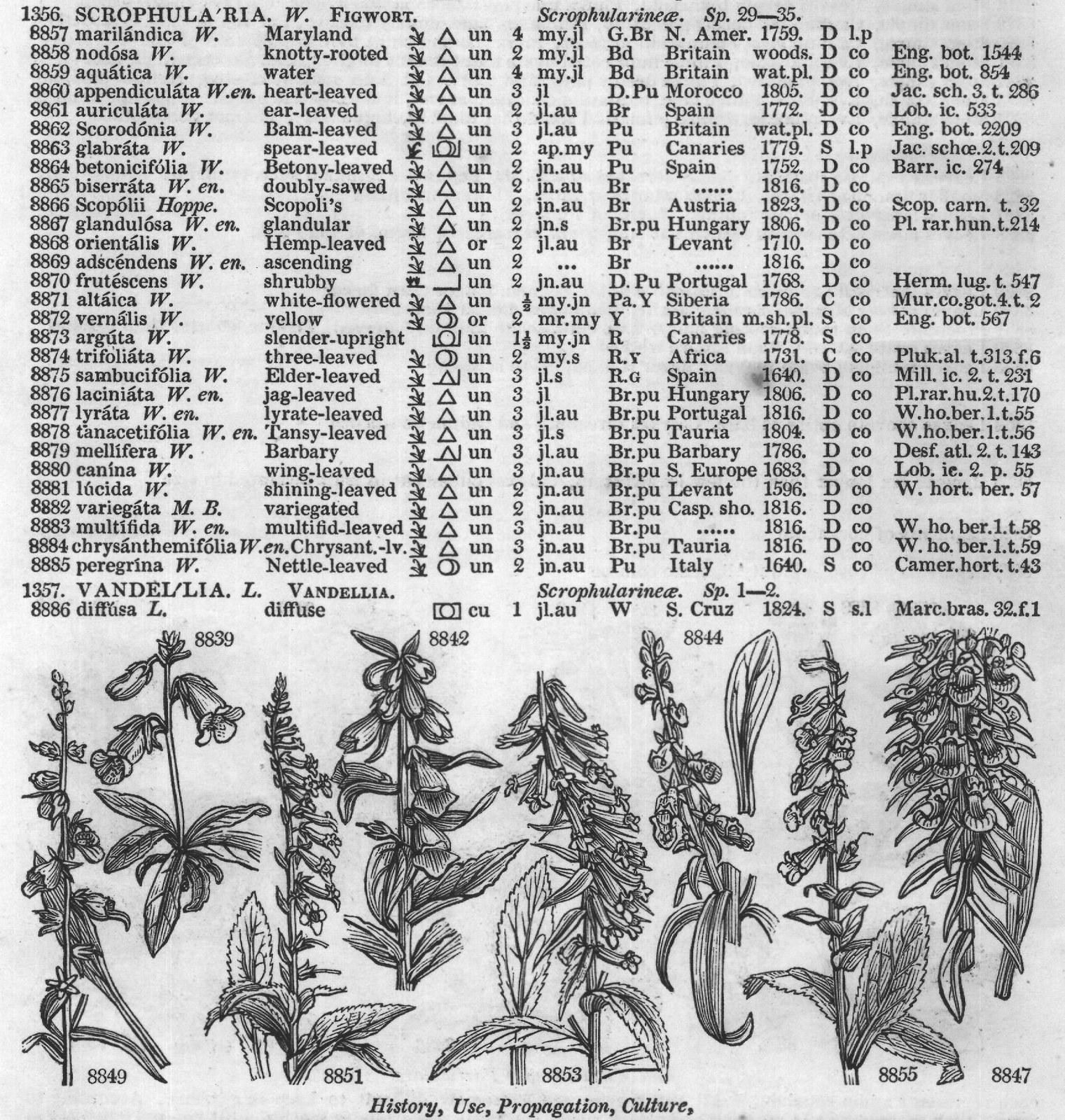
Cs.l Bot. reg. 748 8829 ríngens W. 8830 glutinósus W. 8831 parviflórus Lindl. 8832 alátus W. 1351. MI MULUS. W. MONKEY-FLOWER. small-flowered O or oval-leaved Scrophularineæ. Sp. 5-12. gaping or 1 jl.au L.P N. Amer. 1759.
C p.l Bot. mag. 283 Orange-flower. or ja.d Or California 1794.
Cr.m Bot. mag. 354 ja.d Y Chili 1824. S co Bot. reg. 874 Δ 1 jl.au L.P N. Amer. 1783. D p.1 Bot. cab. 410 8833 lúteus W. yellow-flowered A 2 jn.s Y America 1812. D p.1 Bot. mag. 1501 1352. HORNEMAN NIA. W.en. HORNEMANNIA.
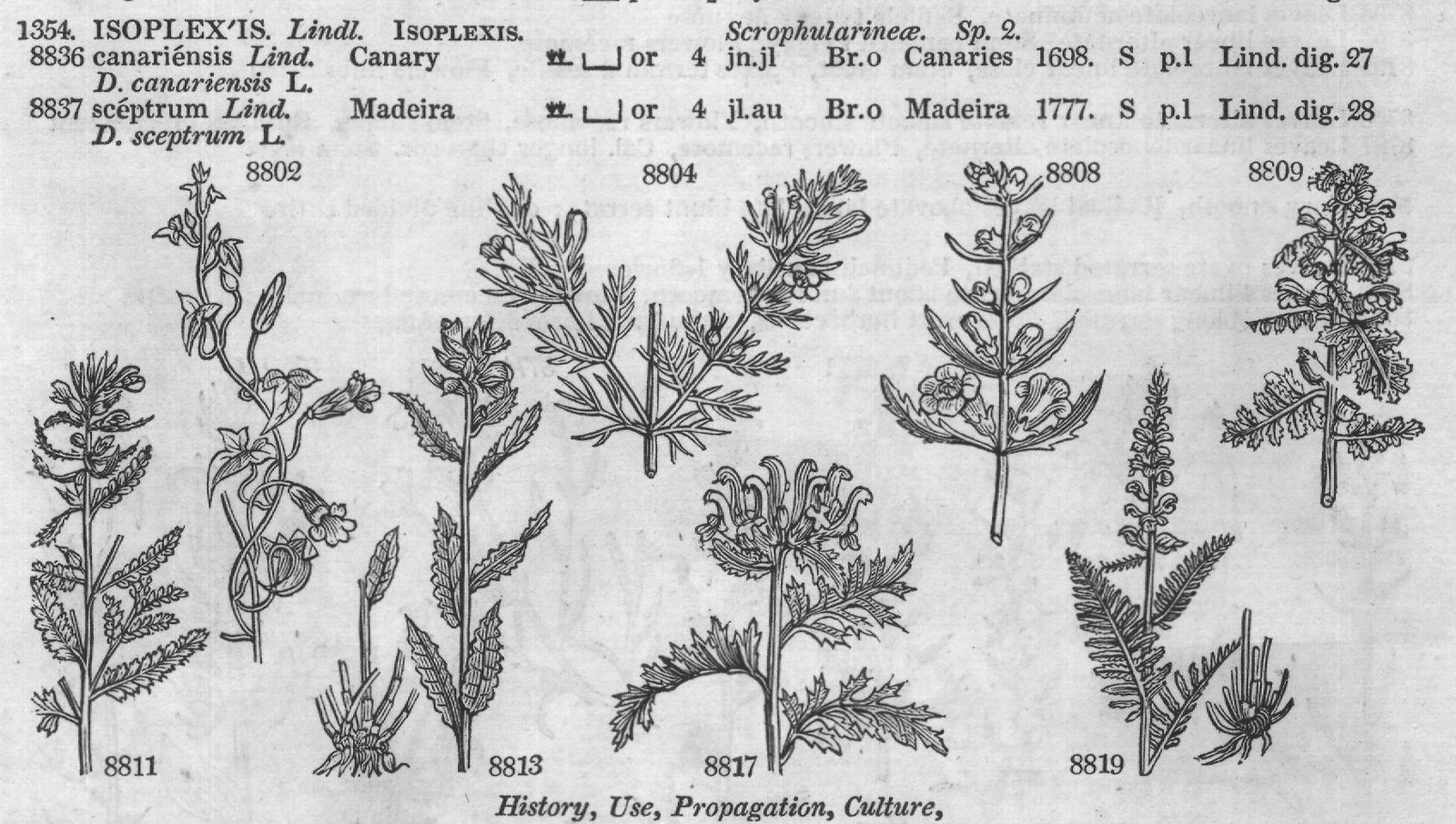
Scrophularineæ. Sp. 1-2. 8834 bícolor W. en. 1353. MA'ZUS. Lour. 8835 rugósus H. K. 1354. ISOPLEX'IS. Lindl. ISOPLEXIS. 8836 canariénsis Lind.
D. canariensis L. 8837 scéptrum Lind.
D. sceptrum L. 8802 two-colored MAZUS.
China Canary Madeira pr jn.s B E. Indies 1816. S s.l Scrophularinea. Sp. 1. pr my.s Y.Pu China 1780. S s.1 Sweet fl. gard.36 Scrophularineæ. Sp. 2. or 4 jn.jl Br.o Canaries 1698. S p.1 Lind. dig. 27 or 4 jl.au Br.o Madeira 1777. S p.1 Lind. dig. 28 8804 8808 8809 8811 8813 8817 History, Use, Propagation, Culture, 8819 1347. Maurandya. Named in honor of the lady of Dr. Maurandy, the botanical professor at Carthagena. An elegant greenhouse plant, native of Mexico, and flowering for months together in the summer. 1348. Gerardia. In honor of John Gerarde, our old English botanist, author of the Herbal, 1597, folio, and a great cultivator of exotic plants, of which he published a catalogue in 1596. These are handsome North American herbaceous plants, of such very difficult culture, that few persons have seen them in gardens. They deserve any pains which may be necessary to their successful cultivation. 1349. Pedicularis; of which the English word lousewort is a translation and explanation. The term lousewort is applied from a supposition that sheep which feed much on the plant become lousy; probably because the plants grow in very bad pastures, which may occasion the sheep to be in bad condition and to breed vermin. The species have their leaves very much cut, and that in a very regular manner. Their flowers are red, white, or yellow, and the mixture or shades of these three colors sometimes give the corolla the colour of fire. They grow in general at a considerable elevation; namely, more than a thousand toises above the level of the sea.
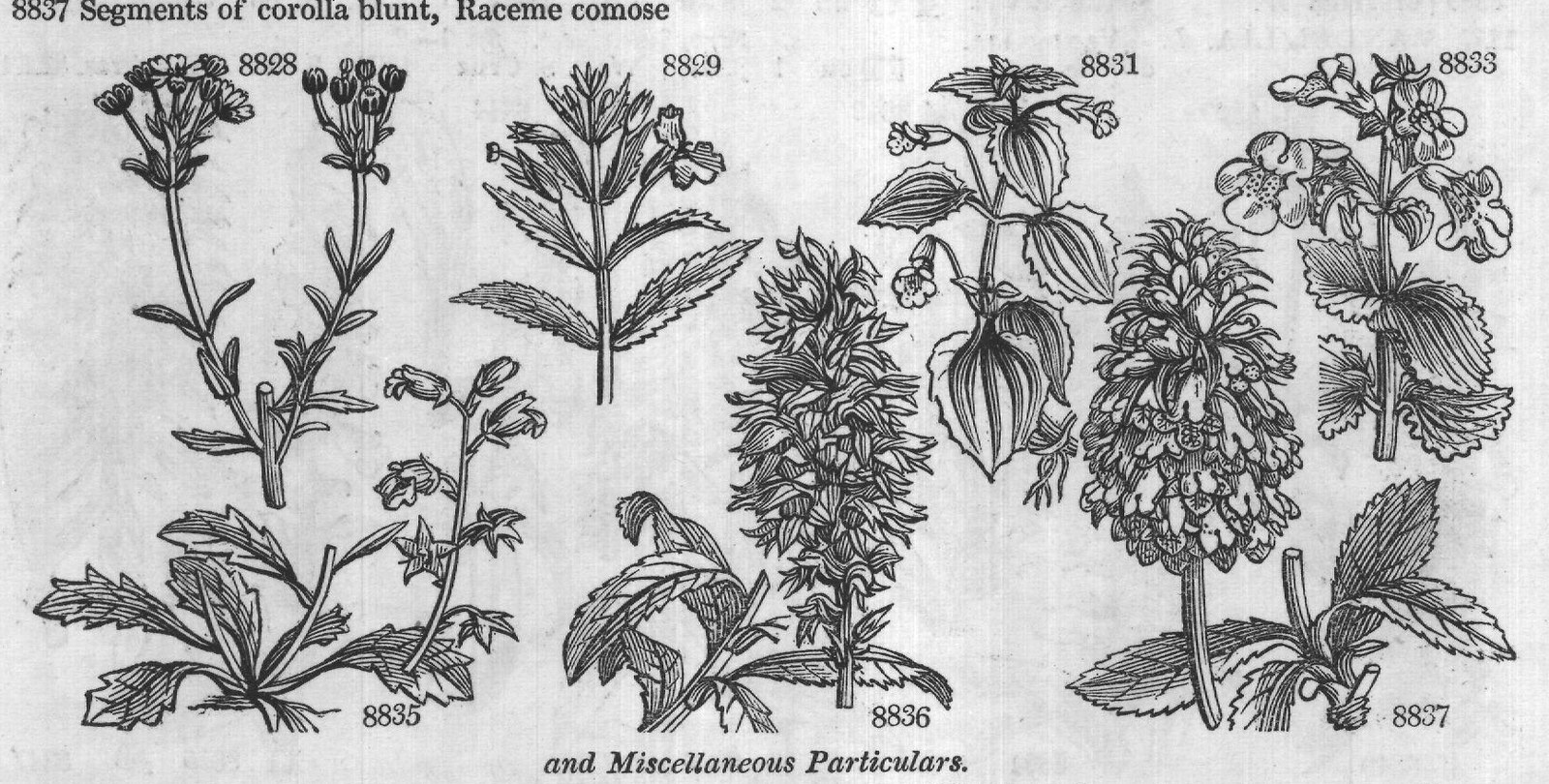
P. sceptrum Carolinum was so named by Rudbeck, in honor of Charles XII. It abounds in the north of Sweden and Lapland, where it was greatly admired by the traveller Dr. Clarke, who sent seeds of it to the Cambridge botanic garden, but they never came to any thing. The flowers grow in long whorled spikes, and ORDER II. 8802 Orifice of corolla pervious 8803 Orifice of corolla closed DIDYNAMIA ANGIOSPERMIA. 8804 Leaves linear pinnatifid, Stem somewhat branching 8805 Stem oppositely much branched, Leaves linear, Flowers axillary opposite subsessilę 8806 Branches panicled, Leaves linear, Peduncles axillary opposite longer than flower 8807 Pubescent, Stems nearly simple, Leaves subsessile lanceolate entire or toothed: lower pinnatifid cut 8808 Smooth, Stem panicled, Leaves stalked pinnatifid, Flowers axillary opposite stalked 8809 Stem branched, Lvs. pinnat. Pinnæ pinnatif. cut, Cal. inflated ovate 2-parted crest. Helmet blunt truncate 8810 Low tufted, Stem branch. at base, Lvs. pinnat. Pinnæ acute. cut, Cal. obl. infl. smooth uneq. 5-cleft crested 8811 Stem branched, Leaves pinnatifid toothed, Cal. tubular 2-parted truncate, Helmet 2-toothed 8812 Stem somewhat branched, Leaves pinnated, Pinnæ in 4s acutely pinnatifid, Helmet acute 2-toothed 8813 Stem nearly simple, Leaves lanc. toothed crenate, Cal. 2-fid truncate, Helmet acute 8814 Stem simple, Leaves pinnatifid, Pinnæ repand crenulate, Cal. 5-fid crested, Cor. closed 8815 Stem simple, Lvs. deeply pinnatifid, Pinnæ lanc. pinnatifid toothed, Spike compact leafy 8816 Stem simple, Cauline leaves deeply pinnatifid, Pinnæ lanc. acuminate pinnatifid toothed, Spike leafy 8817 Stem simple, Spike somewhat leafy, Helmet setaceous 2-toothed, Cal. truncate downwards 8818 Stem simple, Leaves deeply pinnatifid, Pinnæ unequally toothed linear-lanc. Calyxes villous 5-cleft 8819 Stem simple, Cauline lvs. deeply pinnatifid, Pinnæ lin. lanc. doubly toothed, Cal. round smooth 5-toothed 8820 Stem simple, Cauline leaves pinnatifid in fours, Pinnæ oblong blunt toothed, Spike capitate, Cal. hairy 8821 Stem simple, Lvs. pinnated, Pinnæ imbricated ovate blunt doubly toothed, Cal. 5-toothed, Helmet blunt 8822 Stem simple, Lvs. pinnated, Pinnæ deeply pinnatifid tooth. Cal. 5-fid somew. crested, Helmet uncinate 8823 Stem simple, Lvs. pinn. Pinnæ lanc. pinnatifid confluent at end, Spike capitate naked [acum. emargi. 8824 Stem simple, Lvs. pinnate, Pinnæ pinnatifid somewhat toothed, Spike leafy, Helmet two-toothed 8825 Leaves cæspitose spatulate deeply serrated smoothish, Peduncles terminal subcorymbose 8826 Smaller branched villous, Leaves bluntly serrated, Flowers racemose 8827 Leaves lanceolate oblong toothed, Segm. of limb entire 8828 Leaves lanceolate smooth serrated at end, Stem herbaceous, Segm. of limb bifid 8829 Leaves lanceolate acuminate smooth sessile, Pedunc. longer than flower 8830 Leaves oblong bluntish clammy sessile, Peduncles shorter than flower 8831 Procumb. Stem round rooting hairy, Lvs. cord.-ovate toothed 5-nerved, Pedunc, shorter than petioles 8832 Leaves ovate stalked, Stem square winged 8833 Leaves roundish ovate nerved; lower stalked, Stem creeping 8834 Leaves obovate entire at base, Calyxes spreading and peduncles smooth 8835 Raceme lax longer than the few-leaved stem, Calyxes pubescent in fruit increased in size 8836 Segments of cor. acute 8837 Segments of corolla blunt, Raceme comose 8828 8835 8829 8836 8831 8833 8837 and Miscellaneous Particulars. each represents a lion couchant. All the species are extremely difficult to keep in gardens. According to Sweet, they succeed best in peat soil and moist situations; the more tender species must be grown in pots in the same kind of soil, and should be protected under frames in severe weather: the best way of increasing them is by seed. (Bot. Cult. 404.) 1350. Erinus. À name under which Dioscorides describes an aquatic plant with a white flower, black seeds, and a milky stem. From the last circumstance it has derived its name ; ερivεoς signifying a wild fig tree. The plant of the ancients had no resemblance to that called Erinus by the moderns. Beautiful little alpine herbaceous plants, well adapted to rock-work in warm damp situations. 1351. Mimulus. From μiμω, an ape. The flower seeds in front resemble the face of a grinning monkey, The species are showy plants of the easiest culture in almost any soil or situation. 1352. Hornemannia. Named after Professor Hornemann, of Copenhagen, an eminent_botanist, and the present editor of the Flora Danica. Little, inconspicuous, but curious annual plants. 1352. Mazus. From μaζoς, a teat, on account of the little protuberances which close the mouth of the corolla. East Indian herbaceous plants, not unlike some kinds of Antirrhinum. 1354. Isoplexis. From 1005, equal, and πλεξiς, segment, in allusion to the equal-sized divisions of the corolla. purple white dwarf Mullein ambiguous great-yellow DIDYNAMIA ANGIOSPERMIA. 1355. DIGITAʼLIS W. FOX-GLOVE. 8838 purpúrea L.
ẞ alba 8839 mínor L. 8840 Thápsi L. 8841 ambígua Murr. 8842 ochroleúca Jacq.
Scrophularineæ. Sp. 19-21.
Pu Britain CLASS XIV. or 4 jn.s hed.b. S co