Home › D › Dec (Legum t Dec leg tt SCHRANKIA)
Dec (Legum t Dec leg tt SCHRANKIA)
legum. t.63 Dec.leg. tt.61,62 SCHRANKIA.
Vera Cruz hooked Leguminosæ.
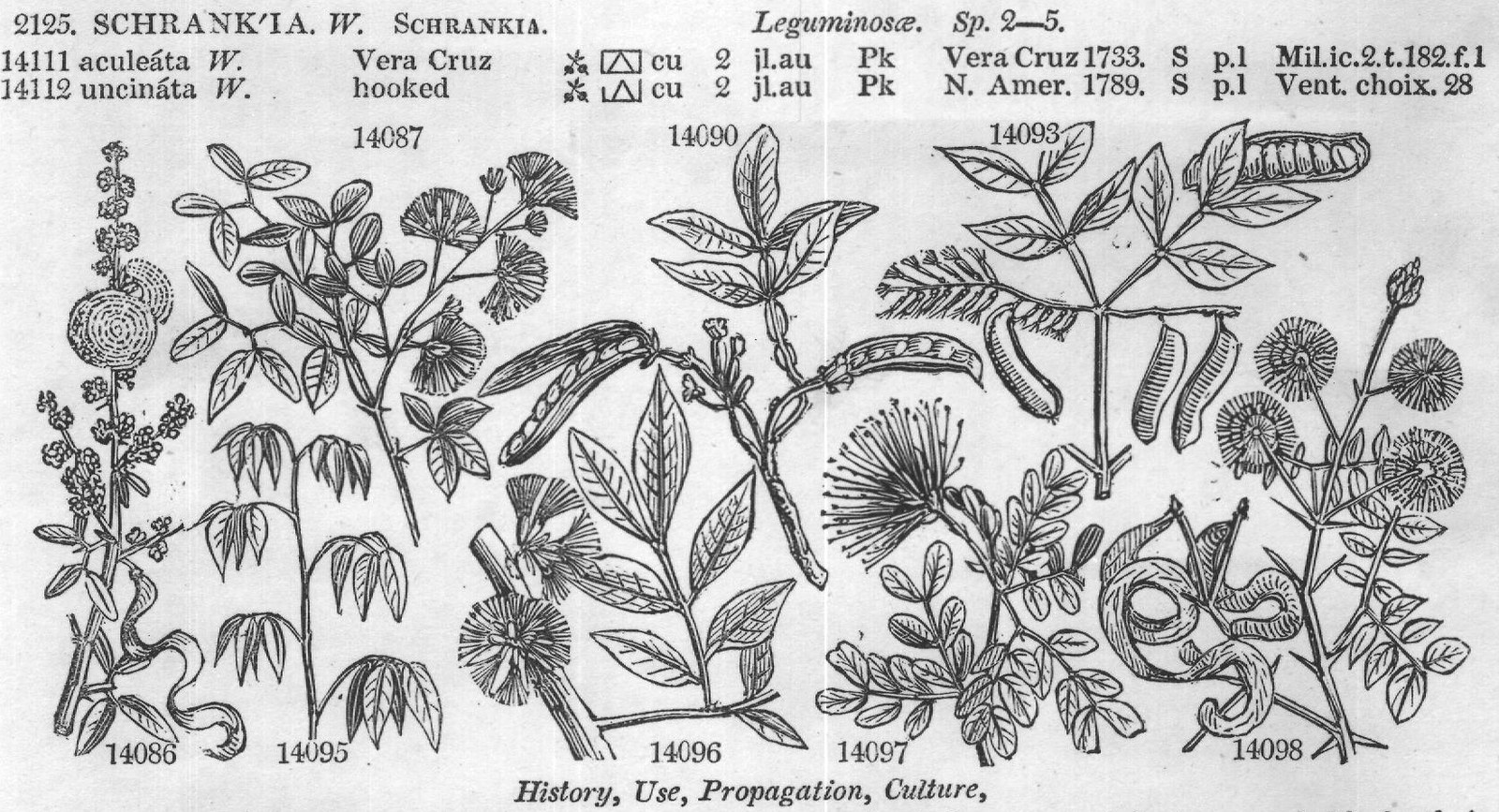
Sp. 2-5. cu 2 jl.au Pk cu 2 jl.au Pk Vera Cruz 1733. S p.1 Mil.ic.2.t.182.f.1 N. Amer. 1789. S p.1 Vent. choix. 28 14090 14093- 14086 14095 14096 14097 14098 History, Use, Propagation, Culture, 2123. Inga. This is an American name adopted by Marcgraaf. A fine genus of plants, remarkable for their beautiful foliage and flowers; but in cultivation they seldom blossom. I. purpurea is a remarkably elegant plant, and so is Inga biglobosa. 1. unguis-Cati, the Cat's claw, Mimosa, is so called from the form of its curved spines. All the species require the greatest heat of the bark stove; they increase very slowly by cuttings. 2124. Mimosa. Said to be derived from μiμoς, a buffoon, because the leaves of the sensitive species appear as if to play with the hand that touches them.
The cause of the well known motion in the leaves of the sensitive plant, has been the subject of many ingenious explanations; but it has not been treated by any botanist with so much ingenuity and address as by Dr. Dutrochet, whose theory we give, as explained by Mr. Lindley in the Botanical Register. M. Dutrochet states, that having ascertained hot nitric acid to possess the power of separating and reducing to its simplest form the whole mass of vegetable tissue, and that the action of the same acid produced other effects equally advantageous for the examination of the most obscure parts of vegetable structure, he was induced to give his attention to that of the Mimosa pudica, in the hope of gaining some evidence respecting the cause to which its sensibility is to be ascribed. Beginning with the pith, he observed a considerable number of minute globules of a greenish color, intermingled among the cells, and adhering to them in an irregular manner. After attempting to shew the probability of these globules having deceived M. Mirbel in various points of his analysis of vegetation, and especially in regard to the pores, which that botanist supposes to exist in the cellular tissue of plants, Dr. Dutrochet proceeds to remark, that the application of hot nitric acid to these globules renders them perfectly opaque, whence he concludes, that they are, in fact, minute cells filled with a particular fluid, which is subject to become concrete by the application of acids. Now, it is known, that such fluids as are thus altered by acids, are usually dissolved and liquefied again by the application of alkalies. A few drops, therefore, of a solution of hydrate of potash were suffered to fall upon a portion of the pith on which nitric acid had been acting, and the mixture was exposed to the heat of a lamp. Being examined after a few minutes, the globules were found to have resumed their natural appearance. This curious fact indicated, in the opinion of Dr. Dutrochet, a strong and unexpected point of analogy between plants and animals. According to the microscopical researches of some modern observers, it has been ascertained that all the organs of animals are composed of a conglomeration of minute corpuscles, similar to those just described; the corpuscles which constitute the muscles are soluble in acids, but those which compose the nervous system are insoluble in the same acids, and only soluble in alkalies. Now, as the chemical properties and the external appearance of the particles scattered among the cellular tissue of plants, and constituting the nervous system of animals, are the same, the author is induced to infer, that the spherical particles of plants are, in fact, the ORDER I.
POLYGAMIA MONŒCIA.
MONECIA. 14086 Spines stipulary very short straight, Leaves of two pairs halved oblong obt. Panicle simple long terminal 14087 Spines stipulary straight, Leaves of two pairs roundish elliptical halved emarginate, Raceme terminal 14088 Unarmed, Leaves bipinnate, Spike double of two globes pendulous 14089 Unarm. Lvs. bipin. of 2 pairs, Leafl. ov. ac. smooth shining above, Glands betw. every pair, Petiole winged 14090 Unarm. Lvs. pinn. of about 5 pairs, Leafl. ov. obl. acum. smooth, Gland between every pair, Petiole winged 14091 Leafil. of 5 pairs obl. acumin . hairy above and shining villous beneath, Branches covered with rusty down 14092 Unarmed, Lvs. of 3 pairs, Leaflets obl. acuminate equal smooth, Gland between each pair, Petiole winged 14093 Unarm. Lvs. pinn. of 2 pairs, Leafl. obl. lanc. acum. smooth, Gland between each pair, Petiole wing. at end 14094 Spines stipulary ulary recurved, Leaves of 2 pairs, Leaflets halved obovate. Pod ensiform straight 14005 Unarm. Lvs. pinn. of 2 pairs, Leafl. obov. obl. unequal sided smooth, A gland between the lowest small ones 14096 Unarmed, Lvs . conjugate pinnate, Leaflets ov. obl. term. opp. lateral alternate, Flowers in lateral umbels 14097 Unarmed, Lvs conjugate pinnate, Leafil. obl. blunt uneq. at base, Petioles without glands, Heads stalked 14098 Spines stipular, Lvs. conjugate pinnate, Pinnæ of 3 pairs, Leaflets ovate acute smooth, Pods spirally twisted 14099 Unarmed herbaceous, Leaves conjugate pinnate, Pinnæ 4 pairs, Leaflets roundish, Pods with one joint 14100 Prickles of branches and stems scattered hooked, Lvs. bipinn. ciliat. and rough, Sutures of pods very spiny 14101 Stem and petioles prickly , Leaflets nearly halved ovate acute hairy beneath smooth above 14102 Spines of petiol. scatter. very broad compr. straight, Lvs. bipinn. finally smooth without glands, Leafl. 10-15 petioles prickly, Leaflets halved cordate ovate blunt smooth 14104 Stem prickly more or less hispid, Leaves digitate-pinnate, Pinnæ 4 of many pairs, Leaflets linear 14105 Stem aculeate smooth hairy upwards, Leaves digitate-pinnate, Pinnæ 8 of many pairs, Leaflets linear 14106 Like M. asperata, but less hairy 14107 Prickles of branches and stems scattered hooked, Leaves bipinnate, Pinnæ of 5 pairs, Leaflets 20-25 lin. 14108 Leaves bipinnate, Pinnæ of 8-12 pairs, Leaflets of many pairs bristly ben. Peduncles twin as long as head 14109 Prickly, Leaves bipinnate: partial of 6 pairs; proper of many pairs cultrate, Gland of petiole depressed 14110 Lvs. bipinnate terminated by a tendril, Pinnæ of 2-3 pairs, Leaflets oval emarg. Spikes numerous fascicled 14111 Prickly, Leaves bipinnate: partial of 3 pairs; proper of many pairs, Pods acute, Stem 4-cornered 14112 Prickly, Leaves bipinnate: partial of 6 pairs; proper of many pairs, Pods acute, Stem 5-cornered 14099 14100 14107 14101 14111 14104 and Miscellaneous Particulars. scattered elements of their nervous system. This hypothesis receives additional strength from the great similarity which exists between the medullary substance of the brain of Mollusca Gasteropoda and the cellular medullary tissue of plants. In pursuit of this idea, Dr. Dutrochet made a variety of experiments upon the sensitive plant, the results of which seem to be these. - The principal point of locomotion, or of mobility, exists in the little swelling which is situated at the base of the common and partial petioles of the leaves; this swelling is composed of a very delicate cellular tissue, in which is found an immense number of nervous corpuscles; the axis of the swelling is formed of a little fascicle of tubular vessels. It was ascertained by some delicate experiments, that the power of movement, or of contraction and expansion, exists in the parenchyma and cellular tissue of the swelling, and that the central fibres have no specific action connected with the motion. It also appeared that the energy of the nervous powers of the leaf depended wholly upon an abundance of sap, and that a diminution of that fluid occasioned an extreme diminution of the sensibility of the leaves. Prosecuting his remarks yet further, the author ascertained, that in the motion of the sensitive plant, two distinct actions take place, the one of locomotion, which is the consequence of direct violence offered to the leaves, and which occurs in the swellings already spoken of; the other of nervimotion, which depends upon some stimulus applied to the surface of the leaflets, unaccompanied by actual violence, such as the solar rays concentrated in the focus of a lens. As in all cases, the bending or folding of the leaves evidently takes place from one leaf to another with perfect continuity; it may safely be inferred, that the invisible nervous action takes place in a direct line from the point of original irritation, and that the cause by which this action of nervimotion is produced, must be some internal uninterrupted agency. This was, after much curious investigation, determined by the author to exist neither in the pith, nor in the bark, nor even in the cellular tissue filled with nervous corpuscles, and on which, he supposes, the locomotion of the swelling at the base of petioles to depend. It is in the ligneous part of the central system, in certain tubes supplied with nervous corpuscles, and serving for the transmission of the sap, that Dr. Dutrochet believes he has found the true seat of nervimotion, which he attributes to the agency of the sap alone, while he considers the power of locomotion to depend upon the nervous corpuscles alone.
Some of the species ripen seed; others may be increased by cuttings from the points of the young shoots planted in sand and kept closely covered. in sand and kept closely covered.
The pods of M. fagifolia contain a sweet whitish pulp, which the natives of Martinique suck; they call the tree and its fruit Pois Doux, or sweet pea. 2125. Schrankia. Named by Willdenow, in honor of his countryman, Francis de Paula Schrank, a well. known German botanist. Herbaceous prickly shabby-looking plants, with the habit of Mimosa 3 I 4 POLYGAMIA MONECIA.
CLASS XXIII. 2126. DESMANTHUS. W. DESMANTHUS.
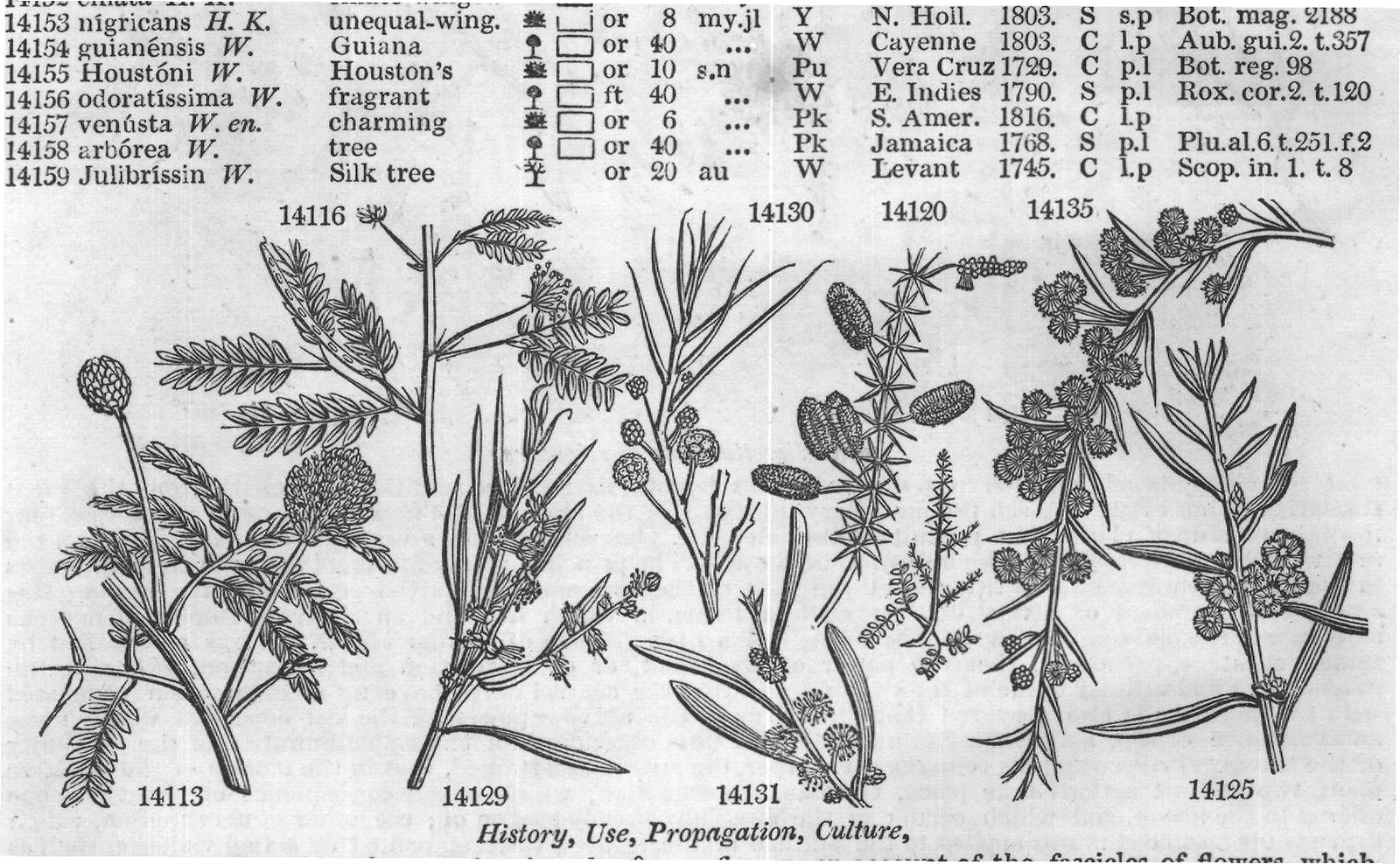
Leguminosæ. Sp. 7-19. 14113 nátans W. floating un 2 jl.s W China 1800. C p.l Bot. rep. 629 14114 plénus W. double-yellow ☑ ☑ un 2 jl.s Y Vera Cruz 1733. C p.l Mil.ic.2.t.182.f.2 14115 diffúsus W. prostrate' un 3 jl.au W 14116 virgátus W. long-twigged un 3 jl.au Y 14117 punctátus W. spotted-stalked un 3 jl.au W 14118 cinéreus W.
Ash-colored un 3 jn.jl W 14119 divérgens W. en. divergent 益 un 6 jn.jl W Pluk.al. t.307.f.3 Bot. mag. 2454 Com.hort. 1. t.31 W. Indies 1731. C p.1 W. Indies 1774. S p.l Jamaica 1686. C p.l E. Indies 1739. C p.l. Rox.cor. 2. t. 174 Abyssinia 1816. C p.1 Bruce Abys. t. 6 2127. ACA'CIA. W. 14120 verticilláta W. 14121 juniperína W. 14122 aciculáris H. K. 14123 genistifólia Link. 14124 sulcáta H. K.
ACACIA.
Leguminosæ.
Sp. 83-258. whorl-leaved or 10 mr.my Y V. Di. Isl. 1780. Ss.p Bot. mag. 110 Juniper-leaved or 6 mr.jn Y N. S. W. 1790. C s.p Bot. cab. 398 needle-leaved or 6 mr.au Y N. S. W. 1796. S s.p furze-leaved or 3 mr.au Y N. S. W. 1825. S s.p furrowed-leav. or 2 my.au Y N. Holl. 1803. S s.p Bot. reg. 928 14125 suavéolens W. sweet-scented or 4 f.jn Y N. S. W. 1790. C s.p Bot. cab. 730 14126 glaucéscens W. blunt-leaved or 3 f.jn YN. S. W. 1790. S s.p 14127 floribúnda W. many-flowered or 6 my.jn Y N. S. W. 1796. C s.p Vent. choix. 13 14128 linifólia W.
Flax-leaved or 3 my.jn Y N. S. W. 1790 S s.p Bot. mag. 2168 14129 lineáris B. M. linear or 3 my.jn Y N.S.W. 1820. 1820. S s.p Bot. mag. 2156 14130 calamifólia Lindl. reed-leaved or 3 my.jn Y N. S. W. 1819. S s.p Bot. reg. 839 14131 strícta W. double-headed or 2 f.my Y N. S. W. 1790. C s.p Bot. rep. 53 14132 longifólia W. long-leaved or 10 mr.my Y N. S. W. 1792. S s.p Bot. mag. 2166 14133 falcáta W. sickle-leaved or 6 my.jn Y N. S. W. 1790. C s.p 14134 laurifólia W.
Laurel-leaved or 4 my.jn Y Tanna 1775. S s.p 14135 diffusa B. Reg. diffuse or 2 my.jn Y N. S. W. 1818. s.p Bot. reg. 634 A. prostrata Bot. Cab. 631 14136 longis'sima Wendl. longest-leaved or 4 my.jn Y N. S. W. 1819. s.p Bot. reg. 680 14137 unduláta Lindl. wavy-leaved or 4 o.n Y N. S. W. 1817. s.p Bot. reg. 843 14138 melanóxylon H. K. black-wooded or 8 ap.jn Y V. Di. Isl. 1808. S s.p Bot. mag. 1659 14139 Sophóræ H. K.
Sophora-podd. ☐ or 10 ap.jn Y V. Di. Isl. 1805. S s.p Lab.no.h.2.t.237 14140 margináta H. K. marginate-leav.or 4 ap.jn Y N. S. W. 1803. S s.p 14141 myrtifólia W.
Myrtle-leaved or 3 f.my Y N. S. W. 1789. C s.p Bot. mag. 302 14142 lunáta Dec. lunate or 2 ap.my Y N. S. W. 1810. S s.p Bot. cab. 384 14143 angustifólia Wendl. narrow-leaved or 2 ap.my Y N. S. W. 1816. S s.p Bot. cab. 763 14144 hispídula W. little harsh or 2 ap.my Y N. S. W. 1794. S s.p Bot. cab. 823 14145 decípiens H. K. paradoxical or 3 mr.jn Y N. Holl. 1803. C s.p Bot. mag. 1745 14146 biflóra H. K. two-flowered or 3 mr.jn Y N. Holl. 1803. S s.p 14147 armáta H. K. simp.-lv.-prick.or 6 ap.jn Y N. Holl. 1803. S s.p Bot. mag. 1653 14148 aláta H. K. wing-stalked or 6 ap.jl Y N. Holl. 1803. C s.p Bot. reg. 396 14149 vestita B. Reg. clothed or 6 ap.jl Y N. Holl. 1820. S s.p Bot. reg. 698 14150 scándens W. climbing or 10 Pu India ... 1780. S s.p Rh.mal.8.t.32.34 14151 Lambertiána B. Reg. Cowan's 14152 ciliáta H. K. 14153 nígricans H. K. ciliate-winged ☐ or 8 mr.jn Y unequal-wing.or 8 my.jl 14154 guianénsis W.
Guiana 14155 Houstóni W.
Houston's 14156 odoratíssima W. fragrant 14157 venústa W. en. 14158 arbórea W. charming tree ft 40 or 6 ... 14159 Julibrissin W.
Silk tree 14116 el 6 my.jn Pu Y ... or 40 W or 10 s.n Pu W Pk Pk or 40 ... ... or 20 au W 14130 N. Holl. 1803. S s.p Cayenne 1803. C 1.p Vera Cruz 1729. C p.l E. Indies 1790. S p.1 S. Amer. 1816. C 1.p Jamaica 1768. S p.l Levant 1745. C 1.p 14120 14135 Bot. mag. 2188 Aub. gui.2. t.357 Bot. reg. 98 Rox. cor.2. t. 120 Plu.al.6.t.251.f.2 Scop. in. 1. t. 8 Mexico N. Holl. 1818. S s.p 1803. S s.p Bot. reg. 721 00000 14113 14129 14131 History, Use, Propagation, Culture, 14125 3126. Desmanthus. From δεσμη, a bond, and avθoς, a flower, on account of the fascicles of flowers, which seem as if bound up together. These plants are chiefly aquatic; a few are prickly; and they all have the habit of Mimosa. D. natans is used in China as a pot-herb; and is described by Loureiro, under the name of Neptunia oleracea. Willdenow, the author of the genus, observes, that the neuter florets have always a different color from that of the hermaphrodites, whence the spikes appear parti-colored, by which character the genus may be known at a distance. Culture as in Mimosa. D. natans should be grown in water. 2127. Acacia. This was the Greek name of some plant of the present genus, and not being appropriated, was taken by Willdenow, in his reformation of the old genus Mimosa, as the designation of one of his new divisions. This is one of the most ornamental families of the greenhouse plants, and some are curious as well as beautiful. A. Julibrissin, the Gul ebruschim, or rose of silk of the Persians, and the Gazia of Italian gardeners, is an elegant hardy tree with beautiful tufts of pink colored flowers, which resemble tassels of silken threads.
A. Catechu and vera are used in medicine. The inner wood of the former tree is of a brown color, from which the catechu is thus prepared. "After felling the trees, the manufacturer carefully cuts off all the exterior white part of the wood. The interior colored part is cut into chips, with which he fills a narrowmouthed unglazed earthen pot, pouring water upon them until he sees it among the upper chips; and when ORDER I.
POLYGAMIA MONŒCIA. 14113 Unarmed, Leaves bipinnate: partial of 3 pairs; proper of many pairs, Spikes ovate, Pedunc. with bractes 14114 Unarmed, Leaves bipinnate: partial of 3 or 4 pairs: proper of 12 pairs, Spikes ovate, Stem prost. compres. 14115 Unarmed, Lvs. bipinnate: partial of 4 or 5 pairs; proper of 12 pairs, Spikes few-fl. capit. pentand. Pods lin. 14116 Unarmed, Lvs. bipinnate: partial of 4 pairs; proper of 12 pairs, Spikes few-fl. capitate decand. Pods linear 14117 Unarmed, Leaves bipinnate; partial of 4 or 5 pairs; proper of many pairs, Spikes ovate, Pods obl. blunt 14118 Spines solit. Lvs. bipinn.: partial of about 9 pairs; proper of many pairs, Spikes cylind. atten. at base cernu. 14119 Spines solitary, Leaves bipinn.: partial of 8 pairs; proper of many pairs, Spikes cylindrical twin pendulous 1. Leafless. 14120 Unarmed, Petioles linear subulate mucronate rigid pungent whorled, Spikes cylindrical solitary 14121 Unarmed, Petioles linear subulate mucronate rigid pungent alternate clustered, Spikes globose solitary 14122 Petioles round subulate mucronate scattered rigid, Stipules deciduous, Spikes globose solitary 14123 Stipules spiny very minute, Petioles linear subulate-pungent close together, Peduncles solitary 14124 Petioles filiform furrowed on each side: point harmless, Heads twin, Pods wavy 14125 Unarmed, Petioles linear narrowed at base mucron. Spikes globose stalked racemose, Branches 3-cornered 14126 Unarmed, Petioles lanceolate subfalcate narrowed at base blunt about 2-nerved glaucous, Spikes axillary 14127 Unarm. Petioles lin. narrowed at each end mucron. arcuate striat. Fls. interruptedly spik. Branches round. 14128 Unarm. Petiol. lin. narrow. at base straight mucron. Spikes glob. stalk. racem. Racemes nearly as long as lvs. 14129 Petioles narrow lin. very long 1-nerved erect entire, Spikes several axillary generally branched 14130 Stip. scarcely any, Petioles filiform compressed cernuous spreading with an incurved point, Pods torulose 14131 Unarmed, Petioles linear lanceolate narrowed at base obtuse, Spikes globose axillary stalked double 14132 Unarmed, Petioles lin. lanc. narrowed at each end 3-nerved striated, Spikes axillary double cylindrical 14133 Unarmed, Petioles oblong falcate narrowed at base acute veiny, Branches 2-edged 14134 Unarmed, Petioles ovato-acute many-nerved, Spikes globose stalked, Pods falcate 14135 Stip. very small decidu. Petiol. lin. 1-nerved with an oblique point, Branches procumb. diff. smooth angul. 14136 Petioles very long filiform 1-nerved spreading, Spikes several axillary generally branched 14137 Petioles half oblong wavy: their inner edge a little truncate, Stipules spiny, Branches smooth 14138 Petioles lanceolate oblong nerved somewhat falcate, Heads racemose, Young shoots furred 14139 Petioles oblong equal-sided nerved, Spikes twin sessile, Corollas 4-petals, Pods torose 14140 Petioles long lanc. somewhat falcate edged 1-nerved: the anterior edge with 1 gland, Heads racemose 4-fl. 14141 Unarmed, Petioles oblong acuminate veiny, Spikes globose stalked racemose 14142 Petioles half obl. somew. falcate tapered at base with a little gland on the convex side, Branches smooth 14143 Petioles linear tapered at base acute mucronate 1-nerved entire, Heads racemose many-flowered 14144 Unarmed, Petioles sessile oblong cuspidate toothletted scabrous, Spikes globose solitary axillary 14145 Petioles triangular: outer angle spiny; inner bearing glands, Stip. setaceous caducous, Branchlets smooth 14146 Petiol. triangul.: outer angle spiny; inner bearing glands, Stip. setaceous spiny persist. Branchlets downy 14147 Petiol. halv. obl. smooth mucronul. 1-nerv.: never parallel with inner edge, Stip, veiny, Branches hirsute 14148 Stem winged two ways, Petioles decurrent 1-nerved terminated by a spine, Stipules spiny 14149 Petioles half elliptical lanceolate mucronate aristate 1-nerved in middle and branches hispid 2. Leafy. * Unarmed. 14150 Leaves conjugate pinnate terminated by a tendril, Pinnæ of 4 pairs, Spikes filif. Petals 5, Stem climbing 14151 Unarmed, Leaves bipinnate: partial of 2 pair; proper of 2 pair vill. Petiole without glands, Head globose 14152 Unarmed hairy, Lvs. bipinnate: partial of 2 pair; proper of 2 or 3 pair, Stip. somew. setaceous deciduous 14153 Unarmed smooth, Leaves bipinnate: partial of 2 pair; proper of 2 to 7 pair, Stip. subulate setaceous 14154 Lvs. bipinnate: partial and proper of 10 pairs ellipt. blunt, Gland of petiole convex, Spikes filif. solit. axill. 14155 Leaves bipinnate: partial of about 6 pairs; proper of many, Petioles downy, Spike terminal interrupted 14156 Leaves bipinnate: partial of 4 pairs; proper of 10-12, lowest very minute, Spikes globose term. panicled 14157 Unarmed, Leaves bipinnated, Pinnæ of 3 or 5 pair, Leaflets of 15 or 20 pair falcate acute smoothish 14158 Lvs. bipinn.: partial of 7 pair; proper of 17 pair halv. acute, Spikes glob. stalk. axill. Pods arcuate twisted 14159 Lvs. bipinn.: partial of 11 pair; proper of many pair halved acute, Spikes subglobose terminal aggregated 14155 14137 14141 14143 14151 14153 14145 and Miscellaneous Particulars. this is half evaporated by boiling, the decoction, without straining, is poured into a flat earthen pot, boiled to one-third part, and then set in a place to cool for one day. The decoction is afterwards evaporated by the heat of the sun, stirring it several times in the day; and when it is reduced to a considerable thickness, it is spread upon a mat or cloth, which has previously been covered with the ashes of cowdung. The mass is lastly divided into square or quadrangular pieces by a string, and completely dried by turning them in the sun, until they are fit for sale. This extract, when first introducd as a medicine into Europe, was named Terra Japonica, from the supposition that it came from Japan and was an earth." Medicinally catechu is one of the most valuable of the vegetable astringents; and as the dark colored contains the greater quantity of tannin, on which its astringency depends, it is to be preferred for medicinal use. It is employed with the best effects in dysentery and diarrhea, when the use of astringents is admissible; in alvine and uterine hæmorrhages, leucorrhœa, gleet, and in obstinate catarrhal affections. As a local astringent, it is used in sponginess of the gums, and aphthous ulcerations of the mouth and fauces, and we have found the slow solution of a small piece of it in the mouth, a certain remedy for the troublesome cough induced by a relaxed uvula hanging into and irritating the glottis. Dr. Paris recommends it as a dentifrice, especially when the gums are spongy.
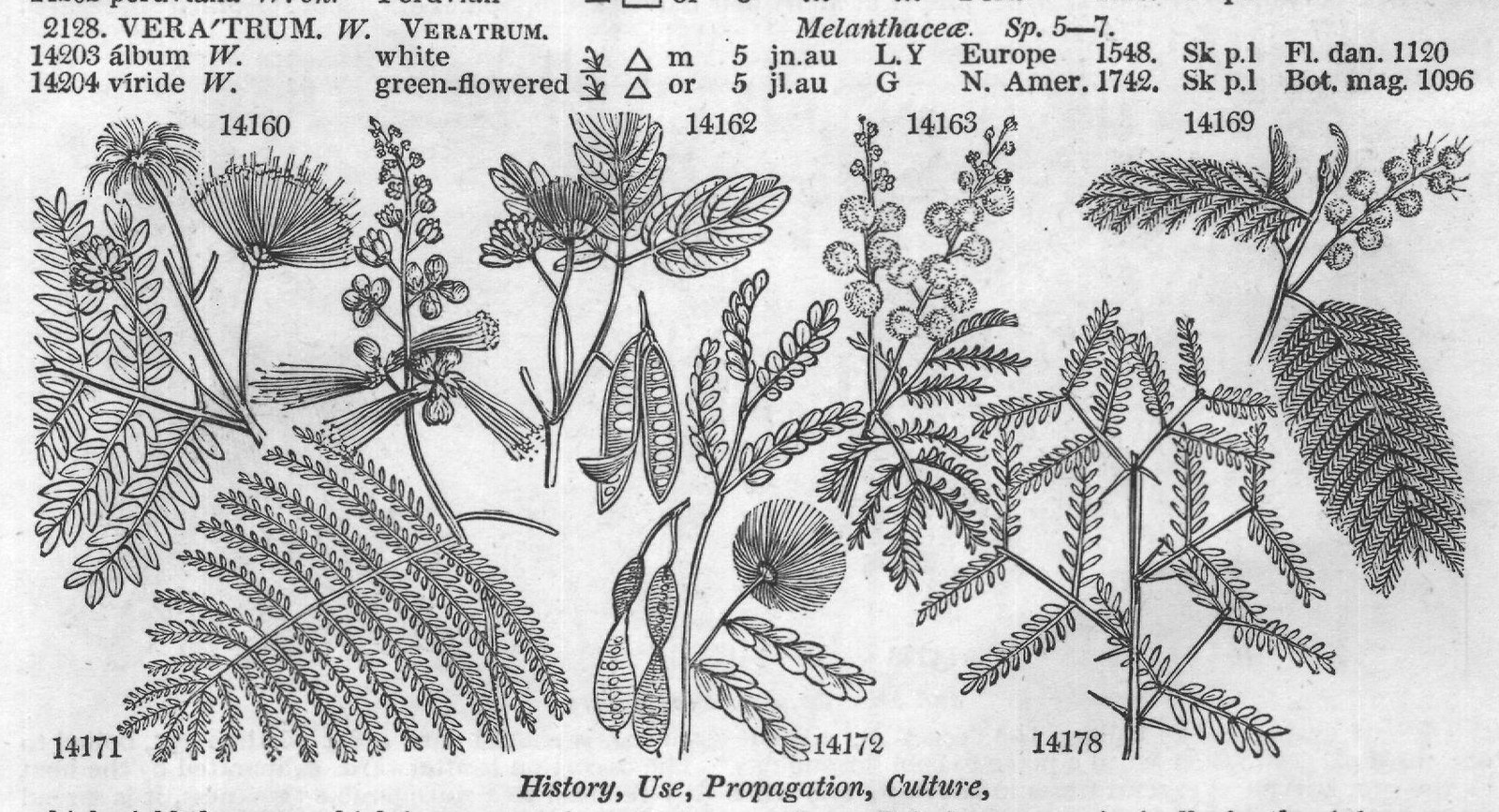
A. vera produces the gum arabic of the shops. The tree is found in almost every part of Africa, but those or 8 or 10 or or 3 or 20 or 40 or 12 14185 Cátechu W. 14186 leucophlæ'a W. panicled to Q or 15 m 40 14160 speciósa W. 14161 latisíliqua W. 14162 Leb'beck W. 14163 díscolor W. 14164 pubescens H. K. 14165 lophántha W. 14166 brachýloba W. 14167 glandulósa W. 14168 decúrrens W. 14169 móllis B. Reg. splendid broad-podded Egyptian two-colored hairy-stemmed Illinois POLYGAMIA MONŒCIA. 豊 ☐ or 10 au.s Pu or 10 mr.jn Pk or 20 mr.jn Pk or 10 mr.jn Y E. Indies 1742. C l.p W. Indies 1777. C 1.p Egypt 1823. C 1.p N. S. W. 1788. S s.p Jac. ic. 1. t. 198 Plum. ic. 3. t. 6 Pl.man.p.331.f.1 Bot. rep. 235 or 10 mr.jn Y N. S. W. 1790. R s.p Bot. mag. 1263 two-spiked or 6 my.jl Y N. Holl. 1803. S s.p Bot. mag. 2108 or 2 WN. Amer. 1803. C s.p glandulous or 2 ...
W N. Amer. 1806. C s.p Vent. choix. 27 decurrent or 6 my.jl Y N. S. W. 1790. S s.p soft or 6 jl.au Y N. Holl. 1810. C s.p Bot. reg. 371 14170 peregrína W. white-flowered ☐ or 8 jl W 14171 grandiflóra W. great-flowered or 10 jn.s Pu 14172 glaúca W. glaucous or 5 jn.au W 14173 leucocéphala Pers. white-headed or 5 jn.au W 14174 portoricénsis W. Portorice or 6 jn.au W S. Amer. 1780. C s.p E. Indies 1769. C p.1 America 1690. S s.p S. Amer. 1823. S s.p S. Amer. 1824. S s.p Bot. rep, 592 Cat. car. 2. t. 42 14175 quadranguláris Link. quadrangular or 4 jl.s W 14176 dealbáta Link. whitened or 4 Y ... 14177 strombulífera W. spiral-podded 14178 reticuláta W. en. 14179 pulchélla H. K. 14180 juliflóra W. 14181 Sénegal W. 14182 Giráffæ W. en. 14183 Cáfra W. 14184 Chúndra W. netted zigzag spiny long-flowered Arabian camelopard's Hottentot hook-spined medicinal OCCC ...
CLASS XXIII.
Jacq. ic. t. 633 .. 1825. S s.p Bot. mag. 2651 ...... 1824. C s.p Peru ... 1825. S s.p W ...
C. G. H. 1816. C s.p Pluk.al. t. 123.f.2 4 ap.jl YN. Holl. 1803. S s.p Bot. cab. 212 W ...
Jamaica 1793. C s.p W Arabia .0. 1823. C s.p Alp. ægypt. t. 15 ...
C. G. H. 1816. S p.l ...
Y.w C. G. H. 1800. S s.p ... ...
E. Indies 1789. C s.p ...
Pa.Y E. Indies 1790. S p.l Rox. cor.2. t.175 오 or 12 ...
Pa.Y E. Indies 1812. C p.l Rox. cor.2. t.150 14187 cornígera W.
Cuckold Tree or 15 ...
Pa.Y S. Amer. 1692. C p.1 Plu.al.3.t.122.f.1 14188 ebúrnea W. ivory-thorned or 5 Y ... 14189 hæmatóxylon W.en. hoary or 20 ...
Y.w 14190 farnesiána W.
Sponge Tree 오 ft 15 jn.au Y E. Indies 1792. C p.l C. G. H. 1816. C p.l St. Domin. 1656. S p.l Rox. cor.2. t.199 14191 véra W.
Egyptian Thorn or 12 jl W 14192 arábica W.
Gum Arab. tree 오 ec 20 W ... 14193 cæ'sia W. gray உ or 15 14194 pennáta W. fine-leaved உ or 12 ... 14195 I'ntsia W. angular-stalked or 12 ... 14196 Ceratónia W. round-leaved or 3 W ... 14197 tamarindifólia W. Tamarind-lvd. or 4 W ... 14198 hórrida W. horrid or 6 ... ... 14199 flexuósa W. flexuose or 6 ... ... 14200 brachyacantha W.en.short-spined or 14201 ciliáris W.en. ciliated or 14202 peruviana W. en.
Peruvian or 6 446 ... ... ... ... ... 2128. VERA TRUM. W. VERATRUM. 14203 álbum W. 14204 víride W. white m green-flowered 14160 Egypt 1596. C p.1 E. Indies 1820. S p.l YE. Indies 1773. S p.1 YE. Indies 1773. S p.l Y.w E. Indies 1778. S p.1 S. Amer. 1800. S p.1 W. Indies 1774. S p.1 Africa 1823. Spl Cumana 1824. S p.l S. Amer. 1824. C p.l S. Amer. 1822. C p.l Peru 1820. C p.l Melanthaceæ. Sp. 5-7. 5 jn.au L.Y Europe 1548.
Aor 5 jl.au G N. Amer. 1742. 14162 14163 Pluk.al. t. 123.f.1 Pluk.al. t.251.f.1 Pluk. t. 330. f. 1 Burm. zeyl.2.t.1 Rheed.mal.6.t.4 Plum. ic. t. 8 Jac.schœ.3.t.396 Pluk.al. t.121.f.4 Sk p.l Bot, mag. 1096 14169 Sk p.l Fl. dan. 1120 14171 14172 14178 History, Use, Propagation, Culture, which yield the gum which is exported from Barbary to Great Britain, grow principally in the Atlas mountains. It is a hard withered looking low tree, with a crooked stem, and a grey bark. The gum exudes naturally from the bark of the trunk and the branches, in a soft, nearly fluid state, and hardens in the air without losing its transparency. It is collected about the middle of December. It has a faint smell when first stowed in the warehouses, and is heard to crack spontaneously for many weeks. Medicinally gum exerts no action on the living system, but is a simple demulcent, serving to lubricate abraded surfaces, and involve acrid matters in the primæ viæ. In the solid form it is scarcely ever given, unless to sheath the fauces, and allay the tickling irritation which occasions the cough in catarrh and phthisis pulmonalis; in which cases a piece of it is allowed to dissolve slowly in the mouth. It is chiefly used in a state of mucilage.
According to Sweet, all the species of Acacia are of easy culture. Those of the hothouse he recommends to be grown in loam and peat. "Cuttings," he says, " of most kinds will strike root. From the strongest growing kinds, take off large cuttings at a joint, and plunge them in a pot of sand under a hand-glass in the bark-bed. ORDER I.
POLYGAMIA MONŒCIA. 14160 Lvs. bipinn.: partial of 4-5 pair: proper of 7-11 pair halved blunt smooth, Spikes subcapitate axill. aggregate 14161 Lvs. bipinn.: partial of 5 pair pair; proper of 10 pair ellipt. blunt, Spikes globose stalked termin. with bracteæ 14162 Lvs. bipinn.: partial of 4 pair; proper of many pair oblong halved blunt, Spikes subglobose term, aggregate 14163 Lvs. bipinn.: partial of 5 pair; proper of about 10 pair discolored beneath, Spikes globose stalked racemose 14164 Lvs. bipinn.: partial of 8 pair; proper of about 15 pair, Racemes axillary solitary, Heads globose stalked 14165 Lvs. bipinn.: partial of 9-12 pair; proper of 20 pair lanc. veinless, A gland on stalk and betw. 2 term. petiol. 14166 Lvs. bipinn.: partial of 8 pair; proper of many pair, A gland between the lowest pair of the partial ones 14167 Lvs. bipinn.: partial of 12 pair; proper of many pair, A gland betw. every pair of partial ones, Spikes glob. 14168 Lvs. bipinn.: part. of 11 pair; prop. of many pair, A gland betw. every pair of part. ones, Part. petiole marg. 14169 Lvs. bipinn.: partial of 8-18 pair; proper of many pair lin. very close downy, A gland between every pair 14170 Lvs. bipinn.: partial of 16 pair; proper of about 40 pair, A gland on petiole, Spikes glob. stalked axill. in 38 14171 Lvs. bipinnate: partial of 17 pair; proper of about 40 pair, Spikes subcapitate stalked racemose terminal 14172 Leaves bipinnate: partial 5-6 pairs; proper of 18 distant pair, Spikes globose stalked axillary 14173 Leaves bipinnate, Pinnæ of 4 or 5 pair, Leaflets of 12 or 15 pair oblong linear acute, Petiole downy 14174 Lvs. bipinn.: partial of 5 pair; proper of many pair lin. acute, Spikes glob. axill. about 3, Cal. ciliat. at edge 14175 Lvs. of 5 pair, Pinnæ of many pairs, Leafl. lin. acute ciliat. Rachis of lvs. downy, Heads axill. on long stalks 14176 Leaves of 15 pair, Pinnæ of many pair, Leaflets equal-sided minute downy, Racemes lateral * Spiny. 14177 Spines stipulary, Leaves conjugate pinnate, Pinnæ of 4-6 pair, Pods spirally twisted 14178 Spines stipul. straight almost length of leafl. Leaflets oblong linear obtuse dist. Petiole with a gland at end 14179 Lvs. conjugate pinnate, A stalked gland betw. pinnæ which consist of 5-7 pair, Stip. spiny as long as leaves 14180 Spines stipulary twin, Lvs. bipinn.: partial of 2 pair; proper of 20 pair, Spikes axill. 2-3 cylind. pendulous 14181 Spines stipul. in 3s: midd. one reflex. Lvs. bipinn.: part. of 5 or 6 pair: prop. of many pair, Spikes axill. cylind. 14182 Spines stipul. twin con. as long as lvs. Lvs. bipinn. Pinnæ 3 or 6 pair, Leafl. 20 pair, Gland betw. every pinnæ 14183 Spines stipulary twin incurv. Lvs. bipinn.: partial of 12 pair; proper of many pair, A gland on the petiole 14184 Spines stipulary twin hooked, Leaves bipinnate: partial of 9-13 pair; proper of many pair, A gland on the petiole and between the three terminal outer leaflets 14185 Spines stipulary twin hooked, Leaves bipinnate: partial of 10 pair; proper of many or downy, A gland 14186 Spines stipulary twin connate, Leaves bipinnate: partial of 6-10 pair; proper of many, A gland between 14187 Spines stipulary connate compressed, Leaves bipinnate: partial of 6 pair: proper of 20 pair smooth, A gland on the petiole and between the two terminal outer leaflets the 2 pair of partial leaves 14188 Spines stipul. connate twin, Leaves bipinnate: partial of 4 pair; proper of 6 pair, Spikes globose aggregate 14189 Spines double slender and branches smooth, Branchlets, leaves, peduncles and fils. hoary 14190 Spines stipulary setac. dist. Lvs. bipinn.: partial 16 pair; proper many pair, A gland on petiole and between 2 term. pair of partial leaves 14191 Spines stipulary twin spreading, Leaves bipinnate: partial of 2 pair; proper of 8-10 pair, A gland betw. each pair of partial leaves 14192 Spines stipul. twin spread. Lvs. bipinn.: partial of 5 pair; proper of many pr. Spikes globose axill. stalked 14193 Prickly, Lvs. bipinn.: partial of 7 pair; proper of 16 pair, A gland on petiole, Spikes globose panic. term. 14194 Prickly, Lvs. bipinn.: partial and proper of many pr. A gland on petiole, Com. ped. and petioles prickly at 14195 Prickly, Leaves bipinnate: partial of 6 pair; proper of about 12 pair incurved, Petioles prickly 14196 Prickly, Leaves bipinnate: partial of 5 pair; proper of 3 pair obovate 3-nerved [base 14197 Prickly, Leaves bipinnate: partial of 5 pair; proper of 15 pair, Gland on petioles stip. and bractes cordate 14198 Spines stipul. twin nearly as long as lvs. Lvs. bipinn. of 2 or 3 pr.: partial of about 10 pr. Spikes glob. stalked 14199 Spines stipulary twin connate, Leaves bipinnate: partial of 16 pair; proper of many pair, A gland on the petiole and between the two terminal pair of partial leaves 14200 Spines stipulary twin hooked, Leaves bipinnate, Pinnæ of about 10 pair, Leaflets of 10 or 12 pair ciliated 14201 Spines stipul. twin straight subulate, Leaves bipinnate, Pinnæ of 3 or 4 pair, Leaflets of 13 pair ciliated 14202 Spines stipulary setaceous double, Leaves bipinnate, Pinnæ of 2 pair, Leaflets of 11-15 pair blunt smooth 14203 Racemes panicled, Bractes of branches oblong: partial as long as downy peduncle, Flowers erect 14204 Racemes panicled, Bractes of branches oblong-lanceolate: partial longer than downy petiole 14185 14198 14195 14186 14188 14192 14191 14204 and Miscellaneous Particulars.
Of the smaller kinds take younger cuttings, and put them under a bell-glass, also plunged in heat. The sooner the plants are potted off after they are rooted the better. If they stay too long, the sand injures their roots: they should be kept under a close glass, and shaded for a few days after potting off, and exposed to the air by degrees." (Bot. Cult. 11.) The greenhouse species are particularly valuable as flowering for the most part in winter, or early in spring; they are very hardy and grow freely in loam, peat, and sand well drained. Cuttings of most kinds, Sweet observes, will root pretty freely, taken off in the young wood and planted in sand, under a bell-glass, and plunged in a little bottom heat. The kinds that do not root readily from cuttings may be increased by taking off roots, as large pieces as can be spared, and planting them in the same kind of soil as the old plants, when they should be plunged under a hand-glass in a little bottom heat. Most of the kinds might be propagated by that means. (Bot. Cult. 126.) 2128. Veratrum. Said by Lemery to be so called, because its root is vere-atrum, truly black. V. album has a fleshy fusiform root, beset with strong fibres, gathered into a head; this root and every part of the plant is POLYGAMIA MONŒCIA.
CLASS XXIII. 14205 virgínicum H. K.
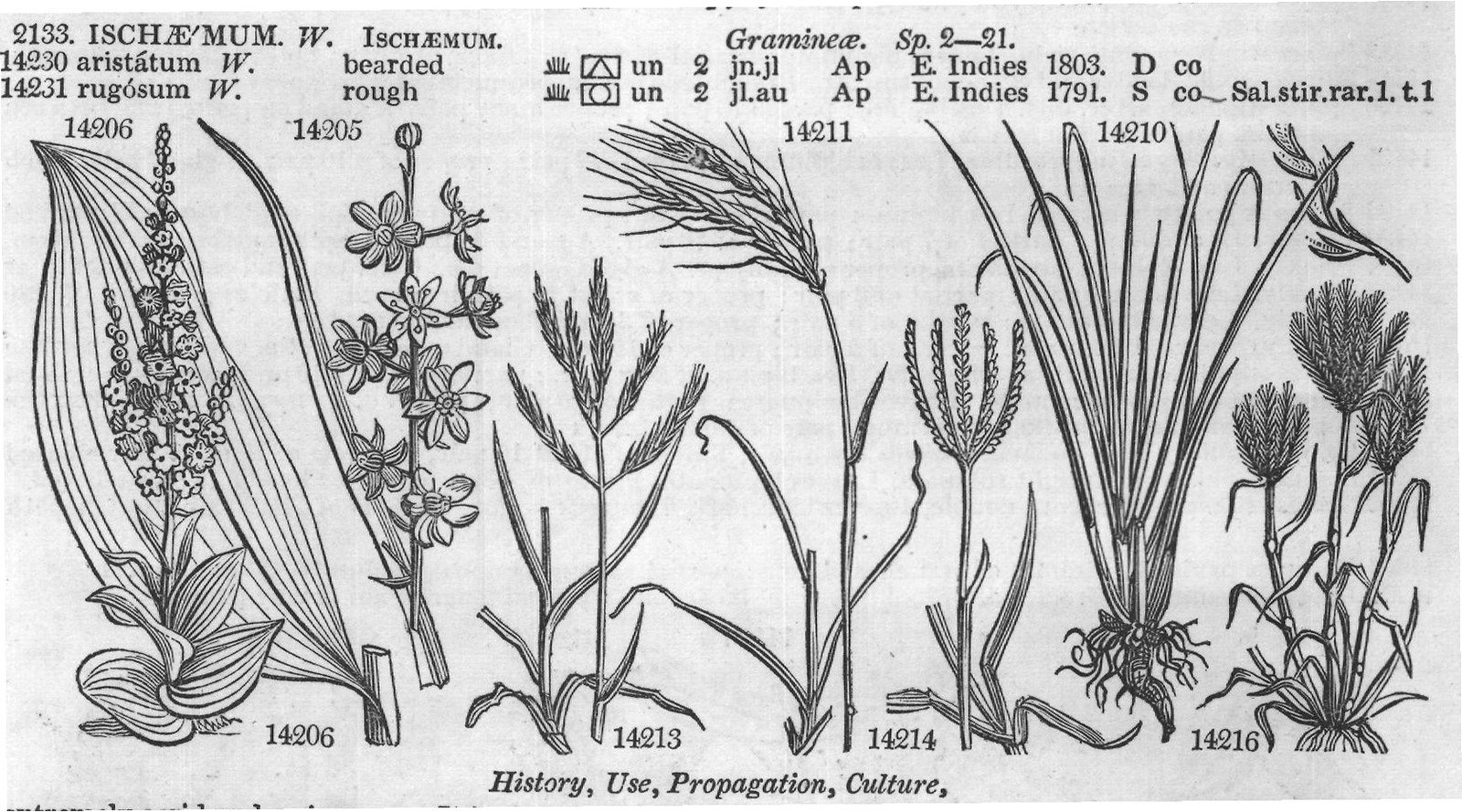
Virginian or 2 jn.jl Br N. Amer. 1768. D 1.p Bot. mag. 985 14206 nigrum W. dark-flowered or 3 jn.jl D. Pu Siberia 1596. D p.l Bot. mag. 963 14207 parviflórum W. small-flowered or 2 jn.jl G Carolina 1809. D p.l 14210 Schænánthus W. 14212 múticus W. 2129. ANDROPO'GON. W. ANDROPOGON. 14208 striátus W. 14209 contórtus W. 14211 distáchyos W.
Lemon-grassfit smooth-spikedun Gramineæ. Sp. 6-66. nerve-glumed 11 au Ap E. Indies 1793. D co twisted 2 jl.s Ap E Indies 1779. D Co Sch.ha.3.t.342.a. 1 Ap E. Indies 1786. D co Ru.am.5. t.72.f.2 two-spiked un 1½ jl.au Ap jl.s Ap S. Europe 1805. D co C. G. H. 1794. D co Fl. græc. 1. t. 69 14213 Ischæmum W. woolly 1 au Ap S. Europe 1768. D co Sch. gram. 2. t.33 2130. CHLOʻRIS. W.
CHLORIS.
Gramineæ. 14214 petræ'a W. 14215 ciliáta W. ciliated 14216 radiáta W. flat-stalked many-spiked pr pr jl.au Ap jl.s Ap 14217 barbáta W. bearded 14218 curtipéndula W. 2131. SOR GHUM. W.en. SORGHUM. short-spiked pr سلا Apr علم au.s Ap pr 1 jn.jl Ap jn.au Ap Sp. 5-24.
Jamaica 1779. D co Jamaica 1779. D co W. Indies 1739. S co E. Indies 1777. S co Illinois 1808. D co Vah.symb.2.t.27 Moris.s.8.t.3.f.15 Gramineæ.
Sp. 5-9. 14219 bícolor W. en. two-colored clt 3 jl Ap Persia 1731. S co M.ac.he.8.t.4.f.4 14220 vulgáre W. en.
Indian Millet 4 jl Ap India 1596. S co M.ac.he.8.t.4.f.3 14221 rúbens W. en. red-seeded ○ clt 3 jl Ap Africa 1817. S co 14222 saccharátum W.en. yellow-seeded clt 6 jl.au Ap India 1759. S co A.ac.pa.1. t.4.f.2 14223 halepénse P. S. panicled un 3 jl.au Ap Syria 1691. D co Fl. græc. 1. t. 68 2132. HOL/CUS. W.en. SOFT-GRASS.
Gramineæ.
Sp. 6-8. 14224 Grýllus R. Br. purple-flower'dun jn.jl Ap S. Europe 1791. D co Fl. græc. 1. t. 67 14225 móllis W. creeping ag 2 jl.au Ap Britain corn fi. Dh.l