Home › B › Bux (Cen t Pensylvanian pr jn au Y)
Bux (Cen t Pensylvanian pr jn au Y)
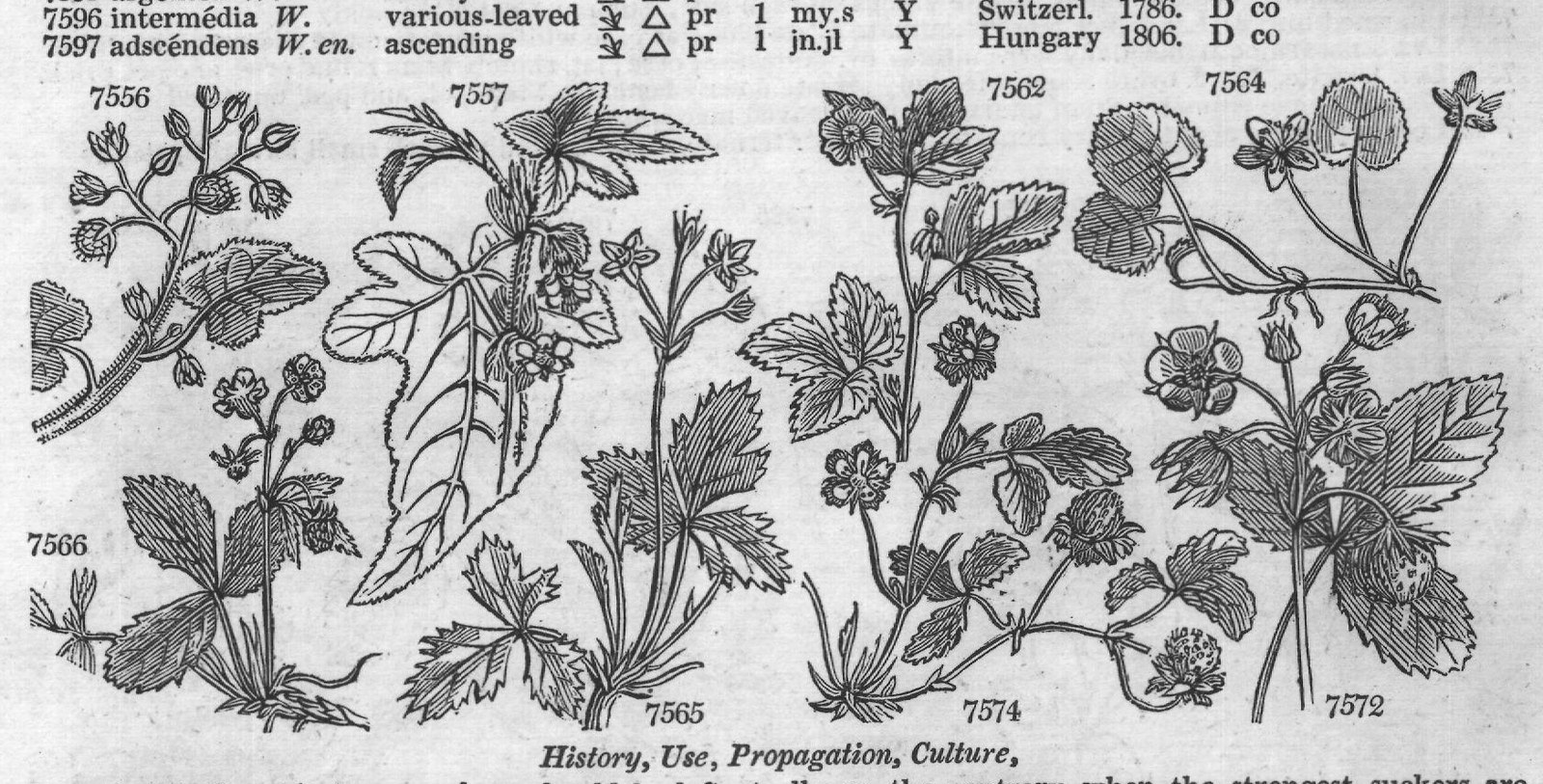
cen. 1. t.48 Pensylvanian pr 1 jn.au Y N. Amer. 1725. D co Jac. vin. 2. t. 189 trailing pr jl.au Y Siberia 1696. D co Jac. aus. 5. t. 406 upright silvery Apr 1 jn.jl Apr 1 jn.au Y Y various-leaved pr 1 my.s Y 7597 adscéndens W.en. ascending Apr 1 jn.jl Y 7556 7557 S. Europe 1648. D co Britain gra.pa. D co Switzerl. 1786. D co Hungary 1806. D co 7562 Jac. aus. 4. t. 383 Eng. bot. 89 7564 7566 7565 7574 7572 History, Use, Propagation, Culture, large fruit is the object, no suckers should be left at all: on the contrary, when the strongest suckers are wanted, the fruit-bearing shoots should be cut down. R. occidentalis is a showy plant for large shrubberies. The fruit of R. cæsius is blue, edible, and it continues till frost. R. corylifolius and fruticosus are both common in our hedges; the shoots of the latter are much tougher than those of the former, and are preferred by thatchers for binding their roofs, and by straw-hive and mat makers. The berries, eaten at the moment they are ripe, are cooling and grateful; a little before, they are coarse and astringent; and a little after, disagreeably flavored or putrid. They are sometimes made into pies; but great care is requisite in gathering the fruit, for one berry of the last sort will spoil a whole pie. The double-flowering variety is considered very ornamental. The fruit of R. arcticus and chamæmorus is eaten in the north of Scotland and Sweden. In the iatter country, Dr. Clarke informs us, it is much prized in soups, sauces, and for making vinegar; and Dr. Clarke was cured of a bilious fever by eating great quantities. The plant is rather difficult to preserve in gardens, but by raising successive generations from the seed it might perhaps be subjected to the same culture as the cranberry. The fruit of R. pauciflorus, the Nepal raspberry, is very agreeable. 1150. Dalibarda. Denis Dalibard was a French botanist, who published, in 1749, a catalogue of the plants in the neighbourhood of Paris. Small plants, resembling the little species of Rubus. ORDER III.
ICOSANDRIA POLYGYNIA. 7556 Leaves simple cordate somewhat lobed downy beneath, Stem prickly decumbent 7557 Branches round villous, Lvs. cordate obl. 5-lobed: the middle lobe elongated, Stip. and bractes pectinate 7558 Leaves 3-5 downy beneath, Stem peduncles and petioles with recurved prickles ** Herbaceous. 7559 Leaves tern. naked, Runners creeping herbaceous, Panic. few-flowered 7560 Leaves tern. naked, Leafl. rhomboid acute cut serrate: the odd one stalked, Flowers about 3 7561 Stem unarmed 1-flowered, Leaves term. smooth finely serrate, Pet. obl. entire, Styles approximating 7562 Leaves ternate, Stem unarmed 1-flowered 7563 Leaves simple lobed, Stem unarmed 1-flowered 7564 Leaves simple cordate crenate, Peduncles 1-flowered 7565 Leaves ternate, Leafl. cuneate serrate-cut, Tube of cal, obconical 7566 Cal. of fruit reflexed, Pubescence of petioles spreading, of the peduncles appressed 7567 Leaves simple 7568 Cal. of fruit erect, Pubescence of pedunc. erect, of petioles much spreading, Leaves downy on each side 7569 Cal. of fruit reflexed, Pubescence of pedunc. and petioles much spreading 7570 Large, Leaves broad oval, Pedic. long recurved pendulous, Recept. much excavated globose villous 7571 Cal. of fruit spreading, Pubescence of petioles erect, of peduncles appressed, Leaves smoothish above 7572 Cal. of fruit erect, Pubescence of peduncles and petioles erect, Lvs. smoothish above 7573 Cal. of fruit erect, Pubescence of peduncles and petioles much spreading, Lvs. villous on each side 7574 Outer sepals larger than the rest obovate 3-toothed 7575 Leaves pinn. Petals smaller than calyx 7576 Leaves tern. Petals larger than calyx 7577 Leaves pinnate, Leafl. lin. obl. flat, Petioles long, Branches 1-2-fl. 7578 Leaves pinnate, Leafl. lin. obl. revolute at edge, Petioles short, Corymbs terminal 7579 Leaves interruptedly pinnate silky, Leaflets finely serrate, Stem creeping, Pedunc. 1-fl. 7580 Leaves ternate stalked, Leafl. obovate cut serrate white with down beneath, Sepals ellipt. Pet. obcordate 7581 Rad. lvs. quinate cauline tern. Leafl. cuneate obl. serrate, Stipules large adnate entire 7582 Leaves pinnate white with down beneath, Leafl. serrate, Stem shrubby 7583 All over silky, Lvs. interruptedly pinn. Fl. dichoto. corymb. Sepals ov. acute, Stem erect nearly simple 7584 Lvs. interruptedly pinn. with spread. hairs, Leafl. lanc, cut toothed, Stip. cut, Pet. obcord. larger than cal. 7585 Lvs. bipinnatifid in many pairs downy on each side: segments parallel approximating, Stem decumbent 7586 Lvs. bipinnatifid in four pairs smooth above downy beneath: segments distant, Stem decumbent 7587 Leaves pinnate: the outer largest, Runners creeping 7588 Rad. leaves subpinn. cauline tern. Leafl. lanc, unequally coarsely serrate hairy on each side 7589 Leaves pinnate alternate, Leafl. 5 ovate crenate, Stem erect 7590 Leaves pinnate nearly equal, Leafl. oblong subbifid: the outer confluent 7591 Leaves pinnate, Leafl. roundish toothed equal, Stem erect 7592 Leaves pinnate upper ternate, Leaff deeply toothed, Stem erect pubescent 7593 Leaves pinnate, Leafl. oblong deeply toothed, Stem decumbent dichotomous, Pedun. axill. solitary 7594 Leaft. 7-5 lanceolate coarsely toothed, Petals obcordate larger than calyx, Stem erect 7595 Leafl. 5 cuneiform cut downy beneath, Stem erect 7596 Radic. leaves 5-nate, Cauline ternate, Stem nearly erect much branched 7597 Lvs. 5-nate with adpressed hairs: of the branches ternate, Leafl. obl. cuneate deeply toothed, Stem ascend. 7575 7577 7579 7592 7582 7581 7587 and Miscellaneous Particulars. 1151. Fragaria. From fragrans, in allusion to the perfumed fruit. Ital. This is a genus of fruit-bearing herbaceous plants, of which there are few in the vegetable kingdom, and none to equal the strawberry in wholesomeness and excellence. This fruit is universally grateful, alone, or 7588 Fraisier, Fr., Erdbeere, Ger., and Tragolo, with sugar, cream or wine; and has the property, so valuable for acid stomachs, of not undergoing the acetous fermentation. Besides the species or subspecies enumerated, there are upwards of sixty mongrel varieties or different names, some of which, recently produced from seed, are of great excellence. The strawberry is not only a valuable and easily cultivated out-door fruit, but forces well, and with a little trouble in choosing a succession of sorts, they may be had at the dessert every month in the year, though during the three winter months they are without flavor.
In cultivating the strawberry an open situation and rich loamy soil, rather strong, is required for most varieties; and from their large mass of foliage and flowers, they must, till the fruit is set, have copious supplies of water. The row culture is most convenient, and frequent renewal insures vigorous plants and large fruit. 1152. Comarum. A name given by the Greeks to the Arbutus. The Comarum of the moderns produces a fruit not unlike that of the Arbutus. 1153. Potentilla. In allusion to its supposed potential virtues in medicine. These, however, appear to con- Gg3 7598 hírta W. hairy pr 1 my.s Y 7599 stipuláris W. stipular 7600 opáca W. small-rough pr 1 jl.au Y pr my.jn Y 7601 vérna W. spring 7602 aúrea W. golden pr Apr mr.my Y my.jl Y 7603 astracánica W.
Astracan 7604 álba W. white pr f.au W 7609 réptans W. 7613 nívea W. 7615 tridentáta W. 7616 grandiflóra W. 7605 cauléscens W. 7606 Clusiána W. 7607 lupinoídes W. 7608 nítida W. 7610 sarmentósa W.en. 7611 diffúsa W. en. 7612 monspeliénsis W. 7614 norvégica W.
Clusius's shining common sarmentose Montpelier snowy Norwegian trifid-leaved great-flowered 1154. TORMENTIL/LA. L. SEPTFOIL.
Alpine Apr 1 my.jn Y Apr 1 jlau Y close-flowered pr jn.jl Y Aprjn.jl Y Apr jn.s Y prjl Y various-leaved Apr jn.au Apr jl.au Y Y ICOSANDRIA POLYGYNIA.
Apr 1 jn.au Y S. Europe 1725. D co Siberia 1797. D co S. Europe 1680. D co Britain hghl.p. D co Scotland sc.alp. D co Siberia 1787. D co Wales w.alp. D co Austria 1759. D co Austria 1806. D co Al. of Eur. 1739. D co Austria 1798. D co Britain me. pa. D co N. Amer. 1804. D co 1817. D co CLASS XII.
Gm. si. 3. t.37.f.2 Jac. ic. 1. t. 91 Eng. bot. 37 Eng. bot. 561 Jac. ic. 1. t. 92 Eng. bot. 1384 Jac. aus. 3. t.220 Bot. mag. 1327 Bot. cab. 654 Jac. au.5.t.ap.25 Eng. bot. 862 ...... pr jn.au W prjn.jl Y cu jn.jl W or 1 jn.jl Y France 1680. D.co Siberia 1816. D co N. Europe1764. D co Scotland sc. alp. S co Siberia 1640. D co M. h. s. 2. t.20f.2 Bot. cab. 460 Fl. dan. 171 Eng. bot. 2389 Bot. mag. 75 Rosacee. Sp. 2. 7617 réptans W. large-flowered w jn.jl Y Britain me.pa. Rs co Eng. bot. 864 7618 erécta W. common W 1 my.o Y Fritain bar.pa. D co Eng. bot. 863 officinalis E. B. 1155. GE'UM. W.
AVENS.
Rosacea. Sp. 10-20. 7619 stríctum Ph. upright or 1 my.jn St N. Amer. 1778.
D p.l Jac. ic. 1. t. 93 7620 agrimonoídes Ph.
Agrimony-lvd. or 1 jn.jl W N. Amer. 1811.
D p.l 7621 álbum Ph. white-flowered or 1 jl.au W N. Amer. 1730.
D p.1 Jac. vin. 2. t. 175 7624 urbánum W. 7622 virginiánum Ph. 7623 macrophýllum W. en.large-leaved 7625 intermédium W. en, wood small white-fl. or 1½ jl.au W N. Amer. ...
D p.1 or 2 jn.jl Y common or 14 my.au Y 7626 rivále W. water 7627 hýbridum Jac. hybrid 7628 pyrenáicum W.
Pyrenean or or 1156. KER'RIA. Dec.
KERRIA.
Δ or 1 my.au Y A Aor 1 jn.jl R.Br Britain m.mea. D p.1 ...
D p.l Pyrenees 1804. D p.1 1 jn.jl R.Br Europe 1½ jn.jl Y Rosaceæ. Sp. 1.
Kamtsch. 1804. D p.l Britain woods. D p.1 1794. D p.1 Eng. bot. 1400 W. ho. b. 1. t. 69 Eng. bot. 106 Jac. ic. 1. t. 94 Lam. ill. t. 443 7629 japónica Dec.
Japan or 3 ja.d Y Japan 1804. C co Bot. mag. 1296 Corchorus japonicus L. 1157. CALYCAN'THUS. L. ALLSPICE.
Calycantheæ.
Sp. 3-5. 7630 flóridus W.
Carolina ft 7631 fértilis W. glaucous-lvd. ft 6 my.au Br 3 my.au Br Carolina 1726. L 1.p Carolina Llp ... 7632 lævigátus W. en. smooth-leaved ft 3 my.jl Br N. Amer. 1806. L l.p Bot. mag. 503 Bot. reg. 404 Bot. reg. 481 1158. CHIMONAN'THUS. Lindl. CHIMONANTHUS. Calycantheæ. Sp. 1. 7633 frágrans Lindl. Japan ft 6 f.d Y.R Japan 1766. L l.p Bot. mag. 466 Calycánthus præcox W.
ẞ grandiflórus Lindl. large-flowered ft 8 f.d Y.R China L co ...
Bot. reg. 451 1159. DRY'AS. W.
DRYAS.
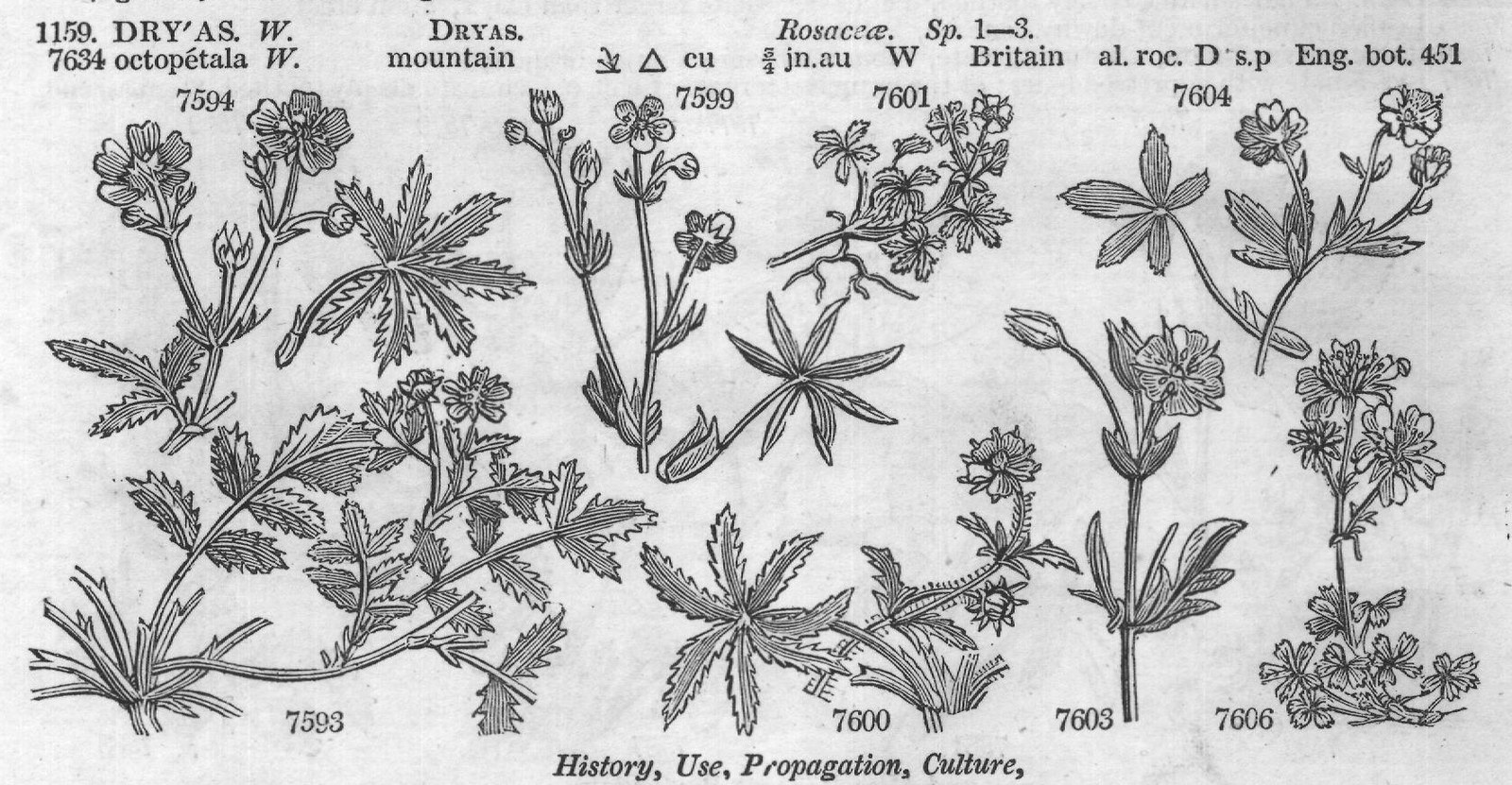
Rosacea. Sp. 1-3. 7634 octopétala W. mountain 7594 cu 7599 jn.au W Britain al. roc. D's.p Eng. bot. 451 7601 7604 7593 7600 7603 7606 History, Use, Propagation, Culture, sist of nothing beyond a slight vulnerary quality. P. fruticosa and floribunda are shewy shrubs. P. anserina is remarkable for the silvery whiteness of its foliage, which is eaten by geese, as the roots were once by the country people in some places. All the species are pretty, and deserving cultivation. 1154. Tormentilla. From tormina, the dysentery, which this plant was formerly employed for curing. T. erecta was once a plant of some importance in economy and medicine. The roots are still used in most of the Western Isles of Scotland and in the Orkneys for tanning leather, for which they are superior even to oak-bark. They are first boiled in water, and the leather is then steeped in the cold liquor. In the islands of Tirey and Col, the inhabitants have destroyed so much ground by digging them up, that they have been prohibited the use of them. They are also used for dying of a red color. And Mr. Young informs us, that many swine are reared with them on the mountains of Killarney.
In the London Materia Medica it is employed in intermittents, and as a local application in the form of gargle and lotion, in ulcerations of the tongue and mouth, against spongy gums, and as an application to fœtid ill conditioned sores; but it is seldom used. (London Dispensatory, 538.) 1155. Geum. From γεuω, to taste well. The roots of G. urbanum have a mildly astringent aromatic taste, somewhat like that of cloves, whence this plant has the name of Caryophyllata. They should be gathered in dry warm situations, for in shady moist places they have little virtue. Gathered in the spring, and put fresh info ale, they give it a pleasant flavor, and prevent its turning sour. Infused in wine, it is esteemed a good ORDER III.
ICOSANDRIA POLYGYNIA. 7598 Leafl. 5-7 cuneiform cut pilose, Stem erect hairy 7599 Leafl. 7 sessile seated upon a dilated stipule 7601 7600 Leaves Rad. lvs. 5-7 lin. cuneiform toothed, Petals retuse the length of calyx, Stems filiform decumbent hairy than calyx, Stems declinate 7602 7603 Rad. lvs. 5-nate, Leafl. cuneif. ciliate 5-toothed at end, Caul. 3-nate subsess. Pet. obcord. larger than calyx