Important: Safety Warning
This page recommends preparations containing opium, laudanum, morphine, or similar narcotics — in some cases for children. These substances are dangerously addictive, easily fatal in overdose, and strictly controlled by law today.
This page prescribes plants as medicine according to pre-modern medical theory. Several of the plants named are toxic, correct identification is difficult, and the doses given have no scientific basis. Do not ingest or apply any preparation described here.
This page presents medical treatment from an era before modern medicine. The remedies described are ineffective against the conditions named, and some of the ingredients or doses are harmful. Do not use them to treat any illness; consult a qualified medical professional.
This information has been left in for historical purposes but should not be acted upon.
Home › B › Bux (Cent t Boragine)
Bux (Cent t Boragine)
cent. 5. t.30 Boragineæ.
Sp. 24-80. 3 my.jn Pk C. G. H. 1759. C p.l Bot. reg. 86 3 my.jn Pu Madeira 1777. S p.1 Bot. reg. 43 3 jn.jl Pk Madeira 1787. S p.l Bot. reg. 124 B Madeira 1794. C s.l Bot. rep. 39 1978 gigantćum W. gigantic or 10 jl.n W Canaries 1779. C p.1 Vent. mal. 71 1979 strictum W. upright or 3 my.d B Canaries 1779. C s.1 Jac.schen.1.t.35 1980 argenteum W. silvery or 3 jn.jl B C. G. H. 1789. S p.1 Bot. rep. 154 1981 lævigátum W. smooth-stalked or 1 jn.jl B C. G. H. 1774. C s.l Lehm. ic. asp.t.3 1982 glábrum W. sea-green or 1 my.jn W C. G. H. 1791. C s.l Bot. rep. 165 1983 fastuósum H. K. noble or 4 ap.au Pu Canaries 1779. C s.l 1984 nervósum H. K. sinewy or 4 jn.au Pu Madeira 1777. S p.l 1985 spicátum W. spiked-dwarfor mr.my W C. G. H. 1799. C s.l Lehm. ic. asp.t.1 1986 glaucophyllum Jacq. glaucous 1987 plantagíneum W. Plantain-leaved or 2 jl B C. G. H. 1792. C s.l Jacq. ic. 2. t. 312 or 1 jl.o V Italy 1776. C s.l Barr. ic. t. 1026 1988 itálicum W. white or 4 jl W Jersey ...
Ss.l 1989 rúbrum W. red or 4 jlau R Hungary 1791. Co Eng. bot. 2081 Jac. aus.5. t. ap.3 1990 vulgáre W. common or 2 jl.au R 1991 violáceum W. violet-flowered or 3 jl.au B 1992 marítimum W. sea or jl.au B 1993 pyrenaicum W. en. Pyrenean or 1 jl.au Pk 1994 créticum W. 1995 orientále W. 1996 lusitánicum W.
Cretan oriental Portugal O or 1 jl.s or 3 jl.au O or 3 jl.au V W 2003 suffruticósa W. 2005 laurifólia Vent. 347. NOLA'NA. W. 2006 prostráta W. 348. ARE/TIA. W. climbing laurel-leaved NOLANA. 1998 Messerchmídia R. Br. shrubby 2000 fœtidissima W.
Tobacco-leaved 2001 cymósa W. broad-leaved 2002 bícolor W. two-colored hoary-leaved 2004 volubilis W. 1997 parviflórum H. K. small-flowered 346. TOURNEFOR TIA. R. Br. TOURNEFORTIA. 1999 Argúzia R. & S. herbaceous or 2 jl.au W Boragineæ.
Britain sto. fi. S l.p Austria 1658. S co Italy 1815. S co Pyrenees 1815. S co Levant 1683. S s.l Pa.B Levant 1780. S co S. Europe 1731. S co Barbary 1798. S co Sp.8-36.
Eng. bot. 181 Boc. mus. 2. t.78 Bot. mag. 1934 Trew pl.rar.1.t.1 or 6 jn.o G Canaries 1779. C s.l Bot. reg. 464 or jn.o W Siberia 1780. C s.l or 9 s Pk Jamaica 1739. C p.1 Plu. ic.226. t.230 or 9 jl Pk Jamaica 1777. C p.1 Jac. ic. 1. t. 31 or 6 G ...
Jamaica 1812. C p.l or 4 W Jamaica 1759. C p.1 Slo.jm.2.t.162.f.4 or 12 jl.au G Jamaica 1752. C p.l Slo.jm.1.t.143.f.2 호 or 12 jn.jl Y Porto Rico1819. C p.1 Vent. chx. t. 2 Boragineæ.
Sp. 1-7. trailing or jl.s B Peru 1761. C p.1 Bot. mag. 731 ARETIA.
Primulacea.
Sp. 3-9. 2007 helvética W. imbricated or 2008 alpína W. linear-leaved or my.jn W my.jn Pk Switzerl. 1775. D s.p Schk. han.1. t.32 Switzerl. 1775. D s.p Bot. cab. 297 2009 Vitaliána W.
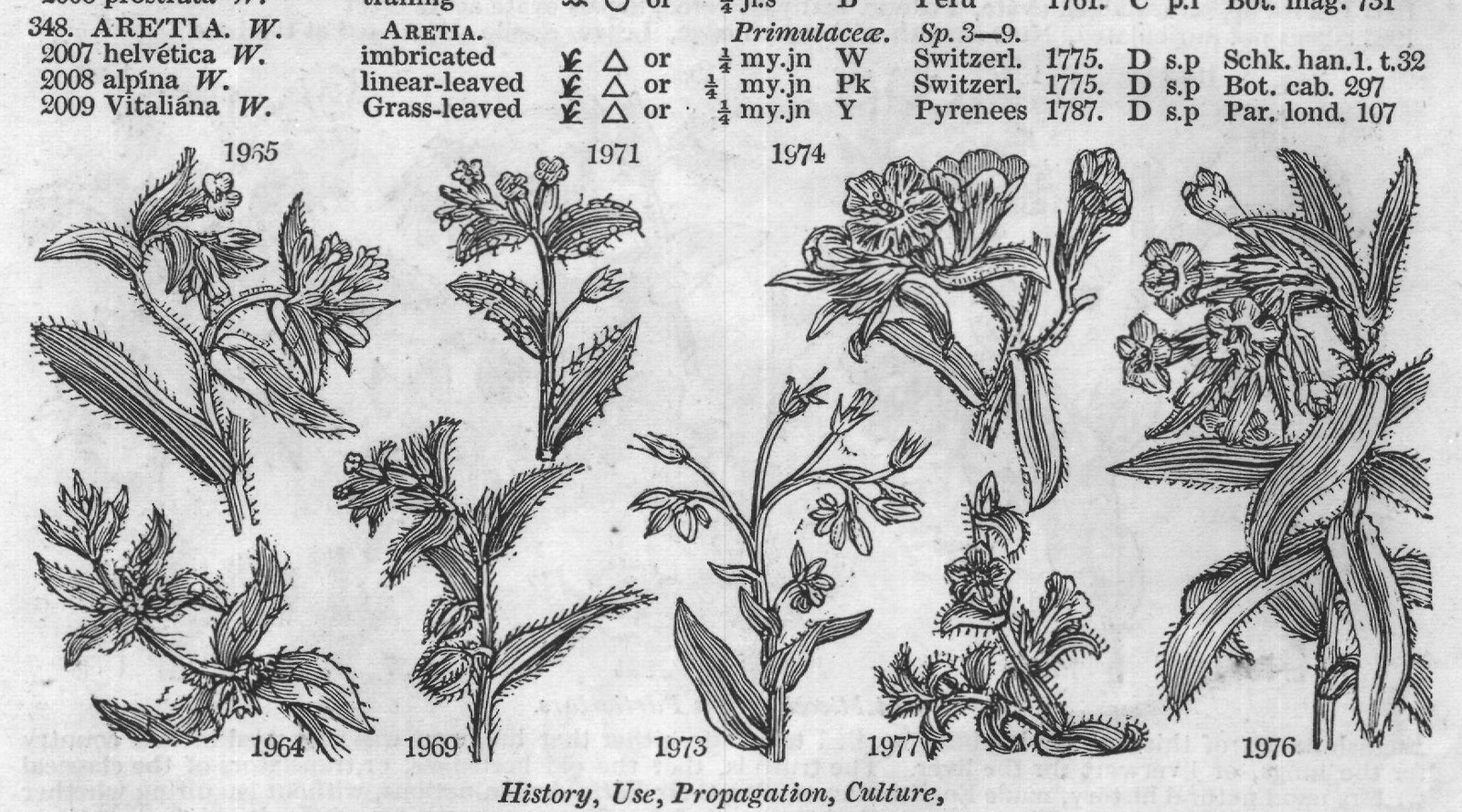
Grass-leaved or my.jn Y Pyrenees 1787. D s.p Par. lond. 107 1965 1971 1974 1964 1969 1973 1977 1976 History, Use, Propagation, Culture, the principal feature in the generic character. This has been separated from Borago by modern botanists; it is a plant of no beauty. 342. Asperugo. So called from its asperity. The only species is a procumbent annual with small blue flowers, found all over Europe, from Lapland to the Mediterranean. 343. Nonea. A name contrived by Mönch, in his Methodus Plantarum, to distinguish the dark flowered species of Lycopsis. The genus was long neglected, but has recently been adopted by both Decandolle and Lehmann. 344. Lycopsis. From λuκoς, a wolf, and of, the eye. Ingenious people have found a similarity between the small blue flowers of this plant and the eye of a wolf. All the species are weed-like plants. 345. Echium, is an ancient name applied to some plant of this family, and derived from εχiς, a viper, from the resemblance between its seeds and the head of a viper. The spotted stem, which may be likened to a snake's skin, affords a reason for the application of the name. All the species are beautiful in their flowers, but rough and unpleasant in their foliage. The common E. vulgare of our downs is perhaps the handsomest of European plants.
ORDER I.
PENTANDRIA MONOGYNIA. 1964 The only species. Stem climbing very rough, Flowers small axillary 1965 Leaves entire, Stem erect, Cal. of fruit inflated pendulous 1966 Leaves obl. lanc. strigose floral cordate longer than the cal. Cal. acute, in fruit inflated pendulous 1967 Cal. 5-cleft, in fruit inflated pendulous, Leaves obl. hispid floral cordate longer than cal. Stems procumb. 1968 Stem procumbent, Leaves entire, Cal. of fruit pendulous, Cor. shorter than calyx 1969 Leaves lanceolate, Stem prostrate, Cal. of fruit inflated nodding 10-angular, Cor. longer than calyx 1970 Leaves lanceolate denticulated hispid ciliated, Cal. of fruit inflated pendulous 1971 Leaves repand toothed callous, Stem decumbent, Corollas nodding 1972 Leaves lanceolate hispid, Cal. always erect 1973 Leaves ovate entire scabrous, Cal, erect 1974 Pubescent, Fl. in loose corymb. Pan. at end of branches, Tube closed by a 5-lobed fringe, Stam, included 1975 Stem shrubby, Leaves lanc. nervose and branches hairy, Sepals oblong and lanceolate acute, Styles hairy 1976 Stem smooth, Leaves lanceolate rough above, Flowers cymose equal, Tube of flower very long 1977 Stem shrubby, Branches and leaves prickly, Flowers in spikes, Corollas nearly equal 1978 Stem shrubby, Leaves lanc. atten. at base hairy, Hairs very short, Bract. and cal. strigose, Stam. exserted 1979 Stem shrubby upright branched, Leaves oblong lanc. hairy, Cor. campanulate small, Stamens exserted 1980 Stem and lanceolate acute leaves silky, Spike terminal nearly simple leafy 1981 Stem smooth, Leaves lanceolate smooth ciliated prickly, Cor. equal 1982 Stem smooth, Leaves lanceolate smooth scabrous at edge 1983 Stem branched, Leaves lanceolate nerved and branches silky, Styles hairy, Racemes cylindrical 1984 Leaves lanceolate nerved and branches silky, Styles hairy, Racemes ovate 1985 Stem villous, Leaves sword-shaped elliptical villous, Spike compound linear oblong 1986 Stem shrubby, Branc. and cal. smooth, Lvs. lanc. glauc. veinl. smooth above with a few coarse hairs at back 1987 Leaves radical ovate lined stalked [towards the end 1988 Stem herbaceous hairy, Leaves linear lanc. strigose hairy lower nerved, Cor. equal, Stamens exserted 1989 Stem erect hispid, Leaves linear lanceolate hispid, Spike compound terminal, Cor. nearly equal 1990 Stem warted hispid, Cauline leaves lanceolate hispid, Flowers spiked lateral 1991 Cor. as long as stamens, Tube shorter than calyx 1992 Leaves spatulate lanceolate villous, Stam. shorter than corolla 1993 Stem herb. erect panic. hisp. dotted, Lvs. lin. lanc. strigose, Flowers remote, Stamens as long again as cor. 1994 Stem herb. echinate, Lvs. obl. lanceol. hispid little narrowed at base, Stam. as long as cor. Cal. of fr. distant 1995 Stem branched, Cauline leaves ovate, Flowers solitary lateral 1996 Stem nearly simple, Lvs. lanc. rather silky, the radical very long on stalks, Spikes axillary bent backwards 1997 Stamens shorter than cor. Cal. as long as limb, Leaves lanceolate strigose 1998 Stem shrubby, Leaves stalked, Flowers hypocrateriform 1999 Stem herbaceous, Leaves sessile, Flowers funnel-form 2000 Leaves ovate-lanceolate hairy, Peduncles branched, Spikes pendulous 2001 Leaves ovate entire naked, Spikes in cymes 2002 Leaves ovate acuminate smooth above rugose, Spike cymose erect recurved 2003 Leaves nearly lanceolate hoary, Stem half shrubby 2004 Leaves ovate acuminate nearly smooth, Leafstalks hairy, Stem climbing, Cal. 5-parted 2005 Stem climbing, Leaves ovate oblong acute repand smooth, Berry with 4 projections bipartible 2006 Leaves ovate oblong, Cal. pyramidal, Sepals triangular sagittate 2007 Stems rounded, Leaves imbricated, Flowers sessile 2008 Villous, Scapes 1-flowered 2009 Stem branching, Leaves smooth above, Pedunc, short, Petals conniving 1979 1998 2005 1986 2001 and Miscellaneous Particulars. 2003 1982 2008 346. Tournefortia. So named by Linnæus, after Joseph Pitton de Tournefort, author of an elegant arrangement of plants under the title of Institutiones rei Herbariæ, and the father of the French school of botany. The system of Jussieu is founded upon that of Tournefort, or is rather an adaptation of the principles of that botanist to the actual state of the science. The species are by no means handsome either in flowers or foliage, and in some cases the latter is even fetid. 347. Nolana. Is a diminution of nola, signifying a bell in low Latin. The name has been applied to this plant on account of its bell-shaped corolla. The species are hardy annuals, of beautiful appearance when in flower. They may be sown in the spring in the open border, where they will grow without protection. 348. Aretia. In honor of Benoit Aretio, a Swiss, professor in the university of Berne. He died in 1574. He published a work upon alpine plants, and his name has been applied to a charming alpine genus, said by some, with little reason, not to be distinc from Primula. The species are very delicate, and require good air and skilful cultivation to succeed well. They are peculiarly suitable for rock-work or growing in pots, well drained, and filled with turfy loam and peat. 2010 máxima W. 2011 elongáta W.
PENTANDRIA MONOGYNIA. 349. ANDROSA'CE. W. ANDROSACE. oval-leaved cluster-flowered. 2012 septentrionális W. tooth-leaved Primulacea. Sp. 10-35. or mr.jn W Austria 1597. S p.1 CLASS V.
Jac. aus. 4. t. 331 or ap.my W Austria 1776. S p.1 Jac. aus. 4. t. 330 or 2013 villósa W. villous 2014 lactiflóra Fisch.
Buckshorn-lvd. அ ap.my W Russia 1755. S p.l Bot. mag. 2021 or jn.jl Pk Pyrenees 1790. D s.p Bot. mag. 743 or jn.s W Siberia 1806. D s.p Bot. mag. 2022 2015 Chamæjásme W.
Grass-leaved or jn.au Pk Austria 1768. D s.p Bot. cab. 232 2016 láctea W. white-flowered 2017 cárnea W. awl-leaved 2018 obtusifólia W. blunt-leaved 2019 nána Horn. dwarf 4000 or jn.au W Austria 1752. D s.p Bot. mag. 868 or jl.au F Switzerl. 1768. D s.p Bot. cab. 40 or ap.jn Pk Italy 1817. S s.p All. ped.1.t46.f.1 or ap.my W Denmark 1803. S p.l 350. PRIMULA. W.
Primulaceæ.
Sp. 23-55. 2020 vulgáris E. B. common or mr.my Y Britain woods. D s.1 Eng. bot. 4 ẞ plena-carnea B. M. flesh-col.-double or mr.my Pk Britain ...
D s.l Bot. mag. 229 plena-álba double-white or mr.my W Britain D s.l ... plena-sulphûrea doub.-brimstone or mr.my Y Britain D s.l ... & plena-rúbra double-red or mr.my R Britain D s.l plena-cúprea double-copperor mr.my O Britain η plena-violacea plena-atropurpurea doub.-drk-purp.or mr.my Pu Britain ... ... ...
D s.l D s.1. double-lilac or 2021 elátior W.
Oxlip or 2022 véris W. 1 mr.my Y mr.my Li Britain D s.l ...
Britain woods. D s.l Eng. bot. 518 Cowslip or my.jn Y Britain m. pa. D s.1 Eng. bot. 5 2023 farinósa W. 2024 davúrica Fisch.
Bird's-eye or jn.jl R Britain m. pa. D p.l Eng. bot. 6 Siber. bird's-eye or my.jn Siberia 1806. D p.l Bot. mag. 1219 2025 cortusoídes W.
Cortusa-leaved Aor 1 my.jl R Siberia 2028 villósa W. 2026 dentiflóra Andr. 2027 longifólia H. K.
ẞ flore-albo 2029 nivális W. 2030 margináta W. 2031 Aurícula W. 2032 Palinúri W.en. 2033 integrifólia W. 2034 finmárchica W. 2035 mínima L. 2036 sinénsis Lindl. 2037 strícta Horn. 2038 scótica Hook. 2039 Pallásii Lehm. 2040 pusílla Hook. 2041 viscósa W. 2042 decóra B. M. 2010 Pallas's little clammy comely tooth-flowered or 1 my.jl R Siberia long-leaved or ap.my R 1794. D p.1 1806. D p.l Levant 1790. D p.1 Bot. mag. 399 Bot. rep. 451 Bot. mag. 392 villous-leaved orap.my Pu Switzerl. 1768. D p.1 Bot. mag. 14 white-flowered or ap.my W Switzerl. 1768. D p.l Bot. mag. 1161 snowy or ap.my Pu Dauria 1790. D s.1 Pal. it. t. G.* f. 2 silver-edged or mr.ap Pk Switzerl. 1777. D s.1 Bot. mag. 191 Auricula or ap.my Y Switzerl. 1596. Dh.l Jac. aus. 5. t. 415 flat-flowered or ap.my Y Naples 1816. D h.l Sweet fl. gard. 8 entire-leaved or jn.jl Pk Pyrenees 1792. D p.1 Bot. mag. 942 Norwegian or my.jn V least or ap Pu Chinese or ja.d Pk upright or ap.my Pk Scotch or orjn.jl R ... or jn or ap Y Pu P orap P ......
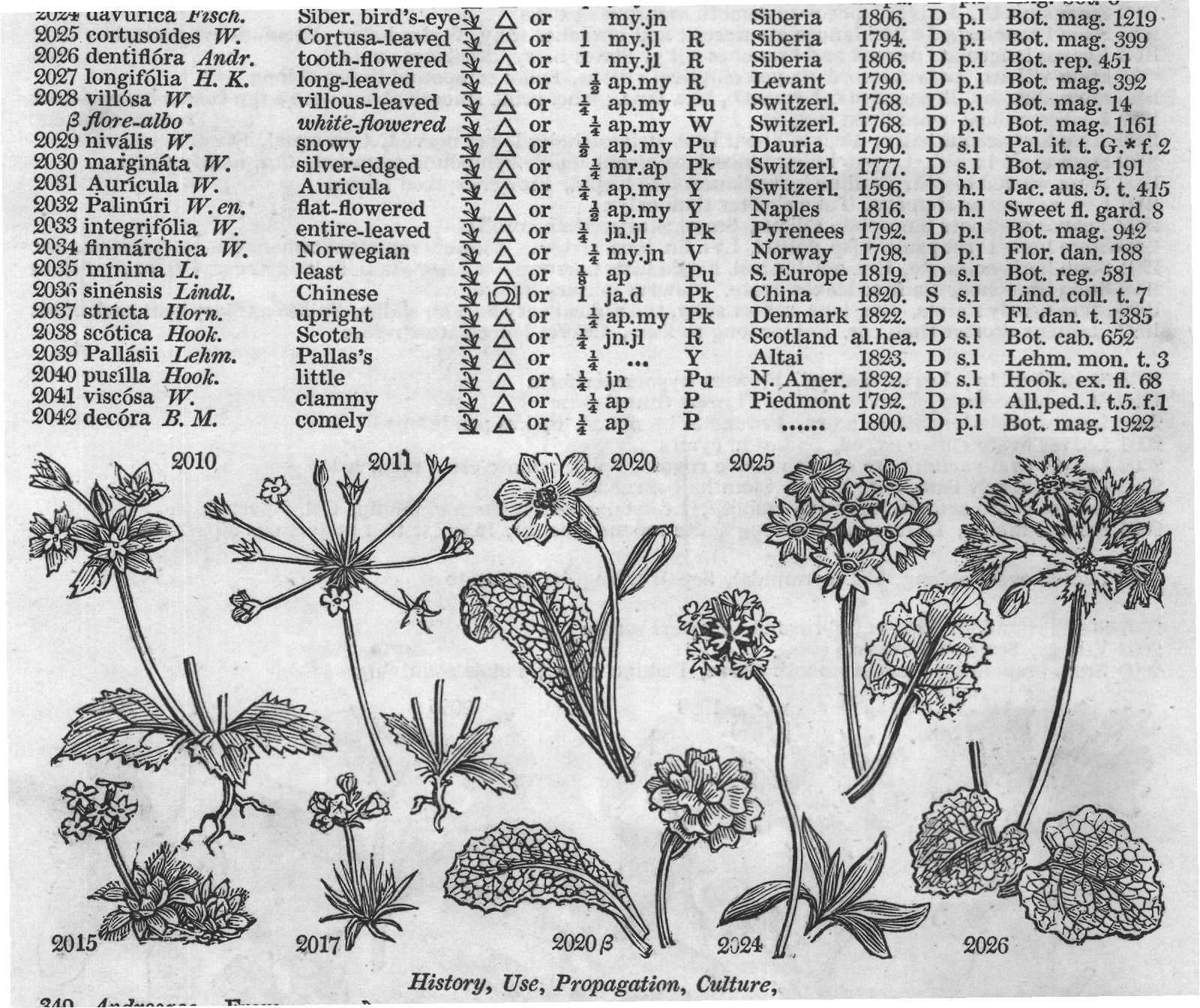
Norway 1798. D p.1 S. Europe 1819. D s.1 China 1820. S s.1 Denmark 1822. D s.1 Scotland al.hea. D s.l Altai 1823. D s.1 N. Amer. 1822. D s.l Piedmont 1792. D p.1 1800. D p.l Lind. coll. t. 7 Fl. dan. t. 1385 Bot. cab. 652 Lehm, mon. t. 3 Hook, ex. fl. 68 All.ped.1. t.5. f.1 Bot. mag. 1922 Flor. dan. 188 Bot. reg. 581 2011 2020 2025 2015 2017 2020 β 2024 2026 History, Use, Propagation, Culture, 349. Androsace. From avης avδρoς, a man, and σaκoς, a buckler; the large round hollowed leaf of the common Androsace has been compared to the buckler of the ancients. The Androsace of Pliny and others must Androsace has been compared to the buckler of the ancients. The Androsace of Pliny and others must have been something very different. These are elegant mountaineers which may be treated in all respects as Aretia. 350. Primula, is derived from primus, the first, - to flower; the delicate blossoms of many of the species appearing when all nature is otherwise inert. This genus consists of beautiful dwarf alpine plants, valuappearing when all nature is otherwise inert. This genus consists of beautiful dwarf alpine plants, valuable in horticulture, on account of their flowering early in spring, and being prolific in variation.
P. vulgaris is a native of most parts of Europe in woods and hedges on a moist clayey soil. It is generally found with brimstone-colored flowers, and single; but in some places, though rarely, it is found of a white, and again, of a purple hue, and occasionally double. The leaves and roots, which smell of anise, when dried, ground, and used as snuff, act as a sternutatory, and, taken internally, as an emetic. The varieties and subvarieties of this plant are very numerous. Some consider P. veris and elatior as sprung from it, and only more permanent varieties. The Hon. W. Herbert says, he raised from the seed of one umbel of a highly-manured red cowslip, a primrose, a cowslip, and oxlips, of the usual and other colors; a black polyanthus, a hose-in-hose cowslip, and a natural primrose bearing its flower on a polyanthus stalk; and from the seed of the hose-in-hose cowslip he raised a hose-in-hose primrose. (Hort.
Trans. iv. 19.) But this requires confirmation, as the circumstance was never before recorded. For distinction's sake we shall consider them as species or subspecies. The varieties of P. vulgaris are arranged by florists in two classes; the first contains all those whose flowers are on separate pedicels, rising from the root upon a common stem, SO short as not to be seen without separating on separate pedicels, rising from the root upon a common stem, so short as not to be seen without separating the leaves of the plant, and are called primroses . The second class includes all those whose flowers are in umbels on a scape or flower-stalk rising from three to six inches or more, and are called polyanthuses. Of the primroses there are about a dozen beautiful varieties in cultivation; and of the polyanthus an innumerable number, geadily added to by propagation from seed. The names of the varieties, with the exception of the double sorts riven above, are entirely arbitrary. The rules for judging of the beauty or merits of a variety are also wholly artificial, and founded on an imaginary form far removed from ordinary nature. These rules or canons are ORDER I.
PENTANDRIA MONOGYNIA. 2010 All villous, Leaves ovate oblong and sepals toothed, Involucres very large, Flowers very small 2011 Much branched rough, Branches spreading, Leaves obl. somew. toothed, Sepals lanc. ent. Fl. very small toothed, Sepals lanc. ent. Fl. very small 2012 Roughish erect, Lvs. lanc. tooth atten. at base, Prop. ped. elong. upright, Cor. longer than cal. Pet. ov. ent. 2013 Leaves lanceolate entire villous, Umb. few-flowered, Cor longer than the ovate campanulate calyx 2014 Smooth, Lvs. lanc. lin. tooth. at end, Ped. sprdg. elon. Cor. longer than cal. pet. obcord. (A. coronopif. B. M.) cal . pet. obcord. (A. coronopif.
B. M.) 2015 Pubescent, Leaves lanc. nearly entire ciliated, Umb. few-flowered, Cor. longer than the turb. calyx 2016 Caulesc. smooth, Lvs. lin. shining ent. cil. at end, Umb. few-fl. Stalks elong. Cor. longer than turb. calyx turb. calyx 2017 Caulesc. pubesc. Lvs. scattered lin. subulate ciliat. Umb. few-fl. Stalks short, Cor. longer than turb. calyx 2018 Leaves elliptical lanceolate smooth, Scapes umbellate 2019 Lvs. ov. lanc. from middle to end acutely toothed, Scape lvs. and stalks rather long. than invol. Cor. shorter than angular cal. (A. Bocconi of Gardens.) 2020 Leaves obovate oblong toothed rugose villous beneath, Umb, radical, Flower-stalks as long as lvs. Cor. flat 2021 Leaves toothed rugose hairy on both sides, Umbel many-flowered with outer flowers nodding, Cor. flat 2022 Lvs. toothed rugose hairy beneath, Umb. many-flowered, Flowers all nodding, Cal. angular, Cor. concave Cal. angular, Cor. concave 2023 Lvs. cuneate lanc. rug. cren. tooth. powdery, Umb. many-fl. Ped. spread. Tube gland. at end, Limb flat the [length of tube spread. Tube gland, at end, Limb flat the [length of tube 2024 Leaves sessile lanc. spatul. entire smooth on both sides, Outer fl. nodding 2025 Lvs. cordate stalked doubly crenate smooth beneath hairy at the veins, Stalks villous, Umb. many-fl. erect 2026 Leaves cordate crenate-lobed very rugose, Corolla acutely toothed 2027 Leaves oblong spatulate toothed green on each side, Leaves of involucre auricled at base 2028 Leaves obl. oval serrulate villous pale green, Scape 2-3-fl. erect rounded, Cal. globose, Tube of cor. villous 2029 Leaves lanc. flat finely toothed smooth, Umb. many-fl. erect, Leaves of invol. connate at base 2030 Leaves smooth on each side crenate powdery at edge, Cal. very short (P. crenata, Lehm.) 2031 Leaves obov. ent. or serr. fleshy, Scape central as long as lvs. Umb. erect, Inv. with short lvs. Cal. powdery 2032 Leaves spatulate serrated smooth, Scape lateral, Umbel nodding, Involucre with large leaves 2033 Leaves elliptical nearly entire thickish cartilaginous at edge, Umb. 2-3-fl. erect, Cal. tubular obtuse 2034 Leaves ovate entire stalked smooth, Umb. erect 3-fl. Cal. campanulate, Cor. cyathiform 2035 Leaves wedge-shaped shining many-toothed at end, Scape about 1-fl. Petals half bifid like a Y 2036 Leaves stalked ovate cordate rugose, Umbel proliferous, Cal. inflated 2037 Lvs. lan. obov. tooth. stlk. beneath nearly nak. Um. few-fl. erect, Lvs. of inv. lan. Pet. obov. short. than tube 2038 Resembles P. farinosa. Distinguished by its flat corolla, and more robust habit 2039 Leaves obovate oblong close toothed smooth somewhat wavy, Umb. pubesc. Cal. ovate gaping, Cor. flat 2040 Leaves obovate spatulate beneath and scape mealy, Segments obcordate toothed 2041 Leaves obovate tongue-shaped entire vill. viscid, Umb. many-fl. erect, Leaves of inv. ovate short membr. 2042 Leaves flat coarsely serrated acute, Cal. viscid, Pedicels longer than scape 2030 2037 2031 2033 2035 2042 2038 2036 and Miscellaneous Particulars. agreed on by the general consent of florists; they were first brought forward by the Dutch, and are now to be found in the treatises on florists' flowers of all countries : one of the best in this country is Maddocks's Florist's Directory.
The culture of P. veris as a border flower is abundantly simple, as it will grow any where, but best in a situation shaded from the mid-day sun, and in a loamy soil; but its culture as a florists' flower, the crossing to procure new varieties, and all the various cares of the florist involve details much too tedious for this work, if they were to be given at such length as to be of real use. We refer to Maddocks, Emerton , and Hogg, and to , the Encyclopedia of Gardening.
P. elatior is found in the same situations as the primrose, but is much less common than either it or P. veris, It has little or no smell. Sir J. E. Smith considers it as probably a hybrid between the cowslip and primrose. There are two or three varieties of oxlip, but they are not considered as florists' flowers .
P. veris smells more strongly of anise than the primrose. Its leaves have been used as a pot-herb, and in salads, and are recommended for feeding silk-worms. The flowers make a pleasant wine, flavored like muscadel, but considered somniferous. Liquors and syrups are sometimes tinctured with the leaves. Having been less cultivated than the primrose, there are but few varieties of this plant in gardens. They may be raised from seed, however, to any extent, as Messrs. Gibbs, of the Brompton nursery, and others, have lately proved.
P. auricula is a well known favorite of the florist. It is a native of the alpine regions of Italy, Switzerland, and Germany, and found also about Astracan. The most common colors in its wild state are yellow and red, sometimes purple, and occasionally variegated or mealy. The cultivated are innumerable, and many of them of exquisite beauty and fragrance. The leaves in different varieties differ almost as much as the flowers, a the flowers, a circumstance which does not take place to the same extent in the variations of P. vulgaris or veris. Near most of the manufacturing towns of England, and many in Scotland, the culture of this flower forms a favorite amusement of weavers and mechanics. Lancashire has been long famous for its auriculas it is no uncommon thing there for a working man who earns, perhaps, from 18s. to 30s. per week, to give two guineas for a new variety of auricula, with a view to crossing it with some other, and raising seedlings of new properties, PENTANDRIA MONOGYNIA. 351. CORTU'SA. W. 2043 Matthíoli W. 352. SOLDANEL/LA. W. SOLDANELLA. 2044 alpína W.en. 2045 montána W. en.
BEAR'S-EAR SANICLE. common or Alpine mountain Primulaceæ. Sp. 1. ap.jn R Austria 1596. D s.1 Primulacea. Sp. 2-3. ap Pu Switzerl. 1656. D p.1 CLASS V.
Bot. mag. 987 or Bot. mag. 49 or ap Pu Bohemia 1816. D p.l Bot. mag. 2163 S. Clusii B. M. 353. DODECA THEON. AMERICAN COWSLIP.
Primulaceæ. Sp. 1. 2046 Méadia W.
Mead's or 354. CY CLAMEN. W.
CYCLAMEN. 1 ap.jn L.Pu Virginia 1744. D p.1 Primulaceæ. Sp. 5.
Bot. mag. 12 2047 cóum W. round-leaved or 2048 europæ'um W. common or au L.R Britain 2049 pérsicum W.
Persian or 2050 héderæfólium W.
Ivy-leaved or f.ap ap 2051 ver'num Mill. spring or mr Pu ...... 355. HOTTONIA. W.
WATER-VIOLET.
Primulaceæ.
Sp. 1-2. 2052 palústris W. marsh △or 1 jl.au F 356. LYSIMA CHIA. W. LOOSE-STRIFE.
Primulacea.
Sp. 16-29. 2053 vulgáris W. common or 3 jl.s Y 2054 Ephémerum W.
Willow-leaved or 2 jl.s W 2055 angustifólia Mich. narrow-leaved or 1 jl.s Y 2056 dúbia W. purple-flowered or 1 jl.s Pu 2057 strícta W. upright Aor 1 jlau Y 2058 thyrsiflóra W. tufted or 1 my.jl Y 2059 capitáta Ph. headed 2060 punctáta W.
Aor 1 my.jl Y dotted Aor 1 jl.au Y 2061 verticilláta Pall. whorled or 1 jl.au Y 2062 quadrifólia Ph. four-leaved or 2 jl.au Y 2063 ciliáta Ph. ciliated Aor 2 jl.au Y 2064 longifolia Ph. four-flowered Aor 2 jl.au Y 2065 hýbrida Ph. hybrid or 1 jl.au Y 2066 Línum-stellátum W. small or jn G 2067 némorum W. wood or 2068 Nummulária W. my.jl Y Britain Moneywort or jn.jl Y Britain ja.ap L.R S. Europe 1596. S s.p banks. S s.p R.w Cyprus 1731. S p.1 W Austria 1596. S p.l England dit. Saq Eng. bot. 364 Britain wat.sh. D co Spain 1730. D p.1 N. Amer. 1803. D p.1 Levant 1759. D p.1 N. Amer. 1781. D p.1 England bog. pl. D co N. Amer. 1813. D co Holland 1658. D co Crimea 1820. D co N. Amer. 1794. D p.1 N. Amer. 1732. D m.s N. Amer. 1798. D p.1 N. Amer. 1806. D co Italy 1658. S s.1 m.s.pl. D m.s m.me. D m.s Bot. mag. 2346 Eng. bot. 761 M.co.go.1782. t.1 Bot. mag. 104 Eng. bot. 176 Jac. aus. 4. t. 366 Bot. mag. 2295 Lm.ill.1.t.101.f.2 Walth. hort.t.12 Bot. mag. 660 Mag. b. mo.t.162 Eng. bot. 527 Eng. bot. 528 Bot. mag. 4 Ss.l Eng. bot. 548 Bot. mag. 44 Bot. mag. 1001 Sweet fl. gard. 9 Eng. bot. 761 357. ANAGAL/LIS. W. PIMPERNEL.
Primulacea. 2069 arvénsis W. common W jn.s S Sp. 4-12.
Britain 2070 cærúlea E. B. blue W 2071 fruticosa H. K. large-flowered or 343 jn.s B Britain my.jl Ve 2072 latifólia W. broad-leaved or 1 my.jl Pu cor. fi. S co cor. fi. S co Morocco 1803. L p.1 Spain 2044 1759. L p.l 2050 Eng. bot. 529 Eng. bot. 1823 Bot. mag. 831 Meerb. ic. 1. t.22 2043 2045 2046 2047 2052 History, Use, Propagation, Culture, As to the soil proper for auriculas and polyanthuses, much has been written, and some highly artificial compositions of bullock's blood, sugar-baker's scum, night-soil, fuller's earth, &c. recommended. Many of the most successful growers, however, use nothing more than a loam from an old pasture or hedge-row, kept and turned over occasionally during a year, and then mixed with hot-bed dung rotten to a mould, or with leaf-mould, and some sand to keep it open. The soil and manure must be well mellowed by time before using, and not mixed till it is wanted, as that is said to generate worms. (See Encyc. of Gard. art. Primula.) P. auricula, helvetica, nivalis, and viscosa, are considered by Herbert as only varieties of one original, for he says he raised a powdered auricula and a P. helvetica from P. nivalis, and a P. helvetica from P. viscosa. (Hort. raised a powdered auricula and a P. helvetica from P. nivalis , and a P. helvetica from P. viscosa. (Hort.
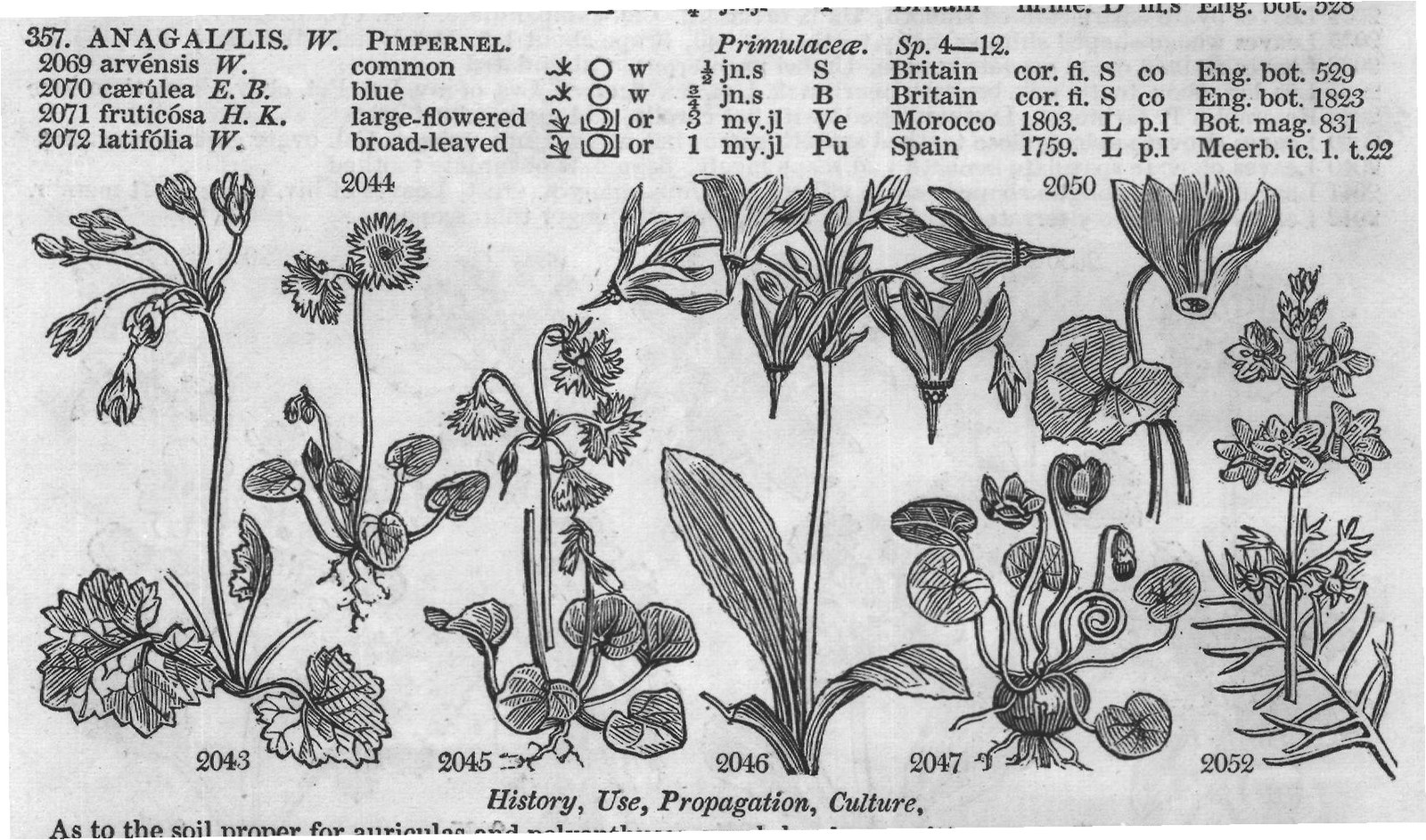
Trans. iv. 20.) These, and the other species of this genus, are well adapted for being kept in pots of loam and leaf-mould, or loam and peat well drained, and in frosty or wet weather during winter, protected by a frame to imitate their natural covering of snow in alpine regions. Sweet says, "they require to be shifted and parted frequently, for if left too long without these being done, they will dwindle away and die." The best time for parting and shifting is after they have done flowering P. scotica, a pretty plant, resembling P. farinosa, has lately been discovered in Scotland by Dr. Hooker, professor of botany at Glasgow. 351. Cortusa. So named by Mathiolus, in honor of his friend J. A. Cortusus, who first noticed it. This is a handsome little alpine, requiring a similar treatment to the Swiss Primulæ. 352. Soldanella. The diminutive of solidus, a shilling. The round leaves of these plants are very like pieces of money. They are among the least and most beautiful of alpine plants, and remarkable for the manner in which their corolla is cut or lacerated. Culture as in the Swiss Primulæ. 353. Dodecatheon. A name of the Romans, signifying 12 gods or divinities, applied with singular absurdity by Linnæus to a plant, native of a world the Romans did not know, and resembling in no particular that of Linnæus to a plant, native of a world the Romans did not know, and resembling in no particular that of their writers. It was originally named Meadia by Mark Catesby, in honor of Dr. Mead, but the name was continued only as a specific appellation by Linnæus . It is very ornamental when in flower; afterwards the leaves die away, and the root only remains till next season. It is not easily kept; but thrives better in a bed of light loamy soil, in a shady and rather moist situation, than in pots. 354. Cyclamen. Derived from κuκλoς, a circle, on account of the numerous coils of the fruit-stalks. This genus consists of humble plants with very beautiful flowers. In the north of Italy wild swine feed on its ORDER I. 2043 The only species PENTANDRIA MONOGYNIA. 2044 Cor. funnel-shaped spreading out beyond the middle, Calyx erect, Style shorter than corolla 2045 Cor. cylindrical bell-shaped not cut so far as the middle, Cal, spreading, Style longer than corolla 2046 The only species. Leaves radical flat on the ground, Scape bearing at top an umbel of drooping flowers 2047 Leaves orbicular cordate entire, Segments of cor. ovate 2048 Leaves orbicular cordate crenate or toothed, Segm. of cor. lanceolate 2049 Leaves oblong ovate cordate or reniform-cordate crenated, Segm. of cor. oblong obtuse 2050 Leaves cordate oblong acuminate angular toothed, Segm. of cor. oblong lanceolate rather acute 2051 Leaves cordate crenulate emarginate, with the base overlapping, Flower short, Style exserted 2052 Flowers vertical stalked, Leaves under water all finely cut 2053 Racemes terminal compound, Leaves opposite 3-4 together oblong lanceolate 2054 Racemes terminal, Petals obovate spreading, Leaves linear lanceolate sessile 2055 Smooth branching, Leaves opp. or whorled long linear spotted, Raceme terminating a short scape 2056 Racemes terminal, Petals conniving, Stam. shorter than corolla, Leaves lanceolate stalked 2057 Racemes terminal, Petals lanceolate spreading, Leaves lanceolate sessile 2058 Racemes axillary stalked ovate compact, Leaves opp. lanceolate 2059 Smooth, Stem simple spotted, Leaves opp. sess. lanc. acute spott. Flowers in close heads 2060 Leaves 3-4 together ovate lanc. stalked pub. beneath, Ped. axill. whorled, Pet. ovate fringed with glands 2061 Leaves whorled obl. lanc. stalked, Pet. ovate acute glandular, Stem pubescent 2062 Leaves subsessile 4-5 together oval acuminate dotted, Peduncles four, 1-flowered, Petals oval entire 2063 Pub. Lvs. opp. on long stalks cord. ovate, Fl.-stalks axill. in pairs, Fl. cernuous, Petals rounded crenulate 2064 Smooth much branched, Leaves linear very long, Segments of cor. serrulate 2065 Smooth, Leaves opp. on long stalks lanc. Petioles ciliated, Fl. cernuous, Cor. shorter than cal. Pet. cren. 2066 Leaves lanc. sessile, Peduncles axillary opp. Stem much branched smooth, Cal. longer than corolla 2067 Leaves ovate acute, Flowers solitary, Stem procumbent, Stamens smooth 2068 Leaves opposite roundish cordate, Pedunc. axillary 1-flow. Stem smooth creeping, Stamens glandular 2069 Stem procumbent, Leaves 3-nerved ovate lanceolate petals dilated at end crenate with glands 2070 Leaves 5-nerved ovate lanceolate, Stem erect a little winged, Petals toothed at end 2071 Leaves lanceolate about 3 together sessile, Stem shrubby at base rounded, Branches diffuse angular 2072 Leaves cordate stem-clasping, Stem brachiate erect 2067 2053 2054 2058 2057 2064 2061 2071 and Miscellaneous Particulars. bulbs, which are round, flattened, and solid, and as large as pigeons' eggs. When the flowers fade the pedicels twist up like a screw, inclosing the germen in the centre, and, lying close to the ground among the leaves, remain in that position till the seeds ripen. The plant is peculiarly adapted for pots, and for chamber decoration in spring. C. hederæfolium is very scarce, and agreeably fragrant. C. persicum is tender; the others are quite hardy. 355. Hottonia. In honor of Peter Hotton, a professor in the university of Leyden, born in 1648, died in 1709. He wrote several academical dissertations, and published remarks upon medicinal plants, valuable in their day. Plume d'eau, Fr. Wasserviole, Ger., and Miriofillo aquatica, Ital. This singular aquatic has roots consisting of white capillary fibres, which strike deep into the mud. The leaves grow in tufts under the water, and only the upper part of the flowering stem rises above it, producing a showy spike of white and blue flowers. It affords refuge to the fresh-water periwinkle (Turbo Littoreus), and other small shellfish. The seeds being sown in a pond when ripe, the plants will rise in the water the spring following. 356. Lysimachia. From λuσiς μaχη, of which the English name Loose-strife is a translation; it has been given to this plant from the quality absurdly ascribed to it by the ancients, of quieting restive oxen when put upon their yokes. Linnæus says it was named after king Lysimachus of Sic Sicily, who first used it, which account is nearly the same as that of Pliny. Most of the species are bog or fen plants, of the easiest culture. L. nummularia is ornamental on moist rock-work or hanging from a pot in a northern exposure. Though one of the hardiest natives, it seldom produces ripe seeds, like most plants which multiply themselves much by the roots or stem. The flowers of L. thyrsiflora come out in lateral bunches from the axils towards the top of the stem, which Linnæus notices as a singular circumstance in an upright plant. L. stricta, after flowering, throws out bulbs from the axils of the leaves, which, if allowed to lie on a moist surface, will produce young plants the following spring. L. dubia requires to be treated like a tender annual. 357. Anagallis. From avaγελaω, to laugh; the name expressing the medicinal qualities of the plant, which, by removing obstructions of the liver, removed a cause of low spirits and despondency; so at least say Pliny and Dioscorides. A. arvensis is a beautiful trailing weed, and one of the Floræ horologicæ, opening its flowers regularly about eight minutes past seven o'clock in our latitude, and closing about three minutes past two o'clock. It also serves as an hygrometer, for if rain fall, or there be much moisture in the atmosphere, the flowers either do not open, or close up again. Small birds are very fond of the seeds. A. monelli is a very K 2073 Monélli W. blue-Italian 2074 linifólia W.
Flax-leaved PENTANDRIA MONOGYNIA. or 1 my.s B or 1 jn.jl B CLASS V.
Italy 1648. L p.l Portugal 1796. C s.1 Bot. mag. 319 Bot. mag. 2389 2075 tenélla W. bog or 358. DIAPEN'SIA. W.
DIAPENSIA. au.s Pk Britain bog. pl. D l.p Ericeæ. Sp. 1.
Eng. bot. 530 2076 lappónica W. obtuse-leavedor f.mr W Lapland 1801. D s.l Bot. mag. 1108 2077 barbuláta Mi. 360. CO'RIS. W. 359. PYXIDANTHERA. Mi. PYXIDANTHERA. 2078 monspeliensis W. Montpelier Ericeæ. Sp. 1. bearded CORIS. or jl W Carolina 1806. Dl.p Mich. amer. t.17 Primulacea. Sp. 1. or jn.jl Li S. Europe 1640. S s.p Bot. mag. 2131 361. GA'LAX. W.
GALAX.
Saxifrageæ. Sp. 1. 2079 aphýlla W. heart-leaved or jn.jl W N. Amer. 1786. D s.p Bot. mag. 754 362. MENYAN'THES. W. BUCK-BEAN.
Gentianeæ. Sp. 1-2. 2080 trifoliáta W. common or 1 jl W Britain moi.pl. C p Eng. bot. 495 363. VILLAR'SIA. R. Br. VILLARSIA.
Gentianeæ.
Sp. 6-12. 2081 nymphoídes W. fringed or 1 jn.jl Y England rivers. S p.l Eng. bot. 217 2082 lacunósa V. smooth-flower. or 1 jn.jl W N. Amer. 1812. S p.1 Vent. choix. 9 2083 sarmentósa B. M. running or1 jn.jl YN. Holl. 1806. S p.l Bot. mag. 1323 2084 índica W.
Indian or 1 my.au W C. G. H. 1792. S p.1 2085 parnassiifólia R.Br. tall or 2 jn.o Y N. S. W. 1805. S p.1 2086 ováta V. oval-leaved or 1 my.jl O C. G. H. 1786. S p.1 Bot. mag. 658 Bot. mag. 1029 Bot. mag. 1909 364. CHIRONIA. L.
CHIRONIA.
Gentianeæ.
Sp.7-14. 2087 jasminoides Thunb. Jasmine-leaved 2088 lychnoídes Thunb. Lychnis-flower.or or 2 ap.jl Pu C, G. H. 1812.
C p.l Bot. reg. 197 2 ...
Pu C. G. H. 1816. C p.l 2089 linoídes W.
Flax-leaved or 2 jl.s R C. G. H. 1787. C s.p Bot. mag. 511 2090 baccífera W. berry-bearing or 2 jn.jl Y C. G. H. 1759.
S s.p Bot. mag. 233 2091 angustifolia H. K. narrow-leaved or 1 jn.au R C. G. H. 1800.
C s.p Bot. mag. 818 2092 frutéscens W. shrubby or 1½ jn.s R C. G. H. 1756.
C s.p Bot, mag. 37 2093 decussata H. K. cross-leaved or 1 jn.s R C. G. H. 1789.
C s.p Bot. mag. 707 365. EUSTOMA. P. L.
EUSTOMA.
Gentianeæ.
Sp. 1. 2094 silenifólium P. L. silene-leaved O or 1 jl W 366. ERYTHREA. P. S. ERYTHREA.
Gentianeæ. 2095 Centaurium P. S. common 2096 pulchella E. B. dwarf-branched 2097 littorális E. B. dwarf-simple 2098 marítima P. S. procumbent 2099 conférta Pers. clustered 367. SABBATIA. P.L. Sabbatia. 2100 grácilis Ph. slender 2101 calycósa Ph. dichotomous 2102 chloroídes Ph. chlora-like 2103 paniculáta Ph. panicled ০০০বর ০০04 পপপপ jl.au Pk or or or jl.au Pk Gentianeæ. or or au.s Pk jn.jl Pk jl.au Y I. Provid. 1804. S s.1 Par. lond. 241 Sp. 5-29.
Britain heaths. S s.1 England sea co. S s.l Britain sea co. S s.1 S. Europe 1777. S s.l Spain 1821. S s.l Eng. bot. 417 Eng. bot. 458 Eng. bot. 2305 Cav.ic.3.t.296.f.1 Sp. 4-6. or 1 jl Pu or 368. LOGA'NIA. R. Br. LOGANIA. or 1 jn.au Pk jl.au Pk or 1½ my.jn W Gentianeæ.
N. Amer.
N. Amer. 1812. C co N. Amer. 1817. S co N. Amer. 1817. C co Par. lond. 32 Bot. mag. 1600 2104 latifólia R. Br. broad-leaved or 3 W ... 2105 floribúnda R. Br. many-flowered or 2 ap.my W Sp. 2-11.
N. Holl.
N. S. W. 1816. C l.p Lb.nov.ho.1.t.51 1737. C l.p Bot. rep. 520 Euosma albiflora B. Rep. 2076 2078 2083 2074 2077 2079 2080 2086 History, Use, Propagation, Culture, beautiful small plant, and, with A. latifolia and linifolia, require the protection of a frame during winter. A. tenella is a delicate bog-plant, but not a very certain tenant of the genus. It is probably botanically distinct. 358. Diapensia. An ancient Greek name of the Sanicle, and signifying a plant which removes pain; the Sanicle being a vulnerary. Linnæus applied the name to this plant, which is neither a Sanicle nor a vulnerary, but a pretty alpine species, requiring the same cultivation as similar things, and retaining its deep green leaves through the severest winters. 359. Pyxidanthera. From πuξiς, a box, and ἀvθηρa, an anther, the anthers bursting across like a little box. A small plant resembling Azalea procumbens, with heath-like leaves and minute white flowers. It is found on the White-Mountains of New Hampshire, and in Pine-barrens in other parts of North America, but is very rare in cultivation 360. Coris. A name of Dioscorides, for which even the etymological ingenuity of a Linnæus or a De Théis have been unable to provide a meaning. It was given to a plant analogous to Hypericum, and resembling the heath. Tournefort applied the name to this plant, whose fine leaves, and purple or pink flowers, clothe, like the heath , the places where it grows wild. 361. Galax. From γaλa, milk, in allusion to its milk-white spikes of flowers. This is a neat little plant, and thrives best in a moist situation; where alone it flowers freely. 362. Menyanthes. From μηvη, a month, and avθoς, flower, in allusion to the power which the plant is supposed to possess of exciting menstruation. Buck-bean or Bog-bean, Eng., Bachsbohne, Ger. An infusion of the leaves is bitter, and is frequently recommended in dropsy and rheumatism. In Sweden the plant is used ORDER I.
PENTANDRIA MONOGYNIA. 2073 Leaves linear lanceolate opp. or whorled, Stems ascending 2074 Leaves sessile opposite 3-4 together lanceolate 3-nerved, Sepals linear acute, Cor. twice as big as caлyx 2075 Leaves ovate acute, Stem creeping, Stigma acute 2076 The only species. Plant growing in dense tufts 2077 A small plant resembling Azalea procumbens 2078 The only species 2079 The only species. Roots deep red. Flowers in long slender spikes 2080 Leaves ternate 2081 Leaves cordate orbicular floating, Flowers umbelled, Corollas fringed 2082 Leaves reniform subpeltate beneath full of holes floating, Petioles flower-bearing, Corollas smooth 2083 Runners creeping, Leaves cordate roundish repand dotted beneath, Panic. opp. the leaves, Seeds smooth 2084 Leaves cordate roundish nerved floating, Petioles flower-bearing, Corolla hairy within 2085 Leaves radical cordate roundish spreading toothed, Stem long naked, Flowers panicled 2086 Leaves ovate erect, Flowers in panicled racemes fringed 2087 Leaves lanceolate smooth, Stem herbaceous 4-cornered cernuous 2088 Stem simple, Leaves linear-lanceolate 2089 Herbaceous, Leaves linear erect, Branches fastigiate, Peduncles elongated 2000 Leaves linear-lanceolate smooth spreading, Stem much branched shrubby, Fruit a berry 2091 Leaves linear spreading, Cal. ovate closed, Cor. clammy, Segm. cuneate pointed 2092 Shrubby, Leaves lanceolate subtomentose, Calyxes campanulate 2093 Shrubby subtomentose, Leaves close together decussate oblong obtuse, Cal. globose 5-parted 2094 The only species 2095 Stem herbaceous dichotomously panicled, Leaves ovate lanceolate, Cal. shorter than tube 2096 Flowers stalked, Segments of cal. shorter than tube, Style simple, Leaves ovate 2097 Stem nearly simple dwarf, Flowers clustered sessile, Cal. as long as tube of cor. Leaves lin. lanc. 2098 Herbaceous, Leaves oblong-lanceolate, Stem dichotomous corymbose rounded, Flowers stalked digynous 2099 Dwarf upright much branched, Lvs. oval obtuse, Fl. sessile fasc. clustered, Cal. as long as tube of cor. 2100 Weak, Branches lax elongated 1-flowered, Leaves linear ellipt. Pet. obovate, Stem angular 2101 Erect leafy, Leaves oblong, Flowers solitary about 7-parted, Cal. leafy longer than cor. 2102 Weak, Leaves lanc. erect, Branches few 1-flowered, Flowers 7-13-parted, Sepals linear shorter than cor. 2103 Erect, Leaves lanc. linear, Pan. many-flowered brachiate, Cal. subulate thrice as short as cor. 2104 Leaves obovate acute at each end, Flowers corymbose, Branches smooth, Stem erect 2105 Leaves lanceolate attenuate at each end smooth, Stipules lateral setaceous, Racemes axillary compound 2091 2087 2093 2096 2090 2101 2100 2105 2098 and Miscellaneous Particulars. as a substitute for hops, two ounces of the leaves being substituted for a pound of hops. The powdered roots are sometimes eaten in Lapland. The only species cultivated is the wild plant of our rivulets. 363. Villarsia. A genus divided from the last, and named after Villars, a French botanist of repute, who wrote the Flora of Dauphiny, in 1786, a work used even at the present day. This is an aquatic genus of easy culture, and increased by seeds or dividing at the root. V. nymphoides is one of the most elegant of British water-plants. 364. Chironia. Named after Chiron, one of the fathers of medicine, botany, and surgery. He is mythologically represented to have been the son of Saturn, or of Time and Experience. Many plants, the virtues of which he is believed to have first discovered, have borne his name. The genus, however, to which it is now applied, is probably not one of those. It consists of pretty plants of short duration, generally with pink flowers. The species are not long-lived plants, and therefore require to be frequently raised from cuttings. Peat mould suits them best, and a little loam mixed with it; and young cuttings planted in the same kind of soil, under hand-. glasses, strike root readily. 365. Eustoma. From ἐv, well, and 5oμa, mouth or orifice, in allusion to the colored aperture of the tube of the flower. A pretty little plant rarely seen in gardens. It resembles a Sabbatia. 366. Erythræa. From ερuθρoς, red, in allusion to the color of the flowers. This is a pretty genus of herbaceous and annual flowers, but impatient of cultivation, and therefore rarely seen in gardens. In 367. Sabbatia. Named after Liberatus Sabbati an Italian botanist, author of many works on botany. 1772 he published the first volume of the Hortus Romanus, a fine work, in folio, of which the seventh and last volume appeared appeared in 1784. A pretty N. American genus of plants resembling Chironia. 368. Logania. Named by Mr. Brown, after a Mr. James Logan, said to have been the author of some experi- K2 369. PHLOX. W.
ẞalba LYCHNIDEA.
PENTANDRIA MONOGYNIA.
Polemoniacea. Sp. 18-24.
CLASS V. 2106 paniculáta W panicled or 3 au.s Pk N. Amer. 1732.
D p.1 Mil.ic.2. t.205.f.2 white or 3 au.s W N. Amer. 1813.
D p.l 2107 unduláta W. waved-leaved Aor 3 jlau R N. Amer. 1759.
D p.l 2108 acumináta Ph.
Lyons's or 4 my.au Pu N. Amer. 1812.
D p.l Bot. mag. 1880 2109 suavéolens W. white-flowered or 2 jl.au W N. Amer. 1766.
D p.l 2110 maculáta W. spot-stalked or 4 jlau R N. Amer. 1740.
D p.1 Jac. vind.2. t.127 2111 pyramidális H. K. pyramidal or 4 jn.au F N. Amer. 1800.
D p.1 Bot. cab. 342 2112 pilósa W. hairy-leaved or 1 my.jn Pk N. Amer. 1759.
D p.1 Bot. mag. 1307 2113 amœ'na B. M.
Fraser's-hairy or jn.jl Pk N. Amer. 1809.
D p.l Bot. mag. 1308 2114 Carolína W. rough-stemmed or 1 jl.s D.Pu Carolina 1728.
D p.l Bot. mag. 1344 2115 triflóra Mi. pubescent or 1 jl.s Pu Carolina ...
Dp.1 Sweet fl. gard. 29 2116 suffruticósa Vent. shining-leaved or 1 jl.s D. Pu N. Amer. 1790.
D p.1 Bot. reg. 68 2117 glabérrima W. smooth or 3 jn.au R N. Amer. 1725.
D p.l D. elt. t. 166.f.202 2118 divaricáta W. early-flowering or 1 ap.jn L.B N. Amer. 1746.
D p.l Bot. mag. 163 2119 stolonífera H. K. creeping or jn.s R N. Amer. 1800.
D p.l Bot, mag. 563 2120 ováta W. ovate-leaved or 14 my.jl Pu N. Amer. 1759.
D p.l Bot. mag. 528 2121 subuláta W. awl-leaved or ap.jn FN. Amer. 1786.
D p.l Bot, mag. 411 2122 setácea W. fine-leaved or ap.my F N. Amer. 1786.
D. p.l Bot. mag. 415 ẞ nivális snow-white or ap.my W N. Amer. 1820.
D p.l Bot. cab. 780 2123 cárnea B. M. flesh-colored or 1 au.s Pk N. Amer. 1816.
D p.l Bot. mag. 2155 370. POLEMO'NIUM. W. GREEK-VALERIAN.
Polemoniacea. Sp.3-12. 2124 réptans W. creeping Aor ap.my L.B N. Amer. 1758.
D co Mill. ic. 2. t. 209 2125 cærúleum W. blue-floweredor 2 jn B Britain bu. pl.
D co Eng. bot. 14 ẞ álbum white-flowered or 2 jn W D co ...... maculátum spotted-flowered or 2 jn St ..
D co ... 2126 mexicánum Cav.
Mexican or 1 ap.my B Mexico 1817. D co Bot. reg. 460 371. VESTIA. W.en.
VESTIA.
Polemoniacea. Sp. 1. 2127 lýcioídes W. en.
Box-thorn-like or 3 jn Y Chili 1815.
Cs.p Bot. reg. 299 372. HYDROPHYL/LUM. W. WATER-LEAF.
Boragineæ. Sp. 3-6. 2128 appendiculátum Ph. appendaged 2129 virgínicum W.
Virginian cu cul 2130 canadénse W.
Canadian cu my.jn P.B my.jn W my.jn W 373. PHACE'LIA. Mich. PHACELIA.
Boragineæ.
N. Amer. 1813.
N. Amer. 1739.
Canada 1759.
Sp. 1-4.
D p.l D m.s Bot. reg. 331 D m.s Bot. reg. 242 2131 bipinnatífida Mich. bipinnatifid cul 2 jn.jl B N. Amer. 1824. D co Mich. am.1. t. 16 374. RAMON DA. P. S. RAMONDA. 2132 pyrenaica W. en. Borage-leaved or Verbáscum Mycóni Linn.
Solaneæ. Sp. 1. my Pu Pyrenees 1731. D s.l Bot. mag. 236 6 jl.au Y Britain ro.sid. S co Sco ...
Italy 1739. S co S. Europe 1570. S co Tauria 1813. S p.l S. Europe 1815. S co Austria 375. VERBASCUM. W. MULLEIN.
Solaneæ. Sp. 31-70. 2133 thápsus W.
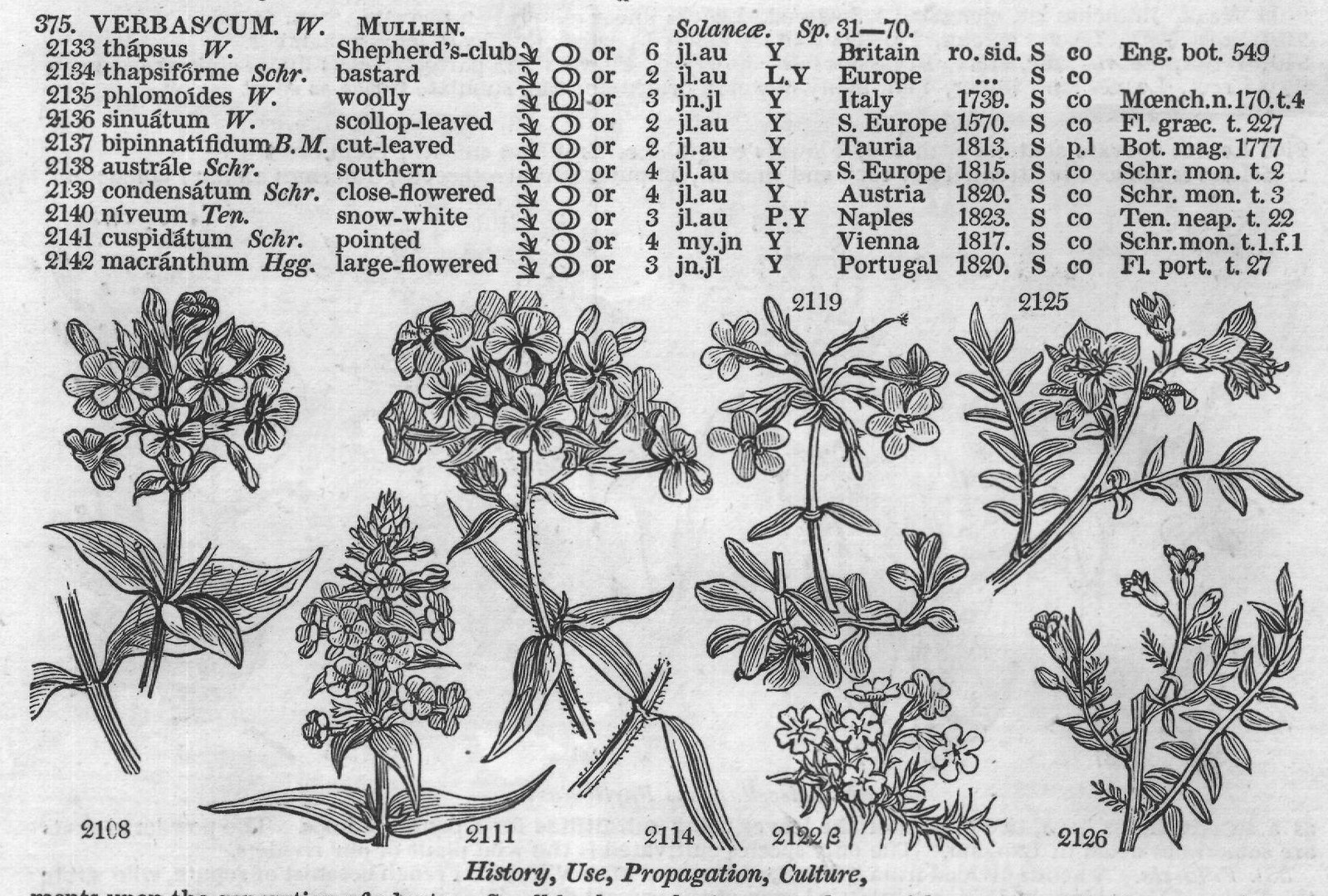
Shepherd's-club or 2134 thapsifórme Schr. bastard or 2 jl.au L.Y Europe 2135 phlomoídes W. woolly or 3 jn.jl Y 2136 sinuátum W. scollop-leaved or 2 jl.au Y 2137 bipinnatifidumB. M. cut-leaved or 2 jl.au Y 2138 austrále Schr. southern or 4 jl.au Y or 4 jl.au Y 2140 níveum Ten. snow-white or 3 jl.au P.Y 2141 cuspidátum Schr. pointed or 3 jn.jl 2139 condensátum Schr. close-flowered 2142 macránthum Hgg. large-flowered or 4 my.jn Y 1820. S co Naples 1823. S co Vienna 1817. S co Portugal 1820. S co Y 2119 2125 Eng. bot. 549 Mench.n.170.t.4 Fl. græc. t. 227 Bot. mag. 1777 Schr. mon. t. 2 Schr. mon. t. 3 Ten. neap. t. 22 Schr.mon. t. 1.f.1 Fl. port. t. 27 2108 2111 2114 2122 β History, Use, Propagation, Culture, 2126 ments upon the generation of plants. Small bushes or herbaceous plants with opposite entire leaves, and terminal or axillary bunches of white flowers. Eleven species, natives of New Holland, are described. Ripened cuttings may be struck in sand under a hand-glass. 369. Phlox. From φλoξ, flame. The plant so named by the ancients is supposed to have been an Agrostemna. The genus now so called is a native of North America only, and is one of the handsomest in cultivation. It consists of most elegant border flowers, valuable for blossoming late in the season, and for their lively colors of red, white, and purple, while the majority of plants that. flower in autumn have yellow, and generally syngenesious blossoms. Most of the species delight in a rich moist soil, or loam and leaf mould or peat. The dwarf species are admirably adapted for pots, or a select rock-work: they require some protection in severe winters. 370. Polemonium. From πoλεμoς, war. Pliny relates, that the plant which he called by this name received its appellation from having been the cause of a war between two kings, who could not agree which of them first discovered its virtues. It was also called Chilodynamia (from χiλioi, a thousand, and δuvaμiς, power), on account of its extraordinary merit. The plant which possessed all these good qualities is now forgotten. Its name has descended to a flower which ornaments the garden, but which preserves nothing of the virtue of its progenitor, beyond a slight vulnerary quality. P. cæruleum is a border flower of long standing, and of the easiest culture. 371. Vestia. Named by Willdenow, in his Enumeratio Plantarum, in honor of his friend Dr. Vest of Clagen- / ORDER I.
PENTANDRIA MONOGYNIA. 2106 Leaves lanc. flat rough at edge, Stem smooth, Corymbs panicled, Segments of cor. rounded 2107 Leaves obl. lanc. somewhat wavy rough at edge, Stem smooth, Corymbs panicled, Segm. of cor. blunt 2108 Erect pubescent, Leaves ovate acum. beneath pubescent decussate, Cor. panic. Segm. of Cor. rounded 2109 Erect, Stem smooth not spotted, Leaves ovate lanc. quite smooth, Raceme panic. Teeth of cal. erect 2110 Erect, Stem rough spotted, Leaves obl. lanc. smooth rough at edge, Pan. obl. close, Teeth of cal. recurved 2111 Leaves cordate ovate acute smooth, Flowers densely pyramidal, Teeth of cal. upright, Stem spotted 2112 Hairy, Stem erect, Leaves linear-lanceolate, Sepals subulate, Tube of cor. curved pubescent 2113 Hairy, Stems assurgent, Leaves ovate lanceolate, Sepals subulate, Tube of cor. smooth straight 2114 Leaves lanceolate sessile smooth thick, Stem erect rough, Flowers whorled terminal 2115 Stems erect subpubescent, Leaves lanc. smooth, Branches of corymb 3-flowered, Teeth of cal. linear 2116 Leaves lanc. shining on both sides acute nearly without veins, Stem smooth trifid above shrubby at base 2117 Tufted assurgent smooth, Leaves linear lanceol. smooth, Corymb term. fastigiate, Teeth of cal. mucron. 2118 Dwarf diffuse pubescent, Leaves ovate lanc. chiefly alternate, Branches few-fl. lax, Cal. subul. Pet. cord. 2119 Stoloniferous pubescent, Fertile stems erect simple few-leaved, Leaves oval, Corymb few-flowered 2120 Leaves ovate, Flowers solitary 2121 Dwarf tufted pubescent, Leaves fascicled subulate pungent ciliated, Pedicels few terminal 2122 Leaves ciliated lowest setaceous upper lin. lanc. Branches 3-5-fl. at end, Cal. spreading hairy, Pet. retuse 2123 Stem erect rounded, Leaves lanc. smooth half stem-clasp. Cal. edged, Tube of cor. twice as long as limb 2124 Pinnæ 7, Flowers terminal nodding 2125 Leaves pinnate, Flowers erect, Cal. longer than tube of corolla 2126 Pinnæ many the terminal 3-lobed, Flowers nodding, Cal. viscid 2127 The only species 2128 Very hairy, Radical leaves subpinnatifid, cauline lobed angular, Sinus of calyx with reflexed appendages 2129 Leaves pinnate or pinnatifid, Segm. ovate lanceol. cut serrate, Fascicles of flowers clustered 2130 Smoothish, Leaves lobed angular, Fascicles of flowers close together 2131 Erect, Leaves pinnatifid, Segments cut lobed, Racemes generally bifid 2132 A stemless plant with hoary leaves and short scapes of purple flowers. The only species Leaves decurrent. 2133 Lvs. cren. toment. upper acute, Raceme spiked dense, Cor. rotate with obl. obt. segm. Anth. nearly equal 2134 Lvs . cren. toment. upper acumin. Raceme spiked dense, Cor. rotate with obov. round segm. 2 of anth. obl. 2135 Lvs. cren. tom. radic. ell. stlkd. Caul. obl. ac. upper brd. ov. cusp. slightly decur. Fasc. remotish, Two an. obl. 2136 Leaves toment. radical and lower cauline sinuated upper crenate slightly decurr. Spikes pan. Fl. clustered 2137 Leaves bipinnatifid [Fasc. of rac. remote, Two anth. obl. 2138 Leaves crenate tom. Radic. obl. lanc. narr. to stalk, Caul. obl. acute decurr. upper broad ov. cusp. decur. 2139 Leaves tom. radic. ellipt. narr. at base uneq. doubly crenate, Caul. obl. acute simply crenate upper round. ovate cusp. slightly decurr. Racemes dense, Two anthers oblong 2140 Leaves decurrent crenate snow-white, Raceme spiked dense, Anthers equal 2141 Leaves crenulate tomentose the upper cuspidate, Fascicles of raceme remote, Two anthers oblong 2142 Leaves cren. tom. rad. ellipt. obl. narr. at base caul. obl. acute decurr. Fasc. of rac. rem. Two anth. obl. Leaves cren. tom. rad. ellipt. obl. narr. at base caul. obl. acute decurr. Fasc. of rac. rem. Two anth. obl. 2127 2131 2136 2129 2132 2135 and Miscellaneous Particulars. 2137 furth. A native of Chili, with pale-green smooth leaves, and pale yellow flowers. It is very nearly related to Lycium. 372. Hydrophyllum. From ύδως, water, and φuλλov, a leaf. This plant grows in the marshes of North America, and in the spirng time has a small quantity of water in the cavity of each leaf. The species are two only, , and in the spirng time has a small quantity of water in the cavity of each leaf. The species are two only, both humble plants, with neat foliage , which protects the small white flowers. H. virginicum is used as a salad, under the name of Shawanese salad in North America. 873. Phacelia. From φaκελoς, a bundle, the flowers being disposed in fascicled spikes. 374. Ramonda. Named after M. L. Ramond, a French botanist, who discovered many new plants in France. (V. myconi.) A very pretty dwarf plant, kept in a frame with other alpine plants. Formerly a species of Verbascum, very pretty dwarf plant , kept in a frame with other alpine plants. Formerly a species of Verbascum, (V. myconi.) 375. Verbascum. An alteration of barbascum, on account of the beard (barba) with which all the leaves and stems are closely covered. The species are all very fine looking plants , well calculated for shrubberies, among other tall plants. They have been well illustrated by M. Schrader in a learned Monograph. V. thapsus has been so called from its native place , the Isle of Thapsos. V. blattaria is said to have the power of driving away the blatta or cockroach.
V. pulverulentum is one of the most magnificent of native herbaceous plants, sending up a stem a yard high, covered with many hundreds of gold colored flowers. Correa observes of this golden rod, that in still weather two or three blows with a stick will bring down all the corollas. The nap of K3 2151 ferrugíneum W. rusty 2153 nigrum W. copper-colored black-rooted PENTANDRIA MONOGYNIA. 2143 ovalifolium H. K. oval-leaved 2144 Boerhaávii W. annual 2145 elongátum W.en. long-stalked 2146 pyramidátum W.en. pyramidal 2147 hæmorrhoidale W. Madeira 2148 fioccósum P. S. wool-bearing 2149 Lýchnitis W. white 2150 pulveruléntum E.B. powdered 2152 cúpreum B. M.
Y.Pu S. Europe 1731. S co CLASS V.
A or 1 jl.s A or Caucasus 1804. D p.l 2 jl.au Bot. mag. 1037 Mill. ic. 2. t. 273 or 5 jl.au Y 1813. S co or 3 jl.au Y Caucasus 1804. S co Sweet fl. gard. 31 or 2 jn.au W.pu Madeira 1777. S co or 3 jn.jl Y Hungary 1805. S co Pl.rar.hung.t.79 or 3 jn.au C Britain ro.sid. Sco Eng. bot. 58 or 3 jn.au Y England bor.fi. S co Eng. bot. 487 or 3 my.au Br S. Europe 1683. D p.1 Bot. rep. 162 or 3 my.au Br Caucasus 1798. D p.1 Bot. mag. 1226 or 2 my.au Y England ch.so. D p.l Eng. bot. 59 2154 phœníceum W. purple-flowered or 3 my.au Pu S. Europe 1596. D p.1 Bot. mag. 885 2155 virgátum E. B. • slender or 5 au Y Britain gra.pl. S co Eng. bot, 550 2156 Blattária W. moth or 4 jl.au Y Britain gra.pl. S co Eng. bot. 393 2157 glábrum W. en. 2158 repándum W. en. smooth waved or 2 jl.au Y ...... or 3 jl.au Y 1805. S co 1813. S co 2159 pinnatifidum W. pinnatifid or 1 my Y Archipel. 1788. S p.l 2160 Osbéckii W.
Osbeck's or 1 jl.au G Spain 1752. S p.1 Tourn. it. 2. t. 83 2161 orientále M. B. eastern or 2 jn.jl Y Caucasus 1821. S co 2162 spectábile M. B. shewy or 2 jn.jl Y.Pu Tauria 1820. S co Bot. reg. 558 2163 spinósum L. spiny. or 1 my.jn Pu Crete 1824. S co Alp. exot. t. 36 376. DATU'RA. W.
THORN-APPLE.
Solaneæ. Sp. 7-10. 2164 férox W.
Chinese or 3 jl.s W China 1731. S s.l Zano.h.212.t.162 2165 Stramónium W. common clt 3 jl.s W England rub. S s.l Eng. bot. 1288 2166 Tátula W. blue or 3 jl.s B N. Amer. 1629. S s.1 Meerb. ic. 2. t.13 2167 fastuósa W. purple or 3 jl.s Pu Egypt 1629. Sr.m Kno.the.1.t.S.11 2168 Métel W. downy or 2 jn.s W Asia 2169 læ'vis W. smooth-fruited or 2 jn.s W Africa 2170 ceratocaúlon Ort. horn-stalked or 2 jl.s W S. Amer. 1596. Sr.m Bot. mag. 1440 1780. Sr.m Jac. vind. 3. t. 82 1805. S r.m Jac. sch. 3. t. 339 377. BRUGMAN'SIA. P. S. BRUGMANSIA.
Solaneæ. Sp. 2-3. 2171 suavéolens W. en. smooth-stalked or 15 au.s W Peru 1733. C l.p 2172 arbórea W.en. downy-stalked or 10 au.s W Peru 1813. C l.p Fl. peruv. 2. t.128 378. LISIAN THUS, W. LISIANTHUS.
Gentianeæ.
Sp. 4-29. 2173 longifólius W. long-leaved or 1½ jn.jl Y 2174 glaucifólius Jac. glaucous-leaved or 2 jn.jl Pu ......
Jamaica 1793. C l.p Cl.p Brow.jam.t.9.f.1 ...
Jac. ic. rar.1.t.33 2175 exsértus W. oval-leaved 오 or 12 Y ... 2176 cordifólius W. heart-leaved or 2 Y ...
W. Indies 1793. C l.p Jamaica 1816. C 1.p Br. jam. t. 9. f. 2 379. SPIGE/LIA. W. 2177 Anthélmia W. 2178 marilándica W.
WORM-GRASS.
Gentianeæ.
Sp. 2-4. annual perennial W 1 jl G.R W. Indies 1759.
S s.l Bot. mag. 2359 or 1 jl.au S N. Amer. 1694.
D l.p Bot. mag. 80 380. NICAN DRA. J. 2179 physalódes P. S.
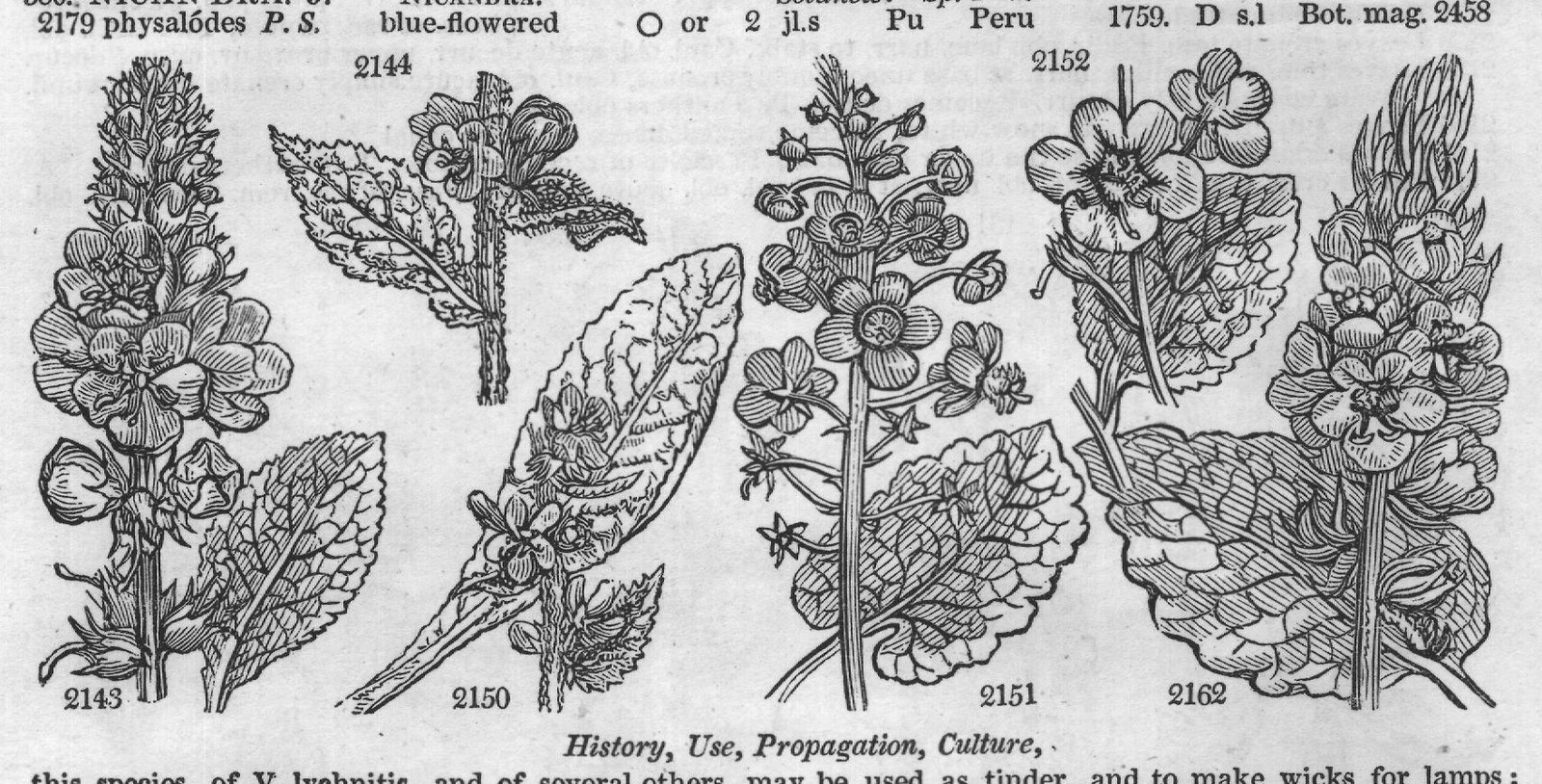
NICANDRA. blue-flowered Solaneæ. Sp. 1-2. or 2 jl.s Pu Peru 1759. D s.l Bot. mag. 2458 2144 2152 2143 2150 2151 2162 History, Use, Propagation, Culture, this species, of V. lychnitis, and of several others, may be used as tinder, and to make wicks for lamps; whence the name Lychnitis applied to one of the species, from λύχvoς, a lamp. Several mules have been produced between the species of this genus; and it has been questioned whether those accounted species are not productions of this kind. 376. Datura. An alteration of the Arabic name tâtôrah, Forskahl. About Goa and Canara, it is called Daturo, Rumphius. Stramonium is an abbreviation of the Greek word στρuχvoμaviκov, or mad-apple, on account of the dangerous effects of the fruit of that species. Metel or Methel, is an Arabic name employed by Serapion, ch. 375, and expresses the narcotic effect of the plant. Tatula is altered from Datula, a name given to the Datura by the Turks and Persians. D. stramonium is an instance of a South American plant, naturalized within a comparatively short time, the seeds having been introduced from Constantinople in Gerarde's time, and by him " dispersed through this land." Kalm says, that this plant and a species of Phytolacca are the worst weeds in America. Professor Martyn observes, that " in the earth brought with plants from various parts of that extensive country, we are sure to have the thorn-apple come up." At night, the leaves next the flowers rise up and enclose them. The whole plant smells strongly of bean meal. Every part of the plant is poisonous, bringing on delirium, tremors, &c. but under proper regulations it is a useful medicine in asthma, &c.
D. fastuosa has a fine polished purple stalk, varied with dots or lines; the leaves are large, the flowers of a beautiful purple outside, and a satiny white within; some are single, others semidouble. They have an agreeable odor at first, but if long smelt to become less agreeable, and are narcotic. D. ceratocaulon is a fine species; its seed will sometimes remain in the ground several years before it will vegetate. 377. Brugmansia. So named by Persoon, in honor of Professor S. J. Brugmans, author of some botanical works, and especially of a dissertation "De Plantis Inutilibus, et Venenatis," published at Groningen, in 1783. B. arborea is one of the greatest ornaments of the gardens of Chili. The flowers which come out at the ORDER I.
PENTANDRIA MONOGYNIA.
Leaves sessile. 2143 Stem erect simple, Leaves oval sessile tooth-crenate smooth above, Flowers spiked 2144 Leaves sublyrate, Flowers sessile 2145 Leaves decurrent tomentose on both sides, Stem branched, Three filaments hairy in the middle 2146 Leaves nearly naked lower oblong attenuated at base upper cord. acum. sess. Racemes panic. Stam. beard. 2147 Leaves ovate oblong at base atten. toment. obsoletely cren. Racemes spiked elongate, Fl. without bractes 2148 Leaves ovate sessile beneath closely woolly, Stem branched, Filaments bearded 2149 Leaves wedge-shaped oblong naked above, Stem angular panicled 2150 Leaves ovate oblong subserrate powdery on both sides, Stem rounded panicled, Hairs of stamens white 2151 Leaves subvillous rugose cauline subsessile equally crenate, Radical oblong cordate doubly crenate 2152 Stems virgate simple, Leaves cordate ovate rugose crenate woolly beneath, Pedunc. with 1 bract. solitary 2153 Leaves oblong cordate stalked wavy crenate subpubescent 2154 Leaves naked radical uneq. toothed, Caul. lanc. toothed wedge-shaped at base, Stem naked, Rac. elong. 2155 Leaves oblong lanc. toothed sessile radical sublyrate pubescent, Stem branched, Flowers aggreg. sessile 2156 Leaves stem-clasping oblong smooth doubly serrated, Peduncles 1-flowered solitary 2157 Leaves naked lower obl. stalked upper obl. lanc. Stem simple pub. Raceme term. Stalks altern. very short 2158 Leaves naked radical sinuated cauline oblong cordate stem-olasping coarsely toothed, Pedunc. alternate 2159 Leaves tomentose radical bipinnatifid cauline pinnatifid, Flowers clustered sessile 2160 Leaves cut naked, Stem leafy, Calyxes woolly, Pedunc. 2-flowered 2161 Leaves ovate oblong beneath hoary the lower narrowed at base upper subcordate, Racemes lax panicled 2162 Leaves cordate acuminate, Spike lax downy, Two lower stamens declinate smooth 2163 Stem leafy prickly shrubby 2164 The upper spines very large converging at the top of the pericarp 2165 Leaves ovate smooth angular toothed, Pericarp prickly 2166 Leaves ovate subcordate smooth angular toothed, Stem spotted, Pericarp prickly 2167 Leaves ovate angular, Pericarps tuberculated nodding 2168 Leaves cordate nearly entire pubescent, Pericarps prickly globose nodding 2169 Leaves ovate angular toothed smooth, Stem hollow herbaceous, Pericarps smooth erect 2170 Leaves ovate lanceolate wavy beneath hoary, Stems dichotomous cornute, Pericarps obovate pendulous 2171 Leaves oblong entire smooth, Calyxes 5-toothed 2172 Leaves oblong entire powdery, Stalks and branches pubescent, Cal. spathaceous acuminate 2173 Leaves lanceolate acute pubescent, Stem rounded 2174 Leaves ellipt. lanceolate obtuse smooth, Stem rounded, Peduncles long 1-flowered 2175 Leaves ovate lanc. pedunc. trichotomous, Genitals very long 2176 Leaves cordate 2177 Stem herbaceous the upper leaves 4 together 2178 Stem simple, All the leaves opposite sessile lanceolate oval 2179 Leaves sinuated, Calyxes closed acute-angled 2165 2170 2172 2174 12178 2179 and Miscellaneous Particulars. divisions of the branches, have a loose tubular calyx nearly four inches long, which, opening like a spathe, a corolla is protruded, with a narrow trumpet-shaped tube, which spreads wide at the brim, where it is divided into five angles, which terminate in very long points: they are white within, pale yellow outside, and one tree will perfume the air of a large garden. It flowers freely in the bark-stove, in a moist heat. 378. Lisianthus. From λuσiς, dissolution, and avθoς, a flower; a name given to the plant on account of the medical virtues possessed by it of dissolving humours. It is a powerful cathartic. The species are very handsome stove plants. Cuttings root readily in sand under a bell-glass. 379. Spigelia. So named by Linnæus, in honor of Adrian Spigelius, born at Brussels in 1578; professor of anatomy and surgery at Padua; author of Isagoge in rem Herbariam; died in 1625. S. anthelmia is so named from its peculiar efficacy in destroying worms, for which it has been long in use among the negroes in the West Indies. Dr. Browne, after a number of successful experiments, says it operates in so extraordinary a manner , that no other simple can be of equal efficacy in any other disease, as this is in those which proceed from these insects. those which proceed from these insects. (Hist. of Jamaica.) The same plant procures sleep almost as cerand in an equal degree with opium. S. marilandica is used as a vermifuge in North America, and according to Dr. Garden, (Letters to Dr. Hope,) with very powerful effects. The annual plant may be treated like other tender annuals; but S. marilandica is very powerful effects. The annual plant may be treated like other tender annuals; but S. marilandica is rather difficult to preserve; according to Sweet, " it requires to be grown in a pot, that it may be protected from severe frosts, or too much wet: it will sometimes survive the winters when planted in the open ground in a bed of peat: the best soil for it is an equal mixture of loam and peat, and young cuttings, planted under a hand-glass, root readily." (Bot. Cult. 424.) 380. Nicandra. Nicander was a Greek physician, who lived about a century and half before Christ. The genus was formed by Adanson it consists of the Atropa physaloides of Linnæus. The Indians of Peru make was formed by Adanson; it consists of the Atropa physaloides of Linnæus. The Indians of Peru make use of the berries of this plant to bring away gravel, and to relieve persons who have a stoppage of urine. of the berries of this plant to bring away gravel, and to relieve persons who have a stoppage of urine. K 4 PENTANDRIA MONOGYNIA. 381. HYOSCY'AMUS. W. HENBANE.
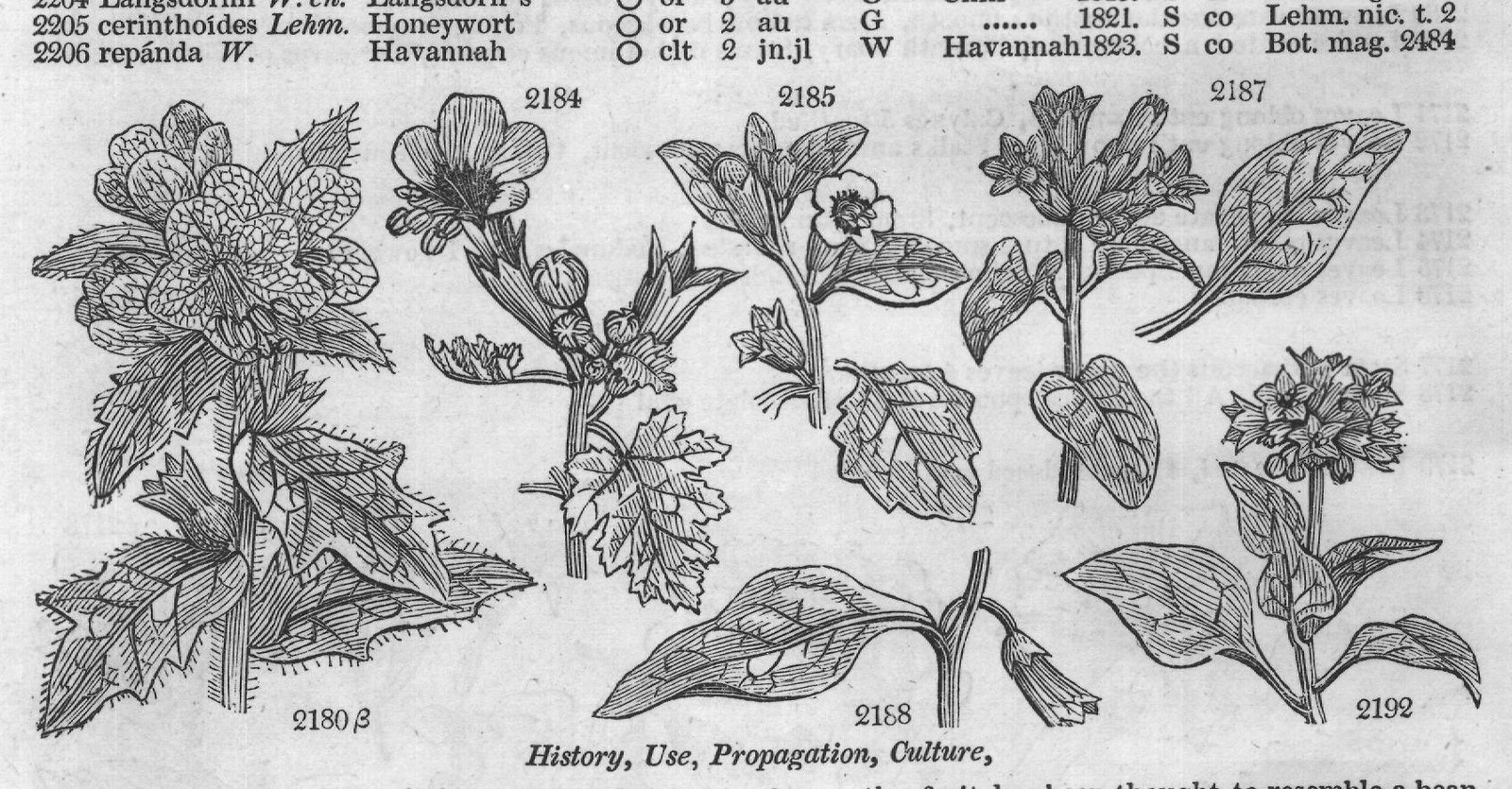
CLASS V. 2180 níger W.
ẞ annuus 2181 álbus W. 2182 reticulátus W. 2183 Seneciónis W.en. 2184 aúreus W. 2185 canariénsis Ker. 2186 pusíllus W. 2187 physaloídes W. 2188 Scopólia W. 2189 agréstis Kit. common annual white Egyptian yellow-flowered golden various-leaved dwarf purple-flowered Nightsh.-leav'd field 2190 pállidus W. & K. pale 2191 múticus L. blunt-calyxed 2192 orientális Bieb. eastern ભભ સત્ર મ 382. NICOTIA'NA. W.
TOBACCo.
Solaneæ. Sp. 14-26. 2193 Tabácum W. Virginian clt 4 jl.au Pk 2194 macrophýlla W. en. large-leaved or 6 jl.au Pk 2195 fruticosa W. shrubby or 3 jl.au Pk 2196 unduláta R. Br. sweet-scented clt 2 my.s W Bot. mag. 2394 Blackw. t. 111 Com.hort.77.t.22 Solaneæ. Sp. 13-14. p 1 jn.jl p 1 jn.jl St Britain St rub. S s.l Eng. bot. 591 Europe 1818. S s.l W W 1 jl.au R W 1½ mr.o Y W 1 mr.o Y 2 jl.au Pa. W S. Europe 1570. S co cu 1 ja.d Y W w W jl Y 1 mr.ap Pu Egypt 1640. S co Egypt 1812. C s.l Levant 1640. Sr.m Canaries 1816. D s.l Persia 1691. D s.l Siberia 1777. D p.l 1 ap.my D.Pu Carolina 1780. D p.1 1 ap.my Y.Vy Hungary 1820. S p.1 1 ap.my Y Hungary 1815. S p.l W W W 1 mr.ap Y.Pu Egypt 1822. S p.l Bot. mag. 87 Bot. reg. 180 Plk. alm. t.37. f.5 Bot. mag. 852 Bot. mag. 1126 Sweet fl. gard.27 A or 1 ap Pu Iberia 1821. D s.l Bot. mag. 2414 America 1570. Sr.m Blackw. t. 146 America ...
Sr.m China 1699. Cr.m N. S. W. 1800. Dr.m Bot. mag. 673 2197 rústica W. common-green clt 3 jl.s G America 1570.
S co Blackw. t. 437 2198 paniculáta W. panicled or 3 jl.s G Peru 1752.
Sr.m Flor. per.2. t.129 2199 glutinósa W. clammy or 4 jl.s S Peru 1759.
Sr.m Bot. rep. 484 2200 plumbáginifólia W.en.curled-leaved 2201 pusílla W.
Primrose-leav'dor அ or 2 my.jn W America 1816.
Dr.m Jacq. fragm. t.84 3 au W Vera Cruz 1733.
Sr.m Mil. ic.2.t.185.f.2 2202 quadriválvis Ph. four-valved or 2 jl.au W N. Amer. 1811.
S r.m Bot. mag. 1778 2203 nána Lindl.
Rocky-mount. cu jn W 2204 Langsdorffii W. en. Langsdorff's or 5 au G N. Amer. 1823.
Chili 1819. S co Bot. reg. 833 2205 cerinthoídes Lehm. Honeywort or 2 au G ...... 2206 repánda W.
Havannah clt 2 jn.jl W 1821. S co Havannah1823. S co Bot. mag. 2484 Bot. mag. 2221 Lehm. nic. t. 2 2184 2185 2187 2180 β 2188 2192 History, Use, Propagation, Culture, 381. Hyoscyamus. From ὡς ὑoς, a pig, and κuaμoς, a bean; the fruit has been thought to resemble a bean, and, although dangerous to other animals, is said to be eaten by pigs with safety. H. niger is a well-known fœtid weed, which follows civilized man, growing on rubbish of old houses, dunghills, &c. It has a strong peculiar odor, greatly affecting the heads of some persons, and the whole plant is reputed poisonous. Sir J. E. Smith and Professor Martyn say they have often eaten the seeds without suffering inconvenience. Lightfoot, on the contrary, says, a few of them have been known to deprive a man of his reason and limbs. A species of bug (Cimex) and of beetle (Chrysomela) take their specific names from feeding on the plant; but no quadruped is known to eat it, unless the goat and sheep, and that very rarely and sparingly. As a medicine, henbane is of immemorial use, and is still continued in the Pharmacopeias. It is given with or without opium in coughs, epilepsy, convulsions, &c. Country people sometimes smoke the leaves for the toothach. 382. Nicotiana. So named from John Nicot of Nismes, in Languedoc, ambassador from the king of France Color, ambassador from the king of France to Portugal, who procured the seeds from a Dutchman who had received them from Florida. The first plant was said to have been presented to Catherine de Medicis, whence the French name Herbe à la Reine. The name tobacco, which has superseded all others, is the appellation of a district of Mexico. Petum or Petume, Bras., Tabac, Fr., Taback, Ger., and Tabac, Ítal. The species grown as tobacco are the N. tabacum and rustica; the former greatly preferred. The popular narcotic which it furnishes is probably in more extensive use than any other, and its only rival is the betel of the east. According to Linnæus, tobacco was known in Europe from 1560. It was brought to England from Tobago in the West Indies, or Tobasco in Mexico , ( and hence the name,) by Ralph Lane, in 1586, but only the herb for smoking. Afterwards, according to Hakluyt, seeds were introduced from the same quarter. Sir Walter Raleigh first introduced smoking in the house in house in which he lived at Islington are his arms on a shield, with a tobacco plant on the top. Smoking has consequently been common in Europe for upwards of two centuries. It is a powerful narcotic, and also a strong stimulant with respect to the whole system, but especially to the stomach and intestines, to which, in small doses, it proves emetic and purgative. The smoke thrown up the anus acts as a glyster: an infusion of the leaves forms a powerful lotion for obstinate ulcers: the oil applied to a wound, is said by Redi to be as fatal as the poison of a viper. The decotion, powder, and smoke of tobacco, are used in gardening to destroy insects, and in agriculture for the same purpose, and to cure cutaneous eruptions in domestic animals. Tobacco, as used by man, says Du Tour, (Nouveau Cours d'Agriculture, &c.) gives pleasure to the savage and the philosopher, to the inhabitant of the burning desert and frozen zone. In short, its use either in powder, to chew, or to smoke, is universal; and for no other reason than a sort of convulsive motion (sneezing) produced by the first, and a degree of intoxication by the two last modes of usage. A hundred volumes, he adds , have been written against it, of which a German has preserved the titles. Among these books is that of James Stuart, king of England, who violently opposed it. The Grand Duke of Moscow forbade its entrance into his into his territory under pain of the knout for the first offence, and death for the next. The emperor of the Turks, king of Persia, and Pope Urban VIII. issued similar prohibitions, all of which were as ridiculous as those which attended the introduction of coffee or Jesuit's bark. At present, all the sovereigns of Europe, and most of those of other parts of the world derive a considerable part of their revenue from tobacco. Tobacco is cultivated in Europe as far north as Sweden, and is also grown in China, Japan, and other eastern ORDER I.
PENTANDRIA MONOGYNIA. 2180 Radic. leaves sinuated pinnatifid upper stem-clasping, Flowers nearly sess. Cor. netted 2181 Leaves stalked the lowest rounded entire the rest cordate ovate sinuate toothed, Fl. axill. sess. or stalked 2182 Cauline leaves stalked cordate sinuate acute, Flowers entire inflated 2183 Leaves stalked 3-lobed cut-toothed, Flowers stalked, Segm. of cor. equal flat 2184 Leaves stalked ovate acute angular toothed, Flowers stalked, Three upper segm. of cor. wavy 2185 Lower leaves cordate ovate angular obtuse, floral ovate entire 2186 Leaves stalked oblong lanc. toothed, Flowers stalked, Calyx teeth mucronate 2187 Leaves stalked ovate cordate entire, Flowers stalked axillary solitary terminal in umbels, Cal. inflated 2188 Leaves stalked ovate obl. entire, Flowers axillary stalked nodding, Cor. camp. trunc. (Scopolina, Schul.) 2189 Stem simple pubescent, Leaves sessile decurrent sinuate toothed smoothish, Flowers sessile 2190 Leaves stem-clasping angular, radical angular toothed, Flowers sessile 1-colored 2191 Leaves stalked ovate acute angular, Cal. pointless, Bractes undivided 2192 Leaves deltoid ovate repand, Cal. of fruit tumid, Stamens exserted 2193 Leaves sessile obl. lanc. acumin. the lower decurr. Mouth of cor. inflated, Segm. acuminate 2194 Leaves stem-clasping ovate acute auricled at base, Mouth of cor. inflated, Segm. short acuminate 2195 Stem shrubby simple, Lvs. stalked lanc. obliquely acuminate, Coroll. inflated at mouth, Segm. acumin. 2196 Stem nearly sim. Lvs. somew. stlkd. ov. lanc. wavy, Tube of cor. cyl. much longer than cal. Seg. uneq. round 2197 Stem rounded, Leaves stalked ovate entire, Tube of cor. cylind. longer than cal. Segment rounded obtuse 2198 Stem nearly sim. Lvs. stlkd. ov. subcord. entire, Tube of cor. clav, very sm. much longer than cal. Seg. obt. 2199 Leaves stalked cordate entire, Fl. racemose 1-sided, Cal. 2-lipp. upper lip longest, Cor. ringent, Segm. acute 2200 Leaves sessile lower obovate spatulate obtuse upper stem-clasping wavy, Tube of cor. very long clavate 2201 Stem dichot. Lvs. sess. radic. obl. oval. Cal. very short, Tube of cor. cyl. thrice as long as cal. Segm. acute 2202 Stem herbac. branching, Lvs. stalked obl. Tube of cor. twice as long as cal. Segm. obt. Caps. 4-valv. round 2203 Leaves lanceolate hairy, radical longer than the solitary flowers, Petals obtuse 2204 Lower leaves ovate obtuse stalked upper sessile decurrent, Tube of cor. clavate long, Limb obtuse 2205 Stem branc. at base, Lvs. stlkd. all cord. ent. Tube of cor. clav. pub. much long. than cal. Seg. very sh. acute 2206 Leaves stem-clasping cord. spat. roundish repand, Tube of cor. slender very long, Segm. ovate acute plic. 2196 2199 2203 2193 2198 2202 and Miscellaneous Particulars. 2206 2204 and hot countries. The sort preferred is the N. tabacum, which is an elegant plant, grown also in gardens as a border flower. N. rustica, fausse tabac, Fr., Bauern taback, Ger., and Tabacca cimarosa, Span., is also frequently cultivated, especially in Europe, it being considered hardier than the Virginian sort. Parkinson says, he has known Sir Walter Raleigh, when prisoner in the Tower, prefer it to make good tobacco, "which he knew so rightly to cure." Tobacco has been successfully cultivated and cured in this country, but its growth is prohibited to encourage our commerce with America. It is now only grown for curiosity as a border flower, or by gardeners for the destruction of insects. In Germany and other northern countries, most families who have gardens grow enough of N. rustica for their own use; but as they do not know how to cure it, it is not much valued, and is never made into chewing tobacco or snuff. In the culture of Tobacco in America, the plants are raised on beds early in spring, and when they have acquired four leaves, they are planted in the fields in well prepared earth, about three feet distance every way. Every morning and evening the plants require to be looked over, in order to destroy a worm which sometimes invades the bud. When four or five inches high they are moulded up. As soon as they have eight or nine leaves, and are ready to put forth a stalk, the top is nipped off, in order to make the leaves longer and thicker, by diverting all the energies of the plant to them. After this, the buds which sprout from the joints of the leaves are all plucked, and not a day is suffered to pass without examining the leaves, to destroy a large caterpillar, which is sometimes very destructive to them. When they are fit for cutting, which is known by the brittleness of the leaves, they are cut with a knife close to the ground, and, after lying some time, are carried to the drying shed, where the plants are hung up by pairs upon lines, having a space between, that they may not touch one another. In this state they remain to sweat and dry. When perfectly dry, the leaves are stript from the stalks and made into small bundles tied with one of the leaves. These bundles are laid in heaps, and covered with blankets. Care is taken not to over-heat them, for which reason the heaps are laid open to the air from time to time, and spread abroad. This operation is repeated till no more heat is perceived in the heaps, and the tobacco is then stowed in casks for exportation. (Long. Jam. iii. 719.) In the manufacture of tobacco, the leaves are first cleansed of any earth, dirt, or decayed parts; next, they are gently moistened with salt and water, or water in which salt along with other ingredients has been dissolved, according to the taste of the fabricator. This liquor is called tobacco sauce. The next operation is to remove the midrib of the leaf; then the leaves are mixed together, in order to render the quality of whatever may be the final application equal: next, they are cut into pieces with a fixed knife, and crisped or curled before a fire; the succeeding operation is to spin them into cords, or twist them into rolls by winding them with a kind of mill round a stick. These operations are all performed by the grower, and in this state (rolls) the article is sent from America to other countries, where the tobacconists cut it into chaff-like shreds for smoking, by a machine like a straw-cutter; form it into small cords for chewing; or dry and grind it for snuff. In manufacturing snuff, various matters are added for giving it an agreeable scent, and hence the numerous varieties of snuffs. The three principal sorts are called Rappees, Scotch or Spanish, and Thirds. The first is only granulated, the second is reduced to a very fine powder, and the third is the siftings of the second sort. The best Havannah segars are made from the leaves of N. repanda. The Indians of the Rocky Mountains of N. America prepare their tobacco from N. quadrivalvis and N. nana. 383. IPOMÆ'A R. Br. 2207 quamóclit W. 2208 dissécta Ph.
IPOMEA. wing-leaved cut-leaved or 6 jl.s or 10 jn.s S 2209 carolína Ph.
Carolina 2210 tuberósa W. tuberous-rooted or 10 jl.au or 10 Pu ... 2212 pentaphýlla Jac. 2213 umbelláta L. 2211 paniculáta B. Reg. panicled 2214 tuberculáta B. Reg. tubercled m 20 jn.s five-leaved or 20 au.s W umbel-flowered or 20 jn.jl S or 10 au.s Pu 2215 péndula R. Br. pendulous $ or 10 my.o Pk 2216 Pes-tígridis W. palmated or 6 au R 2217 platénsis Ker.
Plata or 10 jn.s V 2218 chryséides Ker.
Mr. Herbert's or 4 jn.s Y 2219 cærúlea Ker. pale-blue or 9 jn.s L.B 2220 setósa Ker. bristly or 9 au Pu PENTANDRIA MONOGYNIA.
Convolvulaceæ. Sp. 52-170.
D.R E. Indies 1629.
Georgia 1813.
CLASS V.
Sr.m Bot. mag. 244 C s.p Wil.phy.1.t.2.f.3 Carolina 1732. Cr.m Dill. elt. t.84.f.98 Pa.Y W. Indies 1731. C s.p Bot. reg. 768 Pk Bot. reg. 62 E. Indies 1799. C s.p W. Indies 1739. S s.p W. Indies 1739. Rr.m E. Indies 1815. C 1.p N. S. W. 1808. R 1.p E. Indies 1732. C s.p Jac. ic. 2 t. 319 Plu. am. 88. t.102 Bot. reg. 86 Bot. rep. 613 Dil.el.t.318.f.411 S. Amer. 1817. S r.m Bot. reg. 333 China 1817. Sr.m Bot. reg. 270 E. Indies 1818. Sr.m Bot. reg. 276 Brazil 1817. S r.m Bot. reg. 335 2221 scábra Gm. rough or 10 s W S. Amer. 1804. S r.m 2222 Turpéthum Br. square-stalked ☐ or 5 jl.s W Ceylon 1759. crimson-scarlet or 10 jn.s S Carolina 1759. bright-scarlet or 10 jn.s starry or 10 jl.au W splendid or 15 jn.s Pu ...... ...
Sr.m Bot. mag. 2093 Sr.m Bot. mag. 221 S r.m Bot. rep. 99 Cr.m Dill.elt.t.87.f.102 Cs.p Bot. reg. 75 prickly or 10 jl.au W Bot. mag. 752 blood-flowered ☐ or 10 f.n D.R W. Indies 1812.
C s.l Bot. reg. 9 changeable or 10 my.s Pu S. Amer. 1812.
Bot. reg. 39 or 15 jn.au W N. Amer. 1776.
Bot. mag. 1603 m 10 au.s Li m 10 au.s R Cr.m Bot. mag. 1572 Bot. reg. 621 Hepatica-leav'd or 10 au.s Pu Nightshade-lvd. or 8 jl.au Pk bell-flowered or 8 au.s purple-flowered flesh-colored or 8 au.s Pu or 10 au.s F scolloped or 10 au Oor 8 jl.au 2222 Tu 2223 lutéola W. en. 2224 coccínea W. en. 2225 lacunósa W. 2226 gossypiifólia W.
I. insignis B. R. 2227 Bona-nox W. 2228 sanguínea Vahl. 2229 mutábilis R. Reg. 2230 cándicans B. M. 2231 Jálapa Ph.
B rosea 2232 hepaticifólia W. 2235 solanifólia W. 2234 campanuláta W. 2235 violácea W. 2236 cárnea W. 2237 repánda W. 2238 sibírica P. S. 2239 speciósa P. S. 2240 purpúrea P. S.
ẞ incarnáta y vária 2241 díscolor Jac. hoary Jalap rose-colored Siberian broad-leaved 3 ☐ or 8 jl.au great-purple or 10 jn.s flesh-colored $ ☐ or 10 jn.s striped spotted three-lobed ◎ or 10 jn.s Oor 20 jn.s $ ☐ or 10 jn.jl AMAMAMAMAMAMAMAMAMAMAM O or 10 jl s or 10 jl.s or 10 jn.jl or 10 jl or 8 s D.R W. Indies 1713.
N. Amer. 1640.
W. Indies 1773. S s.1 C p.l R p.l America 1733. Cr.m E. Indies 1759. S co America 1759. C s.p Pu.w E. Indies 1800. S s.I S. Amer. 1732. S s.l S. Amer. 1799. S s.1 W. Indies 1793. C s.p Siberia S F F St B.w V V ... 1779. S co Pu E. Indies 1778. C p.1 D.Pu America 1629. Sco America 1629. S co America 1629. S co Sco W. Indies 1752. S s.1 S. Amer. 1773. S s.1 L.B America 1597. S s.p N. Amer. 1729. S s.p L.Pu S. Amer. 1732. S s.p Carolina 1732. S co E. Indies 1802. S s.1 E. Indies 1777. S co E. Indies 1732. S s.p B B Bu. in.50.t.20.f.2 Plum. ic. t.94.f.1 Rhd. mal.11.t 56 Plum.ic. t.93. f. 1 Jac. am. 26. t. 18 Par. lond. 81 Pa.it.3.p.723.t. K Bot. mag. 2446 Bot. mag. 113 Bot. mag. 1682 Bot. mag. 1005 Pl. ic.82. t.93. f.2 Bot. mag. 188 Bot. reg. 85 Fl.per.2.t.119.f.a D. elt. t. 318.f.410 Bot. rep. 188 Jac. schœ.3.t.323 Bot. reg. 239 2242 tríloha W. 2243 hederifólia W.
Ivy-leaved 2244 Nil P. S. blue 2245 hederácea B. Reg. five-lobed 2246 cuspidáta P. S. sharp-pointed 2247 tamnifólia W.
Tamnus-leaved 2248 grandiflóra B. Rep. great-flowered W 2249 muricáta Jac. rough-stalked or 8 jl.au Pu 2250 obscúra B. Reg. hairy or 8 jn.au W 2251 sagittifólia Ker.
Catesby's or 3 jn.s Pu Bot. reg. 437 2252 médium W. 2253 denticuláta R. Br. 2254 glaucifólia W. arrow-headed denticulate or 6 jl.au Pa or 6 jlau Y 6 my.jl Pk Bot. reg. 317 Dil. elt.t.87.f.101 2255 angustifólia Jac. or 6 jl.au Pk Jac. ic. rar. t.317 2256 tridentata P. S. trifid or 10 jl.au Y 2257 marítima R. Br. 2258 brasiliensis L.
Brazilian 2215 thick-leaved or 10 jn.jl 2217 2222 Pu Pu E. Indies 1778. Cs.p E. Indies 1770. S s.p S. Amer. 1726. R s.p 2231 glaucous-leaved or narrow-leaved Carolina 1819. S co E. Indies 1778. S co E. Indies 1778. S co Mexico 1732. R s.p India 1800. S s.1 Rhd. mal.11.t.65 Bot. reg. 319 Plu. am.89. t.104 2211 2227 2239 History, Use, Propagation, Culture: 383. Ipomea. From i! iπoς, a bindweed, or something analogous, and oμoioς, similar. This genus is nearly allied to Convolvulus and Calystegia. It consists chiefly of twining stove plants, free flowerers, nearly allied to Convolvulus and Calystegia. It consists chiefly of twining stove plants, free flowerers, and of the easiest culture.
I. tuberosa is a plant of great beauty and fragrance. In Jamaica it is evergreen, thickly covered with leaves and large flowers, and much used to shade arbors. Browne says it may be carried over an arbor of 300 feet in length. Every part of the plant abounds with milk, and is purgative . Long thinks Scammony might be made from its tubers, and Loureiro affirms them to be edible.
ORDER I.
PENTANDRIA MONOGYNIA. §1. Leaves pinnate, digitate, or palmate. 2207 Leaves pinnate pinnæ filiform, Pedunc. a little longer than leaf 1-flowered 2208 Leaves palmate, Segments narrow pinnatifid toothed, Pedunc. about 2-flowered 2209 Leaves digitate, Leaflets stalked, Pedunc. 1-flowered 2210 Leaves palmate, Lobes 7 lanceolate acute entire, Pedunc. 3-flowered 2211 Smooth, Leaves palmate, Lobes 7 oblong lanc. entire, Cymes dichotomous, Cal. equal obtuse, Caps. erect 2212 Leaves digitate in 5s hairy entire, Seeds smooth 2213 Leaves digitate in 7, Peduncles umbelled very short 2214 Leaves digitate or nearly pedate 7-parted smooth, Stalks warted rough, Pedunc. 1-flowered 2215 Leaves palmate pedate, Lobes ciliate mucronate at end, Pedunc. 1-flowered 2216 Leaves palmate, Flowers aggregate 2217 Branches peduncles and petioles tubercled, Leaves palmate, Lobes 7 narrow oblong with a short point §2. Leaves cordate, angular, or lobed. 2218 Leaves obl. cordate rarely obsoletely 3-lobed, Pedunc. 1-fl. shorter than leaf, Calyx very smooth 2219 Leaves cordate 3-lobed villous, Pedunc. 2-3-f1. Edge of cor. nearly entire, Stigmas 3-lobed 2220 Branches petioles peduncles and calyxes bristly, Leaves naked cordate 3-lobed, Lobes tooth sinuated 2221 Stem twining, Leaves cordate 3-lobed, Pedunc. longer than petiole, Fruit nodding 2222 Leaves cordate angular, Stem membranous square, Peduncles many-flowered 2223 Leaves cordate acuminate angular, Pedunc. first dichotomous afterwards branching 2224 Downy, Lvs. cord. acum. at base angular, Pedunc. 5-flowered, Cal. warted bearded, Limb. of cor. entire 2225 Smooth, Lvs. cord. below obscurely repand or ang. Pedunc. short 1-fl. Cal. hairy ciliated, Cor. small short 2226 Leaves cordate at the end 5-lobed smooth, Peduncle many-flowered corymbose 2227 Very smooth, Leaves cordate entire or angular, Pedunc. 1-3-fl. Cal. aristate, Cor. undiv. Tube very long 2228 Pedunc. upwards cymose trichotomous longer than the 5-lobed cordate or hastate leaves 2229 Leaves cordate entire or 3-lobed acuminate above pubescent beneath villous, Flowers numerous in cymes 2230 Smooth, Leaves cordate acuminate entire, Peduncles many-flowered without bracteæ 2231 Stem warted, Leaves cord. ovate rugose villous beneath entire or lobed, Pedunc. 1 many-fl. Seed woolly 2232 Leaves 3-lobed, Flowers aggregate 3. Leaves cordate entire. 2233 Leaves cordate acute entire, Pedunc. 1-flowered solitary as long as leaves 2234 Leaves cordate, Pedunc. many-fl. Outer calyx orbicular, Cor. campanulate lobed 2235 Leaves cordate entire, Flowers close together, Cor. undivided 2236 Leaves roundish cordate smooth, Pedunc. many-flowered, Cor. edged 2237 Leaves cordate oblong repand acuminate, Peduncles branched cymose 2238 Leaves cordate acuminate smooth, Peduncles 2-flowered 2239 Leaves cordate ovate acute above hairy, beneath silky, Pedunc. longer than the stalks in umbels 2240 Leaves cordate undivided, Fruit cernuous, Stalks thick, Leaves cordate entire, Ped. many-fl. Cal. hispid 2241 Stem very tall, Leaves orbicular rounded, Flowers spotted with eyes 2242 Leaves 3-lobed cordate, Peduncles 3-flowered 2243 Leaves 3-lobed cordate, Peduncles many-flowered racemose 2244 Leaves cordate 3-lobed, Flowers half 5-cleft, Peduncles shorter than the petioles 2245 Hairy, Leaves cordate 3-lobed, lateral lobes acuminate intermediate acute, Pedunc. 1-fl. Cal. hairy 2246 Leaves cordate 3-lobed, Lobes cuspidate, Peduncles 1-fi. Sepals linear very hairy at base 2247 Leaves cordate acuminate hairy, Flowers aggregate 2248 Leaves cordate ovate obtuse entire, Pedunc. about 2-fl. Cal. coriaceous, Stem and petioles pubescent 2249 Leaves cordate roundish with a long point smooth, Pedunc. thick 3-fl. and cal. smooth, Stem muricated 2250 Leaves cordate acuminate, Pedunc. filiform 1-fl. and cal. smooth, Stem very hairy §4. Leaves sagittate or hastate. 2251 Very smooth, Leaves oblong sagittate with a very deep sinus, Auricles acuminate, Pedunc. 1-flowered 2252 Leaves linear hastate pointed, Auricles toothed, Flowers solitary, Cal. sagittate 2253 Smooth, Leaves hastate lanceol. or linear acute, Lobes toothed, Pedunc. 1-fl. Sepals oblong lanc. ovate 2254 Leaves sagittate truncate behind, Peduncles 2-flowered 2255 Leaves linear hastate obtuse mucronate smooth, Auricles nearly entire, Peduncles 1-flowered §5. Leaves oblong, entire, or lobed. §6. Leaves rounded. 2256 Leaves oblong 3-pointed dilated at base toothed, Pedunc. 1-fi. thick 4-cornered 2257 Creeping smooth, Lvs. roundish emarginate or 2-lobed thickish at base beneath with 2 glands, Cal. obt. 2258 Leaves emarginate with 2 glands at base, Peduncles 3-flowered 2245 2240 2240 2248 2257 2253 and Miscellaneous Particulars. 2241 2256 I. bona-nox, like most of the species of this genus and Convolvulus, varies much in the leaves, which it produces cordate, lobed, or panduriform. I. nil is a highly beautiful plant, with the corollas of a clear blue color, whence its name of Anil or Nil (Indigo.) I. quamoclit is a most beautiful tender annual. Its name has been formed from xuxuos, a bean, and X)ITOS, κuaμoς, a bean, and κλiτoς, dwarf, because it resembles the kidney-bean in its climbing stem, but is less tall.
I. jalapa is found wild near Mexico, at Xalapa, whence probably the name of the drug which its root affords. It is said to have been first brought to Europe in 1610. Its virtue as a purge resides chiefly in the resin. small scammony Maiden-blush 2262 japónicus Vahl.
Japanese 2263 pannifólius H. K. 2264 Batátas W.
PENTANDRIA MONOGYNIA. 384. CONVOLVULUS. W. BIND-WEED. 2259 arvénsis W. 2260 scammónia W. 2261 erubéscens B. M. cloth-leaved tuberous Convolvulaceæ. Sp. 34-185.
Aw 1½ jn.s m 2 jl.au 6 jl.s Aor 6 jl.au or ...
F Britain W.pu Levant Pk N. S. W.
Pu China CLASS V. cor. fi. R co 1596. R s.l 1803. Cr.m 1817. D co Eng. bot. 312 Mill. ic. 1. t. 102 Bot. mag. 1067 Bot. reg. 322 or 15 jn.s clt 12 B W.pu India 2265 bícolor Vahl. 2266 pandurátus W. involucrated Virginian or 6 jn.au or 12 jn.s 2267 althæoídes W.
Althæa-leaved or 1 jn.s Pk 2268 bryoniæfólius B. M. Bryony-leaved ☑ or 2269 macrocárpus W. long-fruited 1½ jl.au Pk 2270 gláber W. smooth ماما or 10 jl.au Pu or 12 my.jn W 2274 ciliátus W.en. 2271 pentánthus B. M. five-flowered 2272 canariénsis W. 2273 farinósus W.
Canary mealy-stalked hairy or 6 jl.s L.B or 20 my.s Pu or 6 my.jn Pk or 6 jl.s Pk 2275 máximus W. great-Ceylon or 20 jl Pk 2276 Hermánniæ W.
Peruvian Lab or 5 au.s W 1805. R s.l Bot. reg. 222 1597. Rr.m Rhed, mal.7. t.50 W.pu Isl. France1818.
W.pu N. Amer. 1732. R p.l Levant 1597. R s.l China 1802. R s.l S. Amer. 1752. S co Cayenne 1806. C p.l E. Indies 1808. C s.l Canaries 1690. R s.l Madeira 1777. Rs.1 1816. S co Bot. mag. 359 Bot. mag. 943 Plum. ic.t.91. f.1 Aub. gui. t. 53 Bot. mag. 2151 Bot. mag. 1228 Par. lond. 45 Ceylon 1799. 1799. R r.m Rhd. mal.11.t.53 Peru 1799. R r.m Jac. ic. 2. t. 315 Bot. mag. 2205 Bot. mag. 1939 2277 sículus W. small-flowered or 1 jn.au L.B 2278 elongátus W. en. long-peduncled or 1 jl.au W S. Europe 1640. S co Canaries 1815. S co Bot. reg. 445 Bot. reg. 498 2279 Imperáti Vahl.
Imperati's or 1 ...
Y 2280 réptans W. creeping or 1 ...
Pu 2281 hírtus W. hairy-stalked or 3 jn.au B 2282 suffruticosus H. K. shrubby 2283 pentapetaloides W. Majorca or 1 jl Pk Oor jn 2284 lineátus W. dwarf A or jn 2285 saxátilis W. rock orjn 2286 Cneórum W. silvery-leaved or 3 my.s Pk 2287 lineáris W. narrow-leaved or 1 my.s Pk 2288 cantábrica W.
Flax-leaved or 1 my.s F 2289 Dorýcnium W. 2290 scopárius W. 2291 flóridus W. 2292 trícolor W. 385. ARGYREIA. Lour. SILVER-WEED. 2293 cuneáta Ker. 386. NEMO PHILA. 2294 phacelioídes 387. CALYSTEGIA. R. Br. BEARBIND. 2295 sépium R. Br.
ẞ incarnáta 2296 sylvestris W.en. 2297 spithamæ'a Ph. 2298 Soldanélla R. Br. 2262 silky-leaved or 1½ jn.jl Pk Broom or 2 au.s W many-flowered or 1½ au.s Pk three-colored or 3 jl.au St Naples 1824. D co E. Îndies 1806. Rp.1 E. Indies 1804. S s.1 Madeira 1788. R r.m L.B Majorca 1789. S co Pu S. Europe 1714. R s.l WS. Europe 1796. R s.l Levant 1640. C p.1 1770. C 1.p S. Europe 1680. Rs.1 Levant 1806. C s.l Canaries 1733 C s.l Canaries 1779. C p.1 S. Europe 1629. S co Bot. reg. 133 Jac. col.4.t.22.f.2 Tri.ob.91.t.91.f.2 Bo. mus.138.t.96 Bot. mag. 459 Bot. mag. 289 Jac. aus. 3. t.296 Cyrill. fasc. 1. t.5 Rum. 5. t.155. f.1 Vent. choix. 24 Jac. ic. 1. t. 34 Bot. mag. 27 Convolvulaceæ. Sp. 1-4. wedge-leaved or 2 au.s Pu E. Indies 1822. Cs.l Bot. reg. 661 NEMOPHILA.
Boragineæ. Sp. 1. shady cu 1 jl.au B N. Amer. 1822. S co Bot. mag. 2373 Convolvulaceæ.
Sp.3-7. great-hedge or 6 jn.s W red-flowered or 6 jn.s R Britain m.hed. R s.l N. Amer Eng. bot. 313 ...
R co Bot. mag. 732 wood small-upright A or or 18 jn.s W or 1 jl W sea or 1 jn.jl F 2264 Hungary 1815. R co N. Amer. 1796. R co Britain sea sh. Rs.1 2265 Hook. ex. fl. 97 Eng. bot. 314 2276 2260 2263 2267 2277 History, Use, Propagation, Culture, 384. Convolvulus. From convolvere, to entwine. This is an extensive genus of some beauty, and the C. batatas is of known utility as an edible root. The stems in the greater number of species are herbaceous and twining, a few are shrubby, and one or two very low herbs. C. arvensis has white jointed worm-like roots, very difficult to eradicate in gardens or corn-fields: it is considered as a certain indication of a dry soil. C. scammonia, named in Arabia Scamuniâ (Forsk. Golius), affords the gummy resin of that name from the roots, which are three or four feet long, from nine to twelve inches in circumference, and contain a milky juice. The top of the root being bared of earth, it is cut through in a sloping direction, and a shell or cup placed close to the section for the juice to run into. This juice hardened is the true scammony, chiefly used as a stimulating cathartic.
C. turpethum is derived from turbid, its name in Arabia (Golius.) C. batatas, (Batatas is Malay according to Rumphius, Mexican according to Nieremberg) skirrets of Peru, or Spanish potatoes, is a native of both Indies and China. It came first to Spain from the West Indies, from thence it was imported here annually, and sold as a delicacy. It is the potatoe of Shakspeare and contemporary writers, the Solanum tuberosum being then scarcely known in Europe. The batatas is cultivated in all the tro- ORDER I.
PENTANDRIA MONOGYNIA. §1. Climbing; leaves sagittate or hastate. 2259 Leaves sagittate acute at each end, Peduncles about 1-flowered 2260 Leaves sagittate truncate behind, Peduncles rounded 3-flowered 2261 Leaves cordate sagittate behind sinuate repand, Pedunc. axillary solitary about 2-flowered 2262 Leaves lanceolate hastate acute, Auricles 1-toothed behind, Stem simple, Peduncles 1-flowered §2. Climbing; leaves cordate hastate. 2263 Leaves cordate hastate hirsute, Pedunc. about 3-flowered, Bract. linear remote from calyx 2264 Leaves cordate hastate angular lobed 5-nerved smoothish, Ped. long, Fl. fasc. Sepals lanceol. acuminate §3. Climbing; leaves cordate lobea. 2265 Leaves cordate villous at the base angular lobed, Peduncles 1-flowered, Outer sepals bract-like 2266 Pubescent, Leaves broad cordate entire or lobed fiddle-shaped, Pedunc. long, Flowers fascicled §4. Climbing; leaves quinate or palmate. 2267 Leaves cordate sinuate silky lobes repand, Pedunc. 2-flowered 2268 Leaves 7-lobed palmate hispid middle lobe sinuated drawn out, Pedunc. axill. solitary very long jointed 2269 Leaves palmate pedate 5-parted, Pedunc. 1-flowered 2270 Very smooth, Leaves digitate quinate, Leaflets stalked acuminate entire, Pedunc. branched divaricating §5. Climbing; leaves cordate or subcordate. 2271 Leaves oblong cordate acuminate subrepand smooth, Pedunc. umbelled 5-flowered, Flowers sessile 2272 Leaves cordate pubescent, Stem perennial villous, Pedunc. many-flowered 2273 Leaves cordate acuminate repand, Pedunc. 3-flowered, Stem mealy 2274 Leaves cordate ovate acuminate ciliated, Heads stalked very hairy with an involucrum 2275 Leaves cordate ovate acuminate entire smooth, Stem and leaf-stalks smooth 2276 Tomentose, Leaves cordate oblong obtuse subrepand, Pedunc. longer than stalk, Limb acute 6. Prostrate; leaves cordate. 2277 Leaves cord. ovate upper acute, Ped. 1-fl. shorter than leaves, Bractes obl. lanc. longer than ciliated cal. 2278 Leaves cordate ovate cusp. Ped. 2-fl. longer than leaves, Bractes lin. subul. shorter than parted peduncle 7. Prostrate; leaves cordate lobed or hastate. 2279 Leaves panduriform or entire emarginate cordate at base, Peduncles 1-flowered, Stem creeping 2280 Leaves hastate lanceolate, Auricles rounded, Stem creeping, Peduncles 1-flowered 2281 Leaves cordate and somewhat hastate villous, Stem and leaf-stalks hairy, Peduncles many-flowered §8. Prostrate; leaves ovate or oblong and linear. 2282 Leaves linear lanceolate, Stem ascending villous, Peduncles axillary 1-flowered 3 times as long as leaf 2283 Leaves lanceolate obtuse naked lined, Branches declinate, Flowers silky 5-cleft 2284 Leaves lanceolate silky lined stalked, Peduncles 2-fl. Cal. silky leafy 2285 Very hairy, Leaves linear, Flowers capitate, Calyxes acuminate 2286 Leaves lanceolate tomentose, Flowers capitate, Calyxes hairy, Stem nearly erect 2287 Stems erect shrubby, Leaves linear acute silky, Flowers terminal umbelled panicled, Cal. hairy 2288 Leaves linear lanc. acute, Stem branched nearly erect, Cal. hairy, Pedunc . 2-flowered 2289 Leaves nearly linear silky, Stem panicled, Cal. naked obtuse 2290 Leaves linear hairy, Peduncles about 3-flowered, Cal. silky ovate acute, Branches twiggy 2291 Prostrate hoary, Leaves linear lanceolate smooth, Thyrse terminal pyramidal compound 2292 Leaves lanceolate ovate smooth, Stem declinate, Flowers solitary 2293 Leaves wedge-shaped emarginate beneath silky, Peduncles 2-flowered 2294 The only species 7 2295 Leaves sagittate very acute, behind obtuse or trunc. entire, Bract. ac. longer than cal. twice as short as cor. 2296 Leaves cordate, Lobes angular truncated, Pedunc. rounded 1-fl. Bract. ovate obt. inflated, Sepals obtuse 2297 Leaves cordate pubescent, Stem erect, Peduncles 1-flowered 2298 Leaves reniform, Peduncles 1-flowered, the angles winged 2280 2291 2283 2286 2288 2293 2294 2297 and Miscellaneous Particulars. pical climates much in the same manner as our potatoe, but with more room for its trailing stalks. Not only the tubers, but the young leaves and tender shoots are boiled and eaten; and as is the case with all plants long in cultivation, there are several varieties.
C. tricolor is a well known border-annual, commonly called C. minor, with reference to another borderflower, Ipomea purpurea, which gardeners and seedsmen commonly call C. major. C. reptans, is a common potherb in the East Indies and in China. 385. Argyreia. From aργuρov, silver, in allusion to the silvery texture of the leaves of the plant. A. beautiful genus nearly related to Convolvulus. 386. Nemophila. From vεμoς, a grove, and φiλεω, to love; the species growing in shady woods. A small hardy N. American plant, with bright blue flowers and divided leaves. 387. Calystegia. From κaλoς, pretty, and σεγη, a covering, in allusion to the two bracteæ in which the calyx is inclosed. A very artificial genus, distinguished from Convolvulus and Ipomea, only by the presence of bracteæ, and by its capsule being one-celled. C. sepium, the Convolvulus sepium of Willdenow, has medical properties similar to Scammony, for which Withering thinks it may serve as a substitute. Swine, it is said, eat the roots in large quantities, and yet are not purged by them. C. soldanella is an acrid purge. or scarlet 2303 cærúlea Cav. blue or or 3 388. COBE΄A Cav. 2299 scándens Cav. 389. CAN'TUA. W. 2300 coronopifólia W. 2301 inconspícua H. K. 390. HOITZIA. Cav. 2302 coccínea Cav.
PENTANDRIA MONOGYNIA.
COBEA. climbing CANTUA. scarlet small-blue HOITZIA.
Cobœacea. Sp. 1. or 20 my.o Pu Mexico 1792. S p.l Polemoniacea. Sp. 2-16.
Carolina 1726. C l.p 2 s.n B America 1793. S co Polemoniacea. Sp. 2-5.
CLASS V.
Bot. mag. 851 or 3 aus S Ex. bot. 1. t. 13 Ex. bot. 1. t. 14 ...
S Mexico 1824.
Cr.m Cav. ic. 6. t. 365 1 ...
Pa.B Mexico 1824.
Cr.m Cav. ic. 6. t. 366 391. RET'ZIA. Th.
RETZIA.
Convolvulacea. Sp. 1. 2304 spicáta Th. spiked cu 4 my.jn Br C. G. H. ...
Cl.p Lam. ill. t. 103 392. LUBI'NIA. Comm. LUBINIA.
Primulaceæ. Sp. 1-8. 2305 atropurpúrea Lk. dark-purple cu 2 ... Pu C. G. H. 1820. C 1.p 393. EPA CRIS. R. Br.
EPACRIS.
Epacrideæ.
Sp 6-18. 2306 purpuráscens R. Br. rigid or 2307 pulchélla R. Br. 3 ja.mr Pu N. S. W. 1803.
C s.p Bot. mag. 844 sweet-scented or 4 ap.jn Pk 2308 grandiflóra R. Br. crimson N. S. W. 1804.
C s.p Bot. mag. 1170 or 3 ja.jn 2309 obtusifólia R. Br.
SN. S. W. 1803.
C s.p Bot. mag. 982 blunt-leaved or 3 ap.jn W 2310 exsérta R. Br.
N. S. W. 1804.
C s.p Ex. bot. 1. t. 40 exserted ☐ or 2 ap.jn W V. Di. L. 1812.
C 1.p 2311 microphýlla R. Br. small-leaved or 2 ...
N. S. W. 1822.
C 1.p 394. STYPHELIA. R. Br. STYPHELIA.
Epacrideæ.
Sp. 4-8. 2312 longifólia R. Br. long-leaved or 2313 viridiflóra R. Br. 3 ap.jn G N. S. W. 1807. Cl.p Bot. reg. 24 green-flowered or 4 ap.jn G N. S. W. 1791.
C s.p Bot. rep. 312 2314 triflóra R. Br. three-flowered or 6 my.au Pk 2315 tubiflóra R. Br.
N. S. W. 1796.
C s.p Bot. mag. 1297 crimson or 6 my.au C N. S. W. 1802.
S s.p Smith n. hol.t.14 395. LISSAN'THE. R. Br. LISSANTHE. 2316 daphnoídes R. Br. Daphne-leaved 396. ASTROLOMA. R. Br. ASTROLOMA. 2317 humifúsum R. Br. Juniper-leaved 397. SPRENGE/LIA. R. Br. SPRENGELIA. 2318 incarnáta R. Br. flesh-colored 398. ANDERSOʻNIA. R. Br. ANDERSONIA. 2319 sprengelioides R. Br. Sprengelia-like 399. LYSINEMA. R. Br. LYSINEMA.
Epacrideæ.
Sp. 1-6. or 3 jn.jl W N. Holl. 1818.
C s.p Bot. cab. 466 Epacrideæ.
Sp. 1-6. or 2 my.o S N. S. W. 1807.
C s.p Bot. mag. 1439 Epacrideæ.
Sp. 1-2. or 2 ap.jn F N. S. W. 1793.
C s.p Bot. mag. 1719 Epacrideæ.
Sp. 1-6. or 2 mr.jl Pk N. Holl. 1803.
Cs.p Bot. mag. 1645 Epacrideæ.
Sp. 2-5. 400. MONO'TOCA. R. Br. MONOTOCA. 2320 púngens R. Br. pungent ẞ rúbrum red 2321 attenuátum Lk. narrow-flower'd 2322 ellíptica R. Br. 2323 lineáta R. Br. elliptic lined כך ככך or 2 fap WN. S. W. 1804.
C l.p Bot. mag. 844 or f.ap R N. S. W. 1804.
C 1.p Bot. mag.
Bot. mag. 1199 or 2 f.ap Pk N. S. W. 1812.
Cl.p Bot. cab. 38 Epacrideæ.
Sp. 2-5. or 8 my.au WN. S. W. 1802. C l.p or 6 my.au W V. Di. L. 1804. C s.p L.nov.holl.1.t.61 2300 2301 2307 2299 2303 2305 2304 2302 History, Use, Propagation, Culture, 388. Cobœa. In honor of Barnadez Cobo, a Spanish Jesuit, who wrote upon subjects of natural history about the middle of the 17th century. The name arose with Cavanilles. This is the most rapid growing the middle of the 17th century. The name arose with Cavanilles. This is the most rapid growing greenhouse climber known, having been found to grow 200 feet in length in one summer in a conservatory. It will thrive almost equally well in the open air during summer, but is destroyed by frost; and its shoots are only of annual, or at most of biennial duration. It strikes in sand in moist heat, but it generally ripens seeds, which, sown early in spring, and forwarded in a stove, will flower in the greenhouse or open air the same season. 389. Cantua. From Cantu, the native name of the genus among the Peruvians. Pretty greenhouse plants, rarely seen in gardens. 390. Hoitzia. Hoitzit is the name of this plant in Mexico. A handsome plant with brilliant scarlet flowers. It is occasionally raised from Mexican seed, but is very rare in collections. is occasionally raised from Mexican seed, but is very rare in collections. 391. Retzia. Named after John Retzius, professor of botany at Lund, in Sweden. His Observationes Botanicæ is a work of reputation. A small upright shrub with whorled lanceolate leaves, and clustered brown flowers , almost hidden among the leaves. 392. Lubinia. A genus dedicated by Commerson to M. de Saint Lubin, a French officer who travelled in the East Indies. A small plant with ascending stem and fleshy smooth leaves, of little merit. hing; because in New Zealand 393. Epacris. Named by Forster from επi, upon, and axeos, the top of a thing; the species grow on the top of the mountains. A most ornamental genus, which Sweet observes, thrives "best in a sandy peat soil; the rougher and more turfy the soil is, the better the plants will thrive: these should always be shifted in fresh pots before they are turned out of doors in spring, as their roots are so very fine, and are generally matted round the pots, so that the hot sun coming against the pots destroys them, and they look brown all through the summer, and are very difficult to recover. Young cuttings planted in pots of sand under bell-glasses in autumn or winter, or early in spring, will strike root readily, but they will not strike so readily in summer: when rooted, they should be potted singly in small pots, and set in a close frame, and must be hardened to the air by degrees ." (Bot. Cult. 186.) 394. Styphelia. A name derived from στuφoς, dense, in allusion to the compact habit of the genus. Erect ORDER I. 2299 The only species PENTANDRIA MONOGYNIA. 2300 Lobes of leaves linear entire oblong, Flowers panicled terminal, Cor. tubular twice as long as cal. 2301 Plant smaller than the last, Leaves very narrow, Cor. short blue 2302 Stem half shrubby, Leaves sessile ovate acute pubescent 2303 Stem half shrubby, Leaves subsessile linear toothed spinous 2304 Leaves in fours linear sessile erect, Flowers clustered hidden among the leaves 2305 Leaves fleshy dark-green glabrous obovate, Stem ascending 2306 Sepals acuminate as long as tube of cor. Leaves cucullate subsess. with a recurved end longer than base 2307 Sepals acum. as long as tube of cor. Lvs. conc. their base longer than spreading point, Spike flow. at base 2308 Cor. cylindrical 4 times as long as cal. Flowers pendulous, Leaves acuminate flat 2309 Flowers nodding, Leaves lanceolate erect imbricated with a callous obtuse end, Stamens included 2310 Leaves lanceolate acute erect above flat beneath convex, Cal. obtuse as long as tube, Stamens exserted 2311 Sepals obtuse as long as tube of cor. Leaves cucullate acute spreading, Spike flowering at end 2312 Leaves long lanceolate attenuated at end, above concave smooth at edge, Branches pubescent 2313 Leaves obovate oblong obtuse mucronate flat smooth above roughish at edge, Flowers spreading 2314 Leaves oblong lanceolate flat glaucous smooth, Branches smooth, Flowers corymbose, Ped. 1-3-flowered 2315 Leaves linear obovate mucronate rough above revolute at edge, Flowers nodding 2316 Leaves ellipt. lanceolate concave with a short callous point, Segm. of cor. smooth 2317 Prostrate much branched, Leaves lanceolate linear convex above ciliated at edge 2318 Anthers connate bearded, Cal. colored, Leaves long acuminate 2319 Leaves spreading with a flat point 2320 Cor. monopetalous, Tube entire as long as cal. Leaves ovate acuminate spreading 2321 Leaves sessile cordate acuminate pungent recurved, Cal. imbric. as long as narrow tube of cor. 2322 Spikes erect subterminal aggregate or axillary solitary, Leaves ellipt. oblong 4 times broader than long 2323 Spikes axillary few-flowered nodding stalked, Leaves oblong acute flat mucronate 2315 2312 2316 2317 2323 2313 2319 2321 2320 and Miscellaneous Particulars. branched shrubs, natives of New Holland, with scattered mucronate leaves, and axillary, nodding, very showy flowers. Culture as for Andersonia. 395. Lissanthe. A New Holland genus of shrubs with small white flowers, the segments of which are smooth, not bearded as in Leucopogon, to which the genus is next. From this difference its name has been contrived; λiσσoς, smooth, and avθoς, a flower. 396. Astroloma. From asgov, a star, and λῶμa, a fringe, in allusion to the stellate disposition of the little bundles of hairs at the bottom of the tube. A genus of neat little bushes, with axillary erect flowers. Culture as for Andersonia... 397. Sprengelia. So called in honor of Curt Sprengel, professor at Halle, in Saxony, a learned man and respectable botanist. His Historia Rei Herbariæ is a monument of industry and information. This is a handsome half-hardy genus, delighting in a shady aspect, sandy peat soil, and dry bottom. They must be watered sparingly when not growing freely. Cuttings root in sand under a bell-glass. 398. Andersonia. Named by Mr. Browne, first, after William Anderson, a navy surgeon, who died in Cook's last voyage; secondly, after Dr. Anderson, formerly director of the botanical garden, St. Vincents; and lastly, after William Anderson, the curator of the apothecaries' garden, Chelsea. According to Sweet, this genus "grows freely in a sandy peat soil with the pots well drained; and care should be taken not to over-water it, as they are very liable to get sodden, when they seldom recover. The very young tops put in for cuttings, under a bell-glass in sand, will root readily. When first potted off, they should be put singly in small thumbpots, and kept close in a frame for a few days, and hardened to the air by degrees." (Bot. Cult. 133.) 399. Lysinema. Perhaps derived from λuσiς, a separation or solution, and vημa, a stamen; but the application of the name is not obvious. Shrubs with the habit of Epacris. They prefer rough turfy soil, and cuttings root readily in sand under a bell-glass. 400. Monotoca. From μovoς, one, and τoκoς, birth, because only one ovulum is borne by the ovarium, a remarkable circumstance in the natural order of the genus. The species are little shrubs, with axillary or terminal spikes of white flowers. They require well drained pots, and their cuttings must be taken off when very young, and planted in sand under a bell-glass.
PENTANDRIA MONOGYNIA.
CLASS V. 401. LEUCOPOGON. R. Br. LEUCOPOGON.
Epacrideæ. Sp. 4-48. 2324 lanceolátus R. Br. small-flowered 2325 ericoídes R. Br. Heath-leaved or 6 or 12 my.au W Pk N. S. W.
N. S. W. 2326 amplexicaúlis Br. stem-clasping or 3 WN. S. W. 2327 juniperínus R. Br. Juniper-leaved or 3 ap.jn W N. S. W. 1790. C s.p 1815. C l.p 1815. C 1.p 1804. Cl.p Bot rep. 287 Cav.ic.4.t.347.f.1 Linn. trans.8.t.8 Bot. cab. 447 402. STENANTHERA. R. Br. STENANTHERA.
Epacrideæ.
Sp. 1. 2328 pinifólia R. Br.
Pine-leaved or 6 my.jl S N. S. W. 1811. Cs.p Bot. reg. 218 403. AZA'LEA. W.
AZALEA.
Rhodoraceæ.
Sp. 10-14. 2329 índica W.
Indian or 4 mr.my S China 1808. C p.l Bot. mag. 1480 n álba ẞ purpúrea pléna variegata dálba & aurantiaca 2330 póntica W.
ẞ glauca albiflóra 2331 calendulácea Ph.
ẞ flammea 2332 canéscens Ph. 2333 nudiflóra W. a coccinea ẞ speciósa y aurantia 8 cuprea E rútilans ζ cárnea 9 papilionacea , partíta z semipléna flore pleno 2334 bícolor Ph. 2335 viscósa Ph. a odoráta ẞ vittáta 2 físsa 2336 nítida Ph. 2337 glaúca Ph. orange copper-colored deep-red pale-red double-purple or 4 mr.my Pu China 1819. C p.l variegated or 4 mr.my St China 1824. C p.1 pure-white or 4 mr.my W China 1819. C p.1 Bot. reg. 811 orange or 4 mr.my O China 1822. C p.1 yellow or 6 my.jn Y Turkey 1793. Ls.p Bot. mag. 433 glaucous or 6 my.jn Y ...... ...
Ls.p Bot. mag. 2383 white-flowered or 6 my.jn W ... ...
L s.p orange or 4 my.jn O N. Amer. 1806.
L s.p Bot. mag. 1721 flame-colored or 4 my.jn R N. Amer. 1812.
L s.p Bot. reg. 145 downy or 3 my.jn Pk N. Amer. 1812.
L s.p naked-flowered or 3 my.jn Pk N. Amer. 1734.
L s.p small-scarlet or 4 my.jn S N. Amer. 1734.
L s.p large-scarlet or 4 my.jn S N. Amer. 1734.
Ls.p Bot. mag. 180 Bot. cab. 624 or 3 my.jn ON. Amer. 1734.
L s.p or 3 my.jn Ful N. Amer. 1734.
L s.p or 4 my.jn D.R or 3 my.jn L.R N. Amer. 1734.
L s.p N. Amer. 1734.
L s.p Bot. reg. 120 early-white or 3 my.jn W N. Amer. 1734.
L s.p variegated or 4 my.jn St N. Amer. 1734.
L s.p five-parted or 4 my.jn W N. Amer. 1734.
L s.p semi-double or 4 my.jn W N. Amer. 1734.
L s.p double-flowered or 4 my.jn W N. Amer. 1734.
L s.p two-colored or 4 my.jn St N. Amer. 1734.
L s.p Trew.ehret. t.48 viscid or 2 jl.au W N. Amer. 1734.
Ls.p Meerb. ic. 2. t. 9 common-white or 3 jl.au W N. Amer. 1734.
L s.p striped-flowered or 3 jl.au St N. Amer. 1734.
C 1.p narrow-petaled or 3 jl.au Pk N. Amer. 1734.
L s.p shining-leaved or 4 jl.au Pk N. Amer. 1812. C l.p dwarf-glaucous or 2 jn W N. Amer. 1734. L s.p Bot. reg. 414 2338 híspida Ph. tall-glaucous or 15 jn Pk N. Amer. 1734. L s.p Dend, brit. 6 2339 procúmbens Lk. 405. BREXΊA. Nor. 2341 Múngos L. 2324 404. CHAMÆLE DON. Lk. CHAMÆLEDON. 2340 madagascariensis P.s. Madagascar 406. OPHIORHIZA. L. SNAKE-ROOT.
Rhodoraceæ.
Sp. 1. trailing or ap.my Pk Britain sc. mo. L s.p Eng. bot. 865 BREXIA. ..
Sp. 1-3. or 30 jn G Rubiaceæ.
Mauritius 1812. C s.p Sp. 1.
Bot. reg. 730 common 2327 or 3 my.d W E. Indies 1820. C s.p 2329 2331 2325 2326 2328 History, Use, Propagation, Culture, 2330 401. Leucopogon. From λεuκoς, white, and πoγωv, a beard, because the segments of the white flowers are bearded. A very extensive genus of small shrubs, with spiked axillary or terminal flowers. Culture as for Andersonia. 402. Stenanthera. From στεvoς, narrow, and avθηρa, an anther; the anther being in this genus not so broad as its filament. A bush with pine-like leaves, and erect large scarlet blossoms. Culture as in Andersonia. 403. Azalea. From aζaλεoς, dry, arid; either in allusion to the places where the plant grows, or to the brittle dry nature of its wood. This is a very ornamental genus, from its abundance of flowers of almost all colors, and the fragrant smell of most of the species. A. indica is the most delicate, but flowers well in a moist heat in rough peat well drained. According to Sweet, " it thrives best in a sandy peat, and the pots to be well drained with small pieces of potsherd: it should be set in an airy part of the greenhouse in winter, and great care must be taken not to over-water it: in summer it should be exposed to the open air, but not in a very sunny situation. Young cuttings taken off close to the plant, and planted in pots of sand, will root readily, if plunged in heat under a bell-glass." (Bot. Cult. 144.) T. Blake keeps his plants "in peat and leaf-mould, always in the greenhouse till they are in a flowering state, and then he removes them to the hothouse, the sudden heat causing the blossom to open the better." (Hort. Trans. iv. 133.) J. Nairn uses the most fibrous part of peat-earth and sand; he places them in a considerable heat, and always in the shade, and when the plants exhibit blossom buds in March, he then raises the temperature from 50° to 60°. This species strikes by cuttings of the young wood, taken off close to that which is ripened, planted in pots of sand, and plunged under a bell-glass.
The hardy Azaleas are best grown in compartments or groups by themselves, or with other American or European plants requiring a moist peat soil, and rather shady situation. Where peat is not to be had, the ORDER I.
PENTANDRIA MONOGYNIA. 2324 Spikes nodding aggregate, Ovaries 2-celled, Drupes oval, Leaves lanceolate flat 3-nerved 2325 Spikes axillary close together 3-4-flowered, Leaves obl. lin. moderately spreading mucronate 2326 Spikes axillary and terminal spreading stalked longer than the leaves, Leaves cordate stem clasping 2327 Flowers subsessile solitary or 2 together, Leaves divaricating lanceolate linear bristly pointed 2328 The only species. Leaves like those of a fir very close together 2329 Flowers nearly solitary, Calyx hairy 2330 Leaves oblong narrowed at the end shining ciliated smooth, Corymb. terminal, Tube of cor. glandular 2331 Nearly naked flowered, Leaves oblong pubescent on both sides, Flowers large not viscid, Cal. teeth obl 2332 Leaves beneath thinly downy nerve not bristly, Flowers rose-colored not viscid, Cal. very minute 2333 Leaves oblong narrowed at the base ciliated smooth, Corymb terminal, Cor. hairy outside, Stam. exsert. 2334 Naked flowered, Leaves oblong slightly pubescent on both sides, Flowers small not viscid, One segment of corolla linear 4 times as long as the others 2335 Branches hispid, Leaves same color on both sides with the nerve hispid, Cal. teeth very short round 2336 Branches smooth, Leaves small oblanceolate mucronate coriaceous with a hispid nerve, Flowers viscid 2337 Branches hispid, Leaves acute smooth on both sides glauc. beneath with a hispid nerve, Fl. very viscid 2338 Branches upright very hispid, Leaves long lanceolate hispid above, Flowers very viscid 2339 The only species 2340 Leaves long narrow entire with a brown edge 2341 The only species 2333 2334 2335 2337 2339 2341 2340 and Miscellaneous Particulars. next best soil is a soft black sandy loam with leaf-mould, or mould from any decayed vegetable matter unmixed with animal remains, as the mould of decayed thatch, or the sweepings of stack-yards, wood-piles, &c. Seeds are obtained from many of the sorts, and should be sown in pans or shallow wide pots thinly covered, placed in a shady situation, and kept moderately moist. When fit to transplant, they should be pricked into other pots, and placed under a glass, and shaded till they have struck roots afresh. They may then be hardened by degrees, and, when their roots fill the pots, planted out in beds, or where they are finally to remain. Most of the hardy Azaleas are well adapted for growing in pots, and for forcing early in spring. The deciduous sorts flower better than those which are subevergreens.
By intercrossing with Azalea and Rhododendron, some new and curious varieties or hybrid species have been produced, especially in Colvill's nursery, under the direction of Mr. Sweet: and from some thousands of seedlings which have not yet flowered, many more are expected. (See Encyc. of Gard. part II. b. i. ch. viii. sect. 7. The juice in the bottom of the flower of A. pontica is poisonous, and communicates its bad properties to the unwholesome honey of Pontus. Several fine varieties of the Azalea indica have lately been brought to this country; but many of the best varieties are still among the desiderata of English cultivators. 404. Chamæledon. From χaμai, dwarf, and λεδov, a kind of cistus. This has been formed from the well known Azalea procumbens of Linnæus, one of the most interesting of our northern plants. 405. Brexia. So named by Noronha, perhaps from Beekis, rain, in allusion to the protection afforded by the fine large leaves of the genus against rain. Fine stove plants with firm, spiny, or entire leaves, and axillary green flowers. In the garden they are commonly called Theophrastas. 406. Ophiorhiza. From όφiς, a snake, and ῥiζa, a root, from the use which is made of the roots in the East Indies for curing the bites of dangerous snakes. Mungos is an Indian name. A pretty stove plant, whose white flowers are well relieved by the dark red back ground of the calyxes and pedicels. willow-leaved or 12 jn.jl prickly or 3 PENTANDRIA MONOGYNIA. 407. ALLAMAN'DA. W. ALLAMANDA. 2342 cathártica W. 408. THEOPHRASTA. L. THEOPHRASTA. 2343 Jussiæ'i Lindl.
Apocyneæ. Sp. 1.
Y CLASS V.
Guiana 1785. Cr.m Bot. mag. 338 W Hispanio. 1818. Sr.m Lind, coll. 26 Myrsineæ. Sp. 1. 409. CLAVIJA. Fl. per. CLAVIJA. 2344 macrophýlla Fl. per. long-leaved Myrsineæ. Sp. 1-4. 오 or 30 ...
W S. Amer. 1816. Cr.m 410. VIN CA. W.
PERIWINKLE.
Apocyneæ.
Sp. 5-6. 2345 herbácea W. en. herbaceous or 1 jn.jl Pu Hu Hungary 1816. D s.l Bot. mag. 2002 2346 mínor W. lesser in or 4 mr.s V Britain bu. pl. S co Eng. bot. 917 B argenteo variegáta silver-striped or 4 mr.s V Britain ...
Sco y aureo variegata gold-striped in or 4 mr.s V Britain Sco ... flore pleno 2347 májor W.
ẞ variegáta 2348 parviflóra W. 2349 rósea W.
ẞ alba yocelláta 411. NERIUM. R. Br. 2350 oleander W.
ẞ álbum spléndens variegatum 2351 odórum W.
ẞ cárneum plénum common white-flowered double-hybrid variegated sweet-scented flesh-colored double-flowered 412. WRIGH'TIA. R. Br. WRIGHTIA. 2352 antidysenterica R.br. oval-leaved 2353 zeylánica R. Br. spear-leaved 2354 tinctória R. Br. double or 4 mr.s V Britain ...
Sco greater or 6 mr.s B England groves. S co Eng. bot. 514 variegated 2 or 6 mr.s B Sco ... small-flowered Madagascar white-flowered red-eyed 0000 or au B E. Indies 1778. S s.1 M.co. got. t.2. f.1 or 1 mr.o or 1 mr.o ...
R.w E. Indies 1756. Cr.m Bot. mag. 248 WE. Indies or 1 mr.o St E. Indies Cr.m Cr.m ...
OLEANDER.
Apocynee. Sp. 2-5. dyer's 오오오 ]]]]]]O 00 000 or 8 jn.o R or 8 jn.o W S. Europe 1596.
S. Europe ... or 7 jn.o R 1814.
L r.m Lam. ill. t. 174 Lr.m Bot. cab. 700 Lr.m ...... or 8 jn.o St .. or 6 jn.au or 6 jn.au or 5 jn.au Pa.R E. Indies 1683.
Pk E. Indies 1683.
Pa.R E. Indies 1683.
Lr.m Bot. cab. 666 Cr.m Rheed. mal.9.t.2 Cr.m Cr.m Bot. reg. 74 Apocyпeæ. Sp. 3-5. or 10 W ... or 10 ...
W E. Indies 1778.
E. Indies Cr.m Rhed. mal.1.t.47 ... or 15 W ...
E. Indies 1812.
Cr.m Bur.zeyl.t.12.f.2 L l.p 413. ECHI'TES. R. Br.
ECHITES.
Apocyneæ. 2355 biflóra W. 2356 suberécta W. twin-flowered Savanna-flower or 20 W or 10 jn.au Y 2357 torósa W. climbing or 10 jn.au Y 2358 umbelláta W. umbelled or 15 jl W 2359 diffórmis Ph. deformed or 8 jl P.Y 2360 bispinósa W. twin-spined cul 1 jl.n Pk 2361 caryophylláta Roxb. clove-leaved 走 or 60 2362 grandiflora Rth. large-flowered or 8 ... 2363 antidysentérica Rth. Medicinal m 6 ...
Pk 2364 sanguinolénta Tuss. red-veined or 20 jn.au Y 414. ICHNOCAR/PUS. R. Br. ICHNOCARPUS.
Apocyпeæ. 2365 frutescens H. K. shrubby 2349 or 10 jlau Pu 2344 Sp. 10-60.
W. Indies 1793. C p.1 Jac.amer.30.t.21 Jamaica 1759. C p.1 Bot. mag. 1064 Jamaica 1778. C p.1 Jac.amer.33.t.27 Jamaica 1733. C p.1 Jac.amer.30.t.22 Carolina 1806. C p.1 C. G. H. 1795. C. p.1 Pa.Y E. Indies 1812. C p.1 Bot. mag. 1919 Pk E. Indies 1823. C p.l E. Indies 1821. C p.1 W. Indies 1821. C p.1 Bot. mag. 2473 Sp. 1-2.
E. Indies 1759. C p.l Bur. zeyl.t.12.f.1 2345 2351. 2312 2343 2347 2350 2346 History, Use, Propagation, Culture, 407. Allamanda. In memory of Dr. Frederick Allamand, a professor of natural history in the university of Leyden, who went to Guiana about 1769, and to Russia about 1776, and sent descriptions, figures, and specimens , who went to Guiana about 1769, and to Russia about 1776, and sent descriptions, figures, and specimens of plants to Linnæus.
It is a milky shrub, of cathartic qualities; flowers freely, and strikes with ease in a moist heat. 408. Theophrasta. Theophrastus was born at Eresus in Lesbos, 310 years before Christ, and died at the age of 83. Linnæus has justly termed him the prince of botanists. The genus which has been selected to comme- 83. Linnæus has justly termed him the prince of botanists. The genus which has been selected to commemorate his name, is a curious prickly-leaved, low plant, native of St. Domingo, where it is called by the negroes wild cocoa. In the collections of this country it is rare, and no means has yet been discovered of propagating it, except by seeds. 409. Clavija. Named in honor of Joseph Clavijo Faxardo, a Spanish naturalist, who translated into his own language the works of Buffon. A fine genus of plants, exceedingly rare both in gardens and herbaria. 410. Vinca. A name, the true origin of which is buried in obscurity. None of the fanciful etymologies which have been formed of it, appear entitled to attention. The Anglo-Saxons called it peruince, the English, have been formed of it, appear entitled to attention. The Anglo-Saxons called it peruince, the English, periwinkle, the French, pervenche. This is a genus of well-known little shrubs, valued for their early and long continued flowering, and the hardy species as being evergreens which thrive under the shade and drip of trees. V. minor and major, like other plants which run much at the root, very rarely produce seeds. V. rosea is continually in flower, and is easily propagated by cuttings under a hand-glass. 411. Nerium. From vagos, damp, the plant growing upon the borders of rivulets, in the southern parts of Europe. This is a genus of beautiful evergreen shrubs of easy culture and propagation, and free flowerers . This is a genus of beautiful evergreen shrubs of easy culture and propagation, and free flowerers great part of the year. N. tinctorium affords a blue equal to that of indigo, and it is thought by Dr. Roxburgh might be cultivated for that purpose.
N. oleander is very common in the Levant, and especially in the Isle of Candia, and in Sicily, Magna Græcia, ORDER I.
PENTANDRIA MONOGYNIA. 2342 The only species. Leaves 4 together subsessile ovate oblong, Flowers in villous fascicles 2343 A small prickly-leaved bush without branches and with terminal clusters 2344 Leaves very long lanceolate retuse toothed spinous 2345 Stems herbaceous prostrate, Leaves oblong lanceolate smooth, Flowers stalked, Cal. ciliated 2346 Stems procumbent, Leaves ellipt. lanc. smooth at edge, Flowers stalked, Teeth of cal. lanceolate 2347 Stems nearly erect, Leaves ovate ciliated, Flowers stalked, Teeth of calyx setaceous elongated 2348 Stem herbaceous erect square, Leaves lanceolate, Flowers twin or solitary stalked 2349 Stem erect, Flowers twin sessile, Leaves ovate oblong, Stalks 2-toothed at the base 2350 Leaves lin. lanc. 3 together ribbed beneath, Sepals squarrose, Nect. flat 3-toothed 2351 Leaves linear lanc. 3 together, Corona filamentose, Anthers at end feathery 2352 Leaves ovate oblong shortly acuminate smooth, Corymbs terminal, Tube of cor. 6 times as long as calyx 2353 Leaves obl. lanceol, subacuminate smooth, Corymbs terminal, Tube of cor. 4 or 5 times as long as calyx 2354 Leaves ellipt. lanc. and ovate acum. smooth, Branches and corymbs divar. Tube of cor. twice as long as cal. 2355 Stems sarmentose, Leaves oblong, Pedunc. 2-flowered 2356 Pedunc. many-flowered, Cor. cylindrical hairy outside, Leaves ovate mucronate pubescent beneath 2357 Pedunc. racemose, Leaves lanceolate acuminate, Follicles torulose very long 2358 Pedunc. umbelled, Leaves ovate obtuse mucronate 2359 Leaves oval lanceolate acute at base the lowest linear, Flowers in fascicled corymbs 2360 Prickles two extra-foliaceous, Leaves lanceolate smooth, Cor. hypocrateriform 2361 Panicle terminal, Cal. spreading as long as corolla, Leaves ovate mucronate 2362 Stem erect rounded, Leaves oval acuminate smooth, Flowers terminal in threes 2363 Stem erect angular, Leaves ovate lanceolate obsoletely crenate, Corymbs axillary dichotomous 2364 Leaves ovate lanceolate entire strongly marked with crimson veins 2365 Stem erect shrubby, Leaves lanceolate oval, Cor. acute, Throat villous 2352 2353 2356 2358 2357 2364 2365 2361 and Miscellaneous Particulars. &c. by rivers and torrents: the leaves are acrid and poisonous. Young cuttings planted under a hand-glass, and placed on a little heat, root freely.
N. odorum and its varieties, though treated as a greenhouse plant, requires a stove to make it flower freely. 412. Wrightia. Named after Dr. William Wright, a Scotch physician, who resided some years in the West Indies at the end of the last century, and the author of one or two botanical tracts. W. antidysenterica is reputed to be a specific in the dysentery. The wood is well adapted for the turner, and to make cabinets and other elegant furniture. It is very white, and of a fine grain like ivory, only much lighter. It mixes admirably with ebony. W. zeylanica is an elegant branched shrub, with whitish yellow flowers and an agreeable odor. Both species may be treated like Nerium. 413. Echites. A name employed by Pliny as the designation of a kind of Clematis; it is derived from εχiς, a viper, on account of the twisting nature of its shoots. This is a genus of plants somewhat singular in habit, with opposite, veined, shining leaves, and flowers in peduncles void of scent. They all flower freely, and root readily under a hand-glass in sand.
E. biflora supports itself partly by stems, and partly by twining on trees, hence frequently acquiring the air of a tree. It grows in salt marshes.
E. suberecta climbs: when it grows in savannahs it does not rise above three feet, and sometimes not more than one foot high.
E. sanguinolenta is remarkable for the beauty of its foliage, the veins of which are stained with crimson. 414. Ichnocarpus. An unexplained name, the meaning of which is unknown. Climbing shrubs of Sierra Leone and the East Indies, with long branches covered with smooth entire leaves, and white sweet-scented flowers. Cuttings root freely in sand under a hand-glass. L2 PENTANDRIA MONOGYNIA 415. PLUMIERIA. W. PLUMIERIA.
Apocyneæ. Sp.7-14.
CLASS V. 2366 rúbra W. red or 15 jlau R Jamaica 1690.
Cr.m Bot. mag. 279 2367 acumináta H. K. acuminated ☐ or 20 jn.s R.Y E. Indies 1790.
Cr.m Bot. reg. 114 2368 álba W. white or 15 jl.au W Jamaica 1733.
Cr.m Jac. am. t.174.f.2 2369 obtúsa W. blunt-leaved or 10 jl.au W W. Indies 1733. 2370 pudíca Jac wax-flowered or 5 jl.au Y S. Amer.
Cr.m Cat. car. 1. t. 93 Cr.m .. 2371 bícolor Fl. per. two-colored or 15 jl.o W.Y 2372 trícolor Fl. per. three-colored or 15 jl.o Va S. Amer. 1815.
W. Indies 1815.
C r.m Bot. reg. 480 Cr.m Bot. reg. 510 417. CAMERA'RIA. W. BASTARD-MANCHINEEL. 2374 latifólia W. 2375 Tamaquárina Aub. yellow-flowered 2376 dúbia B. M. doubtful 2377 angustifolia W. narrow-leaved 416. STROPHAN'THUS. Dec. STROPHANTHUS. Apocyпeæ. 2373 dichótomus Dec. yellow Apocynea. Sp. 4-6. broad-leaved 오 or 30 au W or 4 o.n Y or 6 my.au Or 8 s W 418. TABER NÆMONTA'NA. W. TABERNÆMONTANA. Apocyпece. Sp. 1-5. or 3 f.mr Y China 1818. Cr.m Bot. reg. 469 Havannah1733. C r.m Bot. rep. 261 Cayenne 1793.
Cr.m Aub. gui.1. t.102 E. Indies 1813.
C r.m Bot. mag. 1646 or S. Amer. 1752.
Cr.m Plum. ic. t.72. f.2 Sp. 4-34. 2378 citrifólia W.
Citron-leaved or 15 ...
Y Jamaica 1734.
Cr.m Plum.ic.t.248.f.2 2379 laurifólia W.
Laurel-leaved or 13 my Y W. Indies 1768.
Cr.m Bot. reg. 716 2380 coronária H. K.
Rose-bay-like or 4 my.s W E. Indies 1770.
Cr.m Bot. mag. 1865 2381 amygdalifólia Jacq. almond-leaved or 6 my.s W S. Amer. 1780 Cr.m Bot. reg. 338 419. AMSOʻNIA. Mich.
AMSONIA.
Apocyneæ.
Sp. 3-4. 2382 latifólia Ph. broad-leaved or 2 my.jn B N. Amer. 1759.
D co Bot. reg. 151 2383 salicifólia Ph.
Willow-leaved 2384 angustifólia Ph.
A or 2 my.jn B N. Amer. 1812.
D co Bot. mag. 1873 hairy-stalked or 2 my.jn B N. Amer. 1774.
D co Vent. choix. 29 2386 Mánghas W. 2387 maculáta W. 2388 ováta Cav. 420. CER'BERA. W. 2385 Ahoúai W.
CERBERA. oval-leaved spear-leaved waved-leaved Apocyneæ. 어어 ☐ or 20 jn.jl Y Sp. 6-10.
Brazil 1739.
Cr.m Bot. mag. 737 or 20 s W India 1759.
Cr.m Bot. rep. 655 or 4 jn.jl W Bourbon 1782.
Cr.m Bot. rep. 130 oval-leaved or 3 Y ...
N. Spain Cr.m Cav. ic. 3. t. 270 2389 Thevetia W. linear-leaved or 12 jn.jl Y S. Amer. 1735.
Cr.m Bot. mag. 2309 2390 fruticosa Roxb. shrubby or 4 my R Pegu 1819.
Cr.m Bot. reg. 391 421. TECTONA. W.
TEAK-WOOD.
Verbenaceæ.
Sp. 1. 2391 grándis W. great 오 tm 100 ...
W 422. CALDA'SIA. W.en. CALDASIA. 2392 heterophylla W. en. various-leaved Verbenaceæ.
E. Indies 1777. S l.p Roxb. cor. 1. t. 6 Sp. 1. or 2 my.d B N. Spain 1813. S r.m Bot. reg. 92 423. BUMELIA. W. 2393 lycioídes Ph. 2394 ténax W.
BUMELIA.
Sapoteæ. Sp. 8-26.
Boxthorn-leav. silvery-leaved or 10 au W N. Amer. 1758. L s.l tm 20 jl.au W Carolina 1765. C p.1 Duha. arb.2. t.68 Jac. obs. 3. t. 54 2371 2374 2379 2366 2372 2373 2376 2381 History, Use, Propagation, Culture 415. Plumieria. So named by Tournefort, in honor of Charles Plumier of Marseilles, a Franciscan friar, who travelled into South America. He is distinguished for the accuracy of his observations, and for the fidelity of his drawings, which are the only representations of many of the most curious plants of the West Indies and South America. His drawings of flowers have seldom, even in these days of pictorial excellence, been equalled. He was the author of Plantæ Americanæ, 1693, and other excellent works. This is a fine flowering genus. "It succeeds best in a light loamy soil, and requires but little water. Large cuttings taken off and laid to dry for a considerable time, may be stuck in the tan in a moderate heat, or planted in pots, and they will root freely; they must not be covered with a glass, or it will rot them. To have the plants flower well, they should be kept very dry when not in a growing state, which will throw them into bloom." (Bot. Cult. 95.) 416. Strophanthus. From στρέφω, to turn or twist, and avθoς, a flower; in allusion to the manner in which the segments of the corolla are twisted together before expansion. A most beautiful genus of tropical shrubs, with bright yellow flowers more or less spotted with red. They require the same treatment as Echites. 417. Cameraria. So named by Plumier, from Joachim Camerarius, a physician and botanist of Nuremberg, who was born in 1534, and died in 1598. He published an edition of Matthiolus, in Latin and German, with new figures, and many observations; but the most celebrated man of the name was Ralph James Camerarius, a German botanist, who published in 1719, a tract, in which the first principles of the arrangement of plants by their seeds were propounded. This is a fine flowering genus, of easy culture, and cuttings root freely under a hand-glass in a pot of sand. 418. Tabernamontana. So named by Plumier, in memory of James Theodore, surnamed Tabernæmontanus, from Berg-Zabern, the place where he was born. He published "Krauterbuch," and figures of plants in 1589-90; was physician to the Elector Palatine, and died in 1590. This is a genus of easy culture but little beauty. All the species root in sand under a hand-glass. 419. Amsonia. So named by Clayton in his Flora Virginiana; referred to Tabernæmontana by Linnæus, now separated again. These are pretty plants, which grow in any soil; and may be propagated by cuttings under a hand-glass, or dividing at the root. 420. Cerbera. A poetical name formed in allusion to the mythological dog Cerberus, whose bite was poison. ous, as is the juice of this genus. Ahouai and Manghas are vernacular names of the countries where the spe- 1 ORDER I.
PENTANDRIA MONOGYNIA. 2366 Leaves ovate oblong flat, Leaf-stalks with two glands 2367 Leaves scattered lanceolate acute, Flowers corymbose terminal 2368 Leaves lanceolate revolute, Peduncles tuberous above 2369 Leaves lanceolate stalked obtuse 2370 Flowers always with the limb closed very sweet-scented 2371 Leaves oblong acuminate flat at edge, Cor. white and yellow 2372 Leaves oblong acute, margins flat veiny, Cor. tube red, throat yellow, limb white 2373 Branches dichotomous, Leaves mucronate-acuminate, Cor. infundibuliform 2374 Leaves rounded ovate acuminate at the base transversely striated, Flowers terminal corymbose 2375 Leaves ovate oblong netted, Umbel stalked few-flowered, Flowers large yellow sweet (C. lutea.) 2376 Leaves ovate lanceolate wavy, Corona 10-cleft: alternate segm. shorter obtuse 2377 Leaves linear 2378 Leaves ovate, Flowers lateral in clustered umbels 2379 Leaves ovate, Peduncles few-flowered, Stamens included 2380 Leaves lanceolate ovate, Branches divaricating 2381 Leaves oval lanceolate, Stamens longer than tube of corolla 2382 Stem smoothish, Leaves oval lanceolate the upper acuminate beneath a little hairy 2383 Stem smooth, Leaves linear lanceolate acute at each end quite smooth 2384 Leaves narrow lanceolate close erect pubescent, Stem obviously pubescent 2385 Leaves ovate acute 2386 Leaves lanceolate, Nerves transverse 2387 Leaves lanceolate attenuate at each end veiny spotted, Cymes axillary branched 2588 Leaves ovate scattered subsessile, Flowers terminal about 5 2389 Leaves linear very long, Flowers subsolitary axillary, Fruit roundish 2390 Dichotomous, Leaves broad lanceolate, Corymbs terminal, Drupes obliquely cup-shaped gaping 2391 Leaves obovate scabrous very large whitish beneath 2392 The only species. A pretty stove annual 2393 Prickly, Leaves lanceolate obtuse acute at base attenuate smooth 2394 Leaves obovate lanceolate beneath silky, Peduncles axillary clustered 2384 2382 2386 2387 2389 2392 2390 2394 2391 and Miscellaneous Particulars. cies so called are found. Thevetia is named after Andrew Thevet, a French monk, who travelled in Brazil about 1530. C. Ahouai has thick succulent leaves about three inches long, and near two broad, of a lucid green, smooth, and very full of a milky juice, as is every part of the shrub. The flowers are in loose bunches at the ends of the branches, and are succeeded by nuts, the kernels of which are a most deadly poison. The wood stinks abominably, and is not used even by the Indians for fuel. They put small stones into the empty nuts, string them, and fasten them about their legs when they dance. C. Manghas is a milky tree with broad lanceolate leaves a foot in length; flowers in terminal racemes, and the drupe ovate, the size of a goose's egg, inclosing two seeds resembling two large chestnuts, poisonous and emetic.
C. Thevetia is an elegant shrub or small tree, with acuminate leaves, and large, specious, nodding, yellow, sweet-smelling flowers. The fruit is a green drupe, containing a nut with a single kernel in it. Cuttings of all the species strike very readily in sand under a hand-glass. 421. Tectona. Altered by Linnæus from Tekka, its name in Malabar. This is a timber-tree of immense size and great durability, and is justly called the oak of the east. The trunk is erect, and the bark ash-colored; the leaves are obovate, downy underneath, and on young trees from 12 to 24 inches long, and from 8 to 16 broad. The flowers are in panicles, small, white, and fragrant. The seeds are lens-shaped in 4-celled drupes. The tree abounds in the vast forests of Java and Ceylon, Malabar, Coromandel, &c., and especially in the empires of Birman and Pegu. The wood has, by long experience, been found to be the most useful in Asia. It is easily worked, and at the same time both strong and durable. It is considered superior to all others for shipbuilding. Calcutta and Madras draw all their supplies of wood for ship-building from the teak forests of Ava and Pegu. Some of the finest vessels that have ever arrived in the Thames have been of teak tree, built in Bengal. The tree was introduced to the British possessions by Lord Cornwallis, and is now planted with a view to timber in the mountainous parts of Bengal. In our stoves it thrives in loam and peat, and ripened cuttings root freely in sand under a hand-glass. 422. Caldasia. A pretty stove herbaceous plant, with handsome small blue flowers. It was named by Willdenow, after the MSS. of Baron Humboldt, in honor of Joseph Caldas, a meritorious Spanish botanist, residing at Popayan in South America. It may be propagated by cuttings. 423. Bumelia. A name given by the Greeks to our common ash. Swartz applied the name to this West Indian L3 PENTANDRIA MONOGYNIA.
CLASS V. 2395 salicifólia W.
Willow-leaved tm 20 W S. Amer. 1758. C p.l Cat. car. 2. t. 75 2396 nígra W. black tm 30 W W. Indies 1806. Cr.m 2397 lanuginósa Ph. woolly-leaved or 6 W Carolina 1806. Cr.m 2398 reclináta Ph. reclinate or 3 jn W Carolina 1806. Cr.m Vent. choix. 22 2399 serráta Ph. 2400 rotundifólia Swz. round-leaved 424. CHRYSOPHYLLUM. W. STAR-APPLE. serrated fr 12 W Missouri 1812. Cr.m or 12 W ...
Jamaica 1823. Cr.m Sapote Sp. 4-14. 2401 Cainíto W. 2402 argénteum W. common narrow-leaved 2403 monopyrénum Swz. one-seeded 2404 glábrum Jacq. smooth 425. SIDEROXYLON. W. IRON-WOOD. 2405 inérme W. 426. JACQUINIA. W. JACQUINIA. 2406 armilláris W. 2407 aurantíaca H. K. 2408 ruscifólia W. 오오오오 fr 50 my.jn W W. Indies 1737.
Cr.m Jc.am.51.t.37.f.1 fr 20 W ...
Martiniq. 1758.
Cr.m Jc.am.53. t.38.f.1 fr 30 Br ...
W. Indies 1812.
Cr.m Burm.amer.t.69 fr 15 ...
W Martiniq. 1823.
Cr.m Jacq. am.t.38.f.2 Sapoteæ. Sp. 1-8. smooth or 5 jl W W C G. H. 1692. L p.l Lm.ill.2.t.120.f.1 Sapoteæ. Sp. 3-8. obtuse-leaved or 6 jn.jl W orange-flower'd or 4 ap.s 0 W. Indies 1768. C p.l Sandw. 1. 1796. C p.1 Jac.amer.53.t.39 Bot. mag. 1639 prickly or 3 ...
W S. Amer. 1729. C p.1 D.elt. t. 129. f.149 427. A'CHRAS. W.
SAPOTA.
Sapotea. Sp. 3-4. 2409 mammósa W.
Mammee 2410 Sapóta W. common 2411 Zapotílla Naseberry-tree 오오오 fr 40 ...
W 100 fr 30 ...
W S. Amer. 1739. Cr.m Jac.am.t.182.f.19 S. Amer. 1731. Cr.m Jac. am. 57. t. 41 fr 10 W ...
S. Amer. 1731.
C 1.p Jac.am.57. t.41.b 428. COR DIA. W.
CORDIA.
Cordiaceæ.
Sp. 9-60. 2412 Mýxa W. smooth-leaved or 30 W ...
E. Indies 1640.
C p.l Rhed.mal.4. t.37 2413 monoíca Roxb.
Birch-leaved or 15 mr.ap W 2414 Sebesténa W. rough-leaved or 15 jn.au O E. Indies 1799.
W. Indies 1728.
C p.l Roxb. cor.1. t.58 C p.1 Bot. mag. 794 2415 Geraschánthus W. Spanish-elm tm 30 my Pk W. Indies 1789. C p.1 Bro. jam. t.29.f.3 2416 macrophýlla W. broad-leaved tm 60 ...
W 2417 Collocócca W. long-leaved tm 30 ...
G 2418 nodósa Lam. hairy 2419 ellíptica Sw. elliptic or 6 jn.jl tm 50 W W ...
W. Indies 1752. C p.1 Jamaica 1759. C p.1 Guiana 1803. C p.1 W. Indies 1804. C s.l Sl.jam.2.t.221.f.1 Sl.jam.2.t.203.f.2 Aub. guia. 1. t.86 2420 Patagónula W. spear-leaved 429. VARRONIA. W.
VARRONIA. tm 20 jn.au W Cordiaceæ.
S. Amer. 1732. C p.l Lam. ill. t. 96 2421 lineáta W. 2422 mirabiloídes W. round-spiked jointed or 4 ... 오 or 12 s W W Sp.4-30.
W. Indies 1793. C s.l Hispaniola1798. C s.1 2401 2405 2404 Bro. jam. t.13.f.2 Jacq. am.41. t.33 2407 2398 2402 History, Use, Propagation, Culture, 2408 genus. These are plants with good foliage, but no beauty of blossom. Some of the species are robust enough to bear our winters in the open air; but they are rather tender, and require to be placed in a sheltered situation or against a warm wall, and covered with mats during winter. Cuttings root in sand under a hand-glass. The stove species are low West Indian trees, and known there under the name of Bully tree. They thrive well in loamy soil, or loam and peat, and cuttings will root, but, according to Sweet, "not freely, in sand under a hand-glass," being well ripened before they are taken off. 424. Chrysophyllum. From χρuσoς, gold, and φuλλov, a leaf; all the species having their leaves covered on the under surface with dense shining hairs of a bright yellow or white color. C. cainito has large elegant leaves, surface with dense shining hairs of a bright yellow or white color. C. cainito has large elegant leaves, ferruginous underneath; it forms a tree of considerable size, with slender flexible branches. The leaves and fruit, like the Achras, to which the tree is very nearly allied, are full of milk, which the fruit retains even in the most perfect state. This milk is rough and astringent before the fruit ripens; but when it grows to full perfection, it becomes sweet and gelatinous, with an agreeable clamminess. Being mixed with a small quantity of orange juice, it binds the body extremely. The tree is of general and easy culture in Jamaica, and is here grown chiefly for its foliage. Sweet says, ripened shoots of all the species taken off and planted in sand, will root under a hand-glass with a strong moist heat. 425. Sideroxylon. From σiδηρoς, iron, and ξuλov, wood; in allusion to the hardness of the wood. The specific name melanophleum (μέλaς φλoioς) means black-bark. The wood of this tree is very close and hard, and so heavy as to sink in water. It grows well in loam and peat; and cuttings somewhat ripened may be struck in sand under a hand -glass. 426. Jacquinia. So named by Linnæus, in honor of James Nic. Jos. de Jacquin, professor of botany at Vienna, born at Leyden, in 1727, author of many splendid works. A noble genus, well devoted to perpetuating the at Leyden, in 1727, author of many splendid works. A noble genus, well devoted to perpetuating the memory of one of the first of botanists. The name of one of the species armillaris, (from armilla, a garland,) has been applied in consequence of the shoots being used by women in America as garlands. This beautiful genus requires some care in propagation, but is of easy culture in the bark-stove, in loam and peat, and with a moist heat. "Cuttings," Sweet observes, "will strike root with ease in sand, under a hand-glass, in heat." 427. Achras. The Greek name of the wild pear. The root of the word has been thought to have been found in ac, the Celtic for a point, in allusion to the many stout spines with which the tree is covered. The word Sapota, applied to one of the species, is derived from its Mexican name Cochit-zapotl. This is a genus of fruitbearing timber-trees, chiefly natives of the West Indies. A. mammosa, or American marmalade, grows in America to the height of 35 or 40 feet, having a straight trunk covered with an ash-colored bark. The branches form a regular head; the leaves a foot in length, and near three inches broad in the middle. The flowers are a regular head; the leaves a foot in length, and near three inches broad in the middle. The flowers are ORDER I.
PENTANDRIA MONOGYNIA. 2395 Leaves lanceolate ovate acuminate, Peduncles clustered axillary and lateral 2396 Leaves terminal oblong lanceolate smooth wavy at edge, Branches lax 2397 Spiny, Branches spreading pubescent, Leaves oval lanceolate smooth above beneath woolly 2398 Spiny bushy loosely reclinate, Sterile branches divaricate divided, Leaves small obovate smooth 2399 Unarmed, Leaves evergreen oblong lanceolate acute at each end prickly serrate, Berries large 2400 Leaves rounded edged veiny coriaceous smooth on both sides 2401 Leaves ovate with parallel veins beneath tomentose shining 2402 Leaves falcate ovate beneath downy shining 2403 Leaves oblong acuminate beneath downy gold color, Fruit ovate 1-seeded 2404 Leaves ovate oblong smooth on both sides, Fruit elliptical smooth 2405 Leaves oblong ovate obtuse, Flowers lateral and axillary 2406 Leaves wedge-shaped, Branches at the ramifications nodose whorled 2407 Leaves obovate lanceolate acuminate pungent 2408 Leaves lanceolate acuminate 2409 Flowers solitary, Leaves cuneiform lanceolate 2410 Flowers solitary, Leaves lanceolate ovate 2411 Brachiate diffuse, Fruit rounded with the mucro of the hilum shorter 2412 Leaves ovate smooth above, Corymbs lateral, Calyxes 10-striated 2413 Leaves roundish ovate toothed veiny scabrous, Corymbs axillary monœcious 2414 Leaves ovate subcrenate subrepand rough, Cal. cylindrical shorter than the tube 2415 Leaves lanceolate ovate rough, Panicle terminal, Cal. tomentose 10-striated 2416 Leaves ovate villous a foot and half long 2417 Leaves oblong ovate entire, Flowers corymbose, Cal. downy inside 2418 Leaves in 3s ovate oblong acuminate, Branches nodose hispid, Cal. bearded 2419 Leaves oblong attenuated at the end entire coriaceous, Racemes comp. diffuse 2420 Leaves oblong lanceolate smooth on each side the upper serrate, Branches pilose 2421 Leaves lanceolate linear acuminate hoary beneath, Pedunc. lateral axillary naked 2422 Leaves ovate on long stalks, Stalk above the base bent inwards and jointed, Cor. hypocrateriforn 2410 2411 2413 2417 2422 2409 2412 and Miscellaneous Particulars. 2414 2421 cream-colored, and are succeeded by large oval or top-shaped fruit, covered with a brownish skin, under which is a thick pulp of a russet-color, very luscious, called natural marmalade, from its likeness to marmalade of quinces. It is commonly planted in gardens for the fruit in Jamaica, Barbadoes, Cuba, and most of the West India islands. In this country it has been hitherto grown only as a part of botanic collections, but some attempts have been lately made to cultivate it as a stove fruit, and we have no doubt they will be attended with success. Cuttings root readily in a pot of sand plunged in heat, under a common hand-glass. The cuttings should be taken off as near the stem of the plant as possible, not being so apt to rot as when cut off in the middle of the s shoot. No leaves should be taken off or shortened above the sand." (Sweet.) 66 A. sapota is a large, tall, straight tree, without knots or branches, for twenty feet or more. The head spreads into many small branches; the bark is dark-grey and full of chops; the fruit is bigger than a quince, round, and covered with a thick grey rind, yellow when ripe. The flesh is as yellow as a carrot, with two stones the size of almonds, of a rich smell and taste. The variety called the Naseberry has fruit as big as a bergamot pear, and similarly shaped. When it is green or first gathered, the juice is white and clammy, and will stick like glue; then the fruit is hard; but when it has been gathered two or three days, it grows soft and juicy, and then the juice is clear as spring-water and very sweet; in the midst of the fruit are two or three black stones or seeds, about the bigness of a pompion seed. It is esteemed an excellent fruit in the West Indies. In our stoves it is propagated like the mammee tree. 428. Cordia. So named by Plumier after E. Cordus, a German botanist of the 16th century. Valerius Cordus, his son, was born in 1515, and died in 1544. He left a History of Plants, and was the author of some Observations upon Dioscorides. Sebestena, the name of a species, is sebestân in Persian. Myxa is derived from μuξ, a viscidity, on account of its viscid mucous juice, which is used for glue in the east. Geraschanthus, from γερaσκω, to grow old, and avθoς, a flower, is in allusion to the long duration of the flowers; collococca, (κoλλη, glue, and κoκκoς; glutinous fruit) in allusion to the fruit. This is not a delicate genus, but flowers freely. The timber of C. myxa is tough and solid, and used in the east for procuring fire by friction. The leaves bruised with those of Datura metel are applied to the forehead in the headach; children eat the fruit, from which also a glue is prepared. C. sebestena is very ornamental, on account of its large, tubular, scarlet flowers; the most beautiful and agreeable, says Browne, of any I have seen in America. A small piece of the wood put on a pan of lighted coals, will perfume a whole house. From the juice of the leaves, with that of a species of fig, is prepared the fine red color with which they dye their clothes in Otaheite. Poultry in the West Indies feed on the berries of C. collococca, which is there called the clammy cherry, or Turkey berry-tree. All the species grow readily in loam and peat, and cuttings strike in sand, under a glass, in heat. 429. Varronia. Named after Marcus Terentius Varro, a most learned Roman, born 116 years before Christ, L4 2423 martinicénsis W. 2424 angustifólia W.
Martinique narrow-leaved or 6 au.s W or 15 W PENTANDRIA MONOGYNIA.
CLASS V.
Martinico 1795. C s.l Jacq. am.41. t.32 430. EHRETIA. W.
EHRETIA.
S. Cruz