Important: Safety Warning
This page states that certain wild plants are safe to eat. Its identifications and edibility claims are more than a century old and in some cases simply wrong, and deadly look-alikes exist for many edible species. Never eat a wild plant on the strength of this text.
This information has been left in for historical purposes but should not be acted upon.
Buxb
cen. 5.t.18 Bot. mag. 659 Pl. rar. hun.t.64 Knor. th. 1.t. G.2 Bot. mag. 404 Par. lond. 26.
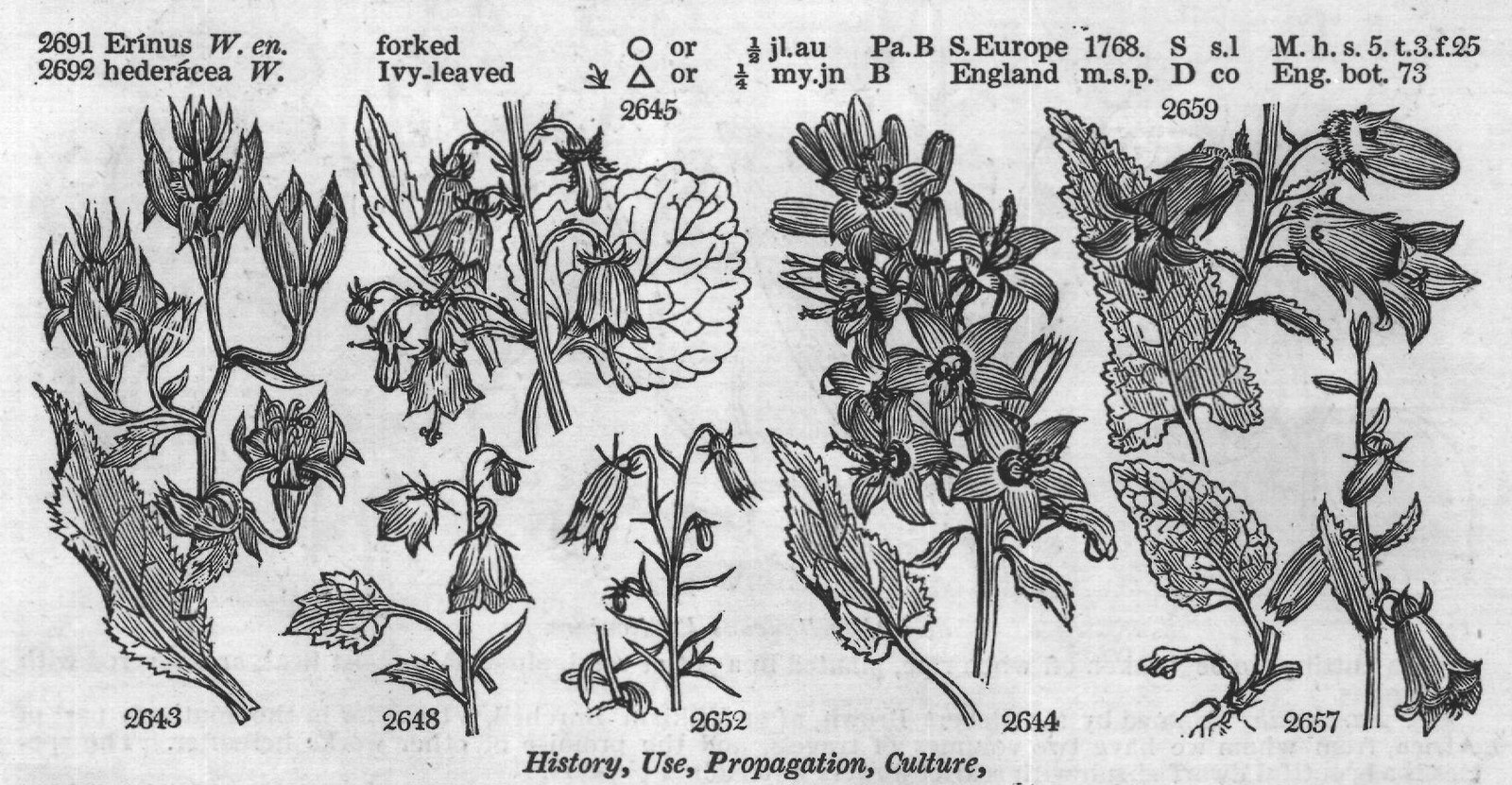
Bot. rep. 385 Bot. reg. 149 Bot. mag. 811 capitáta B. M. ! 2690 lanuginósa W. en. woolly-leaved or 2 my.au B ...... 1814. S s.l 2691 Erínus W. en. 2692 hederácea W. forked Ivy-leaved or or 2645 jl.au Pa.B S. Europe 1768. S s.1 my.jn B England m.s.p. D co 2659 M. h. s. 5. t.3.f.25 Eng. bot. 73 2643 2648 2652 2644 2657 History, Use, Propagation, Culture, English it is called Venus' looking-glass. Ancient mirrors were always round, on which account the astrological sign of Venus was, or a figure of the antique mirror and its handle. This is a shewy genus; some of the species are beautiful, and all of them of easy culture in the borders of the flower garden or shrubbery. One or two species are used in dietetics, and probably the roots of the whole might be eaten. Almost all the species have long thick white roots, which abound in an acrid milky juice. C. rapunculus is much cultivated in France and Italy, and sometimes in Britain, for the roots, which are boiled tender and eaten hot with sauce, or cold with vinegar and pepper. It is sown in Spring on deep light soil in drills, and will be ready for use by the autumn of the same year. C. persicifolia and Rapunculoides may also be cultivated for the same purpose.
C. pyramidalis was a very fashionable plant thirty years ago, and is still cultivated, but has given way to Lobelia splendens and fulgens. It is still in demand in Holland as an ornament to halls, staircases, and for being placed before fire-places in the summer season; for which purpose it is planted in large pots, and trained in the fan manner, so as to cover a large surface. In the shade it will continue in flower for two or three ORDER I.
PENTANDRIA MONOGYNIA. 2642 Leaves oblong crenulate rigid sessile, Flowers erect flat 2643 Caps. 5-celled, Leaves elliptical serrate smooth, Flowers panicled 5-parted, Stems shrubby fleshy 2644 Leaves cordate serrate smooth, Thyrse terminal, Sepals subulate, Corolla rotate spreading 2645 Leaves lanceolate: cauline acutely serrated, Flowers panicled nodding 2646 Leaves stalked subcordate acutely serrated, Flowers small nodding, Style exserted 2647 Leaves ternate oblong finely serrated, Stem 1-flowered, Flower spreading 2648 Leaves rhomboidal serrated, Spike one-sided, Cal. toothed 2649 Leaves about 6 lanceolate toothed, Flowers whorled [very long 2650 Stem erect, Lvs. altern. opp. and ternate lin. lanc. entire, Pan. pyram. Flowers cernu. glob. trunc. Style 2651 Stem branched upright twiggy, Lvs. lin. lanc. toothed, Pedunc. filiform long, Cor. funnel-shaped 3-4-cleft 2652 Smooth, Stem.1-fl. Lower Ivs. obl. cauline lin. subsetaceous, Cor. cernuous with the bott. of seg. cut out §2. Leaves rough. 2653 Stem rounded striated smooth, Lvs. ovate lanc. doubly serrated, Pedunc, axillary 1-fl. erect, Cal. smooth 2654 Stem furrowed pubescent, Leaves ovate-lanceolate doubly serrate, Pedunc. axillary solitary, Cal. woolly 2655 Stem angular hispid, Lvs. ov. lanc. coarsely serrated, Pedunc. axillary 1-flowered cernuous, Cal. hispid 2656 Stem angular, Leaves stalked, Cal. ciliated, Peduncles trifid 2657 Leaves cordate-lanceolate, Stem branched, Flowers one-sided scattered nodding, Cal. reflexed 2658 Leaves oblong unequally toothed rough beneath, Stem panicled, Bractes and calyx ciliated 2659 Leaves downy: lower cord, lanc, stalked, Flower nodding, Germens woolly 2660 Leaves ovate lanceolate beneath scabrous sessile, Stem panicled [very long 2661 Stem rounded and lvs. beneath tomentose, Lower lvs. cordate lanc. stalked, upper sessile, Raceme term. 2662 Stem angular simple smooth, Leaves scabrous oblong lanceolate cordate sessile, Head clustered 2663 Stem angular subsimple hispid, Rad. lvs. ovate cordate stalked: cauline cordate sessile, Flowers clustered 2664 Hispid, Flowers sessile, Head terminal, Leaves lanceolate linear wavy 2665 Stem simp. few-fl. Lvs. hairy, lower cord. lanc. stalked, upper obl. sessile, Flowers nodding, Cal. hispid 2666 Leaves ovate-oblong sessile serrated, Stem simple angular, Flowers panicled 2667 Leaves lanc. twin serr. and branched stem hispid, Flowers panicled, Calyxes hispid, Seg. dilated serrated 2668 Stem angular smooth, Caul. leaves sessile equally toothed wavy lanceolate, Floral cordate, Cor. tubular 2669 Hispid, Raceme ovate oblong terminal, Stem quite simple, Leaves linear lanceolate 2670 Leaves ovate rugose, Leafstalks with a dilated and serrated edge, Stem simple hispid, Flowers spreading 2671 Leaves oblong waved hairy, Flowers terminal cernuous, Cal. smooth 2672 Leaves lanceolate toothed hispid, Pedunc. very long 1-flowered with strigose capsules §3. Capsules covered by the reflexed recesses of the calyx. Medium. 2673 Stem simple erect pubescent, Lvs. lanc. crenate, Racemes simple with nodd. flowers, Cor. bearded inside 2674 Hairy, Radical leaves stalked ovate acute serrate, Flowers cernuous dotted inside villous 2675 Stem undivided erect hispid. Leaves lanceolate obtusely serrated sessile 3-nerved at base, Flowers erect 2676 Hispid, Caps. 5-celled, Branches pyramidal, Peduncles axillary, Flowers erect solitary 2677 Hispid, Spike lax, Flowers alternate, Leaves linear entire 2678 Stem simple, Pedunc. axillary 1-flowered 2-leaved 2679 Caps. 5-celled covered stalked, Stem prostrate, Leaves very soft nearly round 2680 Caps. 5-keeled covered, Flowers alternate nodding, Leaves obovate crenate 2681 Radical leaves reniform coarsely doubly serrate: cauline ovate toothed sessile 2682 Leaves reniform cordate doubly crenate stalked tomentose beneath, Flowers one-sided reflexed 2683 Stem panicled pubescent, Leaves lanceolate obtuse wavy 2684 Stem simple diverging pubes. Lvs. lanc. obtusely serrated sessile veiny, Pedunc. axill. 3-fl. and terminal 2685 Hispid, Stem simple, Flowers capitate terminal, Leaves lanceolate obtuse crenate 2686 Lvs. obovate wavy rough, Stem creeping, Branches erect few-flow. Segm. of the hispid cal. nearly equal 2687 Caps. stalked, Leaves serrated: radical lyrate; cauline lanceolate nearly wedge shaped 2688 Radical leaves stalked cord. doubly serr. Raceme few-flowered lax 2689 Caps. covered, Leaves oblong wavy hispid; radical sinuated, Flowers clustered sessile terminal 2690 Leaves woolly: radical lyrate; cauline rounded ovate serrate, Flowers cernuous 4. Corolla in some degree unequal, Stigma nearly simple, Capsule opening at the end. 2691 Stem dichotomous, Leaves sessile, the upper opp. 3-toothed 2692 Leaves cordate 5-lobed stalked smooth, Stem lax 2667 2668 2669 2679 and Miscellaneous Particulars. 2678 2683 2692 2687 months. The art of producing a very large plant is to begin with pots of a small size, and shift frequently during two years, till at last the plant occupies a pot of a foot or more in diameter. Rich light soil should be used, but no animal manures or recent dung, as these are found very injurious. Cuttings of the roots flower the second, and seedlings the third year. C. carpatica and grandiflora may be treated in a similar manner.
C. lilifolia has a singular anomaly in the leaves, which before the panicle is produced come out in a kind of rose on the summit of the stem, but are, through its prolongation, afterwards dispersed. The flowers vary much both in size and color, and the roots are eaten in China both raw and boiled. C. glomerata is a handsome rock or pot plant; it requires a dry lean soil, otherwise, as in most plants, the flowers lose the intensity of their color in that which is very rich. C. hederacea is a very small plant, with the leaves so much resembling those of Veronica hederifolia, that Linnæus suspected it to be a hybrid.
C. medium is a very ornamental border flower of the easiest culture, and with varieties, double and single, M 3 PENTANDRIA MONOGYNIA.
CLASS V. 2693 fruticosa W. shrubby or 1 au B 2694 Prismatocárpus W. shining or my.au B 2695 Spéculum W.
Venus' Look.-gl. or 1 my.au Pu C. G. H. 1787. S p.l C. G. H. 1787. S s.l S. Europe L'Her. s.an.2.t.3 1596. S s.l Bot. mag. 102 ẞalba white or 1 my.au W 2696 hýbrida W. corn or 1 my.au Pu England cha. fi. S s.l Eng. bot. 375 2697 pentagónia W. five-angled or 1 my.au B.P Turkey 1686. S s.l Bot. reg. 56 2698 perfoliáta P. S. perfoliate or 1 my.au Pu N. Amer. 1680. S s.1 M.h. 2.s.5.t.2.f.23 464. LOBELIA. W.
LOBELIA.
Campanulaceæ. Sp. 46-170. 2699 símplex W. simple-stalked or my.au B C. G. H. 1794. C l.p 2700 lineáris W. linear-leaved or B C. G. H. 1791. C l.p ... 2701 pinifólia W.
Pine-leaved 2702 unidentáta H. K. single-toothed 2703 Dortmánna W. 2704 salicifólia water. willow-leaved 业业兰数 or or 1½ my.au V C. G. H. 1752. S s.p Bot. rep. 273 C. G. H. 1794. R 1.p Bot. mag. 1484 or 1 jl.au B Britain lakes. R l.p Eng. bot. 140 P 6 jn.au S Chili 1794. R s.p Bot. mag. 1325 Túpa H. K. gigantéa B. M. 2705 Kálmii L.
Kalm's or 2706 racemósa B. M. racemose or 1 jl.au B 5 jl.au Carolina 1820. S co Bot. mag. 2238 G 2707 bellidifólia W.
Daisy-leaved or 2708 tríquetra W. triangular or 2709 longiflóra W. long-flowered or 1 my.au W 2710 secúnda W. side-flowering or my.au W 2711 goodenioídes H. K. Goodenia-like or my.au B 1 my.au B W. Indies 1818. C co C. G. H. 1790. C s.p 1774. C s.p 1752. S s.p C. G. H. 1790. S s.p 1 jn.au Pa.B N. Amer. 1799. D s.I Bot. mag. 2137 C. G. H.
Jamaica Jac. vind. 1. t. 27 2712 assur'gens W. purple or 3 jn.o S 2713 fúlgens W. en. fulgent or 3 my.s S W. Indies 1787. C s.p Mexico 1809. C s.p Will. hor. ber. 30 Bot. rep. 553 Bot. rep. 659 2714 verbascifólia Sm.
Mullein-leaved or 6 my.jn R 2715 cardinális W.
Cardinal-flower or 3 my.s S Nepal 1822. Dr.m Virginia 1629. C s.p Bot. mag. 320 2716 spléndens W. en. splendid Aor 3 my.s S Mexico 1814. C s.p Bot. reg. 60 2717 débilis W. feeble or 1 jl.au B C. G. H. 1774. S s.p 2718 aláta R. Br. winged-stalked or 1½ my.au B N. S. W. 1804. S s.p La.no.hol. 1.t.72 2719 siphilitica W. blue-cardinal or 2 au.o L.B 2720 surinaménsis W. shrubby or 2 ja.jl 0 ẞ rubra red or 2 ja.jl 2721 grácilis R. Br. slender or 1 jl.o 2722 purpuráscens R. Br. purplish or 1 jn.au B 2723 infláta W. bladder-podded Pa.B 2724 cliffortiána W. purple-flowered Oor 1 jl.au Pk 2725 micrántha Hook. small-flowered cu jlau B 2726 úrens W. acrid 2727 amœ'na Mich. beautiful-blue 2728 minúta W. small 2729 Lauréntia W.
Italian 2730 tenélla Biv. slender 2731 campanuloídes Th. chinese 2732 Erínus W. ascending পপস পপস A cul 1 jn.jl B or 3 jn.au Acul lin jn.s B W C. G. H.
Ocul 1 jl.au Virginia 1665. C s.p W. Indies 1786. C s.p RW. Indies 1820. C s.p D.B N. S. W. 1801. S s.p N. S. W. 1809. D s.p N. Amer. 1759. S s.p N. Amer. 1733. S s.p Nepal 1822. S s.p England hea. S s.I N. Amer. 1812. D s.1 Bot. mag. 741 Li.ac.up.1741.t.1 Li. h. cl. 426. t.26 Hook. ex. fl. 44.
Eng. bot. 953 Ann. mus. 18.t.1 Bot. mag. 2077 Bot. reg. 537 Bot. mag. 225 Bot. cab. 749 1772. R s.p or jl B Italy 1778. S s.p Mich. ge. 18.t.14 or my.jl P.v Sicily 1821. D co or my.au W China 1820. D co Bot. reg. 733 or jn.s B C. G. H. 1752. S s.p Bot. mag. 901 2733 erinoídes W. trailing or jn.au BC. G. H. 1759. Rs.p Her. lugd. t. 109 2734 bícolor H. K. spotted or jn.au Pa.B C. G. H. 1795. C s.p Bot. mag. 514 2735 ilicifólia B. M.
Holly-leaved or my.s Pk C. G. H. 1815.
D s.p Bot. mag. 1896 2736 pubéscens W. downy-leaved Aor jn.au B C. G. H. 1780.
R s.p Jac. sch. 2. t. 178 2737 lútea W. yellow or jn.jl Y C. G. H. 1774.
S s.p 2738 hirsúta W. hairy or my.s B C. G. H. 1759.
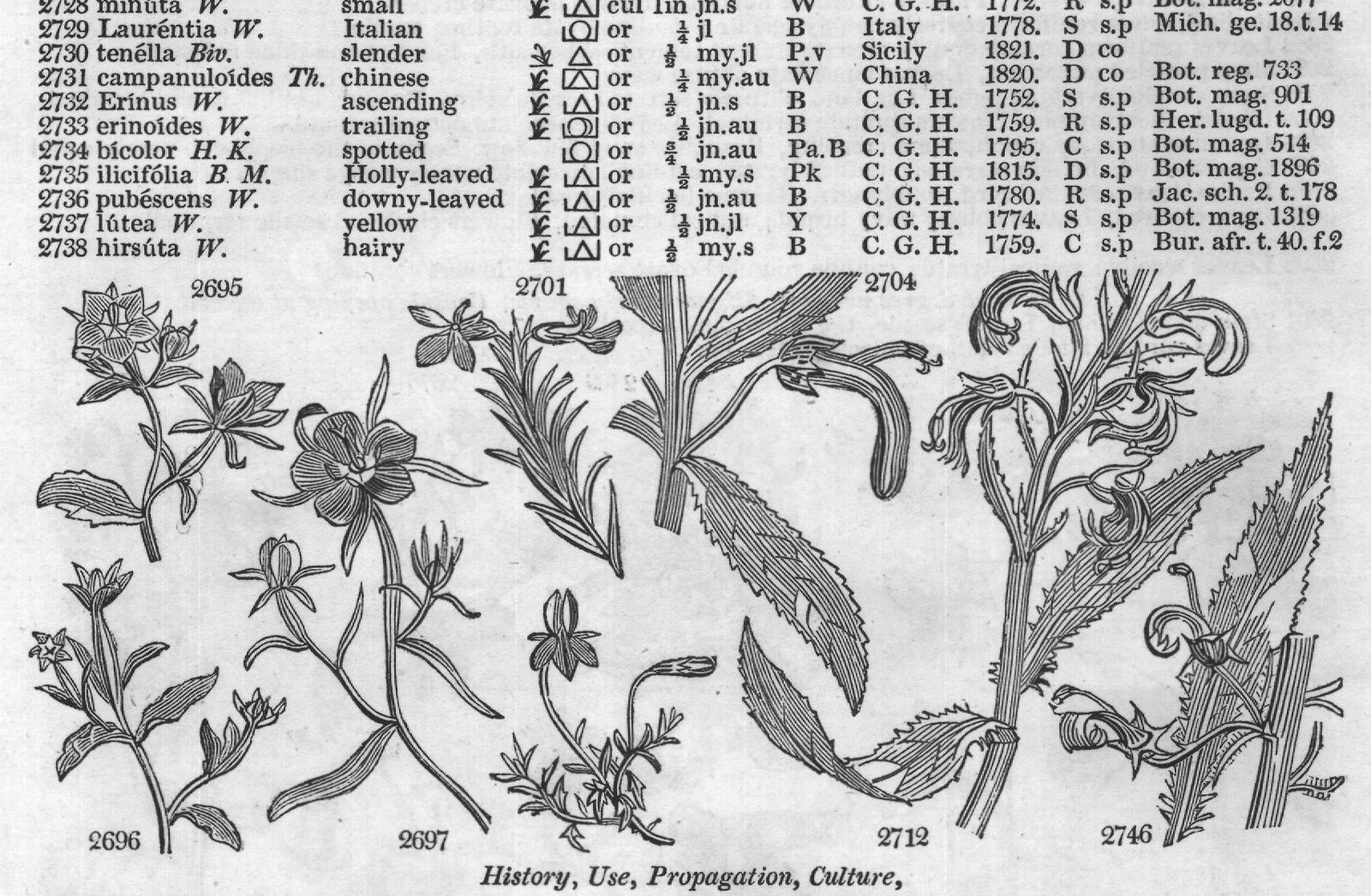
Cs.p Bot. mag. 1319 Bur. afr. t. 40. f.2 2695 2701 2704 2696 2697 2712 2746 History, Use, Propagation, Culture, of blue, red, purple, and white flowers. Like other biennials, it may either be sown where it is to remain any time after midsummer, or sown in beds in spring for transplantation. C. speculum and hybrida are annual border flowers of considerable beauty. 464. Lobelia. In honor of M. Lobel, author of various works, and particularly of that called Icones Plantarum; he was born at Lisle in 1538, became physician and botanist to James I., and died in London in 1616. This genus furnishes some of our most splendid herbaceous plants, as L. cardinalis, fulgens, and splendens. The predominant color of the corollas is blue.
L. Dortmanna (from Dortmann, an apothecary, who first sent it to Clusius), is a beautiful aquatic with leaves reflected into an elegant curve at the end, and the flowers in loose spikes. L. longiflora, which grows by moist places and rivulets in the West Indies, is a very poisonous plant. Taken internally it brings on an invincible purging. If the plant be handled, and the hand be unawares applied to the eyes or lips, it brings on an inflammation. In the Spanish West Indies it is called Reventacavallos, because horses are reported to burst with eating it. L. fulgens, splendens, and cardinalis, are the three grand ornaments of the genus. They are readily multiplied by cuttings or slips, or by seeds when they ripen, and grow well in light rich soil. The culture of L. cardinalis is given at length by Justice, who designates it "a flower of most handsome appearance, and which should not be wanting in curious gardens, on account of the rich color of its flowers." The culture of L. ORDER I.
PENTANDRIA MONOGYNIA. §5. Capsules prismatical. Prismatocarpus. 2693 Caps. columnar 5-celled, Stem shrubby, Leaves linear subulate, Peduncles very long, Panicles terminal 2694 Caps. linear 2-celled, Leaves lanceolate coarsely serrated smooth, Stem decumbent 2695 Stem very much branched diffuse, Leaves oblong crenate, Flowers solitary 2696 Stem branched at base upright, Leaves oblong crenate, Cal. aggregated longer than corolla 2697 Branching diffuse, Lower leaves oblong obtuse, Upper lanceolate, Flower solitary, Cor. longer than calyx 2698 Stem simple, Leaves cordate toothed stem-clasping, Flowers sessile clustered 2699 Leaves linear villous, Stem erect 2700 Leaves linear smooth, Stem erect 2701 Shrubby, Leaves linear erect close together 2702 Leaves linear one toothed on each side 2703 Leaves linear 2-celled, Scape simple naked racemose 2704 Leaves lanceolate, Raceme spiked 2705 Stem erect, Leaves lin. lanc. obtuse alternate entire, Raceme terminal 2706 Stem half shrubby erect, Leaves lanc. ovate serrate toothed, Rac. term. Pedic. as long as flowers 2707 Leaves ovate toothed hairy, Stem simple 2708 Leaves lanceolate pinnatifid toothed, Raceme terminal 2709 Leaves lanceolate toothed, Peduncles very short lateral, Tube of cor. filiform very long 2710 Smooth, Lower leaves oblong toothed, upper lanceolate entire, Peduncles racemose 1-sided 2711 Erect simple slightly pubescent, Lvs. obl. obt. almost entire, the lower spatulate, Spike naked small flow. 2712 Leaves broad lanceolate serrate below toothed decurrent, Racemes compound terminal 2713 Leaves narrow lanceolate toothed revolute at edge and stem pubescent, Raceme terminal 2714 A tall plant with rugose coarse leaves, and a long spike of fine red flowers 2715 Leaves oblong lanceolate cartilaginous-toothed and erect stem smooth, Raceme terminal 1-sided leafy 2716 Leaves narrow lanceolate toothletted flat at edge and stem quite smooth, Raceme terminal 2717 Leaves lanceolate serrated smooth, Peduncles lateral longer than the leaf 2718 Flowers axillary, Stem winged, Radical leaves ovate lanceolate with glandular reflexed teeth 2719 Lvs. ovate-obl. acute at each end unequally serrated, Flowers axillary solitary, Recesses of calyx reflexed 2720 Lvs. obl. acuminate serrated smooth, Pedunc. axill. 1-fi. Sepals linear lanc. spreading, Anthers bearded 2721 Leaves ovate cut, Stem divided, Racemes terminal naked, Upper lip of cor. bearded 2722 Smooth, Stem ascending 4-cornered, Leaves ovate-lanceolate cut serrate twice as short as leafstalk 2723 Stem hairy, Lvs. toothed serrate, the lower ov. obl. the upper ovate, Pedunc. axillary 1-fl. Caps. inflated 2724 Stem erect, Leaves cordate obsoletely toothed stalked, Corymb terminal 2725 Smooth erect, Stem 3-cornered, Leaves ovate round repand, Pedunc. longer than leaves 2726 Stem erect, Lower leaves obovate toothletted, upper lanceolate serrate, Raceme terminal 1-sided 2727 Quite smooth, Lvs. broad lanc. serr. Spike many-flowered 1-sided, Sepals entire, Lower petals ov. acute 2728 Radical leaves ovate, Scapes capillary 2729 Stem prostrate, Leaves lanceolate oval-crenate, Stem branched, Peduncles solitary 1-flowered very long 2730 Radical leaves spatulate repand, Cauline setaceous, Stems simple 1-flowered erect 2731 Leaves somewhat stalked lanceolate oblong toothed, Stems decumbent, Peduncles elongated 2732 Stem spreading, Lvs. toothed, lower ellipt. stalked, upper sess. narrow lanc. Pedunc. longer than leaves 2733 Stems prostrate filiform, Leaves stalked oblong toothed 2734 Stems spreading, Lower leaves oblong toothed pubescent subsessile, Upper lip of cor. reflexed 2735 Leaves ovate lanceolate deeply toothed, Peduncles axillary 2 or 3 times as long as leaves 2736 Stems angular prostrate and leaves lanceolate toothed hairy, Peduncles axillary 1-flowered 2737 Stems procumbent, Leaves lanceolate serrated, Flowers sessile spiked 2738 Shrubby hairy prostrate, Leaves ovate toothed, Flowers lateral with very long stalks 2 or 3-flowered 2728 2720 β 2732 2716 2726 2735 and Miscellaneous Particulars. 2734 2737 fulgens is given by J. B. Van Mons, and W. Hedges, in the Hort. Trans. Both confess that very little art is required. Hedges, to procure strong flower stalks, keeps the plants in pots, shifts very frequently from a smaller to a larger size, places them first in cucumber frames, and when they begin to flower in a stove. The pots in which they are allowed to flower are nine inches in diameter, and, in order to supply abundant moisture, pans are placed under the pots constantly filled with water. The soil used is equal parts of loam and leaf-mould, with a third of the whole of sand. They begin to flower in July, and continue flowering through the autumn. One plant so treated produced a flower-stalk which measured six inches in circumference at the base; the height of the centre spike of flowers was five feet and a half; the shoots from the bottom and sides of the main stem were in number seventeen, and rising four and a half feet. L. splendens and cardinalis may either be treated as above, or as a tender border, or as frame plants. Van Mons observes, that L. cardinalis perishes in sandy soil, but becomes strong and multiplies in loam, while, at the same time, it produces the most brilliant colors in the former. The same thing may doubtless be predicted of the other species; it being a well known law of nature as to living beings, that their energies are concentrated in proportion to the obstacles thrown in the way of their expansion. L. siphilitica has its specific name from its supposed efficacy in the cure of siphilis, among the North American Indians. Sir William Johnston purchased the secret from them, but Woodville says, its virtues have not been confirmed by any instances of European practice. M 4 PENTANDRIA MONOGYNIA.
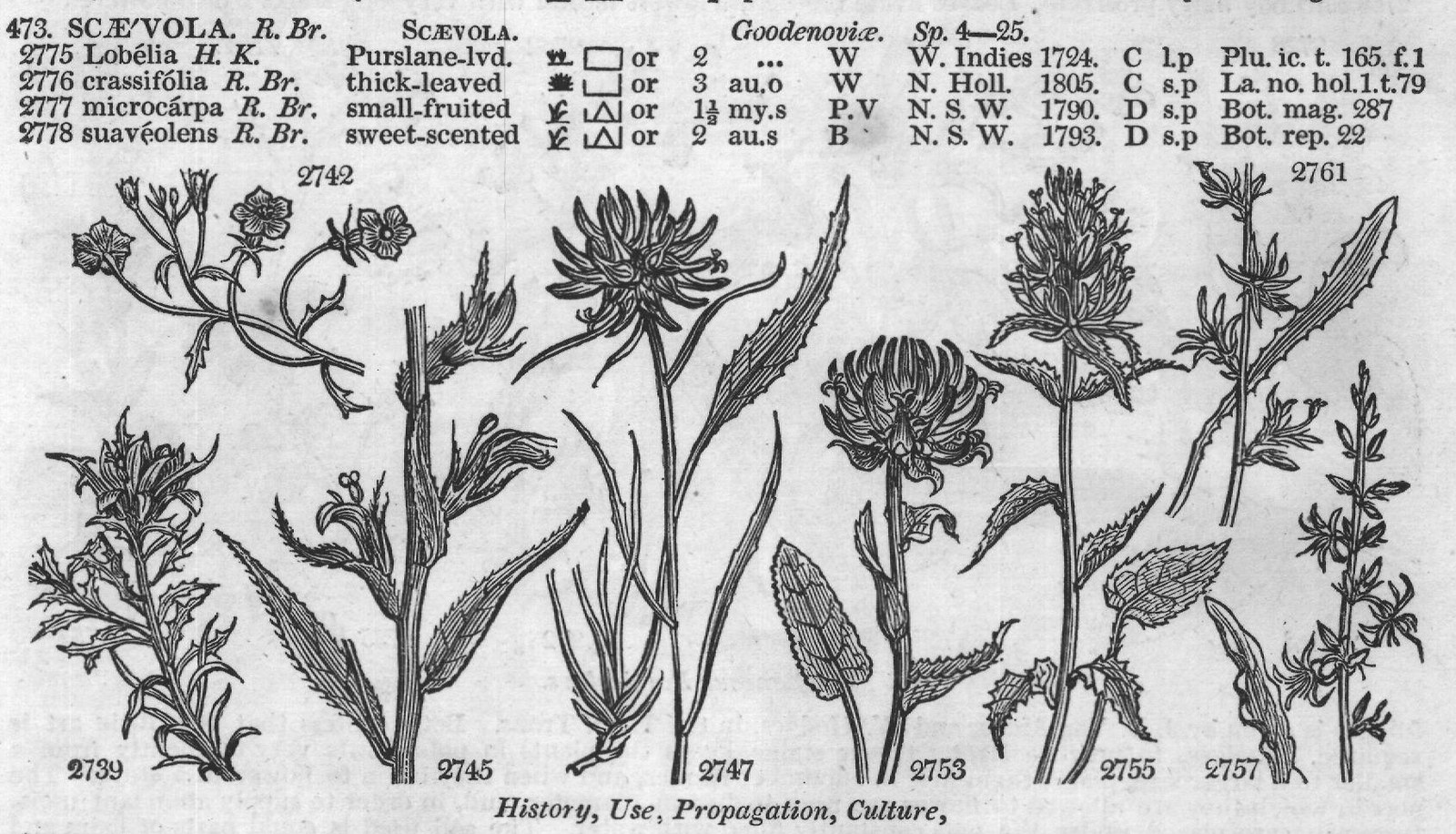
CLASS V. 2739 variifólia B. M. 2740 corónopifólia W. various-leaved ΔI or 1 jn.jl Y C. G. H. 1812. C s.p Bot. mag. 1692 Buck's-horn or jl.au B C. G. H. 1752. S s.p Bot. mag. 644 2741 crenáta W. notched-leaved or ap.my B C. G. H. 1794. C s.p 2749 Michélii All. 2742 spéculum B. M. 2743 pedunculáta B. M. 2744 decúmbens B. M. 2745 pyramidális B. M. 465. PHYTEU'MA. W. 2746 pauciflórum L. few-flowered 2747 Scheuchzéri W. Scheuchzer's 2748 scorzonerifólium Vil. scorzonera-lvd. 2750 hemisphæricum W. linear-leaved Looking-glass long-stalked decumbent or jlau Pu C. G. H. 1812. S s.p Bot. mag. 1499 Aor 1 o.n B C. G. H. 1819. D co Bot. mag. 2251 or o.n B C. G. H. 1820. D co Bot. mag. 2277 pyramidal or 4 s Pu Nepal 1822. D co Bot. mag. 2387 RAMPION.