Class IV
- TETRANDRIA. 4 STAMENS.
THIS class is neither so large nor so important as the last. It is composed chiefly of ornamental or curious plants, mostly shrubs, of which the Proteaceæ hold the first rank. Among the few plants used in the arts which it contains, may be mentioned the madder (Rubia), Fuller's thistle (Dipsacus), the holly (Ilex), one of the best evergreen hedge plants; and some foreign timbers and dyes, as the sandal-wood and chayroot.
The Proteaceæ, of which the first section of the class partly consists, are natives chiefly of the Cape of Good Hope and New South Wales and there is this singular circumstance connected with their geographical distribution, that those two continents do not possess any one genus in common; a singular fact, and of the more difficult solution, as the genera of the order are strictly natural. They have been described by Mr. Brown, in a long and learned memoir, in the Transactions of the Linnean Society, vol. x., where much information respect- of the , vol. x., where much information respecting them may be found. It has been impossible to state the natural height or color of flower of many of the New Holland kinds, as Mr. Brown says nothing upon these two points; and he is the only author who has seen the plants in their native country, where alone many of them have flowered. In the conservatory they are mostly shrubs of from four to seven feet in height.
The principal part of the fourth section of Monogynia consists of the Stellatæ or Crossworts, which are common weeds all over Europe. Many of the genera in the sixth section, such as Ixora, Pavetta, Catesbæa, are beautiful ornaments of the conservatory. The wood of Curtisia in the seventh section furnishes the Caffres with materials for the shafts of their hassagays.
With the exception of Proteaceæ, the class is made up of a miscellaneous assemblage of species, with few characters in common. The genera have not been combined in any other than a purely artificial manner, and among them are to be found plants belonging to almost all the natural orders of Dicotyledonous plants of the older French botanists. Pothos, Potamogeton, and Ruppia are among the rare instances of a quaternary division of the flower in Monocotyledonous plants. Order 1. MONOGYNIA. 4 Stamens. 1 Style. 1. Flowers incomplete, (no corolla), inferior. 229. Petrophila. Cal. 4-cleft, all deciduous. Style persistent at base. Stigma spindle-shaped, narrowed at end. Scales beneath the ovary none. Cone ovate. Nut lenticular, comose at one end. ORDER III.
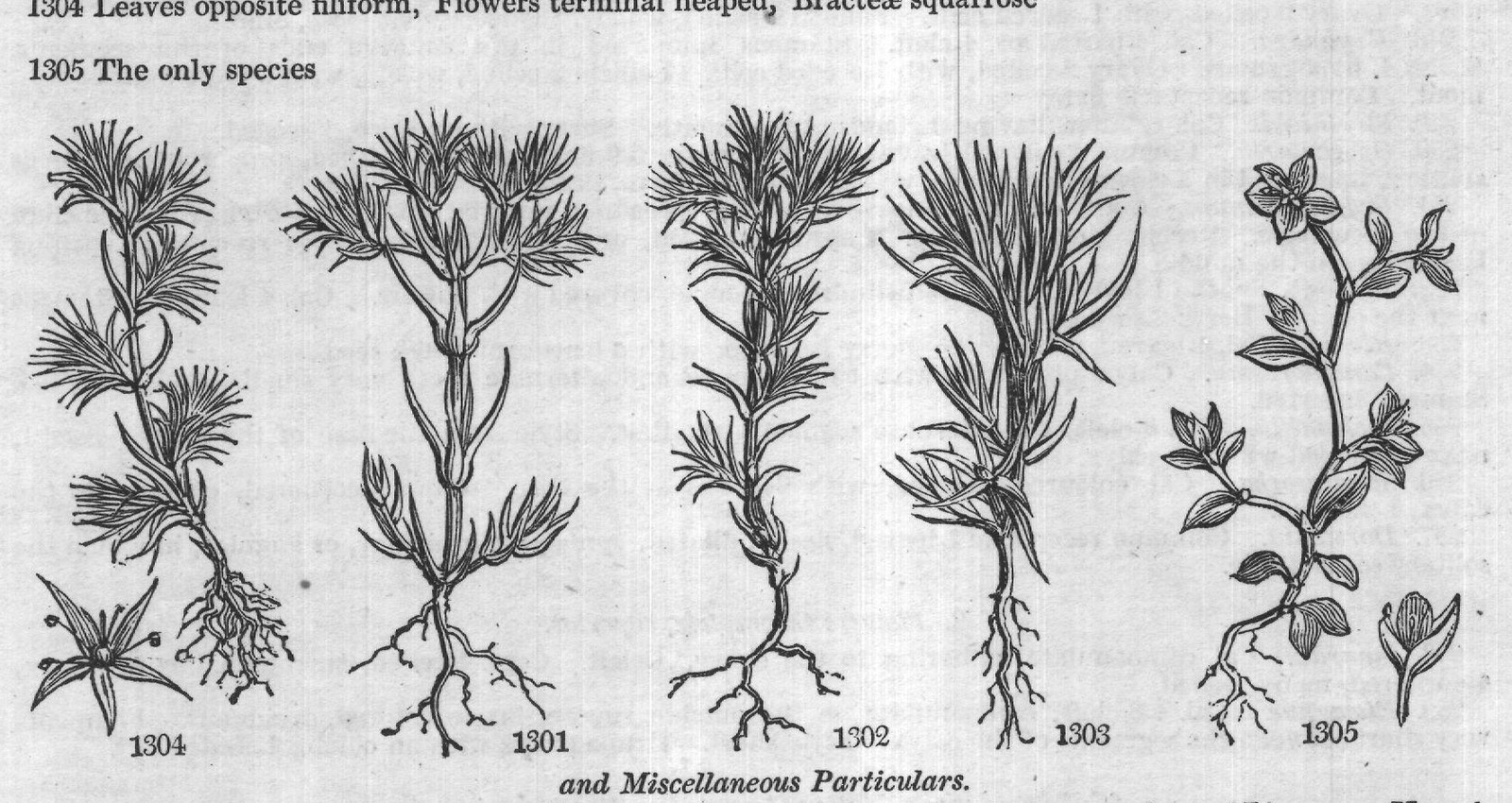
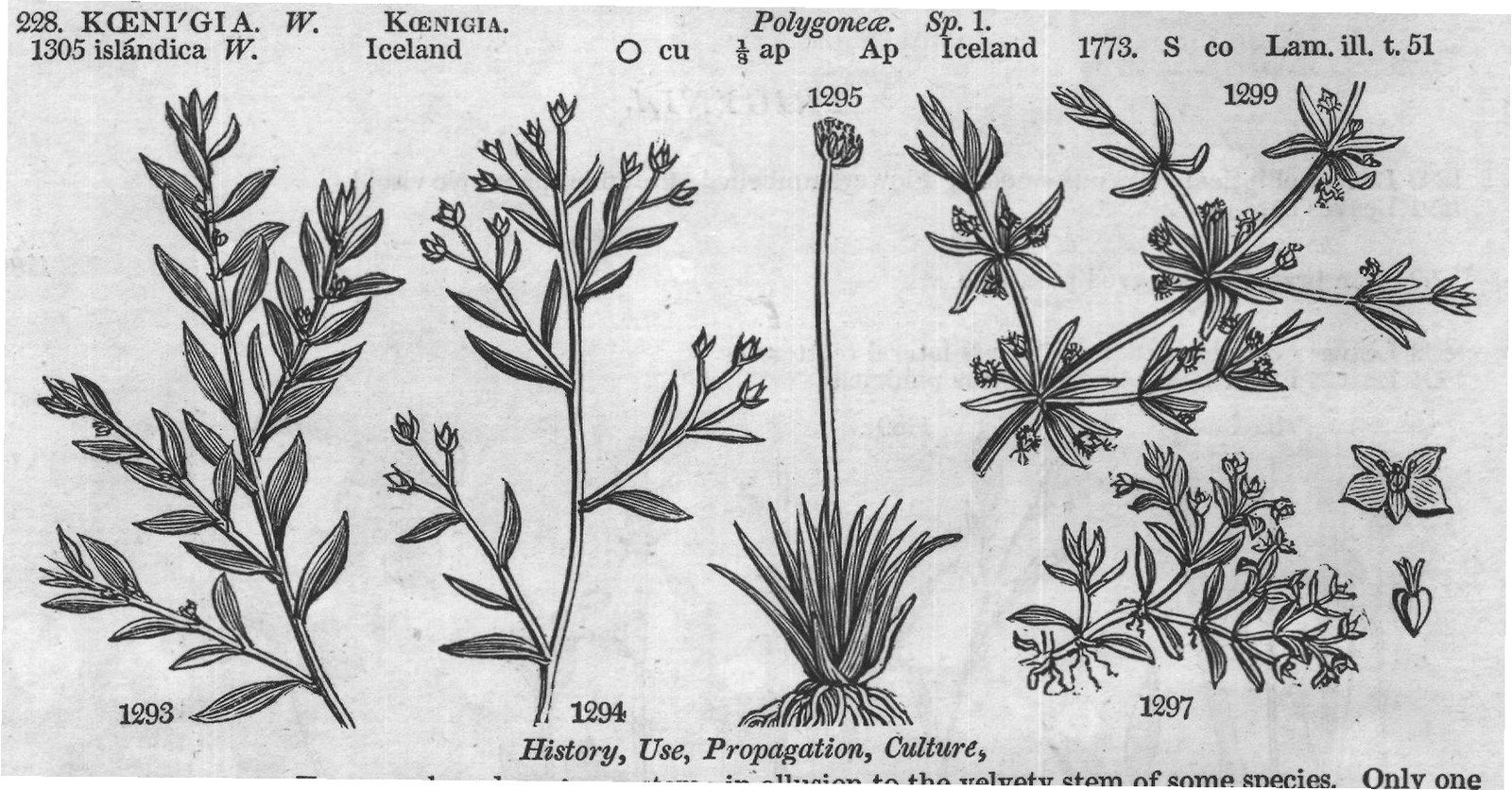
TRIANDRIA TRIGYNIA. 1295 Stem 7-angled, Leaves acuminate cellular, Male fl. monopetalous tetrandrous 1296 Stem 7-angled, Leaves flat hairy much shorter than the stem, Scales of the head powdery 1297 Stem erect divaricating, Leaves connate-sessile oblong ovate 1298 Stem weak dichotomous, Leaves opp. sessile obtuse lanceolate fleshy 1299 Leaves whorled wedge-shaped acute, Stem divided decumbent, Pedunc. 1-flowered 1300 Stem erect, Leaves whorled three larger than the rest, Pan. terminal and lateral 1301 Leaves filiform dilated at base, Branches terminal capitate corymbose, Flowers axillary 1502 Leaves capillary, Flowers terminal stalked alternate longer than bracteæ 1303 Leaves capillary, Corymbs leafy axillary stalked, Flowers shorter than bracteæ 1304 Leaves opposite filiform, Flowers terminal heaped, Bracteæ squarrose 1305 The only species 1304 1301 1302 1303 1305 and Miscellaneous Particulars. 226. Minuartia. In memory of John Minuart, a Spanish botanist, and correspondent of Linnæus. He published some Opuscula in 1739. 227. Queria. In memory of Joseph Quer, a Spanish botanist, who published a Flor Espagnol in 1762, in six volumes, quarto, held in no estimation. The plant is Spanish, and worthless also. 228. Kœnigia. In honor of Emanuel Kœnig, professor of botany at Bale, and called the modern Avicenna; he died in 1731. He published several works now forgotten. The plant is a curious inconspicuous annual, occasionally seen in botanic gardens. 230. Isopogon. Cal. 4-cleft, with a slender tube, persistent for a long time. Style wholly deciduous. Stigma spindle-shaped or cylindrical. Scales beneath the ovary none. Nut sessile, ventricose, comose on all sides. 231. Protea. Cal. bipartible, unequal, with the stamen-bearing divisions of the broader lip cohering. Style subulate. Stigma narrowly cylindrical. Nut bearded on all sides, with the remains of the persistent style. Common receptacle with short persistent scales. Involucrum imbricated, persistent. 232. Leucospermum. Cal. irregular, labiate, with three of the segments (rarely all) cohering at the base, the stamen-bearing divisions distinct. Style filiform, deciduous. Stigma thickened, smooth, sometimes unequal-sided. Nut ventricose, sessile, smooth. Head indefinitely many-flowered. Involucrum many-leaved, imbricated. 233. Mimetes. Cal. 4-parted, equal, with distinct divisions. Style filiform, deciduous. Stigma cylindrical, slender. Nut ventricose, sessile, smooth. Common receptacle flat, with narrow deciduous scales. Involucrum indefinitely many-leaved, imbricated. 234. Serruria. Cal. 4-cleft, nearly equal, with distinct claws. Stigma vertical, smooth. Scales 4, hypogynous. Nut shortly stalked, ventricose. Head indefinitely many-flowered, with persistent imbricated scales. 235. Nivenia. Cal. 4-cleft, equal, wholly deciduous. Stigma clavate, vertical. Nut ventricose, shining, sessile, entire at the base. Involucrum 4-leaved in a simple series, 4-flowered, when in fruit indurated. Receptacle flat, without scales. 236. Sorocephalus. Cal. 4-cleft, equal, wholly deciduous. Stigma vertical, clavate. Nut ventricose on a very short stalk, or emarginate at base. Involucrum 3-6-leaved in a simple series, definitely few-flowered or 1-flowered, in fruit not altered. Recept. without scales. 237. Spatalla. Cal. 4-cleft, wholly deciduous, the inner segment usually largest. Stigma oblique, dilated. Nut ventricose on a short stalk. Involucrum 2-4-leaved in a simple series, 1-flowered, or definitely manyflowered. Recept. without scales. 238. Persoonia. Cal. 4-leaved, regular, the segments having the stamens in their middle, recurved at end, and deciduous. Stamens exserted. Glands 4, hypogynous. Ovary stalked, 1-celled, 1-2-seeded. Stigma obtuse. Drupe berried, with a 1-2-celled nut. 239. Grevillea. Cal. irregular, with the segments 1-sided, bearing the stamens in their hollow ends. Anthers immersed. Gland 1, hypogynous, halved. Ovary 2-seeded. Stigma oblique, depressed (sometimes nearly vertical and conical). Follicle 1-celled, 2-seeded, with a cell in the middle. Seeds edged, or with a very short wing at the end. 240. Hakea. Cal. 4-leaved, irregular, with the segments on one side. Stamens immersed in the concave ends of the calyx. Gland 1, hypogynous, halved. Ovary stalked, 2-seeded. Stigma nearly oblique, with a conical point from a dilated base. Follicle 1-celled, woody, with a cell out of the centre, falsely 2-valved. Seed with a wing at the end longer than the nut. 241. Stenocarpus. Cal. irregular, segments distinct, at one side. Stamens immersed in the concave ends of the cal. Gland 1, hypogynous, half-annular. Ovary stalked, many-seeded. Style deciduous. Stigma oblique, orbicular, flattened. Follicle linear. Seeds winged at base. 242. Lambertia. Cal. tubular, 4-cleft, the segments spirally revolute. Stamens inserted in the segments. TETRANDRIA.
CLASS IV.
Scales 4, hypogynous, distinct or united in a sheath. Ovary 2-seeded. Stigma subulate. Follicle 1-celled, coriaceous. Seeds emarginate. Involucrum 1-7-flowered, imbricated, deciduous. Receptacle flat, without chaff. 243. Xylomelum. Cal. 4-leaved, regular, the segments revolute at the end. Stam. inserted above the middle of the segments. Glands 4, hypogynous. Ovary 2-seeded. Style deciduous. Stigma vertical, clavate, obtuse. Follicle thick, woody, 1-celled: the cell out of the centre. Seeds winged at end. 244. Telopea. Cal. irregular, on one side irregularly divided, on the other 4-toothed. Stam. immersed in the concave ends of the calyx. Gland none. Ovary stalked, many-seeded. Stigma oblique, orbicular, dilated. Follicle cylindrical. Seeds winged at end. Involucrum none. 245. Lomatia. Calyx irregular, with distinct 1-sided segments. Stamens immersed in the concave ends of the calyx. Glands 3, hypogynous on one side. Ovary stalked, many-seeded. Style persistent. Stigma oblique, dilated, roundish, flat. Follicle oval. Seeds winged at ends. 246. Rhopala. Cal. 4-leaved, regular, segments recurved at end. Stamens inserted above the middle of the segments. Scales 4, hypogynous, distinct or connate. Ovary 2-seeded. Style persistent. Stigma vertical, clavate. Follicle 1-celled, woody. Seeds winged at both ends. 247. Banksia. Cal. 4-parted. Stamens immersed in the concave ends of the segments. Scales 4, hypogynous. Ovary 2-celled, with 1-seeded cells. Follicle 2-celled, woody. Dissepiment loose, bifid. 248. Dryandra. Cal. 4-parted or 4-cleft. Stamens immersed in the concave ends of the segments. Scales 4, hypogynous. Ovary 2-celled, with 1-seeded cells. Follicle 2-celled, woody, with a loose bifid dissepi. ment. Common receptacle flat. 249. Struthiola. Cal. tubular, having 8 glands at the mouth. Berry without juice, 1-seeded. 250. Opercularia. Common calyx 1-leaved, campanulate, 3-6-flowered, 6-9-toothed, proper none. Seeds solitary, immersed in a closing receptacle, which is operculiform, deciduous. 251. Cryptospermum. Common calyx 6-leaved: leaflets spreading, unequal; proper, 3-leaved from the chaff of the receptacle. Recept. globose, chaffy. Capsules 1-celled, united into a sub-globose receptacle, opening lengthwise in the middle. 252. Pothos. Spathe 1-leaved. Spadix cylindrical, simple, covered with flowers. Cal. 4-leaved. Stamens next the ovary. Berry 2-seeded. 253. Rivina. Cal. 4-leaved, persistent. Berry 1-seeded, with a lentiform rough seed. 254. Camphorosma. Calyx urceolate, with two opposite and alternate teeth very small. Caps. 1-seeded. Stamens exserted. 255. Alchemilla. Cal. 8-cleft, the alternate segments smallest. Style from the base of the ovary. Seed 1, naked, covered with the calyx. 256. Sanguisorba. Cal. coloured, 4-lobed, with 2 scales at the base. Caps. 4-cornered, enclosed in the calyx, 1-2-celled. 257. Dorstenia. Common receptacle 1-leaved, fleshy, dilated, spreading, orbicular, or angular, in which the solitary seeds nestle. 2. Flowers incomplete, superior. 258. Isnarda. Cal. campanulate, adhering to the ovary, 4-cleft. Caps. 4-celled, surrounded by the calyx, 4-cornered, many-seeded. 259. Elæagnus. Cal. 4-8-cleft, campanulate on the outside rugose, inside colored, deciduous. Filaments very short between the segments of the calyx. Style short. Drupe ovate, with an oblong 1-seeded nut. 3. Flowers monopetalous, 1-seeded or dicoccous, inferior. 260. Globularia. Common calyx imbricated: proper tubular, 5-toothed. Cor. with the upper lip 2-, the lower 3-parted. Seed 1, enclosed in the calyx. Recept. chaffy. 261. Houstonia. Cal. 5-toothed. Cor. tubular. Caps. 2-celled, 2-valved, 2-seeded. 4. Flowers monopetalous, 1-seeded or dicoccous, superior. DIPSACEE. 262. Dipsacus. Common calyx many-leaved, proper superior. Cor. tubular, 4-cleft. Seed 1, crowned by the calyx. Recept. conical, chaffy. Pappus cross-shaped, entire. 263. Cephalaria. Common calyx sub-globose, with scales more or less scarious, proper double, pappus shaped, variously split. Receptacle chaffy. 264. Scabiosa. Common calyx many-leaved, proper double pappus-shaped, variously split. Receptacle chaffy. 265. Knautia. Common cal. many-leaved, cylindrical, oblong, simple, 5-flowered, proper simple, superior. Corolla irregular. Seed 1, crowned by the calyx. Receptacle naked. STELLATE. 266. Galium. Cal. an obsolete superior edge. Cor. rotate. Seeds 2, globose. 267. Rubia. Cal. an obsolete superior edge. Cor. rotate, sub-campanulate. Berries 2, 1-seeded. Stam. 4-5. 268. Asperula. Cal. an obsolete edge, 4-toothed. Cor. monopetalous, funnel-form. Seeds 2, globose, not crowned by the calyx. 269. Sherardia. Cal. a 4-toothed edge. Cor. monopetalous, funnel-form. Seeds 2, 3-toothed, crowned by the persistent calyx. 270. Spermacoce. Cal. a 4-toothed edge. Cor. monopetalous, funnel-form. Caps. 2-celled, not divisible in two, with 2 cells, 2-toothed. Seeds with their edge rolled together over their side. 271. Crucianella. Cal. 2-3-leaved. Cor. monopetalous, funnel-form, with a filiform tube and an unguiculate limb. Seeds 2, linear. 5. Flowers monopetalous, many-seeded, inferior. 272. Callicarpa. Calyx 4-toothed. Corolla tubular, campanulate, 4-cleft. Stamens exserted. Berry 4-seeded. 273. Witheringia. Cor. sub-campanulate, with a tube having 4 projections. Cal. very small, obsoletely 4-toothed. Pericarp 2-celled, berried. Anthers conniving, opening laterally. toothed . Pericarp 2-celled, berried. Anthers conniving, opening laterally. 274. Egiphila. Cal. 4-toothed. Cor. 4-cleft. Style semi-bifid, filiform. Berry 2-celled. Cells 2-seeded. 275. Cephalanthus. Common cal. none; proper, as well as corolla, 4-toothed, tubular funnel-form. Receptácle globose. Caps. 2-4-celled, not splitting. Seeds solitary by abortion, oblong. 276. Scoparia. Cal. 4-parted, equal. Cor. 4-parted, rotate, with a hairy throat, regular. Stamens equal. Stigma obtuse. Capsule nearly round, 2-celled, 2-valved, with a dissepiment from the inflexed margins of the valves. 277. Centunculus. Cal. 4-cleft. Cor. 4-cleft, tubular, with a spreading limb. Stamens short. Caps. 2-celled, cut round, many-seeded. 228. Plantago. Cal. 4-cleft. Cor. quadrifid, with a reflexed limb. Stamens very long. Caps. 2-celled, cut round. 279. Buddlea. Calyx and corolla 4-cleft. Stamens from the incisures. Caps. 2-furrowed, 2-celled, manyseeded. 280. Exacum. Cal. 4-leaved. Cor. somewhat bell-shaped, 4-cleft, with a globose tube. Caps. compressed, 2-furrowed, 2-celled, many-seeded, splitting at the end. 281. Sebæa. Cal. 4-5-parted, the sepals keeled or winged. Cor. 4-5-cleft, withering. Stamens exserted, CLASS IV.
TETRANDRIA. the anthers bursting lengthwise after flowering with a recurved callus at the end. Stigmas 2. Caps. with the valves inflexed at the edge, inserted in a central placenta, which finally becomes loose. 282. Frazera. Cal. deeply 4-parted, spreading. Cor. much larger than the calyx, very deeply 4-parted, spreading, the segments oval, bearded with a gland in the middle. Stamens shorter than corolla, with anthers -divided at the base. Stigmas 2, thick, glandular. Caps. oval, much compressed, 1-celled, 2-valved at the edge. Seeds 8-12, elliptical, with a membranous edge. 283. Penæa. Cal. 2-leaved deciduous. Cor. campanulate. Style quadrangular. Stigma 4-lobed. Caps. 4-cornered, 4-valved, 8-seeded. 284. Blæria. Calyx 4-parted. Corolla 4-cleft, somewhat campanulate. Seeds inserted into a receptacle. Caps. 4-celled, many-seeded, opening at the angles. 6. Flowers monopetalous, 2 or many-seeded, superior. 285. Chomelia. Cal. 4-parted, tubular, with unequal segments. Cor. hypocrateriform, 4-parted. Drupe oval, inferior, with a 2-celled, 2-seeded nut. Stigmas 2, thickish. 286. Adina. Cal. 4-5-cleft, with an occasional toothlet between the divisions. Corolla infundibular. Filaments inserted into the mouth of corolla. Stigma turbinate. Seeds 2-3 in each cell. Flowers in heads. 287. Bouvardia. Cal. 4-leaved, with some teeth between. Corolla tubular. Anthers included. 2-partible, many-seeded. Seeds edged.
Caps. 288. Ixora. Cal. 4-parted. Cor. monopetalous, funnel-shaped, long. Stamens above the throat. Berry 4seeded. 289. Catesbæa. Cal. 4-toothed, very small. Cor. funnel-shaped, very long. Stamens within the throat. Stigma simple. Berry 2-celled, many-seeded. 290. Pavetta. Cal. 4-toothed. Cor. monopetalous, funnel-form. Stigma thickened, incurved. Berry 1-2-seeded, 1-celled. 291. Ernodea. Cal. 4-parted. Cor. hypocrateriform. Style simple. Berry 2-celled. Seeds 2, solitary. 292. Siderodendrum. Cal. small, 4-toothed. Cor. hypocrateriform, 4-cleft, with an incurved tube. Stigmas 2, revolute. Berry 2-coccous, 2-celled, dry, with a contrary dissepiment. Seeds 2, solitary. 293. Coccocypsilum. Cal. 4-parted. Cor. funnel-shaped. Berry inflated, 2-celled, many-seeded. Style half 2-cleft. 294. Mitchella. Cal. 2, on one ovary, 4-parted. Cor. funnel-shaped, hairy within. Stigmas 4. Berry bifid, 4-seeded. 295. Oldenlandia. Cal. 5-toothed, persistent. Cor. of 5 petals inserted into the calyx. 296. Manettia. Cal. 8-leaved. Cor. quadrifid, tubular. Caps. 2-valved, 1-celled. Seeds imbricated, orbiculate, with a central point. 7. Flowers polypetalous, inferior. caducous, opposite the petals. Nectaries 4, cup-shaped, incumbent upon 297. "Epimedium. Cal. 4-leaved, caducous, of the petals. Pod 1-celled, 2-valved, many-seeded. 298. Ptelea. Cal. 4-parted. Pet. coriaceous. Stigmas 2. Samara roundish with a 1-seeded centre, or 2-celled, 2-seeded. celled , 2-seeded. 299. Monetia. Cal. 4-cleft, urceolate. Pet. 4, revolute, linear. Berry 2-celled, with 2-seeded cells, one of which is usually abortive. 300. Curtisia. Cal. 4-parted. Petals 4, obtuse. Drupe roundish succulent. Nut 4-5-celled. 301. Hartogia. Cal. 4-5-cleft. Petals 4, spreading. Drupe not juicy, ovate. Nut rather fleshy, 2-seeded. 302. Ammannia. Cal. 1-leaved, campanulate, plaited, 8-toothed. Pet. 4, inserted in the calyx, or very often none. Caps. 2-4-celled, many-seeded. 303. Fagara. Cal. 4-5-cleft. Corolla of 4-5 petals, which are shorter than the stamens. Cal. 2-valved, 1-2-celled, 1-seeded, simple or compound. Stam. 4-5-8. 304. Zieria. Cal. 4-cleft. Cor. of 4 petals. Stam. 4, smooth, with filaments inserted into a gland. Style simple. Stigma 4-lobed. Caps. 4, connivent. Seeds with an arillus. 8. Flowers polypetalous, superior. 305. Cissus. Cal. 1-leaved, nearly entire. Berry 1-seeded, rarely 3-4-seeded, surrounded by the calyx. 306. Cornus. Involucre 4-leaved in some. Cal. 4-toothed. Pet. 4. Drupe with a 2-celled nut. 307. Santalum. Cal. -superior, campanulate, 4-cleft. Pet. 4, squamiform. Berry 1-seeded. Embryo inverse , albuminous. 308. Trapa. Cal. 4-parted. Nut with 2 opposite spines proceeding from the leaves of the calyx, 1-celled, 1seeded. 309. Ludwigia. Cal. 4-parted, superior, with long persistent sepals. Cor. 4-petals or O. Caps. 4-cornered, 4-celled, crowned, inferior, many-seeded. celled, crowned, inferior, many-seeded.
Order 2. DIGYNIA. 4 Stamens. 2 Styles. 310. Cuscuta. Cor. 4-fid, ovate. Cal. 4-fid. Caps. 2-celled, cut round. 311. Bufonia. Cal. 4-leaved. Pet. 4, shorter than calyx. Caps. 1-celled, 2-valved, 2-seeded. 312. Hamamelis. Involucr. 3-leaved. Sepals 4. Petals 4, linear, very long. Nut 2-horned, 2-celled. 313. Hypecoum. Cal. 2-4-leaved. Pet. 4, the two exterior widest. Fruit a silique. Order 3. TETRAGYNIA. 4 Stamens. 4 Styles. 314. Myginda. Cal. 4-toothed, very small, persistent. Pet. 4, rounded, flat, spreading. Stamens shorter than corolla. Style short. Stigmas 2-4. Drupe globose, 1-celled, with a 1-seeded nut. 315. Ilex. Cal. 4-5-toothed. Cal. rotate, 4-cleft. Style O. Berry 4-seeded. 316. Coldenia. Cor. 1-petalous. Cal. 4-leaved. Seeds 2, 2-celled. 317. Potamogeton. Sepals 4. Pet. O. Style O. Seeds 4, sessile. 318. Ruppia. Cal. and Cor. O. Seeds 4-stalked. 319. Sagina. Sepals 4. Pet.
Caps. 4-celled, 4-valved, many-seeded. 320. Tillea. Cal. 3-5-parted. none. 321. Radiola. Cal. many-cut.
Pet. 3-5, equal. Caps. 3-5, 2 or many-seeded, opening inwards. Nectary 321. Radiola. Cal. many-cut. Pet. 4. Caps. superior, 4-8-valved, 8-celled, globose. Seeds solitary. Fennel-leaved TETRANDRIA MONOGYNIA. 229. PETRO PHILA. R. Br. PETROPHILA. 1306 pulchélla R. Br.
MONOGYNIA.
CLASS IV.
Proteaceæ. Sp. 2-10. or 5 jl.au W N. S. W. 1307 diversifólia R. Br. various-leaved or 5 ... ...
N. Holl. 1790. S s.p Bot mag. 796 1803. S s.p 230. ISOPOGON. R. Br. ISOPOGON. 1308 anéthifólius R. Br. Dill-leaved Proteaceæ.
Sp. 5-13. or 5 mr.jn Pa N. Holl. 1796. S s.p Cav. ic. 6. t. 549 1309 formósus R. Br. handsome or 4 mr.jn Pa N. Holl. 1805. S s.p 1310 anemónifólius R. Br. Anemone-leav. or 5 jl.au Y N. Holl. 1791. S s.p Bot. mag. 697 1311 trílobus R. Br. 1312 attenuátus R. Br. three-lobed attenuate or 4 my.jn Pa N. Holl. 1803. S s.p or 4 Pa N. Holl. 1822. S s ... 231. PROTEA. R. Br. 1313 cynaroídes R. Br. 1314 latifólia Kn. Pr.
PROTEA.
Proteacea.
Sp. 36-55.
Artichoke-flrd. or 1 mr.n Pu C. G. H. 1774. C s.1 Bot. mag. 770 ray-flowered or 7 jl.s Pu C. G. H. 1806. S s.l Bot. mag. 1717 1315 compácta R. Br. compact or 6 ...
C. G. H. 1810. C s.l.p ... 1316 longiflóra R. Br. 1317 speciósa R. Br milk-colored or 7 ja.mr Pa C. G. H. 1795. C s.l.p Ex. bot. 2. t. 81 splendid or 2 mr.jn Pu C. G. H. 1786. 1318 obtúsa Kn. Pr. obtuse or 10 Re C. G. H. 1786.
S s.1 Bot. mag. 1183 C s.l.p Bot. rep. 110 1319 formósa R. Br. crown-flowered or 6 my.jn Re C. G. H. 1320 melaleúca R. Br. black-fringed or 6 mr.jl D.pu C. G. H. 1321 Lepidocarpon R. Br. crested or 6 mr.jl D.pu C. G. H. 1322 neriifólia R. Br.
Oleander-leav'd or 6 f.ap W C. G. H. 1323 pulchélla R. Br. wave-leaved or mr.au Re C. G. H. 1324 pátens R. Br. spreading or 1325 magnífica Kn. Pr. magnificent 1326 longifólia R. Br. long-leaved or 2 mr.au Pu C. G. H. 1327 umbonális Kn. Pr. embossed or 1328 ligulæfólia Kn. Pr. strap-leaved or 7 mr.au Pu C. G. H. 1329 mellifera R. Br. honey-bearing or 1330 grandiflóra R. Br. great-flowered or 2 mr.jn W.pu C. G. H. or 6 mr.jn W C. G. H. 7 mr.au W.bk C. G. H. 6 my.d Pa.Y C. G. H. 8 my.jn WC. G. H. 1789. S p.1 Bot. mag. 1713 C s.l.p Bot. rep. 103 1806. C s.l.p 1795. L s.l C s.l 1789. S s.l 1798. S s.l 1798. C s.l.p 1798. C s.l 1774. S s.1 1787. S p.1 Bot. rep. 301. 2 Bot. reg. 208 Bot. reg. 20 Bot. rep. 543 Bot. rep. 438 Bot. reg. 47 Bot. rep. 144 Bot. rep. 133 Bot. mag. 346 1786. 1806.
S 1789.
Bot. reg. 569 1331 Scólymus R. Br. small-flowered or 3 my.jn Pu C. G. H. 1780. C s.l Bot. mag. 698 1332 mucrónifólia R. Br. dagger-leaved or jl.d W C. G. H. 1803. C s.l Bot. mag. 933 1333 incómpta R. Br. bearded or 3 ap.my W C. G. H. 1822. C s.l.p 1334 nána R. Br. dwarf or 2 ap.jl Pk C. G. H. 1787. C s.l.p Ex. bot. 1. t. 44 1335 péndula R. Br. pendulous or 2 mr.jn ...
C. G. H. 1806. C l.p 1336 ténax R. Br. tough or 2 f.my Y C. G. H. 1801. Cl.p Par. lond. 70 1337 canalículáta R. Br. channel-leaved or 3 f.d Pk C. G. H. 1800. S s.l Bot. rep. 437 1338 acúmináta B. M. sharp-pointed or 3 mr.jn Pu C.G. H. 1809. C s.l Bot. mag. 1694 1339 acaúlis R. Br. short-stalked or 1 my.s Pu C. G. H. 1802. S s.1 Bot. mag. 2065 ẞ glaucophýlla Kn. P. glaucous-leaved or 1 G Par. lond. 11 1340 læ vis R. Br. smooth-leaved or ...
G C. G. H. 1806. C 1.p Bot. mag. 2439 1341 scábra R. Br. rough-leaved or 1342 répens R. Br. creeping or 1343 túrbiniflóra R. Br. turfy 1344Scolopendrium R. Br. Hart's-tongue or 12 으 12 12 Br C. G. H. 1809. C 1.p ...
C. G. H. 1800. C s.l Weinm. t. 897. a ... orap.my Pk C. G. H. 1803. C 1.p Par. lond. 108 ... ...
C. G. H. 1802. S s.l 1345 cordáta R. Br. heart-leaved 1346 amplexicaúlis R. Br. stem-clasping * or 1½ mr.my Pu or 1 ja.mr Pu C. G. H. 1790. S s.1 Bot. rep. 289 C. G. H. 1802. S p.l Par. lond. 67 1347 húmilis R. Br. low-flowering * ☐ or 1 jn.au Br C. G. H. 1802. S s.l Bot. rep. 532 1348 acerósa R. Br.
Pine-leaved or 232. LEUCOSPERMUM. R. Br. LEUCOSPERMUM. 3 mr.my Pk Proteaceæ.
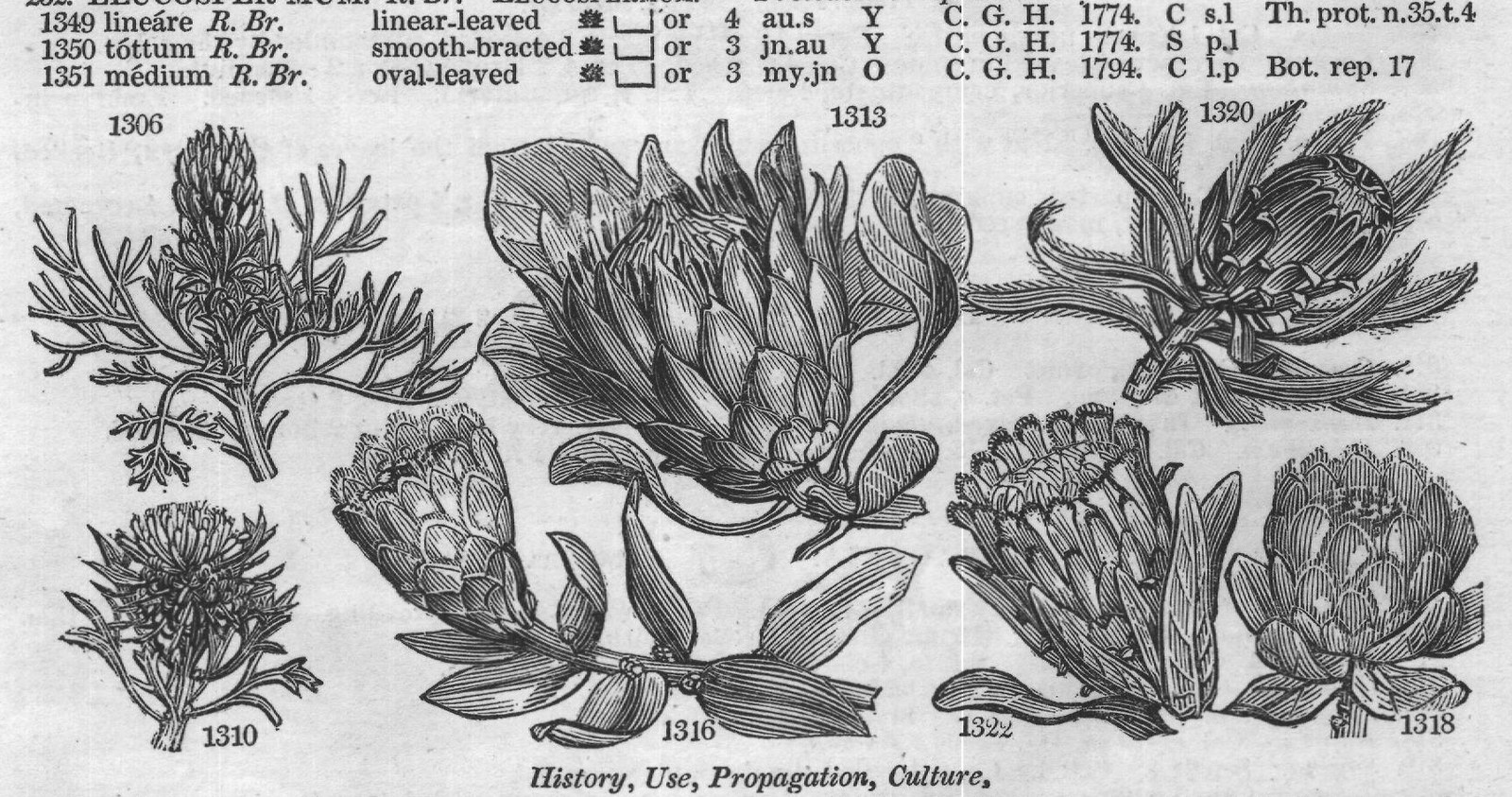
C. G. H. 1803. C s.l Bot. rep. 577 Sp. 12-18. 1349 lineáre R. Br. 1350 tóttum R. Br. linear-leaved 登 or 4 au.s Y smooth-bracted C. G. H. 1774. C s.l Th. prot. n.35.t.4 or 3 jn.au Y C. G. H. 1774. S p.l 1351 médium R. Br. oval-leaved or 3 my.jn O C. G. H. 1794. C 1.p Bot. rep. 17 1306 1313 1320 1310 1316 1322 History, Use, Propagation, Culture, 1318 229. Petrophila. From πετρoς and φiλεω, to love rocks, in allusion to the places in which it is found growing in a wild state. Stiff shrubs, with smooth leaves of various kinds. Heads of flowers ovate or oblong, terminal or axillary. Ripened cuttings root in sand under a hand-glass. 230. Isopogon. This genus consists of stiff shrubs, with smooth, flat or filiform, divided or entire leaves. Heads terminal or rarely axillary. Flowers sometimes closely imbricated in a globose cone, sometimes clustered in a common flat receptacle which is somewhat involucrated; they thrive best in a soil composed of onethird loam, a third of peat, and a third of sand. The pots must be well drained, and ripened wood may be chosen for cuttings which will root in sand and a little earth under a hand-glass. They must be uncovered fre. quently, and the glass wiped, as they are liable to damp off if kept too close. (Sweet.) 231. Protea. A mythological name of Proteus the son of Ocean and Thetis, who assumed various forms upon various occasions, to whom this genus, once equally variable in its forms, has been likened. It, as Sweet observes, thrives best in a soil composed of "light turfy loam, mixed with rather more than one-third of fine sand; the pots must be well drained with broken potsherds to prevent them from getting soddened with too much water; the roots are also very fond of running amongst the small bits of sherds. Care must be taken not ORDER I.
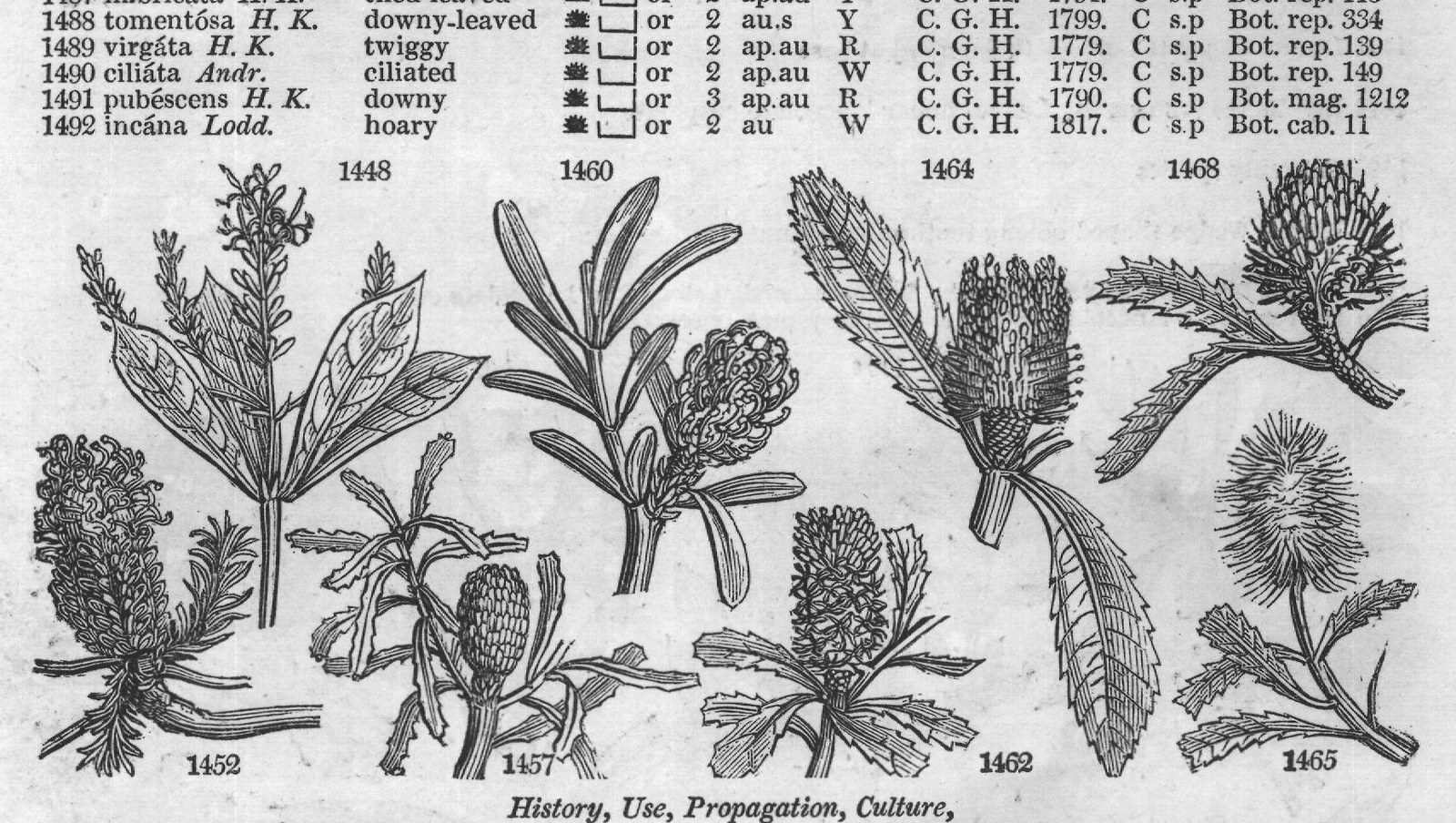
TETRANDRIA MONOGYNIA. 1306 Leaves trifid bipinnate, Segments erect, Flowers silky their segments tomentose at end 1307 Leaves bi-tri-pinnatifid plain, Segments mucronate, Flowers bearded, Cones axillary stalked 1308 Leaves pinnatifid and bipinnatifid filiform furrowed above, Segments erect, Branches smooth 1309 Leaves bipinnatifid somewhat triternate filif. chan. above, Segments divaricating, Branchlets tomentose 1310 Leaves trifid pinnatifid or bipinnatifid, Leaves linear flat spreading erect smooth beneath 1311 Leaves wedge-shaped flat 3-lobed attenuated at base stalked lobes entire, Branchlets tomentose 1312 Leaves elongate oblong mucronate attenuate at base, Branches and involucres smooth Flowers terminal. 1313 Leaves roundish stalked, Invol. silky, Inner bractes acute beardless, Style pubescent below the middle 1314 Leaves broad ovate cordate sessile, Invol. silky toment. Inner bractes narr. dilated at end and bearded 1315 Leaves ovate oblong cordate edged the callus of the end prominent, Invol. silky fringed beardless 1316 Leaves ov. obl. sessile subcord. or simple, Branches toment. Invol. silky, Inner bracte elong. fringed silky 1317 Leaves ov. obl. narr. at base with branches smooth, All the bracteæ sim. inn. dilat. at end and beard. in mid. 1318 Leaves glaucous obov. the adult smooth, Bractes red the upper lyrate spatul. fimbr. obt. Petals obtuse 1319 Leaves narr. oblong veiny oblique simple at base, the edges and branches downy, Involucre ciliated 1320 Leaves linear ligulate edged ciliated, Branches hairy, Invol. long turbinate, Bract. fringed with white 1321 Leaves linear ligulate edged roughish shining with the branches smooth, Inner bract. of invol. spatulate 1322 Leaves linear ligulate smooth opaque at base outside with the branches downy, Invol, fringed with black 1323 Leaves linear ligulate edged shining roughish, Branches little downy, Invol. fringed with black 1324 Leaves narrow oblong rather wavy attenuated at base, Invol. hemisph. inner bearded with black and purple 1325 Leaves broad long elliptical edged the old ones pubescent wavy, Bractes pale yellow, the upper fringed 1326 Leaves elong. lin. atten. at base, Inv. turb. Bractes smooth acute beardl. Beards of cal. longer than segm. 1327 Leaves long ligulate, Head broad convex embossed in middle, Upper bractes spatul. the length of flower 1328 Leaves long ligulate, Head broad not convex, Upper bractes spatulate longer than flowers 1329 Leaves lanc. ligul. attenu, at base, Inv. turb. Bractes smooth beardl. viscid, Beards of flow. woolly white 1330 Leaves obl. sessile and branches smooth, Invol. hemispherical beardl. naked, Fl. toment. Style smooth 1331 Leaves lin. lanceolate acute submucr. attenuated at base, Invol. hemispherical, Bractes smooth obtuse 1332 Leaves lanc. lin. mucr. pungent with an obtuse base, Bractes lanc. mucr. smooth, Stem erect many-flow. 1333 Leaves ligulate oblong the upper and the branches hairy, Inner bracteæ with a round and bearded end 1334 Leaves subulate mucronate, Invol. nodding hemispherical, Bract. smooth obtuse 1335 Leaves linear lanceolate mucronate, Flower-bearing branches recurved, Bract. obtuse at length smooth 1336 Leaves lin. lanc. flat attenuated at base roughish at edge, Branches decumbent, Invol. hemisph. 1337 Leaves linear veinless smooth concave above, Branches smooth decumbent, Invol. obtuse 1338 Leaves lin. lanc. acute flat veiny above, Bractes obtuse pubesc. and conc. at end, Branches wavy colored 1339 Stems short with depressed branches, Leaves obov. obl. edged veiny attenuat. at base, Invol. hemispher. ẞ Leaves more glaucous and narrow 1340 Stems dwarf decumb. Leaves elong. lin. smooth veinless recurved at edge, Invol. hemispherical 1341 Stems dwarf, Leaves elong. lin. scrabrous obsoletely veiny recurv. at edge, Invol. turbinate hemispher. 1342 Stems decumb. dwarf, Leaves elong. lin. roughish revol. at edge, Invol. turb. Bractes obtuse tomentose 1343 Stems dwarf, Leaves elongate lanc. edged subundulate smooth, Invol. turb. Bractes tomentose obtuse 1344 Stems dwarf, Leaves elongate lanc. edged smooth, Invol. turbinate, Bractes lanceolate acuminate Flowers lateral. 1345 Leaves cordate roughish nerved, Bractes smooth 1346 Leaves cordate ovate, Stem clasping divaricate recurved at the end, Bractes pubescent 1347 Leaves linear acute, Receptacle conical, Paleæ acute 1348 Leaves subulate, Receptacle convex, Paleæ obtuse 1349 Style longer than the hairy flower, Stigma gibbous on one side, Invol. downy, Leaves linear entire 1350 Style a quarter longer than the hairy flow. Stigma gibb. on one side, Leaves lin. obl. veiny ent. obt. at base 1351 Style nearly twice as long as hairy flow. Stigma gibb. on one side, Leaves lin. obl. entire or 2 or 3-toothed 1326 1330 1345 1348 1334 1337 1339 1331 and Miscellaneous Particulars. to let them droop for want of water, as the young roots are of a very fleshy substance, and soon suffer by too much drought, as well as by too much wet, so that they seldom recover if suffered to flag much ; they also like to be placed where they may have a free circulation of air, as they cannot bear to be crowded like some more rigid-growing plants. Ripened cuttings taken off at a joint, and pared quite smooth, will strike root if planted thinly in pots of sand placed under a hand-glass, but not plunged the glasses must be often taken off to give them air, as they are very liable to get the damp amongst them, which soon spreads if not cleaned off, and destroys them ; water them regularly whenever they want it, but not over the leaves, and let them get a little get a little dry before the glasses are placed over them again. Some of the kinds root very soon, others are a long time before they root. The quickest rooting kinds I have met with are P. cordata, cynaroides, amplexicaulis , grandiflora, acerosa, nana, and acaulis. P. mellifera also roots very quickly sometimes. The same treatment will agree with several other genera belonging to this family, as Leucospermum, Spatalla, Sorocephalus, Leucadendron, and Aulax. (See Bot. Mag. No. 1717. Bot. Cult. 244.) There are several kinds in cultivation, and published in Knight's Proteeæ, which have not been retained here; because, as they are not acknowledged by Mr. R. Brown, it is probable that they are not distinct from some which are here enumerated." G TETRANDRIA MONOGYNIA.
CLASS IV. 1352 formósum Kn. Pr. handsome 1353 ellípticum R. Br. elliptic ☐ or 4 my.au Pk C. G. H. 1784. S p.1 Bot. rep. 469 or 4 my.au Y 1354 conocárpum R. Br. many-toothed C. G. H. 1803. C L.p or 3 Y C. G. H. 1774. S s.1 Pl. pht. t. 200. f.2 1355 grandiflórum R. Br. great-flowered or 4 my.jl Y C. G. H. 1800. S p.l Par. lond. 116 1356 púberum R. Br. downy-leaved or 2 my.au Y C. G. H. 1774. C s.l 1357 tomentósum Kn. cottony * or 2 au.s Y C. G. H. 1789. S p.1 1358 párile Kn. Pr. matched or 2 au.s Y C. G. H. 1789. C 1.p 1359 cándicans B. R. Rose-scented ☐ ☐ or 2 au.s Y C. G. H. 1790. S p.i Bot. rep. 294 1360 Hypophyllum R.Br. trifid-leaved or 1½ Y ...
C. G. H. 1787. S p.1 Pl. man.t.440.f.3 233. MIME/TES. R. Br.
MIMETES.
Proteaceæ.
Sp. 6-13. 1361 hírta R. Br. hairy or 3 jn.au R C. G. H. 1774. C s.1 W. ph.4.t.899.f.a 1362 palústris Kn. Pr. marsh or jn.au Pu C. G. H. 1802. C 1.p B.lgd.2.p.194.c.t 1363 cuculláta R. Br. three-toothed or 2 ...
Pu C. G. H. 1789. S s.1 P.al.212.t.304.f.6 1364 divaricáta R. Br. divaricate or jn.s W C. G. H. 1795. C s.l 1365 vaccíniifólia Sweet. Vaccinium-lvd.or 3 ...
C. G. H. 1800.
Cl.p 1366 purpúrea R. Br. Heath-leaved or 2 n.d Pu C. G. H. 1789. C s.1 234. SERRU'RIA. R. Br. SERRURIA.
Proteaceæ.
Sp. 20-46. 1367 abrótanifólia Kn. P. Southernw.-lvd. or 4 jn.au Pk C. G. H. 1803.
C 1.p Bot. rep. 522 1368 millefólia Kn. P. thousand-leav'd or 4 jn.au Pu C. G. H. 1803.
C l.s.p Bot. rep. 337 1369 artemisiæfólia Kn. P. wormwood-lvd.or 5 jn.au Pu C. G. H. 1789.
C 1.p Bot. rep. 264 1370 pinnáta R. Br. slend.-creeping or 1 jn.au Pk C. G. H. 1803.
S p.l Bot. rep. 512 1371 arenária R. Br. sand or 1 jn.au Pu C. G. H. 1803.
C s.p 1372 cyanoídes R. Br. trifid-leaved or 1½ jn.au Pu C. G. H. 1803.
S p.l Pl. m.61.t.345.f.6 1373 pedunculáta R. Br. woolly-headed or 7 jn.au Pu C. G. H. 1789.
C p.l.s Bot. rep. 264 1374 Nivéni R. Br. decumbent or jn.au Pu C. G. H. 1800.
C s.p.l Bot. rep. 349 1375 ciliáta R. Br. ciliated or 2 jn.au Pu C. G. H. 1803.
C s.I 1376 phylicoídes R. Br. Phylica-flower.or 3 jn.au Pu C. G. H. 1788.
S p.1 Bot. rep. 507. f. 4 1377 æ'mula R. Br. grey-branched or 3 jn.au Pu C. G. H. 1803.
C 1.p 1378 párilis Kn. P. matched or 2 jn.au Pk C. G. H. 1803.
C p.l Bot. rep. 507 1379 odoráta Sweet. sweet-scented or 2 jn.au Pk C. G. H. 1803.
C p.l Bot. rep. 545 1380 emargináta Sweet. emarginated or 2 jn.au Pk C. G. H. 1800.
C p.1 Bot. rep. 536 Serrúria arenária Kn. Prot. 1381 glomeráta R. Br. 1382 decípiens R. Br. many-headed or 3 jn.au Pu C. G. H. 1789. S p.1 Bur. afr. t.99. f.2 deceptive or 4 jn.au Pu C. G. H. 1806. C 1.p 1383 Roxbúrghi R. Br. 1384 Burmánni R. Br.
Roxburgh's or 3 jn.au W C. G. H. 1806. C 1.p Burmann's or 2 jn.au Pu C. G. H. 1786. C 1.p Bur. afr. t. 99.f.2 1385 triternáta R. Br. silvery-flower'd or 7 jn.au W C. G. H. 1802. S p.l Bot. rep. 447 1386 elongáta R. Br. long-stalked or 1 jn.au Pu C. G. H. 1800.
C 1.p 235. NIVENIA. R. Br. NIVENIA.
Proteaceæ.
Sp. 5-12. 1387 Scéptrum R. Br. sceptre-like or 2 my.jn W C. G.
C. G. H. 1790. S p.l 1388 spathuláta R. Br. maiden-hair-lv. or 2 jl.au Pu C. G. H. 1790. C s.l Thu. dis.n.58. t.5 1389 spicáta R. Br. spiked or 2 jn.au Pu C. G. H. 1786. S p.l 1390 crithmifólia R. Br.
Samphire-leav. or 2 jn.au Pa.pu C. G. H. 1797. S p.1 Bot. rep. 243 1391 média R. Br. middle or 6 jn.au W C. G. H. 1803. C s.p Bot. rep. 234 236. SOROCEPHALUS. R. Br. SOROCEPHALUS.
Proteaceæ.
Sp. 6-10. 1392 imbérbis R. Br. smooth ✓ ☐ or 3 jn.au Pu C. G. H. 1806.
C s.p 1393 diversifólius R. Br. various-leaved or 4 Pu C. G. H. 1803. C 1.p 1394 spatálloídes R. Br. club-bearing or 3 jn.au Pu C. G. H. 1803. C s.p 1395 tenuifólius R. Br. slender-leaved or 3 jn.au Pu C. G. H. 1802. C 1.p 1396 lanátus R. Br. woolly or 2 jn.s Pu C. G. H. 1790. C 1.p Thu. dis.n.30. t.3 1397 imbricátus R. Br. imbricated or 3 ap.jl Pu C. G. H. 1794. S p.l Bot. rep. 517 237. SPATAL/LA. R. Br. SPATALLA.
Proteaceæ.
Sp. 4-16.شر 1398 prolífera R. Br. proliferous or 1½ jn.au Pu C. G. H. 1800. Cs.l Thunb.dis.27.t.4 1399 ramulósa R. Br. cluster-flowered or 3 au.s Pu C. G. H. 1787. C 1.p 1400 incúrva R. Br. incurved-leav'd or 2 my.jn Pu C. G. H. 1789. S s.1 Bot. rep. 429 1401 Thunbérgii R. Br.
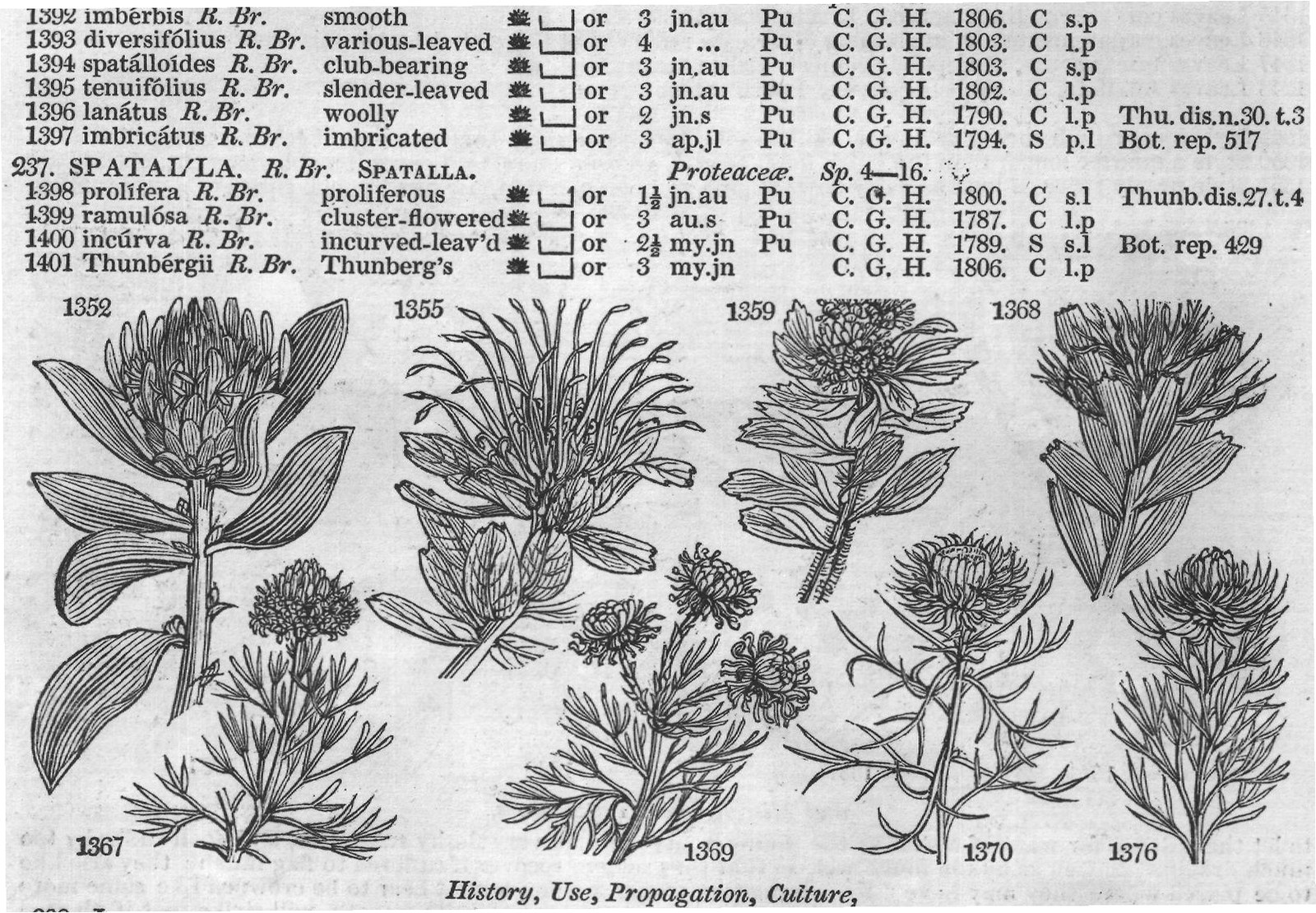
Thunberg's or 3 my.jn C. G. H. 1806. C 1.p 1352 1355 1359 1368 1367 1369 History, Use, Propagation, Culture, 1370 1376 232. Leucospermum. From λεuκoς, white, and σπερμa, seed, in allusion to the color of the seeds. The genus is chiefly composed of low shrubs, which are usually downy or hairy. Leaves entire, or with callous teeth genus at chiefly composed of low shrubs, which are usually downy or hairy. Leaves entire, or with callous teeth at the end. Heads terminal. Flowers yellow. The culture as for Protea. 233. Mimetes. Named by Mr. Salisbury from μiμητης, a mimic, because it resembles various other genera. The soil for this genus is two-thirds of light loam, and one third of sand. In other respects, the treatment is the same as for Isopogon. soil for this genus is two-thirds of light loam , and one third of sand. In other respects, the treatment is the same as for Isopogon. 234. Serruria. Named by Burmannus after Professor Joseph Serrurier, an obscure botanist, of whom little is known. The species flower freely, and make handsome bushy shrubs. The soil best adapted to them is one- . The species flower freely, and make handsome bushy shrubs. The soil best adapted to them is onethird light loam, a third of peat, and a third of sand, with well drained pots. "They also require an airy situation, as they are so crowded with leaves that the branches are liable to damp and canker if any wet settles ORDER I.
TETRANDRIA MONOGYNIA.T 1352 Leaves elliptical edged, Bractes spreading: upper spatulate minutely fringed, Petals downy 1353 Style nearly twice as long as hairy flower, Stigma conical ovate gibb. on one side, Leaves obl. 3-4-toothed 1354 Style longer than the very villous flower, Stigma equal-sided conical, Leaves oval 3-9-toothed 1355 Style longer than very vill. fl. Stig. equal-sided obl. Lvs. obl. lanc. 3-toothed and entire, Branches very hairy 1356 Style longer than hairy fl. Stigma equal-sided ovate, Lvs. lanc. and ellipt. entire short pub. Branches hairy 1357 Leaves linear channelled veinless, Branches and bracteæ tomentose, Segments of flower bearded 1358 Leaves linear flat, Branches hairy, Bracteæ smoothish ciliated 1359 Leaves linear wedge-shaped flat veiny 3-5-toothed, Branches hairy, Bractes and segments of flow. toment. 1360 Leaves linear 3-toothed, Bractes rounded tomentose twice as short as tube of flower 1361 Involucr. equal-sided colored acuminate half exserted 8-10-flowered, Leaves acute entire 1362 Leaves oval lanceolate pubescent, Stigma short prominent at base 1363 Invol. unequal-sided, Leaves lin. oblong 3-toothed smooth the floral dilated beneath with recurved edges 1364 Stem procumbent, Leaves oval obtuse pubescent, Style smooth, Heads terminal 1365 Leaves narrow obovate almost smooth, Upper bractes longer than flowers very acuminate 1366 Stem procumbent, Branches ascending, Leaves linear subulate channelled, Segments of flower smooth Heads simple. 1367 Leaves from below the middle bipinnatifid hairy, Head sessile higher than leaves, Bractes hairy outside 1368 Leaves from base bipinnat. hairy, Ped. as long as head or longer, Bractes hairy at end outside, Stig. trunc. 1369 Leaves from the base 3-pinnatifid pubescent, Ped. 1-3 long smoothish, Bractes recurved scarcely toment. 1370 Heads terminal and axillary stalked clustered, Leaves pinnatifid and trifid more than an inch long 1371 Heads terminal longer than the stalk, Leaves pinnatifid and trifid less than an inch long, Stem pubesc. 1372 Heads ter. longer than stalk, Lvs. sprdg. upper less an inch long nearly bipin. lower shorter trifid, Stem erect 1373 Heads terminal stalked, Leaves bi-tripinnatifid with the erect stem hairy 1374 Heads term, sessile, Leaves bi-pin. about an inch long upper longer than heads with the branches smooth 1375 Heads ter. longer than stalks, Brac. subul. smooth hairy at edge, Lvs. sub-bipinnate and branches smooth 1376 Heads ter. and axil, stalks branch-like squarrose, Outer bractes subul. inner lanc. Lvs. an inch and half long 1377 Bractes a little shorter than the terminal head, Outer lanc. fringed inner less villous, Leaves bipinnatifid 1378 Stem pubesc. Leaves from below middle all bipinnatifid, Heads 1-3 shorter than ped. Bracts reflex. ciliat. 1379 Leaves bipinnatifid filiform pointed hairy, Flowers terminal sweet-scented 1380 Leaves from below the middle bipinnatifid pubescent, Heads 1-3 longer than leaves, Bractes silky at base Heads compound. 1381 Stem erect, Lvs. smth. bipin. more than an inch long, Partial heads many-fl. outer brac. smth.: inner silky 1382 Stem erect, Branches pub. Lvs. bipin. an inch and more long, Partial heads few-fl. All the bractes very vill. 1383 Stem erect, Leaves triternate bundled less than inch long common and partial heads few-flow. sessile 1384 Heads corymbose 10-flow. Leaves bipinnatifid setaceous scarcely 2 inches long, Flowers silky clustered 1385 Corymbs compound, Leaves triternate inch long and stem very smooth, Bractes and partial stalks silky 1386 Corymbs simple or compound, Leaves bi-tripinnat. common flower-stalk long, partial and bractes smooth 1387 Leaves obovate or lanceolate flattish simple at edge, Flower silky with appressed hairs 1388 Leaves broader than long hooded edged, Leaves of invol. obt. Flower bearded style smooth, Stig. clavate 1389 Stalks umbelled as long as the cylindrical spike, Bractes ovate, Style 2-3ds hairy, Leaves smooth 1390 Stalks umbelled about as long as cylind. spikes, Leaves obtuse divar. smooth, Styles vill. as far as middle 1391 Spikes cylindrical 4 times as long as their stalk, Leaves of involucrum ovate acute beardless at end 1392 Involucr. 3-flowered, Segments of flower and points of bracteæ smooth, Spike naked 1393 Leaves spatulate lanceolate smooth beneath, the lower bipinnatifid, Flower bearded, Stigma cylindrical 1394 Involucr. 3-flowered stalked, Segments of flower bearded, Spike naked 1395 Lvs. filif. less than inch long, Heads few-fl. Seg. of fl. feathery except the inner one, Spike with an invol. 1396 Leaves 3-cornered filiform more than an inch long furrowed above, All the segments of flower feathery 1397 Leaves lanceolate scabrous beneath, Claws of flower glandular hairy, Stigma clavate 1398 Involucr. 4-leaved, Leaflets withered at end, Spike conical headed, Flowers sessile 1399 Involucr. 2-leaved the wider leaf trifid, Spike sessile imbricated, Leaves with a sharp point 1400 Spikes racemose stalked, Bractes shorter than the 4-flowered downy involucrum, Leaves incurved 1401 Spike sessile, Bractes and invol, ovate lanc. vill. Leaves longer than flow. acute chann. and branches hairy 1378 1384 1388 1385 1396 1391 1397 1400 1398 and Miscellaneous Particulars. amongst them. Ripened cuttings taken off at a joint and planted thinly in a pot of sand, will root without difficulty under a hand-glass: but the glass must be taken off occasionally to give them air, and dry their leaves." (Bot. Cult. 254.) 235. Nivenia. Named by Salisbury, in compliment to Mr. James Niven, an intelligent collector, who discovered many new plants in South Africa while in the service of Mr. Hibbert. Culture as for Serruria. 236. Sorocephalus. From σωρoς, a heap, and κεφaλη, a head, on account of the heads of flowers being in clusters. 237. Spatalla. A word formed by Mr. Salisbury, with more wit than decency, from σπaτaλάω, lascivio, on account of its ample stigma. Culture as for Leucospermum. G2 TETRANDRIA MONOGYNIA. 238. PERSOO'NIA. R. Br. PERSOONIA.
CLASS IV.
Proteaceæ.
Sp. 6-22. 1402 hirsúta R. Br. hairy 1403 lineáris R. Br. linear-leaved 1404 lanceoláta R. Br. spear-leaved 1405 salicína R. Br. willow-leaved 1406 latifólia Andr. broad-leaved 1407 pinifolia R. Br. pine-leaved 239. GREVIL/LEA. R. Br. GREVILLEA. 1408 serícea R. Br. silky 1409 punícea R. Br. purple 1410 juniperína R. Br. juniper-like 1411 linearis R. Br. linear-leaved 1412 ripária R. Br. river-side 1413 arenária R. Br. sand 1414 acumináta R. Br. acute-leaved 1415 stylósa Kn. P. long-styled 1416 mucrónuláta R. Br. Podalyria-leav. or 4 ap.s 1417 cinérea R. Br. cinereous 1418 buxifólia R. Br.
Box-leaved 1419 collína Kn. P. hill ]]]]]]]]]]] ]]]]] ]] or 4 my.jl Y N. S. W. 1800. C 1.p Bot. cab. 327 or 5 jl.au Y N. S. W. 1794. L s.p Bot. mag. 760 or 4 jn.jl YN. S. W. 1791. L s.p Bot. rep. 74 or 7 jn.jl Pk N. S. W. 1795. C 1.p Cav. ic. 4. t. 389 or 4 jn.jl Y N. S. W. 1795. L s.p Bot. rep. 280 or 4 jn.jl Y N. S. W. 1822. L s.p Proteaceæ.
Sp. 13-38. or 6 ap.s Pk N. S. W. 1790. S s.p Bot. mag. 862 or ... ...
Pu N. S. W. 1822. C 1.p Sm. N.H. t.9. f.5 or 4 ...
Pk N. S. W. 1822. C l.p or 6 ap.s WN. S. W. 1790. S s.p Bot. rep. 272 or 4 ap.s Pk N. S. W. 1791.
C l.p or 5 ap.s Pk N. S. W. 1803.
C l.p or 4 ap.s ...
N. S. W. 1805. S s.p or ap.s Pk N. S. W. 1809. C s.l Pk N. S. W. 1809.
C l.p or ... ... ...
N. S. W. 1822.
C 1.p or 6 f.s Pk N. S. W. 1790.
S s.p Bot. rep. 218 or mr.jl Pk N. S. W. 1802. C 1.p 1420 aspleniifólia R. Br. Asplenium-lvd.or 5 mr.jl Pk N. S. W. 1806.
C 1.p 240. HA'KEA. R. Br.
HAKEA.
Proteaceæ.
Sp. 20-40. 1421 pugióniformis R. Br. dagger-fruited or 1422 párilis Kn. P. 6 my.jn W N. S. W. 1796. S s.p. Bot. cab. 353 matched or my.jn W V. Di. L. 1796.
C 1.p 1423 oblíqua R. Br. oblique-flower. or 6 W ...
N. Holl. 1803. C s.p 1424 gibbósa R. Br. gibbous-fruited or 7 my.jn W N. S. W. 1790.
C s.p Cav. ic. 6. t. 534 1425 aciculáris R. Br. needle-leaved or 3 my.jn W N. S. W. 1790.
C s.p Vent. mal. 111 1426 suavéolens R. Br. sweet-smelling or 4 ja.n WN. Holl. 1803.
C s.p 1427 microcárpa R. Br. small-fruited or 4 my.jn W V. Di. L. 1819.
C s.p Bot. reg. 475 1428 flórida R. Br. many-flowered or 5 my.jn W N. Holl. 1803.
C s.p 1429 ilicifólia R. Br.
Holly-leaved or 4 jl.s WN. Holl. 1803. C s.p 1430 nítida R. Br. glossy or 5 jn.jl WN. Holl. 1803. C s.p Bot. mag. 2246 1431 amplexicaúlis Br. stem-clasping 1432 prostráta R. Br. trailing 1433 ceratophýlla R. Br. horn-leaved 1434 acanthophylla Lk. prickly-leaved or 2 ...
WN. Holl. 1803. C s.p or 1층 ...
WN. Holl. 1803. C s.p or 4 my.jn Br N. Holl. 1803. C s.p or 3 ... ...
N. S. W. 1821. C s.p 1435 unduláta R. Br. wave-leaved or 3 ...
N. Holl. 1803. L s.p 1436 óleifólia R. Br. olive-leaved or 5 jn.jl WN. Holl. 1794. S s.p 1437 salígna R. Br. willow-leaved or 7 mr.jl W N. Holl. 1791. C s.p Bot. rep. 215 1438 cinérea R. Br. hoary-leaved or 5 jn.jl WN. Holl. 1803. S s.p 1439 dáctyloídes R. Br. nerved-leaved or 7 jn.au W N. S. W. 1790. C s.p Cav. ic. 6. t. 535 1440 ellíptica R. Br. oval-leaved or 4 jn.au W N. Holl. 1794. C s.p 241. STENOCAR PUS. R. Br. STENOCARPUS. 1441 salígnus R. Br. fragrant Proteaceæ.
Sp. 1-2. or 242. LAMBERTIA. R. Br. LAMBERTIA. 5 jn.jl G Proteaceæ.
N. Holl. 1819. C s.l Bot. reg. 441 Sp. 1-2. 1442 formósa R. Br. handsome or 243. XYLOME/LUM. R. Br. XYLOMELUM. 1443 pyrifórme R. Br. 4 jn.au Re Proteaceæ.
N. S. W. 1788. C s.p Sp. 1.
Bot. rep. 69 pear-fruited or 14 ... ... 244. TELOPE'A. R. Br. WARRATAH.
Proteacea.
N. S. W. 1789. S s.p Cav. ic. 6. t. 536 Sp. 1-2. 1444 spéciosíssima R. Br. splendid or 10 my.jl S N. S. W. 1789. C s.p Bot. mag. 1128 245. LOMA'TIA. R. Br. LOMATIA.
Proteaceæ.
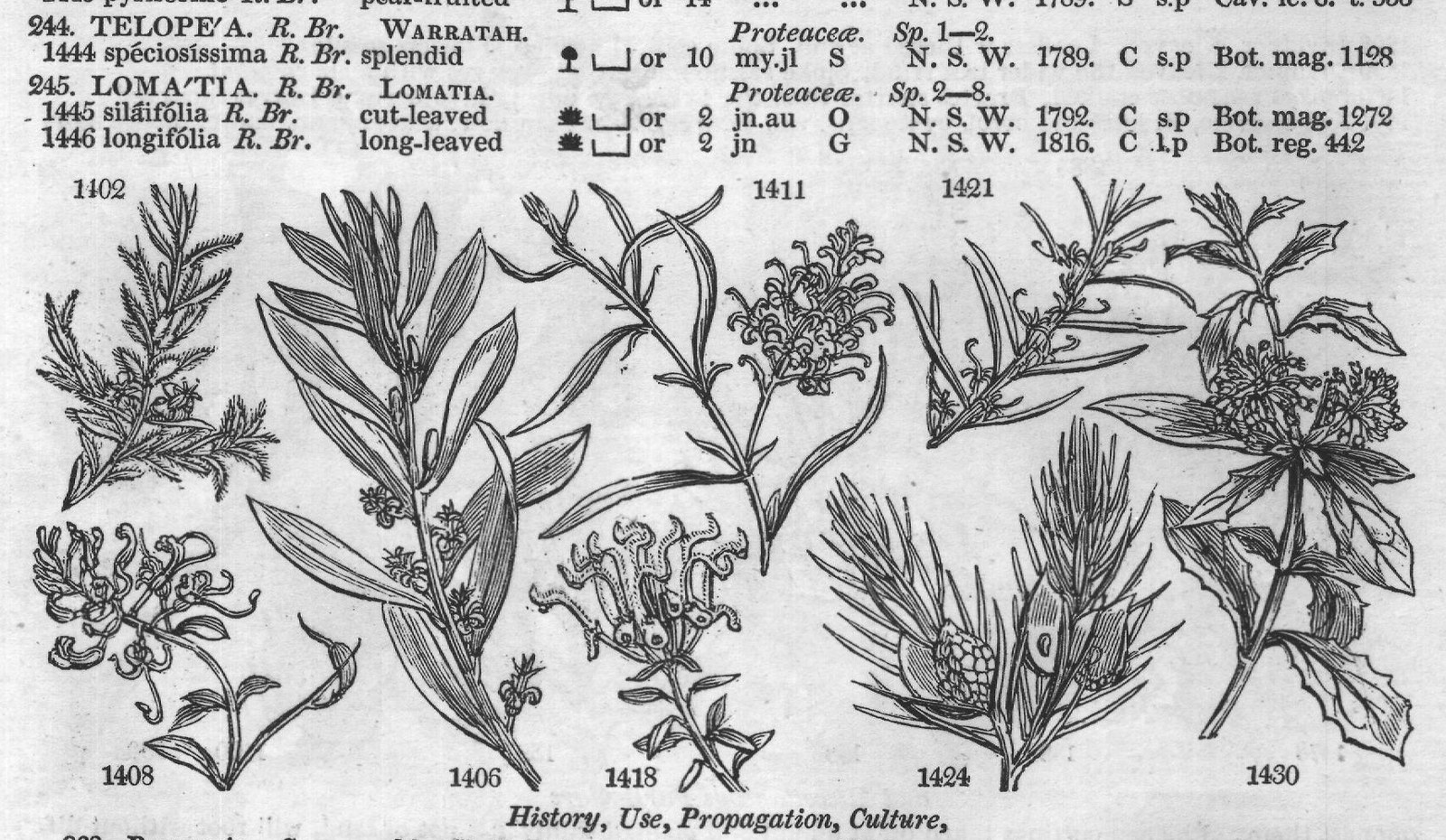
Sp. 2-8. 1445 siláifólia R. Br. cut-leaved 1446 longifólia R. Br. long-leaved ココ or 2 jn.au O N. S. W. 1792. C s.p Bot. mag. 1272 or 2 jn G N. S. W. 1816. Cl.p Bot. reg. 442 1102 1411 1421 1408 1406 1418 1424 1430 History, Use, Propagation, Culture, 238. Persoonia. So named by Sir J. E. Smith, in honor of C. H. Persoon, the celebrated author of Synopsis Plantarum and other esteemed works: he is still living, and about to publish a new edition of his most useful Synopsis. 239. Grevillea. So named by Mr. R. Brown, after the Right Honorable Charles Francis Greville, a great promoter of natural history. He was one of the vice-presidents of the Royal Society. Some species ripen of natural history. He was one of the vice-presidents of the Royal Society. Some species ripen abundance of seeds; all of them thrive in an equal mixture of sandy loam and peat, and strike roots freely in sand under a hand-glass. peat, and strike roots freely in 240. Hakea. Named by Schreber after Baron Hake, a patron of the botanic garden at Hanover. This genus thrives in equal parts of loam, peat, and sand well drained; and cuttings root readily in sand under a hand-glass.
ORDER I.
TETRANDRIA MONOGYNIA. 1402 Leaves linear hairy scabrous recurved at edge, Flowers axillary, Ovary one-sided silky 1403 Leaves oblong linear mucronate rather villous, Flowers axillary solitary 1404 Leaves lanceolate or elliptical mucronate glabrous smooth, Peduncle axillary 1-flowered, Flower silky 1405 Leaves lanceolate oblong unequal-sided, Flowers smooth, Stem arborescent, Bark scarious in layers 1406 Leaves obovate acute smooth on both sides without ribs thick, Flowers axillary remote on long stalks 1407 Leaves filiform lax, Spike leafy elongated pyramidal, Floral leaves abbreviated Style smooth, Follicle ribless. 1408 Leaves ellipt. or obl. obt. mucr. broken back at the edges, Flower branches erect, Racemes abbrev. recurv. 1409 Leaves elliptical oblong attenuate at base broken back at edges, Flower bearing branches recurved 1410 Leaves subulate fascicled divaricating broken back at the edge, Branches villous rounded 1411 Leaves linear lanceolate acute mucr. broken back at edges, Rac. abbreviate erect, Style very smooth at end 1412 Lvs. elong. linear broken back at edges smooth, Inner beard of flower very dense, Stalks longer than ovary Style hairy. Follicle ribbed. 1413 Leaves oblong obtuse mucronate, Racemes recurved few-flowered, Pistils tomentose 1414 Leaves lanc. sub-acum. mucr. above dotted scabrous beneath cinereous, Branc. pubes. Rac. few-fl. recurved 1415 Leaves lanceol, hairy beneath, Style very long compressed hairy at back [or horizontal 1416 Leaves obovate obt. mucr. above scabrous and shining beneath rather silky, Hairs of flowers appressed 1417 Leaves elliptical and obovate mucronate above roughish beneath cinereous Pistil woolly. Follicle ribless. [as recurved appendage 1418 Leaves elliptical above dotted scabrous beneath cinereous with close tomentum, Stig. orbic. scarcely as long 1419 Leaves elliptic lanceolate little revolute at edge, Flowers scarcely higher than leaves Raceme thyrsoid. Leaves pinnatifid. (True Grevilleæ, Br.) 1420 Leaves elongate linear pinnatifid cut or entire beneath tomentose, Racemes 3 times as short as the leaf Leaves filiform. 1421 Leaves smooth, Flowers silky or hairy, Caps. lanceolate acuminate straight crested on both sides 1422 Leaves smooth with bloom not channelled, Petals woolly 1423 Leaves terete, Branches toment. Gland attached to oblique end of stalk, Flow. silky, Caps. gibbous nodose 1424 Lvs. ben. with an obsol. furr. at base and branc. s.-pub. Branchl. and fl-stks. hairy, Caps. gibb. with cav. inside 1425 Leaves smooth beneath below the middle with an obsolete furrow the length of fruit, Caps. gibbous rugose 1426 Leaves furrowed above pinnatifid occasionally undivided, Flowers racemose smooth, Caps. gibbous 1427 Lvs. of upper branches filif. of lower flat, Perianths very smooth, Caps. with 2 spurs umbelled much shorter Leaves flat, toothed, or entire. [than leaf 1428 Leaves narrow-lanceol. prickly toothed minutely dotted a little rough at the edge, Caps. 2-spurred convex 1429 Leaves oval opaque sinuate-toothed prickly stalked, Caps. 2-spurred ovate gibbous compressed at end 1430 Lvs. lanc. or obl. attenu. at base with a few prickly teeth or entire shining veiny with branches very smooth 1431 Lvs. sinu. tooth. shining veiny stem-clasp. with a dilated cord. base, Stem prost. Bran. smooth, Caps. spurl. 1432 Lvs. angul. tooth. dil. at end and cuneate at base cord. stem clasp. Stem prost. Branc. pubes. Caps. spurless 1433 Leaves pinnatifid and bipinnatifid linear, Capsules spurless 1434 Leaves pinnatifid the anterior segments 1 inch long the posterior 14 inch and more 1435 Leaves obovate 3-nerved reticulated wavy prickly toothed, Caps. spurless ventricose 1436 Leaves lanc. entire and nerved obsoletely veined prickly at end upper pubesc. Caps. term. 2-spurred gibbous 1437 Lvs. elongate-lanc. entire 1-nerv. acute withered at end with bran, very smooth, Caps. keeled on both sides 1438 Lvs. lin.-lanc. elongate entire 3-nerv. obsoletely veined rough. wither. at end, Bran. downy, Caps. lanceol. 1439 Leaves entire 3-nerved veiny obovate-oblong or linear lanceolate reversed, Branches angular, Bark warted 1440 Leaves entire 5-nerved reticulated elliptical or oval pointless, Stalks and flowers smooth, Bark shining 1441 Leaves elongate lanceolate 3-nerved at base 1442 Involucres 7-flowered, Leaves linear-lanceolate cuspidate 1443 The only species 1444 Leaves wedge-shaped oblong toothed veiny smooth 1445 Leaves bipinnatifid very smooth, Segments wedge-shaped or lanceolate cut 1446 Leaves linear lanceolate elongate smooth remotely serrate 1437 1441 1439 1442 1443 1446 1444 1445 and Miscellaneous Particulars. 241. Stenocarpus. A handsome genus. The name is derived from στεvoς, narrow, and κaρπoς, fruit. 242. Lambertia. In honor of A. B. Lambert, Esq. F. R. S., vice-president of the Linnæan Society, and possessor of a rich Herbarium. This handsome plant thrives well in loam and peat not over watered. Cuttings must be taken off at a joint before they begin to push, and planted thinly in sand under a glass, and guarded from damp. 243. Xylomelum. A name derived by Sir J. E. Smith from the remarkable fruit of the plant which resembles a wooden apple ; ξuλov, wood, and μῆλov, an apple. 244. Telopea. From τηλωπoς, seen at a distance, in allusion to the brilliant crimson blossoms which decorate the plant, and make it a conspicuous object in its own country, as well as in our conservatories. 245. Lomatia. From λωμa, an edge, on account of the winged edge of the seeds. G3 TETRANDRIA MONOGYNIA. 246. RHOPA'LA. R. Br. RHOPALA.
Proteaceæ.
Sp. 2. 1447 dentáta R. Br. tooth-leaved 1448 sessilifólia R. Br. sessile-leaved 오오 or 10 my.au G or 10 G 247. BANK'SIA. R. Br. BANKSIA.
Proteaceæ. 1449 pulchélla R. Br. small-flowered or 6 ...
Y 1450 sphærocárpa R. Br. round-fruited or 6 Y S. Amer. "1802. C 1.p CLASS IV.
Guiana 1803. Cl.p Rudg. gui. 1. t.31 Sp. 26-35.
N. Holl. 1805. C 1.p N. Holl. 1803. C s.l ... 1451 nútans R. Br. nodding-flower. or 4 jn.s Y N. Holl. 1803. C s.l 1452 erícifólia R. Br.
Heath-leaved or 6 ja.d YN. S. W. 1788. C s.p Bot. mag. 738 1453 spinulósa R. Br. spiny or 6 my.d Y N. S. W. 1788. C s.p Bot. rep. 457 1454 collína R. Br. hill or 6 Y N. S. W. 1800. C s.1 1455 occidentális R. Br. 1456 littorális R. Br. west-coast or 4 ... ...
N. Holl. 1803. C 1.p sea-side or 8 ...
ON. Holl. 1803. C s.p 1457 margináta R. Br. 1458 austrális R. Br. various-leaved southern or 6 my.au Y N. S. W. 1804. G s.p Bot. mag. 1947 or 6 ..
GN. S. W. 1822. C s.p Bot. reg. 787 Island 1459 intégrifólia R. Br. 1460 verticilláta R. Br. 1461 coccínea R. Br. 1462 paludósa R. Rr. 1463 oblongifólia R. Br. 1464 latifólia R. Br. 1465 marcéscens R. Br. 1466 insuláris R. Br. 1467 attenuata R. Br. 1468 serráta R. Br. 1469 æ'mula R. Br. 1470 quercifólia R. Br. 1471 dentáta R. Br. 1472 speciósa R. Br. entire-leaved verticillate scarlet-flowered marshy oblong-leaved broad-leaved ட or 12 jl.o or 12 ...
YN. S. W. 1788. C l.p Cv.ic.6. t.545,546 Y N. Holl. 1794. C s.p Hook. ex, fl. 96 or 6 ...
SN. Holl. 1803. C 1.p or 5 ja.ap Y N. S. W. 1805. L s.p Bot. cab. 392 or 15 my.au Y N. S. W. 1788. C l.p Bot. cab. 241 or 30 my.au G N. S. W. 1802. S s.p Bot. mag. 2406 short-leaved or 6 ja.d Pu N. Holl. 1794. C s.p Bot. rep. 258 or 6 ... ...
N. S. W. 1822. C s.p smooth-flower. or 6 ... ...
N. Holl. 1794. L s.p saw-leaved or 20 jl.s Y N. S. W. 1788. S s.p Bot. rep. 82 deeply-sawed or 6 jl.s GN. S. W. 1788. C 1.p Bot. re 688 oak-leaved or 5 ... ...
N. Holl. 1805. C 1.p toothed or 4 ... ... N. S. W. 1822. C s.p long-leaved or 1473 grándis R. Br. great-flowered or 1474 répens R. Br. creeping or 2 4 5 my.au ...
N. Holl. 1805. C 1.s.p ... ...
N. Holl, 1794. S s.p ...
YN. Holl. 1803. C 1.s.p Voy.de lab. 1.t.23 248. DRYAN'DRA. R. 1475 floribúnda R. Br. 1476 cuneáta R. Br.
DRYANDRA.
Proteaceæ. Sp. 9-13. many-flowered or 3 ja.d Y N. Holl. 1803. S s.p Bot. mag. 1581 wedge-leaved or 3 f.n Y N. Holl. 1803. C l.p 1477 armáta R. Br. acute-leaved or 3 ja.d Y N. Holl. 1803. C 1.p 1478 formósa R. Br. 1479 plumósa R. Br. 1480 obtúsa R. Br. splendid or 4 ja.d YN. Holl. 1803. C l.p Lin.tran. 10. t. 3 feathered or 3 ...
Y N. Holl. 1803. C 1.p obtuse-leaved or 1 ...
Y N. Holl. 1803. C 1.p 1481 nívea R. Br. white-leaved! or 1 jl.s Y N. Holl. 1803. C 1.p Voy.delab.1.t.24 1482 longifólia R. Br. long-leaved or 2 ja.d Y N. Holl. 1805. S s.p Bot. mag. 1582 1483 tenuifólia R. Br. fine-leaved or 2 mr.my Y N. Holl, 1803. S s.p 249. STRUTHIOLA, W. STRUTHIOLA.
Thymelææ.
Sp. 9-18. 1484 juniperína W. 1485 erécta W. en. drooping upright or 2 ap.s W C. G. H. 1758.
C 1.p Bot. mag. 222 or 1½ ap.s W C. G. H. 1798.
C s.p Bot. mag. 2138 1486 ováta W. oval-leaved or 2 f.jn W C. G. H. 1792.
C s.p Bot. rep. 119 1487 imbricáta H. K. tiled-leaved or 2 ap.au Y C. G. H. 1794. C s.p Bot. rep. 113 1488 tomentósa H. K. downy-leaved or 2 au.s Y C. G. H. 1489 virgáta H. K. twiggy or 2 ap.au R C. G. H. 1799. C s.p 1779. C s.p Bot. rep. 334 Bot. rep. 139 1490 ciliáta Andr. ciliated or 2 ap.au W C. G. H. 1779.
C s.p Bot. rep. 149 1491 pubéscens H. K. downy or 3 ap.au R C. G. H. 1790.
C s.p Bot. mag. 1212 1492 incána Lodd. hoary or 2 au W C. G. H. 1817.
C s.p Bot. cab. 11 1448 1460 1464 1468 1452 1457 1462 1465 History, Use, Propagation, Culture, 246. Rhopala. The vernacular name of one of the species found in Guiana is Roupala. The species seldom flower, and are remarkable more for the beauty of their foliage than blossoms, which are disposed in long spikes, usually of a greenish color. 247. Banksia. So named by Linnæus, in honor of Sir Joseph Banks, Bart., Pres. R. S., a distinguished promoter of the study of natural history, and of science in general: he died in 1820. This is an elegant genus, and to be grown well requires a soil composed of equal parts of peat, loam, and sand. The pots must be well drained; and the following is the mode recommended by Sweet: "Place a piece of potsherd about half way over the hole at the bottom of the pot, then lay another piece against it that it may be hollow, afterwards put some smaller pieces all round them, and some more, broken very small, on the top of these. All plants belonging to the Proteaceæ should be drained in the same manner, as the roots are very fond of running amongst the broken potsherds; and there is not so much danger of their being overwatered; care must be taken not to let them flag for want of water, as they seldom recover if allowed to get very dry; they should also be placed in an airy part of the green-house when in doors, as nothing is more beneficial to them than a free circulation of air. Cuttings are generally supposed to be difficult to root, but they will root readily if properly managed: let them be well ripened before they are taken off; then cut them off at a joint, and plant them in pots of sand without shortening any of the leaves, except on the part that is planted in the sand, where they should be taken off quite close; the less depth they are planted in the pots the better, if they only stand firm when the sand is well closed round them; then place them under hand-glasses in the propagating house, but not plunge them in ORDER I.
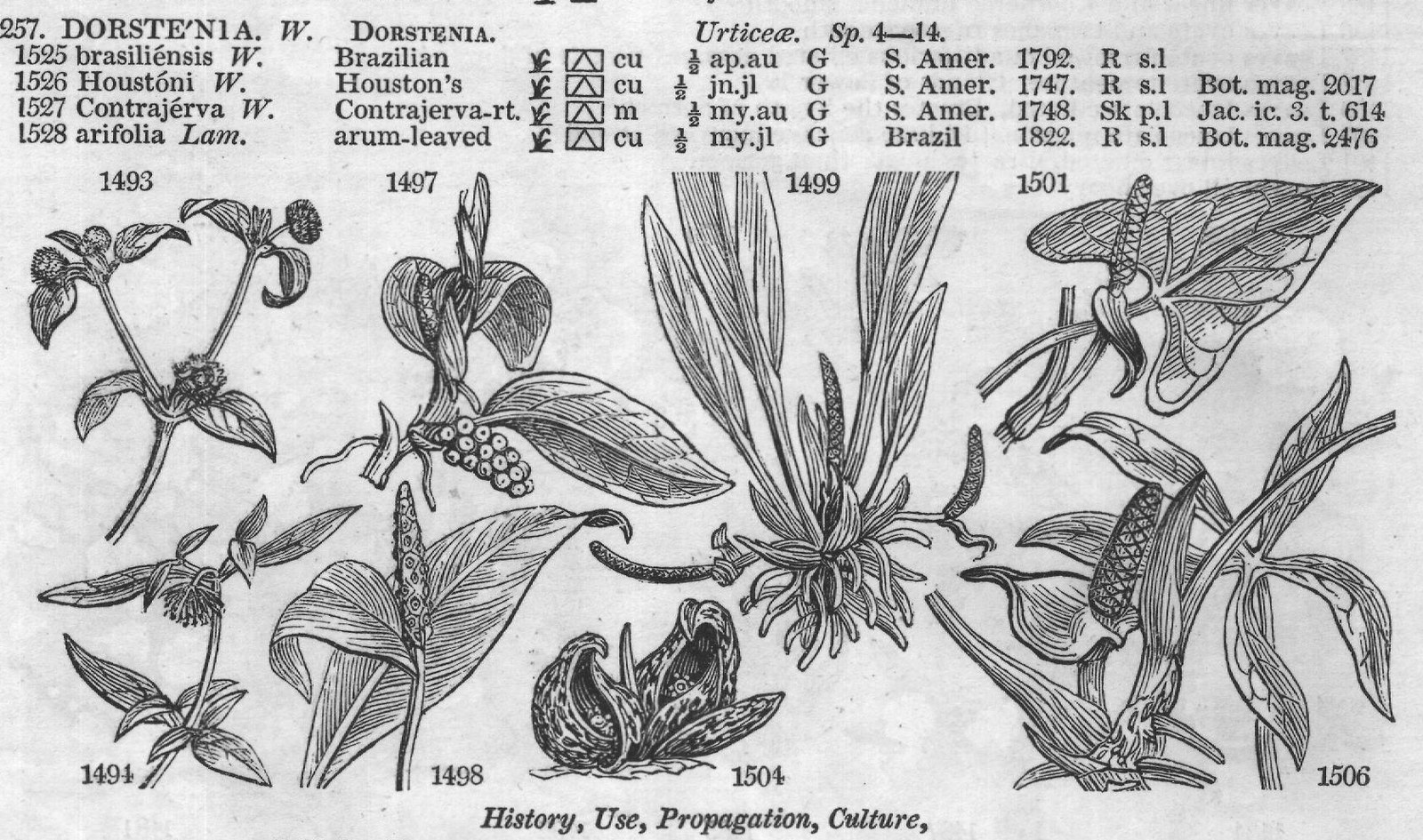
TETRANDRIA MONOGYNIA. 1447 Leaves alternate ovate lanceolate complicate toothed attenuated at both ends 1448 Leaves 4 together subsessile wedge-shaped oblong entire 1449 Leaves acerose entire not pointed, Claws of flower woolly, Segments smooth, Stigma a depressed head 1450 Leaves acerose entire mucronate, Flower all hairy, Stigma subulate, Cones globose 1451 Leaves acerose entire mucronate, Flower hoads nodding, Flowers silky 1452 Leaves acerose emarginate 2-toothed entire, Flower heads long, Flowers silky, Stigma capitate 1453 Leaves acerose 3-toothed at end, the middle tooth longest prickly or entire at the edge, Stigma subulate 1454 Leaves linear prickly toothed; the terminal tooth shortest 1455 Leaves linear beyond the middle prickly toothed beneath veinless, Stem shrubby, Branches smooth 1456 Leaves long lin. prickly toothed atten. at base veinless beneath, Stem arborescent, Branchlets tomentose 1457 Leaves linear truncate mucronate entire or toothed; veins beneath inconspicuous, Ends of branches hairy 1458 Leaves linear truncate mucronate recurved at edge entire beneath netted, Ends of branches tomentose 1459 Leaves whorled oblong lanc. entire mucronulate with conspicuous netted veins beneath, Stem arboreous 1460 Leaves whorled lingulate oblong obtuse unarmed beneath veinless white, Stem arboreous 1461 Leaves altern. wedge-shaped obovate or obl. toothed truncated ribbed reticulated at the base transverse 1462 Leaves somewhat whorled wedge-shaped obl. subtrunc. attenuated at base beyond middle toothed serrate 1463 Leaves scattered narr. obl. trunc. toothed serr. beneath ribbed and veiny, Footstalks and branchl. toment. 1464 Leaves obovate oblong prickly serrate acute at base beneath ribbed reticulated cinereous 1465 Leaves wedge-shaped flat scattered truncate beyond the middle toothed serrate at the base acutish 1466 Leaves linear or wedge-shaped oblong rounded mucronulate scattered or whorled beneath netted 1467 Leaves elongate lin. trunc. at the base attenuate beyond the middle serrated beneath ribbed retic. toment. 1468 Leaves broad linear elongate truncated serrate beneath reticulated smoothish at the base attenuated 1469 Lvs. broad lin. elong. truncated deeply serrate beneath reticulated smoothish, Stig. bearded not furrowed 1470 Leaves oblong wedge-shaped subtruncate smooth cut serrate mucronate, Segments of flower awned 1471 Leaves wedge-shaped oblong truncate sinuate toothed undulated acute at base beneath ribbed veiny snowy 1472 Leaves linear pinnatifid, Lobes triangular half ovate mucronate beneath snowy obsoletely nerved 1473 Leaves pinnatifid, Lobes triangular ovate acute flat beneath nerved smoothish, Flowers smooth 1474 Leaves pinnatifid, Lobes sinuate or toothed, Stem prostrate 1475 Leaves wedge-shaped cut serrate, Bractes of involucre striated outer smoothish 1476 Leaves wedge-shaped sinuate toothed prickly stalked, Bractes all smooth silky 1477 Lvs. pinnatifid, Lobes triang. flat divaricating straight prickly pointed the term. longer than those next it 1478 Lvs. elongate linear pinnatifid, Lobes triangular pointless flat snow-white beneath, Involucres tomentose 1479 Leaves elongate lin. pinnatifid, Lobes an equal-sided triangle mucron. recurved at edge beneath snow-white 1480 Leaves lin. pinnatifid longer than decumbent tomentose stem, Lobes triangular obtuse snow-white beneath 1481 Leaves lin. pinnatifid as long as smooth stem, Lobes triang. acute mucr. beneath white with recurved edge 1482 Lvs. lin. pinnatifid very long acute beneath ashy at base attenuated and entire, Lobes triang. ascend. decur. 1483 Leaves linear elongate pinnatifid sub-truncate white beneath, Lobes triangular decurrent divaricating 1484 Leaves linear acute spreading, Flowers naked, Anthers included 1485 Leaves linear and 4-cornered branches smooth 1486 Leaves ovate and branches rugose smooth 1487 Leaves ovate furrowed quadrifarious ciliated at edge, Glands of flower 4 1488 Leaves ovate tomentose, Glands of flower 12 1489 Leaves lanceolate ciliated, Bractes the length of germen 1490 Leaves lanceolate mucronate ciliate concave incurved at end 1491 Leaves linear ciliated, Bractes longer than germen 1492 Leaves all over hoary 1469 1474 1475 1484 1487 1485 1492 and Miscellaneous Particulars. 1481 heat; the glasses must be frequently taken off to give them air and dry them, or they are apt to damp off; when they are rooted, the sooner they are potted off in little pots the better, as the sand is liable to canker their roots if left too long in it; when potted off, they should be placed in a close frame, but not on heat, as a bottom heat will destroy their roots, when they must be hardened to the air by degrees. Plants raised in this way have better roots, grow faster, and flower sooner than plants raised from seeds. In raising them from seeds they should be sown in the same kind of soil as the plants are grown in, and placed in the green-house; or if it is in summer they will come up sooner if placed out in the open air; they will soon make their appearance, when they should be potted off in small pots, for if left in the seed-pots too long they are apt to die, and are more difficult to move with safety." (Bot. Cult. 147.) 248. Dryandra. Was named by Mr. R. Brown after the famous Jonas Dryander, whose catalogue of the Banksian library would alone be a monument of talent and industry, if his high botanical acquirements had been unknown. This genus is allied in character and habits to Banksia. It thrives best in very sandy loam and peat in well drained pots. Cuttings made from ripened wood taken off at a joint before they begin to push, planted in sand without shortening any of the leaves, and covered with a glass, wiil root without difficulty. The pots should not be plunged, and as soon as the cuttings are rooted they must be potted off, as the sand is apt to injure their roots. Place them afterwards in a close frame or under hand-glasses till they strike root afresh, and then harden them by degrees. (Sweet.) 249. Struthiola. From στρεθoς, a sparrow: the pointed seed vessels have some resemblance to the beak of a G4 250. OPERCULA'RIA. W. OPERCULARIA, 1493 áspera W. rough-seeded w 251. CRYPTOSPERMUM. P.S. CRYPTOSPERMUM 1494 Youngii P. S. chaffy W 4 jl.au Pk 252. PO'THOS. W.
POTHOS.
Aroideæ. Sp. 12-28. 1495 acaúlis W. stemless cu 1 ap.jl Ap 1496 lanceoláta W. lance-leaved 1497 violácea W. blue-fruited cu 2 ap.jn cu 1 ap.jl Ap Ap 1498 cannæfólia H. K. sweet-scented ☑ ☑ cu 3 ap.my Ap 1499 crassinérvis W. thick-nerved ☑ ☑ cu 2 ...
Ap TETRANDRIA MONOGYNIA.
Valerianeæ. Sp 1-12. 1 jn.jl W N. S. W. 1790. S s.p An. mu.4.t.70.f.1 Valerianeæ. Sp. 1.
N. S. W. 1793. C co Linn.trans.3. t.5 W. Indies 1790. Sk s.p Barbadoes1790. Sk s.p Jamaica 1793. Sk s.1 W. Indies 1789. Sk s.p S. Amer. 1796. Sk s.p Jac.am.240.t.153 Plum.am.47.t.62 Hook. ex. fl. 55 CLASS IV.
Bot. mag. 603 1500 cordáta W. heart-leaved cu 3 ap Ap America 1770.
Sk s.p Jac. ic. 3. t. 609 Plum. ic. 26. t.38 1501 sagittáta B. M. arrow-leaved cu 3 au Ap W. Indies 1800.
Sk p.l Bot. mag. 1584 1502 macrophýlla W. large-leaved cu 3 my.jn Ap W. Indies 1794.
Sk s.p Jac. ic. 3. t. 610 1503 obtusifólia H. K. blunt-leaved ☑ ☑ cu 2 my.jn Ap Barbadoes1790.
Sk p.l 1504 fœtida H. K.
Scunkweed cu 1 mr.ap Ap N. Amer. 1735.
Sk p.l Bot. mag. 836 1505 palmáta W. palmated cu 3 jn.jl Ap S. Amer. 1803.
Sk p.1 Plum.am.49.t.64 1506 pentaphýlla W. five-leaved cu 2 o.n Ap Cayenne 1803.
Sk p.1 Bot. mag. 1375 253. RIVINA. W.
RIVINA.
Chenopodeæ.
Sp. 5-7. 1507 húmilis W.
B canes'cens W. 1508 purpuráscens W. en. purple 1509 lævis W. downy or 2 ja.o W W. Indies 1699.
Sr.m Bot. mag. 1781 hoary or 2 my.au W W. Indies 1804.
C 1.p or 2 my.au Pk W. Indies 1815.
C l.p 1510 brasiliensis W. 1511 octándra W. smooth wave-leaved climbing or 2 f.s Pk or 2 jn.jl G 1790. C l.p W. Indies 1733. S r.m Bot. mag. 2333 Brazil or 20 my.jn W W. Indies 1752. C p.l B. jm.149.t.23.f.2 254. CAMPHOROS MA. W. CAMPHOROSMA.
Chenopodeæ.
Sp. 1-5. 1512 monspelíaca W. hairy cu 1 au.s Ap S. Europe 1640. C p.1 Schk. han.1. t.26 255. ALCHEMIL/LA. W. LADIES-MANTLE.
Sanguisorbeæ.
Sp.7-14. 1513 vulgáris W. en. common or 1 jn.au G 1514 montána W. en. mountain or 1 jn.au G 1515 pubescens W.en. pubescent or jn.au G 1516 serícea W. en. silky 1517 alpína W. silvery A or jn.au G 1518 pentaphýlla W. five-leaved A or 12 jl G 1519 A'phanes W.
Parsley-piert 0 or jl W w ap.jn G Britain Britain me.pa. D co Britain moun. D co Caucasus 1813. D co Caucasus 1813. Dco Britain rocks. D co Switzerl. 1784. D co Eng. bot. 597 Mill. ic. t. 18 Hort. ber. 2. t.79 ...
Eng. bot. 244 Bocc. mus. 1. t. 1 Eng. bot. 1011 256. SANGUISOR BA. W. GREAT-BURNET.
Sanguisorbeæ. Sp. 5. 1520 officinális W. officinal ag 2 jn.au Pk Britain me. pa. S co ẞ auriculáta eared or 2 jn.au Pk Italy ... 1521 cárnea Fisch. flesh-colored or 2 jn.au R ...... 1522 tenuifólia Fisch. fine-leaved or 2 jn.au Pk ...... 1823. D co 1820. D co Eng. bot. 1312 Bocc.mus. 19. t.9 Schr. mon. t. 69 1523 média W. short-spiked or 2 jl.s R Canada 1785. D co Zan. h. 181. t.138 1524 canadénsis W.
Canadian or 3 jl.s W Canada 1633. D co