Cor
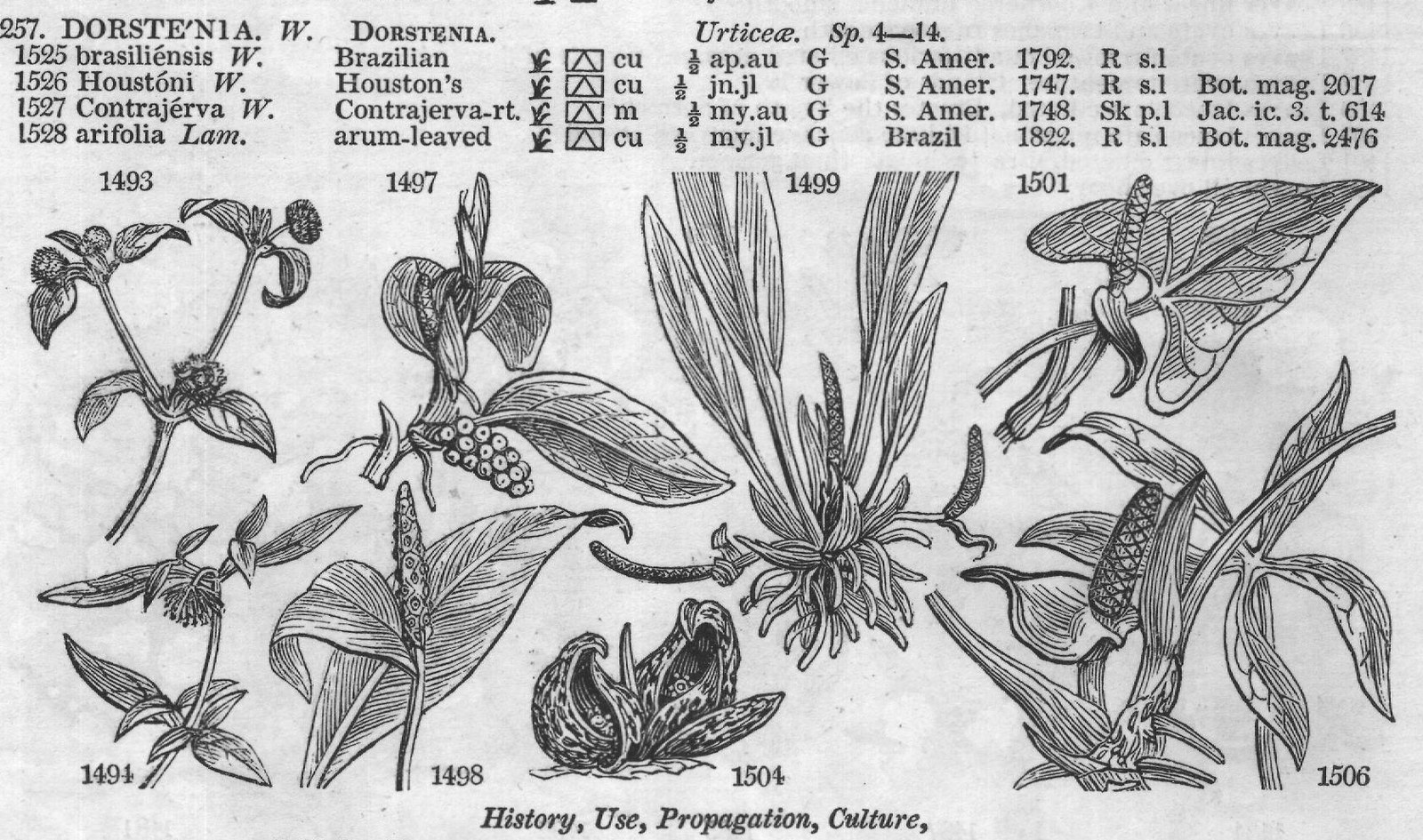
can. t. 174. 257. DORSTE'NIA. W. DORSTENIA.
Urticeæ. Sp. 4-14. 1525 brasiliensis W.
Brazilian 1526 Houstóni W.
Houston's 1527 Contrajérva W. 1528 arifolia Lam.
Contrajerva-rt. arum-leaved সসসস cu ap.au G S. Amer. 1792. R s.l cu jn.jl G S. Amer. 1747. R s.l Bot. mag. 2017 m my.au G cu my.jl G S. Amer. 1748. Sk p.l Brazil 1822. Rs.1 Jac. ic. 3. t. 614 Bot. mag. 2476 1493 1497 1499 1501 1491 1498 1504 1506 History, Use, Propagation, Culture, sparrow or other small bird. The species are all slender, hardy, green-house plants, of pretty appearance, and easy cultivation. 250. Opercularia. From operculum, a lid, in allusion to the manner in which the calyx is closed. Plants of no beauty. 251. Cryptospermum. From κρύπτω, to conceal, and σπερμa, seed. The seeds, or rather seed-vessels, are hidden in the involucrum. Weeds of some tropical countries. 252. Pothos. From potha, the native name of this plant in Ceylon. Most of the species are sub-parasitic, and found climbing, like ivy, on the trunks of trees in the West Indies and America. In our stoves most of the species will thrive planted in old bark and moss, and plunged in heat. P. palmata has leaves upwards of three feet long, with a foot-stalk nearly four feet long, palmate, as thick as strong parchment, smooth, with a midrib of a deep green above, and the fructification on spikes more than a foot in length. The species are cultivated for the sake of their foliage, which is always of an agreeable green color, and not liable to discoloration by damp or other accidents of a hot-house. 253. Rivina. In memory of A. Q. Rivinus, a native of Saxony, born in 1652, and died in 1722. He was for a long time professor of botany and medicine at Leipsig, and left behind him some valuable botanical works; and among them a very ingenious attempt at a classification of plants by the corolla; from which some modern botanists have profited more than they have acknowledged. The name, as Linnæus observes, with his usual neatness, has been given to a shrub always covered with leaves and fruits, in allusion to the merit of the works of Rivinus. R. octandra, the Hoop-withy of Jamaica, and liane à baril of Martinique, has a very long tough flexile stalk an inch or more in diameter, and sometimes made into hoops in the West Indies. The berries con- ORDER I.
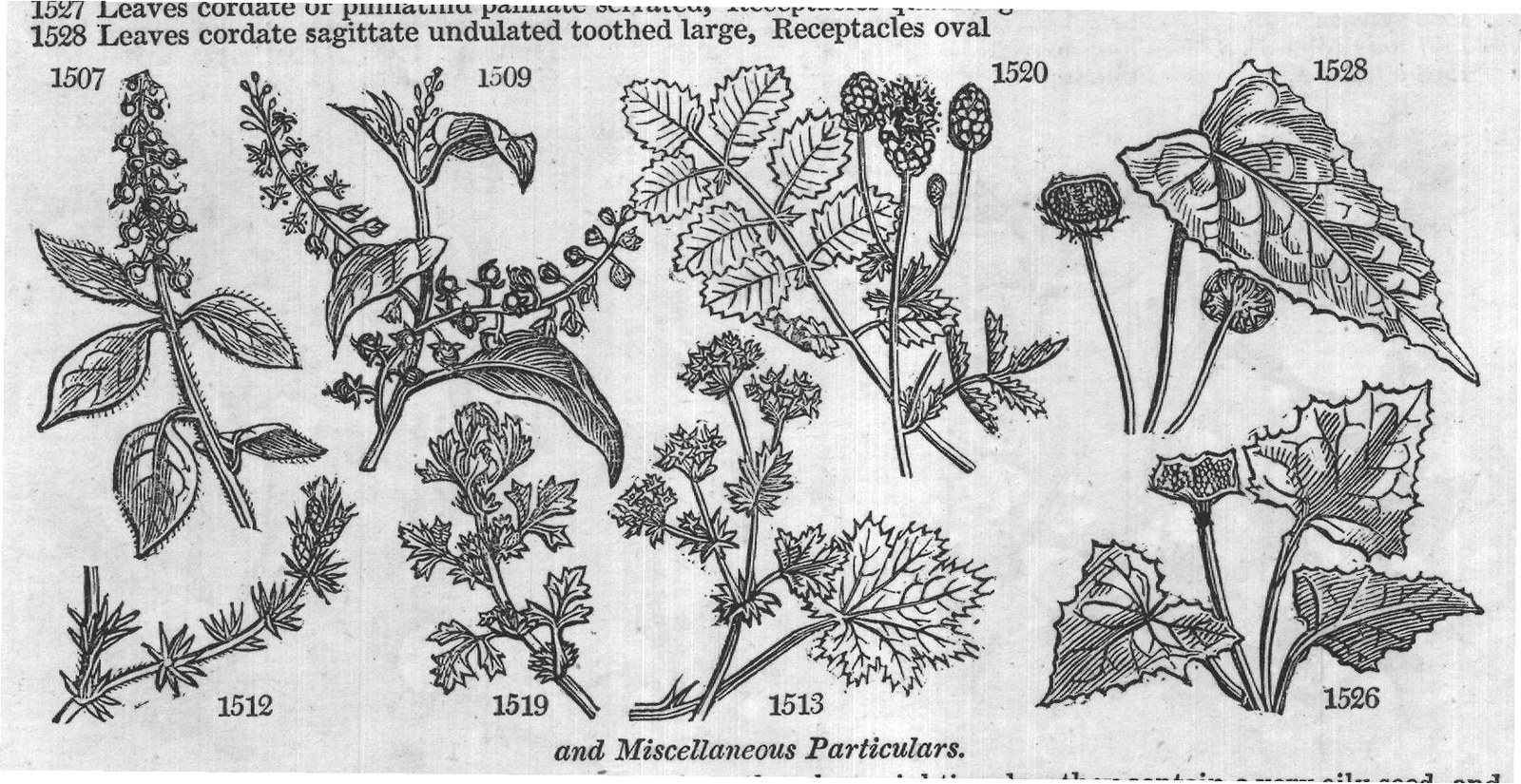
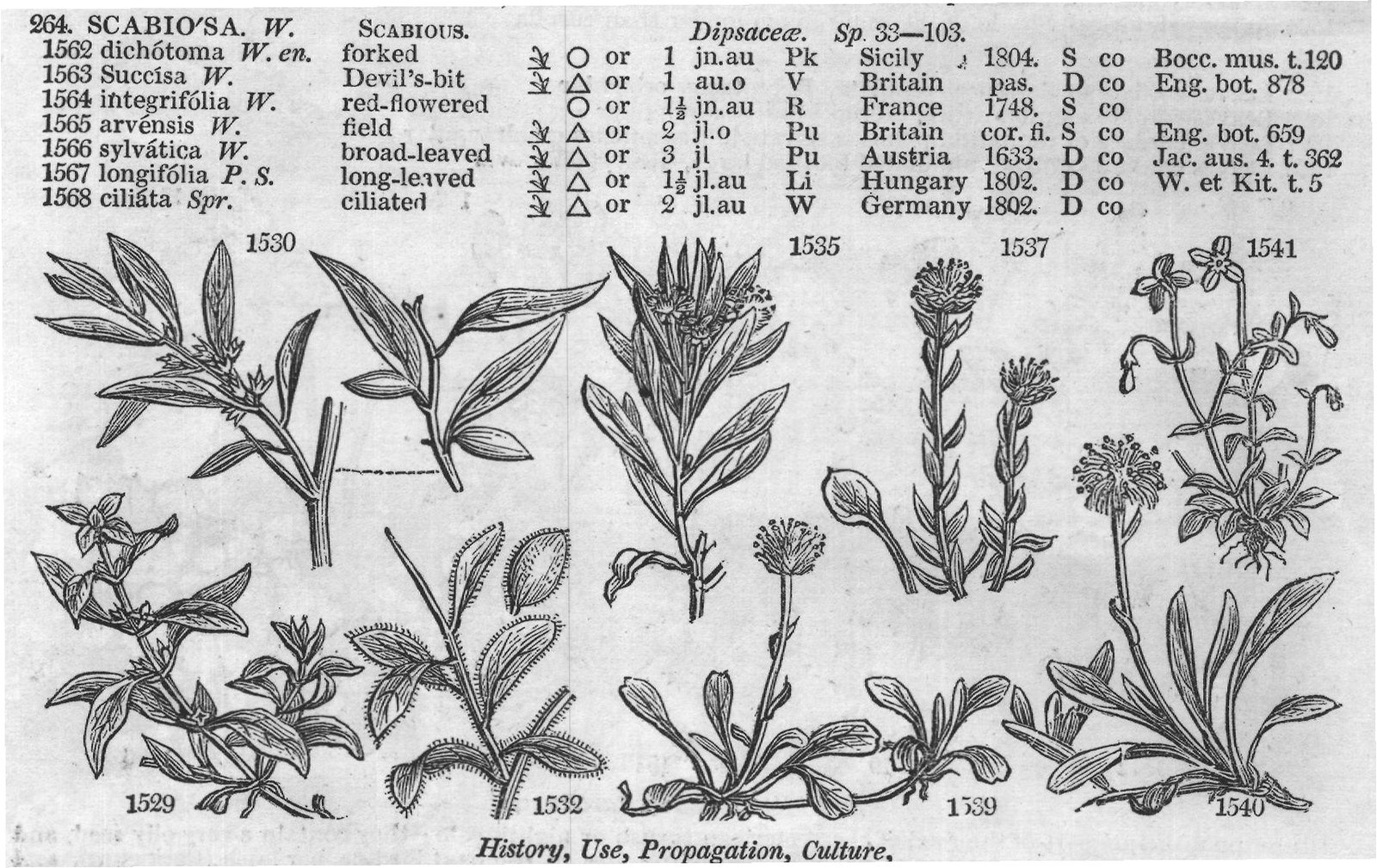
TETRANDRIA MONOGYNIA. 1493 Leaves opposite ovate rough, Flowers capitate, Heads stalked axillary 1494 Stem erect 4-cornered and leaves lanceolate entire smooth 1495 Leaves lanceolate entire nerveless 1496 Leaves lanceolate 3-nerved veiny entire, Scape 3-cornered at the end 1497 Leaves ovate lanceolate entire nerved dotted 1498 Leaves obovate lanceolate pointed at both ends ribbed, Spathe oblong acuminate flat stalked 1499 Leaves obl. attenuated at both ends veiny entire, Middle rib convex on both sides with 3 keels at its base 1500 Leaves cordate lobed imbricated, Spathe flat, Scape rounded 1501 Leaves cordate acute, Lobes spreading, Spathe reflexed as long as the erect spadix 1502 Leaves cordate lobes divaricating, Spadix much shorter than the spatha 1503 Leaves cordate very obtuse 1504 Leaves cordate acute, Spadix subglobose 1505 Leaves palmated, Lobes 9 or 10 lanceolate obtuse 1506 Leaves digitate quinate ovate acuminate 1507 Leaves pubescent 1508 Leaves ovate smooth ciliated, Petioles pubescent 1509 Leaves ovate acuminate smooth flat, Stem round 1510 Leaves ovate wavy rugose, Stem furrowed 1511 Flowers octandrous and dodecandrous 1512 Tufted tomentose hoary, Stems ascending simple 1513 Leaves reniform plaited serrated, Stem and petiole smoothish, Flowers dichotomous corymbose 1514 Leaves reniform 9-lobed beneath with the stem and petioles silky, Flowers fastigiate clustered sessile fastigiate clustered sessile 1515 Leaves reniform 7-lobed toothed silky beneath, Corymbs terminal 1516 Leaves digitate in sevens lanceolate acute, from the middle to the end deeply serrated silky beneath 1517 Leaves digitate in fives or sevens lanceolate cuneate obtuse serrated or toothed at the end silky beneath or toothed at the end silky beneath 1518 Leaves three together, Leaflets ciliated multifid smooth 1519 Leaves three parted, Segments trifid pubescent, Flowers clustered monandrous 1520 Spike ovate, Stamens shorter than the cor. Cal. and leaves smooth, Leaflets ovate subcordate 1521 Leaflets cordate lanceolate crenate toothed quite smooth, Stamens shorter than corolla 1522 Leaflets subsessile ovate-lanceolate finely serrated, Spikes cylindrical, Stamens longer than corolla 1523 Spikes cylindrical, Stamens longer than corolla, Cal. somewhat ciliated 1524 Spikes cylindrical very long, Stamens much longer than corolla 1525 Leaves cordate oval obtuse crenulate, Receptacles orbicular 1526 Leaves cordate angular acute, Receptacles quadrangular 1527 Leaves cordate or pinnatifid palmate serrated, Receptacles quadrangular 1528 Leaves cordate sagittate undulated toothed large, Receptacles oval 1507 1512 1509 1519 1513 1520 1528 1526 and Miscellaneous Particulars. stitute the principal part of the food of the American thrush or nightingale; they contain a very oily seed, and after the bird has swallowed many of them he frequently flies to the next bird-pepper bush (Capsicum), and picks a few pods instinct directing him to what is necessary to promote the digestion of that oleaginous heavy food. 254. Camphorosma. Barbarously named from two words, the one Latin (camphora), and the other Greek (oσμη), signifying a smell of camphor. The plant abounds with a volatile oily salt, and is warm and stimulating; but its appearance has nothing to recommend it . 255. Alchemilla. Named, as Linnæus asserts, from its supposed alchymical purposes; but, as others maintain, from its Arabic app appellation alkêmelyeh. (J. de Souza, p. 52.) A. vulgaris is eaten readily by horses, sheep , and goats, and is considered a good herbage-plant where it abounds in upland pastures. A. alpina is an elegant species, common on many of the Highland mountains, and supposed by Lightfoot and others to aid considerably in giving the peculiarly excellent flavor to Highland mutton. A. aphanes is a worthless weed. 256. Sanguisorba. From sanguis, blood, and sorbere, to absorb. The plant has passed for an excellent vulne- This genus greatly resembles Poterium (Monoecia Polyan.), and Professor Martyn observes, that it is certainly a defect in the Linnæan system that two genera so similar in habit should be placed so far apart. A profound remark, and quite worthy the professor of botany of Cambridge. Alas! poor Linnæus ! if he could rise from his grave he would have little cause to congratulate himself upon the aid of those who call themselves his champions, and the expounders of his system. 257. Dorstenia. In memory of Theodore Dorsten, a German, author of a work entitled Botanicon, printed in 1740. Its flowers, says Linnæus, are like the works of Dorsten, they have little to recommend them. The roots are imported under the name of Contrayerva roots, and used both in medicine and dying. OLEASTER. narrow-leaved silvery oriental 256. ISNARDA. W. 1529 palústris W. 259. ELÆAG NUS. W. 1530 angustifólia W. 1531 argentea Ph. 1532 orientális W.
TETRANDRIA MONOGYNIA.
ISNARDA. marsh Onagrariæ. Sp. 1-6.
W 1 jl G Eur., &c. 1776. S co CLASS IV.
Schk. han. 1. t.25 Elæagneæ. Sp. 5-10. or 15 jl Ap S. Europe 1633. C co Pall. ross. 1. t. 4 or 10 jl.au Ap or 10 jlau Ap N. Amer. 1813. C co Levant 1748. L p.1 Pall. ross. 1. t. 5 1533 latifólia W. broad-leaved or 3 jl.au Ap E. Indies 1712. L p.1 Bm. zeyl. t.39.f.2 1534 acumináta Lk. acuminated or 3 ...
Ap ......
C co ... 260. GLOBULA'RIA. W. GLOBULARIA.
Globularinæ. 1535 longifólia W. long-leaved 1536 A'lypum W. three-toothed ☐ pr 2 au.s Pa 1537 vulgáris W. common pr 1538 spinósa W. prickly-leaved pr 1539 cordifólia W. wedge-leaved A pr my.jn B jn.jl B 1540 nudicaúlis W. naked-stalked pr jn.jl B pr3 jl.au W my.jn B Sp. 6-13.
Madeira 1775. L p.l S. Europe 1640. Lp.l Europe 1640. C p.1 Spain 1640. C l.p Germany 1633. C 1.p Germany 1629. C p.l Bot. mag. 2256 Bot. reg. 685 Garid. aix. t. 42 Jac. aus. 3. t. 245 Jac. aus. 3. t. 230 261. HOUSTONIA. W. HOUSTONIA.
Rubiaceæ.
Sp. 2-15. 1541 cærúlea W. blue-flowered pr my.au L.B N. Amer. 1785. D s.p Bot. mag. 370 1542 purpúrea W. purple-flower'dpr 1 my.au Pu N. Amer. 1800. D co 262. DIPSA'CUS. W.
TEASEL.