Home › C › Col (Ecph t Mor h t f History Use)
Col (Ecph t Mor h t f History Use)
ecph. 1.t.209 Mor.h.3.t.16.f.29 547 548 551 545 549 550 552 History, Use, Propagation, Culture, 78. Valeriana. A word of uncertain import. Linnæus derived it from a certain king Valerius. De Théis thinks it altered from the verb valere, on account of its medicinal qualities. The species are generally orna- This species and mental border plants, of easy culture in common earth, and preferring shady moist situations. V. dioica culture in common earth, and preferring shady moist situations , V. dioica has usually the stamens and pistils in separate flowers, situated on different plants. This species and pistils in separate flowers, situated on different plants. V. officinalis are considered medicinai, and prescribed in hysterical cases and habitual costiveness. Cats medicinai, and prescribed in hysterical cases and habitual costiveness. Cats are delighted with the roots, which are said to smell like the true Teucrium marum ; and rat-catchers employ them to draw the rats together, as they do oil of anise. V. Phu has something of the same qualities. V. tripas they do oil of anise. V. Phu has something of the same qualities. V. tripteris derives its name from THEIS, three, and ATEQUE, a wing, in allusion to the ternary position of its leaves. , three, and πτερuξ, a wing, in allusion to the ternary position of its leaves.
ORDER I.
TRIANDRIA MONOGYNIA. 8. Inflorescence panicled. Spikelets solitary, 1-flowered. Lower paleæ cartilaginous, compressed, keeled. Stamens frequently more than 3. (Oryza.) 217. Leersia. Spikelets 1-flowered. Glumes O. Paleæ 2, beardless, keeled, compressed. Scales 2. Stamens 3-6. Stigmas very finely cut. Seed loose, inclosed in the paleæ. 9. Shrubby. Inflorescence panicled. Spikelets many-flowered. Upper palea with two keels. (BAMBUSACEA.) 218. Diarrhena. Glume 2-valved: valves navicular, rigid, the lower smaller, shorter than the florets. Lower palea navicular, rigid, upper membranous, the edges broad, folded back. Scales 2, ovate, entire. Ovarium with a hood. Seed furrowed, hardened, shining, loose. 219. Arundinaria. Glume 5-7-flowered. Valves unequal, with stalked florets. Lower palea very acute, upper bifid-toothed. Scales 3, smooth. Stigmas 3, feathery. Styles upper Scales 3, smooth. Stigmas 3, feathery. Styles 3. Order 3. TRIGYNIA. 8 3 Stamens. 3 Styles. 220. Holosteum. Cal. 5-leaved. Petals 5. Caps. sub-cylindrical, 1-celled, opening at the end, 6-va.ved, many-seeded. 221. Polycarpon. Cal. 5-leaved, 5-cornered. Petals 5, very small, ovate. Caps. 1-celled, 3-4-valved: valves lanceolate, twisted inwards. Seeds many. 222. Lechea. Cal. 3-leaved. Petals 3, linear. Caps. 3-celled, 3-valved, and as many inner valves. Seed 1. 223. Eriocaulon. Common calyx an imbricated head. Petals 3, equal. 224. Montia. Cal. 2-3-leaved. Cor. monopetalous, irregular, 5-parted. 225. Mollugo. Cal. 5-leaved. Cor. O. Caps. 3-celled, 3-valved. 226. Minuartia. Cal. 5-leaved. Cor. O. Caps. 3-celled, 3-valved. Seeds a few. Stamens above the ovarium.
Caps. 1-celled, 3-valved, 3-seeded. 227. Queria. Cal. 5-leaved or 5-parted. Cor. O. Caps. 1-celled. Seed 1. 228. Königia. Cal. 3-leaved. Cor. O. Seed 1, ovate, naked. MONOGYNIA. 544 Radical leaves spatulate ovate undivided; cauline pinnatifid, Stem erect, Flowers panicled diœcious 545 Leaves all pinnate: pinnæ lanceolate-toothed, Stem hollow furrowed, Flowers corymbose 546 Cauline leaves pinnate, radical undivided, Stem smooth slender, Flowers corymbose slender, 547 Leaves toothed radical cordate simple, cauline ternate ovate oblong, Leaflets lateral lanceol. Stem erect 548 Leaves oblong rather toothed; lower obtuse, upper acute, Stem erect, Flowers panicled 549 Leaves undivided entire obt. radical cuneate obl. cauline linear, Stem smooth ascending, Flowers racemose 550 Radical leaves lanceolate oblong entire, cauline pinnatifid, Stem smooth, Flowers pink corymbose 551 Leaves undivided, radical elliptical 3nerv. entire and toothed, caul. linear, Stem erect, Corymbs racemose 552 Radical leaves ovate, cauline cordate sessile cut halbert shaped, Flowers racemose 553 Leaves cord. uneq. toothed: lower simple, upper ternate and pinnate, Stem striated, Flowers corymbose 554 Radical lvs. pinnated, Leaflets ovate coarsely toothed, caul. pinnated downwards, Segm. lanceol, toothed 555 Leaves simple ciliated, radical obovate, cauline lanceolate, Flowers panicled 556 Leaves membranous pinnatifid, Segm. lanceol.: the terminal very large, Stem smooth, Flowers corymbose 557 Leaves rather fleshy pinnatifid, Segm, entire obt. of nearly one shape, Stem hairy in 2 rows, Flowers corymb. 558 Caps. linear 3-toothed: the outer larger recurved, Stem smooth, Flowers in dichotomous spikes 559 Caps. naked globose compressed, Stem weak, Flowers in heads 560 Caps. polished ovate, Limb of the calyx short 3-5-toothed crowned, Stem smooth, Flowers corymbose 561 Caps. ovate villous, Limb of the calyx bladdered crowned, Stem a little villous, Flowers nearly in heads crowned, Crown camp. Teeth long straight, Stem pubesc. Fls. in heads 563 Caps. vill. Limb of cal. 10-12-rayed crowned, Crown rotate, Teeth long acute, Stem smooth, Flow. in heads 564 Caps, naked smooth cleft-keeled elongated, Stem weak, Flowers nearly in heads 565 Caps. ovate angular hairy irregularly toothed, Stem angular, Flowers corymbose 566 Caps. pubescent naked at the end, Leaves spatulate oblong nearly entire 567 Stem scabrous, Fruit ovate acute 1-toothed at the end pubescent 568 Caps. linear 6-toothed, Teeth hooked loose, Stem and radical leaves spatulate, cauline pinnatifid pubescent 553 555 556 559 557 560 561 565 and Miscellaneous Particulars.
Phu is the Arabic name of the species so called. 79. Patrinia. Named by M. Jussieu in honor of M. Patrin, an assiduous French botanist, who travelled in Siberia, where all the species of the genus are found, and whence he sent home collections. 80. Valerianella. A diminutive of Valeriana, from which the genus has been divided. V. olitoria (Valeriana locusta, L.) Mache salade de prêtre, Fr., corn salad or lamb's-lettuce, from its appearing in corn fields locusta, L.) Mache salade de prêtre, Fr., corn salad or lamb's-lettuce, from its appearing in corn fields about the time when lambs are dropped ; furnishes an agreeable salad, the leaves tasting little inferior to young lettuce. To have it early, it should be sown in autumn on a warm border, All the species are of as easy culture as those of Valeriana D2 UMBRELLA-WORT. viscid aggregate 571 glabrifólia W. en. 572 hispánica W. 573 volúbilis W. climbing $ 84. CNEO'RUM. W.
WIDOW-WAIL. 574 tricóccum W. smooth 81. CALYME/NIA. 569 viscósa W. 570 aggregáta Cav.
TRIANDRIA MONOGYNIA.
Nyctagineæ. Sp. 3-7. smooth-leaved cu 3 jlau P 82. LEFLI'NGIA. W. LEFLINGIA.
Spanish 83. HIPPOCRATEA. HIPPOCRATEA.
N. Spain 1811. S s.l Caryophylleæ. Sp. 1-3.
Spain jn G Acerinæ. Sp. 1-10.
W Terebintaceæ. Sp. 2. ap.s CLASS III. cu 6 my.s P Peru 1793. C 1.p cu 1 jlau Pk Bot. mag. 434 Cav. ic. t. 437 N. Spain 1811. Cs.l Cav. ic. t. 379 Ow 1770. S s.l Cav. ic. 1. t. 94 or 20 S. Amer. 1739. C p.l Jac. amer. t. 9. or 6 575 pulveruléntum Ven. powdery or 6 Y ap.s Y 85. COMOCLA'DIA. W. MAIDEN-PLUM.
Terebintaceæ.
S. Europe 1793. C p.1 Madeira 1822. C p.1 Sp. 3-4.
Lam. ill. t. 27 Vent. cels. 77 576 integrifólia W. entire-leaved tm 15 W 577 dentata W. tooth-leaved 578 ilicifólia W. holly-leaved 호호 tm 30 jl W Jamaica 1778. C p.1 W. Indies 1790. C p.l Slo.ja.2.t.222. f.1 J. am.13.t.173.f.4 tm 15 W Caribee Is.1789. C p.1 Plum. t. 118. f. 1 86. XY'RIS. L.
XYRIS.
Junceæ.
Sp. 3-26. 579 operculáta B. P. rush-leaved 1 pr لا jn.jl Y N. S. W. 1804. S s.p Bot. mag. 1158 580 brevifólia P. S. short-leaved pr jn.au Y 581 lævis Br. smooth pr 87. CALLI'SIA W.
CALLISIA. jn.au Y Commelineæ. 582 répens W. creeping pr jn.jl B Carolina 1812. S s.p N. Holl. 1819.
Sp. 1-3.
W. Indies 1776. R s.p Jac. am. 11. t. 11 88. COMMELINA. B. P. COMMELINA.
Commelineæ.
Sp. 10-60. 583 commúnis W. common or 2 jn.jl P.B America 1732. Sco Red. lil. 206 584 caroliniána W.
Carolina Aor 2 jn.jl P.B America 1732. Dr.m 585 africána W.
African or 1 my.o Y C. G. H. 1759. Rr.m Bot. mag. 1431 586 bengalénsis W.
Bengal or 3 jn B Bengal 1794. R s.p Mur.got.p.18.t.5 587 erécta W. upright or 1 au.s B Virginia 1732. Rs.p Di. el.94.t.77.f.88 588 virgínica W.
Virginian or 2 jn B Virginia 1779. R s.p P.al.135.t.174.f.4 589 longicaúlis W. long-stalked or 3 au B Caraccas 1806. R s.p Jac. ic. 2. t. 294 590 móllis W. soft or 2 au B 591 tuberósa W. en. tuberous-root.or 1 jn.jl B Caraccas 1804. R s.p Mexico 1732. R r.m Jac. ic. 2. t. 293 Bot. rep. 399 592 cœléstis W.en. sky-blue or 1 jn.jl B 1813. Rr.m Bot. mag. 1695. 89. ANEILE/MA. B. P. ANEILEMA.
Commelineæ.
Sp. 3-12. 593 biflórum Br. creeping Aor 1 jl.au B N. Holl. 1820. R co 594 ambíguum Beauv. doubtful or 3 V 595 sínicum Ker.
Chinese or 1 my.jn P.B S. Leone 1822. 1820.
China Dr.m Beauv. Ow. t. 15 Dr.m Bot. reg. 659 90. CARTOONEMA.
CARTONEMA, Commelineæ.
Sp. 1. 596 spicátum spear-leaved or jlau B E. Indies 1783. S s.p 91. ORTE'GIA. W.
ORTEGIA.
Caryophylleæ. Sp. 2. 597 hispanica W.
Spanish W 598 dichotoma W. 92. POLYCNE/MUM. W. POLYCNEMUM. 599 arvénse W. forked W jn.jl Ap Spain au.s 1768. D 1.p Ap Italy 1781. D 1.p Cav. ic. 1. t. 47 All.taur.3.t.4.f.1 Chenopodeæ. Sp. 2-12. trailing W Ap S. Europe 1640. S s.1 Jac. aus. 4. t. 365 600 recúrvum Lois. recurved W 14 از Ap France 1820. S s.l 3. CROCUS. Ker.
CROCUS.
Irideæ. Sp. 17. 601 vérnus E. B. spring or f.ap P England mea. O co Eng. bot. 344 602 albiflórus Kit.
Austrian vern.or f.mr W Austria ...
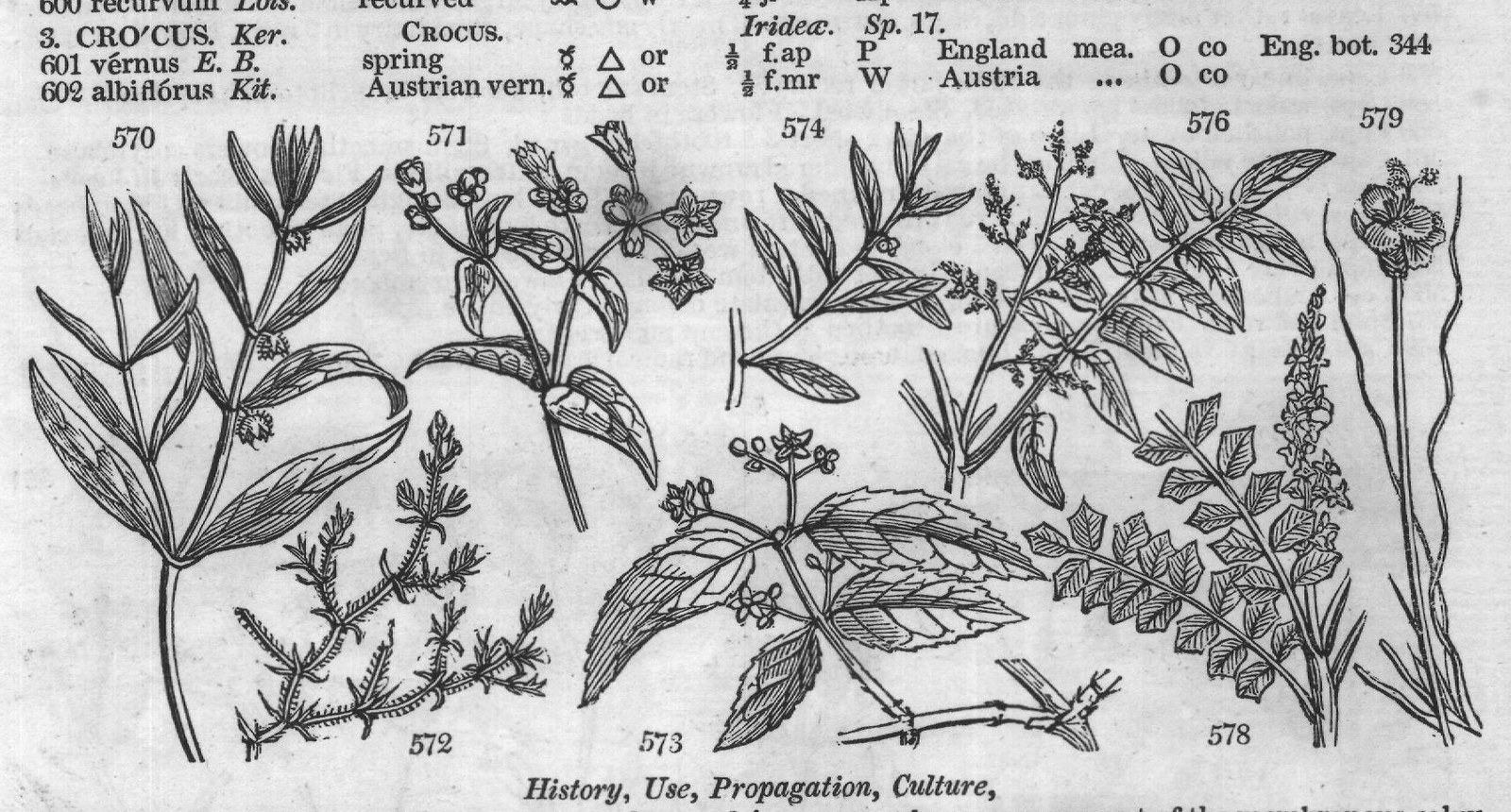
O co 570 571 574 576 579 572 573 History, Use, Propagation, Culture, 578 81. Calymenia. So named from κaλuξ, a calyx, and ὑμηv, a membrane, on account of the membranous calyx by which the genus is distinguished. 82. Læflingia. In honor of P. Læfling, a Swedish botanist, who published a volume of travels in Spain, &c. These are plants of no beauty, and are only cultivated in botanic gardens, 83. Hippocratea. In honor of the celebrated Hippocra Hippocrates, the father of physicians, born in the island of Cos, who flourished 450 years before the vulgar æra. Plumier, who first fixed the genus, called it Coa, which Linnæus changed to its present name. 84. Cneorum. Kvεωρov is a plant described by Theophrastus, as resembling the olive. This is a low yellowish evergreen shrub, which like Veronica decussata, will endure our winters in the open air, with protection during frost. It grows naturally in hot dry barren and rocky soils; thrives well in an artificial state in any light earth; ripened cuttings will root in sand under a hand-glass, or it may be raised from seeds, which it produces in abundance. 85. Comocladia. Koμη, hair, and κλaδoς, a branch. The branches are tufted at the top of the tree. C. integrifolia is a handsome tree with an erect trunk, dividing into few branches, adorned with pinnated smooth leaves, like a frond; flowers numerous, fruit a deep red, shining, eatable, but not inviting. The wood is hard, of a fine grain, and reddish color. If C. dentata be ever so slightly wounded, it emits a strong smell of dung: it grows in Cuba, where the natives have a notion that it is dangerous to sleep under its shade. This genus is not frequent in British collections: it thrives in loam and peat, and may be propagated by ripened cuttings placed under a hand-glass in moist heat.
ORDER 1..
TRIANDRIA MONOGYNIA. 569 Villous viscid, Leaves cordate, Flowers racemose, Stamens longer than the corolla 570 Leaves lanceolate, Peduncles aggregate axillary solitary, Calyxes 3-flowered, Stem ascending 571 Leaves cordate ovate smooth, Peduncles terminal heaped, Stamens shorter than the corolla 572 Flowers triandrous monogynous, Leaves very small: lower linear, upper subulate 573 Leaves oblong-ovate lanceolate or elliptical serrated, Capsules oval 574 Smooth, Flowers axillary 575 Hoary, Leaves flower-bearing powdery, Petals and stamens 4 576 Leaflets stalked ovate-lanceolate entire 577 Leaflets stalked ovate-lanceolate prickly-toothed 578 Leaflets sessile angular-spiny 579 Leaves linear-subulate, Head globose many-flowered, Petals alternate pencil-shaped 580 Scape slender, Head globose 581 Culm 2-edged and leaves smooth very narrow, Head subovate, Scales imbricate on each side, Keel of the glumes ciliate 582 Leaves ovate-lanceolate sessile, Stem procumbent, Flowers axillary sessile 583 Leaves ovate-lanc. nearly sessile acute with the creeping stem smooth, Involucr. cordate doubled together 584 Flowers uneq. Involucres cord. folded together at base with sheaths ciliated, Leaves lanc. sess. Stem decumb. 585 Leaves lanceolate sessile with the decumbent stem smooth, Involucr. cordate doubled together 586 Leaves ovate stalked obtuse, Involucres cordate hooded turbinate 587 Leaves ovate-lanceolate rough, Involucres hooded turbinate, Stem erect 588 Leaves lanceolate stalked rough above, Sheaths rusty, Stem erect simple 589 Leaves linear-lanceolate sessile rather hairy, Involucres ovate doubled together, Stem creeping 590 Villous, Leaves ovate stalked, Involucres half round folded in at the edge, Stem creeping 591 Leaves ovate-lanceolate sessile ciliated, Involucres cordate folded together, Stem erect 592 Involucres cord, acumin. folded together, Pedunc. pubesc. Pedicels smooth, Lvs. obl. lanc. Sheaths ciliated 593 Smooth, Stem creeping, Leaves lanceolate, Flower-stalks 2-flowered 594 Stem solid woody with distant leafy knots, Leaves long ovate acuminate fascicled villous 595 Stem branched diffuse, Leaves ligulate acuminate, Racemes alternate about 7 placed in a panicle form, 3 Stamens bearded 3-naked 596 Leaves lanceolate, Flowers panicled 597 Stem branching, Branches and branchlets opposite, Flower-stalks many-flowered 598 Flower-bearing branches dichotomous, Flowers solitary 599 Leaves subulate prismatic, Spiny at the end 600 Leaves subulate scattered spreading distinct somewhat recurved, Cal. nearly as long as capsules 1. Vernal. 601 Mouth of flower closed by hairs, Segments obtuse, Stigmas dilated, Flowers large early 602 Segments of flower quite entire obt. Anthers twice as long as the stigmas, Mouth of flower closed by hairs 589 599 596 582 590 and Miscellaneous Particulars. 595 597 601 86. Xyris. Xuρoς, acute. Its leaf terminates in a sharp point. Under this name a plant is described by Pliny, which resembles an iris. Pretty little rush-like plants with yellow flowers; uncommon in collections, but easily cultivated, though rarely flowering. 87. Callisia. From κaλoς, pretty; a name aptly given to this plant, which is easily known by its shining leaves edged with purple. 88. Commelina. So named by Plumier, in honor of the brothers, John and Gaspar Commelin, botanists and Dutch merchants. Some of the species, such as C. cœlestis and tuberosa, are very showy herbaceous plants; others are mere weeds. They are all easily cultivated in wet places in the stove or greenhouse, and propagated by the rooting joints of their stem or by division of the roots, or by cuttings." 89. Aneilema. From avεiλεω, to evolve, the flowers being evolved, as it were, from the spatha. A genus resembling Commelina, from which it is chiefly distinguished by not having its flowers enclosed in a spatha. 90. Cartonema. From κaρτoς, shorn, and vημa, a filament, in reference to the stamens. A plant resembling Commelina. 91. Ortegia. In honor of Casimir Gomez de Ortega, a Spanish botanist, and professor of botany at Madrid. An insignificant herbaceous plant. 92. Polycnemum. Πoλus, many, κvημη, knee, on account of the number of joints of the stem. A decumbent annual plant of no beauty. 98. Crocus. A name given by Theophrastus. The story of the youth Crocus being turned into this flower, may be read in Ovid's Metamorphoses. This is an ornamental genus of great value in the flower-garden, on D3 603 mínimus Red.
TRIANDRIA MONOGYNIA.
CLASS III. least or f.mr P 604 versícolor H. K. 605 biflórus H. K. party-colored or Scotch or 1629. O co f.mr Li S. Europe 1629. O co f.mr W Crimea 1629. O co Bot. mag. 1110 Bot. mag. 845 606 pusíllus Ten.
Neapolitan or f.mr W.br Naples 1824. O co 607 susiánus H. K. cloth of gold or f.mr Y Turkey 608 reticulátus M. B. netted vernal or f.mr B Crimea 1605. O co Bot. mag. 652 609 striátus Lk. striped vernal or f.mr W 1820. O co B flavus 611 lúteus Lam. 610 sulphúreus H. K. sulphur-colored 612 lagenæflorus Salisb. golden or f.mr Y S. Europe 1629. O co Bot. mag. 938 pale-yellow or f.mr P.Y S. Europe 1629. O co Bot. mag. 1384 common-yell. or f.mr Y Turkey 1629. O co Bot. mag. 45 or f.mr D.Y Greece O co ...
Fl. græc.1. t.35 B flávus pale or f.mr P. Y Greece O co ...
Bot. mag. 1111 2 penicillatus pencilled or f.mr P.Y ...... co 613 stellaris Haw. starry-yellowor f.mr Y ......
O co ...
Hor. trans. 1. t.6 614 sativus W. saffron 615 serotínus H. K. late autumnal 616 nudiflórus H. K. naked autumn. 617 Pallásii M.B.
Russian autum.or বরবর or S.O V or s.n V or o.n V England mea. O s.1 S. Europe 1629. O co England mea. O co Eng. bot. 343 Bot. mag. 1267 Eng. bot. 491 S.O Li Crimea 1821. O co 94. WITSE'NIA. Ker.
WITSENIA.
Irideæ.
Sp. 2-4. 618 maúra H. K. downy-flowered or 4 n.ja Y.B C.G.H. 1790. C s.p Bot. reg. 5 619 corymbósa H. K. corymbose or ap.s P.B C.G.H. 1803.
C s.p Bot. mag. 895 95. I'XIA. Ker.
IXIA.
Irideæ. Sp. 20-30. 620 lineáris H. K. slender or ap.my WC. G. H. 1796.
O s.p.l Bot. mag. 570 621 capilláris 622 aúlica W. capillary or 1 ap.my V C. G. H. 1774.
O s.p.l Bot. mag. 617 rose-colored or ap.my Pk C. G. H. 1774.
O s.p.l Bot. mag. 1013 623 fucáta Ker. painted or jn.jl Pk C. G. H. ...
O s.p.1 Bot. mag. 1379 624 pátens W. 625 leucántha P.S. spreading-flow. white-flowered or 1 ap P C. G. H. 1779.
Os p.1 Bot. mag. 522 or 1½ my my WC. G. H. 1779.
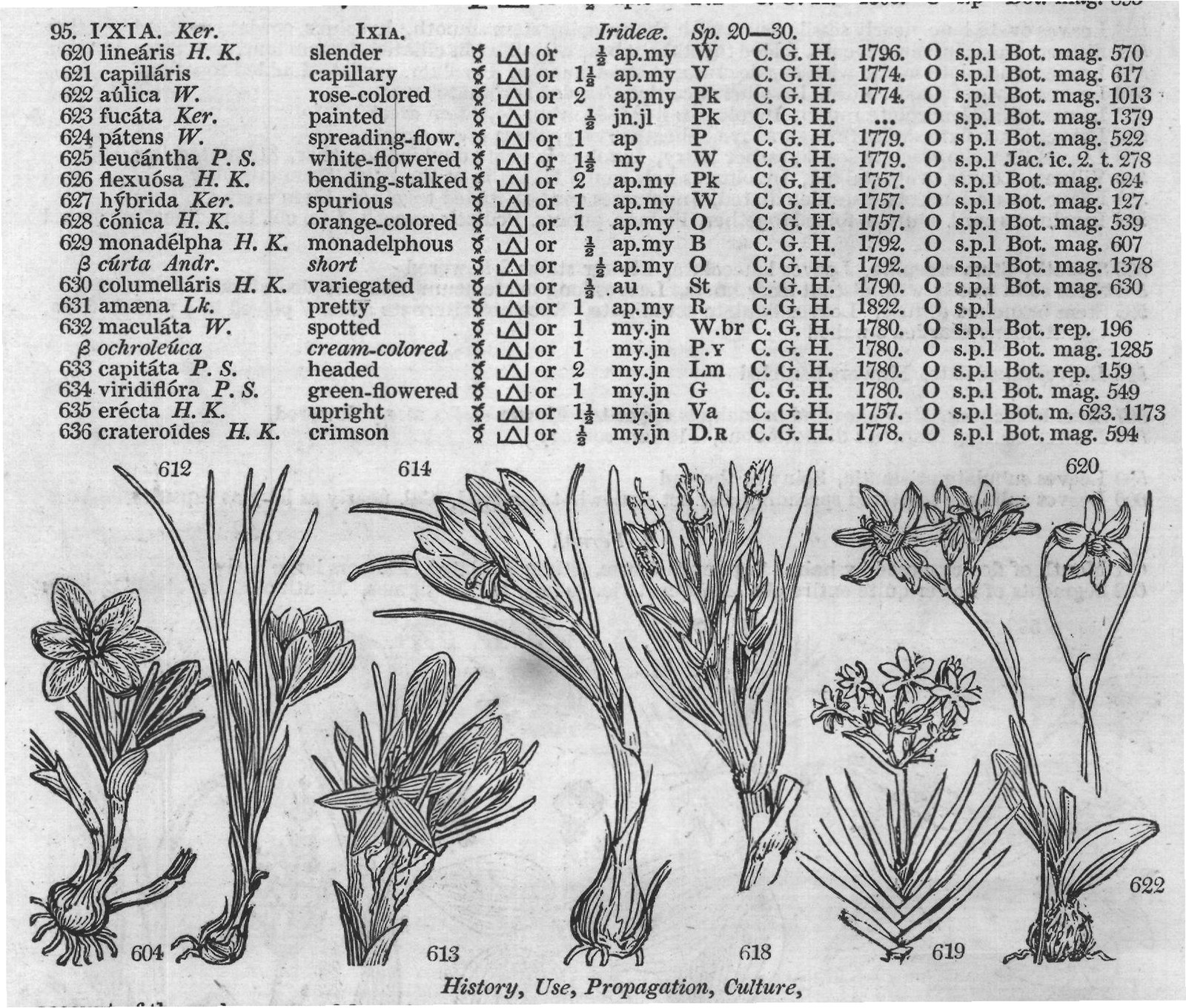
O s.p.1 Jac. ic. 2. t. 278 626 flexuósa H. K. bending-stalked 627 hýbrida Ker. spurious 628 cónica H. K. orange-colored 629 monadélpha H. K. monadelphous ẞ cúrta Andr. short 630 columelláris H. K. variegated 631 amæna Lk. pretty 632 maculáta W. spotted B ochroleúca cream-colored 633 capitáta P. S. headed 634 viridiflóra P. S. 635 erécta H. K. green-flowered 636 crateroides H. K. crimson upright OF YOK YOK YOK YOKYO YO YO YO YO YO YO YO or 2 or 2 ap.my Pk C. G. H. 1757.
O s.p.1 Bot. mag. 624 or 1 ap.my W C. G. H. 1757.
O s.p.l Bot. mag. 127 or 1 ap.my O C. G. H. 1757.
O s.p.1 Bot. mag. 539 orap.my B C. G. H. 1792.
O s.p.l Bot. mag. 607 Aor ap.my O C. G. H. 1792.
O s.p.l Bot. mag. 1378 Aor au St C. G. H. 1790.
O s.p.l Bot. mag. 630 or 1 ap.my R C. G. H. 1822.
O s.p.l or 1 my.jn W.br C. G. H. 1780.
O s.p.1 Bot. rep. 196 or 1 my.jn P.Y C. G. H. 1780.
O s.p.1 Bot. mag. 1285 or 2 my.jn Lm C. G. H. 1780.
O s.p.1 Bot. rep. 159 or 1 my.jn G C. G. H. 1780.
O s.p.1 Bot. mag. 549 or 1 my.jn Va C. G. H. 1757.
O s.p.1 Bot. m. 623. 1173 or my.jn D.R C. G. H. 1778.
O s.p.1 Bot. mag. 594 612 614 620 604 613 618 619 622 History, Use, Propagation, Culture, account of the early season of flowering, and the brilliancy of the flowers. Haworth, who has for thirty years paid particular attention to the Crocus, (Hort. Trans. i. 122.) and raised many varieties from seed, found that the blue, purple, and white flowered kinds, ripened their seeds much more readily than the yellow, and that the leaves of the latter were narrower through all the species and varieties. When this genus is in flower, the germen is situated underground almost close to the bulb, but some weeks after the decay of the flower, it emerges on a white peduncle, and ripens its seeds above ground. This extraordinary mode of semination is peculiarly conspicuous in C. nudiflorus, which flowers without leaves in autumn, and throws up its germen the following spring like the Colchicum. Though some species of Crocus are, or appear to be, naturalized in a few places, yet they cannot be considered as aboriginal natives. Allioni affirms the C. sativus (the saffron) is indigenous in Savoy; but Ray says nothing is certain as to its native country. Professor Martyn considers Asia as its native country, saffron having there first acquired that high reputation in medicine, which it has as its native country, saffron having there first acquired that high reputation in medicine, which it has now almost lost in Europe. The Arabic name Z'afarân, and the Moorish and Spanish terms Azafran and this opinion. C. vernus, the saffran printanier, Fr., is a native of Switzerland and Italy, and is commonly found with white flowers and a purple base. Some botanists consider it and C. sativus as the only distinct species of the genus. Miller describes four, Willdenow four, Sir J. E. Smith three, as natives of Britain, and Haworth (Hort. Trans. i. 132.) no fewer than thirteen species. Parkinson certainly cultivated many varieties which are not now known in collections. Crocus vernus and versicolor, produce by cultivation varieties of singular beauty, both as to size, color, and marking. C. sativus, the saffron. Saffran, Fr. and Ger., and Zafrano, Ital., is said to have been first brought into England in the time of Edward III., and introduced to Walden in Essex, to which town it afterwards gave the prænomen. It was abundantly cultivated there, and in Cambridge, Suffolk, and Herefordshire, in the beginning of the 17th century; but the article is now so little in repute, or so much cheaper in foreign markets, that at present the culture of saffron is confined to a few parishes round Saffron Walden. The bulbs are planted in July in a well pulverized soil, not poor nor a very stiff clay; they ; they are placed in rows six inches apart across the ridges, and three inches bulb from bulb in the row. The purple flowers are gathered in September and carried home, where their yellow stigmas and part of the style are picked out and dried on a kiln between layers of paper, and under the pressure of a thick Stigmas 604 Stigmas convolute hooded lobed as long as the anthers 605 Leaves longer than flowers, Stigmas but little longer than the anthers ORDER I.
TRIANDRIA MONOGYNIA. 603 Segments of flower acute, Stigmas small, Flowers small late, Mouth of throat closed by hairs [membranous 606 Stigma inclosed trifid longer than stamens, Lobes filiform cucullate crisp, Lvs. setaceous, Tunic of the bulbs 607 The three outer segments of flower revolute 608 Stam. as long as the truncate torn stigmas, Leaves supporting the flowers, Bulbs coated with net-work 609 Leaves longer than the flowers, Spathes 2 inner narrowest, Limb of cor. funnel-shaped, Stigma length or 610 Stigmas unequal much longer than the anthers [anthers flattish jagged 611 Filaments hairy, Anthers longer than the stigma 612 Stigma enclosed trifid, Lobes somewhat linear toothed, Coat of the roots membranous ẞ Pale cream-coloured flowers Pale cream-coloured flowers, with 3 sky-blue lines on the tube 613 Leaves upright-spreading: their keel blunt: sides nerveless, Flower in the sun campanulate stellate 2. Autumnal. 614 Stigmas very long reflexed crenate at the end 615 Stigmas erect much divided, Leaves coming out with the flowers 616 Stigmas erect much divided, Leaves later than the flowers 617 Bulbs with a thready skin, Leaves later than the fl. Stam. as long as the truncate stigmas, Flower large 618 Flowers spiked, Outer segments of flower downy without 619 Flowers corymbose smooth 620 Leaves linear very narrow convex, Scape simple erect 621 Leaves with a cartilaginous edge, Racemes 1-7-flowered 622 Leaves ensiform, Tube of the flower turbinate [Anthers diverging 623 Leaves grassy, Spike 1-2-flowered, Flower hypocrateriform, Tube clavate straight, Filaments columnar 624 Tube filiform, Limb bell-shaped spreading, Stigmas longer than the anthers 625 Leaves linear ensiform, Flowers 1-sided, Spathes toothed shorter than the tube 626 Tube slender a little enlarged, Limb below bell-shaped contracted, Segments spreading 627 Leaves slender, Raceme flexuose many-flowered 628 Limb spreading spotted at base, Stigmas not divided lower than the base of the anthers 629 Filaments united in a tube 630 Filaments united at base 631 Leaves lanceolate, Spathe toothed much shorter than the filiform tube, Segments lanceolate 632 Limb campanulate spreading spotted at base, Stigmas divided as low as the tube 633 Smooth with stalked bulbs, Leaves linear ensiform, Flowers in spiked heads, Tube shorter than segments 684 Leaves linear ensiform edged, Scape many-spiked many-flowered, Flowers spotted at base 635 Limb spreading not spotted, Stigmas divided as low as the tube 636 Limb hemispherical campanulate, Stigmas longer than anthers 623 625 626 627 629 634 630 636 and Miscellaneous Particulars. board to form the mass into cakes. Two pounds of dried cake is the average crop of an acre after the first planting, and twenty-four pounds for the two next years. After the third crop the roots are taken up, divided, and transplanted.
The uses of saffron in medicine, domestic economy, and the arts, were formerly very various. It is now employed by painters and dyers, and enters into sauces, creams, biscuits, conserves, liqueurs, &c. As a garden-flower, the C. vernus is the parent of many varieties, and these may be increased at pleasure by propagating from seeds. Haworth directs to sow these immediately after being gathered in light earth, in a shady, but open situation. Sift over them half an inch of earth the first autumn, and the second take them up and immediately replant them. Add another half inch of earth the third autumn, and the following spring most of the plants will show flowers in the midst of their fourth crop of leaves. Afterwards they may be treated like old bulbs, and planted in the open borders or shrubbery, in patches, rows, or as fancy may direct. The bulbs of crocus being renewed every year, and the new bulb formed on the top of the old one, it follows, that at whatever depth they may have been planted, they will in a short time rise to the surface, unlike the tulip and the bulbous iris, whose new bulbs being formed under the old ones, soon sink the plants, unless growing on a hard subsoil. Crocus bulbs should be taken up every third year, after the leaves decay, dried in the shade, parted, and replanted three inches deep, and not later than michaelmas. The longer they are kept out of the ground after this period they become the weaker and flower the later. In this way, and by preserving them in an icehouse, they may be retarded so as to flower at midsummer or later; and they may be accelerated by heat or blown in water-glasses, or on fancy pots called cats, hedgehogs, &c. common in the seed-shops. The yellow-flowered species force better than the blue ones. 94. Witsenia. In honor of Mr. Witsen, a Dutch consul in India, a patron of botanical science, and of Thunberg. This genus and all the succeeding, as far as Pardanthus, consist of handsome herbaceous and bulbous plants, flowering for the most part in the spring, and not distinguished from each other by very distinct characters. The bulbous sorts are easily cultivated in pots, are nearly all natives of the sandy wastes of the Cape of Good Hope, and are capable of succeeding well in a warm open border. To make them flower well in pots, they should have no water while they are dormant. D4 TRIANDRIA MONOGYNIA.
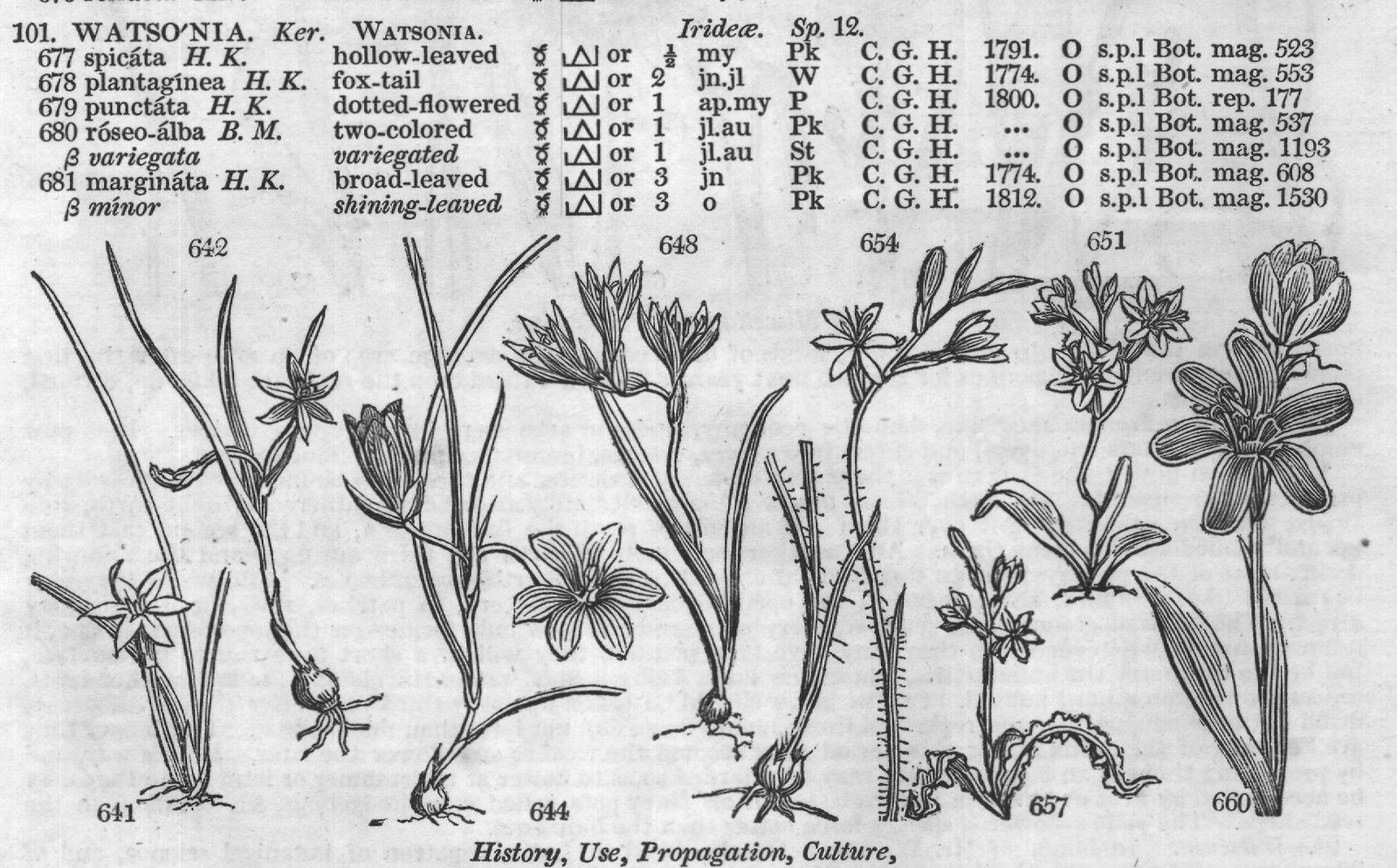
CLASS III. 637 retúsa H. K. 638 scilláris H. K. 639 críspa H. K. sweet-scented squill-flowered curled-leaved or 1 ja.f C. G. H. 1793. O s.p.1 Bot. mag. 629 or 1 ja.f Va C.G.H. 1787. 1787. O s.p.l Bot. mag. 542 or 1 ap.my B C. G. H.
O s.p.1 Bot. mag. 599 96. TRICHONE/MA. Ker. TRICHONEMA. 640 bulbocodium H. K. channel-leaved 641 cruciátum H. K. square-leaved