Home › G › Grev (Crypt Rsh A'ceris Dec Lonic r)
Grev (Crypt Rsh A'ceris Dec Lonic r)
crypt. 134 Rsh 16332 A'ceris Dec. 16333 Lonicéræ Dec.
Sycamore scattered 0 aut.
Honeysuckle powdery 0 aut.
Blsh maple & sycamore 16334 Asperifoliárum Grev. Borage powdery 0 aut. 16335 Ranúnculi Grev.
Crowfoot scattered 0 aut.
Glau. honeysuckles Wsh Asperifoliæ Wsh Ranunculi GASTEROMYCETES.
Class I. ANGIOGASTRES. Division I. Phalloideæ. 2409. PHAL/LUS. Mich. PHALLUS. 2410. BATAR'REA. Pers. BATARREA. 16336 impudícus L. 16337 canínus Huds. 16338 phalloides Pers. 2411. TU BER. Plin. 16339 cibárium Sibth.
Sp. 2-9. su. aut. Wsh woods and hedges Gr.cry.213, 214. fætidus au.sep. Pk rotten hazel trunks Sow. t. 330. inodorus 3 au.
Stinking Morel very fetid 8 scentless smaller 4 Phallus-like long Sp. 1-.
Br banks TRUFFLE.
Division II. Tuberaceӕ.
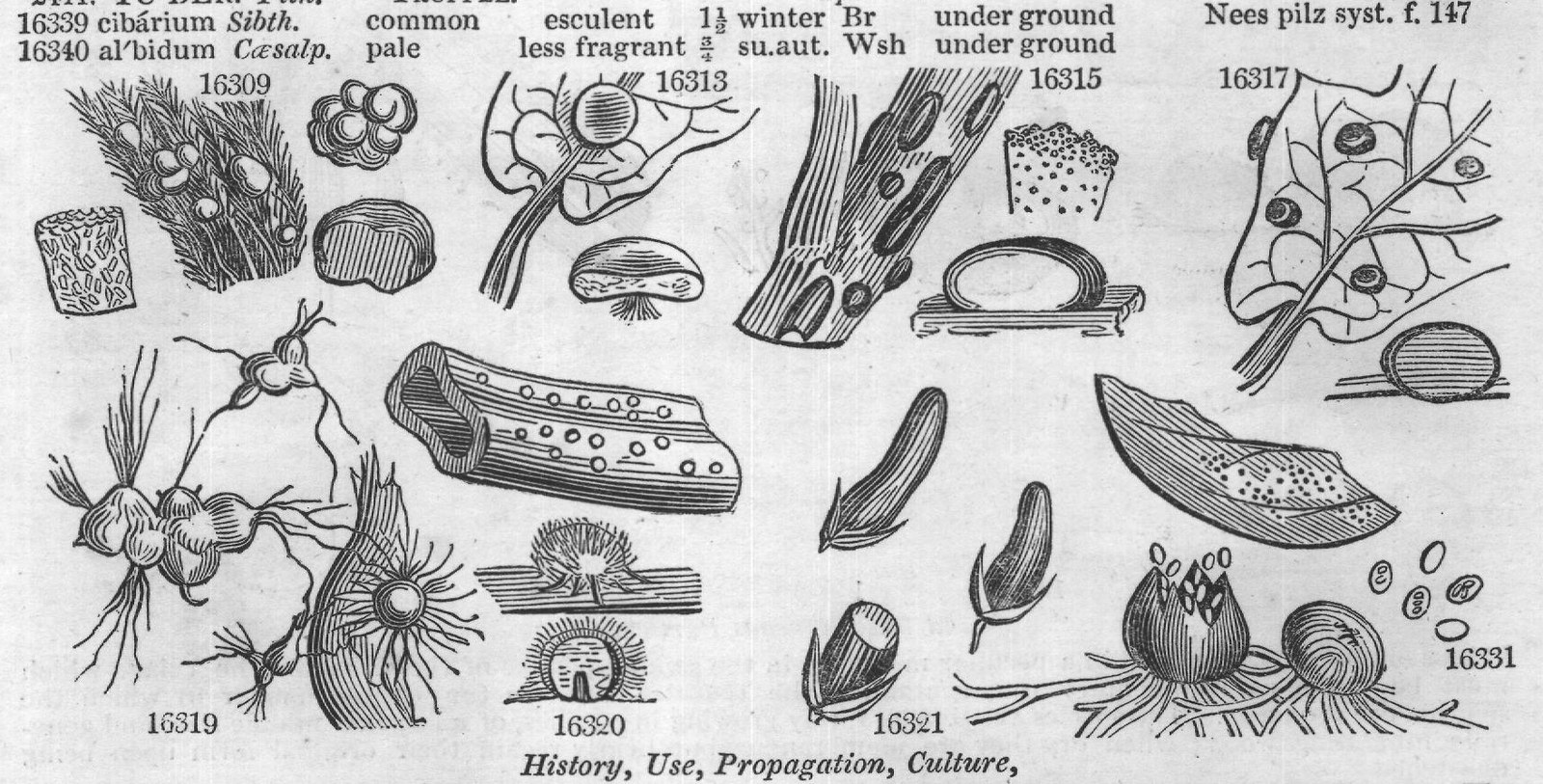
Sp. 2-6. common esculent 1 winter Br less fragrant 16313 under ground less fragrant su.aut. Wsh under ground 16315 16340 al'bidum Cæsalp. pale 16309 Smith spicil. 1. t. 12 Nees pilz syst. f. 147 16317 @ 16331 16319 16320 16321 History, Use, Propagation, Culture, 2405. Rhizoctonia. Subterraneous fungi, reposing upon the roots of living plants, which they destroy. The species appear in the summer or autumn, and are very destructive. They have received their name from their habits; ρiζa, a root, and κτεivω, to destroy. They are very nearly related to the subterraneous Sclerotia. R. crocorum grows parasitically on the roots of the cultivated Saffron, Crocus sativus, in France, and is so pernicious as to have acquired the name of la mort du safran. It is very destructive, soon causing the bulb to perish, and spreading with great rapidity over a whole field of that valuable crop, if not speedily stopped by a trench fifteen to eighteen inches deep, to cut off the communication between the infected and the sound. plants. The smallest quantity of earth from an infected field is said to be capable of communicating this plague, even if the ground were not planted with saffron till twenty years afterwards. " Hitherto this de. structive parasite has not been heard of but in France. The plants are of an irregular knobbed figure, from half an inch to an inch long, of a light reddish brown, scarcely bursting; granular and paler within. Long branching capillary roots are sent out in all directions, propagating the plants very extensively and readily by offsets which attach themselves to the saffron, and multiplying in the substance of the bulbs soon destroy them." (Smith.) 2446. Periola. From περi, about, and 10λoς, hairiness, in allusion to the appearance the species exhibit when growing upon the roots of plants, or decaying fungi. ORD. IX. TRIBE I.
FUNGI HYMENOMYCETES. 16309 Gregarious roundish but very irregular tuberculose orange-yellow within and without or whitish 16310 Depressed epiphyllous scattered or very confluent reddish fulvous 16311 Minute on both sides of the leaf numerous dark mostly angular and subconfluent 16312 Black very minute roundish or oval numerous depressed 16313 Epiphyllous orbicul. flattened at length somew. concave in middle fixed ben. by a central filamentous point 16314 Minute somewhat scattered or partially aggregate very black orbicular depressed 16315 Deep-black oval or elongated cernuous at length substriate or rugose white within 16316 Roundish or oval confluent corneous externally and black paler within and concave 16317 Epiphyllous scattered globular or subdepressed smooth pale at length black, Substance very corneous 16318 Rounded or oblong sometimes confluent white at length brown or black corneous externally, within somewhat hollow and carnose 16319 Rufous, Filaments few spreading over the bulb in the form of a disk 16320 Round deformed downy white 16321 Horn-like cylindrical powdery and purple-black outside, white inside 16322 Very minute on both surfaces of the leaf, Filaments forming a dense whitish web 16323 On both sides of the leaf very globular nearly black, Filaments giving the leaf a farinose aspect 16324 On both sides of leaf form. circular pulverul. spots at length conflu. Filam. dichotom. at their extremities 16325 Red-brown minute, Filaments spreading over the whole leaf pulverulent 16326 On the under-surface scattered very visible blackish, Filaments few simple not rendering the leaf whitish 16327 On the upper-surface finely pulverulent, Receptacles minute congregated here and there 16328 On the under-surface thickly covering the whole leaf, Filam. simple granuliferous: bodies pyriform small 16329 On both sides of the leaf forming a light pulverulent surface, Recept. few scattered distinct 16330 On under-surface very numer. min. Filam, few forming no filament. or pulverul, appear. to the naked eye 16331 On both sides of the leaf so crowded as to darken its color, Filaments very long and slender 16332 On the under-surface scattered at length concave, Filaments elongated interwoven 16333 On both sides the leaf very numerous scattered minute, Filaments presenting a glaucous powdery surface 16334 On both sides the leaf scattered becoming confluent pulverulent, Recept. aggregated here and there 16335 Chiefly on under-surface partially scatter. Filam, long flexu. Granulifer. cells oval contain. mostly 4 gran. GASTEROMYCETES.
Class I. ANGIOGASTRES. - Division I. Phalloideæ. 16336 Volva large, Stipes very cellulose white, Cells of the head containing a fetid dull-green sporuliferous slime 16337 Head close to the stipes ovate warted impervious pink 16338 Stipes cylindrical straight mucilaginous 16339 Very rough with warts blackish 16340 Very rough with warts whitish Division II. Tuberacea. 16341 16339 16336 16337 16338 and Miscellaneous Particulars. 2007. Acinula. Very similar to Sclerotium or Periola; but distinguished by the diffluent coat, containing a resembling an acinus in a berry, whence the name. A. Clavus is the Ergot of corn. nucleus resembling an acinus in a berry, whence the name. A. Clavus is the Ergot of corn. 2408. Erysibe. A Greek name of mildew. Most of the productions arranged under this head are known by their the popular name of mildew. They are better characterized by the plants on which they grow, are than by the popular name of mildew. They are better characterized by the plants on which they grow, than by their peculiar differences, which, it is probable, depend very much upon the former circumstance. 2409. Phallus. Large terrestrial fungi, sometimes growing upon rotten wood, not clustered, appearing in the summer after thunderstorms, fetid, and highly poisonous. Their form is so similar to that of the φaλλoς of the Greeks, as not to be overlooked. 2410. Batarrea. So named by Persoon, in honor of Antonio Batarra, professor of botany in the Lyceum at Rimini, and author of a Historia Fungorum Agri Ariminensis, published at Faenza, in 1759, in quarto, with forty plates. A very curious plant found only in England, where, however, it is exceeding rare. The volva or wrapper is about the size of a hen's egg, originally of three slightly coriaceous layers, hollow internally, when a spongy stalk is formed which rises suddenly to its full height of about twelve inches. This stalk carries up on its summit full half the innermost layer of the vol externally with copious brown sporules intermixed with fibres. volva, which is white and smooth within, and covered 2411. Tuber. An ancient Roman name. T. cibarium is the famous truffle, so celebrated in the annals of CRYPTOGAMIA. flocculent aut.
Sp. 1-4.
Rufes. way sides 2412. RHIZOPO'GON. Fr. RHIZOPOGON. 16341 álbus Fr. white Lycopérdon gibbósum Dicks.
CLASS XXIV.
Bull. champ- t. 404 confluentear. sp. W Division III. Nidulariacea.
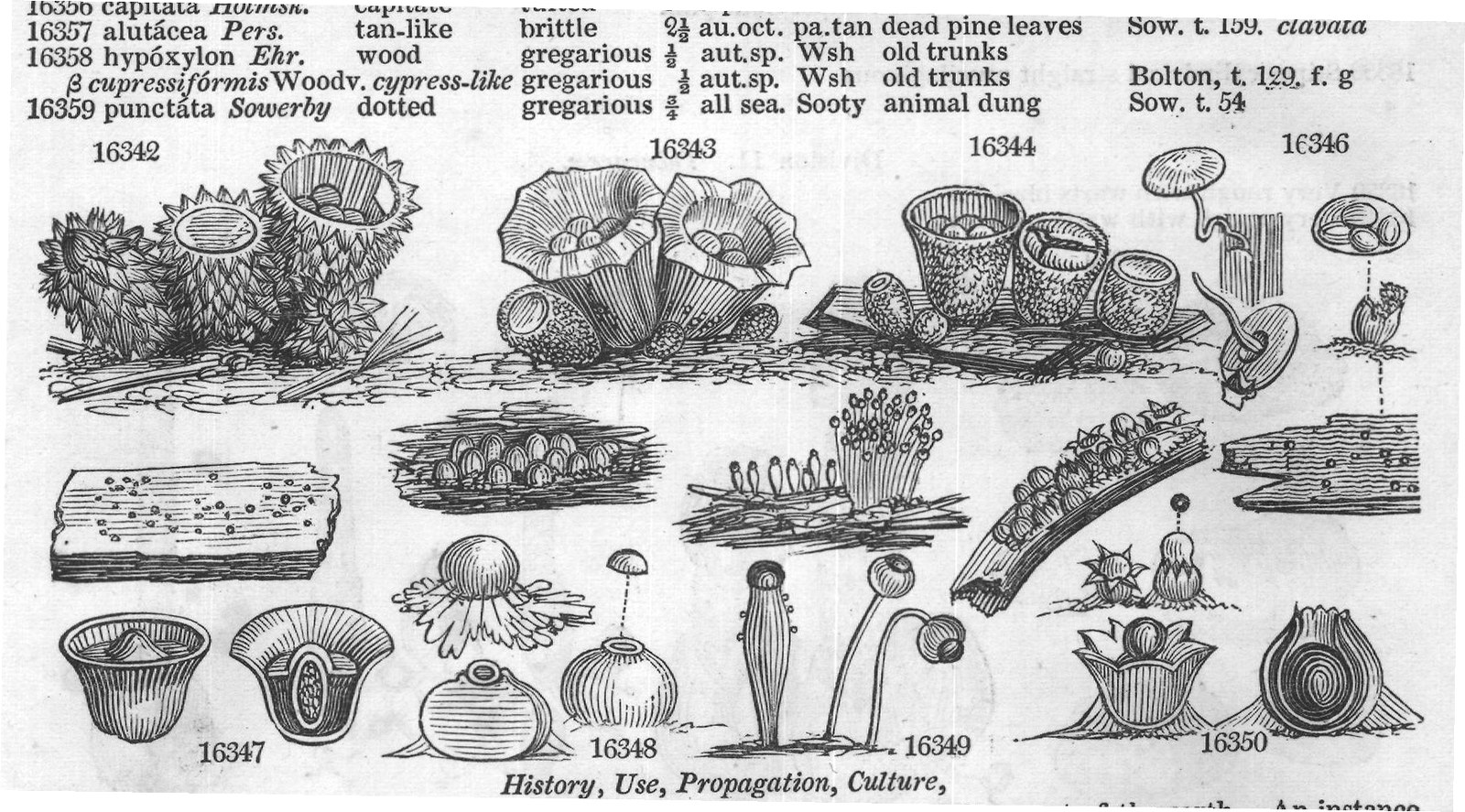
Sp. 3-13. gregarious au. no. Brsh 2413. NIDULA'RIA. Bull. NIDULARIA. on rotten leaves 16342 striáta Bull.. striated 16343 campanuláta Sibth. bell-shaped flocculent su.aut. Ciner. shavings of wood 16344 Crucibulum Hoffm. crucible coriaceoussu.aut.
Oc.fer pine bark 2414. MYRIOCOCCUM. Fr. MYRIOCOCCUM. 16345 præ'cox Fr. early 2415. POLYAN GIUM. Lk. POLYANGIUM. 16346 vitellínum Lk. yolk of egg gregarious 0 au.oct. Y Sow. t. 29. hirsuta Sow. t. 28