Grev
crypt. 86 2420. XYLA'RIA. Hill. XYLARIA.
Sp. 11-29. 16351 hypóxylon Grev. wood various 2 all sea. Bl stumps of trees Sower. t. 55 16352 digitáta táta Pers. fingered tufted 2 all sea. Bl stumps of trees 16353 polymórpha Grev. polymorph. variable 16354 grácilis Grev. slender simple 2 aut. Bl 3 aut.
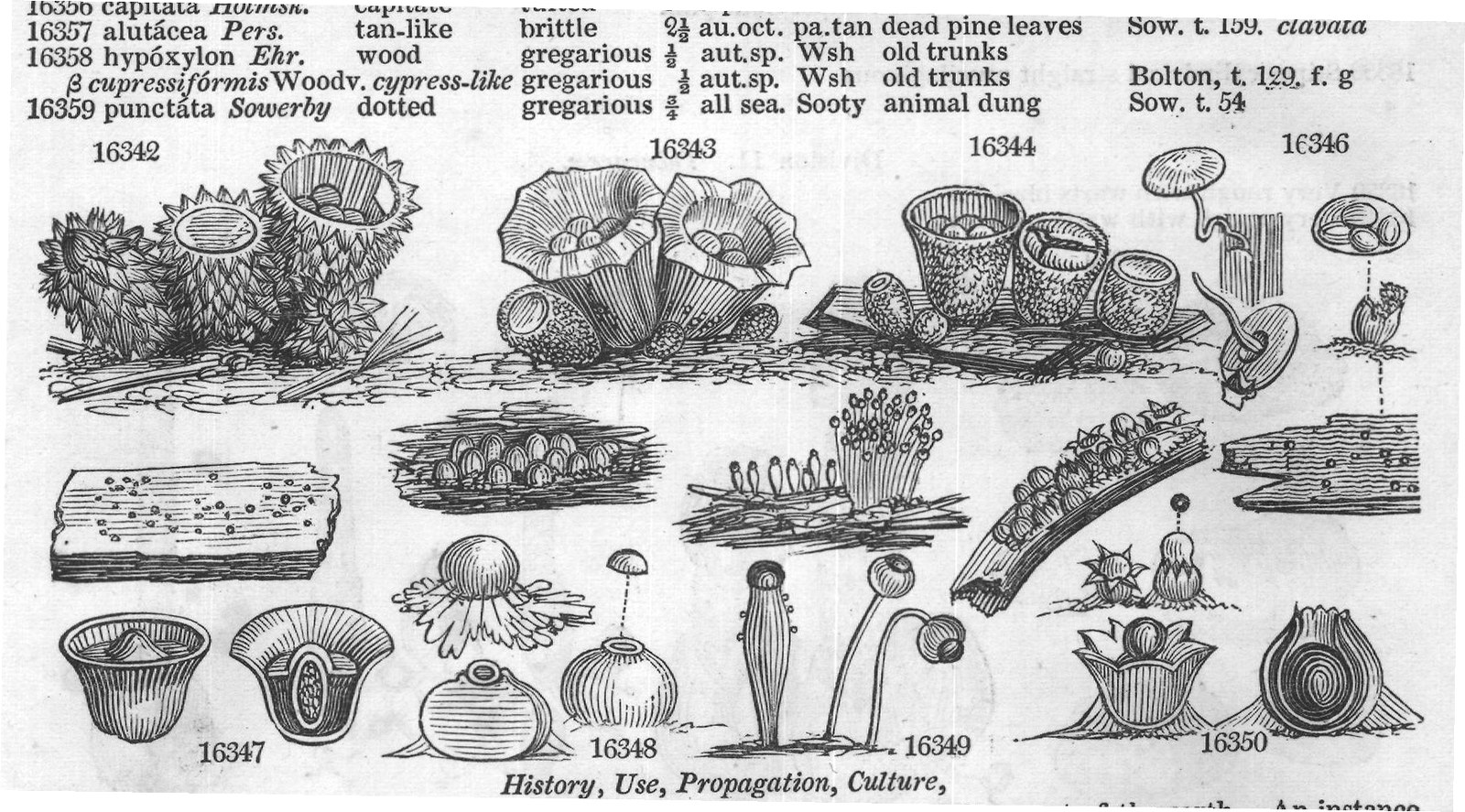
Br 16355 entomorhiza Dicks. insect-root. stalked 16356 capitáta Holmsk. capitate tufted 16357 alutácea Pers. tan-like brittle 16358 hypóxylon Ehr. wood gregarious ẞ cupressifórmis Woodv. cypress-like gregarious 16359 punctáta Sowerby dotted 16342 2 aut. Fusc. 3 sep. oc. Br 2 au.oct. pa.tan stumps of trees moist places dead larvæ of insects on Scler. cervinum dead pine leaves aut.sp. Wsh old trunks aut.sp. Wsh old trunks all sea. Sooty animal dung 16343 16344 Dicks. crypt. 1.t. 3.f.3 Sow.t.354.agariciformis Sow. t. 159. clavata Bolton, t. 129. f. g Sow. t. 54 16346 16347 16348 16349 History, Use, Propagation, Culture, 16350 cookery. Dogs are taught to find this fungus by the smell, and to scratch it up out of the earth. An instance is recorded of a man having possessed this power. It is brought to table either simply boiled, or stewed in various forms. It is reported to have a stimulating aphrodisiacal quality, which perhaps renders them more popular than their flavor, which is trifling. Truffles are found under the surface of the ground in various parts of Europe, where the soil is light and dry; as well as in Japan and the East Indies. There are said to be numerous varieties of color. 2412. Rhizopogon. Large or middle-sized Fungi, emerging from the earth, and resembling potatoes; scarcely eatable; but, according to Gleditsch, possessing aphrodisiacal qualities. On the outside covered with netted corymbose rooting fibres, whence the name, from ῥiζa, a root, and πωγωv, a beard. 2413. Nidularia. A diminution of nidus, a nest. The plants consist of a leathery cup containing several lenticular bodies supposed to contain sporules, and all together resembling a bird's-nest with eggs. 2414. Myriococcum. From μuρioς, a thousand, and zozzos, a little capsule. Related to Sclerotium. The only species consists of superficial deformed confluent tubercles, 2-4-lines broad, at first sight resembling a white compound Sphæria with prominent brown orifices. 2415. Polyangium. Named by Link, from πoλuς, many, and aγγiov, a capsule. Easily distinguished from the last by the internal grumous substance, which Nees and Fries consider unequal sporidia. 2416. Atractobolus. From aτρaκτoς, a spindle, and βaλλω, to cast. The bladder which contains the sporules, is fusiform and closed, and is ejected from the base of the cupule as soon as the operculum is thrown off. 2417. Thelebolus. From θηλη, a nipple, and βaλλω, to emit. The uterus protrudes a globose papilliform vesicle. This is found on the dung of swine , after rainy weather in June and July. Tode compares it to the ORD. IX. TRIBE II.
FUNGI GASTEROMYCETES. 16341 Round somewhat rugose whitish-brown slightly fibrous at base Division III. Nidulariacca. 16342 Obconical hirsute bright-brown striated inside 16343 Campanulate villous cinereous-brown lead-colored and shining inside 16344 Campanulate-cylindrical truncate at each end somew. downy ochrey-brown smooth and pale-yellow inside 16345 Tubercles superficial deformed confluent, at first sight resembling some kind of compound sphæria 16346 About the size of a grain of sand Division IV. Carpoboli. 16347 Resembling to the naked eye flour scattered about 16348 Subglobose saffron-color gregarious sessile 16349 Stem-like receptacle inflated upwards (rarely filiform) Pointed capitular vesicle round depressed black ẞ Stem-like receptacle globose, Stipes oblong filiform, Capitular vesicle dot-like black 16350 Globose pale-yellow, Orifice regular stellate toothed Class II. PYRENOMYCETES. - Division I. Sphæriacei. 16351 Gregarious branched compressed black white and farinaceous towards the apex downy at the base 16352 Gregarious somewhat tufted black, Peduncles glabrous more or less united at their base, Receptacle cylindrical terminated by a sterile acuminate apex 16353 Black gregar. simp. or divid. Pedunc. pass. into a ventric. recept. contain. spherules ben. its whole surface 16354 Stipes elongat. cylindr. equal somew. flexuose, Recept. smooth roundish-ovate brown, Spherules obl. pale 16355 Fleshy, Head globose fuscous, Stipes thin very long 16356 Fleshy, Head ovate globose brown, Stipes yellow becoming blackish 16357 Fleshy soft, Head clavate pale tan-color confluent with the stipes 16358 Corky simple and branch. compressed at first whitish powdery afterwards naked and black, Stipes villous apressed Smaller simple, Head distinct cylindrical conical acuminate 16359 Stipitate turbin. Disk truncate white dotted with black blackish externally 16351 16359 16354 16355 16358 16353 and Miscellaneous Particulars. 16356 16357 roe of a fish in appearance, and to poppy-seed in size. The color is a tawny yellow. Each individual is globular, attached at the bottom by capillary roots, and crowned by a small papillary tubercle of a more orange or golden hue than the rest. 2418. Pilobolus. Named from πiλoς, a cap, and βaλλω. A very natural genus, consisting of gregarious little fungi, of a very fugacious nature, inhabiting dung, appearing in the summer and autumn; when full grown they resemble species of Mucor, but in a younger state they are more evidently interwoven, and resemble Sphæria or Sclerotium. 2419. Sphærobolus. From σφaiρa, a globe, and βaλλω. The peridium is double, membranous inside, at length becoming elastically inverted, and emitting a globose solid sporangium, filled with sporidia clustered in the centre .
Epiphytous persistent plants, generally appearing in the autumn. centre. Epiphytous persistent plants, generally appearing in the autumn. S. stellatus is found in various parts of Europe in autumn upon rotten wood or branches of trees, heaps of sawdust , or in the tan-pits of hothouses.
In an early state each plant consists of a pale yellow globe larger than a mustard seed. Several such grow crowded in patches, bound down as it were by a fine cottony web. After a while each plant bursts into several grow six or eight inches a whitish globular mass of powdery seeds from its internal cavity. Sometimes this ball of seeds remains sticking to the points of the rays. When fallen to a distance, the skin of this ball is found empty, the seeds having flown out, in its passage, through a hole in its base. (Smith.) 2420. Xylaria. From ξoλov, wood, in allusion to their station, or to their woody and durable texture. Once included in Sphæria. 3 U CRYPTOGAMIA. 2421. STROMATOSPHERIA. Grev. STROMATOSPHERIA. 16360 concéntrica Grev. concentric suberose Sp. 24-58. 1 aut. Bl ash trunks CLASS XXIV.
Sow. t. 160. fraxinea 16361 deústa Grev. scorched fleshy all sea. Brsh rotten stumps Sow. t. 338. maxima 16362 fúsca Grev. fuscous suberose 0 all sea. Br dead hazel 16363 unduláta Grev. wavy broad aut.
Bl 16364 striæfórmis Grev. striated gregarious 0 aut.
BI decayed branches herbaceous stems