Home › E › Eng (Bot Jac obs t End via W)
Eng (Bot Jac obs t End via W)
bot. 539 Jac. obs. 4. t. 80 11338 Endívia W.
Endive 11339 divaricátum W. branching 11340 spinósum W. prickly 1658. BACA'ZIA. Fl. per. BACAZIA.
Ocul 2 jl.au B Oun 2 jl.au B un 2 jl.au B E. Indies 1548. Sr.m Barbary 1798. S co Candia 1633. S co Bauh.prodr.t.62 11341 spinósa Fl. per. prickly or 4 my.jl Compositæ. Sp. 1.
Peru ... 1825. C p.l 1659. SCO'LYMUS. W. GOLDEN THISTLE.
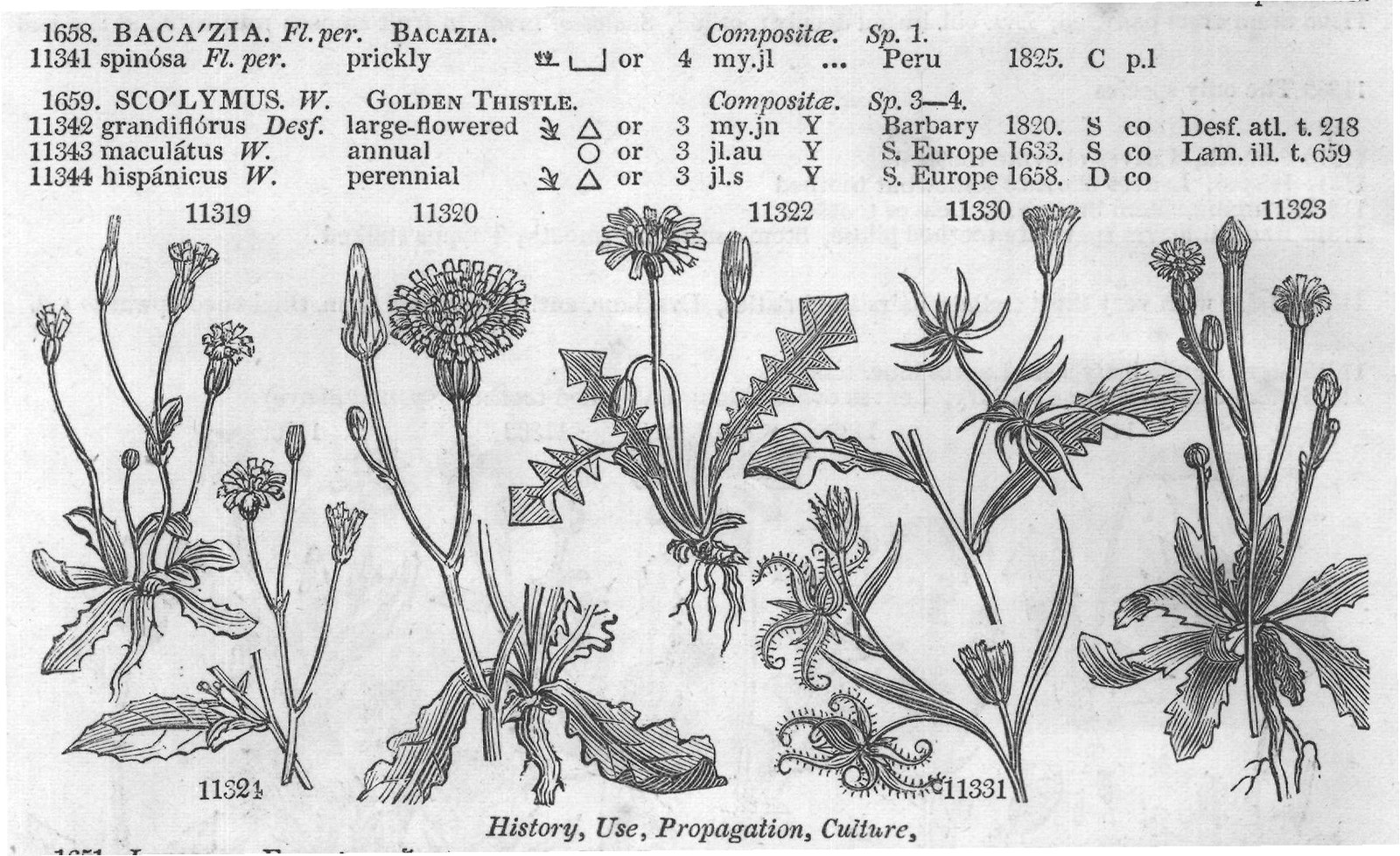
Composite. Sp. 3-4. 11342 grandiflórus Desf. large-flowered or 11343 maculátus W. annual 11344 hispánicus W. perennial or or 3 my.jn Y 3 jl.au Y 3 jl.s Y Barbary 1820. S co S. Europe 1633. S co Desf. atl. t. 218 Lam. ill. t. 659 11319 11320 11322 S. Europe 1658. D co 11330 11323 11321 11331 History, Use, Propagation, Culture, 1651. Lapsana. From λaπaζω, to purge. The Lapsana, says Pliny, gently relaxes the body. L. communis is called nipple-wort, in English, and herbe aux mamelles, Fr., having been formerly applied to the breasts of called nipple-wort, in English, and herbe aux mamelles, Fr., having been formerly applied to the breasts of women to allay the irritation occasioned by nursing. 1652. Zacintha. A plant growing in the island of Zacintha or Zante. It was formerly included in Lapsana, under the name of L. Zacintha. 1653. Rhagadiolus. From ρaγaς, a slit ; each division of the calyx being hollowed out in the middle so as to resemble a furrow, or little gutter. 1654. Moscharia. This plant gives out an agreeable smell of musk. An annual plant, with stem-clasping pinnatifid deeply cut leaves, found in sandy waste places in Chili, where it is commonly called Almizelillo. 1655. Catananche. Vaillant explains the meaning of this word, by deriving it from the two Greek words, xaTa, and avarxn, necessity that is to say, a plant which compels admiration. What is certainly known of , and avaγκη, necessity: that is to say, a plant which compels admiration. What is certainly known of its origin is, that it was employed by Dioscorides to designate a plant used by the women of Thessaly, in The modern genus, which contains two or three species of ornamental border annuals, can have no reference to that of the ancients, one kind of which is believed to have been Ornithopus compressus, and another Astragalus pugniformis. John Bauhin calls Lathyrus Nissolia by the name of Catananche leguminosa. 1656. Triptilion. A genus instituted by the authors of the Flora Peruviana, and named from τρεiς, three, and πterov, a feather, on account of the three divisions of the pappus. The species mentioned above is a πτελov, a feather, on account of the three divisions of the pappus. The species mentioned above is a very pretty little annual, or rather biennial plant, flowering during all the winter months in any place whence frost is excluded, but it requires not to be kept too dry. There is a fine species in Chili, with bright blue flowers, but it has not been yet introduced. The inhabitants of South America employ the flowers of the different species as everlasting flowers, for which their dryness renders them very well adapted. 1657. Cichorium. In Greek κiχωρη. De Theis's remarks are upon this subject excellent. Bodæus, he observes, Linnæus, and others, have derived this name from κiω, to come, and χωρiov, the field; that is to say, ORDER I.
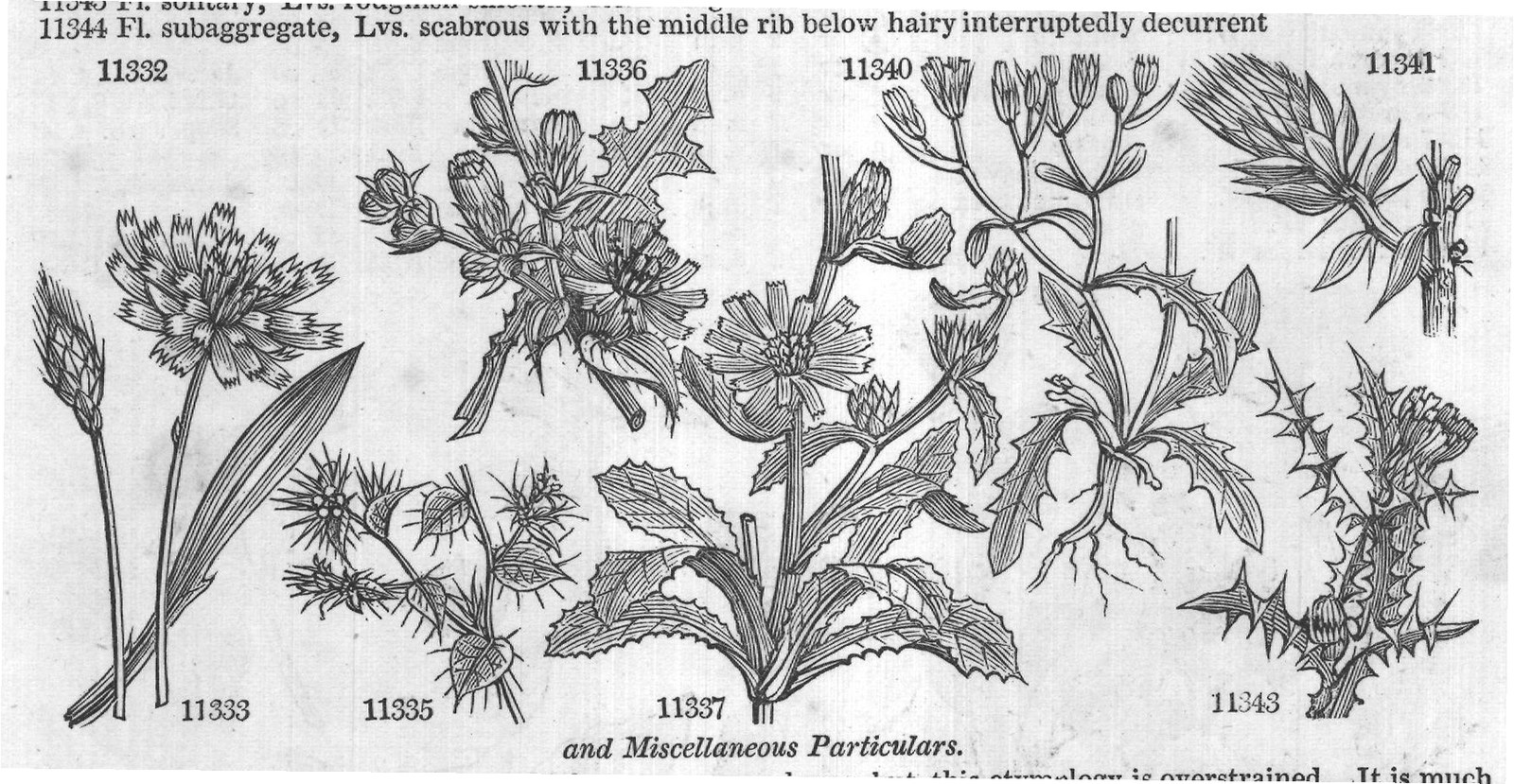
SYNGENESIA ÆQUALIS. 11317 Leaves toothed roughish, Invol. hispid, Pappus of disk stipitate plumose: of the ray sessile setose 11318 Hispid, Calyxes hairy, Stem branched, Lvs. lanc. toothed 11319 Nearly glab. Invol. obl. imbricated, Stem branched somewhat leafy, Radical leaves dentato-sinuate 11320 Stem branched leafless glab. Pedunc. with small scales, Lvs. runcinate obtuse scab. 11321 Different from the last in having a smooth involucrum 11322 Stemless, Scape 1-fl. Leaves runcinate pinnatifid, Terminal lobe rhomboid 11323 Scape branched very thick and fistulose upwards, Leaves obovate oblong toothed 11324 Invol. of the fruit angular, Stem panicled, Pedunc. slender, Lvs. ovate petiolate angulato-dentate 11325 Caulescent branched, Leaves ovate stalked doubly toothed 11326 Caulescent branched, Lvs. angular-toothed: lower lyrate-pinnatifid, Pedunc. and invol. smooth 11327 Caulescent panicled, Stem downy below, Radical leaves lyrate toothed : upper lanc. entire 11328 Rad. leaves lyrate acute, Cauline sagittate amplexicaul. toothed 11329 Fruit smooth spreading, Cauline leaves lanc. undivided 11330 Fruit smooth spreading, Leaves lyrate 11331 Fruit prickly spreading, Leaves linear lanc. entire 11332 Leaves amplexicaul. pinnatifid: segments deeply jagged 11333 Lower scales of invol. ovate mucronate, Leaves villous linear sub-bipinnatifid at base 11334 Lower scales of invol. lanc. Leaves lanc. toothed 3-nerved 11335 Leaves cordate spiny 11336 Flowers sess. axill. in pairs, Leaves runcinate 11337 Flowers axillary twin sessile, Leaves obovate toothed 11338 Pedunc. axill. twin: one long 1-fl.; the other very short about 4-fl. Flowers capitate 11339 Pedunc. axill. twin : one long 1-fl. ; the other very short about 2-fl. Stem dichotomous, Rad. lvs. runcinate Stem dichotomous , Rad. lvs. runcinate 11340 Flowers axill. solitary, Stem dichotomous, Branches naked spiny, Lvs. lanc. runcinate toothed 11341 Leaves obovate mucronate cartilaginous, Flowers solitary 11342 Fl. solitary lateral sessile, Lvs. decurrent, Stem subsimple villous erect 11343 Fl. solitary, Lvs. roughish smooth, Stem winged toothed 11344 Fl. subaggregate, Lvs. scabrous with the middle rib below hairy interruptedly decurrent 11332 11336 11340 11341 11333 11335 11337 and Miscellaneous Particulars. 11343 it is a plant found wild in fields, - which grows every where: but this etymology is overstrained. It is much more natural to suppose that the Egyptians, who used this plant in great quantities, would have communicated to the Greeks, along with the manner of using it, the name by which it was known in Egypt, which appears from Forskahl to be chikoùryeh. Pliny remarked, that the Egyptians made their chicory of much consequence, and it is very well known that, at the present day, chicory or similar plants constitute half the food of the common people in Egypt. In like manner, there can be little doubt that the specific terms Endivia and Intybus, are both derived from the Arabic name hendibeh .
The leaves of Cichorium Intybus are employed by the French under the name of Barbe du Capucine, as a kind of winter salad; for which purpose the leaves are blanched like Endive. The most common method of cultivating the plant, is to SOW the seed in drills in the end of July, and to keep, the plants about six inches apart, and quite free from weeds. In the winter the roots are taken out of the ground and packed up in a warm cellar among earth, in layers, like bottles in a wine cellar, the crowns only of the roots being exposed. In a few days, young leaves are produced in great abundance, from the situation in which they are cultivated quite blanched, and, if not grown too rapidly, with an agreeable taste. There is also a variety of C. Intybus, called Chichorée à café, which is cultivated extensively in France for the sake of its roots, which are taken up in the winter season, cut into squares, dried artificially, and afterwards, being roasted, are ground along with their coffee, for which they serve as an adulteration. There are those, however, who assert, that it is to this admixture of Succory root that the superior flavor of the French to the English coffee is to be attributed. 1658. Bacazia. Named by the authors of Flora Peruviana, in honor of George Bacas, professor of botany Peruviana, in honor of George Bacas, professor of botany at Carthagena. 1659. Scolymus. The Greek name of a spiny plant, which appears to have been the modern artichoke. The word itself is derived from σκoλoς, a spine. S. hispanicus has simple fusiform roots, soft and sweet like Scorzonera, and equally good to eat. The leaves and stalk also abound with a milky juice, and the people of Salamanca eat it in the same manner as Cardoons. The flowers are used for adulterating saffron. X x 4 SYNGENESIA ÆQUALIS.
CLASS XIX. 1660. ARC'TIUM. W.
BURDOCK. 11345 Láppa W.
Composite. Sp. 3-4. smooth-headed W 3 jl.au Pu Britain 11346 Bardána W. woolly-headed W 3 jl.au Pu Britain wa.gr. S co wa. gr. S co