Home › H › Host (Gra t Eng bot Eng bot Eng bot)
Host (Gra t Eng bot Eng bot Eng bot)
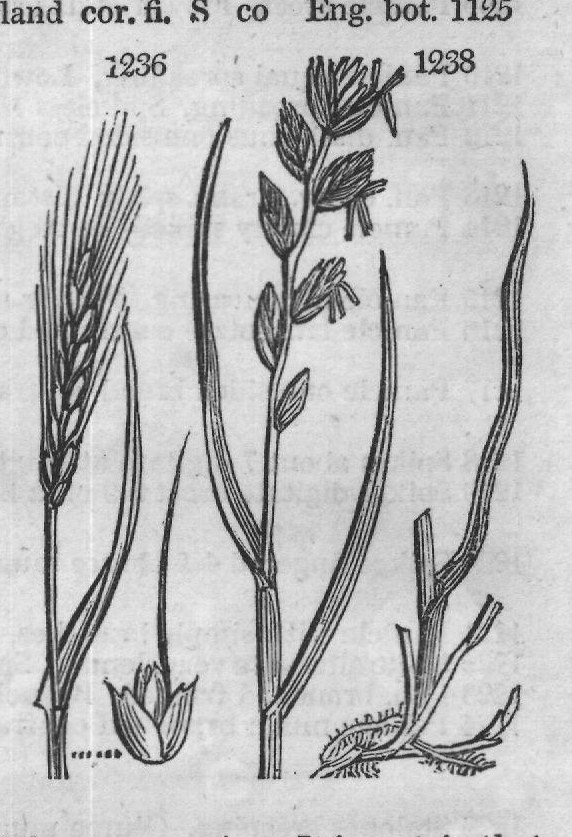
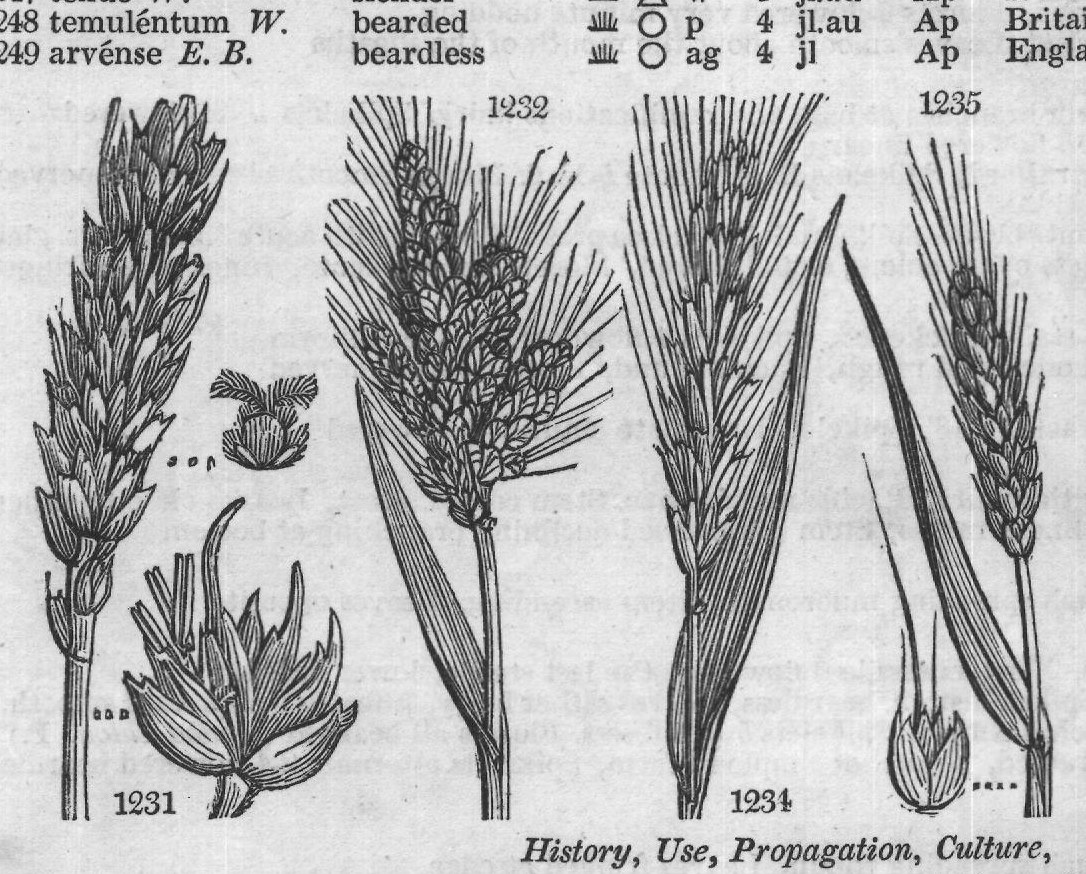
gra. 2. t.23 Eng. bot. 315 Eng. bot. 1124 Eng. bot. 1125 1238 1231 1234 History, Use, Propagation, Culture, T. æstivum, and the five following sorts, are most probably variations of the same species. It is certain that winter-wheat sown in spring will ripen the following summer, though the produce of succeeding generations of spring-sown wheat is found to ripen better. White, red, awned, and beardless wheat change and run into each other on different soils and in different climates; and even the Egyptian wheat is known to change in this country to the single-spiked common plant. There is a sort of summer-wheat apparently a distinct species from those which have been mentioned; the agricultural treatment of which, as well as the general appearance, is similar to that of barley. The straw is short and soft, the ears awned, small, and easily threshed, and the grain may be sown in May and reaped in August or September. It is very subject to the black disease, and though it has been tried in a number of places has never come into general cultivation. A variety from India, called "hill-wheat," and another from the Cape of Good Hope, have also been tried with no better results. But the hill-wheat, and, we believe, the hill-barley, also, of the northern provinces of India has been cultivated with success in Germany, under the direction of the Archduke John of Austria. T. monococcum grown in Switzerland, is of similar appearance.
T. spelta appears a distinct species, and more hardy than common wheat; it has a stout straw almost solid, with strong spikes and chaff adhering firmly to the grain. The grain is light, yields but little flour, and makes but indifferent bread. It is grown in Switzerland in elevated situations, where common wheat would not ripen: also in Bavaria and other parts of Germany. It is sown in spring, and ripens in July and August. Of the common wheat there are many varieties, but the most permanent are the red and white grained, and the spring-wheat, which is generally red. The Hertfordshire reds and whites, woolly eared, awned, and nearly fifty other names are merely sub-varieties of the red and white. Wheat answers best when treated as a biennial, though it does not remain above one year in the ground. Provided the soil be well prepared and dry, and the grain sown in time, the plants do not suffer from the greatest cold of our climate, or even that of Russia. In the latter country, and in the northern counties of Britain, the fields are covered with snow, which retaining a temperature of from 30 to 32 degrees, the plants are found to vegetate and establish their roots firmly in the soil. The snow is not thawed off till the weather is decidedly warm in spring, when the plants make rapid progress, apparently more so than in warmer climates. Wheat, like all culmiferous plants, may be said to have two distinct sets of roots; the seminal or tap-root, and the coronal or surface-root, the former proceeding from the embryo, and the latter from the first joint of the stem. The former seem intended to nourish the plant while young, to fix it to the soil, and to penetrate into the sub-soil for water; the latter to search along the surface among the lighter materials of the soil for nutritive particles. There is in the Banksian museum, a stalk of wheat of ordinary length with a tap-root six feet long, which had penetrated into a subsoil of limestone brush, and was taken up in digging a drain. It grew on the estate of J. Fane, Fsq. at Wormley in Oxfordshire, in 1818. M. Sageret, a scientific French agriculturist, found that when wheat or any of the other grains were etiolated immediately after germination, by growing too rapidly or being sown too thick, the first joint from which the coronal or surface roots proceed is raised above the ground, and in consequence either throws out no roots at all, or so few as to nourish it imperfectly, in which cases it either dies before it comes into flower, or before the grains are matured. This accurate statement of what takes place, is well calculated to show the bad effects of sowing winter-wheats too early, or spring-corn too late, and grasses in general too thick. Animal substances, and especially bones and urine, are the best manures for wheat, as containing much gluten, a substance found in a greater proportion in that grain than any other. Next to animal manures lime is important, as tending to the same effect by chemical combinations. Wheat is almost every where cultivated, both in the temperate and torrid zone, to the 45th degree of north latitude, and the height of 2000 feet above the level of the sea in southern latitudes.
The insects and diseases which attack wheat are various. The grubs of chaffers and beetles, as well as the wire-worm (the larva of different species of Tipula), attack the roots; the wheat-fly (Tipula tritici) the ears; the smut or black the grains; and the mildew, rust, or blight, different names for the same disease, the whole plant. The mildew Sir J. Banks determined to be produced by the growth of a minute fungus on the straws and chaff of the plant, and Dr. Cartwright (Phil. Mag. Oct. 1820.) ascertained it might be destroyed by watering with salt and water. The smut converts the farinaceous part of the grain into a black powder, and is supposed to be prevented or lessened by steeping the grain previously to sowing in any strong saline mixture. It ORDER II.
TRIANDRIA DIGYNIA. 1232 Spike compound at the base, Spikelets 3-flowered ventricose imbricated, Terminal floret beardless neuter 1233 Spikelets 4-flowered ventricose pubescent imbricated bearded, Terminal floret barren, Glumes obtuse 1234 Spikelets 4-flowered ventricose roughish, Two middle florets sterile, Paleæ unequal outer fringed 1235 Spikelets 3-flowered ventricose roughish, Intermediate floret barren, Glumes ovate 1236 Spikel. ventr. imbr. bearded, Barren floret with a short, fertile with a very long beard, Glumes 3-toothed 1237 Spike distich. Spikelets 4-flowered approxim. Two middle florets sterile, Glumes lin. lanc, Stem ascending 1238 Glumes 9-nerved obtuse 4-5-flowered, Florets beardless, Rachis smooth, Root creeping 1239 Root creeping white jointed proliferous 1240 Glumes shortly bearded 3-nerved 5-flowered, Florets bearded, Root fibrous 1241 Spike interrupted, Rachis hispid, Leaves rolled in at edge, Root creeping 1242 Glumes 4-flowered bearded, Spikes lanceolate imbricated, Stems pubescent 1243 Spikelets 4-flowered remote, Two joints of the hairy rachis longer than the spikelet 1244 Spikelets 3-flowered, Ribs of glumes fringed in tufts, Leaves downy 1245 Spikelets lanceolate 8-flowered beardless, Glumes truncate naked, Leaves nerved 1246 Spike beardless, Spikelets longer than glume 1247 Culm slender, Leaves narrow, Spikelets 3-4-flowered 1248 Spike bearded, Spikelets less than glume, Culm rough upwards 1249 Spike nearly beardless, Spikelets as long as calyx 1239 1244 1245 1242 1246 and Miscellaneous Particulars. 1248 is not easy, however, to cure diseases in the vegetable kingdom, and therefore the grand object of the cultîvator ought to be to procure healthy seed, and apply judicious culture. The uses of wheat are well known. The grain yields a greater proportion of flour than every other; for, while 14lbs. of barley yield 12lbs. of flour, and of oats 8lbs., the same quantity of wheat yields 13lbs. It the same quantity of wheat yields 13lbs. It is also more nutritive, 1000 parts of barley yielding 920, of oats 743, and wheat 955 soluble parts. Of these, the gluten of wheat is 90, of barley 60, and of oats 87. (Davy. Ag. Chem. 138.) Gluten is so essential an ingredient article in . 138.) Gluten is so essential an ingredient in bread that the pannary fermentation cannot go on without it, and hence the inferiority of that article in wet seasons, when wheat is blighted or ill ripened, and the advantage of having a stock of old grain, or of grain from the south of Europe, especially of the Mediterranean isles and coasts .
Wheat starch is made from wheat, by steeping it, and afterwards beating it in hempen bags. The mucilage being thus mixed with the water produces the acetous fermentation, and the weak acid thus formed, renders being the mucilage white. After settling, the precipitate is repeatedly washed, and then put in square cakes. cold is repeatedly washed, and then put in square cakes. In drying, the cakes separate into flakes as found in the shops. Starch is soluble in hot water, but not in 4968 Starch is soluble in hot water, but not in cold; and hence, ground down, it makes an excellent hair powder. Its constituents are carbon 43.55 oxygen 49-68; hydrogen 6.77 = 100.
The straw of wheat, from dry chalky lands, is manufactured into hats, for which purpose the middle part of the tube above the last joint is taken, and being cut into lengths of 8 or 10 inches, these pieces split in two are used to form the plait. The operation of plaiting is performed by females and children, who plait it into ribbons of from one to two inches broad, and these are afterwards sown together on blocks or moulds, beginning at the crown, in various shapes according to fancy or fashion. The best straw is produced on the chalky soil about Dunstable, crown, where plaiting is a common occupation. Other grasses afford culms which have also hats occupation. Other grasses afford culms which have also been used and manufactured into much finer and expensive work that those of wheat or rye. Leghorn are work that those of wheat or rye. Leghorn hats are made from the straw of a bearded variety of wheat not unlike rye. It is grown on poor sandy soils on the banks of the Arno, between Leghorn and Florence, expressly for this manufacture. It does not grow above 18 inches in length, is pulled green, and bleached like flax on the gravelly bed of the river. The straws are for the gravelly bed of the river. The straws are not split as in England, which renders the plait tougher and more durable. The value of wheat-straw for thatching, litter, and other purposes, need not be mentioned. T. junceum grows in loose sand on the sea-coast, and by its tough creeping roots and numerous fibres cooperates with Carex arenaria, Elymus arenarius, and Festuca rubra, in keeping them stationary, accumulating more, and eventually rendering drifting sands fit for agricultural purposes .
T. repens, couch, white couch, twitch, dog-grass, quickens, &c. is common in most parts of Europe, and even in Siberia. It is one of the worst weeds in arable lands and gardens, and in the former is only to be destroyed by fallowing or fallow crops, or laying down to grass; and the latter by hand-picking or very deep trenching.
The roots are sweet and nourishing, and are greedily eaten by horses and cattle. Sir H. Davy found them to contain nearly three times the nourishment of the stalks and leaves . 207. Lolium. Loloa is the Celtic name of this grass. L. perenne is the fausse ivraie (see L. temulentum) of the French, from which our term ray-grass is derived, the Dauerende Lolch, Ger., and Loglio vivace, Ital. This appears to be the first grass which was taken into cultivation in Europe, but when is uncertain. Gerarde , Parkinson, appears Plattes, and even Blythe in Cromwell's time, take no notice of it. It is first mentioned cold by notice of it. It is first mentioned by Dr. Plott in 1677. "They have lately sown," he says "ray -grass, Gramen loliaceum, to improve cold sour clayey weeping ground unfit for saint-foin." It was first sown in the Chiltern parts of Oxfordshire, and afterwards by one Eustace at Islip in the same county. There are two varieties of this grass; the perennial, which is of shorter growth than the other, and on sound dry soils will last four or five years, and on rich soils longer; and the annual, or rather biennial, which is tall and larger in all its parts than the perennial, been and larger in all its parts than the perennial, and after producing one bulky crop dies at the root, or, at least, sends up no latter math. After all that has been affirmed of other grasses, none appear so well adapted as the annual rye-grass for producing a bulky crop of hay, with or without red clover; or better adapted than the perennial variety for sowing down with the white althan the perennial variety for sowing down with white clover, to afford three or more years pasture in the rotations of what is called convertible husbandry, or the alternate corn and grass culture. Cock's-foot grass and woolly grass (Holcus) may afford a greater bulk on poor soils, but are far inferior to the ray-grass in regard to nutritive qualities . Sir H. Davy found the value which F4 208. E'LYMUS. W.
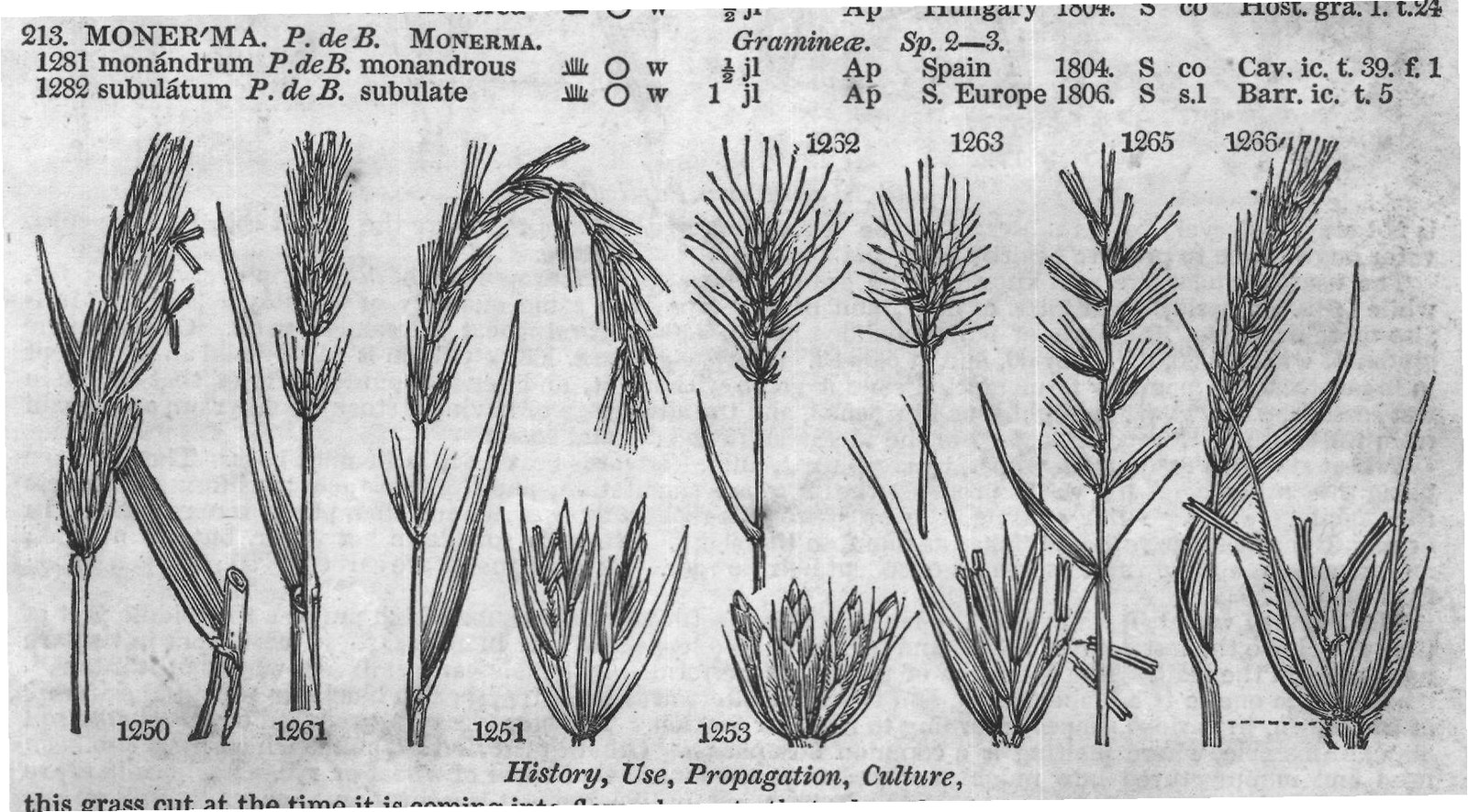
LYME-GRASS. 1250 arenárius W. upright-sea HTT TRIANDRIA DIGYNIA. ag 4 ap.jn Ap CLASS III.
Gramineæ. Sp. 16-24.
Britain sea co. S s Eng. bot. 1672 1251 geniculátus E. B. pendulous 4 jl Ap England sea sh. S s Eng. bot. 1586 1252 sabulósus W. en. glaucous 4 jn.jl Ap Siberia 1806. S co 1253 gigantéus W. gigantic or 5 jl.au Ap Mexico 1790. S co 1254 sibíricus W.
Siberian 1255 téner W. tender A W علا Aw عند 6 jn.jl Ap Siberia 1758. S co Sch.gra.2.t.21.f.1 2 jn.jl Ap Siberia 1801. S co 1256 philadélphicus W. Philadelphian w 4 jl.au Ap 1257 canadénsis W.
Canadian Aw 4 jlau Ap N. Amer. 1790. S co N. Amer. 1699. Sco Mor. h.3. t.2. f.10 1258 virgínicus W.
Virginian 2 jn.jl Ap 1259 striátus W. striated 1260 villósus Ph. villous 1261 europæ'us W. wood 1262 crinítus Sch. long-awned 1263 Cáput-Medúsæ W. Portuguese 1264 júnceus Fisch. rush 1265 hýstrix L.
Porcupine A W علا A للاد لا لا A w علاا علا 2 jn.jl Ap 2 jn.jl Ap Virginia 1781. S co N. Amer. 1790. S co N. Amer. 1802. S co W 2 jn.jl Ap England woods. S s.1 Eng. bot. 1317 1 jn.jl Ap Smyrna 1806. S co Schr. gr. t. 24. f.3 1 jn.jl Ap Portugal 1784. S co Schr. gr. t.24. f.2 2 jn.jl Ap Siberia 1806. S co Mem. msq.1:p.45 W 2 jn.jl Ap Crimea 1770. S co Jacq. ic. 2. t. 305 209. SECAʼLE. W.
RYE.
Gramineæ. Sp. 2. 1266 ceréale W. common عناد ag 3 jn.jl Ap Crimea ...
S