Home › H › Host (Gra t abyss nica W)
Host (Gra t abyss nica W)
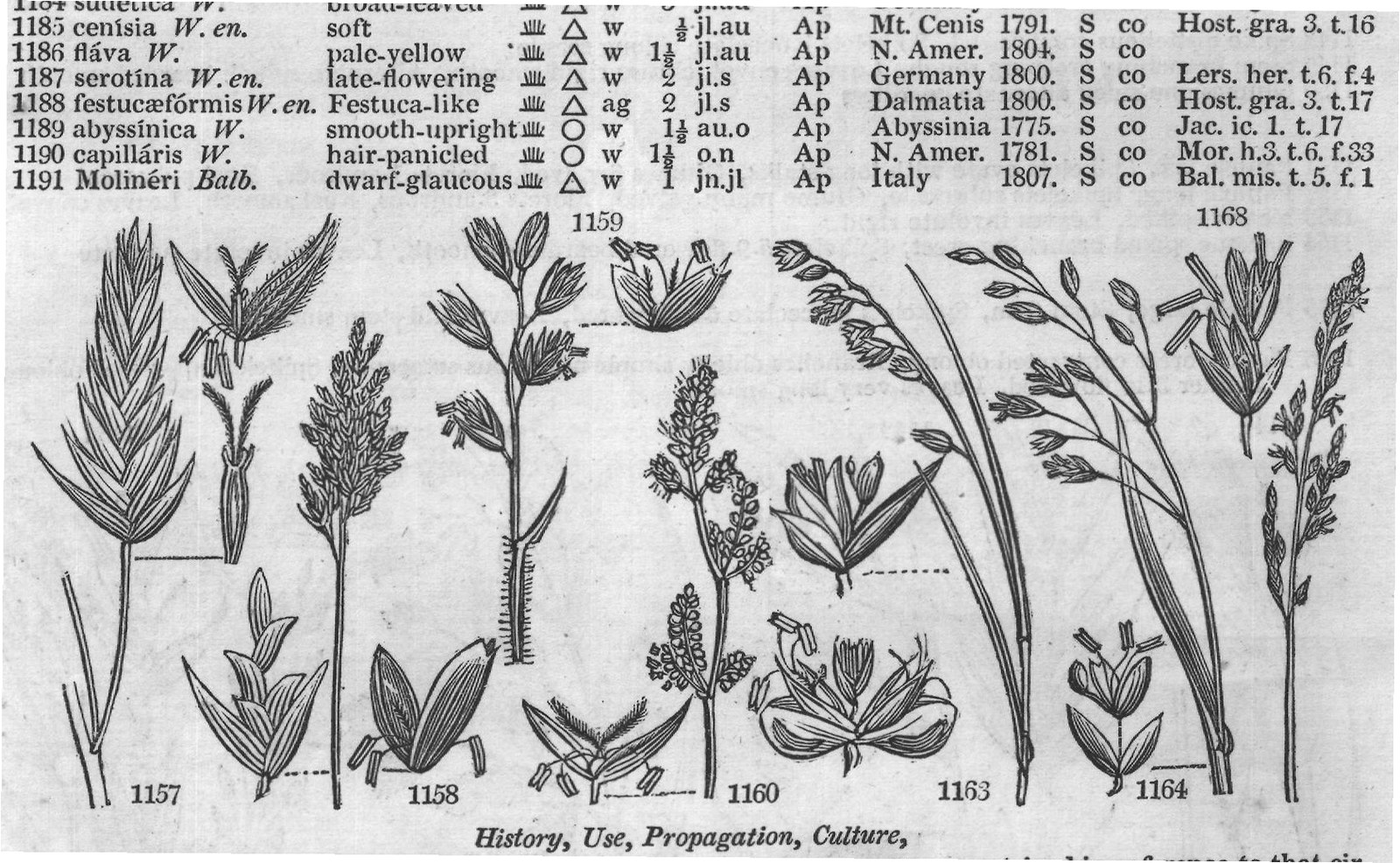
gra. 3. t.17 1189 abyssínica W. smooth-upright w 1½ au.o Ap 1190 capilláris W. hair-panicled 1 o.n Ap 1191 Molinéri Balb. dwarf-glaucous 1 jn.jl Ap Abyssinia 1775. S co N. Amer. 1781. S co Italy Jac. ic. 1. t. 17 Mor. h.3. t.6. f.33 1807. S co Bal. mis. t. 5. f. 1 1159 1168 1157 1158 1160 1163 History, Use, Propagation, Culture, cumstance: κερaς, a horn, and χλoη, grass. 190. Schismus. From σχiσμη, a cleft. The outer palea is emarginate or cleft. 1164 189. Ceratochloa. The seed having three little horns, the name has been contrived in reference to that cir- 191. Triodia. Tρεiς, three, oδouς, teeth, on account of the three teeth of the palea. 192. Beckmannia. In honor of M. Beckmann, the celebrated author of the History of Inventions, and of a Lexicon Botanicum, published in 1801, besides other works. 193. Melica. A name applied in Italy to the Holcus sorghum, L., the pith of which is like mel, honey. M. ciliata and nutans are curious grasses, deserving a place in botanic parterres. 194. Molinia. In honor of Giovanni Ignatio Molina, who wrote an account of the plants of Chile, published in 1782. Of M. cærulea, the fishermen of the isle of Sky make ropes for their nets, which they find will bear the water well without rotting. None of the species are cultivated. 195. Briza. From βρίθω, to balance, the spikelets being continually in a state of balance or suspension in the air. This is an ornamental or curious genus, of little value in agriculture. The perennial species indicate a poor soil, and are bitter in taste. B. maxima is sometimes sown as a border annual. 196. Poa. Пoп is the Greek name of herb. This genus affords several valuable pasture, and some good hay grasses. P. aquatica is one of the tallest of British grasses, with a powerful creeping root, a native of most parts of Europe, and very common in the fens of Cambridgeshire and Lincolnshire, where it not only affords rich pasturage in summer, but forms the chief winter's fodder. It is sometimes cut thrice in one season. grows sometimes cut thrice in one season. It grows not only in very moist ground, but in deep water; and with cat's tail, burr-reed, &c. soon fills up ditches, and occasions them to require frequent cleansing. In this respect it is a formidable plant even in slow rivers. In the isle of Ely they cleanse these by an instrument called a bear, which is an iron roller with a number of pieces of iron like small spades fixed in it this is drawn up and down the river by horses walking along the bank, , ORDER II.
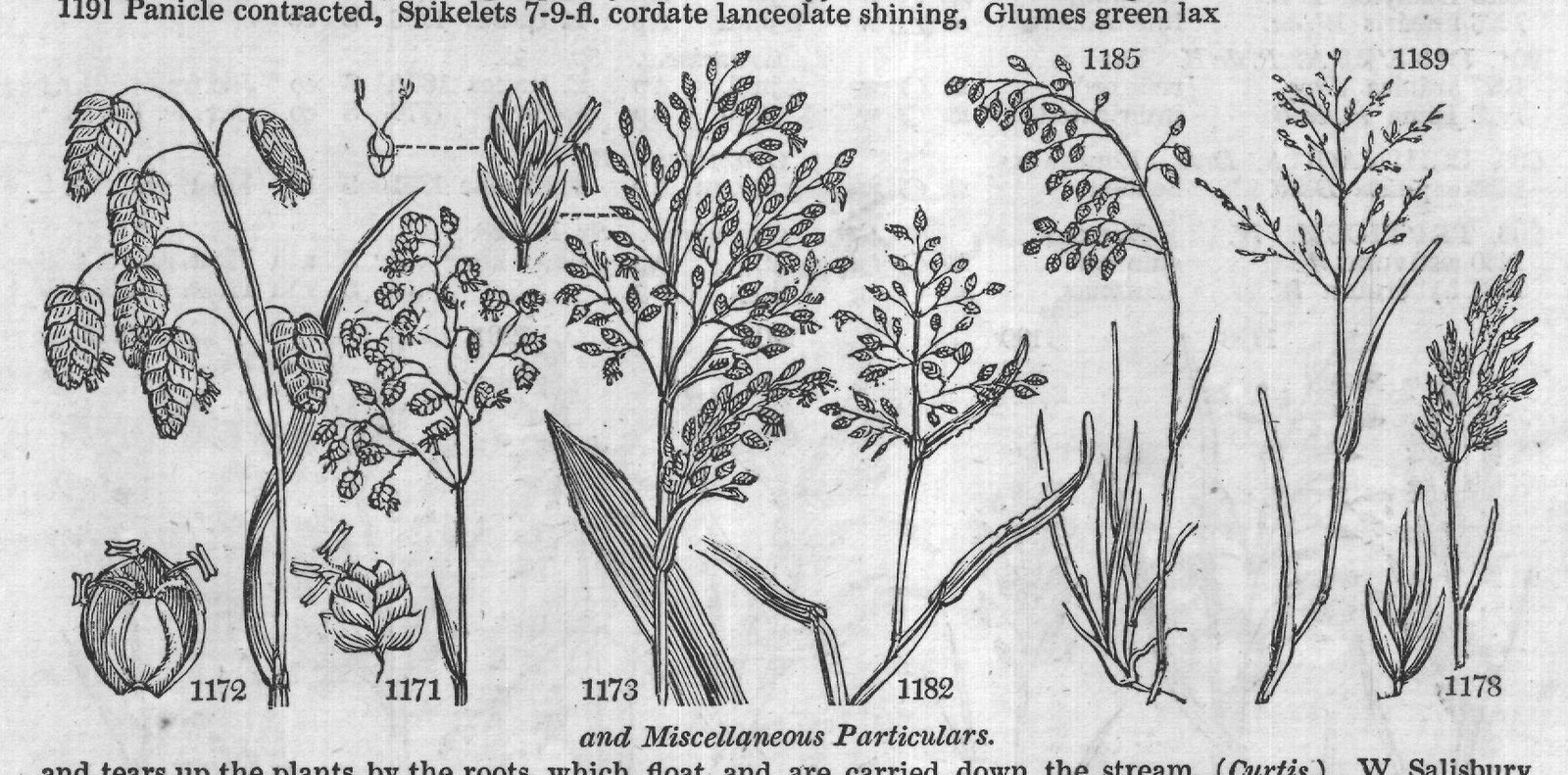
TRIANDRIA DIGYNIA. 1157 Panicle nodding spreading, Spikelets compressed 6-8-flowered, Sheaths of leaves bearded at end 1158 Panicle contracted, Spikelets linear, Glume longer than florets, Leaves bearded at base 1159 Panicle nearly simple contracted few-flowered, Spikelets oblong ovate 3-4-flow. Glume as long as florets 1160 The only species 1161 Outer paleæ of lower floret fringed, Panicle subspicate equal, Spikelets erect at length spreading 1162 Branches of panicle erect or spreading, Spikelets 3-flowered, Outer glume of lower floret hairy at edge 1163 Ligula nearly none, Panicle almost simple, Spikelets nodding beardless, Glumes obtuse 1164 Paleæ beardless, Panicle branching one-sided, Spikelets ovate erect 2-flowered one imperfect 1165 Ligula half-linear, Panicle branching, Spikelets nodding smooth, Glumes acute 1166 Panicle lax few-flowered, Branchlets simple, Flowers obtuse naked, Stem erect smooth 1167 Paleæ smooth, Panicle spiked branching, Spikelets 3-flowered third flower imperfect 1168 A small purplish grass common on moors with a very narrow smooth spikelike panicle 1169 Panicle erect, Spikelet 3-angular 5-7-flowered, Glume larger than florets 1170 Spikelets ovate, Glume equal to florets, Upper leaf involute 1171 Panicle erect, Spikelets finally cordate, about 7-flowered, Glume less than florets 1172 Panicle nodding at end, Spikelets oblong cordate 13-17-flowered 1173 Pan. equal erect diffuse much branched, Spikel. lin. 5-9-fl. Florets obtuse smooth 7-nerved, Root creeping 1174 Panicle diffuse, Spikelets ovate 5-fl. Ligule of the stem-leaves lanceolate acute, of the rest obtuse 1175 Panicle zigzag, Spikelets 3-flowered, Glumes ovate villous at base, Ligules lanceolate 1176 Panicle contracted erect or nodding, Leaves and stems lax, Ligule oblong 1177 Panicle diffuse, Spikelets ovate 5-flowered, Glumes lanceolate rather silky loose, Ligules very short 1178 Panicle equal diffuse, Spikelets ovate 2-4-flowered at length viviparous 1179 Pan. equal diffuse, Spik. obl. ov. about 3-fl. Flor. vill. at base 5-nerved, Stem and sheaths roughish, Lig. obl. 1180 Panicle diffuse, Root creeping, Upper leaves much shorter than their sheaths, Ligule short truncated Panicle divaricating, Radical leaves very narrow and long 1181 Panicle diffuse, Spikelets ovate about 3-flowered, Glumes acute villous at base, Ligule very short obtuse 1182 Panicle one-sided divaricating, Spikelets oblong ovate 5-7-flowered, Stem subcompressed 1183 Panicle spreading, Spikelets ovate compressed acute, Outer paleæ pubescent at back 1184 Panicle equal diffuse, Spikel. ovate lanc. 3-fl. Flor. few, Sheaths loose 2-edged, Ligule short, Root creep. 1185 Panicle diffuse nodding, Spikelets oblong 5-7-fl. Florets villous at base, Ligule short 1186 Panicle diffuse, Spikelets ovate oblong shining 1187 Panicle equal diffuse narrowed one-sided spreading when in seed, Root nodose 1188 Pan. equal sprdg. Spikel. lanc. 9-fl. Flor. vill. at base obtuse 5-nerved, Lvs. rough, Ligule obl. Root creep. 1189 Pan. equal capill. lax erect sprdg. Spikel. 4-5-fl. smooth lin. lanc. Lvs. smooth convol. at end, Stem procumb. 1190 Panicle lax much spreading capillary, Leaves hairy, Stem much branching 1191 Panicle contracted, Spikelets 7-9-fl. cordate lanceolate shining, Glumes green lax 1172 1171 1173 1182 1185 1189 1178 and Miscellaneous Particulars. and tears up the plants by the roots, which float, and are carried down the stream. (Curtis.) W. Salisbury says, " it is highly ornamental, and might be introduced into ponds for the same purposes as Arundo phragmites, or planted with Festuca elatior, Poa sudetica, and Phalaris arundinacea in pits and water-holding excavations, where it would be useful as fodder, and form excellent shelter for game." (Bot. Comp. ii. 11.) P. alpina, in common with many alpine grasses which live almost constantly in a moist vapour, is frequently viviparous. Linnæus says, it is the rudiment of the germen which grows and forms the young plant; Sir J. E. Smith, that the glumes change into leaves, and at length the fructification into a bud. P. trivialis Curtis considers one of our best meadow and pasture grasses, especially for moist soils and sheltered situations; on dry exposed situations it is not productive, and, as Sinclair observes, dies off in the space of four or five years. Contrary to what is the case in almost all other grasses, the hay of this species is of most value cut when the seed is ripe. It and P. annua are almost the only grasses that will thrive in grass plats in towns and small confined situations.
P. angustifolia is a valuable grass for permanent pasture, being of rapid and early growth; but the stalks and leaves being subject to the rust, it is obviously unfit for hay. P. pratensis assumes a beautiful verdure very early in spring; but as it sends up flower-stalks only once in a season, it is less adapted for hay than for early and permanent pasture. Cultivated by itself, it becomes so much matted by its creeping roots as to be unproductive, unless on water meadows, for which it is one of the best of grasses. P. annua is a diminutive plant, the most common in all temperate climates, and perhaps in the world. P. sudetica is a tall aquatic. P. glauca is ornamental from its glaucous hue. P. maritima Sir H. Davy found to be one of the best grasses for producing latter-math. P. fertilis (P. serotina) ranks as one of the most valuable of grasses. According to the Woburn experiments it produces the greatest abundance of early foliage next to P. angustifolia. It prefers a clayey soil, and flowers late.
F2 TRIANDRIA DIGYNIA.
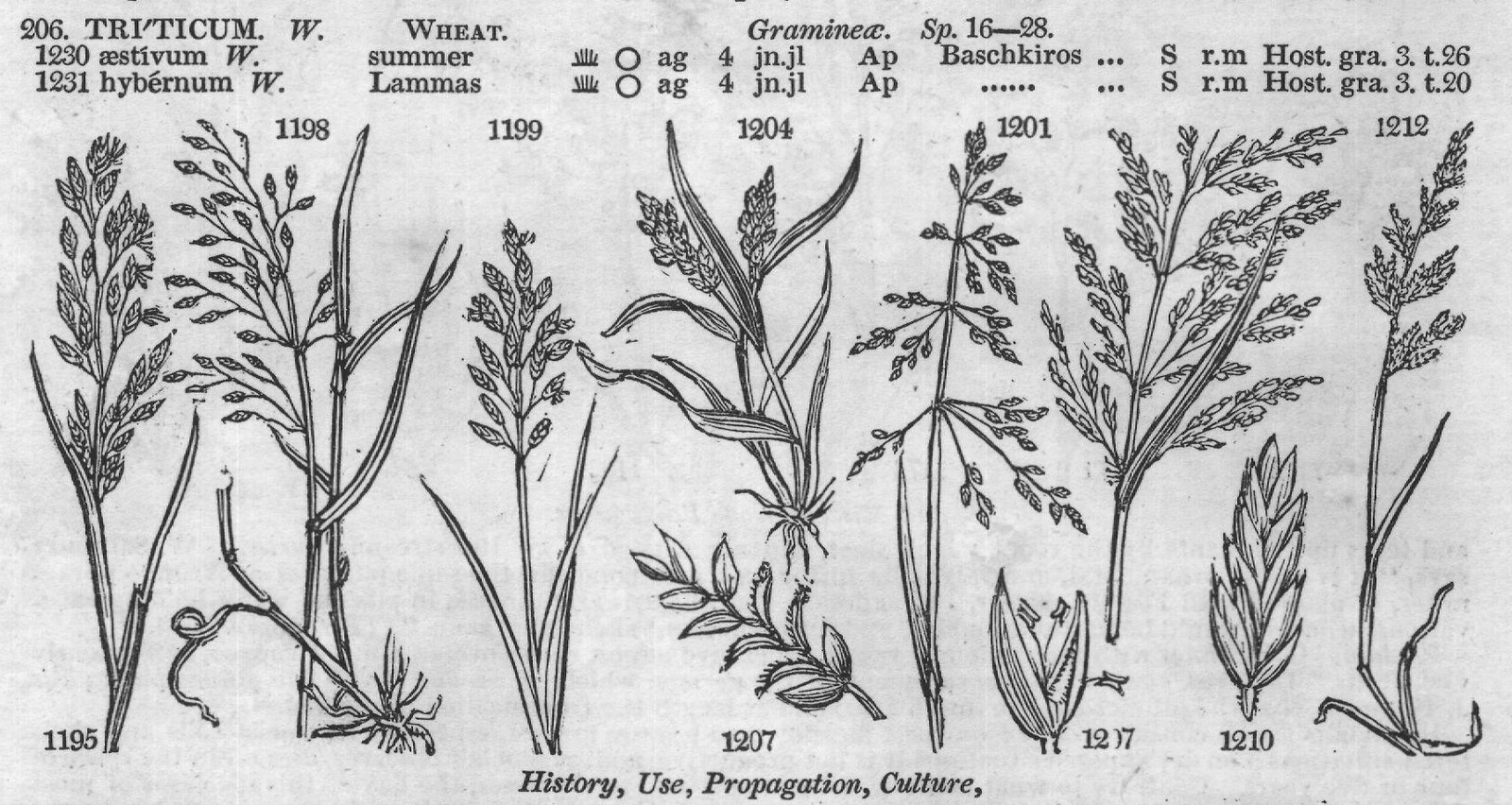
CLASS III. 1192 stérilis M. B. barren 1193 angustáta R. Br. narrow-spiked 1194 ténax Lk. tough 1195 marítima W. sea 1196 compréssa W. 1197 glaúca E. B. flat-stalked 1198 nemorális W. glaucous wood 1199 amboinénsis W. upright 1200 bulbósa W. bulbous 1201 dístans W. distant 1202 retrofléxa E. B. reflexed 1203 ægyptíaca W. en.
Egyptian 1204 peruviána W.
Peruvian A عاد A W علاا اد A W علاد A عاد A W علااد A عاد لا لاد 1 jn.jl Ap ja.f Ap Tauria 1821. S co Melv. Isld. 1823. S co W 2 jl.au Ap 1817. S co 1 jn.jl Ap Britain sal. m. S m.s Eng. bot. 1140 1 jn.au Ap Britain walls. S s.l Eng. bot. 365 jn.au Ap Britain moun. S s.1 Eng. bot. 1720 2 jn Ap Britain woods. Sh.l Eng. bot. 1265 1 jn.jl Ap 1 jl Ap E. Indies 1800. S co England pas. Sh.l Eng. bot. 1071 Rumph.6. t.7.f.3 1 jl.au Ap Britain pas. Sh.l Eng. bot. 986 1 jl.au Ap Britain pas. Sco Eng. bot. 1532 1 jl.au Ap jl.au Ap 1205 nerváta W. nerved w1 jl.au Ap 1206 digitáta R. Br. fingered W 1½ jl.au Ap Egypt 1812. S co Peru 1802. S co N. Amer. 1812. S co N. S. W. 1800. S co Jac. ic. 1. t. 18 197. ERAGROSTIS. P. de B. LIVE-GRASS.
Gramineæ. 1207 pilósa P. de B. pilose عاد 1½ jlau Sp. 3-10.
Italy 1208 tenélla P. de B. small W E. Indies 1209 purpuráscens Spr. purple 1 jl.au 198. MEGASTA CHYA.
P. de B. MEGASTACHYA.
Gramineæ.
Sp. 5-29. 1210 Eragróstis P. de B.
Love-grass 1211 amábilis P. de B. purple 1212 rígida P. de B. hard or لا or لا لالا Poa E. B. 1213 elongáta P. de B. long-panicled w 2 jl.au Ap 1214 ciliáris P. de B. ciliated لا 199. SCLEROCHLO'A. P. de B. HARD-GRASS. 1215 divaricáta P. de B. divaricate 1216 procúmbens P. de B. procumbent 11111 W علا jl.au Ap 1 jl.au Ap Ap 2 jl Ap 1 jl Ap jn.jl Ap Italy 1699. S co E. Indies 1802. S co England san. pl. S s.l E. Indies 1812. S s.l 1½ jl.au Ap Jamaica 1776. S s.l Gramineæ. Sp. 3.
Jac. ecl. gra. t. 3 Jacq. ic. 2. t. 304 lau ApS Europe 1802. S co Gou. ill. 4. 1.2.f.1 S.
Britain 1804. S co