Home › H › Host (Gra t Vi fragm t f Eng bot jl)
Host (Gra t Vi fragm t f Eng bot jl)
gra. 1. t.20 Vi.fragm.t.26.f.1 Eng. bot. 221 jl.au Ap W 1½ jl.au Ap Italy Spain 1818. S co 1758. S co Jacq. ic. 2. t. 303 jn.jl Ap S. Europe 1800. S co Gramineæ.
Sp. 4-7.
Aw عاد W W 4 jn.jl Ap 4 jn.jl Ap jl Ap jn.jl Ap N. Amer. 1809. S co N. Amer. 1793. S co N. Amer. 1790. S co N. Amer. 1789. S co Cates, car. 1. t.32 Gramineæ. ag 2 jn.jl Ap 2 jl.au Ap Sp. 1-3.
N. Amer. 1820. Sr.m Jac. gr. ecl. t. 16 Gramineæ. Sp. 1-2.
N. Amer. 1823. S co Festuca E. B. 185. BRACHYPODIUM. P. de B.
BRACHYPODIUM. 1142 ciliátum W. ciliated 1143 sylváticum R. & S. wood Bromus E. B. 1144 pinnátum P. de B.
Bromus E. B. 1145 distáchyon R. & S. 1146 tenéllum W. 1147 loliáceum R. & S.
Triticum E. B. 1148 unioloídes Lk. 1149 obtusifólium Lk. 1150 unilaterále R. & S. spiked heath two-spiked slender Darnel-like Uniola-like blunt-leaved one-sided 186. UNI OLA.
W.
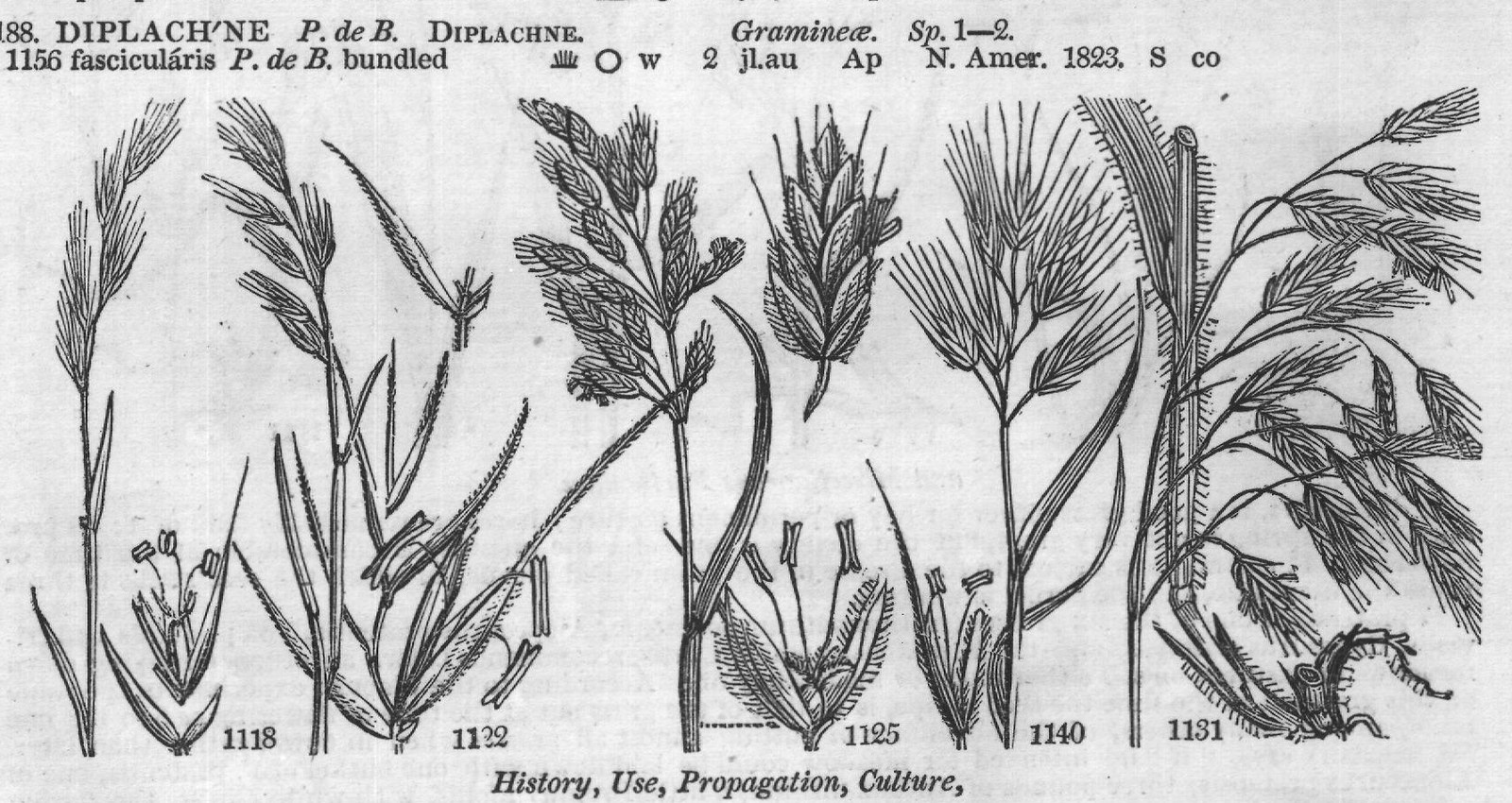
SEA-SIDE-OAT. 1151 latifólia Ph. broad-leaved A علا 1152 paniculáta Ph. panicled 1153 spicáta W. spiked 1154 distichophýlla R.&S. two-ranked A للاد 187. TRICUS'PIS. P. de B. TRICUSPIS. 1155 quinquéfida P. de B. five-cleft 1.88. DIPLACH'NE P. de B. DIPLACHNE. 1156 fasciculáris P. de B. bundled علاا 1118 1122 1125 1140 1131 History, Use, Propagation, Culture, 183. Mygalurus. Named by Link, from μuγaλη, a mouse, and sea, a tail. An alteration of the previous specific name of one of the species, Festuca myurus, L. A natural genus, better distinguished by natural than by artificial characters. 184. Bromus. Bρωμoς is the name given by the Greeks to a sort of wild oat. Most of the species of this genus are of a coarse quality, and being strictly annuals are of little value as pasture, and as hay produce no after math. Sir H. Davy found that the nutritive powers of the straws and leaves of most of the species were greatest when the plant is coming into flower; because, like all other plants strictly annual, or which do not shoot up again from the root the same season, when left till the seed is ripe, the leaves and straws become dried up. B. secalinus is often found among rye and wheat crops; the seeds when ground among the flour are said to impart a bitter taste to bread, and to have similar narcotic qualities as Lolium temulentum. In Scania, the panicles are used to dye green; and there, as formerly in Britain, rye was supposed to degenerate into this grass. The seeds of B. mollis are said to bring on giddiness in the human species and quadrupeds, and to be fatal to poultry. B. asper is the tallest of British grasses; it has had many names, but is distinguished from all ORDER II.
TRIANDRIA DIGYNIA. 1118 Panicle one-sided nodding elongated, Florets rough at end, Leaves setaceous keeled very short 1119 Panicle one-sided erect, Florets rough at the end, Leaves setaceous shorter than their sheath 1120 Panicle nearly erect, Flower-stalks ensiform dilated 1121 Panicle one-sided spiked lanceolate, Spikelets spreading 5-flowered, Leaves linear setaceous 1122 Panicle one-sided erect nearly simple, Florets subulate compressed, One glume very short 1123 Panicle in seed nodding at end, Spikelets ovate oblong compressed naked, Florets at last distinct, Beard wavy shorter than glume, Leaves nearly smooth 1124 Pan. nodding at end, Spikelets lanc. compr. naked, Beard straight longer than glume, Leaves villous 1125 Pan. erect contr. Spikelets oblong ovate roundish pubes. Outer paleæ bifid, Beard straight, Leaves soft 1126 Pan. nearly erect, Spikelet lanc. somew. compr. Flor . closely imbr. smooth, Beard straight afterwards sprdg. 1127 Pan, lax nodd. at end, Spikel. lanc, somewhat compr. Florets closely imbr. Beard at length very much sprdg. 1128 Panicle close erect, Spikelets oblong pubescent 12-15flow. nearly sessile, Beards below spirally twisted 1129 Pan. nodd. Spikelets lanc. slender, Florets 1130 Pan. Pan. nodd. Spikelets lanc. slender, Florets bearded hairy, Beards straight, Leaves smooth, Sheaths hairy beardless, Leaves smoothish, Root creeping 1131 Pan. nodd. one-sided, Spikel. lin. lanc. compr. pubesc. Beard straight shorter than glume, Leaves vill. rough 1132 Panicle spreading branching, Spikelets ovate turgid 1133 spreading branching, Spikelets ovate turgid 10-flowered, Florets elliptical 3-nerved on each side flowered, Florets elliptical 3-nerved on each side 1133 Pan. spreading nodding at end, Spikelets rough lin. lanc . Beard straight longer than glume, Leaves pubesc. 1134 Pan. at length nodding, Spikelets lanc. compr. naked, Beards straight as long as glume, Leaves villous 1135 Pan. erect, Spikel. lin. lanc. compr. Florets imbr. Beard shorter than glume, Leaves tufted very narrow cil. 1136 Pan, nodding at end, Spikelets compressed and leaves 1137 Pan. nodding at end, Spikelets compressed and leaves pubescent, Beard straight about length of glume a short beard, Leaves sheaths and stem smooth 1138 Pan. erect, Spik. obl. ov. compr. nak. Flor. imbr. Outer pal. undiv. Beard straight as long as glume, Lvs. pub. 1139 Leaves villous, Panicle spreading erect, Beards long straight, Rachis pubescent 1140 Pan. erect, Spikel. rough lin. lanc. Flor. diandr. Beards straight about length of glume, Lvs. nearly smooth 1141 Pan. nodd. at end one-sided, Spikel. lanc. compr. naked, Florets imbr. Beard flexuose longer than glume 1142 Panicle loose capillary pendulous, Spikelets 6-fl. compr. Outer palea with a short beard villous at edge 1143 Raceme spiked distich. simple somew. nodd. Spikel. rem. erect, Upper beards longer than glume, Root fibr. 1144 Spike sim. distich. erect, Spikel, altern. pub. bearded, Beard shorter than its valve, Lvs. pub. Root creeping 1145 Spikes in pairs terminal oblong, Florets lanceolate distichous bearded, Culm 2-knotted smooth equal 1146 Spikelets many-flowered 5-9-flowered beardless, Glumes and paleæ obtuse, Leaves setaceous 1147 Glume many-fl. Spike simple compressed, Spikelets ovate unilateral, Glumes 3-nerved, Florets beardless 1148 Spike distichous compressed, Spikelets lanceolate oblong sessile 1149 Stem branching creeping rough, Leaves convol. obtuse rigid smooth, Alternate spikel. bearded smooth 1150 Glumes one-sided alternate beardless 1151 Panicle lax, Spikelets ovate with long stalks, Glumes 3-valved, Florets 1-androus, Keel pubescent 1152 Panicle long, Spikelets subsessile, Glume many-valved, Florets 3-androus, Keel smooth, Leaves convol. 1153 Nearly spiked, Leaves involute rigid 1154 Raceme spiked branching erect, Spikelets 5-9-flowered beardless smooth, Leaves involute subulate 1155 Panicle large, Stem firm, Spikelets lanceolate 6-8-flowered, Leaves and stem smooth 1156 Panicle erect contracted oblong, Branches chiefly simple numerous setaceous, Spikelets appressed oblong slender 8-10-flowered, Leaves very long smooth 1144 1143 1147 1152 1155 1156 and Miscellaneous Particulars. others by the hairyness of its stalks. It is found in copsewood in clayey moist soils. Bromus giganteus partly resembles it. 185. Brachypodium. From βρaχuς, short, and 785, a foot, in allusion to the short stalks of the spikelets. An artificial genus, made up of various species of Bromus, Festuca, and Triticum of former writers. 186. Uniola. Named by Linnæus, on account of the union of the glumes. A fine N. American genus, resembling a gigantic Bromus or Festuca. It is chiefly found upon the sands of the sea-coast. 187. Tricuspis. A word signifying three points, in allusion to the structure of its flower. This grass is called Red -top in the southern states of N. America.
Pursh says, "a most excellent grass. I have seen mountainmeadows in Pennsylvania where they mow this grass twice a-year, producing most excellent crops cach time without manure or any other trouble than the mowing, lasting for the space of sixteen years without the least decline in the crops, the soil at the same time being a very indifferent one." 188. Diplachne. Δiπλoς, divided, aχvη, chaff. The outer palea is divided at the end, and bearded between the divisions.
F 189. CERATOCHLO'A. P. de B. HORN-GRASS.
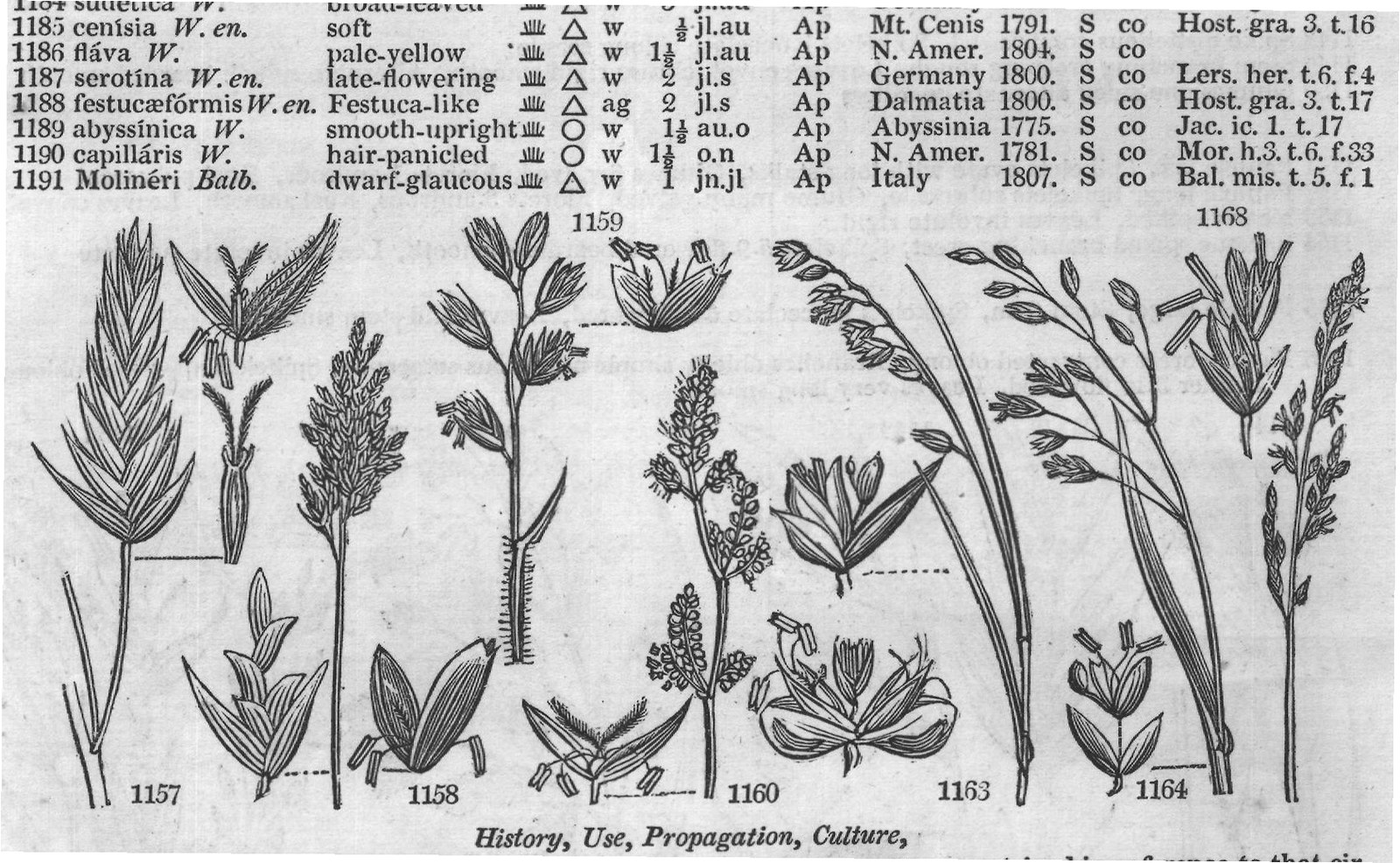
Gramineæ. Sp. 1-2. 1157 unioloídes P. de B. large-spiked w TRIANDRIA DIGYNIA. 1 jl Ap N. Amer. 1788. S co CLASS III.
Hort. ber. 1. t. 3 190. SCHIS'MUS. P. de B. SCHISMUS.
Gramineæ. Sp. 1. 1158 marginátus P. de B. margined 191. TRIO DIA. R. Br.
TRIODIA. 1159 decúmbens R. Br. decumbent 192. BECKMAN'NIA. Host. BECKMANNIA. 1160 erucæfórmis W.en. linear-spiked 193. ME'LICA.
W.
MELIC-GRASS. 1161 ciliáta W. ciliated 1162 Bauhíni W. en.
Italian لاد A W للاد لاد A or علا A للاد jn.jl Ap Spain 1781. S co Lam, ill. t. 46. f.1 1 jlau Ap Gramineæ. Sp. 1-10.
Britain ...
Sco Eng. bot. 792 Gramineæ. Sp. 1. 2 jl Ap Europe 1773. S co