Home › H › Host (Gra t Cav ic t f Barr ic t)
Host (Gra t Cav ic t f Barr ic t)
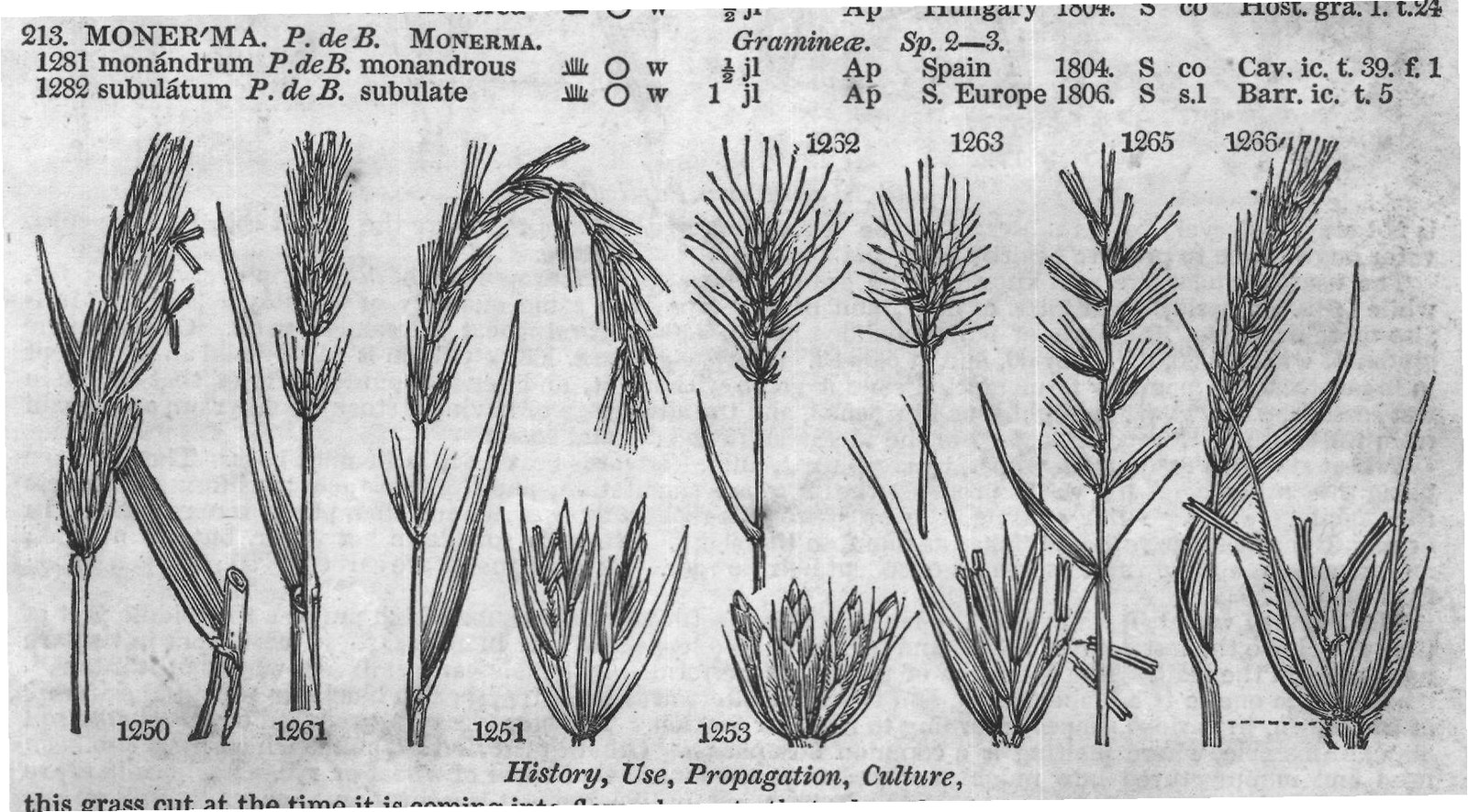
gra. 1. t.24 Cav, ic. t. 39. f. 1 Barr. ic. t. 5 1265 1266 1250 1261 1251 1253 History, Use, Propagation, Culture, this grass cut at the time it is coming into flower bears to that when the seed is ripe, to be as 10 to 11. Pacey's perennial ray-grass, a variety raised in Staffordshire , has long been in repute, and there has lately been a new variety raised in Bedfordshire, known as the Russel ray-grass. 208. Elymus. Linnæus derives the name from εiλεω, to cover, because the leaves of his Elymus maritimus are formed into a coarse sort of fabric. The Elymus of the ancients was evidently a sort of corn. E. arenarius formed into a coarse sort of fabric. The Elymus of the ancients was evidently a sort of corn. E. arenarius is a strong rough glaucous plant common on sandy shores, and like Calamagrostis arenaria and others, which have been mentioned (genus Lygeum, Stipa, Arundo), prevents, by its matted roots, the shifting of loose sand thrown up by the tides. In analyzing the soluble matter afforded by this grass, Sir H. Davy found it to contain more than one-third of its weight of sugar . It is not, however, eaten by any of our domestic animals. 209. Secale. An ancient name, supposed to have been derived from seco, to cut, which word is said to have been formed from the Celtic sega, a sickle. This grain, of which there is probably only one species, affords formed from the Celtic sega, a sickle. This grain, of which there is probably only one species, affords a grain next in value to the wheat for making bread, and is generally used for this purpose, alone or mixed with wheat, throughout Germany and the north of Europe.
It is hardier and earlier than wheat. Like it, it will ripen if sown in spring, but better if treated like a winter -wheat. In Britain it is little sown. Its grain yields 792-1000 parts of soluble matter, of which 645 are mucilage, 190 gluten, and 38 sugar. 210. Hordeum. Bodæus à Stapel derives this word from hordus, heavy, because bread made with barley is very heavy. Bara is the Celtic for bread, whence the English words barn and barley; as beer is a slight alteration of the appellation of barley in that tongue, Bere. Hexastichon (έξ, six, στiξ στiχoς, row) signifies grain growing in six rows; distichon, in two rows. Zeocriton is derived from ζεa, which is supposed to have been Spelt, and κρiθη, barley: that is to say, barley resembling spelt wheat. The four first species, or, more probably, sub-species, are cultivated as barleys. H. vulgare or two probably, and of sub-species, are cultivated as barleys. H. vulgare or two rowed barley, is that in general cultivation, or, more H. hexastichon is the bear or bigg chiefly cultivated in the north of Scotland, and in Denmark and for the north of Scotland, and in Denmark and Sweden. H. distichon has thin husks, and is ears, long awns, and short coarse straw, and is not much cultivated. The native country of barley is unknown. and also. cultivated. The native country of barley is unknown. It was cultivated by the Romans as a horse-corn, from their feeding on this grain. In the south of Europe they have sometimes two crops in one season; one sown in autumn and cut in May, and another ORDER II.
TRIANDRIA DIGYNIA. 1251 1250 Spike erect close, Spikel. 3-fl. pubesc. Lower and upper in pairs middle in 3s rather shorter than fring. glume glumes, Leaves involute rigid 1252 Spike erect close, Spikel. 4-fl. from middle to base pubesc. shorter than smooth glume, Leaves involute rigid 1253 Spike erect close, Spikel. 6-7-fl. pub. in 6s upper in 3s or pairs shorter than smooth glumes, Lvs. invol, rigid 1254 Spike pendulous close, Spikelets 2 together longer than the glumes 1255 Spike pendulous, Spikelets 3-flowered bearded in pairs, Leaves flat 1256 Spike pendulous spreading, Spikelets 6-flowered bearded in threes, Leaves flat 1257 Spike nodding spreading, Spikelets 6-flowered bearded the lower in threes upper in pairs, Leaves flat in pairs, Glumes lanceol. nerved as long as spikelets, Leaves flat 1259 Sp. erect, Spt. 2-fl. beard. hispid in pairs , Gls. lin. nerv. beard. as long as spikel. Lvs. flat and sheaths smooth 1260 Spike erect, Spikel. 3-fl. villous bearded in threes, Glumes bearded longer than spikel. Leaves flat 1261 Spike erect, Spikel. in 3s 1-2-fl. bearded rough, Glms. linear subul, bearded as long as spikel. Sheaths hairy, 1262 Spikelets 1-fl. rough, Involucres erect [Leaves flat 1263 Spikelets 2-fl. Involucres setaceous spreading 1264 Lvs. short involute curved, Spike erect rough, Spikel. in 3s 2-fl. longer than the bearded very narrow invol. 1265 Spike erect, Spikelets spreading, Involucr. none [Outer glume with a short beard 1266 Glumes and beard rough, Paleæ smooth toothed at the end 1267 Stem procumbent at base, Uppermost leafsheath tumid, Glumes and paleæ subulate bearded 1268 All florets hermaphrodite bearded, Seeds in 4 rows, Stems erect 1269 All florets hermaphrodite bearded, Seeds in 6 rows 1270 Lateral florets male beardless hermaphrodite in 2 rows bearded 1271 Lateral florets male beardless hermaphrodite in 2 rows, Spike short, Seeds angular spreading 1272 All florets fertile in threes bearded, Involucres setaceous ciliated at base 1273 Intermediate glumes linear lanceolate ciliated outer setaceous rough 1274 Lateral florets male with a short beard, All the glumes setaceous rough 1275 All the glumes rough, Inner glume of the lateral florets semi-lanceolate the rest setaceous 1276 Beards and involucres setaceous very long 1277 The only species 1278 Spike slender subulate incurved 1279 Spike subulate somewhat compressed erect, Leaves channelled 1280 Spike subulate erect, Leaves flat 1281 Spike subulate erect, Glume minute, Florets bearded 1282 Spike subulate erect, Glume ensiform acuminate appressed 1268 1270 1272 1277 1278 1281 and Miscellaneous Particulars. sown in spring and cut in autumn. In Lapland two months, and in England nine weeks elapse between the sowing and cutting of this grain.
Malt is the chief purpose for which barley is cultivated in Britain, but it is also made into flour, and pot and pearl barley. In order to understand the process of malting, it may be necessary to observe, that the cotypearl barley. In order to understand the process of malting, it may be necessary to observe, that the cotyledons of a seed before a young plant is produced, are changed by the heat and moisture of the earth into sugar and mucilage. Malting is only an artificial mode of effecting this object, by steeping the grain in water, and fermenting it in heaps, and then arresting its progress towards forming a plant by kiln drying, in order to take advantage of the sugar in distillation for spirit, or fermentation for beer. The chemical constituents of mucilage and sugar are very nearly alike: in the process of malting a part of the mucilage or starch is converted into sugar, so that the total quantity of sugar, and consequently the source of spirit, is increased. Of pot-barley there are two sorts, pearl and Scotch, both produced by grinding off the husk, and the former variety by carrying the operation so far as to produce roundness in the kernel. It is used in soups, gruels, and medicinal drinks.
Barley-flour is ground like flour, and forms a light pudding or pottage, which, spread out in thin cakes and slightly toasted, forms a breakfast bread much esteemed in some parts of Scotland. It is brought to table hot from the baking plate, and eaten with butter and honey, or cream and sugar.
H. murinum, squirrel-tail-grass, is common by way-sides, and its awns or heads are so injurious to the gums of horses in the isle of Thanet, that one of the greatest recommendations of an inn is having " hay without gums any mixture of squirrel-grass.' horses in the isle of Thanet, that one of the greatest recommendations of an inn is having " hay without any mixture of squirrel-grass."
H. pratense resembles rye, and to this, Professor Martyn observes, the name of rye-grass belongs, and not to Lolium perenne, which is ray (from ivraye, Fr.) grass. 211. Microchloa. From μiκρoς, small, χλoη, grass, on account of its size. 212. Ophiurus. A name constructed by Gærtner from όφiς, a snake, and sea, a tail, from a fancied resemblance in the spikes of the genus to the tail of a viper. This is the genus Rottböllia of English botanists: but no true species of that genus have yet been cultivated in this country. 213. Monerma. From μovoς, one, and εξμa, support; there is only one glume, which by its rigidity acts as a support to the flower. 214. PEROTIS. H. K. 1283 latifólia W.
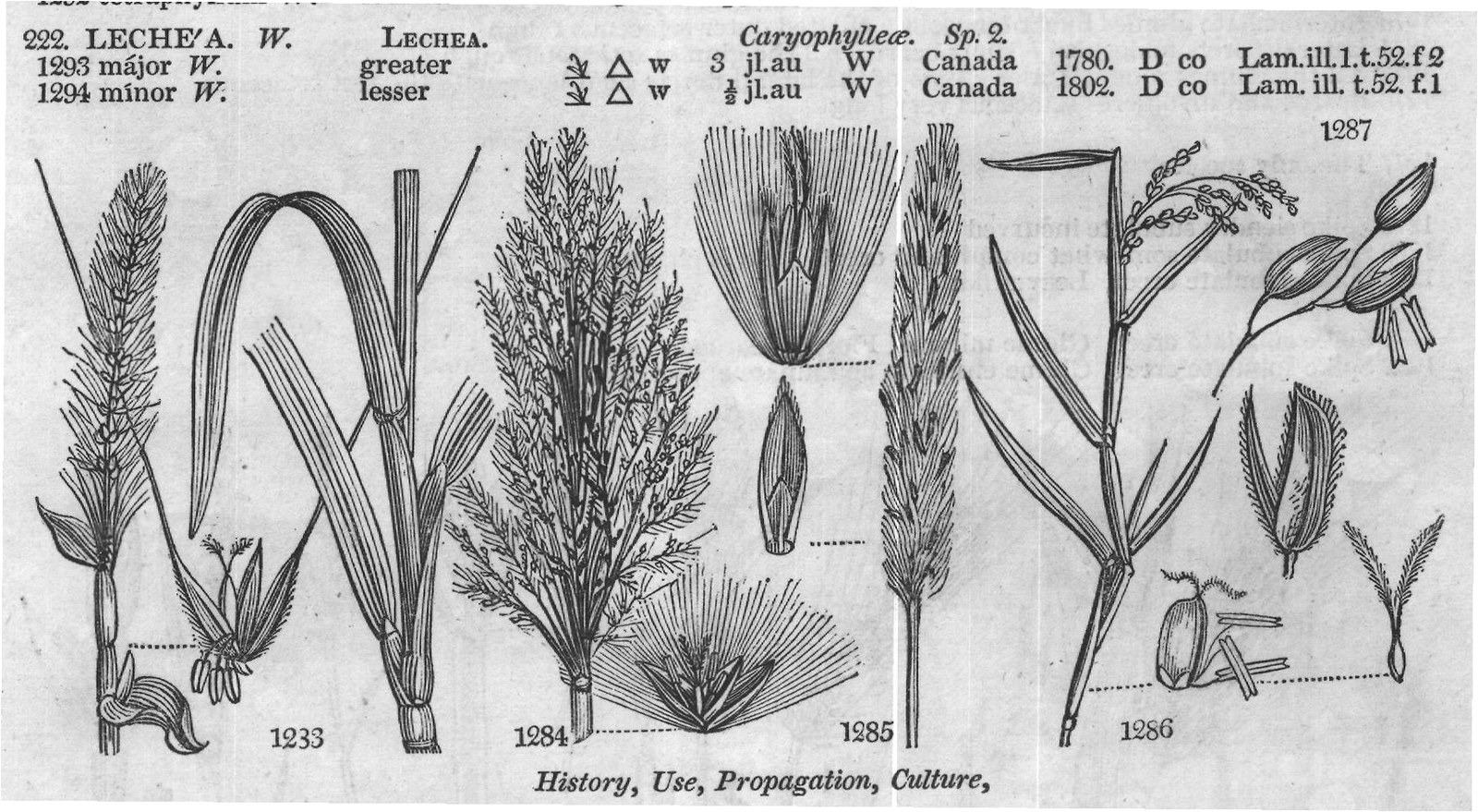
PEROTIS. spiked 215. SAC CHARUM. W. SUGAR-CANE. 1284 officinárum W. common 216. IMPERA'TA. Cyr. IMPERATA. 1285 arundinácea Cyr. reedy TRIANDRIA TRIGYNIA. عاد Gramineæ. Sp. 1-2.
CLASS III. 2 au.s Ap E. Indies 1777. Ss.p Rheede. 12. t. 62 cu clt 12 Ap Gramineæ. Sp. 1-14.
India Gramineæ. Sp. 1-5. 1597. Sk r.m Sloan. jam.1.t.66 ecl.au Ap S. Europe 1817. S co Cvrill. ic. 2. t. 11 217. LEER'SIA. R. Br.
LEERSIA.
Gramineæ. Sp. 2. 1286 oryzoídes W. rough 1287 virgínica W.
Virginian 218. DIARRHE'NA. Mich. DIARRHENA. 1288 americána M.
American لا A بلند A لا 2 jl.au Ap Levant 1793. S co