Home › H › Host (Gra t jl au Ap N Amer S co Jac)
Host (Gra t jl au Ap N Amer S co Jac)
gra. 1. t.35 1 jl.au Ap N. Amer. 1770. S co Jac. ic. 2. t. 305 Gramineæ. Sp. 1. 2 jn.jl Ap N. Amer. 1810. S co Mich. am, t. 10 219. ARUNDINA'RIA. Mich. CANE-BRAKE.
Gramineæ. Sp. 1-2. 1289 macrospérma Mich. long-seeded or 10 jn Ap N. Amer. 1809. S co TRIGYNIA. 220. HOLO'STEUM. W. HOLOSTEUM. 1290 umbellátum W. umbelliferous 1291 cordátum W.
Caryophylleæ. Sp. 2-5.
Opril.au Pk England old wa. S co cordate prjn Jamaica 1814. S co 221. POLYCAR'PON. W. ALL SEED. 1292 tetraphýllum W. four-leaved W W Caryophylleæ. Sp. 1-3.
W England san.pl. S co Eng. bot. 1031 Eng. bot. 27 Lam. ill. t.51. f 2 222. LECHE'A. W.
LECHEA.
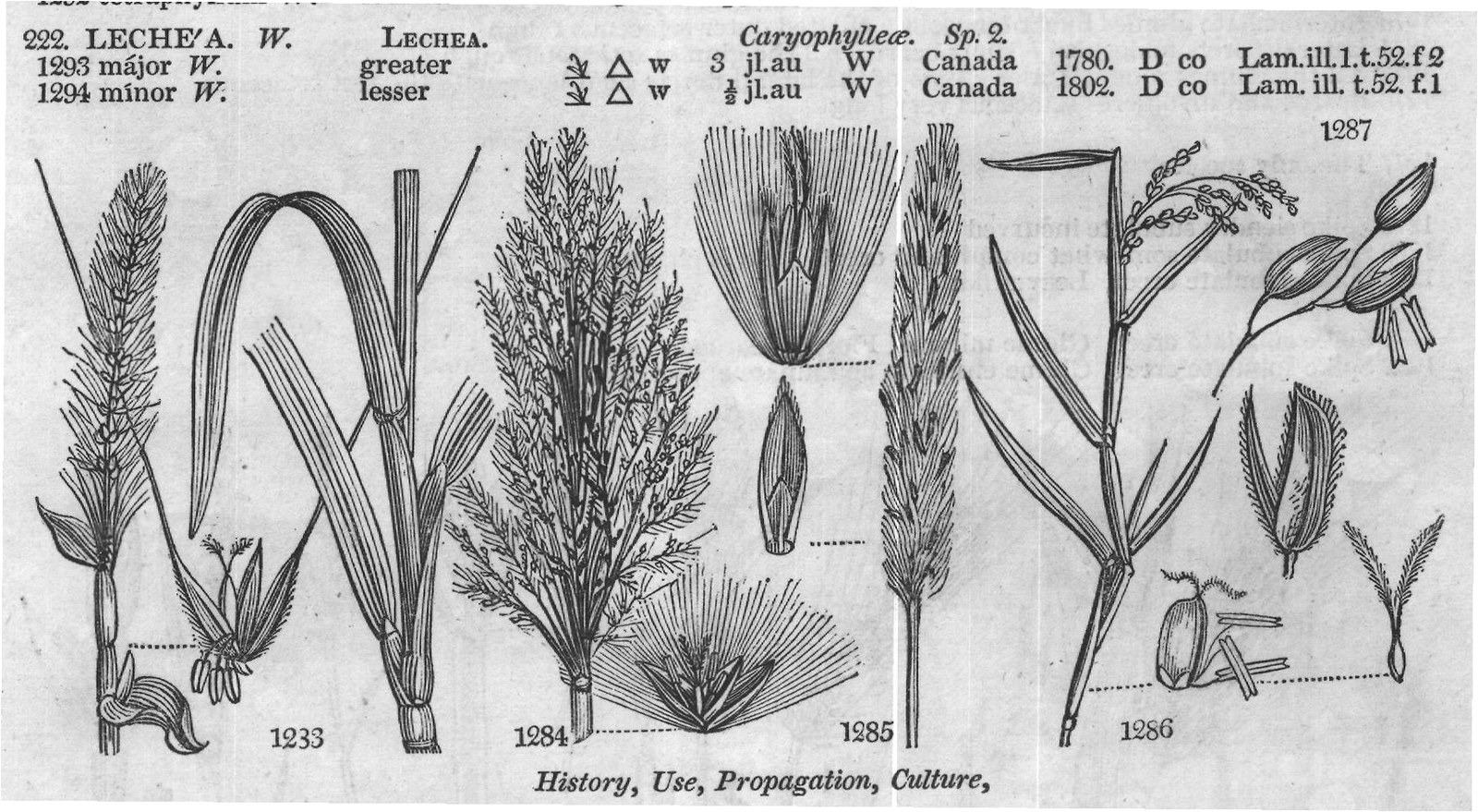
Caryophylleæ. Sp. 2. 1293 májor W. 1294 mínor W. greater W 3 jl.au W Canada 1780. D co lesser W jl.au W Canada 1802. D co Lam.ill.1.t.52.f 2 Lam. ill. t.52. f.1 1287 1233 1284 1285 R 1286 History, Use, Propagation, Culture, 214. Perotis. From πηρoς, deficient, some parts of the flower being absent. 215. Saccharum. From its Arabic name soukar, from which the Greeks formed oaxxa, and modern European Greeks formed σaχχaς, and modern European nations sugar. Sucre, Fr. Sucker, Ger., &c. This grass or reed, though unknown to the ancients, has become of immense importance in modern times. There are many varieties or species both wild and cultivated, , natives of the banks of rivers and meadows in both the Indies, China, Africa, the South Sea islands, and South America. It is cultivated in a zone extending from 35 to 40 degrees on each side of the equator. Where it was first cultivated is unknown; in all probability, in India, for the Venetians imported it from thence by the Red Sea prior to 1148. It is supposed to have been introduced into the islands of Sicily, Crete, Rhodes, and Cyprus by the Saracens, as abundance of sugar was made in these islands previously to the discovery of the discovery of the West Indies in 1492 by the Spaniards, and the East Indies and Brazil by the Portuguese in 1497 and 1500. It was cultivated afterwards in Spain, in Valentia, Granada, and Murcia by the Moors, and sugar is still made in these provinces. (Townsend and Jacob.) In the 15th century the cane was introduced to the Canary islands by the Spaniards, and to Madeira by the Portuguese, and hence to the West India islands and the Brazils. The Dutch began to make sugar in the island of St. Thomas, under the line, in 1610, and the English in Barbadoes in 1643, and in Jamaica in 1644. The culture of the cane has since become general in warm climates, and the use of sugar being universal, it forms one of the first articles of commerce throughout the world. Sugar is described by Pliny and Galen as a sweet salt, and from the former it appears to have been used only in medicine. Actuarius, a physician, who wrote in the 10th century, or later, was the first to substitute sugar for honey in medicinal compositions. It was called Indian salt, and a small piece was recommended to be kept in the mouth to moisten it in fevers. Different medical men have written for and against the use of sugar, as they have against tea, coffee, wine, and all with similar success. The enjoyment derived from these articles to all mankind who enjoy them, is too great to be left off in deference to the opinions of a few. Dr. Mosely is the greatest advocate for sugar. For the last two centuries it has been an ingredient in the popular diet of Europe. It was in use in England in 1466, but chiefly in feasts and as a medicine, till it was brought from the Brazils about 1580 to Portugal, and imported from thence. The quantity consumed in Britain has always kept increasing; the consumption of England alone in 1790 amounted to 166,573,344lbs.; which, taking the population at eight millions, gives each individual at an average about 20 lbs. ayear. The cane, as a stove plant, is of easy culture in soft moist soil with a good heat; it grows seven or eight feet high, but it never flowers. It was grown in abundance in the stoves of the Paris gardens, and a small sugar loaf was made from the canes, and presented to the Empress Josephine. In the botanic gardens of Toulon and Naples it stands the winter in the open air.
The cane in the West Indies is propagated by cuttings from the root end, planted in hills or trenches in spring or autumn, something in the manner of hops. The cuttings root at the joints under ground, and from those above send up shoots, which in eight, twelve, or fourteen months are from six to ten feet long, and fit to cut down for the mill. A plantation lasts from six to ten years. Sugar mills are merely iron rollers placed vertically or horizontally, between which the canes are passed and repassed. The juice thus squeezed out, is collected and boiled with quick-lime, which being an alkali, imbibes the superfluous acid, which would otherwise impede crystallization: impurities are skimmed off, and the boiling is continued till a thick syrup is pro- ORDER III.
TRIANDRIA TRIGYNIA. 1283 Culm simple, Leaves very smooth, Joints smooth 1284 Flowers panicled, Leaves flat 1285 Pan. spiked cylindrical, Leaves convolute, Joints smooth, Flowers generally diandrous 1286 Pan. diffuse sheathed, Florets 3-androus spreading, Keel of the glumes fringed 1287 Pan. diffuse, Branches horizontally spreading, Florets 3-androus, Keel of the glumes fringed 1228 The only species 1289 Smooth, Leaves linear-lanceolate distichous, Flowers panicled TRIGYNIA. 1290 Leaves elliptical glaucous smooth, Flowers umbelled, Common peduncle viscid 1291 Leaves cordate 1292 Stem branched 4-leaved prostrate 1293 Leaves ovate lanceolate, Flowers lateral scattered 1294 Leaves linear-lanceolate, Flowers panicled 1288 1289 1290 1291 Je 1292 and Miscellaneous Particulars. duced, when the whole is cooled and granulated in shallow vessels. It is now the raw or Muscovado sugar of commerce. A further purification is effected by dissolving it in water, boiling, skimming, adding lime, and clarifying from the oily or mucilaginous parts, by adding blood or eggs, which incorporate with them and form a scum. When boiled to a proper consistency it is put into unglazed earthen vessels of a conical shape, with a hole at the apex, but placed in an inverted position, and the base, after the sugar is poured in, covered with clay. When thus drained of its impurities , it is taken out of the mould, wrapped in paper, and dried or baked in a close oven.
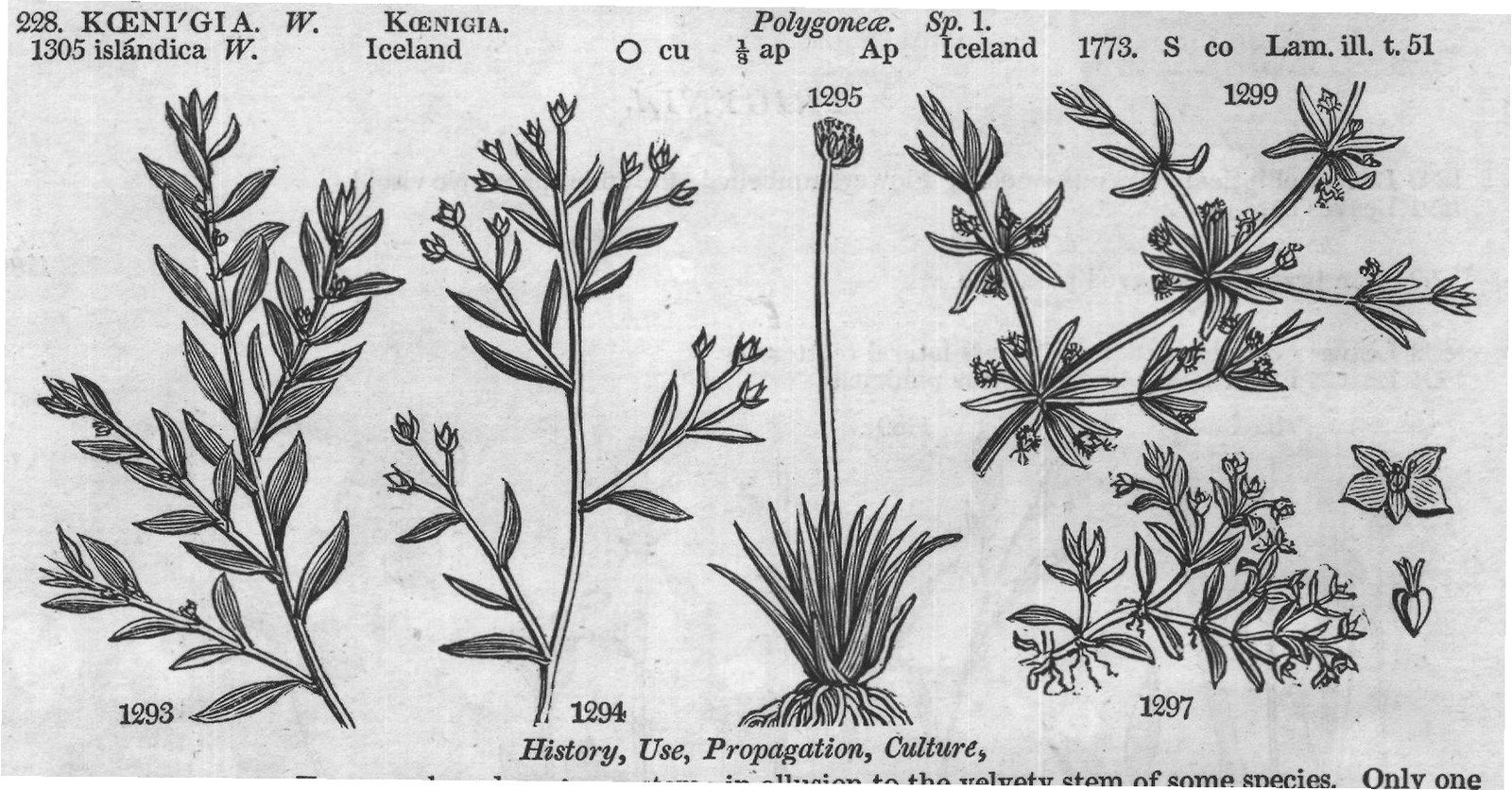
It is now the loaf sugar of the shops, and according to the number of operations it undergoes, is called single or double refined. The operation of refining is seldom or never performed by the growers; but in Europe, at least, generally forms a separate branch in the mother country of the colony. Sugar candy, Shukur and khand, Indian names for sugar in general, is formed by dissolving loaf sugar in water over a fire, boiling it to a syrup, and then exposing it to crystallize in a cool place. This is the only sugar esteemed in the east. Barley sugar is a syrup from the refuse of sugar candy, hardened in cylindrical moulds. Rum is distilled from the fermented juice of sugar and water. Sugar as a chemical compound is described as a neutral salt, consisting of the acetic acid, united to a small quantity of oil and charcoal, carbonated hydrogen, and carbonic acid gas. Besides its use in medicine, dietetics, and distillation, it is employed to preserve animal and vegetable substances from putrefaction, and to communicate a gloss to ink, varnishes, and pigments. When very cheap, it has been successfully employed to fatten cattle. Most plants contain sugar, and it has been extracted in considerable quantities from the beet, parsnip, maple, birch, grape, &c., but the cane is preferred as affording it in greater abundance. 216. Imperata. The derivation or application of the idea not explained. The plants resemble in their noble port and waving silky heads the plumes of a cap of state. 217. Leersia. Named after J. D. Leers, an author of the Flora Herbornensis, the first edition of which, in 1789, is very valuable on account of its rarity: but its merits have been extolled much beyond reality by Sir James Smith. One species, L. lenticularis, which has not yet been introduced to this country, has the power of catching flies by the singular structure of its corolla, which resembles the leaves of Dionæa muscipula. 218. Diarrhena. A word signifying diandrous ; δiς, two, ἄρῥηv, male. 219. Arundinaria. An alteration of the word Arundo, to which genus this may be compared with reference to its large size. 220. Holosteum. A name derived from όλoς, all, and oστεov, bone, all-bone, and applied by antiphrasis to this plant, which is no-bone, being very soft and delicate. This species of wit is not uncommon even at the plant, which is nobone , being very soft and delicate. This species of wit is not uncommon even at the present day, but applied to men, not plants. The abuse of M. Decandolle in the Botanical Register, p. 729. must be considered a modern instance of the use of this figure of speech; for we find the gentle editor eating his words a few months afterwards, p. 791. in a most satisfactory and complacent manner. 221. Polycarpon. From πoλuς, many, κaρπoς, fruit; all-seed; one of the names applied by the ancients to the Polygonum aviculare, and sufficiently applicable to this plant. Polygonum aviculare, and sufficiently applicable to this plant. 222. Lechea. In memory of G. Lecheo, a Swede, professor of natural history at Abo, and author of observations on rare plants; died in 1764. The genus consists of small N. American plants of no beauty. 1295 septánguláre E. B. jointed cu TRIANDRIA TRIGYNIA. 223. ERIOCAU'LON. W. PIPEWORT.
CLASS III.
W Scotland bogs. D m.s Eng. bot. 773 Eriocauleæ. Sp.2-34.
S 1296 austrále R B. australasian cu 1 jn WN. Holl. 1890. D m.s 224. MON'TIA. W.
CHICKWEED.
Portulacea. Sp. 2. 1297 fontána W. water W ap.my W Britain springs. Saq Eng. bot. 1206 1298 rivuláris Gmel. brook W jn.jl W Labrador 1823. D m.s 225. MOLLU GO. W.
MOLLUGO.
Caryophylleæ. Sp. 2-7. 1299 verticilláta W. whorled W jn.au Ap Virginia 1748. S co Ehret. pict. t. 6 1300 triphýlla Lk. three-leaved W jl Ap Brazil 1821. D m.s 226. MINUAR TIA. W. MINUARTIA.