Home › M › Mor (S t f Jac vind t Barr ic t jl)
Mor (S t f Jac vind t Barr ic t jl)
s.7. t.26.f20 Jac. vind. 1. t. 92 Barr. ic. t. 218 3 jl.au 2 jn.jl 1 jl.au Pu Pu Pu 1½ jn.jl Pu Pl.rar.hu.2.t.195 2 jn.jl Vi 3 jn.au Y 3 jn.au Pu Caucasus 1805. D co Hungary 1802. D co Bot. mag. 1248 Pl.rar.hu.2.t.116 1 au.s Y Tartary 1781. D co Vent. cels. 80 2 au.s Vi Barbary 1823. D co 1½ jn.au Pu Britain corn fi. D co Eng. bot. 56 1 jl.s Pu S. Europe 1778. D co 1 jl.au Pu Siberia 1816. D co Gm.s.2.t.44.f.1,2 1 jn.jl Y Austria? 1759. D co 1 jl.au Pa.Y Caucasus 1801. D co Bot. mag. 1175 1 jl.n Y Caucasus 1802. D co 1 jl.au Y Spain 1683. C p.1 Bocc.sic. t.39.f.3 2 jn.jl Y Candia 1710. C p.l Bot. mag. 494 2 jl.au Y Tartary 1801. D co 3 jn.au Y Levant 1816. D co 12572 coronopifólia W.
Buck's-horn or 3 jn.jl Y 12573 parviflóra W. small-flowered or 1 jn.jl Vi 12574 refléxa W. crook-spined or 3 jl.au Y 12575 centauroídes W. lyre-leaved or 3 my.jl Y 12576 collína W. hill or 3 jn.jl Y 12577 rupéstris W. rock or 2 jl.au Y 12578 pubéscens W. downy or 1 jl.au Y 12579 Balsamíta W.
Syrian or 2 jl.au Y 12580 aúrea W. great-golden or 2 jl.s Y 12581 peregrína W. soft-leaved or 2 jl.au Y 12582 radiáta W. rayed or 1½ jl.au W 12583 sórdida W. sordid or 1 jl.au Pu 12584 hýbrida W. hybrid 12585 rigída W. rigid 12586 sonchifólia W. 12587 cruénta W. en. 12588 Séridis W.
Sow-thistle-lvd. obovate-leaved purple-flower'd 12589 romána W.
Roman 12590 férox W. hedgehog 12591 sphærocéphala W. globe-headed 12592 Isnárdi W Jersey સત્ર સ્ત્રાભાાજાણ or jlau 1 jl.au Y Tauria Aor 1 jl.au Pu ...... or 1 au.o Pu or 1 jn.au Pu Aor 1 jn.au Pu or 3 jl.s R or 2 jl.s Pu or 2 jl.au Pu or 1 jl.au Pu 12593 napifólia W.
Turnip-leaved O or 3 jl.s Pu 12594 áspera W. rough or 2 jn.o Pu 12595 pulláta W. various-colored or 2 jn.au Pu 12596 polyacántha W. many-spined or jl.au Pu 12597 benedicta W.
Blessed Thistle or 2 jn.o Y 12598 solstitiális W.
Barnaby's Thistle or 2 jl.au Y 12599 meliténsis W. cluster-headed or jl.au Y 12600 sulphúrea W. en. sulphur-colored or jl.au Y ...... 12601 sícula W.
Sicilian or 1 jl.au Y Sicily 12602 Adámi W.
Adams or 1 jl.au Y Siberia 12603 stramínea W. straw-colored or jl.au Y Egypt ......
Levant 1739. S co Barbary 1823. D co Iberia 1801. D co S. Europe 1739. D co S. Europe 1596. D co Italy 1804. D co Syria 1820. D co S. Europe 1758. D co S. Europe 1749. S co Siberia 1804. D co 1818. D co 1822. D co 1823. D co ...... ......
Mediterr. 1780. D co 1816. D co Spain 1686. D co Rome 1739. S co Barbary 1790. S p.l S. Europe 1683. D co Britain Jersey. D co Candia 1691. S co S. Europe 1772. S co S. Europe 1759. D co Portugal 1804. S co Spain 1548. S co England fields. Sco Malta 1710. S co 1815. S có Col. ecph. 1. t. 35 Co.ecp.1.t. et f.2 Gm.sib.2.t.47.f.1 Plu,alm. t.38. f.1 Barr. rar. t. 504 Desf. atl. 2. t.242 Bot. mag. 2551 Eng. bot. 2256 Herm. par. t.189 Boc. mus.35. t.26 Lob. ic. t.542. f.2 Zorn. ic. 122 Eng. bot. 243 Bocc. sic. t. 35 1710. S co Bocc. sic. t. 8. f.1 1804. S co 1801. S co W. hort. ber. 26 Bot. mag. 421 Pluk.phyt.39.f.1 12604 erióphora W. woolly-headed Oorjn.o Y Portugal 1714. S co 12605 Calcítrapa W.
Star-thistle or 1 jl.au Pk England gra.so. S co Eng. bot. 125 12606 calcitrapoídes W. Phœnician or 1 jn.jl Pu Levant 1683. S co 12607 Verútum W. dwarf O or 2 au.s Y Levant 1780. S co Jac. ic. 1. t. 178 12608 ægyptíaca W.
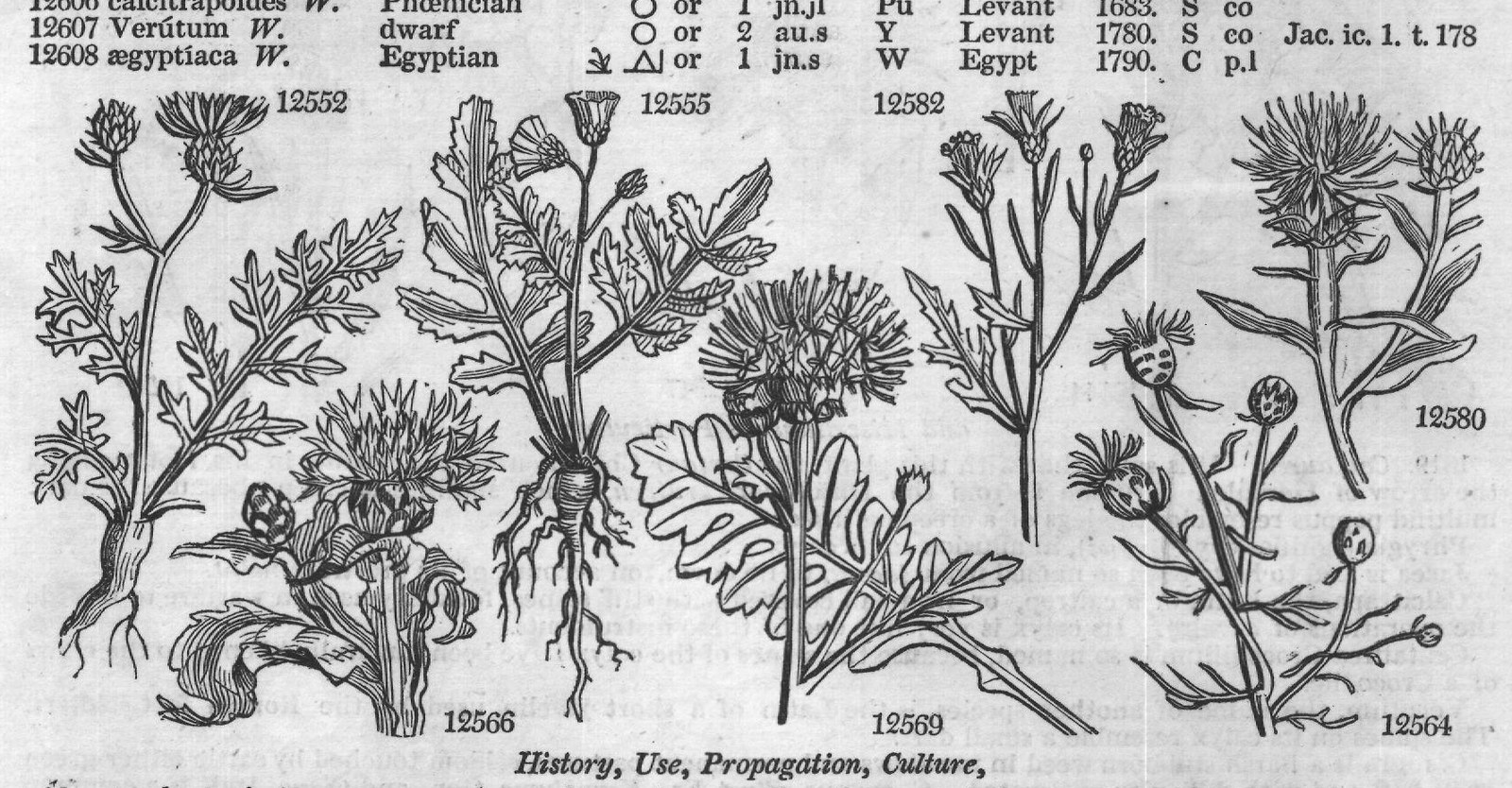
Egyptian or 1 jn.s W Egypt 1790. C p.l 12552 12555 12582 History, Use, Propagation, Culture, 12580 said not only to destroy worms and cure fevers, but also the plague, and the most putrid and stubborn ulcers and cancers. At present it is in no estimation whatever. It has by some botanists been thought advisable to separate this genus into several others; but the differences upon which the separation has been made depend upon variations in the form of the involucrum, ORDER III.
SYNGENESIA FRUSTRANEA. 12552 Invol. ciliated, Leaves downy very white all compound: lowest bipinnatifid; highest pinnate-laciniated 12553 Invol, ciliated, Leaves somewhat downy cinereous: lower ones pinnate-laciniate; upper ones simple 12554 Invol. ciliated, Lvs. downy undern. Root lvs. bipinnatifid: segm. lanceolate acute, Stem-leaves pinnatifid 12555 Invol. serrated, Leaves downy: root ones pinnated; upper 1-eared 12556 Invol. ciliat. smooth, Lvs. pinnatif. scabr. Segm. obl. lanc. acute: highest root ones sometimes cut at base 12557 Invol. ciliated sphacelate, Scales spreading, Leaves obl. lanc. entire villous downy: cauline decurrent 12558 Invol. scales roundish egg-shaped ciliated, Leaves oblong lanc. undivided very scabrous acute serrated 12559 Invol. scales ovate lanceolate serrate-ciliated, Leaves bipinnatifid, Segments lanceolate 12560 Invol. egg-shaped smooth, Scales somew. scar. at tip, Lvs greenish decurr. undivided: radical ones lyrate 12561 Inv. scales scar. at tip serr. Lvs.scab. at edge: root ones obl. tooth.; stem ones lanc.somew.decurr. quite ent. 12562 Scales of the involucre ciliated ovate pubescent, Leaves pinnatifid roughish: the segm. lanceolate acute 12563 Invol. ciliated nearly globular, Leaves deeply pinnatifid, Segments linear 12564 Invol. ciliated ovate roundish beautifully spotted, Leaves slender bipinnatifid, Stem a little panicled 12565 Invol. ciliated oblong, Leaves pinnatifid linear quite entire 12566 Invol. serrated, Leaves oblong serrated decurrent and undivided [branched divaricated 12567 Invol. ciliat. Scales ovate-lanc. spread. at tip, Lower lvs. bipinnatif. lanc. lin.: upper ones pinnatifid, Stem 12568 Invol. ciliated, Leaves lanceolate serrated: lowest tooth elongated so as to appear like a stipule 12569 Invol. ciliated, Leaves downy pinnatifid, Segments obtuse egg-shaped quite entire: outer ones largest 12570 Invol. ciliated, Leaves scabrous: underneath pinnatifid, Segments lanceolate sometimes toothed 12571 Invol. scarious, Scales ovate lanceolate serrated ciliated, Leaves scabrous beneath: radical bipinnatifid §2. CALCITRAPA. Involucrum ciliated with spines. * Spines simple. [panicled 12572 Invol. erect feathery, Head without a neutral ray, Lower Ivs. pinnatif.: upper ones lin. All quite ent. Stem 12573 Invol. ciliate-spinous egg-shaped, Scales reflexed at tip, Lvs. hoary: root ones lyrate; stem ones linear 12574 Invol. ciliate-spinous at tip, Spines of lower scales reflex. Lvs. pinnat. Pinnælin.obt. Root leaves bipinnat. 12575 Invol. ciliate-spinous, Leaves lyrate-pinnated generally entire: terminal lobe large toothed 12576 Invol. ciliate-spinous, Stem-leaves pinnatifid: root ones bipinnatifid, Segments lanceolate 12577 Invol. ciliate-spinous, Stem-leaves pinnated: root leaves bipinnated, Pinnæ linear-filiform 12578 Invol. ciliate-spin. at tip, Stem-lvs. pinnatif. lin. lanc.: root ones bipinnatif. Segm. lanc. terminal 1-toothed 12579 Invol. ciliate fringed with straight rigid white bristles, Lvs. obl. a little toothed, Head yell. without a ray 12580 Invol, simply spinous, Spines spreading, Florets equal, Leaves hairy: lower ones pinnatifid 12581 Invol. bristly spinous, Leaves lanceolate petioled toothed near the base 12582 Invol. scarcely spinous somewhat awned rayed, Leaves pinnatifid 12583 Invol. ciliated spinous, Stem-leaves pinnated quite entire root-leaves bipinnatifid 12584 Invol. ciliate spinous at the tip, Leaves hoary pinnatifid quite entire: upper ones linear-lanceolate 12585 Invol. ciliate subspiny, Leaves oblong downy sessile somewhat toothed; narrowed at base deeply toothed ** Spines palmate. 12586 Invol. palm.-spin. Spines reflex. Lvs. obl. smooth. embracing the stem decurr. repand tooth. Teeth prickly 12587 Invol. palm.-spinous, Spines reflex. Lvs. obov. somew. tooth. stalked: floral somew, decurr. mucro.-toothed 12588 Inv. palm.-spin. Spines reflex. Lvs. obl. hoary embrac. stem-decurr. tooth. cut at base, Teeth rather prickly 12589 Invol. palm. spinous, Lvs. decurr. not prickly: root ones pinnatifid; terminal lobe very large 12590 Inv. palm. spin. Spines reflex, larger than calyx, Lvs. hoary obl. sess. decurr. pinnatifid, Teeth not prickly 12591 Invol. palmate spinous, Lvs. ovate-lanc. petioled toothed 12592 Invol. palmate spinous solitary sess. Lvs. lanc. a little embracing the stem pinnatifid toothed 12593 Invol. palmate spinous, Stem lvs. lanc. toothed decurrent: root lvs. lyrate obtuse 12594 Invol. palmate spinous, Spines 3 or 5, Lvs. lanc. sessile toothed 12595 Invol. ciliated surrounded by a whorl of long lvs. Lvs. lyrate toothed obtuse 12596 Invol. palmate spinous, Lvs. embracing the stem runcinate pinnatifid prickly: toothed root ones lyrate 12597 Invol. doubly spinous woolly bracteated, Leaves half decurrent toothed spiny 12598 Invol. palm. spinous term. solitary, Spines straight, Lvs. lanc. decurr. not prickly: root ones lyrate 12599 Invol. palm. spin. term. ones clustered sess. Spines straight, Lvs. lanc. scabrous decurr. not prickly: lower stem ones a little toothed; root ones sinuated 12600 Invol. palm. spinous solitary subsessile, Spines straight, Lvs. lanc. scabrous toothletted decurrent 12601 Inv. palm. spin. Spines spread. Lvs. scabr.: stem lvs. lanc. a little embrac. stem finely tooth.; root ones lyrate 12602 Invol. palm. spinous solit. Spines straight: inner scales scarious at the tip, Lvs. downy lanc. decurr.: lower ones finely toothed pinnatifid at the base 12603 Invol. palmate spinous terminal sess. glomerated, Leaves petioled pinnatifid cut-toothed *** Appendages of involucrum spiny-pinnate. 12604 Invol. doubly spinous woolly, Lvs. half decurrent entire and sinuated, Stem proliferous 12605 Invol. doubly spinous sess. Lvs. pinnatifid toothed, Stem divaricated spreading hairy 12606 Invol. somewhat doubly serrated, Lvs. embracing the stem lanc. undivided serrated [entire decurr. 12607 Inv. palm. spin.: midd. spine very long; lat. ones short, Root-lvs. sinuate-pinnatif. Stem ones lanc. quite 12608 Invol. doubly spinous somewhat woolly, Lvs. sess. lanc. entire and toothed, Stem proliferous 12588 12590 12595 and Miscellaneous Particulars. unconnected with differences of organization they are therefore not adopted here. The tribe of Centaureæ of M. Cassini is not distinguished from Carduineæ by any very important characters. The greater part of the species are natives of Europe and Asia, several of Africa, a very few of America, and none of the southern parts of the world.
The tribe of Centaurcæ 3 B SYNGENESIA FRUSTRANEA.
CLASS XIX. 12609 salmántica W. 12610 muricáta W. 12611 Crocodýlium W. 12612 Rhapóntica W. 12613 babylónica W.
Ragwort-leaved muricated or 3 jl.au or 1 jl.au Pu Pu blush-flowered O or 1 jl.au Pu S. Europe 1596. S co Spain 1621. S co Levant 1777. S co Jac. vind. 1. t. 64 Barr. rar. t. 503 Swiss or 1 jl.au Pu Switzerl. 1640. D co Bot. mag. 1752 Babylonian or 7 jn.s Y 12614 spléndens W. shining or 3 jl.au Pu 12615 dilúta H. K. pale-flowered or 12616 decúmbens P. S. decumbent Aor 2 jl.au 1½ jl.s 1597. S co Pa.pu S. Europe 1781. D co Pu France 1815. D co Levant 1710. D co Spain Alp. exot. t. 282 12617 Jácea W. 12618 tagána W.
Brown Knapw.
Portugal w 1½ jl.s Pu Aun 1 jl.au Pu 12619 álba W. 12620 amára W. 12621 nítens W. 12622 sibírica W. white-flowered or 2 jn.s W bitter Aor 1 jl.au Pu England past. D co Portugal 1640. D co Spain 1597. D co Italy D co ...
Eng. bot. 1678 Brot.phy.lus. t.3 Boc. mus.31.t.17 shining or 2 jl.au Pu Caucasus 1823. S co Bu.cen.2.t.15.f.1 Siberian or 1 jl.au R Siberia 1782. D co Gm.sib.2.t.42.f.2 12623 glastifólia W.
Woad-leaved or 4 jn.s Y Siberia 1731. D co Bot. mag. 62 12624 orientális W. 12625 Béhen W. oriental or 1 jl.au Y Siberia 1759. D co saw-leaved Oor 1 jl.au Y Levant 1797. S co 12626 répens W. creeping or jn.au Y Levant 1739. D co 12627 moscháta W.
Sweet Sultan or 2 jl.o Pu Persia 1629. S s.1 Kn. thes.2. t.C.4 12628 Centaúrium W. great or 4 jl.au Y Italy 1596. D co 12629 ruthénica W.
Russian or 3 jl.au Pa.Y Russia 1806. D co Gmel. sib. 2. t.41 12630 suavéolens W.
Yellow Sultan or 1 jl.o Y Levant 1683. S s.l 12631 Crupína W. black-seeded or 3 jn.jl F Italy 1596. S co Sweet fl. gard.51 Col.ecphr. 1. t.34 12632 Líppii W.
Lippi's or 1 jn.jl Pa.pu Egypt 1739. S co Is.a.pa.1719. t.10 12633 glaúca W. glaucous or jn.jl Pa. Y Caucasus 1805. D co 12634 alpína W.
Alpine or 3 jl.au Y Italy 1640. D co Corn.can.69.t.70 1820. GALACTITES. P. S. GALACTITES.
Compositæ.
Sp. 1. 12635 tomentósa P. S. woolly or 1½ jl.au Pu S. Europe 1738. S co An. mus. 16. t. 9 NECESSARIA. 1821. WEDELIA. W. WEDELIA.
Compositæ. 12636 híspida Kth. hispid or 1½ jn Y 12637 radiósa Ker. many-rayed or 3 ap.n Y 12638 perfoliáta W. perfoliate un 2 jl.au Y Alcina perfoliáta Cav. 1822. MILLE'RIA. P.S. MILLERIA. 12639 quinqueflóra W. five-flowered 12640 biflóra W.
Compositæ.
Sp. 2. un 2 jl.o Y two-flowered un 1 jl.o Y 1823. BALTIMO'RA, W. BALTIMORA. 12641 récta W.
Compositæ.
Vera Cruz 1731. S co Campeachy1730. S co Sp. 1.
Sp. 3-21.
N. Spain 1819. D co Brazil 1820. C co Mexico 1796. S co Bot. reg. 543 Bot. reg. 610 Cav. ic. 1. t. 15 Cav. ic. 1. t. 82 Mart. dec. 47. f.1 upright Oun 2 jn.jl Pa. Y Vera Cruz 1699. S co Sch.ha.3. t. 261. C 1824. SIL/PHIUM. W. SILPHIUM.
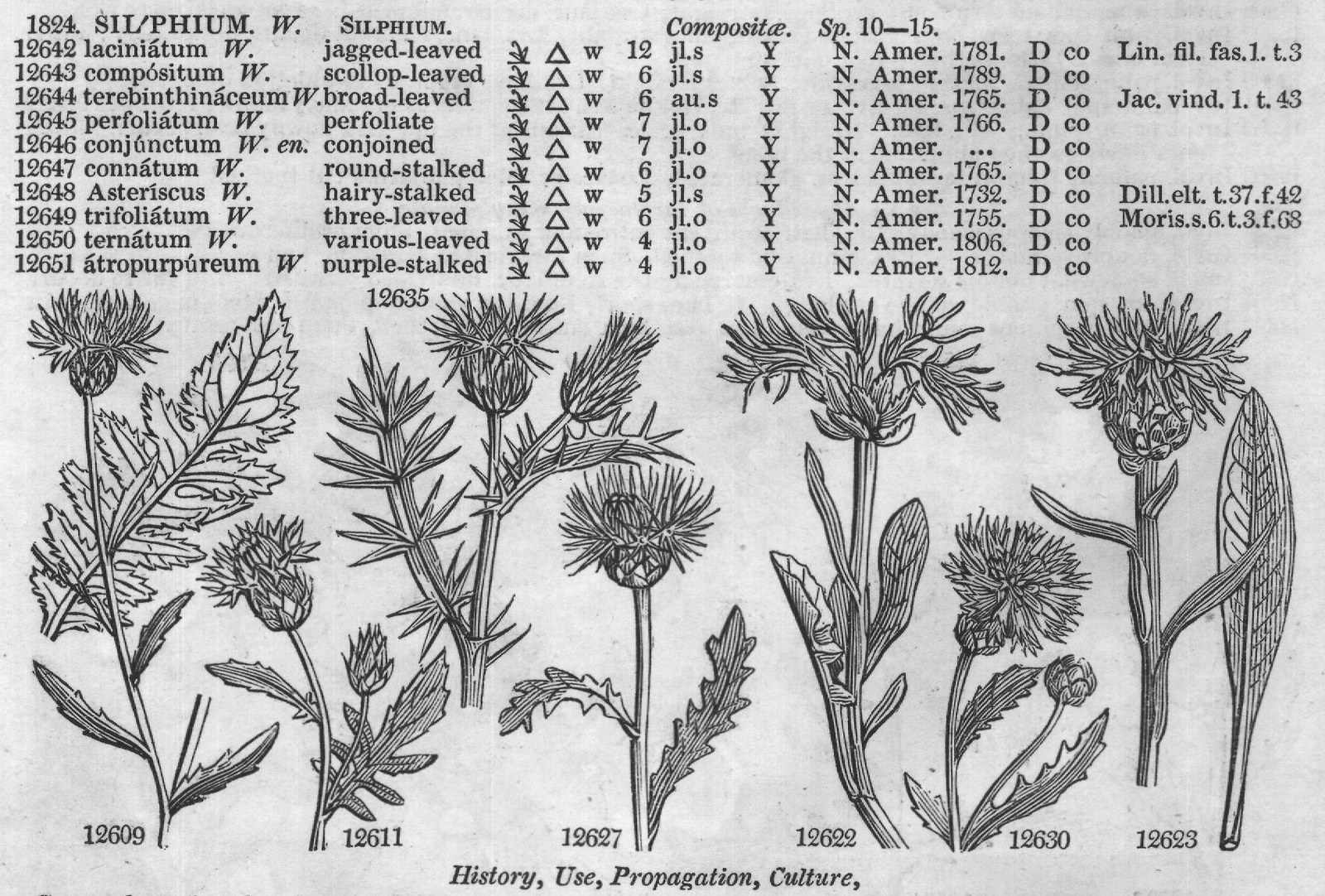
Composite. Sp. 10-15. 12642 laciniátum W. jagged-leaved 12643 compósitum W. scollop-leaved 12644 terebinthinaceum W.broad-leaved 12645 perfoliátum W. perfoliate w 12 jl.s Y N. Amer. 1781. D co Lin. fil. fas.1. t.3 w 6 jl.s Y W 6 au.s Y N. Amer. 1789. D co N. Amer. 1765. D co Jac. vind. 1. t. 43 W 7 jl.o Y N. Amer. 1766. D co 12646 conjúnctum W. en. conjoined W 7 jl.o Y N. Amer.
D co ... 12647 connátum W. round-stalked w 6 jl.o Y N. Amer. 1765. D co 12648 Asteríscus W. hairy-stalked w 5 jl.s Y N. Amer. 1732. D co Dill.elt. t.37.f.42 12649 trifoliátum W. three-leaved W 6 jl.o Y N. Amer. 1755. D co Moris.s.6.t.3.f.68 12650 ternátum W. various-leaved w 4 jl.o Y N. Amer. 1806. D. co 12651 átropurpúreum W purple-stalked w 4 jl.o Y N. Amer. 1812. D co 12635 12609 12611 12627 12622 12630 12623 History, Use, Propagation, Culture, C. moschata is a handsome border annual, of which there is a white-flowered variety. C. Centaurium, montana, splendens, and glastifolia, are among the most ornamental of the perennials. 1820. Galactites. A plant formerly included in Centaurea, and named on account of the milky veins of its leaves (γaλa, milk). 1821. Wedelia. Named after George Wolfgang Wedel, a German, born in 1625, died in 1721. He was professor at Jena, and published many learned dissertations upon the plants of the ancients. There was also a John Adolphus Wedel, professor in the same university. ORDER III.
SYNGENESIA FRUSTRANEA. §3. CROCODYLIUM. Involucrum not ciliated, but spiny at end. 12609 Invol. globul. smth. Spine very small weak a little reflex. Lvs. lanc.serrat.: root ones lyrate, Stem divaricat. 12610 Invol. simply spinous villous, Lower lvs. lyrate toothed: upper ones lanc. Peduncles very long 12611 Invol. scarious simply spinous, Lvs. pinnatifid quite entire terminal: segm. larger toothed §4. RHAPONTICUM. Leaves of involucrum with a round scarious appendage, which is often lacerated. 12612 Invol. scales lacerated, Lvs. ovate-obl. finely toothed tomentose [ones lyrate 12613 Invol, conical hard, Scales ending in a patulous point, Lvs. somew. tomentose decurr. undivided: root 12614 Inv. egg-shap. Scales mucronat. Lower lvs. bipinnatif. bipinnatif. lin.: upper one pinnat. Pinnæ lin. sometimes toothed 12615 Invol, ciliated, Scales acum. somew. thorny, Lvs. obl. pinnatif. Florets of the ray longer than those of disk 12616 Invol. scarious, Scales dilated cut, Lvs. linear-lanc.: radical cut 12617 Scales of invol. scarious torn: lower ones pinnatifid, Lvs. lin. lanc.: the lower ones broader and toothed 12618 Invol. scales roundish quite ent. Lvs. obl. smth.: root ones serrat. Stem ones sometimes slightly cut at base 12619 Invol. scales entire mucronated, Lvs. pinnate toothed: stem ones linear toothed at the base 12620 Stems decumbent, Lvs. lanc. quite entire 12621 Invol. cylindrical, Scales mucronated, Lvs. pinnated, Pinnæ lin. mucronated quite entire 12622 Invol. scales egg-shaped obtuse ciliated, Lvs. downy on both sides pinnatif. and undivided, Stem declining 12623 Leaves undivided quite entire decurrent 12624 Invol. scales pectinate ciliated, Lvs. deeply pinnatifid, Segm. linear lanceolate [the stem decurrent 12625 Invol. conical, Scales quite ent. Lvs. coriaceous reticularly veined: root ones lyrate; stem ones embracing 12626 Leaves lanc. toothed somewhat petioled, Peduncles filiform leafless §5. Leaves of involucrum neither ciliated, nor spiny, nor with a scarious appendage. 12627 Invol. roundish smooth, Scales egg-shaped, Lvs. lyrate toothed 12628 Invol. scales egg-shaped, Lvs. pinnated, Leaflets decurrent serrated 12629 Invol scales egg-shap. obt. Lvs. pinnat. smooth, Leafl. cartilagin. sharply serrat. termin. one obl. egg-shaped 12630 Invol. round, smooth, Lower lvs. broad somew. spatul. tooth.: upp. ones lyr. at base, Head yell. sweet-scent. 12631 Invol, scales linear awl-shaped, Leaves pinnated serrated 12632 Invol. scales mucronate, Leaves somewhat decurrent lyrate toothed 12633 Invol. pubescent, Scales roundish obtuse, Leaves deeply pinnatifid: lowest segments toothed 12634 Invol, scales egg-shaped obtuse, Leaves pinnated smooth quite entire odd one serrated 12635 Invol. bristly spinous, Leaves decurrent sinuated spinous downy underneath. NECESSARIA. 12636 Leaves lanceolate acuminate serrated with a large tooth on each side at the base 12637 Leaves ovate-lanceolate, Invol. urceolate squarrose, Rays imbricated 12638 Stem herbacaous, Leaves rhomboid narrowed at base connate 12639 Leaves stalked roundish-ovate narrowed at base: floral subcordate, Pedunc. terminal dichotomous 12640 Leaves stalked oblong ovate ciliated, Pedunc. terminal aggregate 12641 Stem winged, Heads pale-yellow small 12642 Radical and cauline leaves pinnatifid, Stem hirsute 12643 Cauline leaves sinuate pinnatifid: radical ternate sinuate multifid 12644 Leaves alternate ovate serrated scabrous: radical cordate 12645 Leaves opposite deltoid stalked perfoliate, Stem square smooth 12646 Lvs. opp. conn. unequally toothed, Stem smooth square, Four outer sc. of invol. longer than the inner 12647 Leaves sessile stalked, Stem round scabrous 12648 Leaves opposite or alternate sessile oblong hairy: lower serrate, Stem round hispid 12649 Stems 6-angled, Leaves ternate ovate toothed, Panicle trichotomous 12650 Stems round, Leaves ternate somewhat toothletted, Panicle dichotomous 12651 Stems round, Leaves about 4 toothletted, Panicle dichotomous 12644 12636 12641 12638 12642 12639 12648 and Miscellaneous Particulars. 1822. Milleria. So named by Linnæus, after Philip Miller, F. R. S., the well known author of the Gardener's Dictionary, and considered the first botanical gardener of his time. He was born in 1692, and died in 1769. 1823. Baltimora. This plant grows in the neighbourhood of Baltimore. 1824. Silphium. D'Herbelot asserts, that silphi or serpi, was a name given by the natives of Africa to the plant which produced the laser of the Romans, a substance held in great esteem among them for its flavor and its medicinal properties. All the species are tall herbaceous plants with bright yellow flowers, and are very proper ornaments for a shrubbery. 3 B2 1825. TRIX'IS. Dec.
TRIXIS. 12652 senecioídes Hooker Groundsel-like 1826. POLYM'NIA. W. POLYMNIA. 12653 canadénsis W.
Canadian 12654 Uvedália W. broad-leaved 12655 abyssínica W. upright 12656 virginiánum L. Virginian 1827. CHRYSO'GONUM. L. CHRYSOGONUM. 1828. MELAMPO DIUM. W. MELAMPODIUM. 12657 americánum W. American SYNGENESIA NECESSARIA.
Compositæ. Sp. 1-5.
Opr 1 au.s W Chili or or or Compositæ. Sp. 3-4. 6 jl.au L.Y 8 au.o Y 4 ap.my Y 1821. S co N. Amer. 1768. D co N. Amer. 1699. D co Africa 1775. S co Apr Compositæ. my.jn Y Sp. 1.
N. Amer. ...
CLASS XIX.
Hook. ex. fl. 101 L.am.ac.3.t.1.f.5 Cav. ic. 3. t. 227 D p.l Plu.alm. t.83. f.4 Compositæ. 12658 húmile W. dwarf un 1 au.o W un 1 jn.o W Sp. 2-6.
Vera Cruz 1733. S co Jamaica 1782. S co Rel. Hous.9. t.21 1829. CHAPTA'LIA. Vent. CHAPTALIA.
Compositæ.
Sp. 1. 12659 tomentósa Ph. woolly pr my.jn W N. Amer. 1806. D co Bot. mag. 2257 1830. CALENDULA.
W. MARYGOLD.
Composite. Sp. 19-34. 12660 arvénsis W. field or 2 my.s D.Y Europe 1597. S co 12661 sícula W. en.
Sicilian or 1 my.s D.Y Sicily 1816. S co 12662 stelláta W. starry or 2 jn.s o Barbary 1795. S co Sch.hand.3.t.265 12663 officinális W. common or 3 jn.s 0 S. Europe 1573. S co B pléna 12664 sáncta W. 12665 incána W. 12666 pluviális W. hybrida double-flowered or 3 jn.s 0 Sco ...... ... pale-flowered or 2 my.s Y Levant 1731. S 1.p hoary or 1½ jn.au Y Barbary 1796. S 1.p Desf. atl. 2. t.245 Small Cape or 1 jn.au W.pu C. G. H. 1699. S s.l Mill. ic. t. 75. f. 2 12667 hýbrida W. 12668 nudicaúlis W.
Great Cape or 1 jn.jl W C. G. H. 1752. S s.l Sweet fl gard.39 naked-stalked or 1 jn.au W.pu C. G. H. 1731. S s.l Com.hort.2.t.33 12669 graminifólia W.
Grass-leaved or 1 my.s W.pu C. G. H. 1731. C p.1 Bot. reg. 289 12670 Trágus W. bending-stalk'd or 2 my.jn W.pu C. G. H. 1774. C p.1 Bot. mag. 1981 ẞ fláccida V. flaccid or 2 my.jn Or C. G. H. 1774. C 1.p Bot. reg. 28 12671 viscósa H. K. viscous or 2 jn.s Or C. G. H. 1790. C p.l Bot. rep. 412 12672 oppositifólia W. glaucous-leav'd or 2 au Y C. G. H. 1774. C p.1 12673 fruticosa W. shrubby or 2 jn.jl Y C. G. H. 1752. C p.l Mill. ic. 2. t. 283 12674 chrysanthemifólia V. large-flowered or 2 mr.au Y C. G. H. 1790. C p.l Bot. reg. 40 12975 arboréscens W. rough-leaved or 3 d Y C. G. H. 1774. C p.1 Jac. ic. 3. t. 596 12676 suffruticósa W. suffruticose or 1 d Y C. G. H. 1823. C p.l 12677 denticuláta W. toothletted or 2 d Y Barbary 1821. C p.1 12678 muricáta W. muricated or 2 d Y C. G. H. ...
C p.l 1831. ARCTO'TIS. II. K. ARCTOTIS.
Compositæ.
Sp. 26-40. 12679 acaúlis W. dwarf or ap.jl Y.R C.C C. G. H. 1759.
R p.1 12680 trícolor W. three-colored or 1 my.jl W.R C.G. H. 1794.
D I.p P.
Bot. reg. 122 Bot. reg. 131 12681 unduláta W. wave-leaved Lor 1 ap.jn Or C. G. H. 1795.
C p.l Jac.schœ.2.t.160 12682 grandiflóra H. K. great-flowered or 1 mr.my Pa.Y C. G. H. 1774.
S 1.p 12683 glaucophýlla W.
Sea-green-leav. or 1 my.au Y.Pu C. G. H. 1794. D l.p Jac.schœ.2.t.170 12684 plantagínea W.
Plantain-leav'd or 1 jn.au Or C. G. H. 1768. C p.1 12685 argentea W. silver-leaved or 1 au Or C. G. H. 1774. D 1.p 12686 rósea W.
Rose or 1 jl.s Pk C. G. H. 1793. C 1.p Jac.schœ.2.t.162 12687 decúmbens W. decumbent or 1 jl.s Y C. G. H. 1790. D 1.p Jac.schœ.3.t.381 12688 angustifólia W. narrow-leaved or 1 jl.s Pu C. G. H. 1739. C 1.p 12689 fláccida W. bending-stalked or 1 my.jl W.R C. G. H. 1794. S l.p Jac.schœ.2.t.163 12690 decúrrens W. decurrent or 1½ jn.jl W.R C. G. H. 1794. C 1.p Jac.schœ.2.t.165 12691 melanocícla W. en. various-colored or 1 jn.jl W.pu C. G. H. 1812. C 1.p 12692 réptans W. creeping or jl.s W.o C. G. H. 1795. R p.l Jac.schœ.3.t.382 12693 auriculáta W. ear-leaved or 1jn.au Y C. G. H. 1795. C p.1 Jac.schœ.2.t.169 12694 fastuósa W.
Orange-flower. spl 2 my.jl O.R C. G. H. 1795. S co Jac.schœ.2.t.166 12652 12653 12656 12657 12659 12669 12670 12671 History, Use, Propagation, Culture, 1825. Trixis. From τρεiς, three, on account of its triangular capsule with three cells. 1826. Polymnia. Polymnia was the name of one of the Muses. Why it has been applied to this plant is not very obvious. A coarse broad-leaved weedy plant. 1827. Chrysogonum. From χρuσός, gold, and you, a knee. The bright yellow flowers are usually produced in the bends of the stems. 1828. Melampodium. One of the Greek names of black hellebore, with which the modern plant has no relation. The plant of the ancients was probably named from the blackness of the roots, (μελaς, black, and πες, a foot). 1829. Chaptalia. Dedicated by Ventenat to the famous French chemist, M. Chaptal. A pretty little North American herbaceous plant. 1830. Calendula. So named because it may be found in flower during the Calends of each month, or, which is the same thing, during every month in the year. C. pluvialis has been named from its flowers closing at the approach of rain.
ORDER IV.
SYNGENESIA NECESSARIA, 12652 Herbaceous downy, Leaves sinuate pinnatifid toothed: cauline amplexicaul. 12653 Leaves toothletted acuminate: lower pinnatifid; upper 3-lobed or entire 12654 Leaves 3-lobed acute running down the petiole: lobes angular sinuated 12655 Leaves opposite sessile oblong lanceolate somewhat toothed, Invol. 5-parted, Florets all female 12656 Leafstalks longer than leaves 12657 Stem erect, Leaves somewhat linear 1-toothed on each side 12658 Stem erect, Leaves lyrate-toothed sessile 12659 Leaves ovate-oblong entire silvery beneath, Scape naked 1-headed, Head nodding 12660 Pericarps cymbiform muricated incurved: outer lanceolate-subulate muricated at back 12661 Pericarps cymbiform muricated incurved: outer ovate with a membranous edge toothed crested at back 12662 Pericarps cymbiform incurved muricated: outer 5 ovate-lanceolate membranous toothed at edge 12663 Pericarps cymbiform all incurved muricated 12664 Pericarps urceolate obovate smooth, Involucre somewhat muricated 12665 Pericarps cymbiform smooth: outer subulate erect somew. muricat. Lvs. obl. spatul. downy on each side 12666 Leaves narrow lanceolate sinuate toothletted, Stem leafy, Peduncles filiform 12667 Leaves oblong lanceolate blunt toothed, Stem leafy, Peduncles thickened at end 12668 Leaves lanceolate sinuate toothed, Stem nearly naked 12669 Leaves linear nearly entire, Stem nearly naked 12670 Leaves linear somewhat toothletted muricate dotted beneath, Pericarps orbicular, Stem suffruticose 12671 Leaves cuneate cut toothed glabrous, Invol. downy ciliated, Stem shrubby weak 12672 Leaves opposite linear entire somewhat fleshy smooth 12673 Leaves obovate somewhat toothed, Stem fruticose decumbent 12674 Leaves obovate sublyrate roughish, Stem suffruticose erect 12675 Lvs. obl. toothed scabrous, Invol. in fruit cernuous, Pericarps nearly orbicular, Stem fruticose panicled 12676 Peric. cymbif. incurv. muricat.: outer lanc. subulate muricated erect, Lvs. obl. spatul. downy on each side 12677 Pericarps all uniform incurved cymbiform muricated, Leaves lanceolate toothletted acute smoothish 12678 Leaves oblong papillose scabrous: lower toothed; upper entire, Stem shrubby 12679 Radiant florets fertile, Stem very short decumbent, Leaves hoary on each side ternate lyrate 12680 Radiant florets fertile, Leaves downy beneath ovate entire or lyrate-toothed, Scape furrowed 1-headed 12681 Radiant florets fertile, Leaves downy beneath wavy-toothed ovate or lyrate, Scapes 1-headed 12682 Leaves pinnatifid toothletted cobwebbed 3-nerved 12683 Radiant florets fertile, Leaves hoary pinnatifid repand somewhat toothed, Outer scales of invol. reflexed 12684 Radiant florets fertile, Leaves lanceolate ovate nerved toothletted amplexicaul. 12685 Radiant florets fertile, Leaves lanceolate linear entire downy 12686 Radiant florets fertile, Stem procumbent, Leaves spatulate-lanceolate repand-toothed hoary 12687 Radiant florets fertile, Stem procum. Leaves obl. lanc. unequally toothed hoary downy beneath 3-nerved 12688 Radiant florets fertile, Stem branched ascending, Leaves downy spatulate lanceolate 3-nerved pubescent 12689 Radiant florets fertile, Stem branched ascending, Leaves spatulate lanceolate entire 3-nerved downy 12690 Radiant florets fertile, Stem shrubby, Leaves hairy oblong undivided somewhat toothed 12691 Radiant florets fertile , Stem shrubby erect hoary, Lvs. obov. oblong vill. toothed decurr. down the petiole 12692 Radiant florets fertile, Stem ascend. Lvs. hairy hoary beneath: lower lyrate-toothed; upper lanc. tooth. 12693 Radiant florets fertile, Stem snow white, Leaves lyrate amplexicaul. downy toothed: term. lobe rhomb. 12694 Radiant florets fertile, Stem erect, Leaves hairy oblong toothed, Outer scales of invol. reflexed ciliated 12687 12679 12681 12690 12692 12683 12689 12693 and Miscellaneous Particulars.
C. officinalis, Souci du jardin, Fr., Goldblume, Ger., and Furrancio, Ital., has been a garden plant time out of mind, and used in soups and broths, both to color them, and as comforters of the heart and spirits. It had , and used in soups and broths, both to color them, and as comforters of the heart and spirits. It had formerly many virtues ascribed to it, but is now totally out of use in this country. According to Linnæus, the flowers are open from nine in the morning till three in the afternoon. There are double, lemon-colored, and prolific varieties. From the flowers of Calendula officinalis is obtained a distilled water, a kind of vinegar, and a conserve.
With this genus for his type, M. Cassini has formed a small tribe which he calls Calenduleæ, remarkable for a peculiar smell, very perceptible in the common pot-marygold, which is said to be confined to themselves peculiar smell, very perceptible in the common pot-marygold, which is said to be confined to themselves alone. But this seems to be almost the only character by which they are distinguished from Heliantheæ. The greater part of Calenduleæ are found in the country of the Cape of Good Hope; but some are found in Europe and Asia. 1831. Arctotis. Vaillant, who named this genus, called it Arctotheca, from aρκτoς, a bear, and Inzn, a capsule, because its fruit is shaggy like a bear. This and some neighbouring genera have given rise to M. , because its fruit is shaggy like a bear This and some neighbouring genera have given rise to M. 3B3 12695 spinulósa W. 12696 maculáta W. 12697 áspera B. reg.
SYNGENESIA NECESSARIA.
CLASS XIX. thorny-leaved or 1½ my au Or C. G. H. 1795. S co Jac.schœ.2.t.167 spotted or 1 my.au W.o C. G. H. 1812. C 1.p Bot. reg. 130 broad rough-lv. or 1½ jl.s Y C. G. H. 1710. C p.l Bot. reg. 34 12698 auréola B. reg. 12699 bícolor W. en. narr. rough-lv. or 1 jl.s Or C. G. H. 1710. C p.l Bot. reg. 32 two-colored or 1 jl.s W.R C. G. H. 1812. C 1.p 12700 speciósa B. M. shewy or 1½ jn.au Y C. G. H. 1812. C p.l Bot. mag. 2182 12701 elátior W. tall or 1½ jn.au Y.Pu C. G. H. 1820. C p.l Jac.schœ.2.t.172 2 12702 arboréscens W.
Tree orijn.au W.pk C. G. H. 1818. C p.1 Jac.schœ.2.t.171 12703 cúprea W. copper-colored or 1½ jn.au Y.Pu C. G. H. 1823. C p.l Jac.schœ.2.t.176 12704 Cinerária W. grey or 1 jn.au Y.o C. G. H. 1824. D p.l Jac.schœ.2.t.174 1832. OSTEOSPERMUM. W.
Compositæ.
Sp. 9-27. 12705 corymbósum W. corymbose or 3 au Y C. G. H. 1822. Cl.p 12706 spinósum H. K. rough-leaved or 3 f.o Y C. G. H. 1700. S l.p Com. hort.2. t. 43 12707 spinéscens H. K. smooth-leaved or 3 mr.jn Y C. G. H. 1793. C 1.p Jac.schœ.3.t.377 12708 pisíferum W. smooth or 4 mr.my Y C. G. H. 1757. S 1.p Bot. cab. 470 12709 monilíferum W.
Poplar-leaved or 3 jl.au Y C. G. H. 1714. S l.p Dil. elt. t.68. f.79 12710 ilicifólium W.
Holly-leaved or 4 jl.au Y C. G. H. 1816. C l.p Bur. afr. 172. t.62 12711 rígidum W. rigid or 3 ap.jl Y C. G. H. 1774. C l.p 12712 cærúleum W. blue-flowered or 3 jn.s B C. G. H. 1774. C l.p Jac. ic. 1. t. 179 12713 polygaloídes W.
Milkwort-leav. or 3 jn.s Y C. G. H. 1759. C l.p Pluk.mant.t.382 1833. OTHON'NA. W. RAGWORT.
Compositæ.
Sp. 21-39. 12714 pinnáta W. wing-leaved or 3 ap.jn Y C. G. H. 1759. C 1.p Bot. mag. 768 12715 pectináta W.
Wormwood-lv. or 3 ap.jn Y C. G. H. 1731. C p.] Bot. mag. 306 12716 Athanásiæ W.
Athanasia-like or 3 n.d Y C. G. H. 1795. C p.l Jac.schœ.2.t.242 12717 abrotanifólia W.
Southernw.-lv. or 3 ja.mr Y C. G. H. 1692. C p.l Bot. reg. 108 12718 retrofrácta W. bending-stalk'd or 2 mr.au Y C. G. H. 1812. C 1.p Jac.schœ.3.t.376 12719 coronopifólia W.
Buckshorn-lvd. or 2 jl.s Y C. G. H. 1731. C p.l Com. hort.2.t.70 12720 cheirifólia W.
Stock-leaved or 1½ ap.jn Y Barbary 1752. C p.l Bot. reg. 266 12721 Tagétes W. 12722 flabellifólia B. C. 12723 crassifólia W. 12724 denticuláta W. 12725 heterophylla W. 12726 Língua W 12727 filicaúlis W. 12728 bulbósa W. 12729 perfoliáta Jac. 12730 parviflóra W. 12731 ericoídes W. 12732 tenuíssima W. 12733 arboréscens W.
Marygold-leav. or 1 ap jn Y C. G. H. 1823. S co fan-leaved or 1 ap.jn Y C. G. H. 1821. C co Bot. cab. 728' thick-leaved or or 2 S.O Y C. G. H. 1710. C p.1 Mil.ic.2.t.245.f.2 tooth-leaved or 2 ap.jl Y C. G. H. 1774. C p.1 Bot. mag. 1979 various-leaved 2 or 2 ap.jl Y C. G. H. 1812. C l.p tongue-leaved or 2 my.s Y C. G. H. 1787. D 1.p Jac.schœ.2.t.238 Yam-rooted or 1 ap.my Y C. G. H. 1791.
Dl.p Jac.schœ.2.t.241 bulbous or 2 my.jn Y C. G. H. 1774. D l.p Breyn. cent. t.66 perfoliate or 1 my.jl Y C. G. H. 1789. D 1.p Bot. mag. 1312 small-flowered or 2 jl.au Y C. G. H. 1704. C p.l Volk.norib.t.226 Heath-leaved or 2 jl.au Y C. G. H. 1815. C I.p fine-leaved or 1 ap.jl Y C. G. H. 1759.
C 1.p Jac.schœ.2.t.239 tree or 2 jlau Y C. G. H. 1723.
C p.l Dil.el.t.103.f. 123 12734 cacalioídes W. tuberous or my.s Y C. G. H. 1774.
D I.p 1834. HIP'PIA. W.
HIPPIA.
Composite.
Sp. 2-5. 12735 frutéscens W. shrubby un f.au Y C. G. H. 1710. C p.l Bot. mag. 1855 12736 integrifólia W. annual un jl.au Y E. Indies 1777. S 1.p H.uat h. t.67. f.2 1835. SOLI'VA. Fl. per. SOLIVA.
Compositæ.
Sp. 1-6. 1836. PSIA'DIA. W. 12737 anthemifólia R. Br. Chamomile-lvd. un Gymnóstyles anthemifólia Juss. 12738 glutinósa W. 1837. ERIOCEPHALUS. W. ERIOCEPHALUS. jn.jl Ap N. Holl. 1818. S co An.mus. t.61. f.1 PSIADIA. glutinous Composita.
Sp. 1. un un 2 jn.au Y Mauritius 1796. Cl.p Jac schœ.2.t.152 Composite.
Sp. 2-4. 12739 africanus W. cluster-leaved or 3 ja.mr Y C. G. H. 1732. C p.1 Bot. mag. 833 12740 racemósus W. silver-leaved or 3 mr.ap Y C. G. H. 1789. Cp.1 1838. FILA'GO. L.
COTTON ROSE.
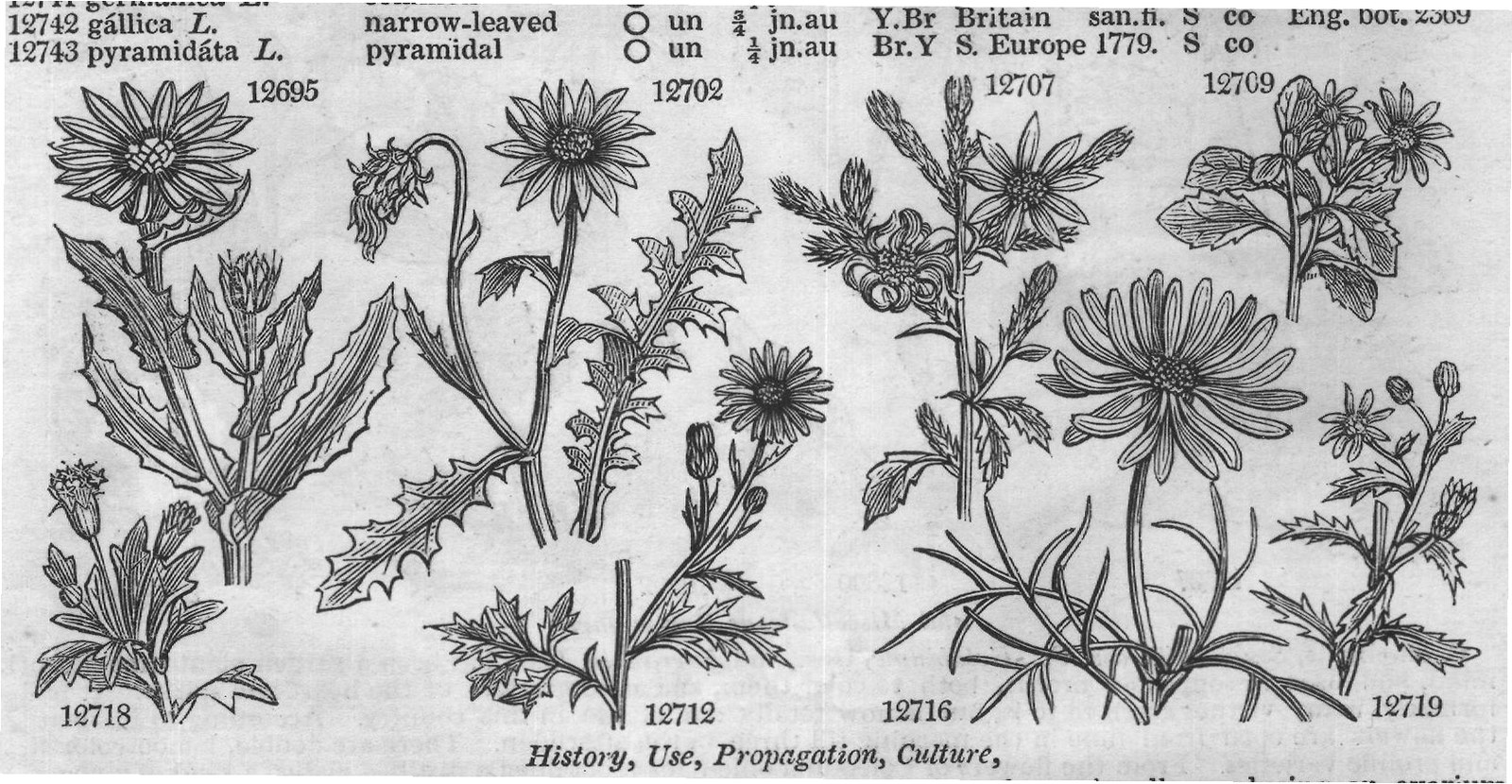
Composite. Sp. 16-21. 12741 germánica L. common 12742 gállica L. narrow-leaved 12743 pyramidáta L. pyramidal 000 un jn.au Y.Br Britain san.fi. S co Eng. bot. 948 un jn.au Y.Br Britain san.fi. S co Eng. bot. 2369 un jn.au Br.Y S. Europe 1779. S co 12695 12702 12707 12709 12718 12712 12716 12719 History, Use, Propagation, Culture, Cassini's tribe of Arctotideæ, which has the remarkable peculiarity of occasionally producing an ovarium with three cells. In the peculiarities of their style they approach the tribes of Echinopseæ, Carduineæ, Cen.. taureæ, and Carlineæ. They are entirely confined to the regions of the Cape of Good Hope. 1832. Osteospermum. From 05εov, a bone, and σπερμη, seed, in allusion to the hardness of the fruit. 1833. Othonna. Dioscorides mentions this name as being applied to various things, but especially to a plant various things, but especially to a plant with a leaf like rocket, but perforated with little holes, whence it was called Othonna, from oθovη, linen. The plant of the ancients can have had little affinity with that of the moderns. 1834. Hippia. A name applied by Cordus to the common Chickweed, because it was agreeable food for ORDER IV.
SYNGENESIA NECESSARIA. 12695 Radiant florets fertile, Stem erect, Leaves hoary viscid oblong amplexicaul. mucronate-toothed 12696 Radiant florets fertile, Leaves pinnatifid lyrate angular toothed downy beneath 12697 Radiant florets fertile, Stem erect, Leaves pinnatifid scabrous downy beneath revolute at edge 12698 Radiant florets fertile, Outer scales of invol. reflexed cuneate obl. with a broad short point somew. cobw. 12699 Radiant florets fertile, Stem erect, Leaves pinnatifid lyrate hoary downy beneath, Invol. imbricated 12700 Stemless, Leaves lyrate pinnatifid hoary beneath 3-nerved, Outer scales of invol. linear recurved 12701 Radi. flor. fertile, Stem erect, Branches downy hairy, Lvs. pinnatif. downy ben.: seg. lin. lanc. angul. downy 12702 Radiant florets fertile, Stem erect, Pedunc. hairy, Lvs pinnatif. hoary downy ben.: seg. lanc. angul. toothed 12703 Radiant florets fertile , Stem erect, Leaves downy beneath: segm. linear subpinnatifid wavy 12704 Radiant florets fertile, Leaves hoary downy long-stalked pinnatifid: segm. lanceolate blunt toothed 12705 Leaves lanceolate glabrous, Heads panicled 12706 Leaves obovate serrate downy, Spines branched 12707 Leaves lanceolate pinnatifid-toothed scabrous, Spines branched 12708 Leaves lanceolate mucronate somewhat stalked smooth serrated, Branches toothletted angular 12709 Leaves obovate serrated stalked subdecurrent 12710 Leaves oblong toothed-angular scabrous-amplexicaul. 12711 Leaves toothed pinnatifid hairy, Branches unarmed Branches furrowed 12712 Leaves pinnatifid smooth, Segments lanceolate unequally serrated 12713 Leaves lanceolate scattered decurrent smooth entire, Axillæ woolly 12714 Leaves pinnatifid: pinnæ lanceolate entire decurrent 12715 Leaves pectinate-pinnatifid downy: segm. linear toothed at the edge 12716 Leaves pinnate filiform, Invol. hemispherical many-toothed 12717 Leaves multifid pinnated linear, Joints of stem villous 12718 Leaves lanceolate 1-toothed on each side in the middle or entire, Peduncles axillary, Stem divaricating 12719 Lower leaves lanceolate entire: upper sinuate toothed 12720 Leaves lanceolate 3-nerved entire, Stem suffruticose creeping 12721 Leaves deeply pinnatifid glabrous: segments linear somewhat toothed, Stem herbaceous 12722 Leaves pinnatifid very small, Peduncles long slender axillary 1-headed, Ray longer than disk 12723 Leaves lanceolate entire somewhat fleshy, Stem erect 12724 Leaves oblong toothletted smooth narrowed at base amplexicaul. Heads panicled 12725 Radical leaves ovate angular toothed: cauline lanceolate entire 12726 Leaves entire: radical lanceolate; cauline lanceolate subcordate-amplexicaul. Stem erect 12727 Leaves entire: radical cordate; cauline ovate-lanceol. cordate at base amplexicaul. Stem flaccid filiform 12728 Leaves ovate somewhat toothed, Peduncles 1-headed very long 12729 Root tuberous, Leaves amplexicaul. Peduncles 1-headed 12730 Leaves lanceolate smooth amplexicaul. Heads panicled 12731 Stem dichotomous imbricated: leaflets acerose, Peduncle very long solitary in the divarications 12732 Leaves filiform fleshy, Stem shrubby 12733 Leaves oblong entire, Stem arborescent fleshy with woolly scars 12734 Fleshy naked smooth a span high, Leaves fascicled obovate sessile, Peduncle 1-headed 12735 Shrubby villous, Leaves pinnatifid, Heads corymbose 12736 Hispid erect, Leaves ovate serrated 5-nerved, Racemes terminal 12737 Leaves pinnated: leaflets linear many-times lobed acute, Pericarps cuneiform hairy 12738 The only species 12739 Leaves entire and divided, Heads corymbose 12740 Leaves linear silky 12741 Stem erect prolifer. at summit, Lvs. lanc. downy acute, Fls. capitate in the axils of branches and terminal 12742 Stem erect dichotom. Lvs. lin. acum. downy, Fls, crowded axill. and term. Clust. much shorter than leaves 12743 Stem erect subdichotomous, Leaves lanceolate spatulate downy, Flowers clustered axillary and terminal 12735 12727 12738 12741 000 12726 12732 12737 12739 and Miscellaneous Particulars. horses, ίππoς, a horse; and given to this plant by Linnæus for no reason whatever. Little plants resembling Tansy. 1835. Soliva. Named by the authors of the Flora Peruviana, after Salvator Soliva, a Spanish physician and botanist. 1836. Psiadia. From ψiaς, a drop of dew, in allusion to the dew-bespangled foliage of the plants. 1837. Eriocephalus. From ερiov, wool, and κεφaλη, a head , on account of the woolly grains collected in terminal heads. 1838. Filago. All the parts of these plants are covered with delicate threads or fila. 3B4 12744 montána Pers 12745 mínima Pers. 12746 arvénsis Pers. 12747 Lagópus Pers. 12748 rec'ta 12749 coarctáta 12750 americána 12751 supína Lk. 12752 pusilla Hænke. 12753 sphærica Lk. 12754 cephaloídea Lk. 12755 uliginósa 12756 sylvática 1839. MICRO'PUS. W. 12757 supínus W. 12758 eréctus W.
SYNGENESIA NECESSARIA. mountain least corn Hare's-foot upright-wood contracted Jamaica dwarf pygmy spherical large-headed marsh highland MICROPUS. trailing upright Br. Y S. Europe 1820. S co CLASS X1X.
Y.Br Britain sa.pas. S co Eng. bot. 1157 Y.Br Europe 1804. S co un jn.au un jl.au un jl.au O un jl.au Y.Br Siberia 1820. S co un 1 au un 1 au Br un 1 jl.au jn.jl un ✔ un lin jn.jl 1840. PARTHENIUM. W. PARTHENIUM. 12759 Hysteróphorus W. cut-leaved A un 1 jn.jl un jn.jl un 1 au un 1 au jn.s Oun unjn.s Y.Br Britain sa.pas. D co Eng. bot. 124 M.Video 1819. D co Pa. Y Jamaica 1815. D co Y.Br Scotland sc.alp. D co Y.Br Austria 1820. D co W N. Holl. 1819. D co Y.w N. Holl.? 1823. S co Y.Br Britain wat.pl. D co Y.Br Britain al.pas. Rs.1 un 1 jl.o W Eng. bot. 1193 Krock.siles. t.41 Eng. bot. 1194 Eng. bot. 913 Compositæ.
Sp. 2-3.
S. Europe 1710. S l.p Sch.hand.3.t.267 S. Europe 1683. S l.p Læf. hisp.t.1. f.3 Composita.
Sp. 2. 12760 integrifolium W. entire-leaved un 3 jn.o W Jamaica 1728. S 1.p Virginia 1661. D p.l Bot. mag. 2275 W. hort. ber. 4 1841. I'VA. W.
IVA.
Composite.
Sp. 2-5. 12761 ánnua W. annual un 2 jl.au W S. Amer. 1768. S l.p Schmidel.ic. t.15 12762 frutéscens W. shrubby or 4 au W N. Amer. 1711. C co Plu.alm. t.27. f.1 1842. ACICAR'PHA, Juss. ACICARPHA. 12763 spatuláta Jacq. spatulate cu Calycereæ. Sp. 1-3.
Brazil ... 1824. D p.l 12764 scáber W. 12765 caroliniánus W. rough-leaved Carolina SEGREGATA. 1843. ELEPHANTO'PUS. W. ELEPHANTS FOOT. un 1 jl.s Composite. Sp. 3-7. un 1 jn.s R 12766 tomentósus W. woolly ✗ un 1 jlau R E. Indies 1695. C s.p America 1732. C l.p W. Indies 1733. D l.p Rhee.mal. 10. t.7 Dil.el.t.106.f.126 1844. EDE'RA. W.
CŒDERA.
Compositæ.
Sp. 1-3. 12767 prolífera W. proliferous pr 1 my.jn Y C. G. H. 1789. C s.l Bot. mag. 1637 1845. FLAVE'RIA. J.
FLAVERIA.
Composite. 12768 contrayérba W. en. Peruvian m 1½ jl.s Y Sp. 1-2.
Peru 1794. S l.p Bot. mag. 2400 1846. STEBE. W.
STOEBE.
Composite.
Sp. 2-4. 12769 æthiópica W. 12770 cinérea W. 2 au Juniper-leaved 2 jl.s Heath-leaved pr pr C. G. H. 1759. C p.l C. G. H. 1784. C p.l Pl. man.t.297.f.1 1847. NAUMBURGIA. W.
NAUMBURGIA.
Composite.
Sp. 1. 12771 trinerváta W. three-nerved un 3 jl.au Y $. Amer. 1799. S l.p Sch.b.j.1800.2.t 5 Brotéra Contrayer'va Spr. 1843. CASSI'NIA. H. K. CASSINIA.
Compositæ.
Sp. 3-11. 12772 aúrea R. Br. yellow or jl.au N. Holl. 1803. Dl.p Bot. reg. 764 12773 spectábilis R. Br. shewy or 6 jl.au Y N. Holl. 1818. S co Bot. reg. 678 12774 leptophýlla R. Rr. small-leaved pr 2 jl.o W.
N. Zeal. 1821. C co 1849. SPHÆRAN'THUS. W. SPHÆRANTHUS.
Compositæ.
Sp.3-8. 12775 indicus W. 12776 africánus W. 12777 hírtus W.
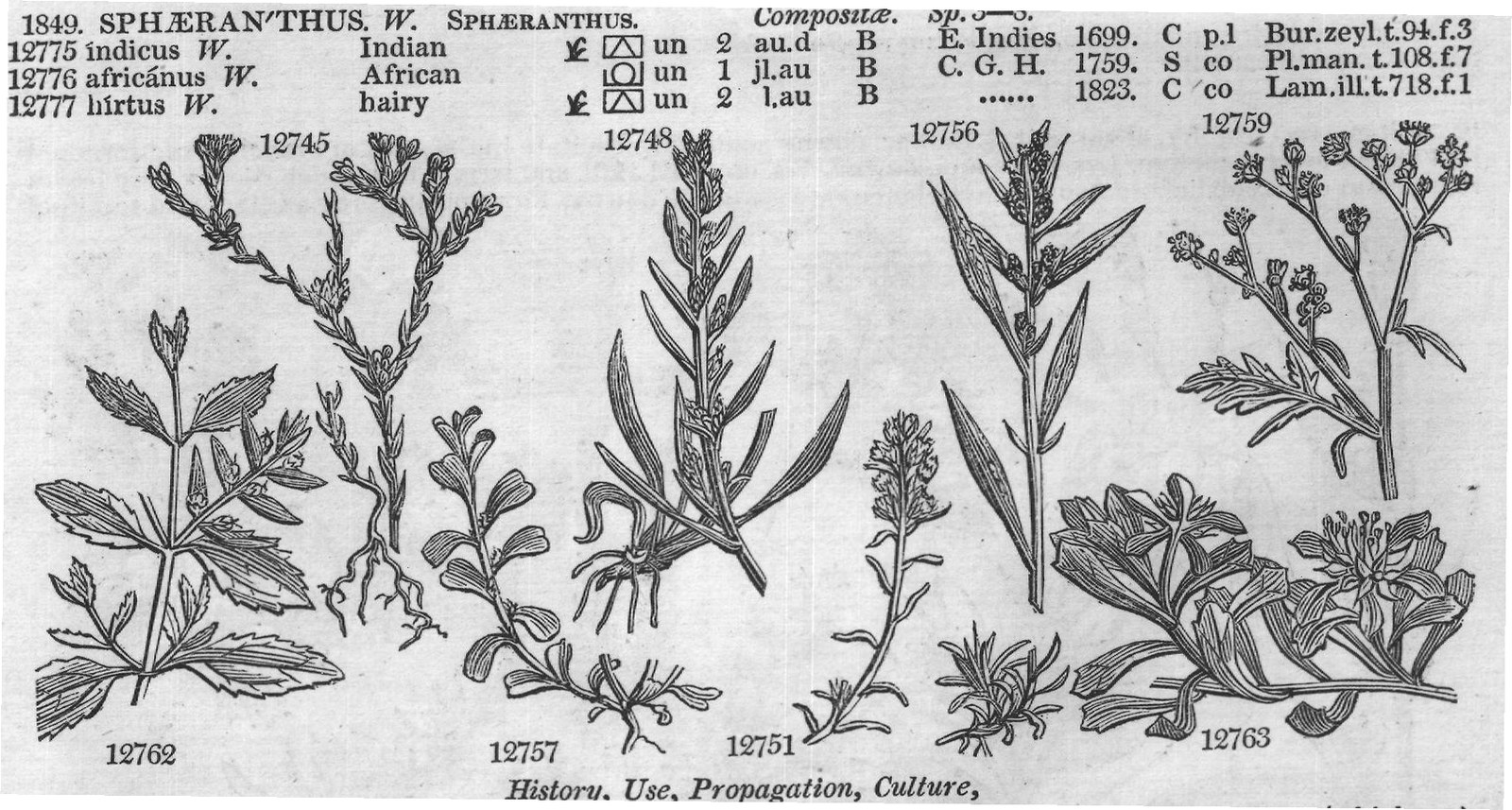
Indian African hairy un 2 au.d B E. Indies 1699. C p.l Bur.zeyl.t.94.f.3 un 1 jl.au B C. G. H. 1759. S co un 2 l,au B 1823. C co Pl.man. t.108.f.7 Lam.ill.t.718.f.1 ...... 12745 12748 12756 12759 12762 12757 12751 12763 History, Use, Propagation, Culture, 1839. Micropus. From μiκρoς, small, and 785, a foot; so called with reference to Leontopodium (which see), than which it is smaller, but which it resembles in its velvety silvery leaves. 1840. Parthenium. The Greek name of the Matricaria, which see. The indecent derivation of the word Hysterophorus, is sufficiently explained by Vaillant. (Mem. Acad. Sciences, anno 1720.) 1841. Iva. This name, according to Fuchsius, is a mere abbreviation of abiga see Ajuga. It has been abbreviation of abiga; see Ajuga. It has been applied by Linnæus to these plants because their smell resembles that of the ancient Iva. 1842. Acicarpha. From azis, a point, and κaρφoς, a palea, because that appendage is spiny. 1843. Elephantopus. It is said that some resemblance may be found between the radical leaves of this plant be found between the radical leaves of this plant and an elephant's foot (ελέφaς, an elephant, and 785, a foot). 1844. Edera. After George Eder, a Dane, professor of botany at Copenhagen, and the founder of the extensive Flora Danica. 1845. Flaveria. From flavus, yellow, because the plants are used in Chili for dying of that color. ORDER IV.
SYNGENESIA NECESSARIA. 12744 Stem erect subdichotomous, Lvs. lin. lanc. appressed downy, Flowers clustered axillary and terminal 12745 Stem erect branch. Branch. sprdg. Lvs. lanc. acute cottony, Fls. conic. clust. lat. term. Clust. longer than lvs. 12746 Stem erect panicled, Leaves oblong lanceolate woolly, Heads clustered lateral and terminal downy 12747 Stem erect branched, Lvs. lanc. cord. at base amplexicaul, woolly, Heads clust. lat. and terminal downy 12748 Leaves nearly glabrous above, Spike longer more interrupted 12749 Stem herbaceous quite simple, Leaves oblong spatulate downy beneath hoary, Heads clustered 12750 Stem erect branched, Lvs. obov. spatulate downy beneath, Heads axillary and terminal clustered spiked 12751 Stem decumb. branch. only from base, Flower. stems erect, Fls. solit. or racem. Lvs. lin. downy on both sides 12752 Stem quite simple nearly erect about 3-flowered, Leaves linear acute downy, Runners procumbent 12753 Stem branched erect, Leaves linear 3-nerved acute very narrow at base downy beneath 12754 Stem simple, Leaves linear 3-nerved acuminate silky beneath, Heads terminal clustered [than lvs. 12755 Stem very much branch. diffuse woolly, Lvs. lin.-lanc. downy, Fls. in term. crowded clust. which are shorter 12756 Stem simple nearly erect downy, Fls. axillary forming a distant leafy spike Leaves linear lanc. downy 12757 Leaves opposite obovate cuneate 12758 Leaves alternate lanceolate, Heads woolly 12759 Leaves bipinnatifid 12760 Leaves undivided oblong toothed 12761 Leaves lanceolate-ovate, Bractes lanceolate and petioles downy 12762 Leaves lanceolate dotted scabrous deeply serrated, Stem shrubby 12763 Leaves spatulate SEGREGATA. 12764 Leaves scabrous: radical narrowed at base; cauline lanceolate, Stem branched strigose 12765 Radical and cauline leaves oblong narrowed at base somewhat hairy, Stem simple hairy 12766 Leaves ovate downy 12767 Leaves lanceolate serrated reflexed 12768 Leaves somewhat stalked lanceolate 3-nerved mucronate-serrate 12769 Leaves mucronate subulate reflexed, Stem erect 12770 Leaves linear subulate oblique, Spike cylindrical 12771 The only species 1 12772 Leaves lanceolate-linear smooth glandular beneath, Corymbs decompound 12773 Panicle decompound, Leaves lanceolate decurrent with their under surface and the branches woolly 12774 Corymb nearly sessile, Leaves small linear white beneath 12775 Leaves lanceolate serrate decurrent glabrous, Peduncles winged, Wings of stem and peduncles serrated 12776 Leaves decurrent ovate serrated, Peduncles round 12777 Leaves obovate serrated hairy decurrent, Peduncles winged, Wings of stem and peduncles serrated 12764 12770 12767 12768 12771 12772 12773 and Miscellaneous Particulars. 1846. Stæbe. The name under which Theophrastus and Pliny designate a plant of a rough and spiny habit. This is the character of the modern plant, which is very dissimilar to that of the ancients, which is believed to have been Poterium spinosum. 1847. Naumburgia. Named by Willdenow without explanation; but we presume in honor of John Samuel Naumburg, author of a Dissertation upon Veronica Chamædrys, &c., published at Erfurt in 1792. 1848. Cassinia. Named after M. Henri Cassini, a celebrated French botanist, who has devoted much attention to the study of the very difficult tribe of plants to which this belongs, and with singular success. But his observations are scattered through so many different works, that it is almost hopeless to acquire a knowledge of their actual extent. Neat New Holland shrubs with white or yellow flowers. 1849. Sphæranthus. From σφaiρa, a globe, and avθoς, a flower, on account of the globular form of the heads of flowers.
SYNGENESIA SEGREGATA. 1850. ECHINOPS. W. GLOBE THISTLE. 12778 sphærocéphalus W. great CLASS XIX.
Composite. Sp. 7-9.
Aor 5 jl.au L.B Austria 1596. D co 12779 spinósus W. thorny-headed or 4 jl.au W Egypt 1597. D l.p 12780 Rítro W. small or 3 jl.s B Europe 12781 strigósus W. annual or 2 jl.s W: Spain 12782 lanuginósus W. woolly or 2, jn.jl B Levant 1570. D co 1729. S 1.p 1736. D l.p Moris.s.7.t.35.f.4 Bot. mag. 932 Bot. mag. 2109 12783 paniculátus Jacq. panicled or 6 jl.au B Spain 1815. D l.p 12784 stríctus B.M. upright or 3 jl.au Pa.B Europe 1822. Dl.p Bot. reg. 356 Bot. mag. 2457 1851. ROLANDRA. W. ROLANDRA.
Composite. Sp. 1. 12785 argentea W. silver-leaved or jl W 1852. BROTE'RA. W.
BROTERA.
Compositæ.
W. Indies 1714. Cl.p Slo. jam.1.t.7. f.3 Sp. 1. 12786 corymbósa W. umbelled or 2 jn.jl B Š. Europe 1640. Dl.p Mor. s.7.t.33.f.17 1853. GUNDELIA. W. GUNDELIA.
Composite. Sp. 1. 12787 Tournefortii W. Tournefort's un 12 jn.au L.G Levant 1739. D s.p Mill. ic. t. 287 1854 EUXE/NIA. Cham. EUXENIA. 12788 gráta Cham. pleasant pr 2 ...
Y Compositæ. Sp. 1.
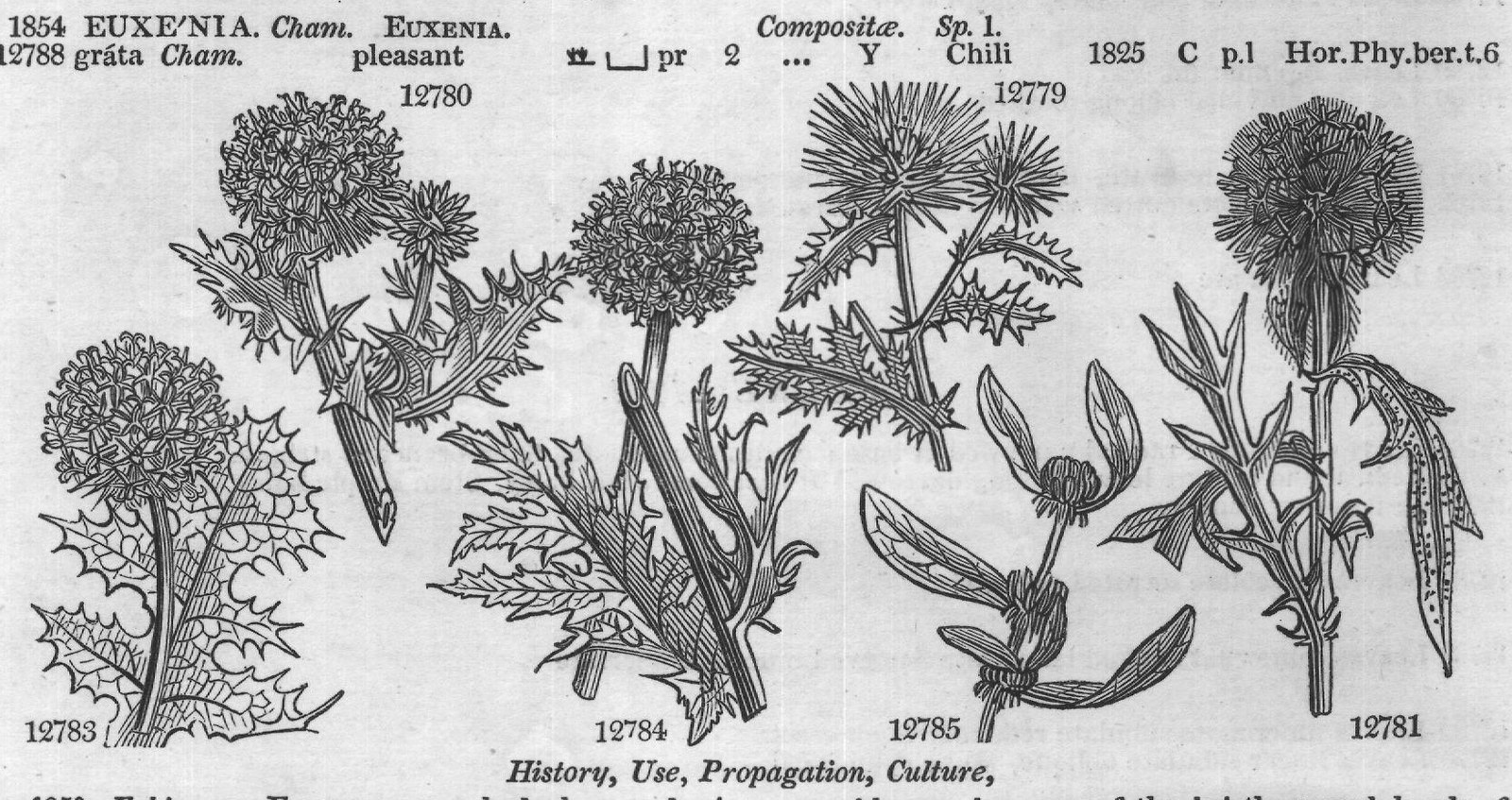
Chili 1825 C p.l Hor. Phy.ber.t.6 12780 12779 12783 12784 12785 History, Use, Propagation, Culture, 12781 1850. Echinops. From εχivoς, a hedgehog, and oψiς, resemblance; because of the bristly round heads of flowers protected in every direction by stiff spines. The woolly leaves of Echinops strigosus are employed in Spain as tinder. Upon this genus M. Cassini has founded his tribe of Echinopseæ, which it must be confessed is entirely distinct from any other, and extremely remarkable on account of its very singular aberrations from the ordinary structure of Compositæ. 1851. Rolandra. After Daniel Rolander, a pupil of Linnæus, who visited Surinam. Nothing appeared from him except an account of Doliocarpus in the seventeenth volume of the Transactions of the Academy of Sciences of Stockholm.
ORDER V.
SYNGENESIA SEGREGATA. 12778 Leaves pinnatifid downy above woolly beneath, Stem branched 12779 Heads scattered with long spines 12780 Head globose, Leaves pinnatifid smooth above 12781 Heads fascicled, Lateral invol, sterile, Leaves strigose on the upper side 12782 Stem branched woolly, Leaves subbipinnate: segments narrow smooth above, Head subsessile 12783 Leaves rugose squarrose pinnatifid smooth above glaucous with down beneath 12784 Stem simple upright 1-headed, Leaves eroded pinnatifid spiny-toothed smooth above downy beneath 12785 The only species 12786 Heads corymbose numerous 12787 Leaves long and spiny 12788 The only species 12788 12787 12775 12777 and Miscellaneous Particulars. 12786 1852. Brotera. Named after Felix Avelhar Brotero, a Portuguese botanist, professor at Coimbra; author of a useful Flora Lusitanica. 1853. Gundelia. Named after Andrew Gundelsheimer, a German botanist, who accompanied Tournefort in his journey into the Levant in 1709. journey into the Levant in 1709. 1854. Euxenia. A name unexplained by its author. Apparently derived from εuξεvoς, hospitable, but in what sense we do not perceive. sense we do not perceive.
GYNANDRIA.
CLASS XX.
CLASS XX. - GYNANDRIA. aby THE singular plants which constitute this class are distinguished from all others by the anomalous structure of their flowers. These do not, as is usually the case, contain a certain number of stamens surrounding a central ovarium or style, but on the contrary are furnished with a solitary fleshy undivided process, round which the sepals radiate, and which supplies the place of stamens and style. The nature of this process has heen variously explained: the modern opinion is that it is formed by the accretion of the stamens and style into a single mass, and this opinion seems to be confirmed by analysis and analogy. Omitting, therefore, a notice of such theories respecting its nature as are opposed to that which is now received as the most correct, it will suffice to explain a little in detail, the opinion which is adopted in this work. The central process, called the columna or column, is understood to be formed by the filaments of three stamens surrounding a style, and by mutual accretion firmly united with it and with each other into a solid mass. Of these three stamens, it most frequently happens that the two lateral are sterile, and not furnished with even the vestige of an anthera; and that their presence is not indicated by more than two irregular excrescences, as in Orchis, or by the same number of small appendages, as in Satyrium, or by two horn-like or tooth-like processes, present in several of the genera with waxy pollen pollen-masses: it even happens, and not unfrequently, that no vestige whatever of them remains. But in Cypripedium both are fertile and bear perfect anthers, while the central stamen is bar- When the lateral stamens are, as above stated, abortive, which is the most common form of the columna, the central stamen bears at its upper extremity an anther, which is either moveable or fixed firmly in its place. The pollen which this contains, assumes three very distinct appearances in different tribes. It is either granular, dividing into many separable small pieces, as in Orchis; or powdery, consisting of an infinite number of granules, as in Spiranthes; or waxy, when it consists of a few large concrete masses, as in Epidendrum. The stigma is most frequently concave, and placed nearly under the anther, but in such a manner, that there is no contact between it and the pollen. In what way, therefore, fecundation can take place among truly Gynandrous plants, is one of those mysterious contrivances of nature which has not yet been explained. It is generally believed to take place by absorption in some undiscovered manner, before the flowers expand; but it is extremely difficult to understand how this can occur in many genera. The foregoing remarks apply only to the tribe of plants called Orchideous. The few genera attached to the latter part of the class are Gynandrous by the cohesion indeed of their stamens and style, but in a much more obvious manner. Gynandrous plants are among the most interesting of the vegetable productions of the globe, whether we consider the vivacity of their colors, or the singularity of their organization, or the grotesque appearance of their tortuous roots, or the delicious perfume of their flowers. They are distributed in abundance over all the earth. In Europe and the temperate parts of the world, they are principally found in meadows and pastures among grass; but in tropical regions they often constitute the chief beauty of the forest, occupying the forked branches of living trees, or the prostrate trunks of fallen timber, over which, in company with ferns and parasitical Aroideæ, they climb and trail in every direction, until they adorn the one with bright hues and rich odours foreign to their nature, and render the others more beautiful in death, than in the full vigour of their existence.
Order 1. MONANDRIA.
Stamen 1. §1. Anther terminal, erect. Pollen granular, cohering by an elastic thread. 1855. Disa. Flowers ringent: helmet with a spur or bag at the base. Inner sepals united to the column. Lip without a spur. 1856. Satyrium. Flower ringent: five anterior sepals united at base. Lip behind, fornicate with two spurs or bags at the base. Anther resupinate. Stigma 2-lipped. 1857. Platanthera. Flower vaulted. Lip entire with a spur. Cells of the anther widely divided at their base by the broad interposed stigma. Glands of pollen masses naked. Lips of stigma absent. 1858. Gymnadenia. Cor. ringent. Lip spurred at the base beneath. Glands of the stalks of the pollenmass naked, approximate. 1859. Orchis. Cor. ringent. Lip spurred on the underside at the base. Glands of the stalks of the pollenmass (1-2) contained in one common little pouch. 1860. Nigritella. Ovary straight. Flower spreading. Lip posterior, entire, with a scrotiform spur. Glands of pollen-masses distinct, and enclosed in a single 2-celled pouch, 1861. Habenaria. Cor. ringent. Lip spurred on the upper side at the base beneath. Glands of the stalk of the pollen-mass naked, distinct, with the cells of the footstalks adnate or separated. 1862. Bartholina. Flower ringent: inner sepals united below with the lip. Lip spurred beneath at the base. Stalks of the pollen-masses long; cells united to the column: glands distinct, ct, half covered by the exterior lobe. 1863. Glossula. Sepals conniving in a galea: the upper without a spur. Lip anterior, spurred, 3-parted, with an inflated spur. Pollen-masses 2, 2-parted, with 2 glands inclosed in distinct pouches. 1864. Anacamptis. The flower of Orchis, from which it differs in having the gland of the pollen-masses single, with inflexed edges, and enclosed in a pouch. 1865. Aceras. Flower ringent. Lip without a spur. Glands of the pollen-masses included in a common 1866. Ophrys. Flower somewhat spreading. Lip without a spur. Glands of the pollen-masses inclosed in two distinct pouches. 1867. Chamorchis. Ovary reclinate at end. Flower galeate. Lip without a spur, undividea. Glands of the pollen-masses naked. Upper lip of stigma divided. Anther of Orchis. 1868. Herminium. Flower somewhat spreading. Lip without a spur. Glands of the pollen-masses naked, 1869. Serapias. Flower ringent. Lip without a spur. Column sharp-pointed. Pollen-masses attached to a single gland inclosed in one pouch. distinct. §2. Anther parallel with stigma. Pollen powdery. 1870. Goodyera. Cor. ringent, with the 2 exterior or lateral segments of the perianth placed beneath the lip, which is gibbous at the base and undivided at the extremity. Column free. Pollen angular. 1871. Diuris. Flower irregular. Two outer linear sepals placed beneath the trifid lip: the inner clawed and spreading. Column with the lateral lobes petaloid. Pollen farinaceous. 1872. Ponthieva. Flower irregular. Lip behind, with the inner sepals inserted in the column. Pollen farinaceous.
CLASS XX.
GYNANDRIA. 1873. Neottia. Flowers connivent. Lip sessile, 2-lobed, with no calli. Anther terminal, sessile. Stigma 2-lipped pervious; the front lip thickened. lipped pervious; the front lip thickened. 1874. Spiranthes. Spike spiral. Ovary oblique at the end. Sepals connivent. Lip clawed, parallel with columna, with 2 calli at the base, entire. Anther terminal stalked. Stigma flat, cuspidate, membranous, finally split. 1875. Stenorhynchus. Like the last; but the lip adheres to the columna by means of the margins of its lateral lobes: it has no callosities. Stigma corneous, always entire. 1876. Listera. Flowers connivent. Lip 2-lobed, sessile, with no calli. Anther intramarginal, half covered over by the hooded clinandrium. Stigma closed, nearly flat, with a strong transverse furrow. by the hooded clinandrium. Stigma closed, nearly flat, with a strong transverse furrow. §3. Anther terminal, persistent. Pollen powdery. 1877. Arethusa. Lip united at base with the columna, at the end hooded, in the inside crested. Sepals 5, united at base. Pollen angular. 1878. Calopogon. Lip at the back clawed, with a bearded inside. Sepals 5, distinct. Column separate. Pollen angular. 1879. Pogonia. Lip sessile, hooded, crested inside. Sepals 5, distinct, without glands. Pollen farinaceous. 1880. Epipactis. Lip ventricose below; the extremity either undivided or 3-lobed: the middle lobe the largest, connected as it were by a joint. Pollen farinaceous. , connected as it were by a joint. Pollen farinaceous. 1881. Caleana. Lip unguiculate, placed at the back, with a peltate hollow lamina, having a perforation on the outside. Pollen farinaceous. 1882. Corallorhiza. Lip produced behind, adnate with the spur or free. Column free. Masses of pollen 4, oblique, not parallel. §4. Anther terminal, opercular deciduous. Pollen waxy. 1883. Rodriguezia. Perianth. 4-leaved ringent. Lip entire, unguiculate cornute at base; callous in the middle. Pollen-masses 2, with an elastic caudicula. Stigma with 2 horns. . Pollen-masses 2, with an elastic caudicula. Stigma with 2 horns. 1884. Gomeza. Like the last, but lip not cornute at base. 1885. Cymbidium. Lip not spurred, concave, jointed with the simple base of the columna. Sepals spreading, distinct. Pollen masses 2, 2-lobed behind 1885. Brassia. Lip expanded, undivided. Sepals spreading, distinct. Column not winged. Pollen-masses 2, 2-lobed behind; fixed by the middle to a common process of the stigma. 2-lobed behind; fixed by the middle to a common process of the stigma. 1887. Lissochilus. Pollen-masses 2, obliquely 2-lobed. Lip saccate at base, sessile, undivided, convex at the base, united with the apterous toothless column. Inner sepals divaricating, petaloid; outer reflexed, calycine. , united with the apterous toothless column. Inner sepals divaricating, petaloid; outer reflexed, calycine. 1888. Geodorum. Lip cucullateventricose, sometimes spurred at base, sessile, not jointed with the column. Sepals like the lip, 1-sided. Pollen-masses 2, lobed at back. like the lip, 1sided. Pollen-masses 2, lobed at back. 1889. Catasetum. Perianth. not inverted, generally globose. Lip saccate, concave, different from the sepals. Pollen -masses 2, 2-lobed behind, inserted on a large naked transverse caudicula, which finally separates with elasticity. 1890. Trizeuxis. Perianth. 2-parted; upper segment 2-lobed; lower 3-parted, inflated. Lip parallel with column, with a recurved dilated limb. Stigma excavated. Anther 1-celled, fleshy. Pollen-masses 2, adhering to a fusiform caudicula. , with a recurved dilated limb.
Stigma excavated. Anther 1-celled, fleshy. Pollen-masses 2, adhering to a fusiform caudicula. 1891. Xylobium. Perianth. spreading. Lip behind jointed, with an unguiform process of the column, 3-lobed, incumbent on columna. Outer lateral sepals united by their bases, with the process of column. lobed, incumbent on columna. Outer lateral sepals united by their bases, with the process of column. Pollen-masses 2, furrowed on one side, seated on a broad caudicula. 1892. Maxillaria. Perianth. spreading. Lip in front 3-lobed, jointed with the unguiform process of the column. Lateral outer sepals united by their bases with the process of column. Pollen-masses 2, bipartite, . Lateral outer sepals united by their bases with the process of column. Pollen-masses 2, bipartite, united by their bases to a common gland. 1893. Notylia. Perianth. 4-leaved: upper sepals spreading. Lip divaricating entire. Columna acuminate. Pollen -masses 2, entire . Anther posterior, not terminal. 1894. Pleurothallis. Lip jointed with the simple or slightly lengthened base of column. The two anterior sepals united at base. Pollen-masses 2, not furrowed. 1895. Oncidium. Lip expanded, lobed, tubercled at base. Petals spreading, sometimes only 4. Column winged. Pollen-masses 2, 2-lobed behind, fixed by the middle to the common process of the stigma. 1896. Cyrtopodium. Sepals 5, distinct. Lip 3-lobed, connected with a joint with the unguiform process of the base of the apterous column. Pollen-masses 2, 2-lobed behind. base of the apterous column. Pollen-masses 2, 2-lobed behind. 1897. Cœlogyne. Perianth. resupinate, spreading. Lip 3-lobed, cucullate, jointed with columna. Column winged . Anther lateral, 2-celled.
Pollen-masses 2, 2-parted. Stigma funnel-shaped, 2-lipped. 1898. Macradenia. Lip sessile, cucullate, concave, undivided, acuminate. Sepals distinct, spreading. Column distinct, with the lobes of its end conniving. Pollen-masses 2, unfurrowed, seated on a long filiform caudicula. 1899. Dendrobium. Lip without a spur, jointed with the unguiform process of the column, to whose edges the anterior sepals adhere. Pollen-masses 4, parallel. anterior sepals adhere. Pollen-masses 4, parallel. 1900. Anisopetalum. Flowers erect. Sepals conniving. The two lateral exterior large, cohering at end: two inner very small subulate. Lip oblong, with 2 teeth near the base. Pollen-masses 4, without gland or caudicula. 1901. Camaridium. Perianth. resupinate, expanded. Sepals distinct. Lip distinct, sessile, cucullate, 3-lobed. Column round. Stigma arched. Pollen-masses 4, parallel, compressed, without a caudicula at the time of expansion. 1902. Ornithidium. Lip sessile, hooded, connate with the base of column. Sepals conniving. Pollenmasses 4, oblique, furrowed at base. 1903. Isochilus. Lip almost of the same shape as the distinct, connivent, sepals. Pollen-masses 4, parallel. 1904. Pholidota. Flowers resupinate. Sepals uniform; the three outer erect, keeled at back. Lip ventricose. Column dilated at end. Anther 2-celled. Pollen masses 4, each pair having a gland. 1905. Broughtonia. Column distinct, or at the very base united with the unguiculate lip, which is lengthened at the base into a tube, connate with the ovarium. Pollen-masses 4, parallel, with a granular caudicula reflexed npon the masses. 1906. Cattleya. Sepals spreading. Lip sessile, cucullate, surrounding the half round column. Pollen-masses 4, with as many powdery reflexed caudiculæ. 1907. Epidendrum. Column united with the claw of the lip, and forming a tube which sometimes runs down the ovarium. Pollen-masses 4, with as many powdery reflexed caudiculæ. 1908. Polystachya. Perianth. not inverted, cuneate, closed. Pollen-masses 4, placed on a simple naked caudicula with a gland. 1909. Cryptarrhena. Sepals 5, distinct, spreading. Lip not spurred, with a dilated flat lamina. Column distinct, not winged. Anther enclosed in the cucullate head of the column. Pollen-masses 4. 1910. Ornithocephalus. Flowers resupinate. Lip stalked. Sepals nearly equal; the two upper finally reflexed. Column short, with a very long beak. Pollen-masses 4, adhering to a very long glandular caudicula. 1911. Bletia. Lip sessile, cucullate; sometimes spurred at the base. Sepals 5, distinct. Column separate. Pollen-masses 8 or 4, 2-lobed. 1912. Eria. Perianthium woolly, conniving or expanded. Lip 3-lobed, jointed with an unguiform process of the column to whose sides the anterior sepals are united. Pollen-masses 8, cohering at the end by means of a powdery substance. 1913. Octomeria. Lip jointed with an unguiform process, to the edges of which the anterior sepals adhere. Pollen-masses 8. Perianthium quite smooth. 1914. Brassavola. Lip with a simple claw, undivided. Sepals distinct, spreading. Pollen-masses 8 or more. GYNANDRIA.
CLASS XX. 1915. Sarcanthus. Lip fleshy, entire, calcarate; the spur furnished with various appendages in the interior. Sepals spreading equally. Pollen-masses 2, seated on an elastic caudicula 1916. Vanda. Lip saccate, continuous with the simple base of the apterous column, trifid, with the middle lobe fleshy. Sepals spreading, distinct. Pollen-masses 2, obliquely 2-lobed, attached to an elastic caudicula. 1917. Aerides. Lip spurred or saccate, inserted at the end of the unguiform process, to whose edges the anthe unguiform process, to whose edges the anterior sepals are united. Pollen-masses 2, two-lobed behind, fixed by a common process to the middle of the stigma. 1918. Renanthera. Like the last, but sepals very long and spreading, and lip only a little saccate at base. 1919. Ionopsis. Sepals connivent, the anterior placed under the labellum. Lip spurred at base. Pollenmasses 2. 1920. Eulophia. Sepals 5, distinct, uniform, ascending, spreading. Lip spurred at base, with a sessile crested lamina, 3-lobed. Pollen-masses 2, two-lobed, with a posterior lobe attached to an elastic caudicula. 1921. Angræcum. Sepals conniving, galeate. Lip spurred 3lobed, jointed with column. Pollenmasses 2. Stigma concave, transverse. 1922. Aeranthes. Lip spurred, membranous, entire, jointed with an unguiform process of the column, to which the two front sepals are adherent. Pollen-masses 2, hollow, perforated on one side, with no caudicula, and two glands. 1923. Calanthe. Lip spurred, lobed, united with the columna. Perianth. spreading. Pollen-masses 8. 1924. Stelis. Lip of the same form as the inner dwarf vaulted sepals. Three outer sepals united at base. Three outer sepals united at base.
Pollen-masses 2. 1925. Malaxis. Lip flat, expanded, regularly vertical. Column round. Pollen-masses 4, loose. 1926. Prescotia. Perianth. spreading. Two upper sepals connate at base. Lip behind, erect, fleshy, cucul- Lip behind, erect, fleshy, cucullate, entire, embracing the very minute column. Pollen-masses 2, twin, granular, united by the end to a gland. . 1927. Microstylis. Lip flat, sagittate, or deeply cordate. Column very small, round. Pollen-masses 4, loose. MONANDRIA. 1855. DI'SA. Sw.
DISA.
Orchidea. Sp. 6-37. 12789 cornúta W. horned el 1 jn.jl Pa.B C. G. H. 1805.
R s.p 12790 spatuláta W. spoon-lipped cu 1 jn.jl Pa.pu C. G. H. 1805.
R s.p Journ.sc.4.t.5.f.3 12791 prasináta B. Reg. green-flowered cu jn.jl G.R C. G. H. 1815.
R s.p Bot. reg. 210 12792 bracteáta W. small-flowered cu jn.jl G C. G. H. 1818.
R s.p Bot. reg. 324 12793 grandiflóra W. large-flowered spl 1 jlau Sc C. G. H. 1825.
R s.p Bot. reg. 926 12794 graminifólia Banks blue spl1 B ...
C. G. H. 1825.
R s.p Journ.sc.6.t.1.f.2 1856. SATYRIUM. W. SATYRIUM.
Orchideæ.
Sp. 3-19. 12795 cucullátum W. cucullate cu jn.s Pa.Y C. G. H. 1787.
R s.p Bot. reg. 416 12796 car'neum H. K. great-flowered el 1½ jn.s Pk C. G. H. 1787.
R s.p Bot. mag. 1512 12797 coriifólium W. leathery-leaved or 10 Y C. G. H. 1820. Rs.p Bot. reg. 703 1857. PLATAN'THERA. Rich. PLATANTHERA.
Orchidea.
Sp. 3-11. 12798 bifólia Rich.
Butterfly Orchis pr 12799 dilatáta dilated pr 1 my.jn W 1 au W Britain woods. R. p.l Eng. bot. 22 Canada 1823. R s.p Hook, ex. fl. 95 12800 orbiculáta round-leaved cu 1 ap.my G Canada 1823. R s.p Hook, ex. fl. 145 1858. GYMNADENIA. R. Br. GYMNADENIA. 12801 conópsea R. Br.
Orchideæ.
Sp. 3-6. fragrant 12802 víridis Rich.
Frog Orchis pr 1 jn.jl Pu Apr jn.jl G Britain me.pas. R h.l Eng. bot. 10 Britain me.pas. R l.p Eng. bot. 94 12803 álbida Rich. small-white pr jn.jl W Britain sun.hi. R l.p Eng. bot. 505 1859. OR CHIS. L.
ORCHIS.
Orchidee.
Sp. 19-84. 12804 Mório W. meadow or my.jn Pu Britain me.pas. R 1.p Eng. bot. 2059 12805 longicórnu P. S. flat-spurred or ap.my Pu Barbary 1815. R 1.p Bot. reg. 202 12806 máscula W. early purple or 1 ap.my Pu Britain woods. R l.p Eng. bot. 631 12791 12792 12793 12799 12800 12798 History, Use, Propagation, Culture, 1855. Disa. A name of unknown meaning, adopted by Linnæus from Bergius. Beautiful Cape herbaceous plants, with flowers of various colors, either growing singly, or in long spikes. Disa cornuta produces a spike, often a foot or a foot and a half long. D. grandiflora has large, nearly solitary flowers, of a brilliant scarlet color. The species are cultivated without difficulty in a stove or in a greenhouse, if the roots are planted in light sandy peat, mixed with a very little loam, and not overwatered. The same treatment is suitable to the other tender tuberous or fibrous-rooted Orchideæ. 1856. Satyrium. The aphrodisiacal properties of Orchideous plants induced the ancients to give this name to almost all the species they knew; from σaτuρoς, a satyr. The bag-like appendages of the lip have perhaps assisted in the application of the name. The species are mostly handsome plants, with yellow or pink flowers. Mr. Salisbury says, he preserved Satyrium cucullatum some years, by attending to planting the bulb in a pot, nearly full of broken tiles, mixed with pure sandy loam, and keeping it quite dry when not vegetating. CLASS XX.
GYNANDRIA. 1928. Liparis. Perianth. spreading. Lip flat, expanded, entire, turned various ways. Column winged. Pollen-masses 4, with neither caudicula nor glands 1929. Calypso, Lip ventricose, spurred beneath near the end. Sepals ascending, 1-sided. Column petaloid, dilated. Pollen-masses 4. §5. Pollen granular. Seeds not arillate. 1930. Vanilla. Flower jointed with ovary, and deciduous. Lip united at base with columna. Capsule fleshy.
Order 2. DIANDRIA.
Stamens 2. 1931. Cypripedium. Lip ventricose, inflated. Column terminated by a petaloid lobe dividing the anthers. Two anterior sepals usually united. 1932. Stylidium. Cal. 2-lipped. Cor. irregular, 5-fid; the fifth segment dissimilar. Column reclinate, with a double bend. Anthers with 2 spreading lobes. Caps. 2-celled. double bend. Anthers with 2 spreading lobes. Caps. 2-celled. 1933. Gunnera. Cal. 2-toothed, superior. Cor. O. Style 2-parted. Drupe 1-seeded, crowned by the teeth of the calyx.
Order 3. HEXANDRIA.
Stamens 6. 1934. Aristolochia. Cal. O. Cor. 1-petalous, ligulate, ventricose at base. Caps. 6-celled, many-seeded, inferior. MONANDRIA. 12789 Helmet blunt: spur conical deflexed, Inner sepals 2-toothed, Lip obovate velvety flat, Spike lax 12790 Helmet erect acute, Lip stalked dilated at end trifid, Stem few-flowered, Leaves linear 12791 Helmet blunt: spur obl. keeled convex at back, Lip linear acutish, Spike lax, Bractes shorter than fls. 12792 Helmet blunt: spur obl.
Lip linear broadest at end, Spike cylindrical, Bractes erect longer than flowers 12793 Helmet acute erect: spur conical nodding , Lip linear blunt, Stem about 2-fl. 12794 Leaves filiform shorter than 3-flowered scape, Spur blunt ascending 12795 Radical leaves twin cordate roundish concave: cauline remote cucullate bluntish 12796 Radical leaves twin cordate roundish: cauline sheath-like close, Spike compact, Sepals keeled outside 12797 Leaves ovate acuminate somew. reflexed sheathing coriaceous crenated at edge, Fls. and helmet cernuous 12798 Horn filiform twice as long as ovary, Lip linear entire, Rad. leaves twin oblong narrowed at base 12799 Lip lanceolate obtuse dilated at base, Spur the length of lip a little shorter than the ovary, Stem leafy 12800 Lip linear lanceolate, Three upper sepals erect conniving: lateral reflexed, Leaves 2 orbicular 12801 Bulbs palmate, Lip trifid entire, Spur setaceous twice as long as ovary 12802 Horn short double, Lip linear 3-toothed: lateral teeth acute; middle very short 12803 Horn blunt 3 times shorter than ovary, Lip 3-parted: segments acute; middle one largest [ovary 12804 Lip 3-lob.: lobes cren. obt. midd. one emargin. Seg. of perianth ascend. obt. Spur conic. ascend. shorter than 12805 Lip 3-lobed: lateral reflexed toothletted; middle shorter than blunt, Spur long comp. truncate ascending 12806 Lip 3-lob. crenul. obt.: the midd. lobe cleft, Seg. of the perianth cleft; exterior one reflex. Spur lin. ascend. compressed at the extremity rather longer than the ovary 12797 12802 12803 12806 12796 12801 12804 and Miscellaneous Particulars. 12805 1857. Platanthera. So named from πλaτuς, broad, and avθηρa, an anther, on account of the width of that organ, which is as broad or broader than the base of the labellum. Curious wood plants with greenish flowers. Platanthera bifolia is one of our indigenous plants, which may be cultivated without any difficulty, if planted in pure loam from a lime-stone bottom. It succeeds in a pot, if filled half full of broken tiles; and when in pure loam from a lime-stone bottom. It succeeds in a pot, if filled half full of broken tiles; and when in the open ground, the border should be well drained, at least six inches in depth. No plant bears forcing better, or exhales a more delightful perfume. This species is never observed but in a lime-stone soil, and is exceedingly plentiful near Buxton. 1858. Gymnadenia. From γuμvoς, naked, and aδηv, a gland; because it differs from Orchis in not having the glands enclosed in a pouch, but altogether uncovered. The principal species of the genus is the Orchis conopsea of old botanists. glands enclosed in a pouch, but altogether uncovered. The principal species of the genus is the Orchis conopsea of old botanists. 1859. Orchis. The Greek name of the plant. In Arabic, according to Forskahl, it is called sahhleb, from 12807 ustuláta W. 12808 fúsca W. dwarf brown GYNANDRIA MONANDRIA. or or my.jn Pu England dr.pa. R l.p 3 my.jn Br.P England ch.hil. R l.p CLASS XX.
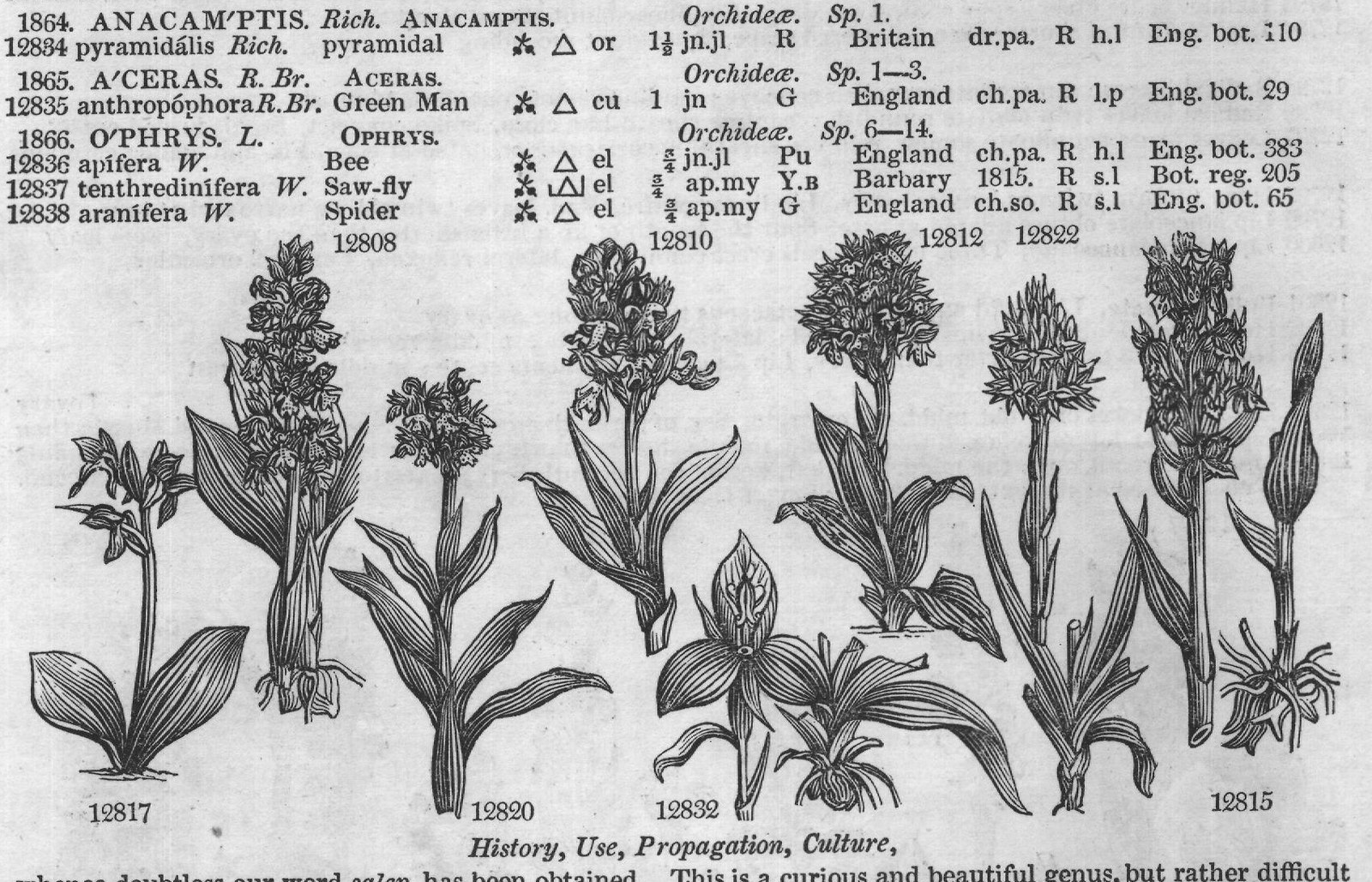
Eng. bot. 18 Eng. bot. 16 12809 tephrosan'thos Desf. fine-lipped or 1½ my.jn Pa.pu Britain 12810 militáris W. military or 1 my.jn Pu England ch.hil. R 1.p ch.so. Rh.l Eng. bot. 1873 12811 unduláta Bivona wavy-leaved or 1 d Pa.pu Sicily 1818. R. l.p Bot. reg. 375 12812 acumináta W. pointed-flower.or 1 ap.my Pa.pu Barbary 12813 globósa W. 12814 hircína W. round-spiked or jn.jl Pa.pu Austria Lizard 12815 latifólia W. 12816 maculáta W. marsh or 1 jn.jl Pu or 1 my.jn England Pk Britain 1815. R l.p 1792. R l.p ch.wo. R l.p m.me. R l.p Bot. mag. 1932 Jac. aust. 3.t.265 Eng. bot. 34 Eng. bot. 2308 spotted-palmate or 1½ jn.jl F Britain woods. R h.l Eng. bot. 632 12817 spectábilis W. showy or jn.jl Pk N. Amer. 1801. R 1.p Bot. cab. 78 12818 papilionácea W. papilionaceous or 1½ jn.jl Pa.pu S. Europe 1788. R. l.p 12819 longibracteata Biv.
Sicilian or 1 d 12820 variegáta All. variegated or 12821 sulphúrea Schrad. sulphur-colored or Pu Sicily 1818. R 1.p ap.my Pa.pu S. Europe 1818. R l.p 1 my.jn Y Portugal 1820. R. l.p Bot. reg. 357 Bot. reg. 367 Bot. mag. 2569 1860. NIGRITEL/LA. Rich. NIGRITELLA.
Orchideæ. Sp. 1. 12822 angustifólia Rich. dark-flowered cu jn.jl Br.PAustria 1759. R 1.p Flo. dan. t. 998 1861. HABENA'RIA. R. Br. HABENARIA. 12823 bracteáta R. Br. long-bracted cu Orchideæ. Sp. 9-17. 1 my.jn G N. Amer. 1805. R 1.p Sweet fl. gar. 62 12824 hyperbórea R. Br. northern cu jn.jl G Iceland 1805. R 1.p 12825 herbíola R. Br. 12826 fimbriáta R. Br.
American * cu 1 jn.jl purple-fringedel 1½ jn.jl G N. Amer. 1789.
R p.l Pu Canada 1789.
R p.1 Bot. cab. 552 12827 cristáta R. Br. yellow-crested el 1 s Y N. Amer. 1806.
R p.l 12828 ciliáris R. Br. yellow-fringed el jn.jl Y N. Amer. 1796.
R p.l Bot. mag. 1668 12829 lácera Mich. torn 12830 blephariglottis Hook. white-fringed Apr 1 my.jn 12831 tridentata Hook. three-toothed Apr 1 my.jn W 1862. BARTHOLI'NA. R. Br. BARTHOLINA..
Apr 1 jn.jl Pa.Y W N. Amer. 1812.
R p.1 Bot. cab. 229 Canada 1820.
R s.p Hook. ex. fl. 87 Canada 1820.
R s.p Hook. ex. fl. 81 Orchidea. Sp. 1. 12832 pectináta R. Br. pectinated cu 4 W C. G. H. 1787.
R 1.p Journ.sc.4.t.8.f.2 1863. GLOSSULA. Lindl. GLOSSULA. 12833 tentaculáta Lindl. feeler-flowered cu d Orchidee. Sp. hina 1824. R l.p Bot. reg. 862 1864. ANACAM'PTIS. Rich. ANACAMPTIS.
Orchideæ. Sp. 1. 12834 pyramidális Rich. pyramidal or 1 jn.jl R Britain dr.pa. Rh.l Eng. bot. 110 1865. A'CERAS. R. Br.
ACERAS.
Orchideæ. Sp. 1-3. 12835 anthropóphoraR.Br. Green Man cu G 1 jn England ch.pa. R 1.p Eng. bot. 29 1866. O'PHRYS. L.
OPHRYS.
Orchideæ. Sp. 6-14. 12836 apífera W.
Bee el jn.jl Pu England ch.pa. R h.l Eng. bot. 383 12837 tenthredinífera W. Saw-fly el ap.my Y.B Barbary 1815. Rs.1 Bot. reg. 205 12838 aranífera W.
Spider el ap.my G England ch.so. R s.l Eng. bot. 65 12808 12810 12812 12822 12817 12820 12832 12815 History, Use, Propagation, Culture, whence doubtless our word salep has been obtained. This is a curious and beautiful genus, but rather difficult of culture. Few of the species produce seeds, but are propagated by their bulbs or tubers, which, in most of the species, are of a peculiar structure and economy. An Orchis being taken out of the ground is found with two solid masses, ovate or fasciculated at the base of the stem, above which proceed the thick fleshy fibres which nourish the plant. One of these bulbs or tubers is destined to be the successor of the other, and is plump and vigorous, whilst the other or decaying one is always wrinkled and withered. From this withered one has proceeded the existing stem, and the plump one is an offset, from the centre of which the stem of the succeeding year is destined to proceed. By this means, the actual situation of the plant is changed about half about half an inch every year; and as the offset is always produced from the side opposite to the withered bulb, the plant travels always in one direction at that rate, and will in a dozen years have marched six inches from the place where it formerly stood.
In the garden, the Orchis can hardly be said to be propagated; the species are generally taken up from their native habitations with balls, and transferred to a shady border, where they remain for a year or two, but seldom increase. Those which grow in the open fields are generally found in calcareous soil, and those in bogs or woods thrive best in peat, or peat and loam mixed. The culture of this genus, however, has been very little attended to. According to Sweet, the best time to transplant the British Orchideæ, is when they are in a growing state.
The Orchis affords the preparation known as Salep, imported from Turkey, and other parts of the Levant; and which has also been made in this country from O. mascula, and other species. The root is washed, the brown skin rubbed off, and then dried in an oven and ground into powder. This powder, as an article of diet, is accounted extremely nutritious, containing a great quantity of farinaceous matter in a small bulk. O. mascula is very abundant in the meadows of Gloucestershire, and Salep has been made from its bulbs, equal to that imported. (Encyc. of Agr. 5527.) ORDER I.
GYNANDRIA MONANDRIA. 12807 Lip 3-part.: seg. lin. dotted scabr.; midd. 2-parted, Sepals erect ac. Spur uncin, thrice as short as ovary 12808 Lip 3-part. dott. scabr.: later seg. obl.; midd. larg 2-lob. cren. with a point betw. Spur straightish thrice as short as ovary, Bractes 4 times as short as ovary 12809 Lip 4-parted very narrow: segm. filif.; middle longer with a tooth between, Spike conic. Bractes minute 12810 Lip 3-parted very narrow: seg. lin.; midd. 2-lob. blunt with a point between, Spur straight twice as short as ovary, Bractes obsolete 12811 Bulbs ovate, Stem leafy, Lip 3-parted scabr.: lat. seg. very narr.: midd. very long bifid with an appendage, Leaves wavy spotted 12812 Lip 3-lobed dotted: middle broadest with a tooth between, Spur compressed, Outer sep. subul. Spike dense 12813 Lip 3-part.: midd. seg. emarg. Sep. mucron. at end, Spur twice as short as ovar. Spike dense ov. Lvs. lanc. 12814 Lip 3-parted: lat. seg. lin. sub.: middle long bifid thrice as long as ovary, Spur very short conical double 12815 Lip slightly 3-lobed: sides reflex. Three inn. segm. of perianth conniv. Spur cylind. shorter than germen, Bract. longer than the flowers 12816 Lip plane 3-lobed crenate: 3 inn. segm. of perianth conniv.; lat. ones patent, Spur cylind. shorter than the germen, Bract. as long as the germen 12817 Lip obov. undiv. cren. ret. Sep.straight: lat.long. Spur clav.short.than ovary, Bract. longer than fl. [ovary 12818 Lip obov. undiv. tooth. emarg. Sep. nerv. conniv. Spur subul. short. than ovar. Bract. membr. col, as long as 12819 Bulbs undivided, Sepals conniving, Lip trifid: middle segment projecting 2-lobed, Bractes longer than fl. 12820 Lip trifid dotted: segments ovate serrulate; middle broadest emarginate, Spike ovate compact 12821 Scape naked, Lip slightly 3-lobed at end, Spur ascending, Bractes as long as ovary 12822 The only species 12823 Spur short double, Lip linear retuse 3-toothed: lateral blunt; middle obsol. Bractes twice as long as fl. 12824 Spur cylindrical shorter than ovary, Lip entire linear oblong [than flower 12825 Spur filif. shorter than ovary, Lip obl. blunt toothed on each side at base, Palate 1-toothed, Bractes longer 12826 Spur filiform longer than ovary, Lip 3-parted with cuneiform fringed segments 12827 Spur filiform shorter than ovary, Lip lanceolate pinnatedly fringed, Inner sepals toothed cut 12828 Spur filiform longer than ovary, Lip lanceolate pinnatedly fringed, Inner sepals fringed cut 12829 Lip long 3-parted: segm. somewhat digitate filiform, Spur length of ovary, Spike obl. Flowers alternate 12830 Roots fascicled, Lip lanc. ciliated the length of upper sepals, Spur very long a little shorter than ovary 12831 Sepals conniving, Lip nearly equal broad ovate bluntly 3-toothed, Spur filiform curved longer than ovary 12832 The only species 12833 The only species [spread. Spur filif. 12834 Lip 3-cleft: lobes eq. ent. with 2 longitud. append. on upp. side near base, Seg. of perin. lanc. 2 outer ones 12835 Lip the length of ovary 12836 Lip 3-fid: middle lobe largest-trifid; middle segm. longest subulate deflexed 12837 Lip 2-lobed villous obovate appendaged, Sepals spreading: three outer oblong blunt; inner very short 12838 Lip 3-lobed: lateral short blunt; middle retuse 12826 12829 12837 12838 12834 12835 12836 and Miscellaneous Particulars. 12833 Orchis fusca and militarís, according to Salisbury, succeed best in chalky soil, free from all manure whatever; but they will endure more moisture than would be supposed; for he found them in a very wet part of the meadow below the terrace, at Mill Hill, where they had, no doubt, been planted by Mr. Peter Collinson. Gymnadenia conopsea affords another singular instance of this sort, which is found growing wild on the driest limestone, mixed with Anacamptis pyramidalis, and in bogs where one can hardly tread, mixed with Epipactis palustris. 1860. Nigritella. So named by M. Richard, from niger, black, in allusion to the color of the flowers. 1861. Habenaria. From habena, a thong or rein, on account of the long spur of the flower, which resembles something of that sort. Most of the species have white flowers, and natives of America. Some have bright yellow flowers, others purple ones. 1862. Bartholina. Named in honor of Thomas Bartholini, a Danish physician, who flourished at the end of the seventeenth century. A small Cape plant, with a beautifully fringed white flower. 1863. Glossula. So called by Mr. Lindley, from γλωσσa, a tongue, in reference to the tongue-like segments of the labellum. An obscure Chinese plant, with pale green minute flowers. 1864. Anacamptis. From avaκaμπτω, to bend back, in allusion, it is presumed, to the reflexed edges of the appendage of the pollen-masses. In all respects similar to Orchis in habit. It is the Orchis pyramidalis of Linnæus. 1865. Aceras. From a, without, and κερaς, a horn, in allusion to the absence of the spur from the labellum, by which character it is chiefly distinguished from Orchis. Aceras anthropophora is difficult to cultivate. It can only be propagated by seeds, which thrive best in a mixture of sand, loam, and chalk. 1866. Ophrys. From the Greek word όφouς, which signifies an eye-lash, to which the delicate fringe of the inner sepals may be very well compared. O. apifera is a singularly beautiful plant, not uncommon on calcareous soils, near woods, and in open meadows. It ripens seeds plentifully, as will all the species, if care be taken, as 3 C GYNANDRIA MONANDRIA.
CLASS XX. 12839 muscifera H. K.
Fly elmy.jn Pu 12840 aráchnites W. villous el my.jn Br 12841 lútea W. yellow el ap.my Y England ch.pa. R h.l Europe R h.l Spain 1818. R h.l Eng. bot. 64 Bot. mag. 2516 Hook. ex. fl. 10 1867. CHAMOR CHIS. Rich. CHAMORCHIS. 12842 alpína Rich. alpine pr Orchideæ. Sp. 1. ap.my Switzerl. 1824. R s.p 1868. HERMI'NIUM. R. Br. HERMINIUM.
Orchidea. Sp. 1. 12843 Monórchis R. Br. musk * cu jn.jl G England ch.ba. R 1.p Eng. bot. 71 12844 Língua W. 12845 cordígera W. 1869, SERA PIAS. R. Br. SERAPIAS. 1870. GOODYE'RA. H. K. GOODYERA.
Orchideæ.
Sp. 2-4. tongue-lipped cu 1 my.jn Br S. Europe 1786. R 1.p Bot. cab. 655 heart-lipped cu 1 jl.au Br S. Europe 1806. R l.p Bot. rep. 475 Orchideæ.
Sp. 5-9. 12846 répens H. K. creeping pr jl.au W Scotland al.wo. D 1.p Eng. bot. 289 12847 pubescens H. K. downy pr jl W N. Amer. 1802. Dl.p Lind. coll. 25 12848 díscolor B. reg. purple-leaved pr n.d W S. Amer. 1815. D l.p Bot. reg. 271 12849 prócera Hook.
Nepal pr 2 jn.jl W Nepal 1821. D l.p Hook. ex. fl. 39 12850 tesselláta Lodd. tessellated Apr jn.jl W N. Amer. 1821.
D l.p Bot. cab. 952 1871. DIU'RIS. Sw.
DIURIS.
Orchideæ.
Sp. 1. 12851 aúrea Sw. golden-flowered el 1층 Y ...
N. S. W. 1810.
R l.p Exot. bot. 1. t. 9 1872. PONTHIE'VA. R. Br. PONTHIEVA.
Orchidea.
Sp. 2. 12852 glandulósa R. Br. glandular cu 1 ja.mr G W. Indies 1800.
Dl.p Bot. mag. 842 12853 petioláta Lindl. stalked cu 1 au Br S. Vincent 1822. D 1.p Bot. reg. 760 1873. NEOTTIA. L.
NEOTTIA.
Orchideæ.
Sp. 1. 12854 Nídus avis W. bird's-nest cu 1 my Br Britain ch.wo. "R 1.p Eng. bot. 48 1874. SPIRAN'THES.
Rich. SPIRANTHES.
Orchidea.
Sp. 6-13. 12855 pícta Lindl.
Lemon-scented ✗ ✓ pr 12856 eláta Lindl. tall pr 2 ap.jn 2 ap.jn W W 12857 pudíca Lindl. 12858 bícolor Lindl. modest pr n.d Pk two-colored pr 1 ja.f W 12859 cérnua Rich. nodding-flower. pr 1 jl W 12860 æstivális Rich.
Ladies-traces pr au.s W Trinidad 1805. D s.p W. Indies 1790. D s.p China 1819. D s.p Trinadad 1823.
N. Amer. 1796.
Britain me.pa. Dl.p D s.p Dl.p Bot. mag. 2026 Lindl. coll. 30 Bot. reg. 794 Bot. mag. 1568 Eng. bot. 541 Bot. mag. 1562 12861 speciósus Rich. showy 1875. STENORHYNCHUS. Rich. STENORHYNCHUS. Orchidea. 12862 orchioides Rich. frosted-flower'd el 1½ my F 1876. LISTE'RA. R. Br. TWAY-BLADE.
Sp. 2-7. el 1 ap.jn Sc W. Indies 1790. D s.p Bot. mag. 1374 Jamaica 1806. D s.p Bot. mag. 1036 Orchidea.
Sp. 2. 12863 ováta H. K. common 12864 cordáta H. K. heart-leaved পপ cu 1 my.jn G Britain woods. R 1.p Eng. bot. 1548 cu jn.jl G Britain moi.h. R l.p Eng. bot. 358 1877. ARETHU'SA. Z. ARETHUSA. 12865 bulbósa H. K. bulbous el Orchidea. my.jn Pk Sp. 1-4.
N. Amer. ... 12839 12842 12846 R 12844 Bot. mag. 2204 12843 12849 12851 12845 History, Use, Propagation, Culture, Sweet directs, to "rub the pollen on the stigma." The seeds must be sown as soon as ripe, and the plants transplanted to where they are finally to remain, when of a small size. Several species of this genus, and of Orchis, were successfully cultivated by Collinson, in his botanic garden at Mill-Hill. His method was to place them in a soil and situation as natural to them as possible, and to suffer the grass and herbage to grow round them. O. aranifera, with a little attention and management, will grow and flower freely in pots. Curtis found the following method successful: "take up the roots carefully when in flower; bare them no more than is necessary to remove the roots of the other plants; fill a large sized garden-pot with three parts choice loam moderately stiff, and one part chalk, mixed well together, and passed through a sieve somewhat finer than a common cinder sieve; in this mixture place your roots at about the depth of two inches, and three inches apart; water them occasionally during summer, if the weather prove dry; at the approach of winter place the pot in a frame under a glass, to keep it from wet and frost, which combined, destroy the beauty of the foliage, if not the plant itself; in the autumn, before any of the others make their appearance, this species emerges." (Curtis, Fl. Lond. n. 68.) Salisbury says, that Ophrys muscifera, and most of its congeners, are very easily cultivated; but require the purest loam from a chalky bottom, and the border to be most effectually drained; for any permanent wet in summer makes them push too soon. On the hillocks and declivities where they grow wild, the slight showers are absorbed by the surrounding turf or long grass, and the heavy rains we usually have after midsummerday run off quickly. 1867. Chamorchis. From χaμai, dwarf, and Orchis. A pretty little alpine plant, exceedingly difficult to cultivate. Roots have been brought in damp moss from Switzerland, but they probably have perished ere now. 1868. Herminium. A name which is not explained by its author. It is the Ophrys Monorchis of old botanists. 1869. Serapias is the name of an Egyptian divinity, whose temples were notorious scenes of profligacy. In this sense, with reference to the uses of the plant, as also in Satyrium, the word seems to have been applied by Pliny. Rare herbaceous plants of the south of Europe, but cultivated in a frame. 1870. Goodyera. So called after Mr. John Goodyer, an obscure British botanist. The species grow freely in sandy peat, and, unlike most of the Orchideæ, may be increased by dividing the roots. ORDER 1.
GYNANDRIA MONANDRIA. 12839 Lip 3-fid: middle lobe large 2-lobed, Anther blunt 12840 Stem leafy, Lip vill. 3-lobed: midd. lobe obov. shortly 3-lobed at end, Inner sepals linear-lanc. very short 12841 Stem leafy, Lip downy obov. 3-lobed at end: lobes nearly equal, Inner sepals lanc. twice as short as outer 12842 Leaves linear setaceous, Scape naked 12843 The radical leaves lanceolate twin 12844 Lip 3-parted: middle lobe oblong lanceolate acute smoothish hanging down 12845 Lip 3-parted: middle lobe ovate acuminate hanging down with a hairy disk 12846 Radical leaves ovate, Lip and petals lanceolate 12847 Radical leaves ovate, Lip ovate acuminate, Sepals ovate 12848 Leaves fleshy chocolate-colored ovate without nerves 12849 Stem leafy, Leaves ovate-lanceolate stalked, Lip rounded glandular inside, Petals broad ovate 12850 A smooth variety of G. pubescens 12851 Leaves linear channelled shorter than scape, Middle segm. of lab. with a double keel inside 12852 Lip unguiculate acuminate, Inner sepals-ovate 12853 Spike lax erect, Leaves stalked erect crisp smooth, Flowers discolored 12854 The only species 12855 Rad. lvs. obl. lanc. Scape with bractes, Anterior sepals decurrent placed under the -inferior labellum 12856 Lip obovate emarginate , Scape sheathed, Bractes shorter than flower, Leaves ovate stalked flat at edge 12857 Leaves linear-lanc.
Lip subsessile crenulate at end, Sepals ovarium and rachis quite smooth 12858 Lvs. linear lanceolate 2-colored, Scape villous much longer than leaves, Fl. gibbous on its outside at base 12859 Leaves lanceolate 3-nerved, Stem sheathed, Flowers recurved cernuous, Lip oblong entire acute 12860 Rad. leaves oblong somewhat stalked, Spike twisted with the flowers on one side, Lip ovate 12861 Lip lanc. undivided, Scape bracteate, Bractes longer than flower, Leaves oblong wavy towards the end 12862 Rad. leaves broad lanceolate, Spike erect, Lip saccate at base with the sepals, Lip acuminate 12863 Stem with only a pair of ov.-ellipt. opp. lvs. Col. of fructification having an appendage in which the anther [is placed 12864 Stem with only 2 cordate opposite leaves, Col. without any appendage behind, Lip with 2 teeth at the base 12865 The only species, Flower solitary large lilac 12852 12862 12861 12854 12854 12855 12865 12859 and Miscellaneous Particulars. 1871. Diuris. From δiς, double, and sea, a tail, in allusion to the form of the sepals. Beautiful New Holland plants, which may be cultivated in the same way as Disa. 1872. Ponthieva. Named after De Ponthieu, who sent many specimens of West Indian plants to Sir J. Banks. The species may be cultivated in pots, well drained, and filled with sandy loam and peat. Water must be species may be cultivated in pots, well drained, and filled with sandy loam and peat. Water must be sparingly given when the plants are not in a growing state. 1873. Neottia. This word in Greek signifies bird's nest, and has been applied to the present plant on account of the interwoven fibres of its roots. No means of cultivating the only species has been yet discovered. It the interwoven fibres of its roots. No means of cultivating the only species has been yet discovered. It grows naturally in woods among decayed leaves, and is supposed to be parasitical. 1874. Spiranthes. From σπεiρa, a screw, or any thing spirally twisted; on account of the disposition of the flowers on their spike. Delicate little herbaceous plants with fibrous roots, and generally white flowers. S. on their spike. Delicate little herbaceous plants with fibrous roots, and generally white flowers. S. æstivalis has the germs on the flower-stalks placed regularly one above another, somewhat resembling tresses of plaited hair; whence its name of Ladies' traces or tresses. This species grows more readily in the garden than most of its tribe.
According to Salisbury, no plant whatever is more easy to cultivate than this. At Chapel-Allerton it propagated itself every where, springing up from seeds in the neighbouring pots, whatever soil or plants happened itself every where, springing up from seeds in the neighbouring pots, whatever soil or plants happened to be in them; and they were once found germinating on a dead root of a Persian Cyclamen, in a pot, which, for want of draining, was full of Jungermannias 1875. Stenorhynchus. A splendid genus of evergreen stove herbaceous plants, with brilliant red or yellow flowers. They have been named from S'EVOS, narrow, and purxos, a beak, on account of the long pointed . They have been named from 5εvoς, narrow, and ῥuvχoς, a beak, on account of the long pointed stigma. N. orchioides is one of the most beautiful plants of this genus, introduced by E. J. A. Woodford, Esq. in 1806, from the Island of Barbadoes , where it grows wild in the most arid places among grass. It requires , nevertheless, moderate waterings here while the leaves are green. 1876. Listera. Dr. Martin Lister was a celebrated English physician and naturalist, who died in 1711. The species require a shady situation and a light sandy soil, with some peat intermixed. They will grow on a species require a shady situation and a light sandy soil, with some peat intermixed. They will grow on a bank under the drip of trees, or in small pots. They are increased by dividing the roots. 1877. Arethusa. A poetical name. Arethusa was a nymph of Diana, who was transformed into a fountain. The species of this genus are all found in moist places. They are very impatient of cultivation. The best way species of this genus are all found in moist places. They are very impatient of cultivation. The best way to manage them, is to plant them in loose wet peaty soil, and to keep them in a frame well exposed to the sun. 3C2 GYNANDRIA MONANDRIA.
Orchidea. Sp. 1.
CLASS XX. 1878, CALOPOGON. R. Br. CALOPOGON. 12866 pulchellus H. K. tuberous-rooted el 1 jl.au Pu N. Amer. 1771. R 1.p Bot. mag. 116 Limodórum tuberósum B. M. 1879. POGONIA. R. Br. POGONIA. 12867cphioglossoídes B.reg. Adder's-tongue 12868 divaricáta H. K. Lily-leaved 12869 péndula Lindl. pendulous 1880. EPIPACTIS. Sw. EPIPACTIS.
Orchideæ. Sp. 3-4.
Apr jn.jl Pk el 1 jn.jl PkN. Amer. 1816. R l.p N. Amer. 1787. D 1.p Bot. reg. 148 Lam. ill.t.729.f.3 prau Pk N. Amer. 1824. D l.p Bot. reg. 908 Orchidee. Sp. 5-9. 12870 latifólia W. broad-leaved Aor 1 jl.au Pu Britain m.wo. Dl.p Eng. bot. 269 12871 palústris W. marsh Aor jl.au Pu Britain mar. Dl.p Eng. bot. 270 12872 pállens W. white or 1 jn W Britain ...
Dip Eng. bot. 271 12873 ensifólia W. narrow-leaved or 1½ jn W Britain m.wo. Dl.p Eng. bot. 494 12874 rúbra W. purple or 1½ jn.jl Pu Britain m.wo. D l.p Eng. bot. 437 1881. CALEA'NA. R. Br. CALEANA. 12875 májor H. K. 12876 innáta H. K. spurless 12866 12883 lancifólium Hook. 12884 depéndens Lodd. hanging-down 12885 xiphiifólium Lindl. sword-leaved 1886. BRASSIA. R. Br. BRASSIA. 12886 maculáta H. K. spotted-flower. 12887 caudáta Lindl. long-tailed 1887. LISSOCHI'LUS. R. Br. LissOCHILUS. 12888 speciósus R. Br. showy 1888. GEODO'RUM. Jacks. GEODORUM. 12889 purpúreum H. K. 12890 citrínum H. K. 12891 dilatátum H. K. 1 my.jn Br ft 2 jn.o Br cujl Y.G pr my.au G E. Indies 1789.
D l.p D l.p E. Indies 1822. D l.p Orchidea. Sp. 2. el 1 jn.jl Y.R Jamaica 1806. 1 jn.jl G.Y.R W. Indies 1823. el Orchidea. Sp. 1. spl 2 my.jn Y el el 1 jn.au Pu 1 o.d Y D p.r.w Bot. reg. 832 C. G. H. 1818.
Dl.p Lindl. coll. 31 Orchideæ.
Sp. 3-4. purple Lemon-colored shovel-lipped ☑ ☑ el 1 my.au Pk E. Indies 1800. Dl.p E. Indies 1800. D l.p E. Indies 1800. Dl.p Roxb. cor. 1.t.40 Bot. mag. 2195 Bot. reg. 675 1889. CATASETUM. Rich. CATASETUM. 12892 tridentátum Hook. three-toothed 12893 Claverin'gi Lindl. Capt. Clavering's 12894 floribúndum Hooker many-flowered E gr gr gr 2 jl.au 2 n 12867 12869 Orchidea. Sp. 5-7. 2 jl.au Y.Br Trinidad 1822.
Y.Br Brazil 1822.
Y.Br Trinidad 1824. 12875 D p.r.w Hook. ex. fl. 90 D p.r.w Bot. reg. 840 Dp.r.w Hook. ex. fl. 151 12870 12874 smooth-lipped pr 1층 Orchidea. Sp. 1-2. 1882. CORALLORRHIZA. H. K. CORALLORRHIZA. Orchidea. Sp. 1-4. 1883. RODRIGUEZIA. Fl. per. RODRIGUEZIA. 12877 secúnda Kunth. one-sided Pleurothallis coccinea Hooker 1884. GOMEZA. R. Br. GOMEZA. 1885. CYMBIDIUM, Swz. CYMBIDIUM. 12878 recúrva B. M. 12879 trípterum W. 12880 aloifólium W. 12881 ensifólium W. 12882 sinénse W. recurved triangul.-fruit.
Aloe-leaved sword-leaved Chinese lance-leaved ㅇ R Scotland sc.wo. Dl.p. Eng. bot. 1547 S. Amer. 1818. D p.r.w Hook. ex. fl. 129 Orchidea. Sp. 1. 1814. D p.r.w Bot, mag. 1748 el my.jn Y Brazil Orchideæ.
Sp. 7-11. cu jn.jl W Jamaica 1790.
Dp.r.w Smith ic. pict.14 or D l.p Bot. mag. 387 China 1780.
Bot. mag. 1751 ft 1 s.O Br el my Y.R China 1793.
Bot. mag. 888 Hook. ex. fil. 51 China China 1822.
Dp.r.w Bot. cab. 936 1814. D l.p Bot. reg. 529 D p.r.w Bot. mag. 1691 ...
G N. S. W. 1810. D l.p cu jn.jl G