Home › O › Orchideæ (Sp el History Use Propagation)
Orchideæ (Sp el History Use Propagation)
Sp. 1-2. el 12876 12877 History, Use, Propagation, Culture, 1878. Calopogon. From κaλoς, beautiful, and πωγωv, a beard, in allusion to the beautiful fringe of the lip. An elegant plant, which was introduced accidentally, as Mr. Curtis informs us, by the laudable exertions of his gardener, who, in the spring of 1783, examining attentively the bog earth which had been brought over with some Dionæas, found several tooth-like knobby roots, which, upon being planted in heat, afforded this plant: on the shelf of a stove, or on a bark pit it thrives exceedingly; and seems merely to require a longer and hotter summer than our climate affords. 1879. Pogonia. A name with the same derivation as the last genus. The species also require the same treatment. 1880. Epipactis. A name given by the Greeks to a sort of Hellebore, and used by Swartz to distinguish a tribe of plants previously called Helleborine. Pretty herbaceous hardy plants. "Some of its species thrive in the borders in the common garden soil, and most of them will do well in pots, in a mixture of loam and peat; they require but little water when in a dormant state, and are increased by by dividing the roots." (Bot. Cult. 365.) 1881. Caleana. Named after Mr. George Caley, a most indefatigable and acute botanical collector, who resided several years among the natives of New South Wales, where he made a valuable collection of plants. The name has been subsequently changed by Mr. Brown to Caleya: which as being too similar to Calea, a very different plant, we cannot prefer to the original designation. The species require the common treatment of the tribe, and are increased by division of the roots. 1882. Corallorrhiza. From zoρaλλiov, coral, and ῥiζa, a root, on account of its branched roots, which much resemble coral. A plant supposed to be incapable of cultivation. It is a native of boggy places in the northern parts of the world. The three American species C. verna, multiflora, and odontorhiza, are said to have been introduced in 1824, but we have not heard of their having been cultivated with any success. ORDER I.
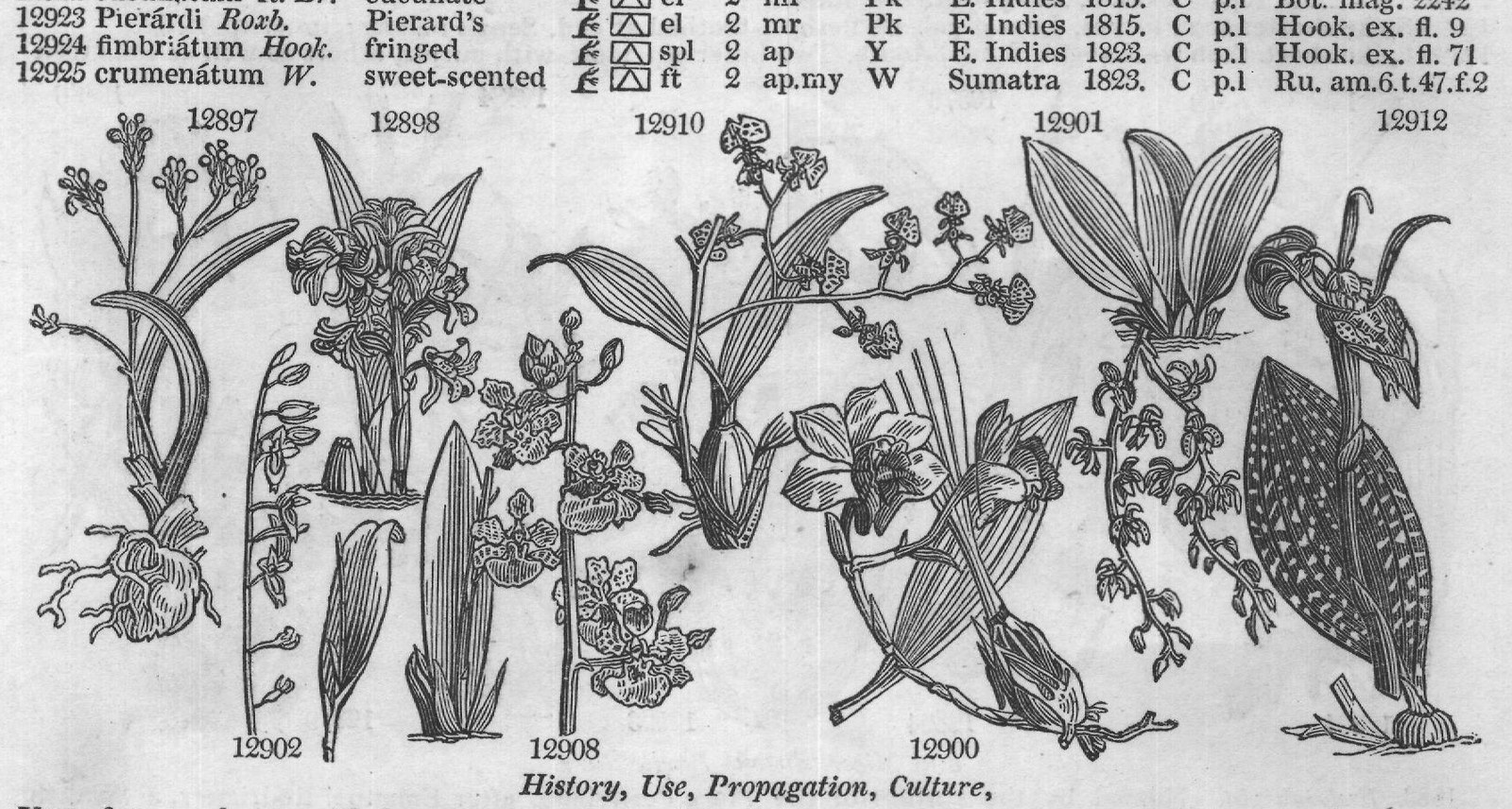
GYNANDRIA MONANDRIA. 12866 Leaves plaited long linear lanceolate. The only species 12867 Root fibrous, Leaf of the scape and bractea elliptical lanceolate, Outer sepals oblong-ovate 12868 Root subpalmate, Leaf and bractea of scape linear oblong, Outer sepals lanceolate linear 12869 Leaves ovate squamiform amplexic. Fls. subcernuous solitary, Middle lobe of lip obl. crisp, Stem angular 12870 Lvs. ov. amplexic. Lower bractes long. than fls. Fls. drooping, Lip entire acuminated shorter than petals 12871 Lvs. lanc. amplexic. Bractes short. than fil. Fls. slightly drooping, Lip cren. obt. rather long. than perianth 12872 Leaves ovate-lanceolate sessile, Bractes longer than the flower, Lip obtuse shorter than perianth 12873 Lvs. lanc. much acum, subdistich. Bract. very minute subul. Fls. erect, Lip obt. much short. than perianth 12874 Lvs. lanc. Bractes longer than ovary, Flowers erect, Lip acute with wavy elevated lines, Ovary smooth 12875 Leaf lanc. lin. flat, Scape with a single bract in the middle, Lip smooth narrowed and-ovate at each end 12876 Spur abbreviated adnate 12877 Spikes nodding 1-sided, Leaves lanceolate complicate 12878 Spikes nodding 1-sided, Leaves lanceolate flat 12879 Stemless, Leaves growing on a bulb: radical sheathing, Scapes many-flowered, Ovary 3-winged 12880 Leaves radical broad-linear channelled fleshy retuse at end, Scapes many-flowered pendulous 12881 Leaves radical ensiform nerved, Scape round few-flowered, Lip ovate somewhat recurved spotted 12882 Leaves radical ensiform nerved, Scape few-flowered, Flowers 1-sided, Sepals striated: 3 outer reflexed 12883 Leaves radical lanceolate nerved narrowed at base, Scape round few-fl. Lip obl. recurved at end spotted 12884 Bulbous, Leaves plaited, Racemes divaricating pendulous radical 12885 Leaves thickish lin.-subulate channelled nerved crenate as long as scape, Spike few-fl. Lip not spotted 12886 Sepals lanceolate spreading not longer than ovary 12887 Sepals linear lanceolate acuminate: the lower caudate very much longer than ovary 12888 The only species. A tall plant with long rigid linear lanceolate leaves on a bulbous base 12889 Scape longer than leaves, Raceme pendulous, Flowers alternate, Lip ovate acute painted 12890 Scape shorter than lvs. Spike pendulous, Fls. close, Lip somewhat spurred at base blunt and entire at end 12891 Scape shorter than lvs. Spike pendulous, Fls. close, Lip somew. spurred at base dilated and crenul. at end 12892 Two inner sepals spotted, Lip galeate 3-toothed 12893 Spike shorter than leaves, Leaves galeate fleshy 3-toothed at end, Sepals oblong: inner spotted 12894 Spike short. than lvs. Lip gal. blunt. 3-tooth. Two inner sep. mott. with purple, others as well as col. green 12888 12891 12878 12894 12893 12884 12879 12886 and Miscellaneous Particulars. 1883. Rodriguezia. Named by the authors of the Flora Peruviana, after Emanuel Rodriguez, a Spanish physician, and, as it is said, of considerable botanical merit. A beautiful herbaceous plant, growing upon decayed wood. Its flowers are placed in cernuous racemes of a lively pink color. 1884. Gomeza. So called by Mr. Brown, in honor of Senor Gomes, a Spanish apothecary. Mr. Lindley thinks it not distinct from the last. A bulbous epiphyte, with drooping spikes of yellow flowers. 1885. Cymbidium. From κuμβη, a little boat, in allusion to the form of the labellum. All the genuine species of Cymbidium are terrestrial, and rarely are found growing upon trees. In cultivation the species grow in loam, chips of wood, potsherds, and other rubbish, broken small, and put in well-drained pots. They are increased by dividing at the root. 1886. Brassia. Named after Mr. Brass, an intelligent gardener, who collected seeds and plants in Africa for the Kew Garden. The two species now known are among the most beautiful of the various tribes of Epidendrums. Brassia maculata has large pale yellow flowers, elegantly spotted with brown; B. caudata has similar flowers, with long tails to their lower segments. 1887. Lissochilus. From λiσσoς, smooth, and χεiλoς, a lip, in reference to the absence of callosity or crests from that part. An exceedingly rare and very noble plant, which grows freely in sandy loam with a little peat. The flowers grow in long spikes of a bright yellow color. 1888. Geodorum. From γης, the earth, and δωρov, a gift, in reference to the beauty of the blossoms lying on the earth. Handsome plants, succeeding with the treatment of Cymbidium. 1889. Catasetum. Apparently a word of hybrid extraction, from κaτa, and seta, a bristle, in allusion to the two long bristles or horns of the columna, which constitute one of the most remarkable characters of the genus. 3C3 12895 Hookéri Lindl. 12896 cristátum Lindl.
Hooker's crested cu 1890. TRIZEUX'IS. Lindl. TRIZEUXIS.
GYNANDRIA MONANDRIA. or 1 n CLASS XX.
Y.Br Brazil 1818. D p.r.w Lind. coll. bot. 2 o.n G Brazil