Rubiaceæ (II)
Sp. 1. ...
Pk S. Leone 1822.
Rosaceæ. Sp. 1-13.
V Aurantiaceæ. Sp. 1. fr 2 jn.jl W China Vinifera. Sp. 9-24. 000 or 15 ... or 2 f or Par. lond. 99 Lind. coll. 21 fr 15 C p.l Hor.trans.5.t.18 tm 25 ...
W. Indies 1782.
Cl.p Aub. gui. 1. t. 98 1798.
Cr.m Bot. rep. 143 fr 30 jn.jl G. Various ...
Cr.m Jac. ic. 1. t. 50 or 20 G Indies 1692. C s.l Rhed. mal. 7. t.6 fr 10 ... ...
G N. Amer. 1656.
L s.p Jac. schœn. 426 fr 10 G or 20 G ...
N. Amer. 1805.
N. Amer. 1656.
L s.p C s.p Jac. schœn.425 2843 2845 2840 2844 2848 2847 History, Use, Propagation, Culture, 490. Randia. So named in honor of Isaac Rand, F.R.S., who published the first catalogue of the Apothecaries' Garden at Chelsea. 491. Mussænda. A name by which Burmann designates a plant of this genus. V. fl. Zeyl. t. 76. The species are all of singular beauty, and especially distinguished by the large colored segment of the calyx, which is either white or purple, and very remarkable. all of singular beauty, and especially distinguished by the large colored segment of the calyx, which is either white or purple, and very remarkable. 492. Pinckneya. So named by Michaux, after some American gentleman of the name of Pinckney, who is now forgotten. The genus is nearly the same as Mussænda. It thrives best, according to Sweet, when turned out against a south wall, and protected by a mat in frosty weather. 493. Erithalis. A name given by Pliny to a plant remarkable for the verdure of its foliage ; εi, a particle signifying augmentation, and θaλλω, to be green. It is now applied to a pretty genus of South American plants. 494. Webera. In honor of G. Henry Weber, a German botanist, who published Flora Gottingensis, in plants with bunches of white flowers. 1778, and other works of merit. He is chiefly known for the attention he bestowed upon muscology. Small , and other works of merit. He is chiefly known for the attention he bestowed upon muscology. Small plants with bunches of white flowers. 495. Plocama. From πλoκaμoς interwined hair, on account of its pendulous twisted branches. A little bush with the habit of some kind of Galium. The flowers are very small, and not much longer than the calyx. 496. Morinda. Morus indica, Indian mulberry; so named by Vaillant, from the shape and color of its fruit. The bark of the roots of this genus is used in the E. Indies to dye yellow. 497. Cephaelis. From κεφaλη, a head, on account of the flowers being united in heads, remarkable for the large, often colored, involucrum in which they are enveloped. Species are very rare in collections; and require a high temperature. 498. Sarcocephalus. From σaρκoς flesh, and κεφaλη, a head, in allusion to the large fleshy fruit of the genus. This is like a pine-apple without its crown, of a dull uniform color, and consisting of a solid fleshy mass containing many minute seeds. The flavor is said to be excellent. A plant now common in gardens near London, but it has not yet fruited. 499. Hirtella. Derived from hirtus, hairy. Its branches are covered with fine hair. Some of these are tall trees of the tropics, usually supporting themselves upon other plants. Flowers, which are generally blue or purple, are rarely seen in this country. Cuttings root in sand under a hand-glass.
ORDER I.
PENTANDRIA MONOGYNIA. 2840 Leaves ovate stalked, Spines curved, Flowers in terminal umbelled cymes 2841 Spines of the branches terminal in pairs, Leaves ovate roundish, Cor. hypocrateriform 2842 Branches and leaves pubescent, Tube of corolla much longer than calyx 2843 A large tree with downy long leaves dividing but little into branches 2844 Leaves obovate, Cymes compound stalked terminal 2845 Leaves oblong acute, Corymb terminal 2846 Leaves ovate acuminate, Cymes many-flowered axillary stalked 2847 A small shrub with the appearance of Galium 2848 Erect, Leaves lanceolate ovate, Flowers clustered 2849 Leaves ovate acuminate smooth on both sides, Flowers solitary 2850 A long trailing plant with ovate entire smooth leaves 2851 Heads globose terminal, Peduncles elongated, Involucre 2-leaved, Leaves smooth 2852 Leaves coriaceous lanceolate smooth, Heads on very long stalks 2853 Heads not in an involucrum so long as the flowers, Leaves lanceolate wavy 2854 The only species 2855 Racemes simple axillary solitary, Common peduncle villous, Leaves oblong, acuminated 2856 Leaves 3-leaved 2857 Leaves sinuated naked 2858 Leaves cordate toothed villous beneath, Tendrils bearing the fruit 2859 Leaves cordate angular 3-lobed toothed, beneath downy clear white 2860 Leaves cordate 3-lobed coarsely toothed smooth, Teeth unequal with long-pointed divisions 2852 2850 2855 2854 2856 2858 2859 2860 and Miscellaneous Particulars. 500. Triphasia. A name of Loureiro, derived from τρiφaσioς, triple, on account of the triple divisions of its flowers, and ternary disposition of its leaves. It is the Limonia trifoliata of gardens, a common bush, sometimes covered over with the little orange berries, which have an agreeable orange-like taste. 501. Vitis. From the Celtic gwyd, a tree or shrub. The G being suppressed in the pronunciation, according to the usage of Celtic nations, the Latins have made of it vitis; the Spaniards vid; the French vigne; and the English vine. The term muscat, applied to particular kinds of grape, is not derived from the perfumed or musky flavor of those varieties, but from the berries attracting flies, musca, for which reason the Latins called the kind vitis apiaria.
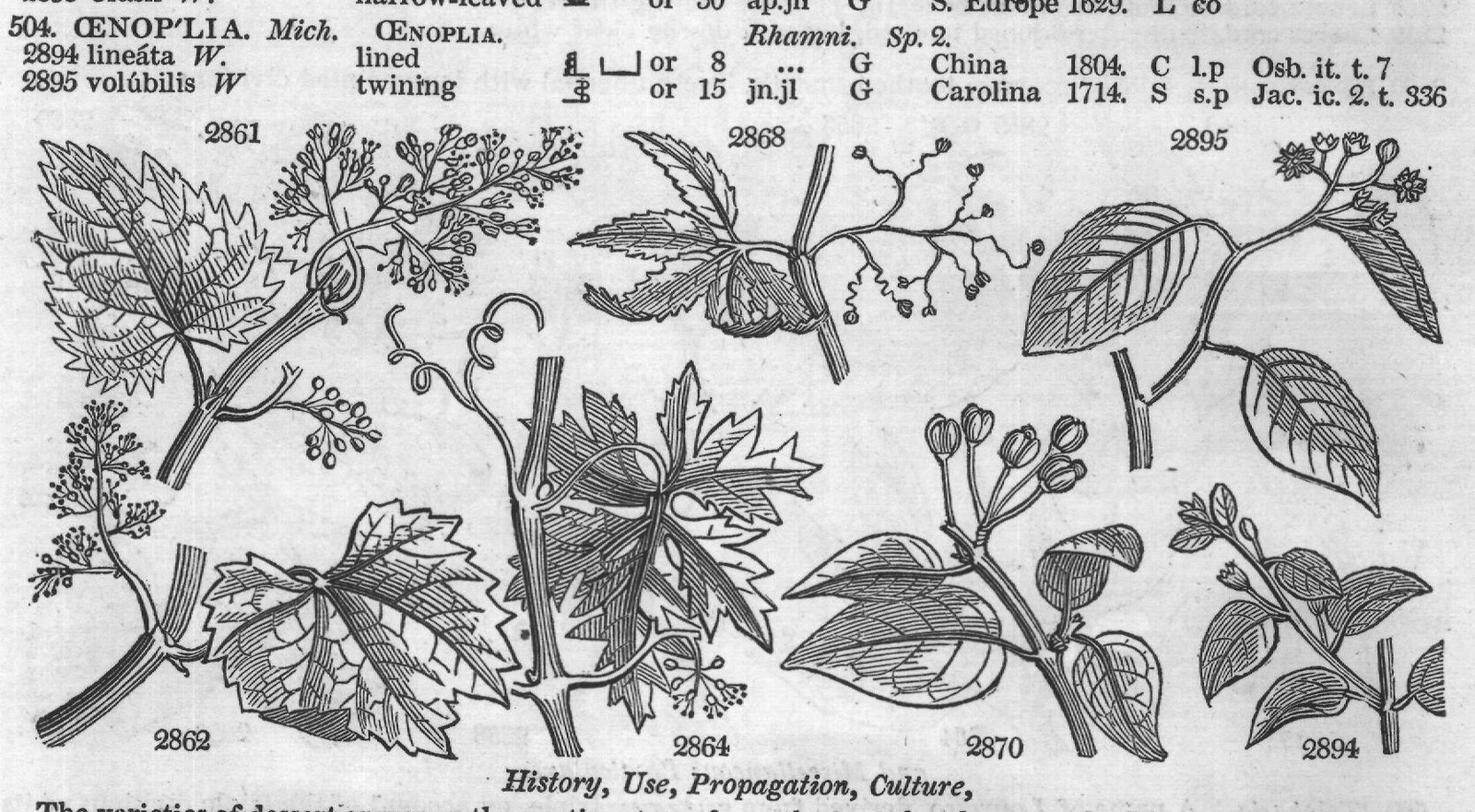
V. vinifera is universally known for its fruit, and for producing the first liquor in the world; a liquor which, notwithstanding all that is said of its dangerous qualities, is yet eagerly drank by all who can procure it, and preferred before all others by those who are unlimited in their means and choice. The grape vine is among fruits what wheat is among the cereal grasses, or the potatoe among the farinaceous roots; and, like them, in every country where it will grow, it is cultivated with pre-eminent care. In Britain, its culture is now confined to the garden as a dessert fruit; though formerly grown in many places for the wine-press. Besides the V. vinifera, the V. labrusca (from busca, the Hebrew for grape) and laciniosa are all cultivated, and both are now so intermingled with the first species by hybrid products, ucts, that for all practical purposes they may be considered as only varieties. The varieties of the grape in countries where it is grown for the wine-press, are almost as numerous as the vineyards; for as these for the most part differ in soil, aspect, elevation, or otherwise, and as the vine is greatly the child of local circumstances, its habits soon become adapted to those in which it is placed. When it is considered that a vineyard once planted will last two or three centuries, it will readily be conceived that the nature of a variety may be totally changed during only a part of that time. The varieties most in esteem for wine making, are small berries, and bunches with an austere taste. The Burgundy, as modified by different soils and situations, may be considered the most general vineyard grape of France, from Champagne or Marne to Marseilles and Bourdeaux. The best wine in Italy and Spain is also made from grapes of this description; but in both countries many of the larger berried sorts are grown as being more productive of liquor. The sweet vines, as the Malmsey, Madeira, Constantia, Tokay, &c. are made from sweet-berried grapes allowed to remain on the plants till over ripe. That wine is the strongest, and has most flavor, in which both the skins and stones are bruised and fermented. The same thing is the case in making cider; but in both processes bruising the stones or kernels is often neglected. 2861 cordifólia Ph. 2864 laciniósa W. 2865 cæ'sia Sab. 2866 cordáta Mich. 2867 bipinnáta Mich. 2862 ripária Ph. 2863 rotundifólia Ph. 502. AMPELOP'SIS. Mich. AMPELOPSIS. 2868 quinquefólia Mich. Virgin.-creeper Winter-grape sweet-scented Bull-grape Parsley-leaved Sierra Leone heart-leaved Pepper-vine 2869 hirsúta Donn. hairy 503. RHAM'NUS. W.
BUCK-THORN.
Rhamni. Sp. 24-70. 2870 colubrína L.
Bahama red wd. tm 20 jn G 2871 ellíptica H. K. oval-leaved or 5 au G 2872 erythroxylon Pall. Red-wood or 6 jl.au Y.G 2873 longifólia Desf. long-leaved or 6 ...
G 2874 cathártica W. purging or 15 my.jn G 2875 infectória W. yellow-berried or 6 jn.jl G 2876 lycioídes W.
Boxthorn-like or 6 s.d G 2877 oleoídes W.
Olive-leaved or 4 jn.jl G 2878 crenuláta W. 2879 saxátilis W. 2880 Theézans W. 2881 tetragóna W. 2882 lanceoláta Ph. 2883 alpína W. 2884 púmila W. 2885 Frángula W. 2886 latifólia W. 2887 glandulósa W. 2888 prinoídes W. 2889 mystacína W. 2890 alnifólia W. 2891 hýbrida P. S.
Teneriffe or 8 mr G rock or 1 my.jn G Tea or 3 my.jn G square-branch. or 6 ...
G spear-leaved or 12 ...
G Alpine or 3 my.jn G dwarf or 1 jl G PENTANDRIA MONOGYNIA. 40000004 CLASS V.
N. Amer. 1806. C s.p Jac. schœn. 427 N. Amer. 1806. C s.p Bot. mag. 2429 N. Amer. 1806. C s.p or 10 G or 20 my.jn G or 20 G fr 20 jn.jl G or 10 G Vinifera. Sp. 4-6. 1648. C s.p Schm. ic. 34. t. 8 S. Leone 1822. C s.p or 20 ap.my P.G N. Amer. 1803. C co or 15 jl.au P.G N. Amer. 1700. C co or 60 jn.jl P.G N. Amer. 1629. C co or 60 ap.my P.G N. Amer. 1806. C co Bahamas 1762. L co Jamaica 1758. L co Siberia 1823. Lco 1823. L co England hed. L co S. Europe 1683. L co 1752. L co Spain Spain 1752. L co Teneriffe 1778. L p.l Europe 1752. C co China C p.l C. G. H. 1816. C p.1 N. Amer. 1812. C p.1