Home › R › Rubiaceæ (Sp tube-flowered or jl W P Y S)
Rubiaceæ (Sp tube-flowered or jl W P Y S)
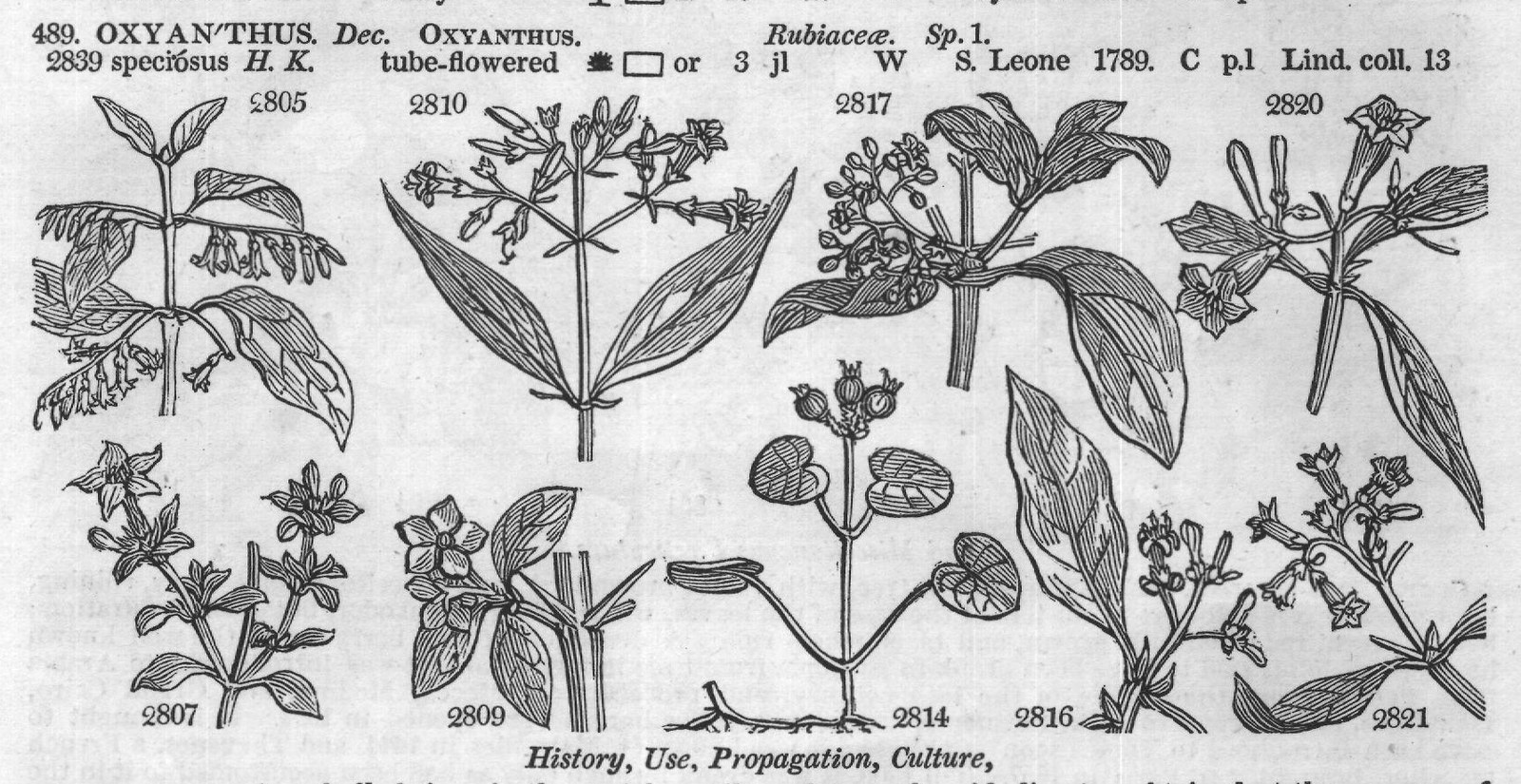
Sp. 1. tube-flowered or 3 jl W 2805 2810 2817 P.Y S. Amer. 1779. C l.p Pl. ic. 127. t. 136 W S. Leone 1789. C p.l Lind. coll. 13 2820 2807 2809 2814 2816 2821 History, Use, Propagation, Culture, consequence greater; bulk being, in these richer soils and more humid climates, obtained at the expence of flavor. In our stoves the coffee-tree is raised from the berry, which must be sown soon after being gathered; otherwise if kept six weeks it loses its vital powers. Cuttings of ripened wood root in sand under a glass in moist heat: transplanted, and furnished with plenty of water and pot room, they flower and fruit abundantly. 480. Chiococca. Snowberry, (χiov, snow, and zozzos, berry). Its berries are of a bright whiteness. 481. Serissa. A name of Commerson's, the meaning of which is not known. The genus is remarkable for the trifid segments of corolla. 482. Canthium. From canti, the Malabar name of the plant. Spiny rigid plants with small opposite leaves. and solitary, sessile, usually fragrant, white flowers. 483. Psychotria. From ψuχη, life; in allusion to the powerful medicinal effects of one of the species, P. emetica; or, as others say, from ψuχoτρoφov, an ancient name for an herb loving shade. The genus consists of a great number of stove plants, nearly all bearing white flowers. Some of them are very beautiful on account of their foliage: one species, P. parasitica, is parasitical upon trees in the West Indies. 484. Hamellia. In honor of the celebrated Henry Louis Du Hamel Du Monceau, born in 1700, died in 1782, author of numerous works on vegetable physiology. The genus consists of handsome shrubs of the West Indies, with tubular yellow or orange-colored flowers. 485. Posoqueria. The Galibis in French Guiana call this plant aymara-posoqueri. A fine shrub, with white flowers more than a foot long, and an eatable yellow berry as big as a hen's egg. ORDER I.
PENTANDRIA MONOGYNIA. 2806 Leaves ovate acuminate, Racemes subdivided axillary 1-sided nodding 2807 Leaves opposite ovate lanceolate, Stipules spiny, Flowers axillary sessile 2808 Spiny, Flowers sessile hairy 2809 Spiny, Leaves ovate wedge-shaped obtuse, Sepals leafy, Berries crowned 2810 Stipules emarginate, Leaves lanceolate ovate 2811 Stipules ovate persistent, Leaves elliptical acuminate subcoriaceous, Berries ribbed 2812 Stipules stem-clasping retuse, Leaves ovate acuminate succulent veinless, Cymes stalked as long as leaves 2813 Stipules ovate oblong bifid, Raceme terminal compound, Flowers clustered sessile 2814 Stem herbaceous creeping, Leaves cordate stalked 2815 Stipules 2-toothed, Leaves lanceolate ovate acuminate pubescent, Panicles cymose spreading 2816 Stipules connate entire deciduous, Leaves oblong ribbed wavy acuminate 2817 Leaves ellipt. narrowed each way, Panicles term. erect lax brachiate shorter than the leaves 2818 Racemes terminal colored, Leaves 3 together villous pubescent 2819 Branches rounded, Leaves ternate oblong hairy on both sides, Flowers corymbose 2820 Racemes terminal and axillary, Cor. campanulate ventricose, Leaves ternate 2821 Racemes terminal, Leaves oblo oblong wedge-shaped acuminate smooth, Flowers stalked 2822 Stipules and leaves oblong-acuminate, Corymbs terminal about 6-flowered, Tube of cor. much curved 2823 Stem unarmed, Leaves large ovate stalked 2824 Stem spiny, Leaves small nearly sessile 2825 Leaves lanceolate, Cor. hypocrateriform, Cal. angular, Stem rooting 2826 Leaves elliptical, Cor. hypocrateriform, Sepals subulate lanceolate vertical 2827 Leaves elliptical, Cor. hypocrateriform, Calyx bursting at side, Sepals dilated at end 2828 Leaves obovate roundish, Cor. hypocrateriform, Sepals subulate bluntly keeled 2829 Leaves oblong, Stipules subulate. Sepals subulate rounded, Tube smooth dilated short 2830 Branches scarred with two spines at the end, Leaves oblong ovate obtuse, mouth of cor. villous Leaves oblong ovate obtuse, mouth of cor. villous 2831 Terminal spines of the branches 4, Sepals linear wedge-shaped, Flowers clustered 2832 Leaves elliptical acute at each end longer than the spines, Flowers sessile smooth 2833 Spines axillary straight shorter than the oval smooth leaf, Flowers terminal solitary 2834 Unarmed, Lvs. ovate pubescent beneath, Fls. usually hexandrous, Cor. hairy on each side, Tube short 2835 A fine species, of which no detailed character has yet been given 2836 Very like G. florida, from which it chiefly differs in being smaller with narrower leaves 2837 Leaves oblong lanceolate, Peduncles axillary many-flowered, Tube short 2838 All over hairs, Leaves oblong-obovate, Flowers clustered on the summit, Fruit rounded flat 2839 The only species, with very long white flowers 2822 2823 2825 2825 2836 2833 2839 2837 and Miscellaneous Particulars. 486. Vanguiera. An abbreviation of the Madagascar name of one species, Voa-vanguier. A fine looking bush, with broad, green, entire leaves. It is said to bear a fine fruit as big as an orange. 487. Gardenia. So named by Ellis, in honor of his friend and correspondent A. Garden, M. D. of Charleston, in Carolina, who sent home many new species of plants. This is a beautiful genus, and most of the species are highly odoriferous, and free flowerers. G. florida, on the first approach, smells like the flower of the it first approach, smells like the flower of the orange, but on being more closely smelled to, like Narcissus. According to Thunberg, there are hedges of it in Japan, and the Japanese are very fond of it near their houses , and in the walks of their gardens. The fruit and seeds are used there to dye yellow. G. Rothmannia smells most during night it bears an ovate, , fleshy, angular berry, black when ripe, and about the size of a small pear. Almost all the species are spiny in their wild state; but lose their spines at an advanced age, or under high culture and keeping. In the stove they require a moist heat to make them flower freely, as do the cuttings to make them strike. According to Sweet, the best way to flower the greenhouse species is to set them in a close frame on a little bottom heat, , but not to plunge the pots. 488. Genipa. A name contrived by Plumier from the name, Genepapo, it bears in Guiana and Brazil. G. americana is an exceedingly rare plant in collections. It bears an excellent fruit, in much request in Dutch Guiana, where it is called Marmalade-box. 489. Oxyanthus. From oξuς, acute, and avθoς, a flower, on account of the acute segments of the corolla. A genus divided from Gardenia, from which it is readily distinguished by the long tube of the flower. MUSSÆNDA. 2842 pubéscens H. K. pubescent 490. RAN'DIA. P. S. 2840 longiflóra P. L. 2841 latifólia P. S. 491. MUSSÆN'DA. W.
PENTANDRIA MONOGYNIA.
RANDIA. long-flowered round-leaved 492. PINCKNEYA. Mi. PINCKNEYA. or