Rubiacea
Sp. 2-28. 2804 arábica W. 2805 occidentális W.
Arabian western 9 clt 20 au.n W or 6 W ... 2781 Yemen 1696.
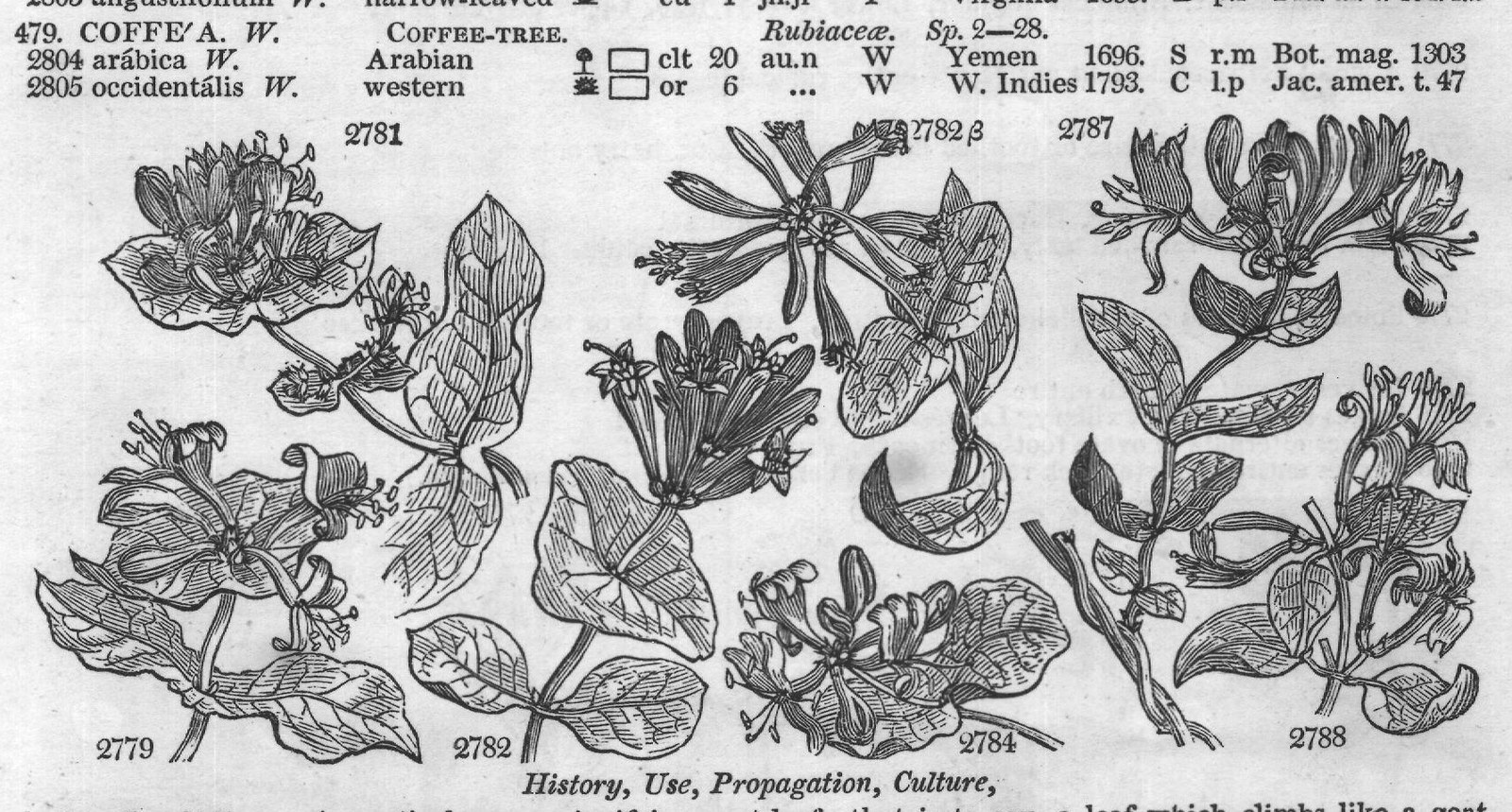
W. Indies 1793. 2782 3 Sr.m Bot. mag. 1303 C 1.p Jac. amer. t. 47 2787 2779 2782 2784 2788 History, Use, Propagation, Culture, 474. Caprifolium. A poetical name, signifying goat-leaf; that is to say, a leaf which climbs like a goat. Chevrefeuille, Fr., Geisblatt or Baumlilie, Ger., and Caprefoglio, Ital. This is a beautiful genus of flowering odoriferous mostly twining shrubs, valuable in the flower garden, shrubbery, and against walls, arbors, or trunks of trees. Like most British twiners, the honeysuckle follows the sun. Like other twiners, it bears pruning well, for, as Professor Martyn observes, "those plants which in a state of nature cannot ascend without the assistance of others, are often liable to lose large branches; they have therefore a proportionate vigor of growth to restore accidental damages." Against a wall, the climbing kinds are very liable to attacks from aphides, and the caterpillar of Phalœna tortrix; and the sphinges, or hawkmoths, according to Withering, extract the honey from the very bottom of the tubular flowers with their long tongues. In raising the honeysuckle from seeds, they should be sown the autumn after they are ripe, otherwise they will not come up the first year. Cuttings are sometimes apt to rot, owing to water lodging in their tubular stems above the last joint. To obviate this inconvenience, some make the cuttings of double the usual length, and insert both ends in the ground, leaving the part above ground in the form of a semicircle. Commonly, however, such cuttings root only at one end; or if at both, but very weakly at what was the top end. 475. Lonicera. Named after Adam Lonicer, a German, who was born in 1528, and died in 1586. 'There was another Lonicer, John, who wrote commentaries upon Dioscorides. A section of what was formerly called Lonicera, comprising the species with a shrubby upright stem, neither climbing nor prostrate plants. All hardy and easily increased by layers or cuttings. 476. Symphoria, is a syncope of symphoricarpos, from σuv, together, φερω, to bear, and κaρπoς, fruit; a plant which bears its fruit together in clusters. A small genus of low branching shrubs, formerly constituting part of Lonicera. 477. Diervilla. Dierville, a French surgeon, travelled in Acadia, whence he sent this plant to his friend Tournefort, who named it after him. A pretty low shrub, with yellow flowers appearing in the spring. 478. Triosteum. From τρεiς, three, and 0580v, bone, three bones, on account of its three hard seeds. The roots of this genus and of Diervilla are used indiscriminately in N. America for Ipecacuana. (Viola. Ipec.) 479. Coffea. An alteration of the Arabic name qahoueh, which is the name for the liquor of coffee; the grain is called boun. Cahwa, Pers., Cahvey, Turk., and Eleave, Egypt. 1 ORDER I.
PENTANDRIA MONOGYNIA. 2779 Flowers whorled terminal, Leaves deciduous, the upper perfoliate 2780 Heads term. generally 3 together, Lvs. decid. pubes. opp. upper perfo. smooth, lower with stalks only conn. 2781 Whorls in heads with bracteæ, Lvs. deciduous glaucous beneath, Upper perfoliate, Cor. gibbous at base 2782 Spikes nearly naked terminal, Lvs. oblong evergreen, the upper perfoliate, perfoliate, Tube of cor. ventricose above 2783 Flowers whorled terminal, Leaves evergreen obovate glaucous beneath, Upper perfoliate 2784 Whorls in heads, Cor. ringent, Segm. obl. obt. Lvs. deciduous ovate glaucous beneath, Upper perfoliate 2785 Whorls terminal capitate glandular, Leaves pubescent the upper connate perfoliate 2786 Flowers capitate terminal, Leaves evergreen all distinct 2787 Flowers capitate terminal, Leaves deciduous all distinct 2788 Flowers in pairs terminal sessile, Leaves evergreen all distinct 2789 Flowers sessile with distinct berries, Leaves ovate entire smooth, Stem wavy 2790 Pedunc. 2-flowered longer than flowers, Leaves entire ovate-elliptical pubescent 2791 Pedunc. 2-flowered, Leaves obovate lanceolate smooth glaucous beneath 2792 Berries united, Leaves oval-lanceolate 2793 Berries globose united, Styles undivided 2794 Leaves elliptical entire 2795 Leaves cordate obtuse 2796 Leaves ovate and cordate ciliated, Cor. with an evident spur 2797 Pedunc. 2-flowered shorter than flowers, Berries twin, Leaves cordate roundish tomentose 2798 Flowers axillary capitate clustered 2799 Raceme terminal, Cor. bearded inside 2800 Leaves cordate ovate, Berries distinct, Pedunc. axillary 2-flowered shorter than leaf 2801 The only species. Racemes terminal, Leaves serrated 2802 Leaves oval acuminate, Leaves abruptly narrowed at base, Axillæ 1-many-flowered 2803 Stem hispid, Leaves oval-lanceolate somewhat connate, Axillæ 1-flowered 2804 Leaves oblong ovate acuminate, Peduncles axillary aggregate, Cor. 5-cleft 2805 Leaves oblong lanceolate acuminate, Panicle few-flowered trifid terminal, Cor. 4-cleft 2790 2800 2802 2805 2793 2795 2799 2801 2804 and Miscellaneous Particulars.
C. arabica is an erect, conicar-shaped, low tree, with a light brown bark, and opposite, oblong, wavy, shining, light green leaves; flowers in clusters at the base of the leaves, white, of a grateful odor, but of short duration; berries green, red when fully grown, and black when ripe. A decoction of this berry forms the well known beverage which is said to have been drank in Ethiopia from time immemorial. It was introduced into Arabia from Persia about the middle of the 15th century, and proceeded by Mecca, Medina, and Grand Cairo, Damascus, and Aleppo to Constantinople, where two coffee-houses were opened in 1554. It is thought to nave been introduced to Venice soon after 1615: it was known at Marseilles in 1644, and Thevenot, a French traveller, brought it to Paris in 1657. Till 1660, it was drank by such only as had been accustomed to it in the Levant. About the end of the 17th century a coffee-house was opened at Paris, by one Pascal, an Armenian, who, not succeeding, came to London, where coffee had been previously introduced by Daniel Edwards, a Turkey merchant, who brought home with him a Greek servant, Pasqua Roffee, who understood the roasting and making of coffee, and afterwards set up a coffee-shed, which he was enabled in time to turn to a house in the churchyard of St. Michael's, Cornhill, In 1688 Ray affirms that London might rival Grand Cairo in the number of its coffee-houses.
The coffee-tree was first introduced to Europe through the Dutch, who procured some berries at Mocha to be sown at Batavia; which being done in the year 1690, Governor Witsen presented a plant to the botanic garden of Amsterdam, where it bore fruit and produced many young plants. From these the East Indies and most of the gardens of Europe have been furnished. Coffee was afterwards cultivated by the Dutch in Surinam in 1718, and by the French in Cayenne and the Mauritius soon afterwards. It was next grown in Martinique, and so spread to the neighbouring islands and to Jamaica in 1730, or earlier. The plants are raised from seeds, then transplanted into nursery lines. Plantations are made chiefly on hills and the skirts of mountains, and, if possible, where the soil is moist and shaded. The trees are planted from five to ten feet apart, according to the goodness of the soil and situation. They produce fruit the next year after planting; and the produce of a good tree is from 1 to 2lbs. of berries. The berries are gathered when they begin to fall, and in this state their pulpy bark begins to shrivel. They are further dried under sheds, and there passed between wooden rollers to separate the husk from the kernel; and afterwards sifted, winnowed, and put into casks for sale. In Arabia the plant and berries are much smaller than in the West Indies, and the flavor in 2806 racemósa W. cluster-flower'd PENTANDRIA MONOGYNIA. 480. CHIOCOCCA. W. SNOW-BERRY.