Home › S › Scrophularineæ (Sp jn au B N Amer D p)
Scrophularineæ (Sp jn au B N Amer D p)
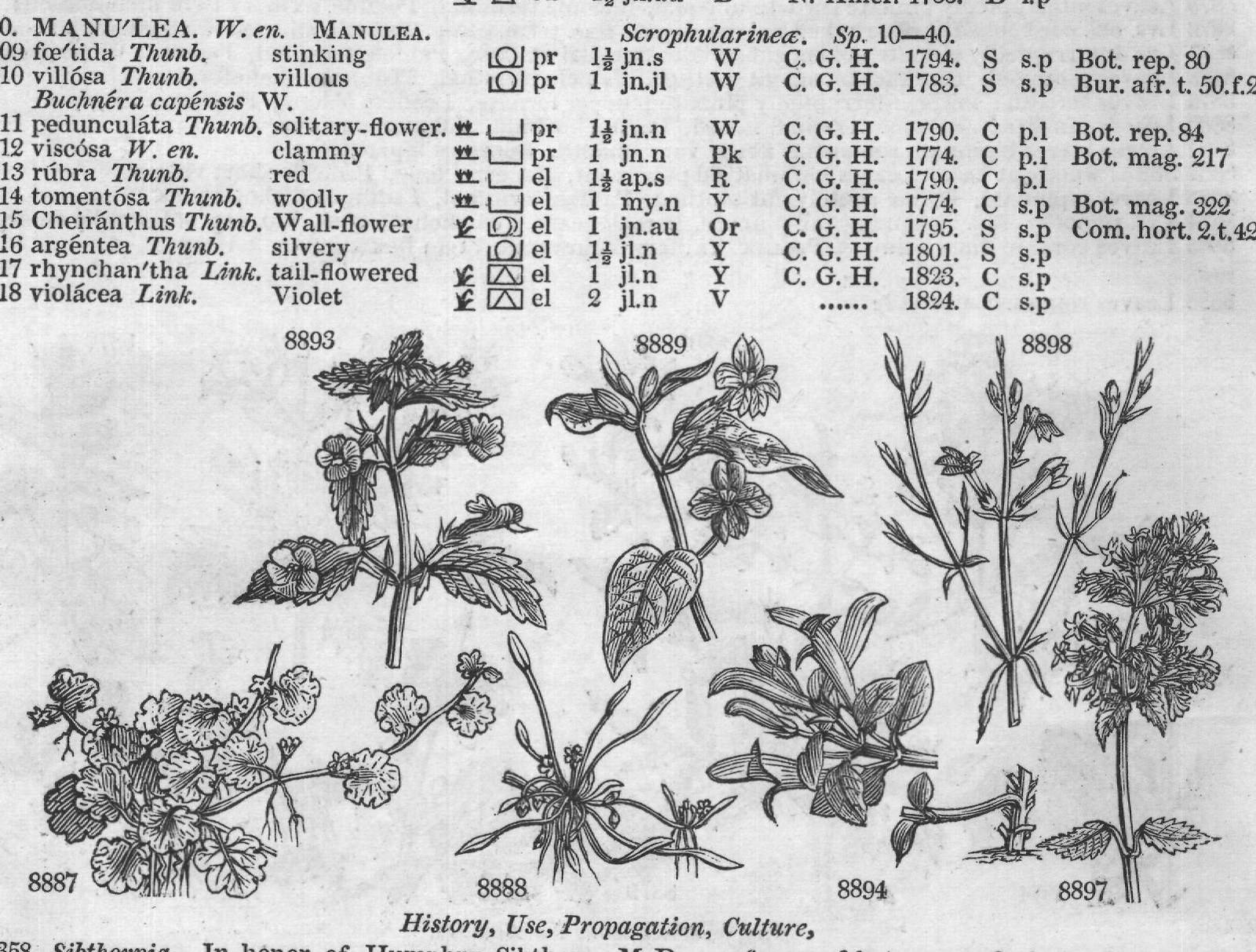
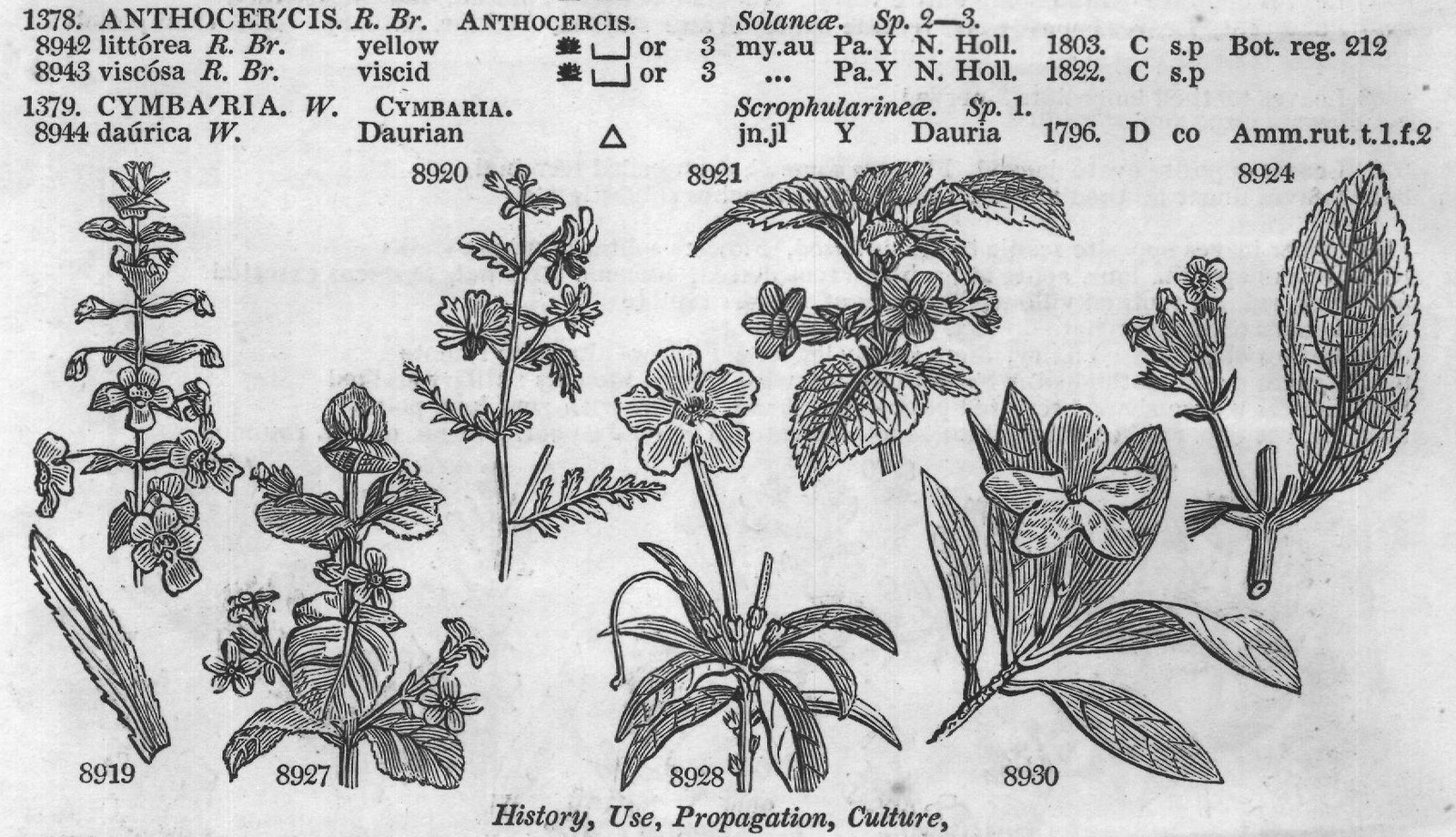
Sp. 1-13. 1½ jn.au B N. Amer. 1733. D 1.p Scrophularinea. Sp. 10-40. 8909 fœtida Thunb. stinking pr 1 jn.s W C. G. H. 1794. S s.p Bot. rep. 80 8910 villósa Thunb. villous pr 1 jn.jl W C. G. H. 1783. S s.p Bur. afr. t. 50.f.2 Buchnéra capénsis W. 8911 pedunculáta Thunb. solitary-flower. 8912 viscósa W. en. clammy pr 1 jn.n W C. G. H. 1790. C p.1 Bot. rep. 84 pr 1 jn.n Pk C. G. H. 1774. C p.1 Bot. mag. 217 8913 rúbra Thunb. red el 1 ap.s R C. G. H. 1790. C p.1 8914 tomentósa Thunb. woolly el 1 my.n Y C. G. H. 1774. C s.p Bot. mag. 322 8915 Cheiránthus Thunb. Wall-flower el 1 jn.au Or C. G. H. 1795. S s.p Com, hort. 2.t.42 8916 argentea Thunb. silvery el 1 jl.n Y C. G. H. 1801. S s.p 8917 rhynchan'tha Link. tail-flowered el 1 jl.n Y C. G. H. 1823, C s.p 8918 violácea Link.
Violet el 2 jl.n V 1824. C s.p 8893 8889 8898 8887 8888 History, Use, Propagation, Culture, 8894 8897 1358. Sibthorpia. In honor of Humphry Sibthorp, M. D., professor of botany at Oxford, who travelled into Greece, for the purpose of collecting materials for a classical Flora Græca, in which he succeeded even beyond his own hopes. After his death the publication of his materials was confided to Sir James Edward Smith, under whose care the work has reached to five hundred figures in folio, of the most magnificent kind; five hundred more have yet to be published. A little trailing plant. 1359. Limosella. From limus, mud. The plant grows by the edge of puddles and in muddy places. 1360.
Browallia. Named by Linnæus, in honor of John Browallius, bishop of Aboa, who defended the sexual system against Siegesbeck, in a book entitled Examen epicriseos, &c., Aboa, 1739, octavo. Handsome plants with blue flowers, often cultivated as tender annuals. 1361. Stemodia. From σημωv, a stamen, and δiς, double. Each of the stamens supports two anthers. 1362. Trevirana.
Named after Dr. Treviranus, a German botanist. This beautiful plant, which is commonly called Cyrilla pulchella, is one of the prettiest of the old inhabitants of the stove. 1363. Columnea. In honor of Fabius Columna, or Fabio Colonna, of the noble family of Colonna in Italy, born in 1567. He published his Phytobazanos in 1592, and his Ecphrasis in 1606, both works of high in 1567.
He published his Phytobazanos in 1592, and his Ecphrasis in 1606, both works of high reputation in their day. One species, C. scandens, is common in hothouses, where it is cultivated for the neatness of its foliage and the beauty of its scarlet blossoms.
ORDER II.
DIDYNAMIA ANGIOSPERMIA. 8887 Leaves reniform subpeltate crenate 8888 Leaves lanceolate spatulate, Scapes shorter than leaf 8889 Peduncles 1-flowered 8890 Peduncles 1 many-flowered 8891 Leaves opposite and ternate stalked 8892 Leaves opposite and ternate stem-clasping 8893 Leaves ternate ovate hairy 8894 Leaves ovate acute entire subvillous, Sepals entire and corollas pubescent, Upper lip undivided 8895 Leaves ovate acuminate serrate hairy above, Sepals toothletted and corollas hairy 8896 Leaves 3 subsessile oblong acutely crenate pubescent, Cor. hairy, Galea dilated reflexed 8897 Leaves ovate acuminate stalked, Raceme terminal whorled, Peduncles cymose 8898 Leaves linear smooth entire, Stem nearly naked 8899 Leaves oblong ovate entire 3-nerved sessile, Pedunc. axillary 1 flowered, Stem procumbent 8900 Leaves oblong entire, Peduncles longer than leaf, Stem declinate 8901 Very smooth, Leaves cuneate oblong upwards obsoletely crenate, Pedunc. nearly as long as leaf 8902 Stem erect, Leaves lanceolate acute doubly serrated smooth, Flowers whorled 8903 Leaves ovate serrated alternate, Flowers twin 8904 Hairy, Leaves alternate rhomboid cuneiform cut serrate, Flowers twin, Sepals linear 8905 Leaves opposite linear entire, Racemes compound terminal 8906 Leaves opposite ovate-oblong entire wavy: upper subcordate whorled, Racemes spiked 8907 Pubescent, Leaves opposite and ternate ovate serrate stalked, Pedunc. axillary shorter than petiole 8908 Leaves toothed lanceolate 3-nerved 8909 Leaves opposite ovate jagged, Flowers somewhat umbelled terminal 8910 Leaves linear toothed villous, Cal. hairy, Branches subfastigiate 3 8911 Upper leaves opposite sessile tooth-sinuated, Flowers solitary on long stalks 8912 Leaves opp. lin. lanc. acute at each end toothletted, Raceme terminal, Stamens exserted 8913 Leaves lanc. toothed villous, Racemes of flowers remote 8914 Leaves obovate crenate downy, Stem decumbent 8915 Leaves obl. serrated hairy, Stem nearly leafless, Flowers alternate remote 8916 Leaves ovate toothed silky beneath dotted with silver, Flowers axillary stalked 8917 Leaves wedge-shaped serrated pubescent, Segm. of cor. with very long points 8918 Leaves opp. stalked oblong blunt tooth-serrated when old smooth, Segm. of cor. rounded 8906 8899 8909 8900 8911 8908 8912 8903 8914 and Miscellaneous Particulars. 1364. Russelia. In honor of Alexander Russel, M. D. F. R. S., born in Scotland; died 1768; author of the natural history of Aleppo, London, 1756. His brother Patrick, published a second edition in 1794, and a work on serpents in 1796, folio. 1365. Dodartia, by Tournefort, after M. Dodart, member of the academy of sciences at Paris; and an eminent physician. An ugly, leafless, almost flowerless plant, of much rarity and little beauty. 1366. Lindernia. Named after Francis Lindern, an obscure Swiss botanist. Pyxidaria is so called from πuξoς, the box, which it resembles in foliage. 1367. Herpestis. From ἑρπησης, any thing which creeps. An exotic genus of herbs, with opposite leaves and axillary flowers, each of whose stalks bears a pair of bracteæ. Herpestis Monnieria is a beautiful aquatic. 1368. Capraria. So named from capra, a goat, the leaves being much liked by that animal. 1369. Buchnera. Named after John Godfrey Buchner, a German botanist, who published in 1743, his Observations upon the Plants of Saxony. Small Cape shrubs of little interest or beauty. Their leaves are generally small, and their flowers white. 1370. Manulea. Derived from manus, the hand. The five divisions of the flower, in some species, from their form and relative position, resemble an open hand. Handsome Cape shrubs of humble growth. They are rare in collections, but deserving of being very generally cultivated. Mm3 DIDYNAMIA ANGIOSPERMIA. 1371. ANGELO'NIA. Kunth. ANGELONIA. 8919 salicariæfólia Kunth, violet