Important: Safety Warning
This page recommends preparations containing opium, laudanum, morphine, or similar narcotics — in some cases for children. These substances are dangerously addictive, easily fatal in overdose, and strictly controlled by law today.
This page gives first-aid or emergency advice that predates modern medicine and can make an emergency worse. Do not follow it. In any medical emergency, call emergency services and follow current first-aid guidance.
This page prescribes plants as medicine according to pre-modern medical theory. Several of the plants named are toxic, correct identification is difficult, and the doses given have no scientific basis. Do not ingest or apply any preparation described here.
This information has been left in for historical purposes but should not be acted upon.
Home › E › Eng (Bot spera W hairy Aun jn jl Y)
Eng (Bot spera W hairy Aun jn jl Y)
bot. 554 11170 áspera W. hairy Aun 1 jn.jl Y Hungary 1805. D co Pl.rar.hu.2.t.110 11171 crócea W. deep-yellow un 1 jn.jl Or Hungary 1823. D co 11172 caucásica Bieb.
Caucasian un 1 jn.jl Y Caucasus 1820. D co 11173 Villársi W.
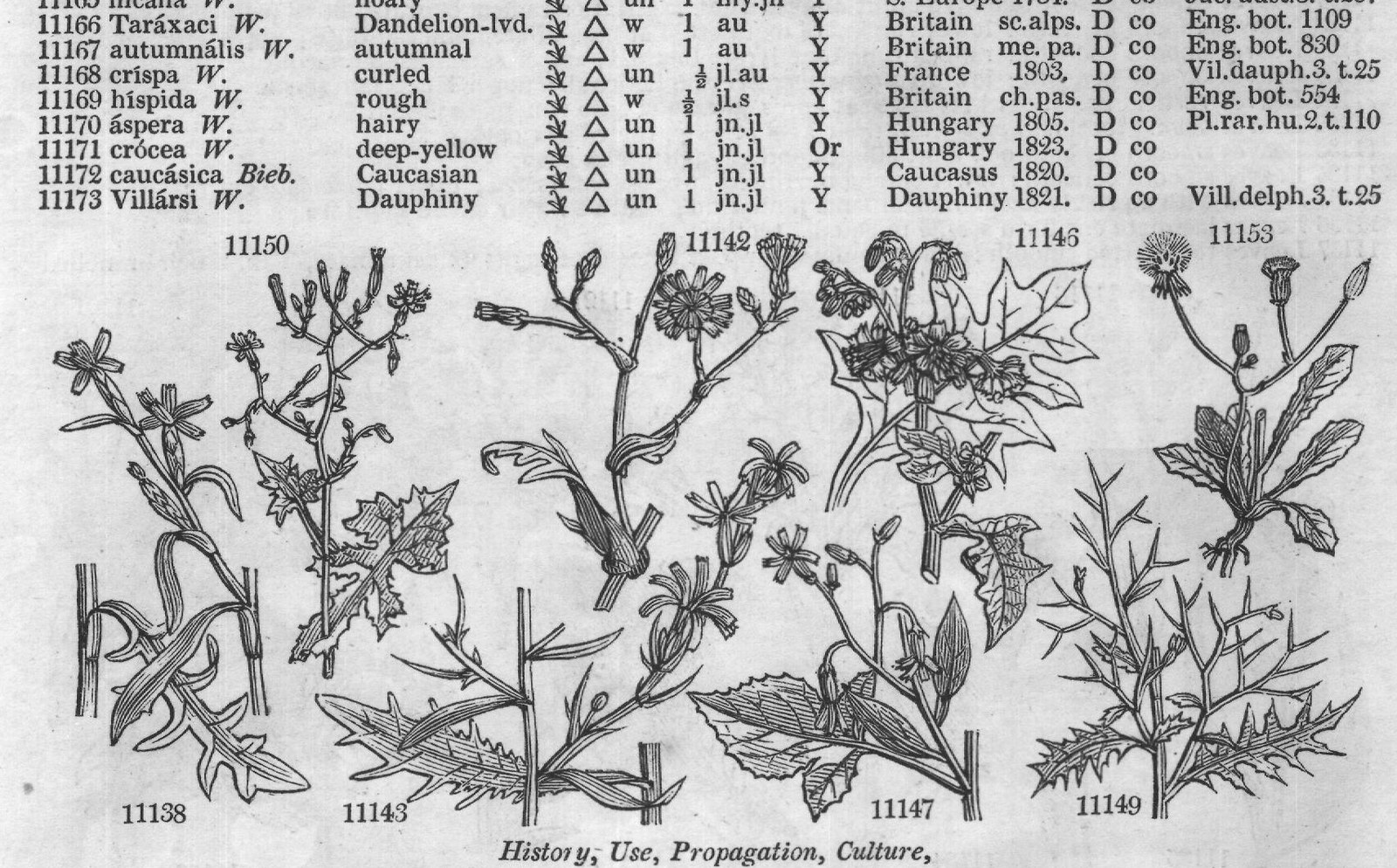
Dauphiny un 1 jn.jl Y Dauphiny 1821. D co Vill.delph.3. t.25 11150 11142 11146 11153 11138 11143 11147 11149 History, Use, Propagation, Culture, Lactucarium, and was first brought into notice by Dr. Duncan, of Edinburgh, who finds it can be administered with effect in cases were poppy opium is inadmissible. Details of the process of collecting and preparing the article, will be found in the Caledonian Horticultural Memoirs. (Vol. i. 160-259. ii. 314. and iv. 153.) The culture of lettuce as a salad plant is familiar to every one who has a garden. It is sown monthly, or oftener, throughout the year, in order to have a successional supply, and thinned out or transplanted to increase the size and succulency. The latter quality is greatly increased by watering in summer; and blanching, another desirable property, is promoted by tying up the leaves when the plant has attained about two-thirds of its usual size. Snails and slugs are very fond of this plant, and should either be watched and hand-picked, or the ground well watered with lime water, which effectually destroys them. The lettuce, unlike the cabbage and spinage, is a vegetable which can be grown to as great perfection in a warm as in a temperate climate, provided it be grown on rich soil, and abundantly supplied with water. Hence the lettuces of Paris, Rome, and Calcutta, are as large and tender as those of London and Amsterdam. This genus is the type of the tribe Lactuceæ of M. Cassini. It differs essentially from all other tribes of Compositæ, in having a divided or ligulate corolla only, and from nearly all other tribes in its style, which can be compared to that of Vernonieæ only. The radiant head of flowers is a character common both to Lactuceæ and Nassauvieæ. The greater part of Lactuceæ are found in Europe, a smaller number in Asia and Africa, very few in America, and in the southern hemisphere none at all. 1629. Chondrilla. Derived from χovδρoς, a lump. Dioscorides says, it bears on its stems little lumps of gummy matter. But Theophrastus speaks of the grumous or tubercled roots of his Chondrilla. The plant now so called is an inconspicuous perennial plant, of no recorded use. 1630. Prenanthes. From πρηvης, drooping, and avθoς, a flower. The heads of flowers of all the species are ORDER I.
SYNGENESIA ÆQUALIS. 11138 Leaves decurrent: lower pinnatifid toothed outwards; upper linear, Stem branched 11139 Lower leaves lanc. runcinate toothed narrowed at base and sessile: upper linear sagittate 11140 Leaves runcinate pinnatifid unequally toothed: floral lanceolate, Flowers racemose 11141 Radic. leaves pinnatif. toothed: cauline linear entire sagittate, Branches 1-flowered 11142 Leaves all pinnatifid: segments linear toothed upwards, Fl. in corymbose panicles 11143 Radic. leaves runcinate: cauline linear entire 11144 Radic. leaves runcinate: cauline undivided filiform, Stem and invol. smooth 11145 Invol. 5-fl. Leaves obl. lanc. amplexicaul. cordate denticulate glaucous beneath 11146 Invol. many-fl. Leaves angular hastate toothed, Flowers nodding racemose panicled 11147 Invol. 5-fl. Leaves 3-lobed stalked angular toothletted rough at edge, Racemes axillary, Fl. nodding 11148 Stem panicled upwards, Leaves stalked cordate toothed ciliated, Panicle lax racemose 11149 Leaves linear tooth-sinuated sessile, Stem shrubby much branched, Branches spiny 11150 Florets 5, Leaves lyrate-pinnatifid and toothed, the terminal lobe with about 5 angles 11151 Leaves pinnated, Leafl. linear filiform, Panicle corymbose stalked, Stem shrubby 11152 Leaves pinnatifid pinnate with linear segments 11153 Leaves pubesc. toothed, those on the stem subsaggitate, Stem panicled corymb. Invol. pyramidal glabrous 11154 Outer scales of the involucre reflexed, Leaves runcinate glabrous toothed 11155 Outer invol. spreading, Leaves runcinate scabrous, Segments round toothletted 11156 Outer scales of the involucre erect appressed, Leaves sinuato-dentate nearly glabrous 11157 Outer invol. spreading, Scales ovate, Scape 1-fl. Leaves obov. bluntish toothed 11158 Outer invol. spreading, Scales ovate-lanceol. Lvs. runcinate pinnatifid glabrous with lin. falc. distant lobes 11159 Leaves pinnatifid to the nerve smooth, Leaves of invol. smooth reflexed 11160 Scape 1-fl. naked thickened and hairy upwards, Invol. hispid, Leaves lanc. obl. somewhat toothed 11161 Scape 1-fl, squarrose thickened and somewhat hairy upwards, Invol. hispid, Leaves lanc. obl. smoothish 11162 Scape 1-fl. naked and invol. smooth, Leaves lanc. runcinate-toothed smooth 11163 Scape 1-fil. nearly naked upward and invol, hairy, Leaves lanc. toothed at base with a few forked hairs 11164 Scape 1-fl. naked smooth. Scales of invol, acute hairy, Lvs. obov. runcin. hairy scabrous, Root tuberous 11165 Scape 1-fl. nearly naked and calyx pubesc. Lvs. lanceol. acute somewhat toothed hoary, Hairs multifid 11166 Scape single-flow. thickened upwards, Leaves glab. runcinato-dentate, Involucre very hairy 11167 Scape branched scaly upwards, Lvs. lanc. toothed or pinnatif. sub-glab. Pedunc. swelling beneath invol. 11168 Scape naked 1-fl. and invol. hairy, Lvs. runcinate pinnatifid hairy, Segm. recurved tooth. Hairs 3-forked 11169 Scape single-flowered, Leaves dentate scabrous, Florets hairy at their orifice glandular at the tip 11170 Stem leafy somewhat branched hairy, Invol. smooth, Leaves lanc. runcinate hairy, Hairs forked 11171 Scape 1-fl. scaly thickened upwards and hairy, Invol. hispid, Leaves runcinate smooth 11172 Scape naked 1-fl. glabrous, Invol. hairy, Leaves runcinate toothed scab. somewhat hairy, Hairs prostrate 11173 Scape naked 1-fl. and invol. smoothish, Leaves pinnatifid-toothed hispid, Hairs simple subulate 11154 11155 11156 11161 11162 11166 11167 11169 and Miscellaneous Particulars. nodding. Prenanthes serpentaria grows to the height of two feet, bearing pale purple flowers. It is known by the inhabitants of Virginia and Carolina under the name of the Lion's Foot, and is in high esteem as a cure for the bite of the rattle-snake. The juice of the plant boiled in milk is taken inwardly, and steeped leaves, frequently changed, are applied to the wound. It must not be confounded with Prenanthes rubicunda, called False Lion's Foot, which is a less powerful plant. Prenanthes virgata has a very fine effect in large plantations. 1631. Leontodon. So named from λεωv, a lion, and oδες, a tooth; in reference to the deep tooth-like divisions of the leaves. The English name Dandelion, is a corruption of the French translation of this word, Dent de lion; in German Pfaffenröhrlein and Dotterbluhme. It has been recommended as a winter salad, blanched like Endive; but it possesses too much bitter principle to render it fit for table under any management. Dent de lion, Fr., from its cut leaves, and Piss-en-lit, in French, and most other European languages, from its diuretic qualities. The tender leaves in spring, used in compound salads, are equal to those of Endive or Succory. The roots, which are fusiform, and abound in a milky juice, are eaten raw as a salad by the French, and boiled by the Germans, like Salsafy and Scorzonera. Dried and ground into powder, they afford a substitute for coffee, in all respects equal to that of Chicory roots. It is a difficult weed to extirpate, because every inch of root will form buds and fibres, and thus constitute a new plant. Swine are fond of it, and goats will eat it; but sheep and cows dislike it, and by horses it is refused. 1632. Apargia. Aπaργia is the Greek name of a plant now unknown. It has been employed by Dalechamp and Scopoli for a species of Hieracium. At the present day it is given to a genus of weedy plants, with the appearance of Leontodon.
SYNGENESIA ÆQUALIS. 1633. THRIN'CIA. W. THRINCIA. 11174 hírta W. 11175 híspida W. 11176 maroccána P. S.
Hyóseris híspida W. 1634. PI'CRIS. W. 11177 hieracioídes W. 11178 asplenioídes W. 11179 híspida H. K. 11180 sprengeriána P. S. 1635. HIERA CIUM. 11181 rupéstre All. 11182 alpínum L. 11183 alpéstre Jacq. 11184 Pilosélla L. 11185 bulbósum W. 11186 aúreum W. 11187 dúbium L. 11188 aurícula L. 11189 fállax W. en. 11190 florentínum All. 11191 cymósum L.
OX-TONGUE.
Hawkweed-like Spleenwort-lvd. hispid branched ODDO Britain gra.pa. D co Eng. bot. 555 S. Europe 1815. S co Morocco 1799. S co England bor.fi. S co