Turpent
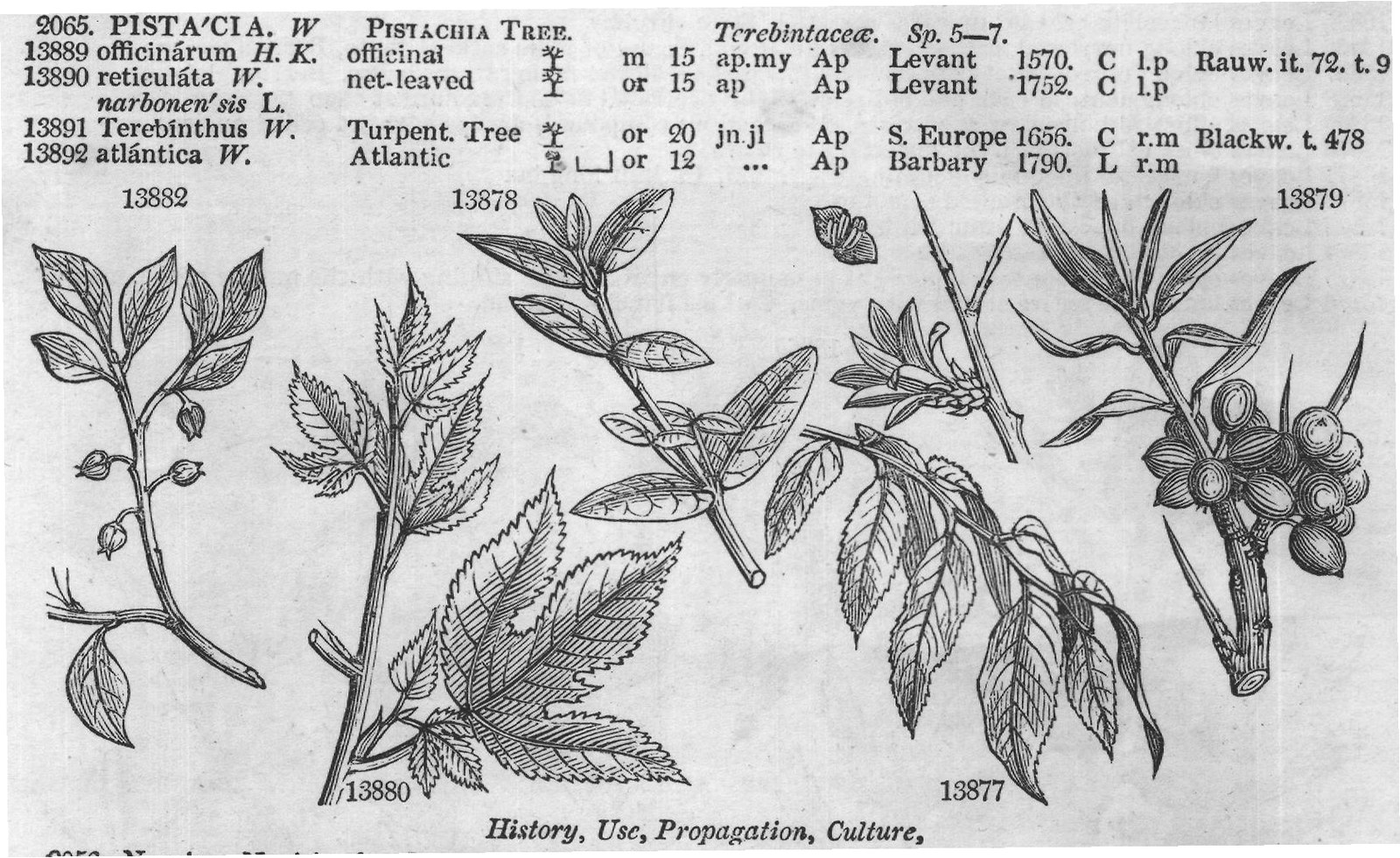
Tree Atlantic or 20 jn.jl or 12 ...
Ap Ap S. Europe 1656. C r.m Blackw. t. 478 Barbary 1790. Lr.m 13878 13879 13880 13877 History, Use, Propagation, Culture, 2056. Nageia. Nagi is the Japanese name of one of the species. That in the gardens is an uninteresting shrub with a loose elegant foliage, and a light grey bark . Ripened cuttings strike freely in a bark pit. 2057. Shepherdia. A name given by Nuttall to the Hippophae canadensis of our gardens, in honor of Mr. William Shepherd, the worthy curator of the Liverpool botanic garden. A small inelegant tree, with dark Shepherd, the worthy curator of the Liverpool botanic garden. A small inelegant tree, with dark green deciduous leaves, covered over with brownish silvery scales on the lower side. 2058. Hippophae. An ancient name given to some plant now unknown, which was applied medicinally to horses; from ἰππoς, a horse, and φaω, to give light. H. rhamnoides is very prolific in berries, when ripe, succulent, smooth, and gratefully acid to the taste. They are much eaten by the Tartars; and the erries, which are yellow fishermen of the Gulph of Bothnia prepare a rob from them, which imparts a grateful flavor to fresh fish. Every part of the plant will dye yellow. The species grow in common soil, and are readily increased by layers or cuttings of the roots. 2059. Broussonetia. Named by L'Heritier, in honor of his countryman P. N. V. Broussonet, a well known naturalist, who travelled in Barbary, and published an Ichthyologia in 1782. This is a vigorous growing shrub or low tree, with large lobed leaves, variously shaped; the foliage of the male and female plant differing so much from each other that they might easily be taken for distinct species. The fruit is little larger than peas, and from the bark the Chinese make paper and the Otaheitans cloth.
B. papyrifera, though a low tree, produces vigorous shoots, furnished with large leaves. The fruit is little larger than peas, surrounded with long purple hairs, when ripe changing to a black purple color, and full of than peas, surrounded with long purple hairs, when ripe changing to a black purple color, and full of sweet juice. In China and Japan it is cultivated as we do osiers, for the sake of the young shoots, from the bark of which the inhabitants of the east countries make paper. The bark being separated from the wood is steeped in water, and the inner bark separated from the outer; the former making the whitest and best paper. The bark is next slowly boiled, then washed, and afterwards put on a wooden table and beaten into a pulp. This pulp being put in water, separates like grains of meal. An infusion of rice and the root of manihot is next added to it. From the liquor so prepared, the sheets of paper are poured out one by one, and when pressed, the operation is finished.
The juice of this tree is sufficiently tenacious to be used in China as a glue, in gilding either leather or paper. The finest and whitest cloth worn by the principal people at Otaheite and in the Sandwich Islands is . The finest and whitest cloth worn by the principal people at Otaheite and in the Sandwich Islands is made of the bark of this tree. The cloth of the Bread-fruit tree is inferior in whiteness and softness, and worn chiefly by the common people. 2060. Schafferia. So called after James Christian Schæffer, a German naturalist of celebrity, who is best known by his excellent work on the Fungi of Bavaria, published in 1762. An inelegant shrub with green flowers.
ORDER IV.
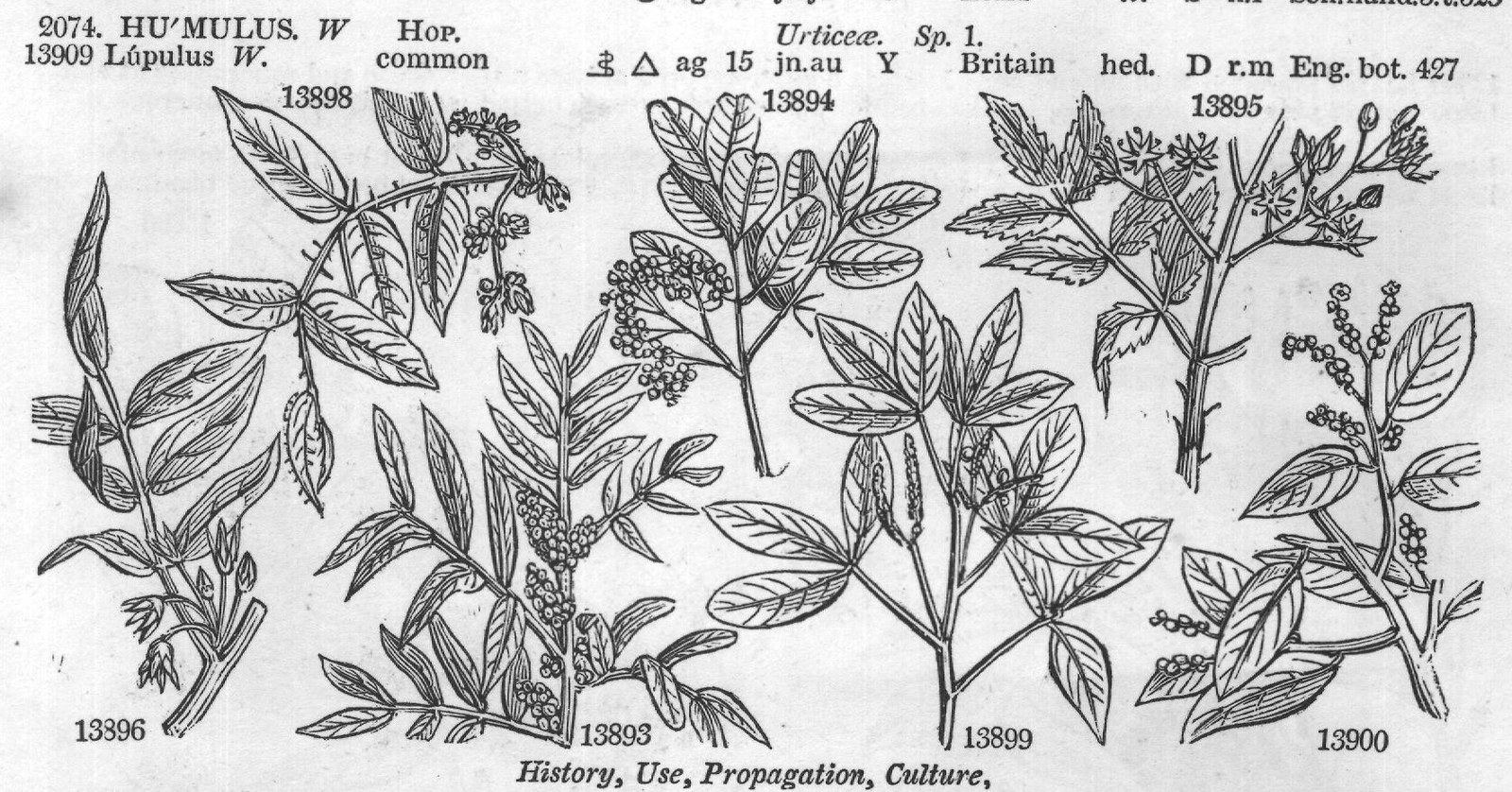
DICECIA TETRANDRIA. 13877 Leaves ovate lanceolate oblique at base finely and simply serrated smooth 13878 Leaves oblong stellate-hairy above brownish white and scaly beneath 13879 Leaves linear-lanceolate smooth above white with scales beneath 13880 Leaves 3-5-lobed acuminate serrated scabrous 13881 Leaves cucullate entire 13882 Flowers tetrapetalous axillary 13883 Leaves opposite stalked pinnated with an odd one of 5 or 6 pairs 13884 Leaflets serrated villous beneath, Racemes often compound 13885 Leaves somewhat whorled linear smooth 13886 Unarmed, Leaves oblong acum. entire smooth, Fruit 1-seeded cornute, Horns reflexed shorter than fruit 13887 Unarmed, Leaves obovate oblong acuminate unequally serrate very scabrous on each side 13888 Leaves alternate oblong oval, Fl. solitary PENTANDRIA. 13889 Leaves pinnated with an odd one, Leaflets 5 ovate tapered at base rather acute and mucronate at end 13890 Leaves pinnate and ternate, Leaflets roundish narrowed at base netted with veins retuse mucronate 13891 Leaves pinnate with an odd one, Leaflets about 7 ovate-lanceolate rounded at base acute mucronate 13892 Leaves pinnate with an odd one, Leaflets lanceolate about 9, Petiole winged between the terminal pairs 13888 13883 13885 13891 13886 and Miscellaneous Particulars. 2061. Brucea. Named in honor of James Bruce, a celebrated Scotch traveller in Abyssinia, who discovered the plant. 2062. Anthospermum. From avθoς, a flower, and σπερμη, seed; its female flower is entirely naked, consisting of a single ovarium; whence its name. A heath-looking evergreen, the leaves of which are fragrant when bruised, and the propagation and culture of the easiest description. 2063. Trophis. From τρέφω, to nourish. T. americana produces berries about the size of large grapes, and of an agreeable pleasant flavor. The leaves and twigs are used as fodder for cattle when grass is scarce. Cuttings root in sand under a glass. 2064. Montinia. In honor of Laurence Montin, a Swede, who published a little tract upon Splachnum. The specific name seems to hint at the nature of his disposition. A little worthless weed-like Cape plant. 2065. Pistacia. Said by Forskahl to have been altered by the Latins from its Arabic name foustaq. P. officinalis abounds in Sicily, where it is cultivated for its nuts. The male flowers come out from the side of the branches in loose bunches, and are of an herbaceous color. The female flowers come out in the same manner in clusters. The male puts forth its flowers first, and some gardeners pluck them whilst yet shut , dry them, and afterwards sprinkle the pollen over the female tree: but the method usually followed in Sicily, when the trees are far asunder, is to wait till the female buds are open, and then to gather bunches of male blossoms ready to blow these are stuck into a pot of moist mould, and hung upon the female tree till they are quite dry and empty. This operation is called tuchiarare, and never fails to produce fructification; sometimes the gardeners ingraft the male bud upon the female tree. P. Terebinthus (from τερεω, to cut) furnishes the Cyprus turpentine. It is procured by wounding the bark of the trunk in several places, during the month of July, leaving a space of about three inches between the wounds; from these the turpentine is received on stones, upon which it becomes so much condensed by the coldness of the night, as to admit of being scraped off with a knife, which is always done before sunrise in order to free it from all extraneous admixture, it is again liquified by the sun's heat, and passed through a and passed through a strainer; it is then fit for use. The quantity produced is very inconsiderable; four large trees, sixty years old, only yielding two pounds nine ounces and six drachms; but in the eastern part of Cyprus and Chio, the trees afford somewhat more, though still so little as to render it very costly, and on this account it is commonly adulterated, especially with other turpentines. The best Chio turpentine is generally about the conthe consistence of thick honey, very tenacious, clear, and almost transparent, white, inclining to yellow, and of a fragrant smell, moderately warm to the taste, but free from acrimony and bitterness. P. Lentiscus (lentiscere, to be sticky) produces the mastick, which is obtained most abundantly, by making transverse incisions in the bark of the tree, whence the mastick exudes in drops, which are suffered 3 H common three-capsuled 13898 nítidum Dec. shining or 2067. PICRAM'NIA. W. PICRAMNIA. 13899 Antidésma W.
Ash-leaved un 4 2068. ANTIDES MA. W. ANTIDESMA. 13893 Lentíscus W.
B massiliénsis DIECIA PENTANDRIA.
CLASS XXII.
Mastick Tree ec 15 my Ap S. Europe 1664. L r.m Bot. mag. 1967 narrow-leaved 2066. ZANTHOXYLUM. W. TOOTH-ACH TREE. Rutacee. Sp. 5-43. 13894 emarginátum W. notch-leaved 13895 Cláva Hérculis W. Lentiscus-leav. 13896 fraxíneum W. 13897 tricárpum H. K. or or 6 ... or 10 G.w Jamaica 1739. C l.p or 10 ap.my G.w W. Indies 1739. C 1.p 6 mr.ap G.w N. Amer. 1759. L s.l G.w N. Amer. 1806. L 1.s 6 ap.my G.w China 1823. L r.m Sp. 1-2.
Jamaica 1793. C p.1 Sp. 2-10. ..
Slo. ja.2. t.168.f.4.
Cat. car. 1. t. 26 Duh. arb. 1. t. 97 Bot. mag. 2558 Slo. ja.2.t.208. f.2 G ... 13900 alexitéria W.
Laurel-leaved 13901 paniculáta W. panicled un 10 my.jn Ap un 10 Ap ...
E. Indies 1793. C p.1 E. Indies 1800. C p.l Rhee.mal.5. t.11 2069. IRE'SINE. W.
IRESINE.
Amaranthacea. Sp. 3-8. 13902 celosióides W.
Florida Apr 1 jl.au W America 1733. Dl.p Lam. ill. t. 813 13903 elongáta W. long-leaved Apr 2 jl.au W 13904 diffúsa W. straggling Apr 1 jl.au W S. Amer. 1822. S 1.p S. Amer. 1818. S 1.p Pluk.al. t. 261.f.1 2070. SPINA CIA. W. SPINAGE.
Chenopodeæ.
Sp. 1. 13905 olerácea W. common Ocul 1 mr.o G ...... 1568. S co Sch.hand.3.t.324 a spinósa prickly O cul 1 mr.o G ...... ...
ẞ glabra Mill. round O cul 1 1½ mr.o G S co Sco ...... ... 2071. FLUG GEA. W.
FLUGGEA.
Euphorbiacea. Sp. 1. 13906 leucopýrus W. white un 6 ... 2072. ACNI'DA. W.
VIRGINIAN HEMP. 13907 cannabína W.
Chenopodeæ. Sp. 1-3. common 2073. CANNABIS. W. HEMP. 13908 satíva W. common 2074. HU'MULUS. W HOP. 13909 Lúpulus W. common Ap E. Indies 1825. Cr.m Oun 2 jn.jl G.Y N. Amer. 1640. S co