Home › W › Wal (Kit t Eng bot Cav ic t Bot mag)
Wal (Kit t Eng bot Cav ic t Bot mag)
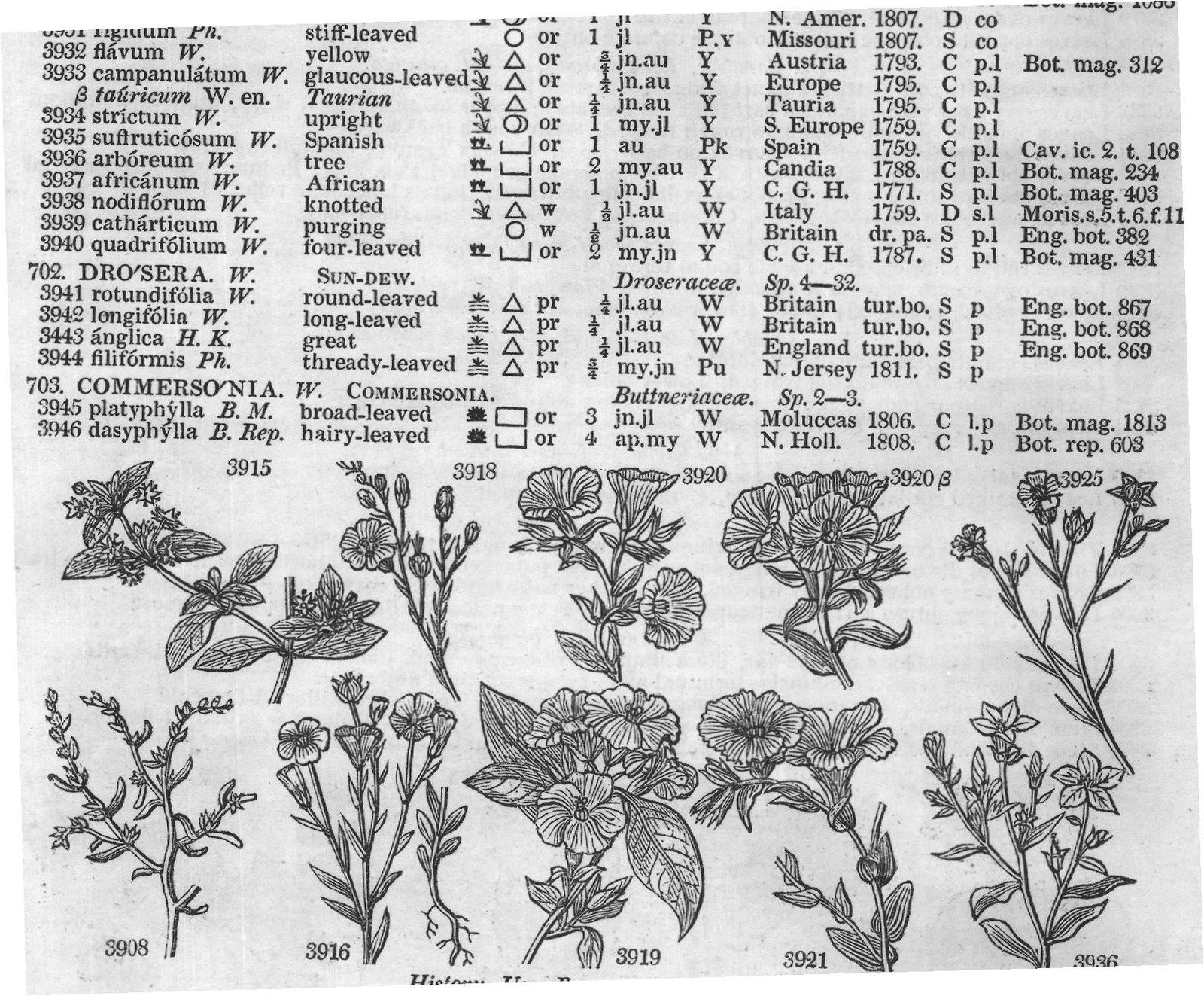
& kit. t. 105 Eng. bot. 40 Cav. ic. 2. t. 108 Bot. mag. 234 Bot. mag. 403 Moris.s.5.t.6.f.11 Eng. bot. 382 Bot, mag. 431 702. DRO'SERA. W.
SUN-DEW. 3941 rotundifólia W. round-leaved pr Droseraceæ. jl.au W Sp.4-32. 3942 longifólia W. long-leaved pr jl.au W 3443 ánglica H. K. great Apr jl.au W Britain tur.bo. S p Britain tur.bo. S p England tur.bo. S p Eng. bot. 867 Eng. bot. 868 Eng. bot. 869 3944 filifórmis Ph. thready-leaved pr my.jn Pu N. Jersey 1811. Sp 703. COMMERSONIA. W. COMMERSONIA.
Buttneriaceæ. Sp.2-3. 3945 platyphýlla B.M. broad-leaved or 3 jn.jl W 3946 dasyphylla B. Rep. hairy-leaved Moluccas 1806. C l.p Bot. mag. 1813 or 4 ap.my W N. Holl. 1808. C l.p Bot. rep. 603 3915 3918 3920 3920 β 3925 3908 3916 3919 3921 3936 easily if laid to dry a few days after cutting off, before they are planted, to dry up the wound, that they may not History, Use, Propagation, Culture, rot. They require no covering, but may be placed in any convenient situation." (Sweet.) 700. Gisekia. In honor of P. D. Giseke, a Danish botanist, who lived abcut the end of the last century. A small weed-like plant, with the habit of Chenopodium. 701. Linum. Llin, in Celtic, signifies thread, whence λivov, in Greek, and linum, and its derivations, in Latin. L. usitatissimum, is a well known thread or clothing plant, which has been cultivated from the remotest antiquity for its cortical fibres, or boon, which, when separated from the woody remotest antiquity for its cortical fibres, or boon, which, when separated from the woody matter or harl, as it is technically called by the growers, forms the lint and tow which is spun into yarn, and wove into linen cloth.
The seeds are sown on well comminuted loamy soil, which is in good heart, in The seeds are sown on well comminuted loamy soil, which is in good heart, in April, broadcast: during summer weeds are carefully removed; and when the plant is in full flower, or (if seed summer weeds are carefully removed and when the plant is in full flower, or (if seed is desired.) when the seed capsules are ripe, it is pulled up by the roots, the capsules torn off by a comb, and the stalks tied in bundles and carried to a pond or pool of stagnated water. Into this water the bundles are thrown, and kept under the surface by being loaded with planks, stones, &c. for ten days or a fortnight , till an appearance of decay or softness is indicated by the bark ; they are then taken out and spread on the grass , or on the gravelly banks of a river for a fortnight, where the alternate dews and heats accelerate the progress of decay. It is next taken up, and when quite dry tied into bundles and stacked till wanted by the flax next taken up, and when quite dry tied into bundles and stacked till wanted by the flax-cleaner. Some cultivators do not steep the flax in water , but only spread it on the surface of grass ground, which is called dewretting, and has nearly the same effect as the other; but the more recent practice, not yet however very general, is neither to steep or dew-ret, but to dry, bind, and stack as in saving a crop of corn, and afterwards to separate the capsules and the fibre by machinery. By this process the fibre is obtained of much greater ORDER V.
PENTANDRIA PENTAGYNIA. 3906 Stem dichotomous pubescent, Leaves linear-lanceolate, End flowers in bundles 3907 Leaves ovate acute distinct ciliated, Stem simple downy, Raceme compound, Branches panicled 3908 Leaves oblong lanceolate acute connate ciliated, Stem smooth, Raceme elongated, Fl. in bundles sessile 3909 Leaves fusiform depressed, Cyme 4-fid leafy, Flowers sessile, Stamens reflexed 3910 Leaves spreading, Flowers whorled awned 3911 Leaves half cylindrical subulate channelled above spreading, Peduncles axillary solitary 1-flowered 3912 Leaves alternate somewhat spatulate acute entire, Raceme compound 3913 Leaves oblong narrowed at base remotely crenate, Peduncles opposite the leaves and axillary solitary 3914 Stem procumbent, Leaves connate oblong acute, Peduncles axillary 1-flowered, Flowers tetrandrous 3915 Leaves elliptical lanceolate 3916 Sepals ovate acute 3-nerved, Petals crenate, Leaves lanceolate, Stem nearly solitary 3917 Sepals and leaves lanceolate subulate 3-5 nerved smooth, Stems branched at end 3918 Sepals obovate obtuse about 5-nerved smooth, Stems numerous ascending 3919 Leaves elliptical acute nearly entire, Styles 3, Capsules 6-celled 3920 Sepals hairy acuminate sessile alternate, Leaves alternate; of the branches opposite 3921 Sepals hairy acuminate, Flowers spiked, Spikes revolute, Leaves cordate-ovate pubescent 3922 Sepals acuminate, Leaves lanceolate scattered upright rough acuminate, Stem rounded branched at base 3923 Sepals acuminate, Leaves ovate lanceolate acuminate reflexed smooth, Filaments connate 3924 Sepals acuminate, Leaves scattered setaceous rough backwards 3925 Sepals elliptical 3-nerved and capsules acuminate, Leaves linear lanceolate 3-nerved, Stems numerous 3926 Sepals subulate acute, Leaves linear lanceolate, Peduncles of panicle about 2-flowered, Flowers sessile 3927 Sepals ovate acute blunt, Leaves lanceolate lower opposite 3928 Sepals rounded obtuse, Leaves linear acutish, Stems declinate 3929 Sepals rounded obtuse, Leaves linear straight acute 3930 Sepals acute alternate, Capsules pointless, Stem panicled, Leaves lanceolate: radical ovate 3931 Sepals ovate acuminate 3-nerved fringed, Leaves very stiff short, Petals oblong very narrow 3932 Sepals acuminate scabrous, Leaves with two glands at base, smooth at edge, Cor. monopetalous 3933 Base of the leaves dotted with glands on both sides 3934 Sepals subulate, Leaves lanccolate upright mucronate rough at edge 3935 Leaves linear acute rough, Stems half shrubby 3936 Leaves wedge-shaped, Stems arborescent 3937 Leaves linear lanceolate, Flowers terminal stalked 3938 Flower leaves lanceolate, Flowers alternate sessile, Cal. as long as leaves 3939 Leaves obovate lanceolate entire, Stem dichotomous upwards, Petals acute 3940 Leaves 4-together 3941 Leaves orbicular radical, Scape racemose erect 3942 Scapes radical ascending, Leaves oval, Stigmas emarginate 3943 Scapes radical erect, Leaves oblong lanceolate, Stigmas clavate 3944 Scapes radical branched, Leaves filiform very long 3945 Leaves cordate ovate acuminate unequally tooth-serrated, rough above downy beneath 3946 Leaves long cordate unequally serrate hairy on both sides 3929 3932 3937 3941 3940 3943 3940 3945 and Miscellaneous Particulars. strength; there is less loss of seed, less demand for labor at a busy season, and the refuse of the operation forms an excellent food for horses or cattle. The machines for breaking and cleaning flax are worked by hand, and the best at present is considered that of Bundy. The process of steeping and spreading flax has the further effect on the fibre of bleaching it when the machine is used, the bleaching progress is effected by steeping in soft soap. Flax seed yields by expression a valuable oil in powder it is much used in poultices; and the refuse, after pressing for oil, forms a cake fit to feed.broken-winded horses, to fatten cattle, and for manure. L. perenne may be used for the same purpose as the other both species have been proposed by some garby some gardeners to be adopted as border-flowers. 702. Drosera. From δρoσoς, dew, on account of the pellucid dew-like glands on the surface of the leaves, whence also our English name sun-dew. The famous Italian liqueur is called Rossoli, on account of the usage of this plant in its composition. D. rotundifolia is an acrid caustic plant, by some supposed to occasion the rot in sheep: it curdles milk, removes warts and corns, and takes away freckles and sunburn: distilled with wine it produces a very stimulating spirit, and it was formerly much used as a tincture spiced and sweetened. The leaf hairs support globules of clear liquor even in the hottest weather, are very irritable, and close upon small insects that touch them, after which the leaf itself bends and holds the dead insect imprisoned. 703. Commersonia. Named by Forster in memory of M. Commerson, the French traveller and botanist, who accompanied Bougainville in his voyage round the world. He stopped at the Isle of France, where he died in 1774, after having discovered an immense quantity of new plants. C. dasyphylla is a pretty flowering shrub: both species grow freely from cuttings in sand under a hand-glass. 704. RULINGIA. R. Br. RULINGIA. 3947 pannósa R. Br. cloth-leaved or 1 my PENTANDRIA POLYGYNIA.
Buttneriacea, Sp. 1.
W N. Holl 1819. C l.p Bot. mag. 2191 CLASS V. 705. ARMERIA. W.en. THRIFT.
Plumbagineæ. Sp. 11-20. 3948 vulgáris W. en. common or jn.au R Europe ...
D co 3949 marítima W. en. sea-side or my.jl R Britain sea co. D s.1 Sch.bot.han.t.87 Eng. bot. 226 3950 alpína W. en. flat-stemmed or my.au Pu Carinthia ...
D s.l 3951 arenária P. S. sand or 3952 littoralis W. en. my.au Pk France ...
D s.l ciliated or 1 my.au Pk S. Europe ...
D s.l 3953 alliácea W.
Garlic-leaved or 1 my.jn W Spain 1798.
D s.l Cav. ic. 2. t. 109 3954 denticuláta Bertoloni.toothed 3955 plantagínea W. en. Plantain-leav'dor △ or 1½ my.jn F Naples 1816. D s.l 1 my.jn R S. Europe 1816.
D s.l 3956 scorzonéræfólia w.en.large-headedor 3957 latifólia W. en. 1 my.jn S S. Europe 1816.
D s.l broad-leaved or 2 my.jl L.R Algarbia 1740.
D p.l 3958 fasciculáta W.en. bundled or 1 ap.au Pu Portugal ...
D s.l Jac. vind. 1. t. 42 Vent. cels. t. 38 706. STA'TICE. W.en. 3959 graminifólia W. 3960 Limónium W. 3961 Gmelíni W.
SEA-LAVENDER.
Plumbagineæ.. Sp. 32-70.
Grass-leaved or 1 jn.jl R Siberia 1780. D s.l common or 1 my.au B England mud.s. D s.1 Eng. bot. 102 Gmelin's or 1 jn.au B Siberia 1796. D s.l Gmel. sib.2. t.90 3962 scopária. W.
Broom or 1 jn.au B Siberia 1796. D s.l 3963 latifólia W. broad-leaved or 1 my.jl B Siberia 1791. D p.l 3964 oleifólia W.
Olive-leaved or 1 my.au R 3965 auriculæfólia W.
Auricula-leaved Ai or jl.au R 3966 emargináta W.en. emarginate or my.jl B 3967 cordáta W. blunt-leaved or my.jl B 3968 scábra W. rough-branched or 1 my.jl B C. G. H. 1788. S r.m 3969 virgáta W.en. twiggy or 1½ jn.au B Spain 3970 reticuláta W. en. matted or 2 jl.au B Italy 1688. D s.1 Scop. ins. 1. t. 10 Barbary 1781. D s.l Gibraltar ...
D s.l S. Europe 1752. D s.l Barr. ic. 805 ...
D s.l England mud.s. D s.1 Eng. bot. 328 3971 cáspia W. en.
Caspian 3972 echioídes W.
Aor 1 jl.au P.B rough-leaved or 1 jl.au P.B Caspian Sea ... Ss.l S. Europe 1752.
Gm.sib.2.t.89.f.2 D s.l Fl. græc. 298 3973 spathuláta Desf. spatula-leaved or 1 jn.au Pu Barbary 1804. D s.l Bot. mag. 1617 3974 speciósa W.
Plantain-leaved or 1 jl.au W Russia 1776. D p.1 3975 conspícua B. M. showy Aor 1 jl.au Pk Russia 1804. D s.1 Bot. mag. 656 Bot. mag. 1629 3976 tatárica W.
Tartarian or 1½ jn Pk Russia 1731. D p.1 Sweet fl. g. 37 3977 flexuósa W. zigzag or 1 jl.au Pu Siberia 1791. S p.1 3978 purpuráta Thunb. purple or 6 jn.jl Pu C. G. H. 1800. S p.1 3979 minúta W. small Aor jn.jl R Mediterr. 1658. S p.1 Plu. al. t. 200. f.3 3980 pectináta W. triangular-stlk. or S.O B Canaries 1780. S p.l 3981 suffruticósa W. narrow-leaved or my.s B Siberia 3982 monopétala W. 1779. Cr.m Gm.s.2.t.88.f.2,3 Sicilian-shrubb. or 3 jl.au Pu Sicily 3983 ferulácea W.
Fennel-leavedor 1 my Y Siberia 3984 sinuáta W. scollop-leaved or 1 my.s P.Y Levant 3985 aláta W.en. winged or 1 jn.au P.Y 3986 mucronáta W. curled or jn.au R 3987 globularifólia Desf. tough-leaved or 1 my.s W 3988 incána L. hoary or 1 jn.au Pk 3989 macrophýlla Link. large-leaved or 2 my.jn W 3990 ægyptíaca Delisle. Egyptian or 1½ my W 1731. Cr.m Boc. sic. t. 16, 17 1796. D s.1 Plu.alm. t.28. f.4 1629. Sr.m Bot. mag. 71 1806. D s.l Barbary 1784. C r.m L'Her.stirp. t.13 Sicily 1822. Cr.m Barr. ic. t. 793 Egypt 1823. Dr.m Canaries 1824. Cr.m Egypt 1823. Dr.m Bot. mag. 2363 707. MYOSU'RUS. W.
MOUSE-TAIL. 3991 mínimus W. small POLYGYNIA.
O cu 708. CERATOCEPHALUS. P. S. CERATOCEPHALUS. 3992 falcátus P. S. sickle-leaved W 3947 3953 3958 3957 Ranunculacea. Sp. 1. ap.my Y Britain cor. fi. S co Eng. bot. 435 Ranunculaceæ. Sp. 1-2. my Y S. Europe 1739. S co 3948 Jac. aust. t. 48 3960 3949 3964 History, Use, Propagation, Culture, 704. Rulingia. Named in honor of J. P. Rüling, author of an Essay on the Natural Orders. A plant related to Commersonia. 705. Armeria. Derivation unexplained. This is a genus of handsome plants, for the most part well suited for rock-work, or growing in pots. A. vulgaris is considered the most valuable edging plant next to the box. 706. Statice. From στaτiζω, to stop. This plant, says Pliny, stops diarrhea. This is a very ornamental ORDER VI. 3947 The only species PENTANDRIA POLYGYNIA. 3948 Scape rounded smooth, Outer leaves of involucrum acute, Leaves linear flat obtuse 3949 Scape rounded pubescent, Leaves of involucr. obtuse, Leaves linear flat obtuse ciliated at base 3950 Scape compressed smooth, Leaves of involucr. ellipt. rounded, Leaves lin. flat acute membr. at edge 3951 Scape long, Bractes 2 or 3 longer than head, Leaves linear stiff smooth 3952 Scape rounded smooth, Outer leaves of involucr. lanceol. acute as long as head, Leaves lin. flat fringed 3953 Scape rushy, Leaves linear lanceolate acute flat narrowed downwards 3954 Quite smooth, Scape simple, Leaves linear flat, the first toothletted, Leaves of involucr. ovate lanc. acum. 3955 Scape rounded roughish, Outer leaves of invol. obl. ov. acute: inner obl. obtuse, Leaves lanc. flat 3-nerved 3956 Scape rounded smooth, Outer leaves of involucr. elliptical mucronate, Leaves lanc. flat acute 3-nerved 3957 Leaves long lanceolate entire smooth 3-nerved acute soft, Leaves of involucr. acute edged 3958 Scape rounded smooth, Leaves of involucr. elliptical obtuse, Leaves linear acute channelled 3959 Branches 3-cornered, Leaves linear channelled 3960 Scape panicled rounded, Leaves wavy at edge oblong smooth obtuse mucronate beneath 3961 Scape panicled pubescent, Leaves elliptical mucronate beneath and nearly smooth 3962 Scape panicled much branched and lvs. ovate oblong obtuse somewhat wavy, beneath mucronate smooth 3963 Scape panicled much branched rough, Leaves pubescent, Hairs in starry bundles 3964 Scape panicled rounded, Lower branches sterile, Leaves oblong spatulate obtuse smooth nearly blunt 3965 Scape simple rounded, Spikes lateral and terminal 1-sided, Leaves spatulate acute 3966 Leaves spatulate emarginate, Scape erect panicled, Upper branches simple, Lower bifid, Flow. 1-sided 3967 Scape panicled, Leaves spatulate retuse 3968 Leaves somewhat radical obovate-oblong obtuse, Branches rough 3969 Lvs. lanc. wedge-shaped acute, Scape erect roughish branched panicled, Fl. 1-sided, Cal. at edge membr. 3970 Lvs. lanc. cuneate obtuse, Scape decumbent branched panicled, Fl. branches long, Bractes mem. at edge 3971 Lvs. spatul. ret. Scape erect branched rough, Sterile branches pectinate, Fl. very close, Brac. transparent 3972 Rough with hoary dots, Scape panicled rounded jointed much branched divaricating, Leaves spatulate 3973 Radical leaves spatulate obtuse glaucous entire on long stalks, Scape rounded, Flowers racemose 1-sided. 3974 Scape branched nearly round, Branches 2-edged winged, Fl. imbricated, Lvs. obov. cuspidate mucronate 3975 Scape leafy, Branches 3-cor. winged, Fl. aggregate in interrupted spikes, Bractes acum. longer than cal. 3976 Scape dichotomous, Leaves lanceolate mucronate, Flowers alternate distant 3977 Scape dichotomous corymbose, Spike-headed, Fl. imbricated, Lvs. lanc. wedge-shaped mucronate 3-nerved 3978 Stem leafy, Leaves obovate wedge-shaped 3-nerved mucronate 3979 Stem shrubby leafy, Leaves clustered wedge-shaped smooth pointless, Scape few-flowered 3980 Stem and branches panicled 3-cornered, Leaves obovate stalked, Spikes 1-sided 3981 Stem shrubby naked above and branched, Heads sessile, Leaves lanceolate sheathing 3982 Stem shrubby leafy, Flowers solitary, Leaves lanceolate sheathing 3983 Stem shrubby branched, Branches imbricated, Paleæ with a bristle at end 3984 Stem herbaceous two-edged, Radical leaves lyrate; cauline linear 3985 Stem winged, Radical leaves sinuate; cauline lanceolate, Peduncles cuneate 3-winged 3986 Stem crisp, Leaves elliptical entire, Spikes 1-sided 3987 Scape panicled rounded, Branches clustered, Leaves obovate spatulate mucronate smooth, Cal. acute 3988 Scape panicled, Leaves lanceolate 3-nerved wavy mucronate at end, Branches of panicle 3-cornered 3989 Leaves broad lanceolate glaucous mucronate, Scape winged, Flowers close corymbose 3990 Radical leaves alternately pinnatifid sinuated, Intermediate segments of cor. linear 3991 Leaves quite entire 3992 Horns of the pericarp falcate ascending 3970 3973 3974 POLYGYNIA. 3975 3972 3967 3984 398.1 and Miscellaneous Particulars. genus; the species are not common, and require a little care in cultivation. Statice speciosa and tatarica, are among the prettiest of hardy border flowers. S. limonium is an inhabitant of salt marshes in many parts of England, whence its name, from λεiμov, a marsh. 707. Myosurus. From μuς μuoς, a mouse, and sea, a tail. Its seeds are situated upon a very long slender receptacle, which looks exactly like the tail of a mouse. 708. Ceratocephalus. From κερaς, a horn, and κεφaλή, a head, on account of the horn-like ends of the seeds in the heads of the capsules.
PENTANDRIA POLYGYNIA. 709. XANTHORHIZA. W. YELLOW-ROOT. 3993 apiifólia W.
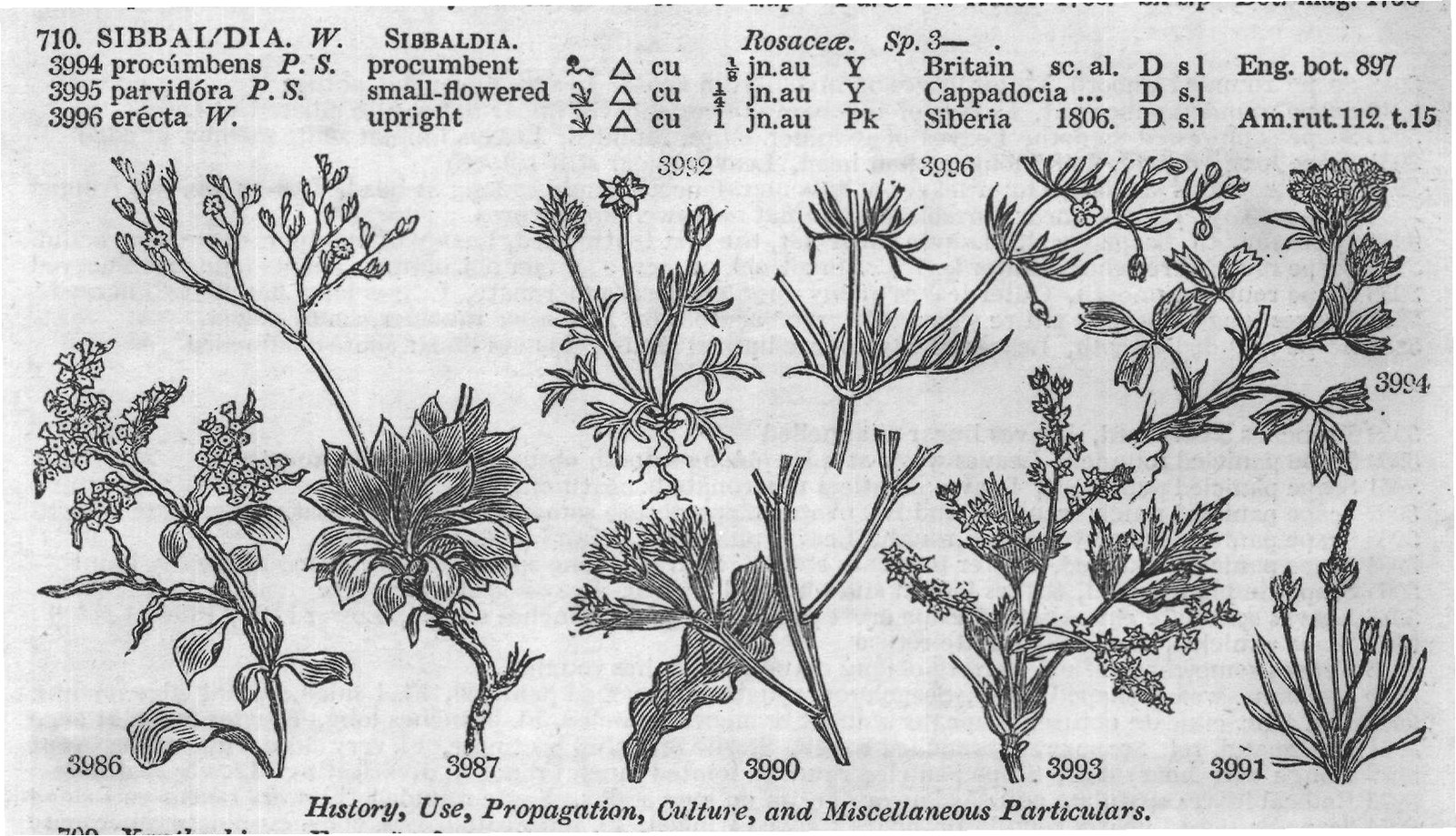
Parsley-leaved or 710. SIBBAI/DIA. W. 3994 procúmbens P. S.
SIBBALDIA. 3995 parviflóra P. S. procumbent small-flowered cu cu 3996 erécta W. upright cu 3992 Ranunculacea. Sp. 1.
CLASS V. 3 f.ap Pu.Gr N. Amer. 1766. Sk s.p Bot. mag. 1736 Rosaceæ. Sp. 3jn.au Y Britain sc. al. Dsl jn.au Y Cappadocia ... D s.l 1 jn.au Pk Siberia 1806. D s.l 3996 Eng. bot. 897 Am.rut.112. t. 15 3994 3986 3987 3990 3993 3991 History, Use, Propagation, Culture, and Miscellaneous Particulars. 709. Xanthorhiza. From ξavθoς, yellow, and ῥiζa, a root, on account of the deep yellow color of the roots. A small shrub, with much cut leaves, and branches of dull purplish brown small flowers. small shrub, with much cut leaves, and branches of dull purplish brown small flowers.. 710. Sibbaldia. So named by Linnæus, in memory of Sir Robert Sibbald, professor of physic at Edinburgh; author of Scotia Illustrata, &c. 1684. Small alpine plants, with the aspect of Alchemilla. CLASS VI. - HEXANDRIA. 6 STAMENS.
THIS class contains the most beautiful of the herbaceous plants of our gardens. With a few exceptions, it is to a considerable degree a natural assemblage, comprehending a large proportion of those favorites of gardeners, the orders Amaryllideæ, Asphodeleæ, Bromeliaceæ, Liliaceæ, and Melanthacese. The class also includes a few grasses and palms, some genera of Berberideæ, all Hypoxideæ, and many Junceæ. The Amaryllideæ, or lilies of the hot-houses, consist of a number of beautiful species, the generic distribution of which is uncertain, and difficult to determine. Much attention has been paid to the subject by Messrs. Ker, Herbert, and others; by the former, perhaps, with the most success; a great deal still remains to be done. The limits of the genera are very obscure, and their extreme characters similar. Among the Bromeliaceæ are found the delicious pine-apple, and the curious Tillandsias, some of which are called air-plants. The asparagus and the officinal squill are included in Asphodeleæ. To the same class are related the lily of the valley, the Solomon's seal, and many other curious little plants. The Phormium tenax, which produces the strong flax of New Zealand; the aloes, curious for their fantastic foliage; the fragrant tuberose; the plantains, so valuable as an important article of food in all the tropics, are all contained in this class. Hither also, are referred the valuable rice, the curious bamboo, and the rush, some of the species of which are well known for their use in economical purposes, others as the most worthless weeds of our heaths.
Hexandria Trigynia is chiefly made up of the natural order Melanthaceæ, among which the Colchicum and Trillium are found, Order 1. MONOGYNIA. * 6 Stamens. 1 Style, 1. Monocotyledons. Perianth superior, colored.
A. Perianth with the orifice surmounted by a corona or nectary. 711. Narcissus. Sepals 6, equal. Cup funnel-shaped, of a single leaf. Stamens inserted within the cup. 712. Pancratium . Flower funnel-shaped, with a long tube. Sepals 6. Cup 12-cleft, membranous. Stamens inserted on the edge of the cup. inserted on the edge of the cup. 713 Eucrosia. Flower ringent nodding. Crown formed by the dilated bases of the stamens. Stamens declinate, united into a tube, which is split on its upper side. 714. Eurycles. Flower funnel-shaped, regular. Crown fleshy, short. Stamens inserted into the edge of the cup. 715. Chlidanthus. Flower funnel-shaped, irregular. Stamens erect, included, united by their dilated bases; the short filaments 2-toothed. Anthers innate. Ovary 3-celled, many-seeded. Style filiform. Stigma 3-lobed. Capsule cartilaginous, 3-valved. Seeds membranous. 716. Calostemma. Flower funnel-shaped, with a 6-parted limb. Crown tubular, with a 12-toothed mouth, the alternate teeth anther-bearing. Ovary 1celled, 2-3-seeded. Style filiform. Stigma obtuse. Berry 1-2-seeded. 717. Chrysiphiala. Flower funnel-shaped, with a tube narrowed downwards thickened at the base, with a dilated 6-cleft limb. Crown 6-cleft. Stamens erect, upright. Stigma thickened, obsoletely trifid. ORDER VI.
PENTANDRIA POLYGYNIA. 3993 Roots very yellow, Leaves compound 3994 Leaves ternate, Leaflets smooth above hairy beneath, Flowers corymbose, Petals as long as calyx 3995 Procumbent, Leaves ternate, Leaflets 3-toothed on each side rough with hairs, Flowers clustered 3996 Leaflets linear multifid, Plant erect B. Perianth with the orifice naked. * Stigma undivided. 718. Lophiola. Flower woolly, 6-parted, bearded inside. Anthers erect. Filaments naked. Ovary nearly superior. 719. Argolasia. Flower woolly, longer than the filaments: limb 6-parted, spreading. Pericarp 3-celled. 720. Anigozanthus. Flower tubular, incurved: with a 6-parted irregular limb. Stamens inserted into the mouth, ascending. * Stigma 3-lobed. Guzmannia has Perianth inferior. 721. Musa. Spathe superior. Cor. of 2 petals: one of which is erect and 5-toothed; the other concave and honey-bearing. Berry oblong, 3-cornered, many-seeded. 722. Urania. Cal. O. Cor. 3 petals. Nect. 2-leaved: one of the leaves bifid. Caps. 3-celled, many-seeded. Seeds in two rows with an arillus.
Anthers 723. Bonapartea. Calyx 2-leaved. Petals 3 convolute. Stamens inserted in the receptacle. exserted. Style 3-cornered. Caps. 3-celled, 3-valved. Seeds numerous, terminated by a bristle. 724. Agave. Flower erect, tubular, or funnel-shaped. Filaments longer than flower, erect. Capsule triangular, many-seeded. 725. Furcrea. Flower campanulate, 6-parted. Stamens inserted in a gland, thickened downwards, compressed, subulate at end. Capsule 3-valved, 3-celled, many-seeded. 726. Bromelia. Cal. 3-fid. Petals 3. A honey-bearing scale at base of petal. Berry 3-celled. 727. Guzmannia. Cal. 3-parted, not superior, with convolute segments. Petals 3, rolled together into a tube. Anthers united in a cylinder. Caps. 3-celled, 3-valved. Seeds numerous, oblong, naked. 728. Pitcairnia. Cal. 3-leaved, half inferior. Petals 3. Stigmas 3, twisted together. Caps. 3, opening inwards. Seeds winged or terminated at each end in a long bristle. 729. Tillandsia. Cal. 3-fid, persistent, convolute. Cor. 3-fid, campanulate. Caps. 1-3-celled. Seeds comose. 730. Pontederia. Flower monosepalous, 6-cleft, 2-lipped. Stamens inserted into the tube of flower at the top. Caps. 3-celled. 731. Hæmanthus. Involucre many-leaved, many-flowered. Flower 6-parted. Berry 3-celled. 732. Galanthus. Sepals 3, concave. Cup formed of 3 small emarginate sepals. Stigma simple. 733. Leucoium. Flower campanulate, 5-parted, with the ends of the sepals thickened. Stigma simple. 734. Strumaria. Sepals 6, spreading. Style thickened below the middle, and cohering occasionally with the filaments. Stigma trifid. Capsule inferior, roundish, 3-celled. 735. Crinum. Flower funnel-form, half six-cleft, with a filiform tube, and a spreading recurved limb. Sepals subulate, channelled. Seeds fleshy. 736. Cyrtanthus. Flower incurved, tubular, clavate, 6-cleft: segments ovate, oblong. Filaments inserted into the tube, conniving at end. 737. Brunsvigia. Flower 6-parted. Capsule turbinate, 3-winged, nearly transparent, many-seeded. 738. Nerine. Sepals 6, spreading, wavy. Stamens declinate, unequal in direction or proportion. Capsule few-seeded. Seeds round like peas. 739. Amaryllis. Flower nodding, irregular, funnel-shaped, ringent. Filaments declinate, unequal in proportion or direction. Seeds flat, numerous. 740. Vallota. Flower vertical, regular. Stamens regularly spreading. Seeds numerous, flat. 741. Griffinia. Flower 6-parted, ringent. Stamens declinate, with the upper one erect, and away from the rest. Seeds few, round, fleshy. 742. Sternbergia. Flower vertical, regular, funnel-shaped, with an erect limb. Stamens slightly declinate. Anthers versatile. Seeds round like peas. 743. Zephyranthes. Flower vertical, nearly regular, funnel-shaped, with an erect limb. Stamens nearly regular. Anthers versatile. Seeds flat. 744. Habranthus. Flower campanulate, nodding Stamens declinate, unequal, inserted into a fleshy rim of the base of the tube. Stigma 3-lobed. 745. Doryanthes. Flower 6-parted. Filaments shorter than flower. Anthers erect. 746. Gethyllis. Flower 6-parted, with a filiform very long tube. Spathe obliquely truncated. Berry clavate, radical, 1-celled. 747. Polyanthes. Flower funnel-shaped, incurved. Filaments inserted into the throat. Ovary at the bottom of tube. 748. Alstroemeria. Sepals 6, campanulate or 2-lipped, the two lower half-tubular at the base. Stamens declinate or erect. Stigmas 3, linear. Caps. roundish-oval, 3-6-angular, 3-valved, or pulpy within, and not opening. 749. Conanthera. Sepals 6, reflexed. Anthers united in an acute cone. Caps. oblong, 3-celled, 3-valved. Seeds few, roundish. 750. Hypoxis. Spathe 2-valved. Flower 6-parted, superior. Caps. long, narrow at the base. Seeds roundish, naked. 751. Curculigo. Sepals 6, flat. Spathe of one valve. Style very short. Stigmas 3, diverging. Caps. 1-celled, 4-seeded, spongy, beaked. 2. Monocotyledons. Perianth inferior.
A. Perianth glumaceous, irregular. 752. Bambusa. Scales 3, covering the 5-flowered spikelets. Glume 2-valved. Style bifid. Seed 1. 753. Calamus. Sepals 6. Berry dry, 1-seeded, imbricated backwards. 754. Ehrharta. Glume 2-valved, abbreviated, 1-flowered. Paleæ 4, in pairs, the outer compressed acinaciform, transversely wrinked. HEXANDRIA.
CLASS VI.
B. Perianth not coloured, regular. Stems herbaceous. Aroideæ and Junceæ. 755. Acorus. Spadix cylindrical, covered with florets. Sepals 6, naked. Style O. Caps. 3-celled. 756. Orontium. Spadix cylindrical, covered with florets. Sepals 6, naked. Style O. Follicles 1-seeded. 757. Tupistra. Cor. 1-petalous, 6-fid, nearly equal. Anthers sessile in middle of sepals. Style 3 cornered, thick. Stigma clypeate, 3-lobed. 758. Tacca. Cal. 6-parted. Cor. 6-petalous, inserted into the calyx, bearing the anthers. Stigma stellate. Berry dry, hexangular, many-seeded. 759. Aspidistra. Cor. 1-petalous, 6-fid, equal. Anthers at bottom of tube. Style stipitate. Stigma clypeate. 760. Juncus. Sepals 6, persistent. Stigmas 3. Caps. 1-celled, 3-valved. Seeds very numerous. 761. Luzula. Sepals 6. Stigmas 3. Caps. 1-celled, 3-valved, 3-seeded. Seeds fixed to a central receptacle. C. Perianth not colored, regular. Fruit, a drupa. Stems arborescent. Palms. 762. Corypha. Cal. 3-leaved. Cor. of 3-petals. Berry 1-seeded. Seed large, round, bony. 763. Licuala. Cal. 3-parted. Cor. 3-parted. Cup truncated, band-like. Drupe 1-seeded. 764. Thrinax. Cal. 6-toothed. Cor. O. Stigma funnel-form, oblique. Berry 1-seeded. D. Perianth partly or wholly colored, regular. 765. Tradescantia. Cal. 3-leaved. Petals 3. Filaments with jointed hairs. Caps. 3-celled. 766. Dichorizandra. Cal. 3-leaved. Petals 3. Two of the stamens separate from the rest. Caps. 3-celled. 767. Agapanthus. Flower funnel-shaped, regular, six-parted. Stamens declinate. 768. Blandfordia. Flower tubular, withering, with a 6-lobed mouth. Stamens inserted on the tube. Anthers fixed to a base like an extinguisher. Ovary stalked. Stigma simple. Capsule 3-partible. Seeds in two rows, with a loose downy skin. 769. Hemerocallis. Flower campanulate, with a cylindrical tube. Stamens declinate. Stigma small, simple, villous. 770. Aloe. Flower tubular, with a 6-cleft spreading mouth, and honey at the bottom of the tube. Filaments inserted into the receptacle. Caps. 3-celled, 3-valved, many-seeded. Seeds in two rows, with a membranous edge. 771. Lilium. Sepals 6, campanulate, with a longitudinal honey-line, and generally reflexed. Valves of the capsule connected by a mesh of hairs. 772. Tulipa. Sepals 6, campanulate. Style O. 773. Fritillaria. Sepals 6, campanulate, with a honey-pore above the claws. 774. Dracena. Flower 6-parted, erect. Filaments thickest in the middle, or simple. Berry 3-celled, 1-seeded. 775. Phylloma. Flower 6-parted, tubular. Sepals imbricated. Stamens hypogynous, included. Style setaceous. Stigma simple. Berry coriaceous, many-seeded. 776. Aletris. Flower funnel-shaped, wrinkled. Stamens inserted into base of segments. Capsule 3-celled, with many seeds. 777. Tritoma. Flower 6-toothed. Stamens inserted into the receptacle, exserted, alternately longer. Capsule 3-celled, many-seeded. 778. Veltheimia. Flower tubular, 6-toothed. Stamens inserted in the tube. Caps. membranous, 3-winged, with 1-seeded cells. 779. Sanseviera. Cor. monosepalous, with a filiform tube, and a 6-parted revolute limb. Stamens inserted into the limb. Berry 1-seeded. 780. Tulbaghia. Flower funnel-shaped, with a 6-cleft limb. Crown of the throat 3-leaved; the leaves bifid as large as the segments. 781. Yucca. Flower campanulate, spreading. 782. Erythronium. Sepals 6, campanulate. sepal.
Style O. Caps. 3-6-celled, with a hole at the end.
Two little tubercles attached to the base of every other 783. Gloriosa. Sepals 6, wavy, reflexed. Style oblique, trifid at end. 784. Bulbocodium. Sepals 6, funnel-shaped, with narrow claws bearing the stamens. 785. Uvularia. Sepals 6, erect. A hollow at the base of the sepals. Filaments very short. Flowers solitary, axillary. Capsule compressed, 3-cornered. Seeds with an arillus. 786. Streptopus. Sepals 6, campanulate. Stigmas very short. Berry globose, polished, papery. Seeds naked. 787. Convallaria. Flower 6-cleft, campanulate. Berry spotted, 3-celled. 788. Smilacina. Flower 6-parted, spreading. Filaments diverging, fixed to the base of the segments. Berry globose, 3-celled. Flowers terminal, panicled, or umbelled. 789. Polygonatum. Flower 6-cleft, cylindrical. Filaments inserted into top of tube. Berry globose, 3-celled, with 2-seeded cells. Flowers axillary. 790. Ophiopogon. Flower half superior, persistent. Anthers sessile. Stigma simple. Berry 1-seeded. 791. Eucomis. Flower 6-parted, persistent, spreading. Filaments united at base into a circle. Capsule 3-celled. Seeds ovate. Scape with a leafy crown. 792. Brodica. Flower campanulate, 6-parted. Filaments inserted into the throat. Ovary stalked. Capsule 3-celled, with many-seeded cells. 793. Peliosanthes. Flower rotate, 6-parted; sepals vaulted at base. Ovary 3-celled, with 2-seeded cells. 794. Aphyllanthes. Spathe glumaceous, imbricated. Flower 6-parted, with a spreading limb. Capsule 3-celled, 3-valved, many-seeded. 795. SowerbϾa. Sepals 6. Filaments 3, each bearing two anthers, with three sterile filaments between them.. 796. Allium. Flower 6-parted, spreading. Spathe many-flowered. Umbel clustered. 797. Albuca. Sepals 6: the inner conniving; the outer spreading, generally with a green stripe at their back. Style 3-cornered. Seeds flat. 798. Xanthorrhea. Sepals 6, persistent. Filaments flat, naked. Caps. 3-cornered. Seeds two, compressed, edged. 799. Thysanotus. Flower 6-parted, spreading, persistent; with the inner segments fringed. Stamens 6-declinate. Filaments smooth. Ovary with two seeded cells. Seeds 2, one erect, one pendulous. 800. Eriospermum. Sepals 6, campanulate, persistent. Filaments dilated at base. Caps. 3-celled. Seeds enveloped in wool. 801. Gagea. Stamens adhering to base of sepals. Style clavate. Caps. 3-celled, 3-valved, covered by the remains of flower. Seeds small, numerous, round. 802. Ornithogalum. Sepals 6, erect, persistent, spreading above the middle. Filaments dilated at base, or subulate. Caps. roundish, angular, 3-celled. Seeds roundish, naked. Flowers white or green. 803. Scilla. Sepals 6, spreading, deciduous. Filaments filiform, attached to base of sepals. Flowers blue or pink. 804. Puschkinia. Flower 6-parted. Cup very short, 6-toothed, covering the throat. Stamens within the cup. 805. Massonia. Limb of flower 6-parted. Filaments attached to the neck of the tube. Capsule 3-celled, 3-winged, many-seeded.
CLASS VI.
HEXANDRIA. 806. Eremurus. Sepals 6, after flowering, rolled together. Stamens naked, rolled together inside the flower, barren, much exserted. Style after fecundation reflexed 807. Bulbine. Sepals 6, spreading. Filaments smooth. Caps. ovate. Seeds angular. Leaves flat. Flowers generally white or purple. 808. Asphodelus. Flower 6-parted, spreading. Six valves covering the ovary. 809. Anthericum. Sepals 6, spreading. Filaments bearded. Caps. ovate. Seeds angular. Leaves succulent, fistular. Flowers yellow. 810. Arthropodium. Sepals 6, spreading: the three inner wavy at the edge or fringed. Filaments bearded. Capsule nearly round. 811. Chlorophytum. Flower 6-parted, spreading, equal, persistent. Stamens 6. Filaments filiform, smooth. Ovary with many-seeded cells. Style filiform. Stigma 1. Capsule deeply 3-lobed, with compressed veiny lobes; three-celled, 3-valved. Seeds few, compressed. 812. Cæsia. Flower 6-parted, spreading, equal, deciduous. Stamens 6. Filaments beardless, narrowe at each end. Anthers inserted by an emarginate base . Ovary 3-celled, with 2-seeded cells. Style filiform. Capsule lobed, or clavate at end. Seeds ventricose 813. Narthecium. Sepals 6, spreading, persistent. Filaments filiform, hairy. Caps. prismatical. Seeds with an appendage at each end. 814. Dianella. Sepals 6, spreading. Filaments thickened at end. Berry 3-celled, many-seeded. 815. Eustrephus. Flower 6-parted, the 3 inner sepals fringed. Capsule berried, 3-celled, 3-valved, manyseeded. 816. Asparagus. Flower 6-parted erect; the 3 lower sepals reflexed at end. Berry 3-celled, many-seeded. 817. Drimia. Flower campanulate , 6-cleft, with revolute segments. Stamens inserted into the sepals. Stigma capitate. black, shining. 818. Uropetalon. Flower six-cleft, with the alternate segments shortest. Capsule membranous. Seeds 819. Hyacinthus. Flower erect, 6-cleft, with equal segments. Stamens inserted in the middle of the flower. Cells of capsule 2-seeded. 820. Zuccagnia. Sepals cylindrical: the 3 outer longest, lanceolate, setaceous, reflexed. The other characters of Hyacinthus. 821. Muscari. Flowers ovate or cylindrical, very shortly divided. The other characters of Hyacinthus. 822. Lachenalia. Sepals 6, obtuse, the 3 inner the longest. Stamens erect. Capsule 3-winged. Seeds globose. 823. Phormium. Sepals 6, the 3 inner the longest. Stamens ascending, exserted. Capsule oblong, 3-cornered. Seeds compressed. 824. Cyanella. Sepals 6: the 3 lower hanging down. Style and lowest stamen declinate. Capsule roundish, 3celled. 3. Dicotyledons. 825. Leontice. Cal. 6-leaved, deciduous. Petals 6. Six leaves inserted upon the claws of the corolla, spreading at end. 826. Caulophyllum. Cal. 6-leaved. Petals 6, opposite the calyx. Cells of anther opening at edge. 827. Diphylleia. Cal. 3-leaved, deciduous. Petals 6, opposite the calyx. Anthers opening with a membrane dividing from the base to the tip. Berry 1 -celled. Seeds 2-3, roundish. 828. Prinos. Cal. 6-cleft. Cor. monopetalous, rotate. Berry 6-seeded. 829. Berberis. Cal. 5-leaved. Petals 6, with glands upon their claws. Style O. Stigma umbilicate. Berry 1. celled, 2-4-seeded. 830. Nandina. Cal. many-leaved, imbricated. Petals 6. Berry juiceless, 2-seeded. 831. Cossignia. Cal. 5-parted. Petals 4 or 5.
Flowers in panicled racemes.
Capsule 3-celled, opening at end with about 3-seeded cells. 832. Hillia. Cal. double, the lower 6-leaved, the upper superior, 2 or 4-leaved. Cor. 6-cleft, with a very long cylindrical tude. Anthers sessile, in the throat of the corolla. Seeds comose. 833. Richardia. Cal. 6-parted, persistent, superior. Cor. funnel-form, 6-cleft. Stigmas 3, capitate. Fruit 3-partible. Seeds 5, truncate. partible. Seeds 5, truncate. 834. Canarina. Cal. 6-leaved. Cor. 6-c eft, campanulate. Stigmas 6. Capsule inferior, 6-celled, manyseeded. 835. Frankenia. Cal. 5-cleft, funnel-shaped. Petals 5. Stigma 2-3-parted. Caps. 1-celled, 3-valved. 836. Peplis. Cal. campanulate, with a 12-cleft mouth. Petals 6 or O, inserted in the calyx. Caps. 2-celled, many -seeded.
Order 2. DIGYNIA. 6 Stamens. 2 Styles. 837. Oryza. Glumes 2, 1-flowered. Paleæ 2, nearly equal, adhering to the seed. 838. Atraphaxis Cal. 2-leaved. Petals 2, sinuated. Stigmas capitate. Seed 1. Order 3. TRIGYNIA. 6 Stamens. 3 Styles. 1. Monocotyledons. 839. Flagellaria. Sepals 5. Berry 3-1-seeded. 840. Scheuchzeria. Sepals 6. Anthers linear. Stigmas sessile, lateral. Capsules inflated, distinct, 2-seeded. 841. Triglochin. Sepals 6, the 3 outer in a different row from the inner. Style O. Capsule opening by the base . 842. Lichtensteinia. Sepals 6, withering, persistent, wavy, spreading. Stamens hypogynous, shorter than the sepals. Capsule many-seeded, half 3-valved. 843. Myrsiphyllum. Flower 6-parted, revolute. Styles 3, contiguous, straight. Ovary stalked. Berry 3-celled, with 2-seeded cells. celled, with 2-seeded cells. 844. Tofieldia. Bracteæ 3. Sepals 6. Capsules 3, superior, united at the base, many-seeded. 845. Melanthium. Polygamous. Flower rotate, 6-parted, with 2 glands at the base of each segment. Filaments from the elongated claws of flower. Capsule 3-fid, 3-celled. Seeds membranous. 846. Medeola. Flower 6-parted, revolute. Berry 3-seeded. 847. Xerophyllum. Flower 6-parted. Stigmas 3, oblong, sessile. 848. Wurmbea. Flower 6-parted, with an hexangular tube. Filaments inserted in the throat. Styles conniving. Caps. oblong, 3-cornered. Seeds round. Caps. 3-celled, with 2-seeded cells. 849. Androcymbium. Sepals 6, unguiculate, cucullate. Stamens inserted in the middle of sepals. Ovaries 3. Styles filiform . 850. Trillium. Cal. spreading, 3-leaved. Petals 3. Berry 3-celled. 851. Colchicum. A spatha. Flower 6-parted, with a tube proceeding directly from the root. Anthers incumbent. Caps. 3, connected, inflated. 852. Helonias. Sepals 6. Styles 3, distinct. Capsule 3-celled, 3-horned, few-seeded. 853. Nolinea. Flower 6-parted, spreading. Style very short. Capsule 3-cornered, membranous, 3-celled, opening by bipartible dissepiments. Seeds solitary, convex on one side. by bipartible dissepiments. Seeds solitary, convex on one side. 854. Aponogeton. An amentum composed of scales. Neither calyx nor corolla. Capsules 4, 3-seeded. Stamens varying from 6 to 7 and 12. varying from 6 to 7 and 12.
CLASS VI. 855. Sabal. Spathes partial. Filaments free, thickened at base. Berry 1-3-seeded. Seed bony. Embryo lateral. A palm. 2. Dicotyledons.
Petals 3, conniving. Seed 1, 3-cornered. 856. Rumex. Calyx 3-leaved. 857. Oxyria. Calyx 2-leaved. Petals 2. Styles 2.
Order 4. POLYGYNIA. ه 6 Stamens. Many Styles. 858. Wendlandia. Sepals 6. Petals 6, succulent. Style reclinate. Caps. 6, 1-celled, many-seeded. 859. Damasonium. Spathe 1-leaved, half-bifid, winged. Flowers superior, 6-parted, with the 3 inner segments petaloid. Stamens 6-12. Ovary with 6-8-parietal prominent placentas. Style short. Stigmas 6-12. 860. Actinocarpus. Flower 6-parted : the 3 outer sepals falling off late, the inner petaloid. Stamens 6. : the 3 outer sepals falling off late, the inner petaloid. Stamens 6.
Ovaries 6-8, connate at base, 2-seeded. Capsules connate at base, stellate above. 861. Alisma. Flower 6-parted: the 3 outer sepals falling off late, like a calyx; the 3 inner petaloid. Stamens 6. Ovaries indefinite in number, 1-seeded. Capsules distinct, not opening. 711. NARCISSUS. W.
NARCISSUS.
Poet's 3998 recúrvus Haw. 3997 poéticus Sal. 3999 patelláris Sal.
MONOGYNIA.
Amaryllideæ. drooping-leav'dor 1 my W 4000 angustifolius H. K. narrow-leaved or W Sp. 55-59. or 1 my W S. Europe co ...
Park. par. 76 spreading-flow.or 4001 biflórus W. two-flowered or 4002 tenúior H. K. slender or 1 my 1 ap.my W 1 ap.my W 1 my S. Europe England co ...
O co Eng. bot. 275 S. Europe 1570. O co Britain mea. O co Bot. mag. 193 Eng. bot. 276 L.Y 1789. co ......
Bot. mag. 379 4003 crenulátus Haw.
Bazelman-min.or 1 mr.ap W Spain O co ... 4004 Trewiánus B. M.
Bazelman-maj.or 1 mr.ap W.
Spain ... r.m Bot. mag. 940 4005 floribúndus Sal.
Grand-Monarq. or 1 mr.ap W.Y Spain r.m ... 4006 fistulósus Haw. hollow-stalked or 2 ap W.Y r.m ...... ... 4007 cerínus Haw. waxen-cupped or 4008 Tazétta W. 4009 Macleaii Lindl.
Polyanthus or 1 ap W 1 mr.ap W r.m Spain 1759. s.l Bot. mag. 925 Mac Leay's or ap.my W Mediterr. 1815. s.l 4010 orientális L. oriental or 1 mr.ap W Levant co ...
Bot. mag, 948 4011 papyráceus B. M. paper or 1 mr.ap W O co ...
Bot. mag. 947 4012 italicus B. M.
Italian or 1 mr.ap P.Y S. Europe O co ...
Bot. mag. 1188 4013 tereticaúlis L. T. round-stalked or 1 mr.ap P.Y Spain O co ... 4014 compréssus L. T. flat-stalked Aor 1 mr.ap L.Y Spain O co 4015 bífrons B. M.
Jonquil-scent.or 1 mr.ap Y S. Europe co Bot. mag. 1186 4016 primulínus Haw.
Cowslip-cupped or 1 mr.ap Y O co Bot, mag. 1299 4017 Jonquilla W.
Jonquil or ap.my Y Spain 1596. O r.m Bot. mag. 15 ẞ flore-pléno double or 1 ap.my Y Spain 1596. Or.m 4018 grácilis Lindl. slender or 1 ap.my Y O co Bot. reg. 816 .. ... 4019 viridiflórus B. M. green-flowered or au.o G Barbary 1629. O r.m Bot. mag. 1687 4020 serotínus W. late-flowered or au.o P.Y Barbary 1629.
Or.m Clu. hist. t. 252 4021 calathínus L. great Jonquilor 4022 odórus L. sweet-scented or 1 ap.my Y 1 ap.my Y S. Europe 1629.
O r.m Bot. mag. 78 S. Europe 1629.
O s.1 Bot. mag. 934 4023 nútans H. K. nodding or 1 mr.my Y S. Europe 1789.
O s.1 Bot. mag. 945 4024 infundibularis Sal. funnel-flowered or mr.my Y ...
O s.l Park. par. 92 4025 pulchéllus B. M. neat or mr.my Y Spain s.l Bot. mag. 1262 ... 4026 triándrus B. M.
Rush-leaved or ap.my W Portugal 1629. O s.l Bot. mag. 48 4027 cápax Sal. capacious or ap.my P.Y s.l Red. lil. 177? ... 4028 montánus B. Reg. mountain or ap.my W Portugal O s.1 Bot. reg. 123 4029 galánthifólius Haw.
Snowdrop-leav.or my W ..... ...
O s.l Park. par. 73 4030 álbicans Haw. whitish or mr.ap P.Y ...... 1789. O s.l Park. par. 106 4031 Bulbocódium W.
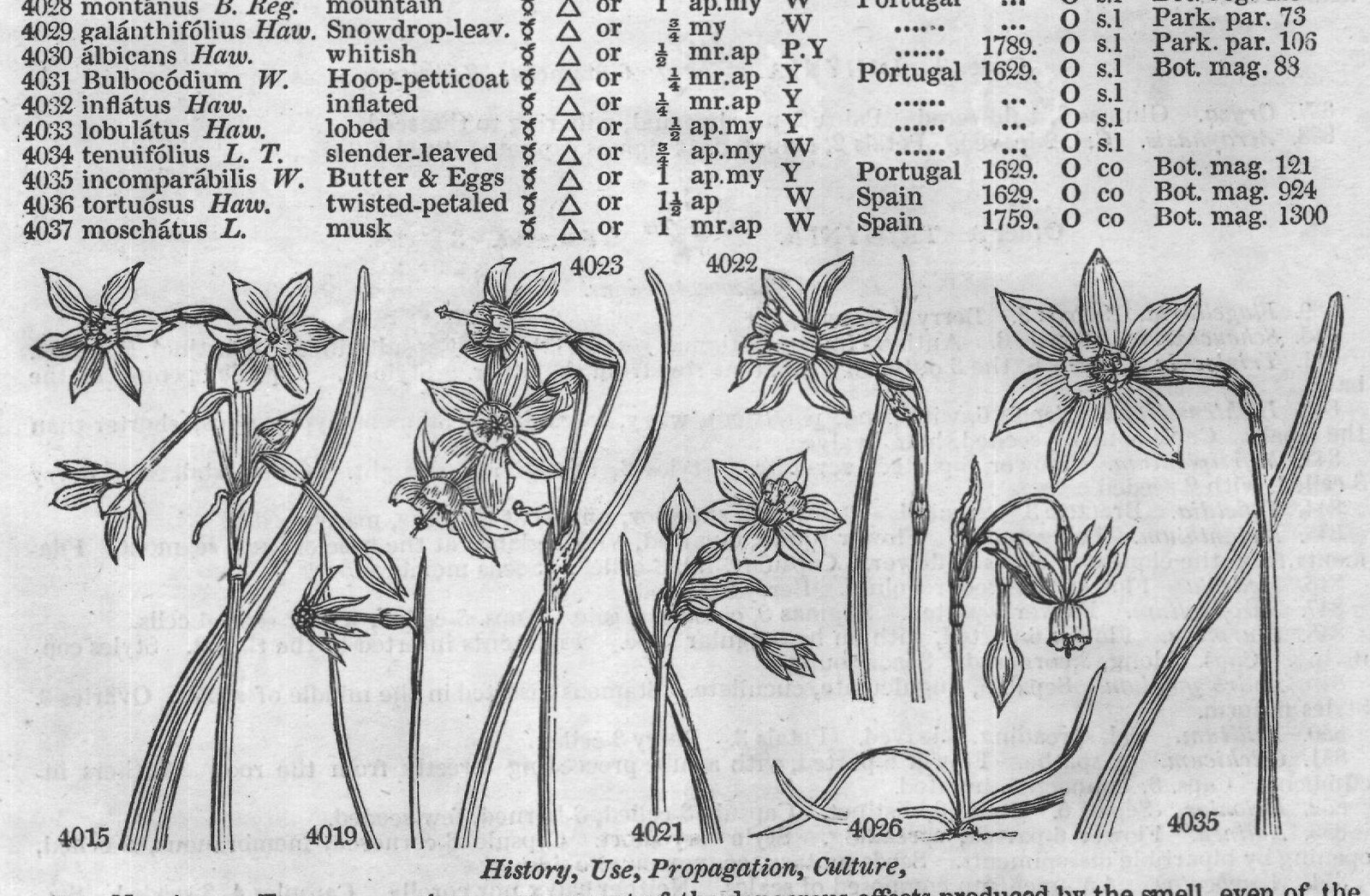
Hoop-petticoat or mr.ap Y Portugal 1629. O s.1 Bot. mag. 83 4032 inflátus Haw. inflated or mr.ap Y O s.1 ...... 4033 lobulátus Haw. lobed or ap.my Y ... 4034 tenuifólius L. T. 4035 incomparábilis W. 4036 tortuósus Haw. 4037 moschátus L. slender-leaved or ap.my W O s.l Os.l Butter & Eggs twisted-petaled musk or ap.my Y or 1½ ap W Spain Portugal 1629. co 1629. O co or 1 mr.ap W Spain 1759. O co Bot. mag. 121 Bot. mag. 924 Bot. mag. 1300 4023 4022 History, Use, Propagation, Culture, 711. Narcissus. From vaęzn, stupor, on account of the dangerous effects produced by the smell, even of the least perfumed kinds, upon the nerves. For this reason Narcissus was consecrated to the Furies, who by means of it were accustomed to stupify those whom they wished to punish. Jonquilla, a name applied to one HEXANDRIA MONOGYNIA.
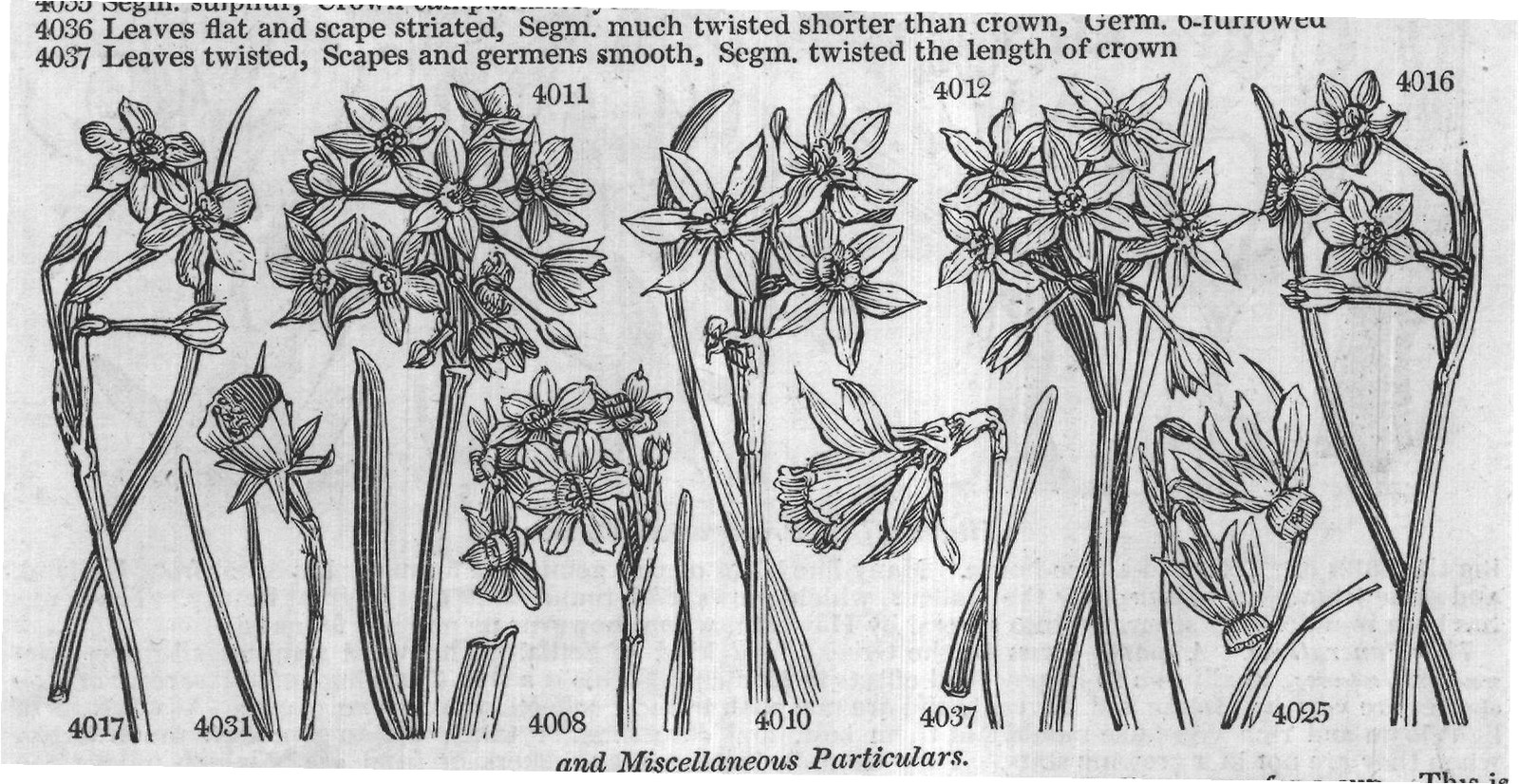
ORDER I. 4001 4000 4036 4028 4018 MONOGYNIA. 3997 Segm. refl. imbr. at base, Cup expanded flat, Three anthers shorter than the tube, Leaves erect narrow 3998 Lvs. an inch broad glauc. at end rec. Seg. imbr. Cup plait. with scarlet rim, Stig. as long as inner stamens 3999 Lvs. erect glauc. Seg. imbric. with deflexed edges, Cup yel. minutely plaited, Stig. as long as inner stamens 4000 Seg. horizontal obo. not imbric. Cup saucer-shaped with very red edge, Lower anth. half included in tube 4001 Scape kneed before flowering usually 2-3-flowered, Cup all yellow 4002 Very slender, Spathe 1-2-fl. Seg. white, Cup yellow cup-shaped 3 or 4 times as long as segm. 4003 About 3-flowered, Seg reflexed white, Cup spreading plaited crenulate yellow 4004 Like N. Tazetta, differing in the 3-lobate cup, and in the edges of the upper leaves not being turned up 4005 Flowers about 16, Seg. round-oval reflexed incurved white, Cup large straight yellow entire 4006 Segm. white almost twice as long as the straight inflated nearly entire yellow cup 4007 2-3-fl. Cup very large thick truncate entire waxen twice as short as white segm. 4008 Spathe many-flowered, Cup camp. truncate shorter than petals, Leaves flat 4009 Spathe 1-2-fi. Scape compr. 2-edged, Sepals spread. imbricated a little longer than truncated entire cup 4010 About 10-fl. Seg. white round ov. thrice as long as pale yel. spread. irreg. cut cup, Scape striat. rounded 4011 Few-flowered, Seg. stellate as long as tube, Cup cupulate crenate, Style within the crown 4012 Many-flowered, Cor. bent back, Segm. stellate, Cup spreading cupulate slightly trifid 4013 About 6-fl. Seg. round-ovate imbr. white, Cup citron spreading entire or lobed, Scape rounded below 4014 Many-fi. Pedunc. nearly erect, Seg. imbr. 3 times as long as the erect eroded cup, Lvs. remarkably broad times as long as the erect eroded cup, Lvs. remarkably broad 4015 Scape obtusely compressed smooth, Segm. very yellow ovate imbr. 3-4-times as long as cup 4016 Like the last, but the cup is more entire and the leaves broader 4017 Spathe 1-3-flowered, Seg. reflexed spatulate, Cup much shorter than seg. saucer-shaped spreading crenate 4018 12-18 inches high, Lvs. linear subulate chann. Scape rounded 1-2-fl. Ovary inflated, Fl. sulphur-colored 4019 Leafless at flowering, Flowers green with acute segm. 4020 Spathe 1-flowered, Cup 6-parted very short, Leaves subulate 4021 About 3-flow. Cup obsoletely curled outside obtusely angular not twice as short as seg. Scape 1½ ft. high 4022 Segm. of starry cor. distinct at base, Cup even distinctly 6-lobed 4023 About 2-fl. Seg. refl. pale yellow, twice as long as cup which is deeper col. trun. cylind. Style exserted 4024 A slight variety of N. incomparabilis 4025 1-7-fl. Leaves erect, Segm. reflexed lanceolate longer than cup which is cyathiform 6-fid repand 4026 All white, Cup twice as short as segm. which are reflexed 4027 A very obscure plant of which no description is anywhere given 4028 Cor. pendulous white with straight half-expanded segm. Cup cyathiform with a crenulate mouth 4029 Segm. twisted stellate, Cup cyathiform much plaited twice as short as segm. 4030 Sulphur-colored or nearly white, Cup turgid entire as long as segm. Style protruded, Leaves obtuse 4031 Flower yellow, Crown turgid truncate entire, Style included, Leaves erect before flowering 4032 Fl. yel. Crown inflated at the end contracted entire, Style exserted, Lvs. always spreading on the ground 4033 Crown undulate lobed at end, Style included 4034 Crown deeply 6-lobed, Style very long, Leaves shining erect before flowering 4035 Segm. sulphur, Crown campanulate yellow at the end spreading 6-lobed, Lobes inbricated 4036 Leaves flat and scape striated, Segm. much twisted shorter than crown, Germ. 6-furrowed 4037 Leaves twisted, Scapes and germens smooth, Segm. twisted the length of crown 4011 4012 4016 and Miscellaneous Particulars. of the species, is a diminution of juncus, a rush; as Tazzetta is of tazza, the Italian name for a cup. This is a popular flower of great beauty, some species very fragrant, and all of them of the easiest culture. They also force well, either in pots of earth or on glasses of water. Their forcing may be greatly accelerated by retard- R HEXANDRIA MONOGYNIA.
CLASS VI. 4038 serrátus Haw. serrated or 4039 spúrius Haw. spurious Aor 1 ap mr.ap P.Y S. Europe England 4040 Pseudo-NarcissusL. Daffodi. 4041 tubiflórus Sal. or Y 1 mr.ap P.Y England woods. O co Eng. bot. 17 tube-flowered or 4042 bícolor B. M. two-colored or 4043 Sabíni Lindl. 1 mr.ap W.Y 1 ap.my W.Y Spain Sabine's or 1 ap.my Y ...... ... 4044 niveus W.en. snowy or 1 my W S. Europe co 1629. O co Bot. mag. 1187 Bot. reg. 762 ... 4045 obvalláris Sal.
Sibthorp's or 1 mr.ap Y Spain ...
O co B. m.1301. f. inf. 4046 májor B. M. large Aor 1 mr.ap Y Spain 1629. co Bot. mag. 51 4047 propinquus Sal. allied Aor 1 mr.ap Y Spain 1629. O co B. m. 1301. f. su. 4048 nóbilis Haw. noble or 1 mr.ap Y co ...... ... 4049 Ajax Sal. great or 1 mr.ap Y ......
O co ... 4050 púmilus Sal. low or mr.ap Y Spain co ...
Pass. hort. 8 4051 mínor W. small or mr.ap Y Spain 1629. O s.l Bot. mag. 6 712. PANCRA'TIUM. W. PANCRATIUM.
Amaryllideæ.
Sp. 24. 4052 zeylánicum W. one-flowered 4053 verecúndum K. R. Narcissus-leav. 4054 marítimum L. sea 4055 caroliniánum K. R. Carolina 4056 canariénse K. R.
Canary 4057 illýricum L. you you you y you or 1 jn.jl W or 1 jn.au W Ceylon 1752. Sk r.m Bot. reg. 479 E. Indies 1776. Sk r.m Bot. reg. 413 or 2 my.jl W S. Europe 1597. Sk s.p Bot. reg. 161 or 2 jn.jl W Carolina 1759.
Sk r.m Cat. car. 3. t. 5 or 1½ jn.jl W Canaries 1815.
Sk r.m Bot. reg. 174 4058 Amáncaes K. R.
Illyrian Narcissus-flow. or 1 my.jn W S. Europe 1615.
Sk s.p Bot. mag. 718 or 1 jn.jl Y Peru 1804.
Sk r.m Bot. reg. 600 4059 calathínum K. R. cup-flowered or 2 jn.jl W Brazils ...
Sk r.m Bot. reg. 215 4060 nútans K. R. nodding or 2 jn.jl W Brazils ... 4061 undulátum K. R. wave-leaved or 1 jn.jl W S. Amer. ...
Sk r.m Bot. mag. 1561 Sk r.m 4062 littorále L. fan-leaved or 2 my.au W S. Amer. 1758. Sk r.m Bot. mag. 1879 4063 Dryándri K. R. tall or 2 my.au W ...... ...
Sk r.m Bot. mag. 825 4064 angústum K. R. narrow-leaved or 1 my.au W ...... ...
Sk r.m Bot. reg. 221 4065 rotátum K. R. large-crowned or 1 jl.s W Carolina 1803. 4066 mexicánum K. R.
Sk r.m Bot. mag. 1082 Mexican or 1 au W Mexico 1732.
Sk r.m Di. el. t. 222.f.289 4067 guianénse Ker.
Guiana or 2n W Guiana 1815.
Sk r.m Bot. reg. 265 4068 pátens Red. spreading or 2 jlau W W. Indies 1822.
Sk r.m Bot. cab. 558 4069 pediále Lodd. long-flowered or 3 au W Brazil 1820.
Sk r.m Bot. cab. 809 4070 frágrans Red. 4071 biflórum Roxb. 4072 caribæ'um L. 4073 amæ'num W. fragrant or 1 my.au W W. Indies 1819. two-flowered or 1 my.au W Caribean or 1½ my.au W E. Indies 1820.
W. Indies 1730.
Sk r.m Bot. cab. 834 Sk r.m handsome or 1 my.au W 4074 ovátum K. R. oval-leaved or 1 my.au W Guiana 1790.
W. Indies ... 4075 speciósum L. large or 1 my.au W 713. EUCRO'SIA. B. Reg. EUCROSIA. 4076 bícolor B. Reg. two-colored or W. Indies 1759.
Amaryllideæ. Sp. 1. 1 ap.my O Cape Hor. 1816. O lt.l Bot. reg. 207 Skr.m Bot. mag. 826 Sk r.m Bot. mag. 1467 Sk r.m Bot. reg. 43 Sk r.m Bot. mag. 1453 714. EU'RYCLES. Salisb. EURYCLES.
Amaryllideæ. Sp. 2-3. 4077 amboinénsis Sal. heart-leaved or 2 my.jn W Amboyna 1759. O lt.l 4078 australásica Cunningham's or 1 my W N. Holl. 1821. O lt.l Bot. reg. 715 Bot. mag. 1419 Pancratium australasicum Ker. 715. CALOSTEMMA. R. Br. CALOSTEMMA.
Amaryllideæ. Sp. 2-3. 4079 lúteum Ker. yellow or 1 n Y N. Holl. 1819. O s.l Bot. reg. 421 4080 purpúreum Ker. purple or 1 n Pu N. Holl. 1819. O s.l Bot. reg. 422 716. CHLIDAN'THUS. Herb. CHLIDANTHUS.
Amaryllideæ. Sp. 1. 4081 frágrans Lindl. fragrant or 1 my.jn Y B. Ayres 1820. O lt.l Lindl. coll. 34 717. CHRYSIPHIALA. Ker. CHRYSIPHIALA. 4082 fláva Ker.
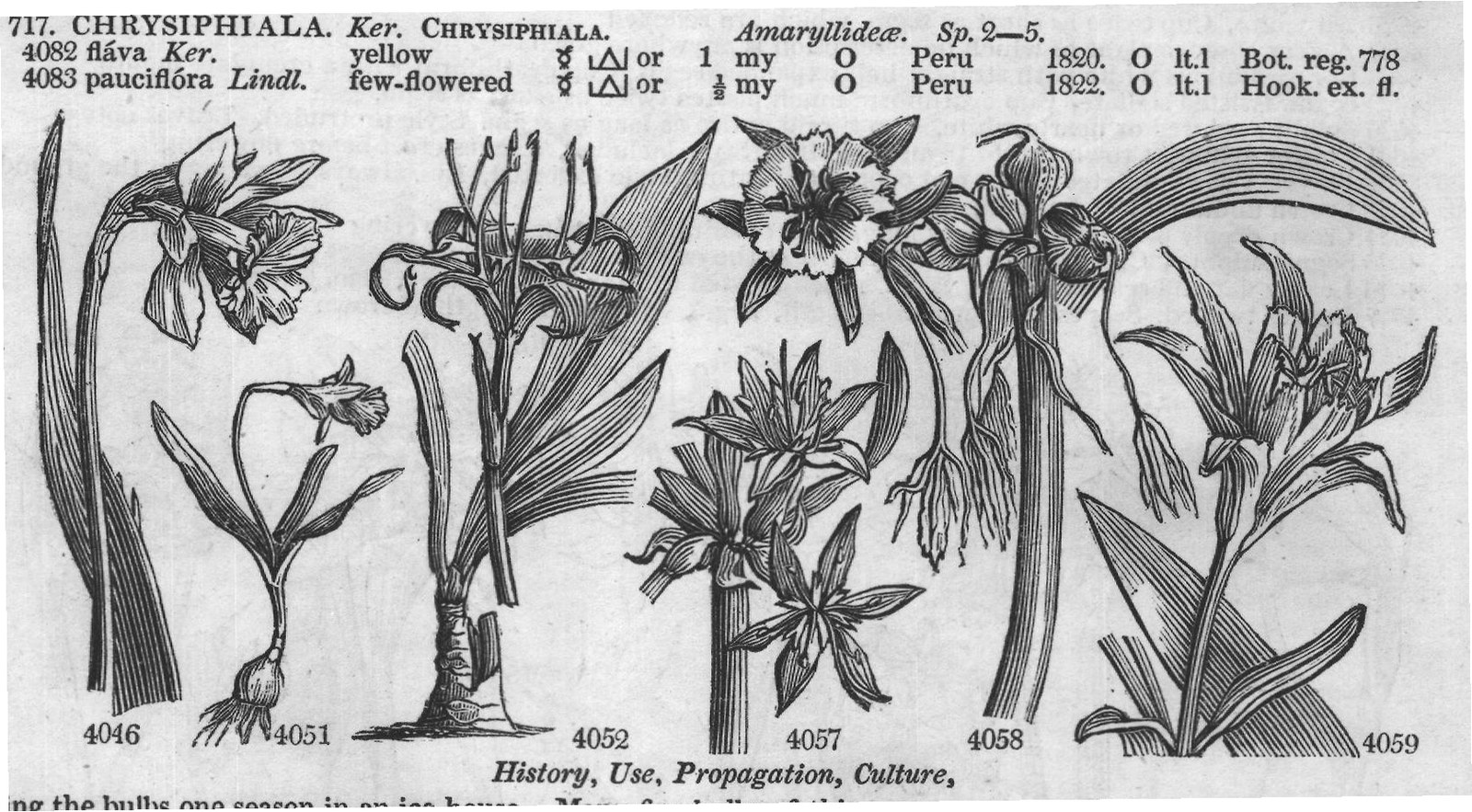
Amaryllideæ. Sp. 2-5. yellow 1 my 4083 pauciflóra Lindl. few-flowered or my Peru 1820. O lt.l Peru 1822. O lt.l Bot. reg. 778 Hook. ex. fl. 4046 4051 4052 4057 History, Use, Propagation, Culture, 4058 4059 ing the bulbs one season in an ice-house. Many fine bulbs of this genus, are annually imported from Holland, and some from Naples, especially the italicus, which grows wild round that city in great beauty. The genus has been injudiciously separated into several by Haworth, whom however no one has followed. 712. Pancratium. A name given by the Greeks to a kind of Scilla. The word signifies all-force, from πay and xgatos, in allusion to its powerful effects in medicine. This is a free-flowering genus several of the and κρaτoς, in allusion to its powerful effects in medicine. This is a free-flowering genus; several of the species are very handsome and fragrant, and are met with in most collections of stove plants. A mixture of light loam and rich vegetable mould suit them best, and care must be taken not to give them much water, when they are not in a growing state. They are to be increased by suckers, or from seeds, which often ripen freely. If any plant happen to lose its heart, if it be kept dry, it will throw out abundance of suckers, which is the readiest way of propagating it. (Bot. Cult. 89.) P. maritimum, illyricum, and carolinianum, are nardy; the other species are stove-plants. P. amancaes has yellow flowers, and is not less beautiful than rare.
ORDER I.
HEXANDRIA MONOGYNIA. 4038 Scape striated compressed, Segm. flat: the outer ovate acuminate not so long as the serrated crown 4039 Scape smooth compressed, Crown very yellow deeply 6-cleft spreading, Segm. erect lanceolate 4040 Scape two-edged straight striated, Segm. sulphur, Crown yellow with serrate crenate orifice 4041 Segm. incurved horizontal a little twisted, Crown funnel-shaped ventricose at base very short 4042 Like the last, but the crown is yellow, the segm. of flower yellowish 4043 Spathe 1-fl. Scape 2-edged, Cup columnar plaited shorter than the sepals, Tube about as long as sepals 4044 Scape 2-edge nearly trian. Spat. 1-2-fl. Seg. of cor. lanc. acute, Crown plaited crenate thrice as long as limb 4045 Segm. half as long as tube ovate, Crown funnel-form 6-cleft plaited upwards 4046 Leaves twisted very glaucous, Crown campanulate very large very open at orifice Segme 4047 Segm. erect twisted incurved spreading, Crown as long as segm. deeply and irregularly cut 4048 Scape deeply striated, Seg. much spread. twisted ellipt. shorter than crown which has a very open orifice 4049 Scape deeply striated, Mouth of crown 6-cleft expanded deeply and irregularly crenate 4050 Pet. narrow obcuneate not imbricating at base, Crown 6-cleft at mouth spreading minutely rugose 4051 Spathe 1-flowered, Crown curled waved lobed, Scape 6 inches high 4052 One-flowered, Leaves lig. lanc. Segments of limb longer than tube, Stamens incurved conniving 4053 Spathe 2-4-fi. Lvs. lin. acute, Limb of cor. shorter than tube, Altern. div. of crown deeper, Stam. incurved 4054 Many-fi. Lvs. sheath. downw. very glauc. with an obt. point, Cr. much unit, to turb.limb, Anth. bent inw. 4055 Many-flowered, Leaves neither glaucous? nor sheathing downwards, Anthers incumbent 4056 Many-fl. Lvs. strap-shap. somew. glauc. obt. Tube twice as short as limb, Fil. not longer than teeth of cr. 4057 Many-fl. Lvs. strap-shap. coœs. Scape 2-edged, Pet. lanc. conv. longer than tube, Cr. short with very deep div. 4058 Many-fl. Leaves bright-green, Tube as long as stellate nodding limb, Stamens short abruptly bent inwards 4059 1 or many-fl. Spat. herb. Limb erect turb. a little shorter than blunt. 3-cor. tube, Cro. not much shorter than 4060 Few-flowered, Leaves obt. Spathe dry, Cor. nodding, Anthers longer than filaments [limb 4061 Lvs. stalked ellip. shortly pointed, Scape compressed, Petals linear wavy, Racemes of crown 1-toothed 4062 Many-flowered, Leaves many lorate narrowed each way, Tube rounded twice as long as limb 4063 Leaves lanc. lorate, Petals little shorter than tube, 5 times as long as crown 4064 Many-fi. Lvs. lorate with long points shin. Petals spread. longer than tube 3 times as short as nar. crown 4065 Two or many-flowered, Leaves linear-lorate obtuse many, Crown turbinate rotate longer than filaments 4066 Two-flowered, Lvs. few linear-lanceolate with long points, Crown rotate turbinate longer than filaments 4067 Many-flowered, Leaves oval-oblong stalked, Spathe 4-valved, Cup narrow 4 times as short as the limb 4068 Lvs. broad-lin. Flowers many sessile with linear straightish segments longer than tube, Crown obconical 4069 Leaves lanceolate dark-green, Flowers a foot long, Stamens short 4070 A slight variety of P. amænum, No. 4073 4071 One or 3-fl. Leaves linear cuneate, Tube as long as lin. petals, Seg. of crown eroded, Fil. length of crown 4072 Many-fl. Lvs. many lin. lanc. Tube twice as short as limb, Cr. twice as short as stam. with 1-tooth. recesses 4073 Lvs. many oval-lanc. 3 or 4 times as broad as stalk, Umbel sessile spreading, Tube shorter than limb 4074 Compactly many-fl. Lvs. oval stri. nar. each way, Tube round. nearly as long as limb, Teeth of crown entire 4075 Lvs. many lanc. elliptical with a point three times as broad as their stalk, Tube twice as short as limb 4076 The only species 4077 Leaves stalked cordate rounded with concentric distant nerves 4078 Like the last, but is smaller with a 6-parted crown 4079 Flowers yellow 4080 Flowers purple 4081 A small plant with bright yellow flowers appearing before the leaves 4082 Leaves linear ligulate, Flowers 6-7-cylindrical, with oblong obtuse segments 4083 Leaves oblong lanceolate stalked, Flowers 2 campanulate funnel-shaped 4064 4072 4076 4080 4074 and Miscellaneous Particulars. 4078 4082 4081 713. Eucrosia. From εu, well, and κρoσσoς, a fringe, in allusion, we presume, to the beautiful fringe to the flower, formed by the cup of united stamens. A pretty half-hardy bulbous plant, extremely rare. 714. Eurycles. From εuρuς, wide, and κλaσμa, a portion of a thing, in allusion to the broad divisions of the crown. A genus formerly included in Pancratium, from which it is distinguished not only by its flowers, but by its broad leaves, which are like those of the Hemerocallis. 715. Calostemma. From κaλoς, beautiful, and 5εμμa, a crown, in allusion to the beauty of the colored corona of the flower. Very pretty New Holland bulbs, requiring the cultivation of other greenhouse bulbs. 716. Chlidanthus. From χλiδεῖoς, delicate, and avθoς, a flower; on account of the deolicate color and tex ture of the beautiful yellow flowers. The plant requires a stove, and produces the scape before the leaves. 717. Chrysiphiala. So named by Mr. Ker, in allusion to the golden cup-like flowers; ; χρuσoς, gold, and φiaλη, a goblet. Bulbous plants from the same country and with the same habits as the last. R2 or 1½ 4086 flávida R. Br. russet-green-fl.
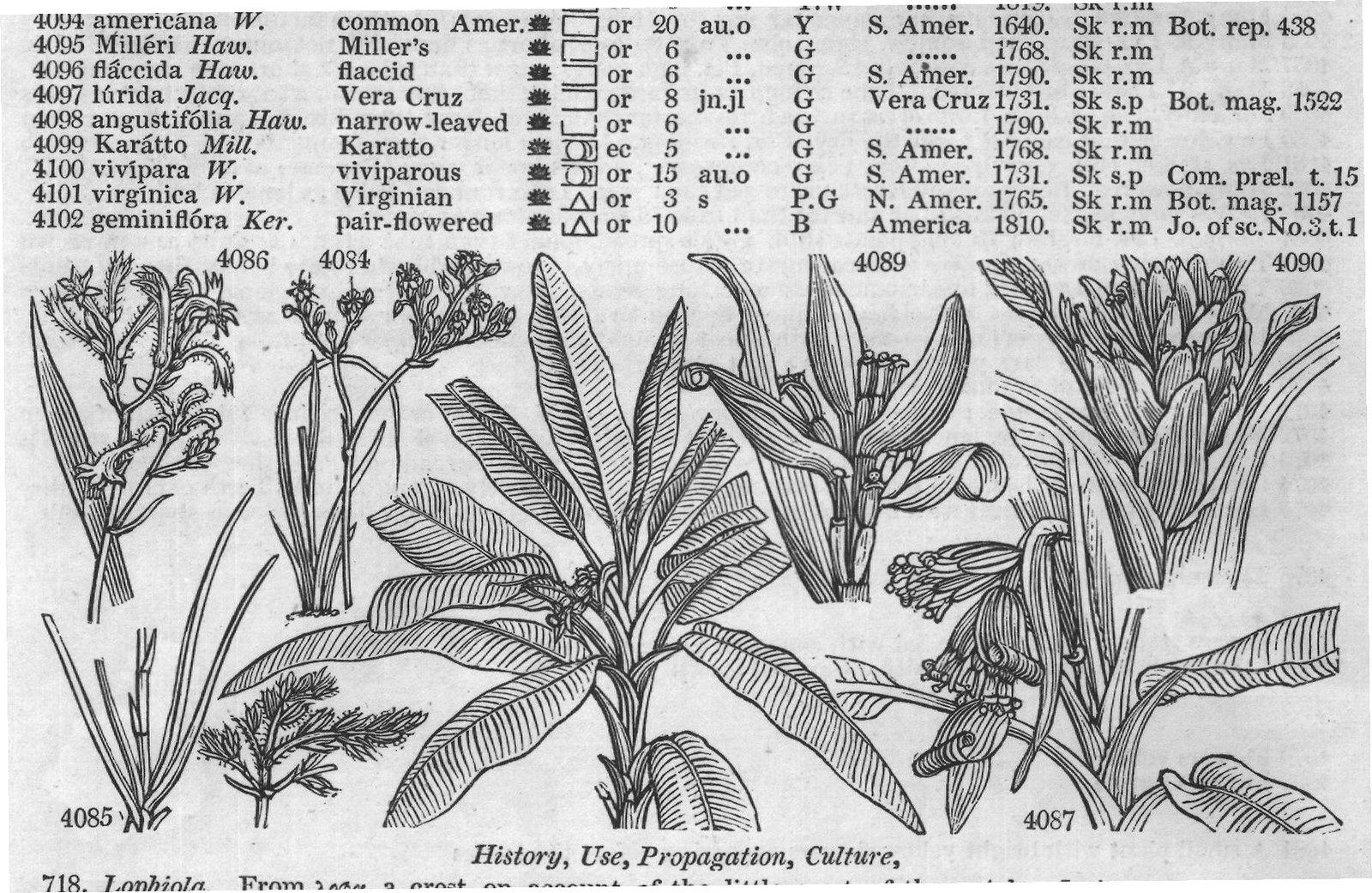
HEXANDRIA MONOGYNIA. golden-flower.or 718. LOPHIOLA. B. M. LOPHIOLA. 4084 aúrea B. M. 719. ARGOLA'SIA. Juss. ARGOLASIA. 4085 plumósa W. woolly 720. ANIGOZAN'THOS. R. Br. ANIGOZANTHOS.
Hæmodoraceæ. Sp. 1.
CLASS VI. 1½ my.jl Y N. Amer. 1811. D p.l Bot. mag. 1596 Hæmodoracea. Sp. 1.
W C. G. H. 1787. D s.l.p Hæmodoraceæ. Sp. 1-2.
N. Holl. 1803. R s.p Bot. mag. 1151 my.s 721. MU'SA. W.
PLANTAIN-TREE.
Musaceæ. Sp. 4-5. 4087 paradisíaca W. common 4088 sapiéntum W.
Banana-tree 오오 clt 20 o.d Pk India 1690.
Sk s.p Tr. eh. 3. t. 18. 20 clt 20 mr.o Pk W. Indies 1729.
Sk s.p Tr. eh.4. t. 21. 23 4089 rosácea W. rose-colored 4090 coccínea W. scarlet-flowered 722. URA'NIA. W.
URANIA. or 20 f.my Pu or 20 mr.d S Musaceæ.
Mauritius 1805.
Sk s.p Bot. reg. 706 China 1792.
Sk s.p Bot. mag. 1559 4091 speciósa W.
Plantain-leaved or 20 R ... 723. BUONAPAR'TEA. F. P. BUONAPARTEA. 4092 júncea Fl. p.
Rush-leaved or 1½ B Peru 724. AGA'VE. H. K.
AGAVE. 4093 yuccæfólia Haw. 4094 americána W.
Yucca-leaved or 6 ... common Amer. ☐ or 20 au.o Y.w Y ...... 4095 Milléri Haw.
Miller's or 6 G ... .. 4096 fláccida Haw. flaccid or 6 G ... 4097 lúrida Jacq. 4098 angustifolia Haw. 4099 Karátto Mill. 4100 vivípara W. 4101 virgínica W. 4102 geminiflóra Ker.
Vera Cruz or 8 jn.jl G narrow-leaved or 6 ...
G ......
Karatto ec 5 ...
G Sp. 1.
Madagasc.
Bromeliacea. Sp. 1-2. ...
Bromeliaceæ. Sp. 10.
S. Amer. 1640. Sk r.m Bot. rep. 438 1768. Sk r.m S. Amer. 1790. Sk r.m Vera Cruz 1731. 1790.
S. Amer. 1768. ...
Sk p.1 Jac. sch. 1. t. 93 1800. C s.l Fl. per. 3. t. 262 1819. Sk r.m Sk s.p Bot. mag. 1522 Sk r.m Sk r.m viviparous Virginian or 15 au.o G pair-flowered Aor 3 s or 10 B ... 4086 4084 S. Amer. 1731.
P.G N. Amer. 1765.
America 1810. 4089 Sk s.p Com. præl. t. 15 Sk r.m Bot. mag. 1157 Skr.m Jo. of sc. No.3.t.1 4090 4085 4087 History, Use, Propagation, Culture, 718. Lophiola. From λoφa, a crest, on account of the little crest of the petals. It is a very rare North American plant, and thrives best in pots set in saucers of water. 719. Argolasia. From aeyos, white, and λaσioς, wool, on account of its calyx, which is white and velvety on the outside. It requires the same culture as the last. 720. Anigozanthus. Named by Labillardiere, from avίσχω, to raise up, and avθoς, a flower. Its flowers are raised upon very long conspicuous scapes. Curious New Holland plants, with yellow or green flowers. 721. Musa. Šo named by Plumier, in memory of Antonius Musa, the brother of Euphorbus, and the the freedman of Augustus. Such is the sense in which Linnæus admits the word. But the Arabic name for freedman of Augustus. Such is the sense in which Linnæus admits the word. But the Arabic name for the plant, mauz, is a much more likely derivation. This splendid genus consists of species which have perennial, roundish, solid, watery bulbs, with biennial, and sometimes longer enduring stems. The stems are straight, erect, varying from five to twenty-five feet in height, simple, thick, round, smooth, fungous, watery, and lamellated. The leaves are oblong, entire, from three to ten feet in length, and under two feet in width. The flowers are in large terminating racemes , without a calyx or perianthium, generally whitish: the fertile flowers occupying the lower, and the barren the upper, part of the raceme. The former are succeeded by oblong, angular, fleshy berries, sweet, eatable, and containing many black seeds. They are natives of the old world, and for the most part cultivated there: none appear to be natives of America.
M. paradisiaca rises with a soft herbaceous stalk fifteen or twenty feet high, with leaves often more than six feet long, and near two feet broad. When the plant is full grown, the spike of flowers appears from the feet long, and near two feet broad.
When the plant is full grown, the spike of flowers appears from the centre of the leaves; it is near four feet in length, and nods on one side. The fruit which succeeds the fertile flowers on the lower part of the spike is eight or nine inches long, and above an inch in diameter, a little incurved, with three angles; at first green, but when ripe of a pale yellow color. The skin is tough, and within is a soft pulp of a luscious sweet flavor.
The spikes of fruit are often, so large as to weigh upwards of forty pounds. Gerarde, and other old authors, name it Adam's apple, from a notion that it was the forbidden fruit of Eden; whilst others supposed it to be the grapes brought out of the promised land by the spies of Moses. It is certainly one of the most useful fruits in the world, and seems to have migrated with mankind into all the climates in which it may be cultivated. The fruit is so much esteemed by all Europeans who settle in America, that the first thing they do in establishing a plantation is to begin with a Plantain walk; enlarging it as their family increases. Some or other of the trees are bearing most part of the year; and their fruit is often the whole food on which a family subsists. When used instead of bread, it is roasted or boiled when just full grown: it is also eaten boiled with salt-meat or fish, and when ripe it is made into tarts, sliced and fried with butter, or dried and preserved as a sweetmeat. A icrmented liquor is made from them, and in some places a cloth from the fibres of the trunk; the leaves make excellent mats, or serve for stuffing mattrasses. Long (Jam. 788.) says, this fruit and the banana are among the greatest blessings bestowed by Providence upon the inhabitants of hot climates. Three dozen plantains are sufficient to serve one man for a week instead of bread, and will support him much better.
M. sapientum is by some considered a variety of the plantain, from 'which it differs in having its stalks marked with dark purple stripes and spots. The fruit is shorter and rounder, with a softer pulp, of a more luscious taste. An excellent marmalade, and a drink like the best Southnam cider, are made from it. There are many varieties both of the plantain and banana.
M. rosacea and coccinea, are very ornamental plants, on account of the color of the flowers, but scarcely to be distinguished from M. paradisiaca. The culture of all the species is easy in lofty houses, with abundance distinguished from M. paradisiaca. The culture of all the species is easy in lofty houses, with abundance ORDER I. 4084 The only species HEXANDRIA MONOGYNIA. 4085 Leaves linear carinate smooth, Scape angular corymbose, Flowers woolly 4086 Stem and leaves smooth, Down of branches deciduous, Anthers with a reflexed end 4087 Spadix nodding, Male flowers persistent 4088 Stem spotted, Spadix nodding, Male flowers deciduous 4089 Spadix-nodding or erect, Male flowers deciduous, Spathes elliptical obtuse, Fruit oblong 4090 Spadix erect, Flowers capitate, Spathes clustered scarlet very large yellow at end 4091 A plant like a Banana 4092 Leaves multifarious cæspitose recurved very narrow and rigid 4093 Lvs. lorate atten. erect recurved glaucous above chan. with marginal minute dense white serrulations 4094 Stemless, Lvs. toothed spiny, Scape branched, Tube of cor. contracted in middle, Stem longer than cor, 4095 Leaves toothed spiny, Scape quite simple 4096 Leaves narrow lanceolate flaccid recurved, Spines marginal minute 4097 A little stemmed, Leaves toothed spiny, Scape branched, Stam. longer than cylind. cor. 4098 With a stem, Leaves narrow lanceolate glaucous tooth-serrated 4099 Leaves erect bright green with an entire brown edge 4100 Stemless, Leaves toothed, Scape branched, Tube of cor. narrowed in middle, Stem as long as cor. 4101 Stemless, Leaves cartilaginous sawed, Scape simple 4102 Leaves thready at edge, Flowers of spike approximating by pairs 4091 4100 4102 4094 4097 4092 and Miscellaneous Particulars. of room for the roots, and a rich loamy soil kept rather moist. A plant of the banana was planted in the pit of a stove about 1811. " It was then about six feet high, with a single stem. In each succeeding year it has produced a bunch of fruit and in 1819 two bunches; the first ripe in May, the other in August, having about four dozen of fruit on each bunch. The plant is now sixteen feet high, and measures three feet round at the bottom." (Hort. Trans. iv. 138.) 722. Urania. A name of one of the muses, unjustifiably applied to this genus by Schreber, in the room of that of Ravenala, which it bears in Madagascar. To grow this plant luxuriantly, a strong heat and a good supply of water are required. Fresh imported seeds will grow freely. 723. Buonapartea. So named by the authors of the Flora Peruviana, after Napoleon Bonaparte, emperor of the French. Fine plants like Bromelia, with long, narrow, recurved leaves, and spikes of simple blue flowers, which were never yet seen in this country. 724. Agave. Altered from aγauoς, admirable, which this genus may well be said to be, considering its appearance, its size, and the beauty of its flowers. In mythology, Agave is the name of one of the Nereids. .
A. americana is a popular succulent throughout Europe. It grows wild or is acclimated in Sicily, the south of Spain, and Italy, and is much used in the latter country, planted in vases as an ornament to piers, parapets, and about houses. About Milan and other towns in Lombardy, where it will not endure the winter, , where it will not endure the winter, they use imitations of copper so well formed and painted, as to be readily mistaken for the original. In France and Germany it is still very common; and in this country formerly used to be the regular companion of the orange, myrtle, and pomegranate, then our principal greenhouse plants. An idea used to prevail that the American Aloe only flowered once in a hundred years; but, independently of this unnatural application of time to the inflorescence, it has long been known to flower sooner or later, according to the culture bestowed on it. Many have flowered within these few years in this country; and if the plant had the same treatment as the pine-apple, it would probably flower nearly as often. There is a variety with striped foliage, and sometimes the stripes are of different shades of white, yellow, and red, as in the queen pine-apple. There are hedges of the plant in Spain, Portugal, Sicily, Calabria, and the West Indies. According to Long, (Jamaica, iii. 710.) the leaves are useful as a succedaneum for soap. For this purpose, after being cut, they are passed between the rollers of a mill with their point foremost; and the juice being conducted into wide shallow receivers, through a coarse cloth or strainer, it is exposed to a hot sun, until the aqueous part being exhaled, it is reduced to a thick consistence. It may then be made up into balls, with the help of ley ashes. It will lather with salt water as well as fresh. This soap may also be prepared by pounding the leaves in a wooden mortar, and then expressing the juice, which may be brought to a consistence by the sun or by boiling. One gallon of juice thus prepared, will yield about one pound of a soft extract. The juice, in both these ways, must be carefully strained and the extract must never be combined with tallow or other unctuous materials. The leaves are also used for scowering pewter, and other kitchen utensils, and floors . The inward spongy substance of the decayed stalk is used for tinder. The fibres of the leaves, separated by bruising and steeping in water, and afterwards beating them, make a strong thread for common uses. All the species greatly resemble each other, and it is doubted, whether, in the works of several travellers, different species of Agave Aloe, and even Bromelia, are not confounded in their descriptions of their uses. There is, for example, a variety of the Agave americana, called Karatas by Long, and there is a species of Bromelia of that designation ; hedges of Karatas are frequently mentioned without noticing the generic name of the plant. R3 725, FURCRÆ'A. V. 4103 gigantéa Vent. 4104 tuberósa H. K. 4105 cubénsis W. 4106 rígida Mill.
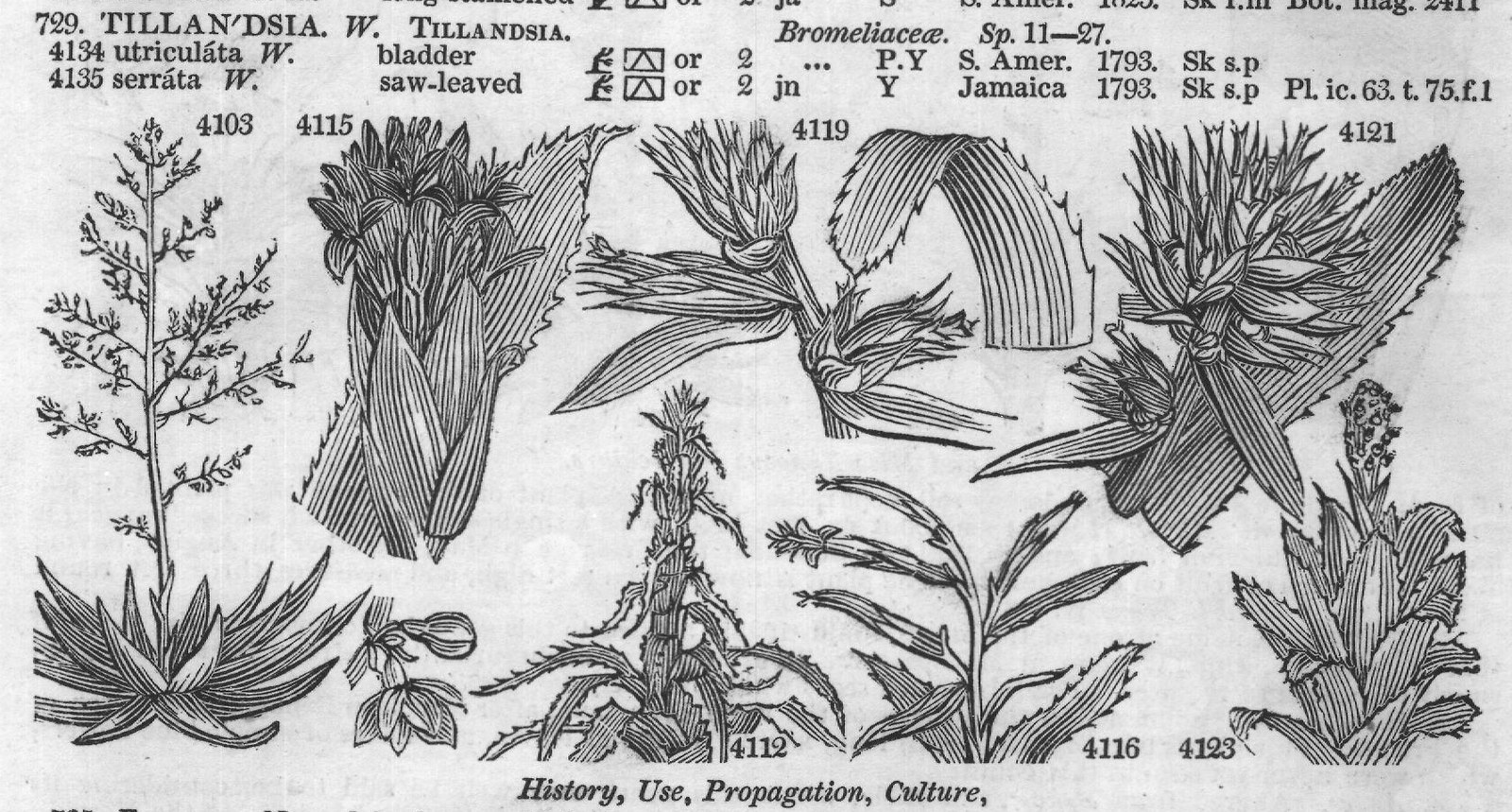
FURCREA. gigantic tuberous Cuba rigid 4107 austrális Haw. entire-leaved 726. BROMELIA. W. 4108 Anánas W.
PINE-APPLE. common 4109 semiserráta W.en. 4110 lúcida W.en. 4111 Pínguin W. half-sawed-lvd.
King-Pine broad-leaved 4112 sylvéstris W. wild 4113 fastuósa Lindl. noble 4114 Karátas W. upright-leaved 4115 nudicaúlis W. naked-stalked pyramidalis B. M. 4116 pállida Ker. pale 4117 chrysantha Jacq. golden-flowered or 2 4118 linguláta W. tongue-leaved 4119 bracteata W. red-bracted 4120 Acánga L. recurved 4121 exsúdans Lodd. sweating 4122 húmilis W. dwarf সসসসসসসসসসসসসসসসসসস or 20 ja.s Gr or 10 au.s Gr or 6 Gr or 6 HEXANDRIA MONOGYNIA.