Woods
Woods. An English writer on Roses.
Wulf., Wul- Wulfen. A German botanist. fen. botany.
Wallroth. A German botanist.
Walter. A writer on the Flora of Carolina.
Waldstein and Kitaibel. Authors of the Flora of Hungary.
Watson. An English writer upon Trees and Shrubs.
W.E., W.en. Willdenow's Enumeration of the Plants in the Berlin Garden.
TABLE OF ABBREVIATIONS AND REFERENCES Used in Columns 3, 4, 5, 6, 7, 8, 9, 10, 11, and 12. COLUMN 3. Habit.
Deciduous tree.
COLUMN 7. Time of Flowering. al. roc. alpine rocks. a. r. tr. alpine rocks and trees. ja January.
S September. ba. banks.
Evergreen tree.
Palm tree.
Deciduous shrub.
Evergreen shrub.
Deciduous under-shrub.
Evergreen under-shrub.
Deciduous twiner, ligneous or herbaceous. f February. ap April. jn June. jl July. au August. all sea all seasons. wet w wet weather. 0 October. bar. gr. barren ground. mr March. n November. bar.he. barren heaths. d December. bar. pa. barren pastures. my May. sp Spring. ba. s. p. barren sandy places. su Summer. bog. h. boggy heaths. aut Autumn. bog. pl. boggy places.
W Winter. bo. m. bgs. m. bogs on mountains. bo. me. boggy meadows. bor. fi. borders of fields. br. branches.
Evergreen twiner, lig. or herb.
Deciduous climber, lig. or herb.
Evergreen climber, lig. or herb.
Deciduous trailer, lig. or herb.
COLUMN 8. Color of the Flower. bu. fi. bushy fields.
Ap apetalous. | Li Erug ærugililac. bu. hi. bushy hills.
Lu lurid. bu. pl. bushy places. nous. o orange. cal. ba. calcareous banks.
B blue.
Och ochraceous cal. ro. calcareous rocks.
Evergreen trailer, lig. or herb.
Bd blood. 01 olive. ch. ba. chalky banks.
Deciduous creeper, lig. or herb.
Bh blush.
Oliva olivaceous. ch. cl. chalky cliffs.
Bk black.
P purple.. ch. fi. chalky fields.
Evergreen creeper, lig. or herb.
Bksh blackish.
Pa pale. ch. hil. chalky hills.
Deciduous herbaceous plant.
Br brown.
Pk pink or ch. pa. chalky pastures Bri brick-corose. ch. so. chalky soil.
Evergreen herbaceous plant. lored.
Pl pellucid. ch. wo. chalky woods.
Grass Bulbous plant. * Fusiform-rooted plant.
Brsh brownish.
R red. clov. fi. clover fields.
Bsh bluish.
Ro rosy. clt. gr. cultivated ground.
Bt bright.
Rsh reddish. cor. fi. corn fields.
C crimson.
Ru rufous. dit. ditches.
Tuberous-rooted plant.
Cæs cæsious.
Rus russet. dit. ba. ditch banks.
Aquatic.
Ch chestnut.
Ci Rust rusty-cod.m.pl. dry mountainous places. citron. lored. dr. co. dry commons.
Parasite.
COLUMN 4. Duration and Habitation. lored.
Cin cinereous. S scarlet.
Cop copper-co- Saf saffron.
Sil silvery. dr. fi. dry fields. dr. he. dry heaths. dr. pa. dry pastures.
Crea cream-co- Smo smoky ash ▲ Perennial.
Biennial.
O Annual.
Bark, or moist, stove.
Dry stove. ☐ Green-house.
Frame.
Bark stove perennial.
Dry stove perennial.
Green-house perennial.
Frame perennial.
Bark stove biennial.
Dry stove biennial.
Green-house biennial.
Frame biennial.
Bark stove annual.
Dry stove annual.
Green-house annual.
Frame annual.
COLUMN 5. Popular Character. ag agricultural. ( m medicinal. cl clothing. or ornamental. clt cultivated in ppoisonous. its native pr pretty. country. cu curious. cul culinary. de delicate. dy dyeing plant. ec economical. el elegant. rk for rockwork. dr. wo. dry woods. lored. color. d. st.pl. dry stony places.
D dark.
Spot spotted. d. st.w. dry stony woods.
Din dingy.
St striped. dungh. dunghills.
Dl dull.
Str straw. ed.of d. edges of ditches.
Dp deep.
Su sulphur. gra. ba. gravelly banks.
F flesh.
Tan tan-colorgra.he. gravelly heaths.
Fer ferruginous ed. gra. pa. gravelly pastures.
Fi fiery.
Taw tawny. gra. so. gravelly soil.
Fla flame-co- Test testaceous. hea. heaths. lored.
Tran transpahea. w. heaths and woods.
Ful fulvid. rent. hed. hedges.
Fus fuscous.
Umb umber-cohed. b. hedge banks.
G green. lored. hghl.v.
Highland valleys.
Gl glaucous.
V violet. hil. pa. hilly pastures.
Go golden.
Va variegated. ir. bog.
Irish bogs.
Gsh greenish. Ve vermilion. ir. mo.
Irish mountains.
Gy grey.
Vy veiny. ir. roc.
Irish rocks.
Hoa hoary.
W white. ir. sho.
Irish shores.
L light.
Wsh whitish. ir. thi.
Irish thickets.
Ld livid.
Y yellow. lak. lakes.
Lem lemon co- Ysh yellowish. m. al.p. moist alpine places. lored. mar. marshes. mar.la.
COLUMN 9. Native Country.
C. G. H.
E. Ind.
N. Amer.
Cape of Good Hope.
E. Indies.
North America.
North of Europe.
New Holland.
New South Wales.
South America.
South of Europe.
Van Diemen's Land.
West Indies.
COLUMN 10. Year of Introduction m. a. w. m. c. h.
N. Eur.
N. Holl.
N. S. W S. Amer. mic.ro.
S. Eur. m. me.
V. Di. L. moi. fi. moist fields. ro robust.
W. Ind. moi.gr. moist ground. spl splendid. moi. h. moist heaths. tm timber tree. moi. pl. un uninteresting w weed, abundof Exotics, and Localities of Brimoi. w. moi.ro. moist rocks. moist places. moist woods. esc esculent. ant in cultish Species. mo. pl. mountainous places. fr fruit tree. tivated soils al. bogs alpine bogs. mos. b. mossy bogs. fra fragrant. in its native al. b. p. alpine bushy places. moun. mountains. gr grotesque. country. al. hea. alpine heaths. m. pas. moist pastures. al. lak. alpine lakes. ms. pas. mountainous pastures.
COLUMN 6. Height. al. ma. alpine marshes. m. r. h. mountainous rocky heaths. al. me. alpine meadows. mrit. r. maritime rocks. fit floating. al. riv. alpine rivers. m. r. tr. moist rocks and trees. a m.ch.s. mea. me. pa. m. h. m. he. } margins of lakes. moist alpine woods. moist chalky hills. moist chalky soil. meadows. meadows and pastures. mountainous heaths. m.hed. moist hedges. micaceous rocks. moist meadows. m. s.pl. moist shady places. sea sh. sea shore. m. thi. mountainous thickets. sev. isl.
Severn isles. m. wo. mountainous woods. sha.ba. shady banks. mud.d. muddy ditches. sha.bo. shady bogs. mud. s. muddy shores. sha. la. shady lanes. n. of e. north of England. sha. pl. shady places. n. of s. north of Scotland. sh. roc. shady rocks. old w. old wa. } old walls. s. m. pl. shady moist places.
SO. CO. south coast. os. hol osier holts. so. of s. south of Scotland.
RULES FOR PRONOUNCING BOTANICAL NAMES. w.sh.p. wet shady places. wy.sh.p. watery shady places. w. thi. wet thickets.
COLUMN 11. Propagation.
B by budding.
D C G cuttings. division of the plant. grafting. pas. pastures. sp. bo. spongy bogs.
I inarching. pea. d. peaty ditches. sta.wa. stagnant water.
L layers. riv. ba. river banks. st.in w. stones in water.
Ls leaves. rivul. rivulets. sto. hi. stony hills. 0 offsets. ro. sid. road sides. sto. pa. stony pastures. rub. rubbish. sto. pl. stony places. sa.hea. sandy heaths. sto.wa. stones and walls.
R S division of the root. seeds.
Sk suckers. sal. m. salt marshes. sun.hi. sunny hills. sa. ma. sandy marshes. sun.ro. sunny rocks.
COLUMN 12. Soil. san. fi. sandy fields. thick. thickets. san. gr. sandy ground. tr. trees. aq. watery places. san. pl. sandy places. tr. & st. trees and stones.. co. common garden soil. san.sh. sandy shores. tru. tr. trunks of trees. c.p. common peat, or bog. sa. pas. sandy pastures. tur. bo. turfy bogs. h. heavy rich clay. sa.w.d. salt-water ditches. tur. he. turfy heath. h.l. heavy loam. sa.w.p. sandy wet places. unc.gr. uncultivated ground. 1. loam. sc. alp.
Scottish alps. unc.pl. uncultivated places. 1.p. loam and peat, most loam. sc. bog.
Scottish bogs. wa. gr. waste ground. lt. light vegetable soil. sc. isl.
Scottish islands. w.al.h. wet alpine heaths. lt.l. light loam. s. cliffs sea cliffs. w. alp.
Welsh alps. m.s. moist soil. sc. ma.
Scottish marshes. wat.co. watery commons. p. peat. sc. mo.
Scottish mountains. wat. pl. watery places. p.l. peat and loam, most peat. sc. pas.
Scottish pastures. w. bog.
Welsh bogs. r. rich garden soil. sc. roc. Scottish rocks. w. co. wet commons. r.m. rich mould. sc. sh. Scottish shores. w. gr. wet ground. ru. rubbish. sc. thi.
Scottish thickets. w. lak.
Welsh lakes.
S. sand.
Sc. wo. sc.wds.2 } Scottish woods. w. roc.
Welsh rocks. s.l. sandy loam. w.sa.p. wet sandy places. s.p. sandy peat. sea co. sea coast. w.s.gr. wet shady ground. s.p.l. sand, peat, and loam.
RULES FOR PRONOUNCING BOTANICAL NAMES.
SYLLABLES.
IN classical words there are as many syllables as there are vowels; except when u with any other vowel follows g, q, or s, and when two vowels unite to form a diphthong . The diphthongs are æ, æ, ai, ei, oi, ui, au, eu, and ou. These seldom coalesce in final syllables; oo, ee, ea, and other combinations which never occur as diphthongs in classical words, follow, in commemorative names, the pronunciation of their primitives, as Teédia, Woódsia.
VOWELS.
In this work the accented vowels are indicated by the mark placed over each; but as this only points out the vowel on which the stress is laid, the following observations will be found useful in showing when the vowel is to be sounded long, and when short. In addition to the primary accent, every word of more than three syllables contains a secondary accent, which is regulated by the same rules. The secondary accent must always be at least two syllables before the primary accent, as in Chelidonium ; for its place the ear is a sufficient guide, and even were it entirely omitted, still, however inharmonious, it would not be incorrect.
Every accented penultimate vowel is pronounced long, when followed by a vowel or a single consonant, as Achillea tomentosa; but it is shortened when followed by two consonants or a double one, as Sórbus, Táxus; except when the first consonant is a mute and the second a liquid, as A'brus.
Every accented antepenultimate vowel, except u, is pronounced short, as Helléborus, Humulus; but when succeeded by a single consonant, followed by e or i and another vowel, it is lengthened, as Stellària; except i, which is short, as Tília.
A unaccented, ending a word, is pronounced like the interjection ah, as Sticta (ah). E final, with or without a consonant preceding, always forms a distinct syllable, as Silènë, A'loë; also when the vowel is followed by a final consonant as Tri-chó-ma-nes, not Tri-cho-manes. vowel is followed by a final consonant as Tri-chó-ma-nes, not Tricho-manes. I unaccented, if final, sounds as if written eye, as Spica vénti (eye); but, when it ends a syllable not final, it has the sound of e, as Méspilus (Mespelus), Smithii (Smithë-eye). ).
Y is subject to the same rules as i.
The diphthongs æ and æ conform to the rules for e; ei is generally ronounced like eye; the other diphthongs have the common English sounds. CONSONANTS.
Cand g are hard before a, o, and u, as Córnus, Galium; soft before e, i, and y, as Cetrària, Citrus. T, s, and c, before ia, ie, ii, io, iu, and eu, when preceded by the accent, change their sounds, t and c, into sh, consonant preserves its sound, as aurantìacum. as Blètia, Vícia and s into zh, as Blàsia but, when the accent is on the first diphthongal vowel, the preceding Blètia, Vicia; and s into zh, as Blasia: but, when the accent is on the first diphthongal vowel, the preceding consonant preserves its sound, as aurantiacum.
Ch, before a vowel, is pronounced like k, as Chelidonium (kel), Cólchicum (kolkekum); but in commemorative names it follows their primitives, as Richardsonia, in which the ch is soft.
Cm, cn, ct, gm, gn, mn, tm, ps, pt, and other uncombinable consonants, when they begin a word, are pronounced with the first letter mute, as Ptèris (teris), Cnicus (nikus), Gmelina (melina), Gnidia (nidia); in the middle of a word they separate as in English, as Lap-sàna, Lém the middle of a word they separate as in English, as Lap-sàna, Lém-na. Ph, followed by a mute, is not sounded; but, followed by a vowel or a liquid, sounds like f, as Phlèum ( fleum).
Sch sounds like sk, as Schœ'nus (skenus); in tl and zm both letters are heard. S, at the end of a word, has its pure hissing sound, as Dactylis; except when preceded by e, r, or n, when it sounds like z, as Ribes (ex).
X, at the beginning of a word, sounds like z, as Xánthium; in any other situation it retains its own sound, as Táxus, Támarix. (Extracted from the Gardener's Magazine, vol. V. p. 232.) Táxus, Tamarix. (Extracted from the Gardener's Magazine, vol. v. p. 232.) GENERAL INTRODUCTION.
THE science of Botany consists of two departments, Phytology and Physiology. This Encyclopædia is exclusively devoted to the former department, and it is limited to the plants in Britain, indigenous and exotic.
Phytology, or the History of Plants, comprehends the knowledge of the external parts of plants, the determination of their names, their classification, their uses, their individual history, and their geography. The object of this work is to convey, in the most convenient manner and in the least possible space, a knowledge of the various particulars which arrange themselves under these heads.
A knowledge of the external parts of plants will be readily and agreeably obtained by turning over the first 700 pages of this work at random, looking at the engravings, and comparing them with the names and descriptions to which they refer; the same process will enable the reader to recognise, at sight, the 10,000 species figured in the 700 pages. In this way, botanical figures supply the place of a botanical garden; and the beginner learns the natures, the technology, and the general appearances of plants, almost as easily and naturally in the one case as he does in the other. To determine the name of an unknown plant, it is necessary to be furnished with a specimen of it in flower. The parts of the plant including those of the flower being already known by the process above mentioned, its class will be ascertained by the Table of the Linnean System (p. 2.), and its order, genus, species, &c., by turning to the page referred to at the end of the class. Thus, if you hold in your hand a specimen of Phillyrèa angustifolia in flower, on counting the stamens and pistils you find it belongs to Class II. Order 1., from which, in the Table in p. 2., you are referred to the details of the class in p. 8.; you there find, under Order 1., the characters of all the genera of that order, and that the flower which you hold in your hand best agrees with the definition given of the genus Phillyrèa, No. 33. But you wish to know the species; and, Phillyrèa being No. 33., you turn to that number in the details of the genera in the subsequent pages. After comparing its leaves with the specific character given of the different species, you find it best agrees with P. angustifòlia; and, finding this species numbered 143., you look for that number in the two plates of engravings in the lower parts of the pages, and find a figure which confirms your decision. By reading the abridgements in the line which follows the word angustifolia, together with the note to the generic name Phillyrèa at the bottom of the page, you find in an abridged form its English name, habit, habitation in the garden, popular character, the height to which it grows, its time of flowering, the colour of its flower, its native country, the year of its introduction into Britain, its propagation, the soil in which it grows, a reference to a work where it is figured and described at greater length, and its uses in the arts, or whatever else is remarkable in its history. You find, also, the natural order to which the genus belongs, the etymology of the name, the French or German name, if the plant has a vernacular name in these languages, and, both generic and specific names being accentuated, you have the pronunciation. On turning to the Table of Synonymous Names (p. 1108.), you will find its vernacular name in the languages of the countries where it is common. If it is not so common in any country as to have received a vernacular name, it will not be found in that list. Finally, if you should not understand any of the terms used in the definition of the specific characters or in the notes, on turning to the Glossary (p. 1094.) you will find them explained, and illustrated where necessary by engravings. a 2 INTRODUCTION.
When the beginner has a leaf or any part of a plant not in flower, he may ascertain, by turning to the Introduction to the Natural System (p. 1051.), to which of the three grand divisions of the vegetable kingdom it belongs, and may learn other particulars, according to circumstances which it is unnecessary to detail. Without the flower, he will not be able by the Natural System to determine the name of a plant; but, what is often much more important, with a very small portion of any part of a plant he will be able to discover something of its nature, an advantage which does not belong to the System of Linnæus. The classification or arrangement of plants is made by botanists with a view to two objects: the first, to facilitate the discovery of their names, and thus to know them individually; the second, to give general ideas respecting their natures, and thus to know them as belonging to large masses or groups. Hitherto, no system has been discovered which has attained both these objects in an equal degree of perfection; but the Linnean Arrangement has made the greatest advances in teaching how to discover the names of plants, and the Jussieuean in teaching us their natures, and how to recognise them as belonging to certain masses or groups. In order that the student may acquire both these kinds of knowledge, we have given both arrangements. We have begun with the Linnean, not only as being best adapted for beginners, but because it is necessary to know how to discover the name of a plant, as well as to be able practically to recognise a number of plants, before attempting to know their natures, or to combine them in masses or groups. "The standing objection to botany," says White of Selbourne, " has always been, that it is a pursuit that amuses the fancy and exercises the memory without improving the mind or advancing any real knowledge; and where the science is carried no farther than a mere systematic classification, the charge is but too true. But the botanist, who is desirous of wiping off this aspersion, should be by no means content with a list of names; he should study plants philosophically, — should examine the powers and virtues of efficacious herbs, - should promote their cultivation, and graft the gardener, the planter, and the husbandman, on the phytologist: not that system is by any means to be thrown aside; without system the field of nature would be a pathless wilderness; but system should be subservient to, and the main object of, our pursuit." should investigate the laws of vegetation, - "After all that has been effected, or is likely to be accomplished hereafter," Professor Lindley observes, "there will always be more difficulty in acquiring a knowledge of the Natural System of Botany than of the Linnean. The latter skims only the surface of things, and leaves the student in the fancied possession of a sort of information which it is easy enough to obtain, but which is of little value when acquired; the former requires a minute investigation of every part and every property known to exist in plants, but when understood has conveyed to the mind a store of information, of the utmost use to man, in every station of life. Whatever the difficulties may be of becoming acquainted with plants according to this method, they are inseparable from botany, which cannot be usefully studied without encountering them." * The History of Plants comprehends every thing relating to their use in the arts, or in any way as connected with man, with animals, or with civilisation. The Geography of Plants relates to the countries in which they are indigenous or acclimated, and to the soils and situations in which they grow or may be grown. Every thing essential in relation to these points will, as we have already stated, be found after the name of each species in the text, after the name of the genus in the notes below, under the natural order to which the genus belongs in the Natural Arrangement (Part II. p. 1051.), in the Table of Synonymes (p. 1108.), or in the Glossary (p. 1094.).
The General Index (p. 1143.) contains not only the names of the genera, and of the classes and orders of both systems, but those of all the remarkable species, and the more important systematic and British synonymes both of genera and species. The various names being included in the same alphabet, this Index may therefore be consulted as a Dictionary of Plants. * Synopsis of the British Flora, arranged according to the Natural Orders, &c., pref. p. xi. THE ENCYCLOPÆDIA OF PLANTS.
PART I.
LINNEAN ARRANGEMENT.
THE main object of the artificial system of botanical arrangement is to facilitate the discovery of the names of plants. For this purpose some one organ, common to plants in general, is fixed on; an and, according to certain conditions in which this organ is found, individual species are referred to their places in the system, as words, by their initial letters, are referred to their places in an alphabetical dictionary. In the progress of artificial systems different organs have been fixed on by different botanists; but those which have been most extensively employed are the corollas by Tournefort, and the stamens and pistils, by Linnæus. The system of Tournefort has been a good deal employed in France, and may be considered as the artificial system of that country; that of Linnæus has been employed in most other countries, and is justly esteemed by far the most perfect artificial system which has hitherto been produced. It is, therefore, adopted in this work.
The application of the Linnean system in practice, Sir J. E. Smith observes, is, above all other systems, easy and intelligible. Even in pursuing the study of the natural affinities of plants, this botanist affirms "that it would be as idle to lay aside the continual use of the Linnean system, as it would be for philologists and logicians to slight the convenience, and indeed necessity, of the alphabet, and to substitute the Chinese character in its stead." (Introduct. to Bot.) "The student of the Linnean artificial system," he elsewhere observes, "will soon perceive that it is to be understood merely as a dictionary, to make out any plant that may fall in his way." (Gram. of Bot.) "If we examine," says Decandolle, "the artificial systems which have been hitherto devised, we shall find the most celebrated of them, that which was proposed by Linnæus, to possess a decided superiority over all others, not only because it is consistently derived from one simple principle, but also because the author of it, by means of a new nomenclature, has given to his terms the greatest distinctness of meaning." (Elements of the Philos. of Plants, by Decandolle and Sprengel.) Whether or not subsequent advances in science may enable botanists to dispense with the Linnean system altogether, it is not for us to affirm; but in the meantime nothing can be more certain than that the Linnean system is the best leading arrangement for such a work as the present, in the existing state of botanical knowledge in Britain. * According to the Linnean system all plants are furnished with flowers, either conspicuous or inconspicuous, The plants with conspicuous flowers are arranged according to the number and position of their stamens and pistils; those with inconspicuous flowers are arranged according to the situation of the flowers on the plant, or according to other circumstances in the plant itself. b a 1 To discover the name of a plant by the Linnean system, therefore, all that is b necessary for a beginner is to possess a specimen of it in flower, and to be able to know its different parts by the names given them by botanists. To discover the class, order, and genus of a plant, it is only necessary to be able to distinguish and name the different parts of the flower. These parts are: the calyx or cup (fig 1. a), which is that leaf, or those leaves, by which the flower is usually enclosed when in a bud, and which, when the flower is expanded, appear under it. The corolla (corona, a crown) is the coloured leaf, or leaves, of a flower (fig. 1. b). The stamen (or first principle of any thing) is the thread-like process, or processes, immediately within the leaves of the corolla (fig. 2.): it consists of two parts, the filament or thread (a), and the anther (b); this anther contains what is called the pollen, or fructifying meal (c). In the centre of the flower is the pistil (fig. 3.): it consists of three parts, the germen, or rudiments of the fruit or seed (a), the style (b), and the stigma or summit(c), which crowns the style, and is destined to receive the fructifying pollen.
C 2 C The pistil and stamen are the essential parts of a flower. The corolla or the calyx may be wanting, ng, and yet the flower will be termed perfect, because the absence of those parts is no obstacle to reproduction. Even the style and the filament may be absent without preventing the formation or ripening of the fruit; and there are many flowers which have the anther sitting close to the corolia, &c., without a filament, and the stigma to the germen without a style; but the anther, the germen, and the stigma are essential. 3 b a The seed is contained in the pericarp, or seed-vessel, which is the germen when grown to maturity. The name of seed-vessel varies according to its form, substance, &c.; but the word pericarp (peri, about, karpon, a fruit) is applicable to all its varieties. The receptacle is the base or medium which connects the other parts of the fructification. (Magazine of Natural History, vol. i. p. 233.) The degree of knowledge conveyed by the following Table, and the preceding observations, will enable a beginner to discover the class, order, and genus of any plant which he may find in flower. * The best work in the English language for acquiring a knowledge of the Linnean system of botany is Smith's Introduction to Botany; there are also various other works nearly as good, and detailed and familiar Introductions to both the Linnean and Jussieuean Systems will be found in the first and second volumes of The Magazine of Natural History.
Stamens and Pistils In Number, [2] LINNEAN ARRANGEMENT.
FIRST GRAND DIVISION. - Plants with conspicuous Flowers (Phanerogàmia). In the same flower, Male and female organs distinct, Stamens not united either above or below, Generally of equal length, ORDERS.
CLASSES.
One, { 1. Monándria (monos, one, aner, a man). Example, Blitum capitàtum. 1 Two, { 2. Diándria (dis, twice, aner, a man). Verónica Chamæ'drys. 8 Three, 3. Triándria (tris, thrice, aner, man). Pòa ánn. 30 Four, { Five, { Six, { Seven, { Eight, { Nine, { Rhèum Ten, { aner, a man). Saxifraga umbròsa. 338 Twelve, { twelve, aner, a man).
Sempervivum tectorum. 392. 4. Tetrándia (tetra, four, aner, a man). Córnus sanguínea. 76 5. Pentándria (pente, five, aner, a man). Lysimachia ephémerum. 108 6. Hexándria (hex, six, aner; a man). Scíila bifolia. 236 7. Heptándria (hepta, seven, aner, a man). E'sculus Hippocástanum. 296 8. Octándria (okto, eight, aner, a man). Füchsia coccínea. 300 9. Enneandria (ennea, nine, aner, a man).
Rhapónticum. 332 10. Decándria (deka, ten, 11. Dodecandria (dodeka, 2. Monogynia (monos, one, gyne, a woman), Digynia (dis, twice, gyne, a woman). 3. Monogýnia, Digýnia, Trigýnia (tris, thrice, gyne, a woman). 3. Monogýnia, Digýnia, Trigýnia. 3. Monogýnia, Digýnia, Tetragýnia (tetra, four, gyne, a woman). 6. Monogýnia, Digýnia, Trigýnia, Tetragýnia, Pentagýnia (pente, five, gyne, a woman), Polygýnia (polys, many, gyne, a woman). 4. Monogýnia, Digýnia, Trigýnia, Polygýnia. 4. Monogýnia, Digýnia, Tetragýnia, Heptagýnia (hepta, seven, gyne, a woman). 4. Monogýnia, Digýnia, Trigýnia, Tetragýnia. 3. Monogýnia, Trigýnia, Hexagýnia (hex, six, gyne, a woman). 5. Monogýnia, Digýnia, Trigýnia, Pentagýnia, Decagýnia (deka, ten, gyne, a woman). 6. Monogýnia, Digýnia, Trigýnia, Tetragýnia, Pentagýnia, Dodecagýnia (dodeka, twelve, gyne, woman).
Many, frequently 12. Icosándria (eikosi, twenty, twenty, attached to the calyx, aner, a man). Cratæ gus Oxyacántha. 408 3. Monogýnia, Di-pentagýnia (dyo, two, pente, five, gyne, a woman), Polygýnia.
Many, generally upwards of twenty, not attached to the calyx, Of unequal length, Two long, and two) short, Four long, and two short, Stamens united, by the filaments, into one body, into two bodies, منه منه 13. Polyándria (polys, many, aner, a man). Clématis erécta. 456 ६ 14. Didynamia (dis, twice, dyo, two, nema, a filament). Teùcrium lùcidum. 490 15. Tetradynamia (tetra, four, dyo, two, nema, a filament). Raphanus satìvus. 536 5. Monogýnia, Digýnia, Trigýnia, Pentagýnia; Polygýnia. 2. Gymnospermia (gymnos, naked, sperma, seed), Angiospermia (aggeion, a vessel, sperma, seed). 2. Siliculosa (silicula, a silicle), Siliquòsa (siliqua, a silique). into many bodies 16. Monadelphia (monos, one, adelphos, brother).
Málva frågrans. 560 17. Diadelphia (dis, twice, adelphos, a brother).
Onònis arvensis. 598 18. Polyadelphia (polys, many, adelphos, brother). Hypéricum quadrán. 650 by the anthers or tops, 19. Syngenèsia (syn, together, genesis, origin). Cicho- 2 rium I'ntybus. 660 into a cylinder, Male organs (stamens) at-720. Gynandria (gyne, a wotached to and standing upon pistil), In different flowers, on the same plant, on different plants, -{ on the same or different plants along with hermaphrodite flowers, man, aner, a man).
O'phrys apífera. 748 21. Monœ'cia (monos, one, oikos, house). Cucurbita Pèpo. 768 22. Diœ'cia (dis, twice, oikos, house). Cánnabis sativa. 816 23. Polygàmia (polys, many, gamos, marriage). Gledítschia triacanthos. 852 7. Triandria, Pentandria, Heptándria, Octándria, Decandria, Dodecandria, Polyándria. 4. Pentándria, Hexándria, Octándria, Decandria. 4. Decándria, Dodecandria, Icosándria, Polyándria. 5. Polygamia æqualis (equal), Polygamia superflua (superfluous), Polygamia frustranea (frustra, in vain), Polygamia necessària (necessary), Polygàmia segregata (separated). 3. Monándria, Diandria, Hexándria. 8. Monándria, Diándria, Triándria, Tetrándria, Pentándria, Hexándria, Polyándria, Monadelphia. 14. Monándria, Diándria, Triándria, Tetrandria, Pentándria, Hexándria, Octándria, Enneándria, Decándria, Dodecandria, Icosándria, Polyándria, Monadelphia, Gynandria. 2. Monce'cia, Diœ'cia.
SECOND GRAND DIVISION. - Plants with inconspicuous Flowers (Cryptogamia). Reproductive organs scarcely visible, 24. Cryptogamia (kryptos, conso that they have not been distinctly described, cealed, gamos, marriage), 874 11. Gonoptérides (gonos, seed, pteris, fern), Stachyoptérides (stachys, a spike, pteris, fern), Poroptérides (poros, a pore, pteris, fern), Fílices (filix, a fern), Hydroptérides (hydor, water, pteris, fern), Schismatoptérides (schisma, a cleft, pteris, fern), Músci (muscus, moss), Hepáticæ (hepar, a liver), A'lgæ (alga, sea weed), Lichens (Greek name), Fúngi (fungus, a mushroom).
MONANDRIA MONOGYNIA.
To discover the particular species or variety of a plant it is necessary to become acquainted with the forms and different conditions of the leaves, stems, and other parts of the bodies of plants, as well as with their flowers, and this knowledge, as we have before stated (p. xix.), will be obtained with the greatest facility by turning to the Glossary (p.1094.), and comparing the definitions with the engraved figures. CLASS I.
MONANDRIA. 1 STAMEN.
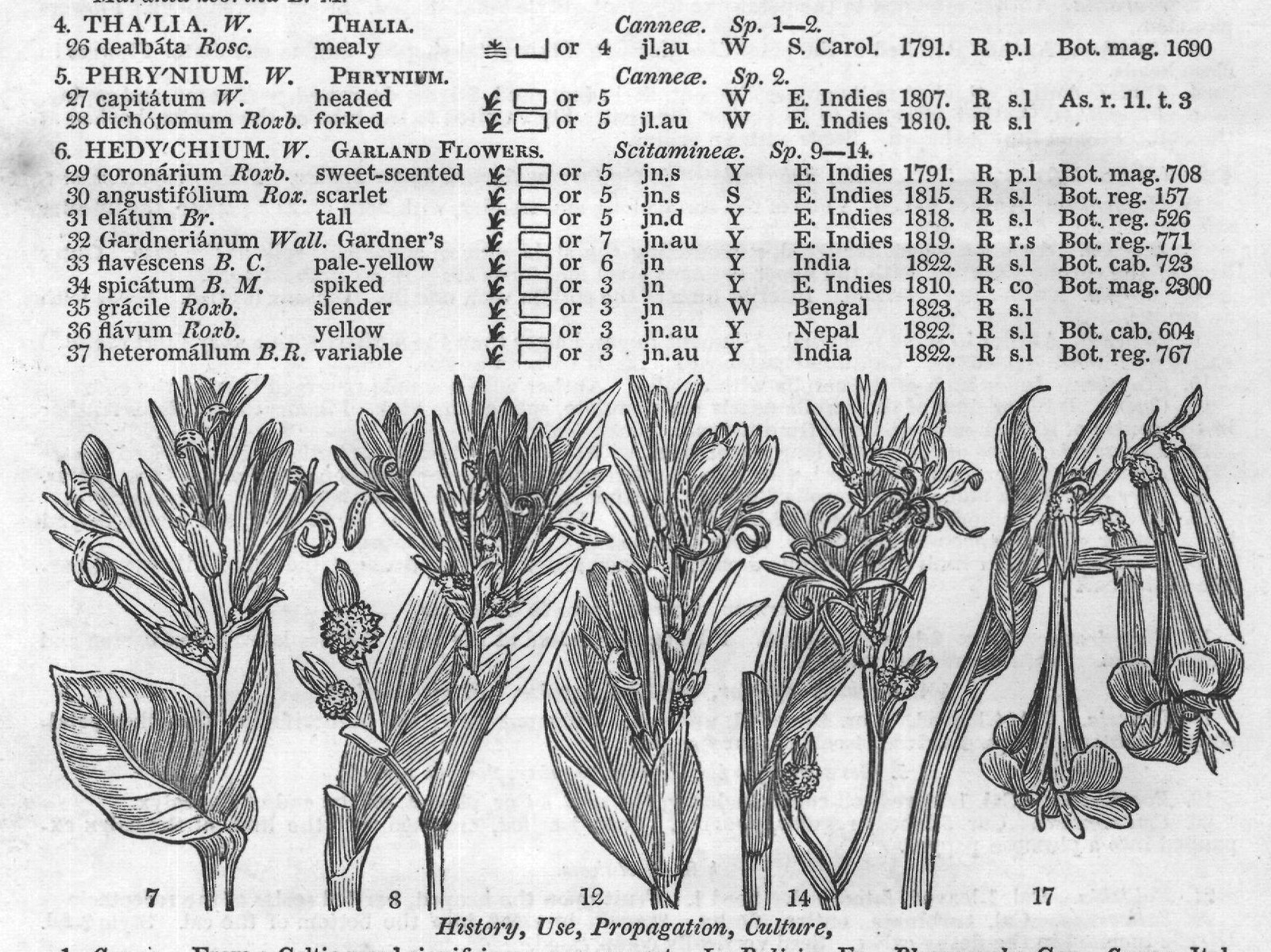
THIS class, which is not large, contains chiefly exotic plants, and of these the tribe of Scitamineæ is considered one of the most beautiful families of the vegetable kingdom. The useful productions are chiefly the Ginger, Cardamom, and Turmerick, spices highly esteemed, and in general use wherever they are known, and can be procured. The Salicornia, Salicornia, a native of our sea-shores, is burned for kelp, and pickled for culinary purposes. Almost all the plants of this class are aquatics, or grow in marshes. They chiefly thrive best in a sandy loam, from which their roots should be well cleaned every year. The genera of the Scitamineæ and Canneæ have been remodelled by Roscoe, whose arrangement has received considerable improvement from the hand of the late Dr. Roxburgh. The nature of the floral envelope of those plants has long been a subject of dispute among botanists, some considering the colored inner segments to be true petals and to be variable in numbers; and others, supposing them to be part of the calyx and constant in number, their occasional variation in number being capable of explanation. Persoon (Synopsis, p. 1.) is of opinion that many of the genera of the first section ought to be referred to Gynandria. According to Willdenow and others, the following species belonging to other classes have only one stamen. Monogynia. Mangifera indica; Alchemilla aphanes, several species of Scirpus, Cyperus, Schænus, Kyllinga, Cryptostomum monandrum, Chorizandra, Polycnemum monandrum, Hopea. Digynia. Lacistema, Leersia, Salsola, and many grasses. Order 1. MONOGYNIA. 1 Stamen, 1 Style. §1. Germen inferior, anther simple, style erect, free. Flowers spathaceous. 1. Canna. Anther attached to the edge of the petal-like filament. Style thick, club-shaped. Stigma linear, obtuse. 2. Maranta. Anther attached to the petal-like filament. Style petal-shaped. Stigma three-sided. Flowers panicled. 3. Calathea. Anther attached to the petal-like filament. Style petal-shaped. Stigma cucullate. Flowers in close heads. 4. Thalia. Anther attached to its proper filament. Style depressed. Stigma depressed, perforated, and gaping. 5. Phrynium. Anther attached to its proper filament. Style united to the tube of the corolla, hooked at the end. Stigma funnel-shaped. Seeds with an arillus. §2. Germen inferior, anther double, style inclosed in the furrow formed by the anther. Flowers spathaceous 6. Hedychium. Anther naked. Tube of the corolla long and slender, with both limbs 3-partite, the interior one resupinate. Capsule dry. 7. Roscoea. Anther 2-lobed, incurved, surrounding the style with an appendage split at the base. Outer limb of the corolla 3-partite, with the upper segment erect and fornicate. Înner limb 2-lipped. 8. Alpinia. Anther not crowned. Interior limb of the corolla with one lip. Capsule berried. Seeds with an arillus. 9. Hellenia. Anther in some marginal. Filament linear, longer than the anther, with a very short rounded entire or 2-lobed appendage. Capsules crustaceous. Seeds with an arillus. 10. Zingiber. Inner limb of the corolla with one lip. Anther with a simple recurved horn at the end. 11. Costus. Interior limb of the corolla nearly campanulate, split at the back. Filament lanceolate. Anther in the centre of it or at some distance from the end. Seeds naked. 12. Kæmpferia. Tube of the corolla long and slender, with both limbs 3-partite. Anther with a 2-lobed crest. 13. Amomum. Inner limb of the corl. with 1 lip. Anther with an entire or 2-lobed crest. Seeds with an arillus. 14. Curcuma. Both limbs of the corolla 3-partite. Anther with two spurs at the base. Seeds with an arillus. 15. Globba. Inner limb of the corolla 2-lobed or none. Filament hollow at the base, with a wedge-shaped lip Anther with an appendage or none. Seeds attached to 3 parietal placentas. 16. Mantisia. Outer limb of the corolla 3-partite, inner filiform with a double trifid limb. Filament 4-partite at the end. §3. Germen superior, corolla irregular. 17. Philydrum. Calyx 2-leaved colored. Filaments 3 united at the base, the two lateral ones barren and petal-shaped. Seeds numerous, minute. §4. Germen inferior, corolla irregular. Flowers naked. 18. Lopezia. Cal. 4-leaved. Cor. 4-petaled, unequal. Filaments two: one antheriferous, the other petalshaped abortive. Caps. 4-valved, 4-celled, many seeded. §5. Germen inferior, corolla regular, flowers naked. 19. Boerhaavia. Cal. 1-leaved, ob-conic, inclosing the seed. Cor. plaited, on the end of the calyx. 20. Centranthus. Cor. 5-lobed, regular, spurred. Caps. 1-celled, crowned with the limb of the calyx expanded into a plumose pappus. §6. Apetalous. 21. Pollichia. Cal. 1-leaved, 5-toothed. Seed 1. Fruit upon the heaped, berried scales of the receptacle. 22. Salicornia. Cal. turbinate, entire, fleshy. Stamen inserted into the bottom of the cal. Style 2-fid. Utricle inclosed in the fleshy calyx. Seed vertically compressed. 23. Hippuris. Cal. entire, minute. Style in the hollow of the anther. Germen inferior, one-seeded, crowned by the rim of the calyx. 24. Zostera. Spadix linear in the sheath of the leaf, bearing seed on one side. Stamens opposite the germens and alternate with them, sessile. Caps. one-seeded. 25. Chloranthus. Stamen irregular, fleshy, lobed, fixed to the side of the germen. Stigma capitate. A drupa.
Order 2. DIGYNIA. 1 Stamen. 2 Styles. 26. Corispermum. Cal. 2-leaved. Cor. O. Seed one, oval, convex-plane. (Stamens often 5.) 27. Callitriche. Cal. 2-leaved. Pet. O. Caps. 2-celled, 4-seeded. 28. Blitum. Cal. trifid. Cor. O. Seed one, immersed in a berried calyx. 29. Aspicarpa. Cal. 5-parted. Cor. O.
Stamen included. Germen and Stigma 2-lobed. Fruit cartilagi nous, 1-seeded.
MONANDRIA MONOGYNIA.
CLASS I.
Systematic Name and Authority.
English Name. 1. CAN'NA. W.
INDIAN SHOT. 1 pátens Rosc. spreading or 2 my 2 indica Rosc. common or 2 ja.d ẞ maculáta spotted or 2 ja.d R.Y 3 coccínea Rosc. scarlet or 2 ja.d S 4 lútea Rosc. yellow or 2 ja.d Y 5 Lambérti Lind.
Lambert's or 4 my S 6 gigantéa R. L. gigantic or 5 d.ja 7 occidentális Rosc. western or 3 s.d 8 limbáta Rosc. bordered or 3 ja.d R 9 variábilis W. variable or 3 ja.d R 10 rúbra W. red or 3 ja.d R.Y Habit.
Habitation in the Garden.
Character.
Popular Height in Feet.
Flowering.
Time of Color of the Flower.
Canneæ.
Native Country.
Sp. 17-20.
R British Species.
Exotics, and Localities of Year of Introduction of Propagation.
Soil.
India 1570.
India ...
S. Amer. 1731.
Reference to Figures.
R.Y Rio Jan. 1778. R r.m Bot. reg. 576 R r.m Red. lil. 201 Rr.m Hook. ex. fl. 53 R r.m Bot. mag. 452 Rr.m Bot. mag. 2085 R r.m Bot. reg. 470 R r.m Bot. reg. 206 Rr.m Bot. reg. 772 Rr.m Bot. reg. 771 E. Indies 1629.
Trinidad 1819.
R.Y S. Amer. 1809.
R.Y W. Indies 1822.
Brazil 1818.
India 1822.
W. Indies 1820.
R r.m Rr.m 11 rubricáulis Lk. red-stemmed or 3 my R ... 1821.
R r.m 12 édulis B. R. eatable or 3 s.d R Peru 1820.
Rr.m Bot. reg. 775 13 speciósa B. M. shewy or 3 au.s R ...... 1820.
R r.m Bot. mag. 2317 14 pedunculáta B. M. stalked or 6 s.d 0 1820.
Rr.m Bot. mag. 2323 15 fláccida Rosc. flaccid or 5 jl R S. Carol. 1788. R r.m Sal. st. ra. 3. t. 2 16 glaúca Rosc. glaucous or 2 jn.au Y S. Amer. 1732.
Brufa rufous or 2 jn.au Br S. Amer. ...
R r.m Ex. b. 2. t. 102 Rr.m Bot. mag. 2302 17 iridiflóra Fl. Per. nodding.flow. or 6 d.ja R Peru 1816.
R r.m Bot. mag. 1968 2. MARAN'TA. W.
ARROW ROOT.
Canneæ.
Sp. 7-20. 18 arundinácea W.
Indian or 2 jl.au W S. Amer. 1732. Rs.1 Bot. mag. 2307 19 oblíqua Rudge. 20 lútea Jacq. 21 angustifólia B. M. narrow-leaved oblique or 2 d R Guiana 1803. Rs.1 Ru. p. g. p. 8. t. 2 yellow or 2 jn.jl Y.w Caraccas 1809.
Rs.1 Jac. ic. r. 2. 201 or 2 jl.au R W. Indies 1820.
Rs.1 3. CALATHE'A. Mey. CALATHEA.
Maránta zebrina B. M. 22 Tónchat W. 23 gíbba L. K. 24 comósa W. 25 zebrína Lind. striped-leaved 4. THA'LIA. W.
THALIA. 26 dealbáta Rosc. mealy 5. PHRY'NIUM. W.
PHRYNIUM. 27 capitátum W. headed ovate or 8 jl.au R E. Indies 1819.
Rs.1 Bot. mag. 2398 Rumph. 4. t. 7 gibbous or 4 au 0 E. Indies 1818.
R s.l close-spiked or 2 jn.jl Y.w Surinam 1812. Rs.1 Canneæ.
Sp. 1-4. or 2 ja.d R.Y Brazil 1815. Rs.p Bot. reg. 385 Canneæ. Sp. 1-2. or 4 jl.au W S. Carol. 1791. R. p.1