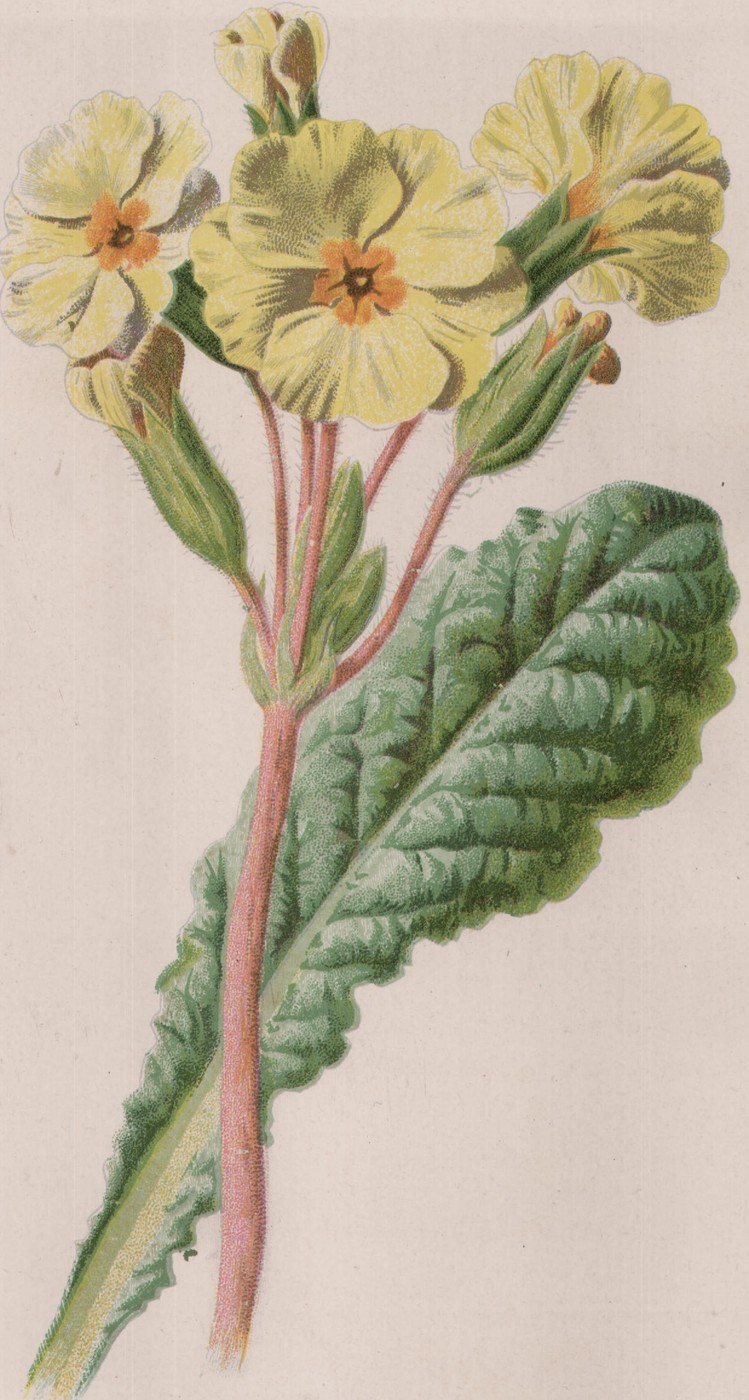
Daffodil
HONESTY, or LUNARIA. The first name is commented on in the description; the second refers to the moon-shaped seed-pods. N.O., Crucifers, or Brassicaceoe. LINNAEAN: 15, Tetradynamia.--The brassicaceous plants have the merit of distinctness, being "cruciferous or four-divided in their flowers, and they agree pretty closely in properties, being mostly wholesome, pungent, and highly charged with compounds of sulphur, a circumstance that accounts for the offensive odour they engender in the process of decay. They are all herbaceous or sub-shrubby; there are no trees in the order. The leaves are alternate, the flowers without bracts, the stamens six, sepals four, the petals four, stigmas two, the fruit a silicule or silique. It is a remarkably natural order, definitely circumscribed, and of great importance in its uses and relations. In the colouring of the flowers white and yellow predominate, but shades of red and purple occur as in stocks, honesty, candytufts, and aubrietias. The number of the stamens constitutes a curiosity in this family, and their disposition is equally curious. The symmetry that prevails so generally in the several organs of fructification is here strangely to be seen, for the stamens should number four or eight and be regularly disposed in relation to the sepals and petals, neither of which is the case. Lindley is inclined to account for the apparent departure from a symmetrical arrangement by supposing that the original number of stamens has been lessened by the non-development of such as are required to complete a hypothetical arrangement. PELARGONIUM, from pelargos, a stork, in allusion to the beak-like seed-pod. N.O., Crane's-bills, or Geraniaceoe. LINNAEAN: 16, Monadelphia; 4, Heptandria.--The great family of geraniums has but a small place in the arts, though a large place in the garden. They are herbs or shrubs, with tumid stems, leaves alternate or opposite, and flowers white, red, or purple, rarely yellow. The flowers are five-divided in sepals and petals, and the stamens are hypothetically) in numerical harmony with the petals, being twice or thrice as many, except when some are abortive. The curious results of the non-development of parts required for the complete agreement of a species with the characters of the order are amusingly illustrated by Endlicher's pelargonium, which has but two petals, owing to the suppression of three, the rudiments of which are visible. The one distinguishing character is what Dr. Lindley describes as "the long, beak-like torus, round which the carpels are arranged. and the presence of membranous stipules or joints which are usually tumid." Plants that have not these peculiarities are not proper members of the Geraniaceae. Between pelargonium and geranium the difference is obvious to the casual observer, and needs but to be pointed out to be readily understood. In pelargoniums the petals are unequal, and it matters not how "highly-bred" the florist's pelargoniums may be, the difference in size of the two lower petals is always discernible. In geranium the petals are all of one size and the flower is perfectly symmetrical. There are many hardy geraniums, but there is only one hardy pelargonium, and that is P. Endlicherianum, referred to above as having an abnormal flower.
KERRIA, named after M. Kerr, formerly superintendent of the Botanical Gardens, Ceylon. N.O., Rosaceoe. LINNAEAN: 12, Icosandria; 3, Trigynia.--The nearest alliance of Kerria is with spiraea.