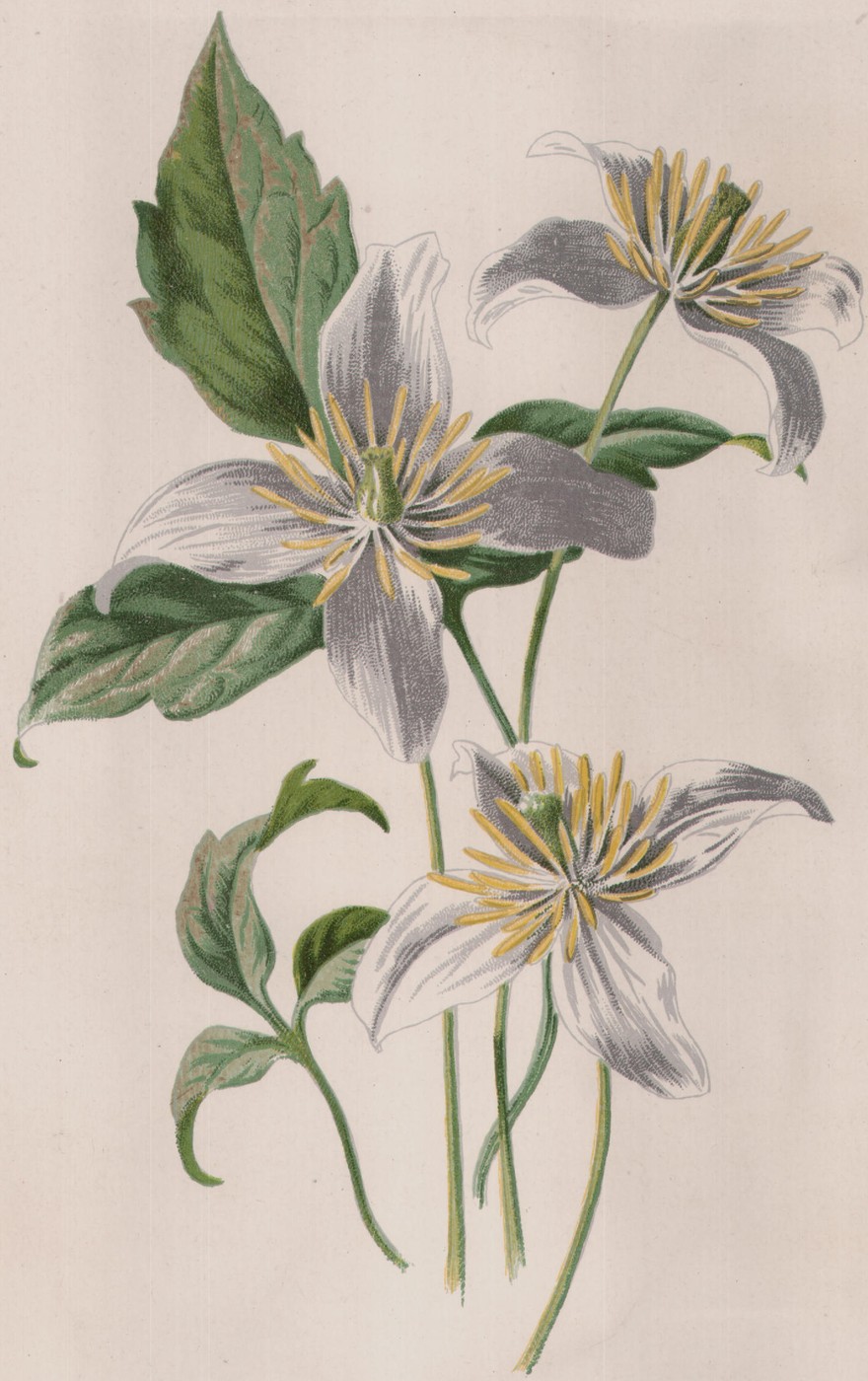
Oxlip
NEMOPHILA, from memos, a grove, and phileo, I love, the genus consisting of woodland flowers. N.O., Hydrophyllaceoe. LINNAEAN: 5, Pentandria; 1, Monogynia.--The order comprises smallish herbs and trees of comparatively little importance, as they have no place in the arts. The leaves are often ten-lobed, the flowers in racemes or spikes, occasionally solitary and axillary; they are five-parted, as in the flower before us; the fruit is a capsule. They are nearly allied to the phloxes, to the primulus, and to the borageworts. The pretty eutoca, a favourite garden flower, is a member of this order.
CAMELLIA. Named after Camellas, a Moravian missionary. N.O., Theads. LINNAEAN: 16, Monadelphia; 8, Polyandria.--The theads, or tea-plant family, are usually headed Ternstromiacoe, after M. Ternstrom, a Swedish botanist, but there appears to be more comfort in recognising them as the family that provides us with our tea. They are all trees or shrubs, with alternate, coriaceous leaves, usually undivided. The flowers are symmetrical in their aspects, but unsymmetrical in the numbers of their several parts, as there are five to seven sepals and five to nine petals, and stamens of indefinite number. The fruit is a capsule; in the camellia it is like a small apple, and contains many oily seeds. The tea-plant, Thea, is closely allied to the camellia, and as a matter of fact the leaves of our familiar favourite contain a certain quantity of thein and might be made available for tea. But the beauty of the camellia is sufficient for its fame.
HELIOTROPIUM, from helios, the sun, and trope, turning, N.O., Ehretiaceoae. LINNAEAN: 3, Triandria; 1, Monogynia.--This is a small order, comprising herbs, trees, and shrubs, with a harsh pubescence; the leaves simple, the flowers gyrate, the corolla in one piece. The nearest alliance is with the borageworts, and therefore the resemblance of the flowers of the heliotrope to those of the myosotis is not an accident, but has a scientific significance. Most of the ehretiads are tropical, and occur in both hemispheres. BERBERIS is named from the Arabic berberys. N.O., Berberidaceoe. LINNAEAN: 6, Hexandria; 1, Monogynia. The "barberry" in all its forms is easily recognisable, and is one of the most interesting of the many families of familiar plants our gardens afford the means of studying. The order comprises a few herbaceous plants, such as the epimedium, a peat plant of great beauty, but trees and shrubs prevail, for the most part hairless, but often very shiny. The leaves are compound, the flowers solitary, consisting of three to six sepals and petals systematically arranged. The fruit is a capsule or a berry, the more conspicuous species of berberis producing an abundance of handsome berries of a sharp, austere flavour, but wholesome and adapted for making preserves and wines. The genus Berberis is the most important, and is by some authors separated from Mahonia, the first comprising the kinds of which B. vulgaris is the type, the second those of which B. aquifolia is the type. The distinction serves no useful purpose, or at the best only marks the two ends of a system of gradations. As garden plants the shrubby kinds are of the highest importance, being hardy, various in aspect, handsome, and producing a gay show of yellow flowers in the spring of the year. The irritability of the stamens is a point of some interest: when touched at the base with the point of a pin they all spring forward and clasp the pistils. CENTAUREA, from centaury, a plant fabled by Ovid to have caused a wound in the foot of Chiron, one of the horse-breakers of Thessaly. N.O., Composites, or Asteraceoe. LINNAEAN: 19, Syngenesia; 3, Frustranea.