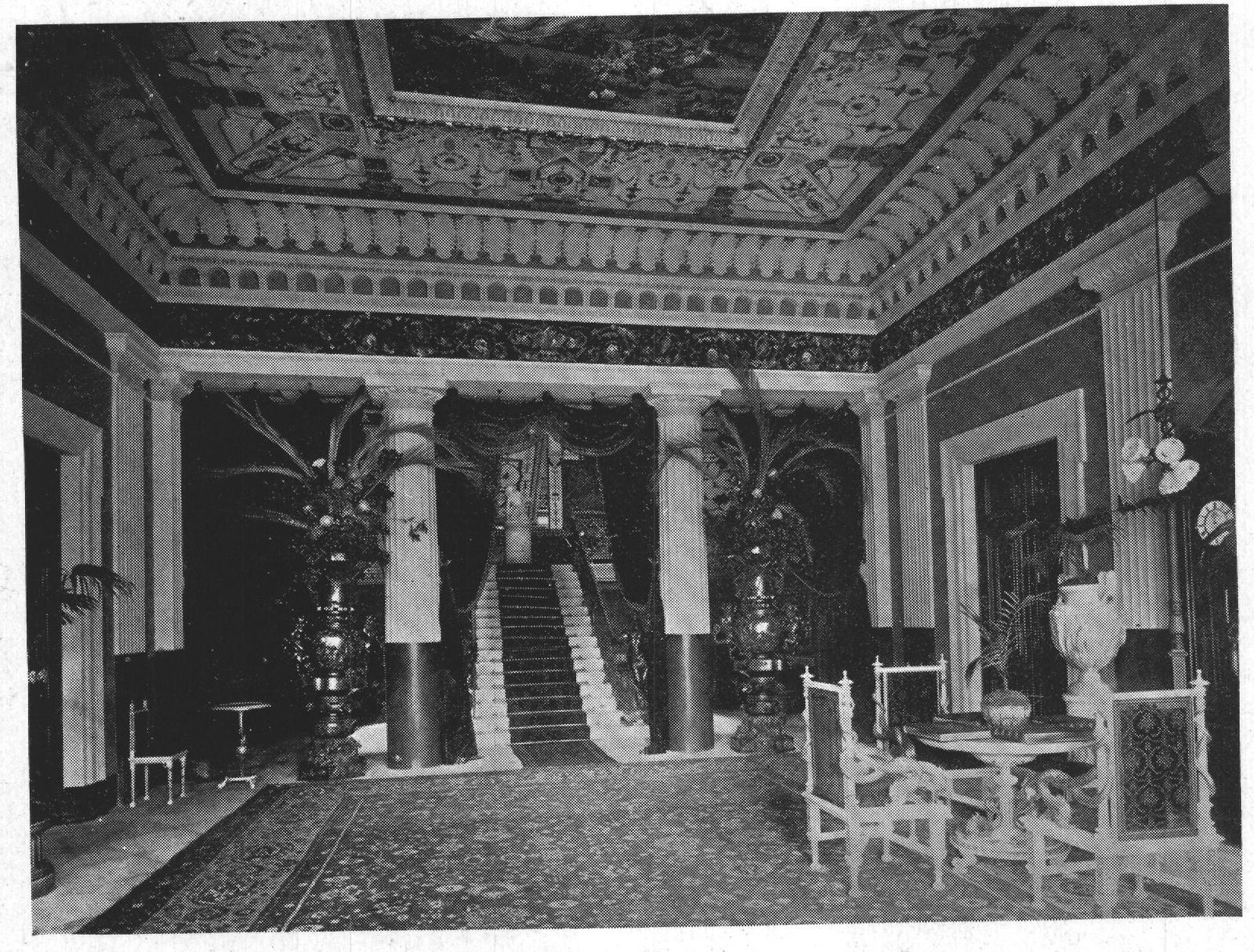
† Now the property of the German Emperor.
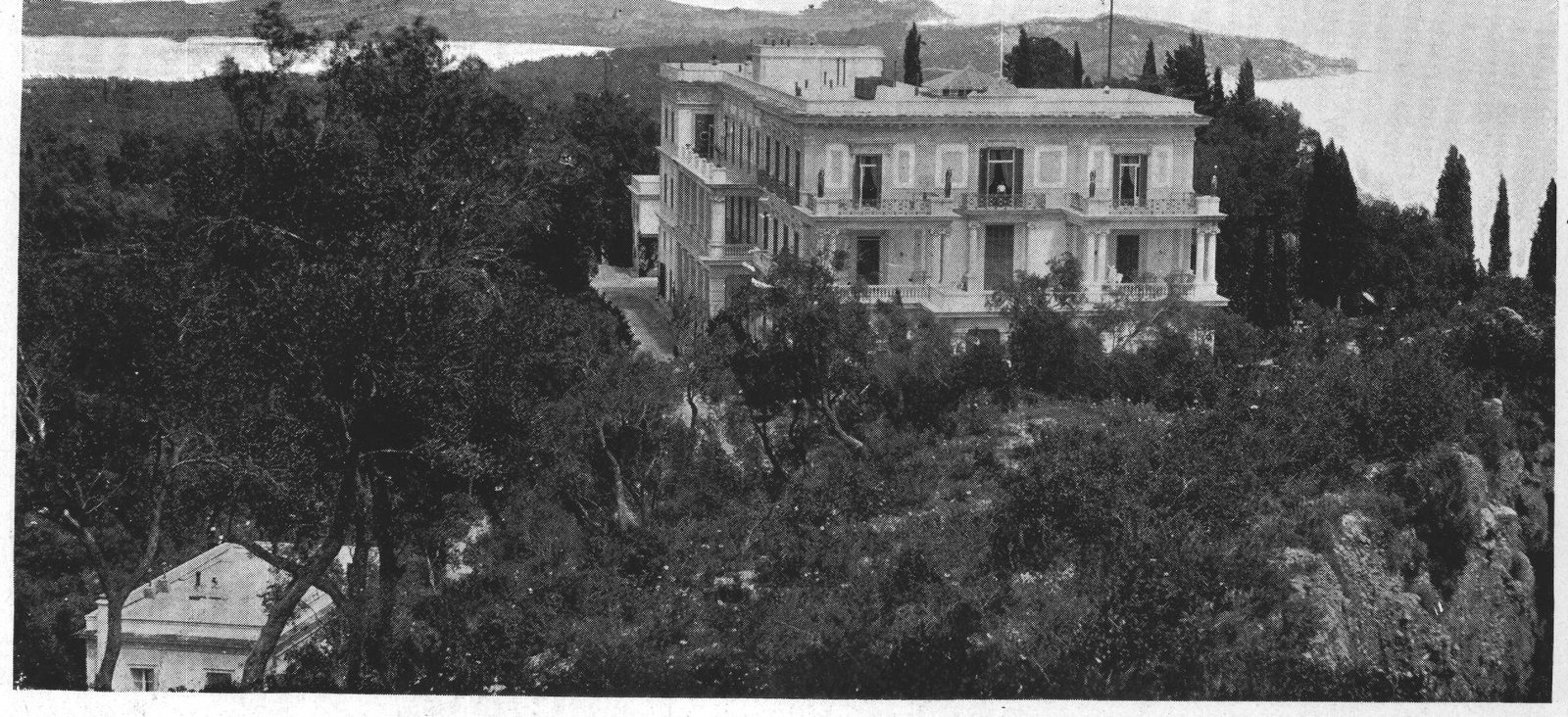
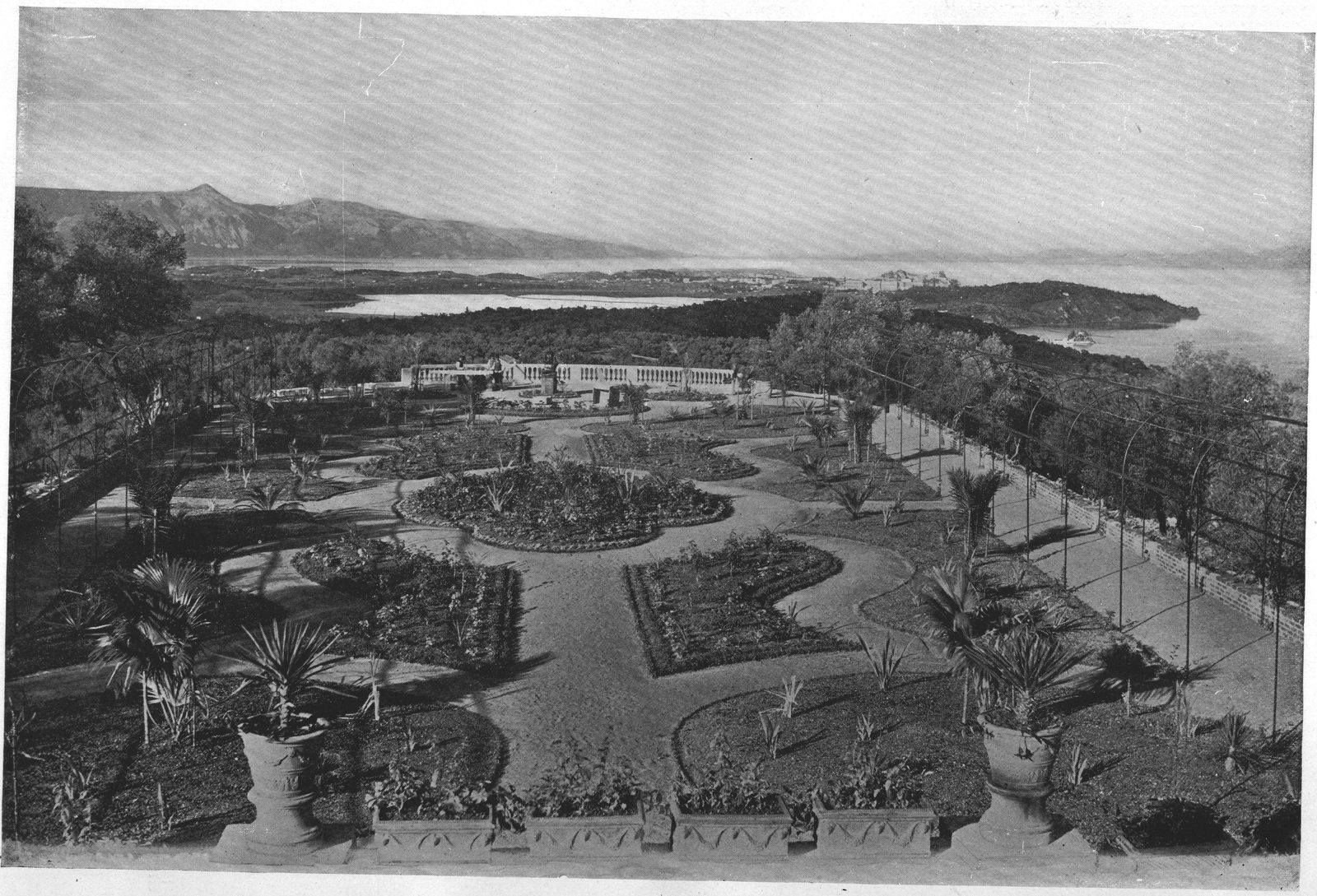
THE pride of the "Hepta Nessie," the seven isles of the Ionian which once were formed into a separate confederacy under the Venetians and later under the régime of Great Britain, is Corfu, the Corcyra or Kerkeera of the ancient Greeks. The gem of the island is the palace of the late Elizabeth, Empress of Austria, which stands almost at the summit of Mount Kyriaké near the little village of Gastouri, overlooking the harbor and city of Corfu and commanding a surpassingly rare and beautiful view of Epirus and Albania, and of the narrow stretch of sea which alone separates the island from the mainland. On this rock-bound coast, 174 meters above the Ionian, this monument to the wealth and esthetic taste of the unfortunate Empress has been reared regardless of temporal and material considerations, but regardful of symmetry and system, of art and artistic adornment, to such an extent that it may well be classed among the most attractive domiciles of Europe. Yet it is neither a poem nor a dream, as the ultra-esthetic are sometimes inclined to name it. Neither is it an oasis in the heart of a desert; for the fertile though poverty-touched island is anything but deserted. It is not even the "Fairy Palace" of Viennese imagination, but a beautiful home, a luxurious retreat into which ambition and a true sense of the beautiful, abetted by wealth, have brought together and displayed the works of art and architecture not merely to delight the senses, but above all to elevate and inspire. The Achilleion is above all things Greek, as its name implies, yet it is also cosmopolitan, for it has called upon many sections of the world to contribute to its equipment and conveniences. Modern in execution and design, the light, rich touches of the East are joined with the more ponderous and elegant effects of the North and West. Its spirit is withal Greek, but Greek of that early age which the world has come to look upon as its own,—the age of Homer and of those beautiful, mythical days which have proved an inexhaustible storehouse from which men of every subsequent period have never ceased to draw ad libitum.
Thus it is in the air of these classic days, and in the presence of the world's master minds in literature, philosophy and art, that one breathes the spirit of the Achilleion more than in the beauty of its surroundings or the comprehensiveness of its position. However, it so happens that we are concerned more particularly with the latter, although no description of the Achilleion which slights the former is either complete or just.
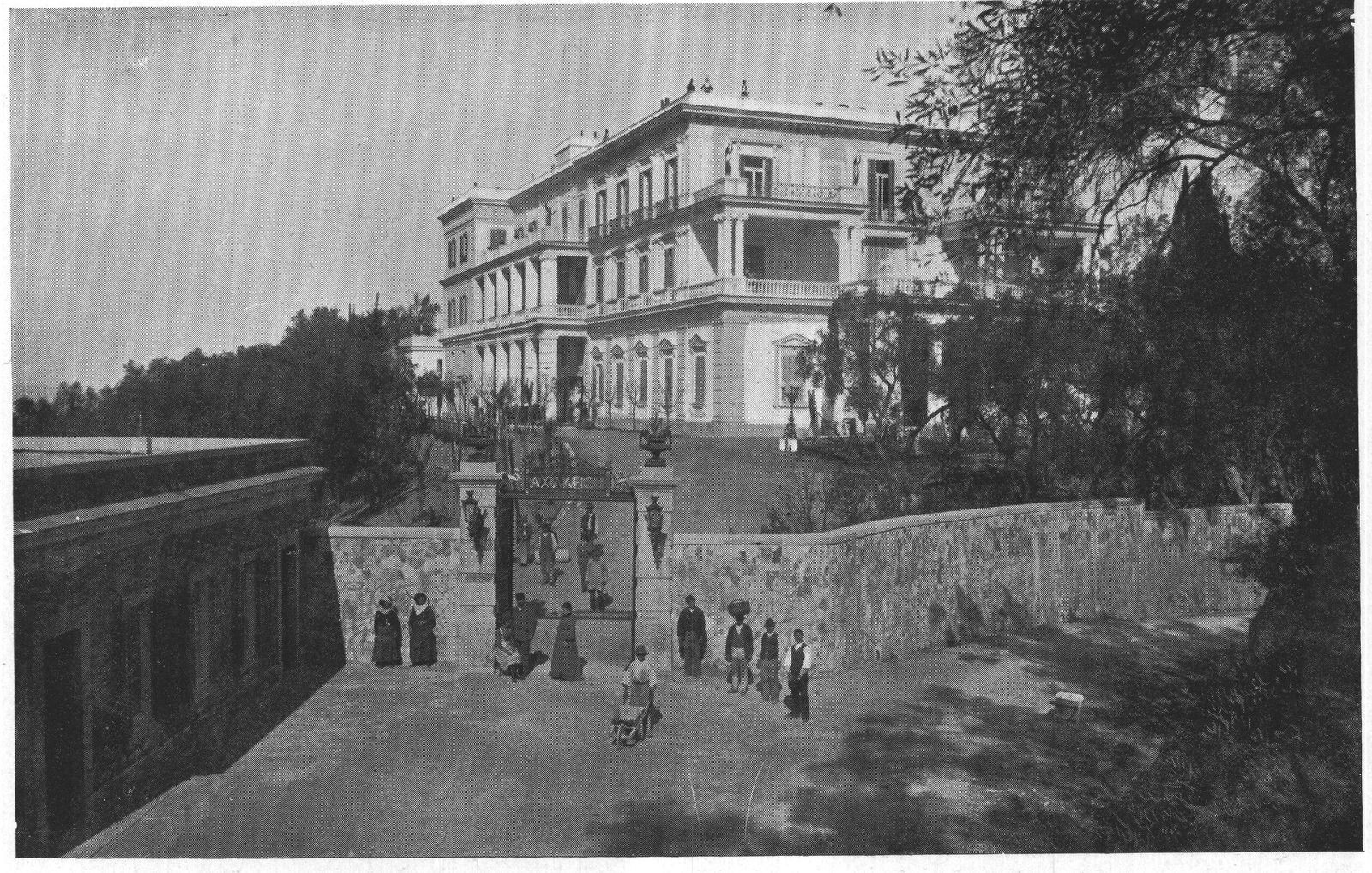
Visitors to the Achilleion may go by sea to the private landing of the palace near the little fishing village of Benizze, whence they may follow the beautiful, easily rising roadway which leads from the small marble pier around and around the steep hillside to the palace above. Or they may drive the eight miles, stretching between the city of Corfu and the palace, along the road which winds about the little lagoon,—Lake Kalikiopulo they call it,—and among olive trees old enough to be saints, until it threatens to land one at Hagii Deka, turns unexpectedly into the ramshackle old town of Gastouri, and plants one without preliminary warning at the lodge-keeper's gate. There one pauses long enough to spell out the letters ΑΧΙΛΛΕΙΟΝ, boldly displaying themselves above the great entrance gates, and takes a hurried and none too satisfactory glimpse at the main entrance of the palace, although in his eagerness to sweep the whole at a single glance, no less than in his belief that he will study the opening effect more minutely upon his return, his first impressions are more or less hazy and undefined. Nor is the visitor alone at fault. The palace, rising so majestically at close view, leaves the eye unprepared for things of an order less magnificent. And between admiration for the stately edifice of marble, and the natural inquisitiveness to know what lies beyond the broad staircase leading off to parts unexplored, one has little inclination to follow the driveway to the left for a fuller or more comprehensive view of the palace, or to wander so much as a few paces along the terraced walks which lead to the right.
Meanwhile the setting of tropical plants and shrubs which adorn the space immediately before the great porte-cochère is almost lost to view. So that if there is one regret, aside from the regret common to all visitors that things so perfectly ordered must be so soon left behind, it is that the proximity of this magnificent and splendid structure to its ground entrance renders an appreciation of its points of architectural excellence little less difficult than the appreciation of a towering American skyscraper from the sidewalk opposite.
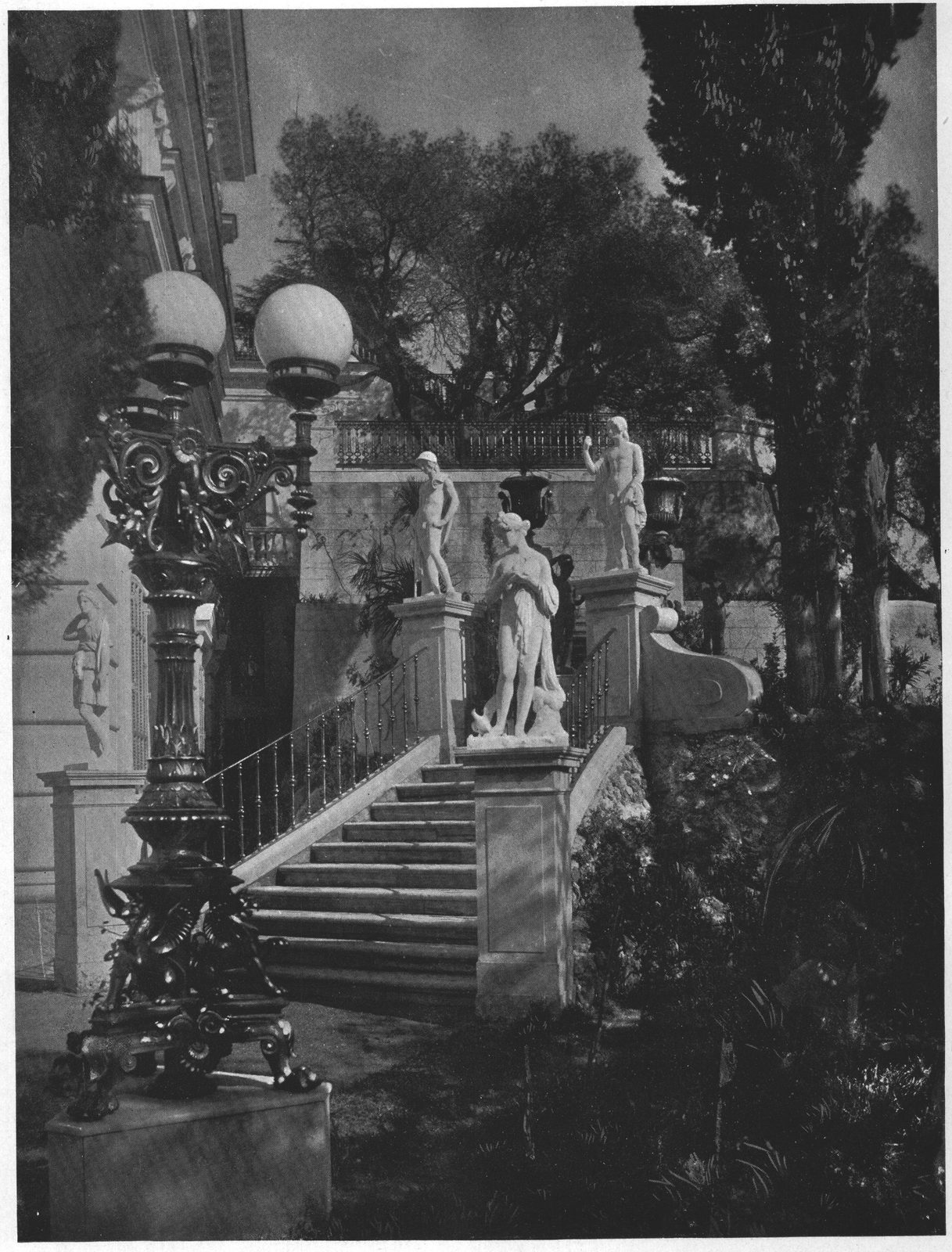
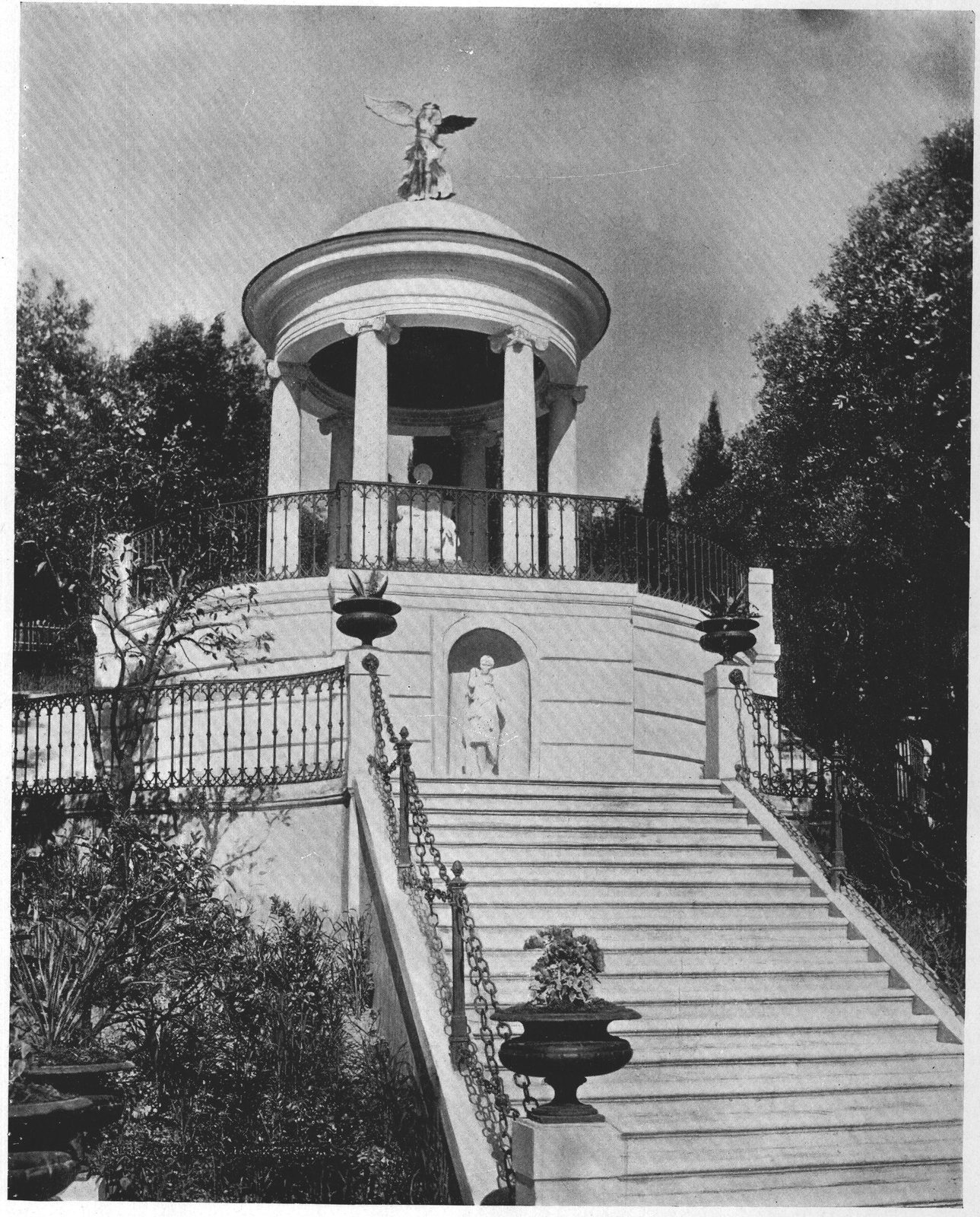
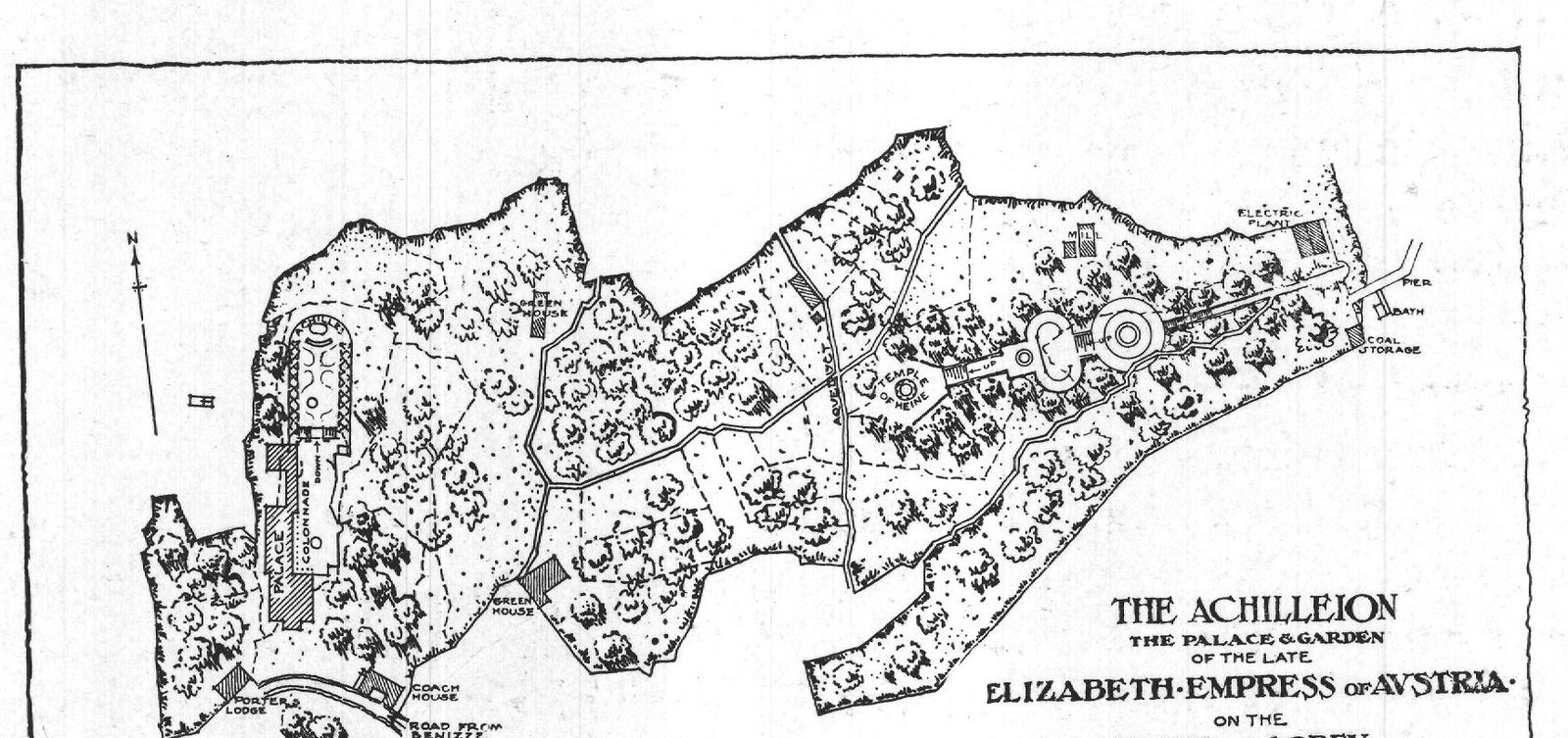
The gardens lie to the rear of the palace on a level with the first floor above the ground floor, and are reached either from within by the grand staircase which opens upon the colonnade, or from without through the beautiful series of marble steps that lead up from the right side of the palace and continue in an avenue of serpentine windings to the colonnade above. Its statues of alabaster whiteness, outlined against a background of ivy-covered walls and overhung by the tall Dendra diaphora which lift their heads from far beneath, form a picture of almost perfect shading. It is doubtful whether any one section or object in this palace beautiful, excepting the masterpiece in marble of the Dying Achilles or the poetic beauty of his triumph over Hector, has a more perfect setting and produces a more pleasing and lasting impression than this marble approach to the palace gardens.
These gardens, comprising three plots terraced into the mountainside, run practically north and south, and the serpentine approach terminates in a semicircular court which opens into the upper terrace at its southeastern corner on a level with and facing the colonnade. The visitor's first impulse is to begin with the colonnade, inspect the first terrace, then in order, the second and third, and finally to return and inspect the palace. A decade ago such an order of procedure probably produced the most satisfactory results,—provided of course one got any farther than the colonnade, which happens to be a most detaining spot,—for then the tall palms and the numerous other varieties of tropical plants were little more than shrubs. To-day, however, these same shrubs are no longer children but grown men, as it were, and the view of a terrace from the one next above is anything but satisfactory, unless one is content with evidences of an artistic beauty too general to analyze, and with a rather confused and too jumbled idea of what is to be seen and of what has been seen. There is plenty of evidence, in fact, that from the beginning these gardens were meant to be viewed from north to south to obtain a concrete idea of their plan. At any rate it seems most satisfactory that we pass unceremoniously through these gardens oblivious of their points of beauty until we stand at the extreme northern limit of a small plain attached, as it were, at right angles to the mountainside, from which the view is bounded only by the limit of human vision.
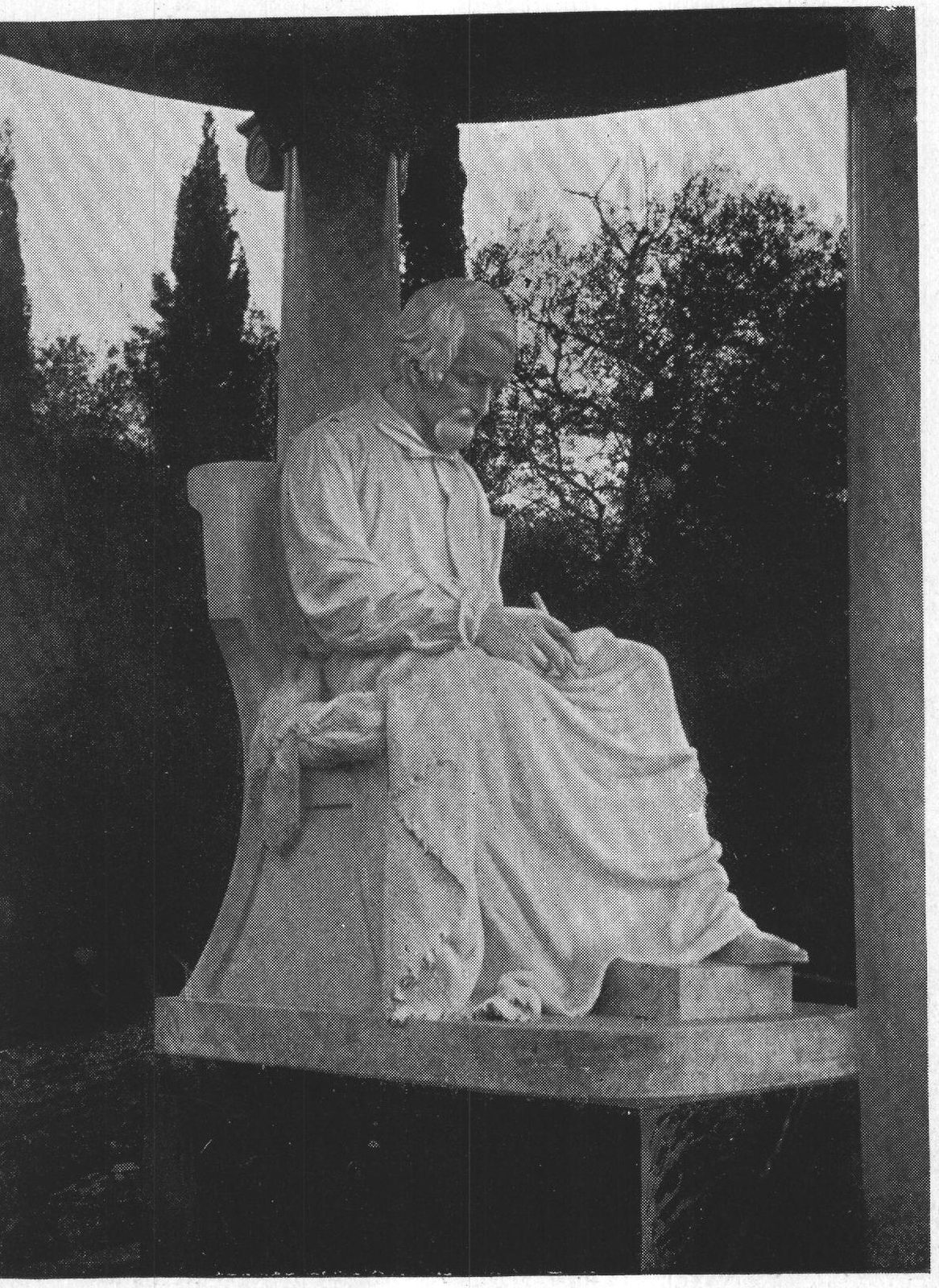
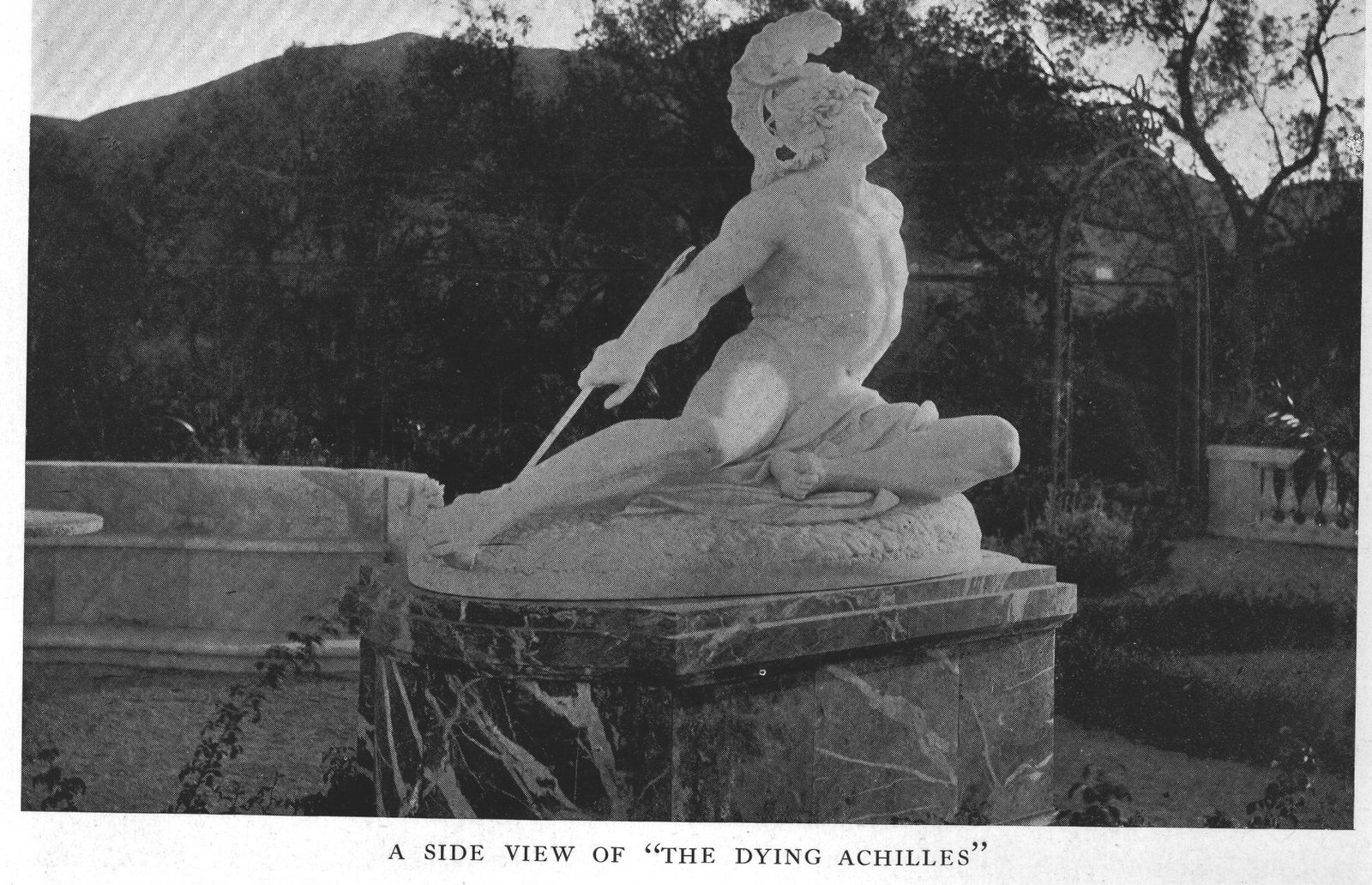
Here in the apex of this somewhat conically shaped garden is located the Dying Achilles, sculptured from Carrara marble by Herter in 1884. As a block of marble, it is faultless; as a work of art, magnificent; and as the crowning feature of the Achilleion, as well as the standard by which every other piece of art has been measured, nothing else of its kind could be conceived more appropriate and more perfect. To look upon that powerful yet graceful form in its agonizing struggle with Death, who has at last found the vulnerable spot with his poisoned dart, is to know as one can scarcely know otherwise the power and influence of the Homeric mind which conceived the character, and to more truly appreciate the inspiration which those patriarchs in literature have given to the art of subsequent ages.
Immediately back of the statue is a semicircular seat of marble overtopped to-day by a tapestry-like hedge of bonibus, and filling the space of this semicircle is a tea-table of Indian granite. Leading to the immediate right and left of the statue are the garden walks, whose ramifications increase in number until the center of the terrace is reached, then decrease in the same proportion to the grotto at the southern end of the garden. The plots of ground thus laid out by these ramifications are correspondingly numerous, and vary in size from the two small ones on the immediate right and left of the statue, to the large one in the center about which are grouped four others of equal size and of like design. Each plot is bordered by a narrow hedge of boxwood, cropped very close, and the whole garden bristles with tropical and quasitropical shrubs of a variety, size and condition such as would more than vie with a tropical garden itself. The phœnix and date palms, numerous and without blemish, are set with every regard for their proper expansion, and the whole plan is free from any sign of crowding or of that confusion of flowers, shrubs and tropical plants such as is too often met with in gardens which grow under these climatic conditions. There is, in fact, a conspicuous scarcity of flowers in this first terrace; and while one remarks the scantiness with which a few of the ordinary varieties are scattered about, he also remarks the restfulness which steals over him as he inspects a spot so elegant, yet so quiet and free from affectation, and so much in harmony, by reason of its very contrast, with the wild mountain scenery about it.
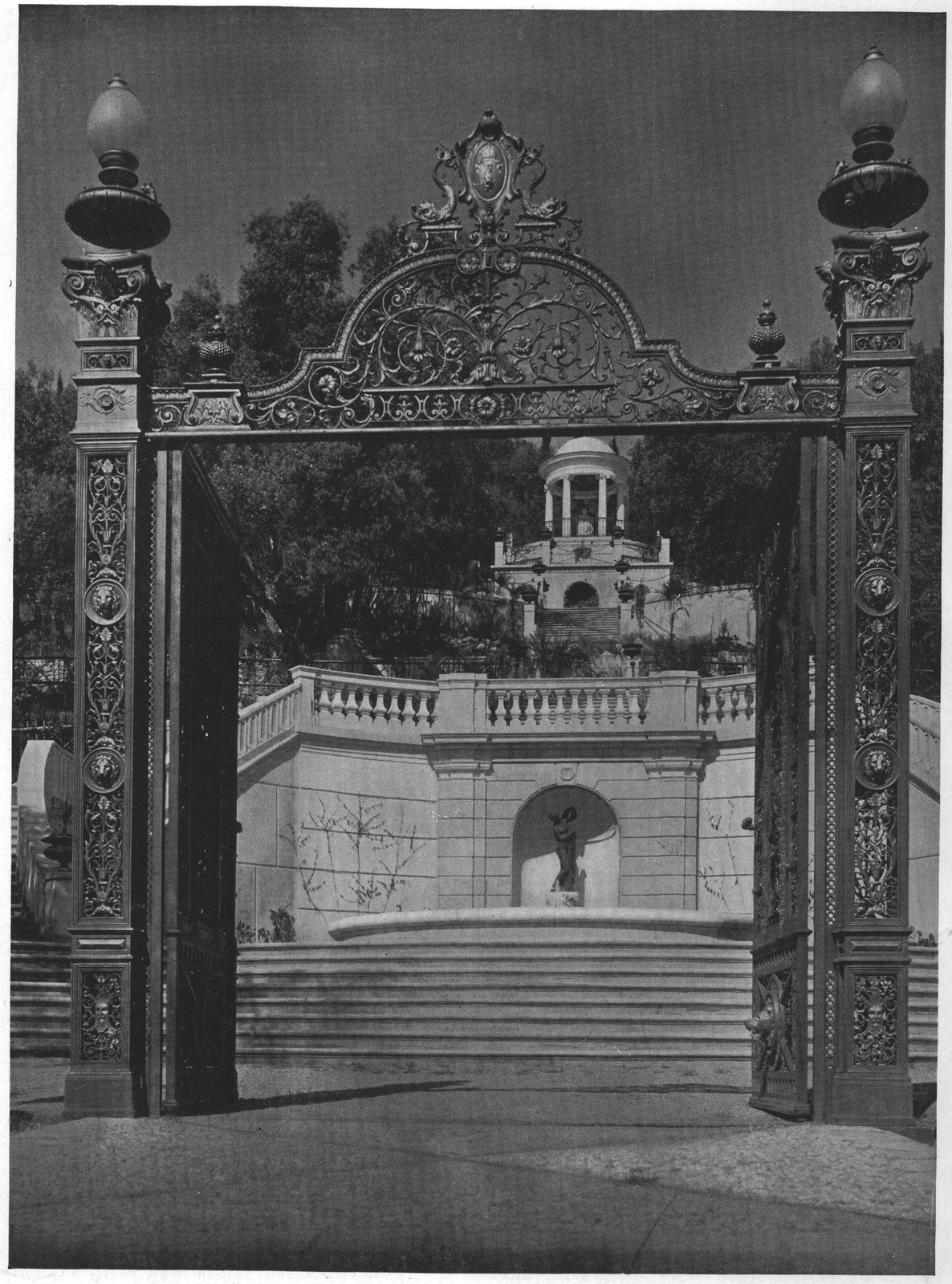
To the far right and left of the Achilles, following the marble balustrade which caps the garden wall rising like a giant fortress from the mountainside beneath, two other paths lead away and are almost immediately lost in the arbored avenues or pergolas which follow the garden walls to their southern limit and converge at the grand marble approach to the second terrace. These walks now canopied with vines of great beauty, form a cool retreat for the numerous potted plants whose frail natures are not proof against the searching rays of the summer sun, and their noticeable though slight convexity of form as they draw in toward the southern end of the terrace, contribute much to the general beauty and harmony of this section of the garden.
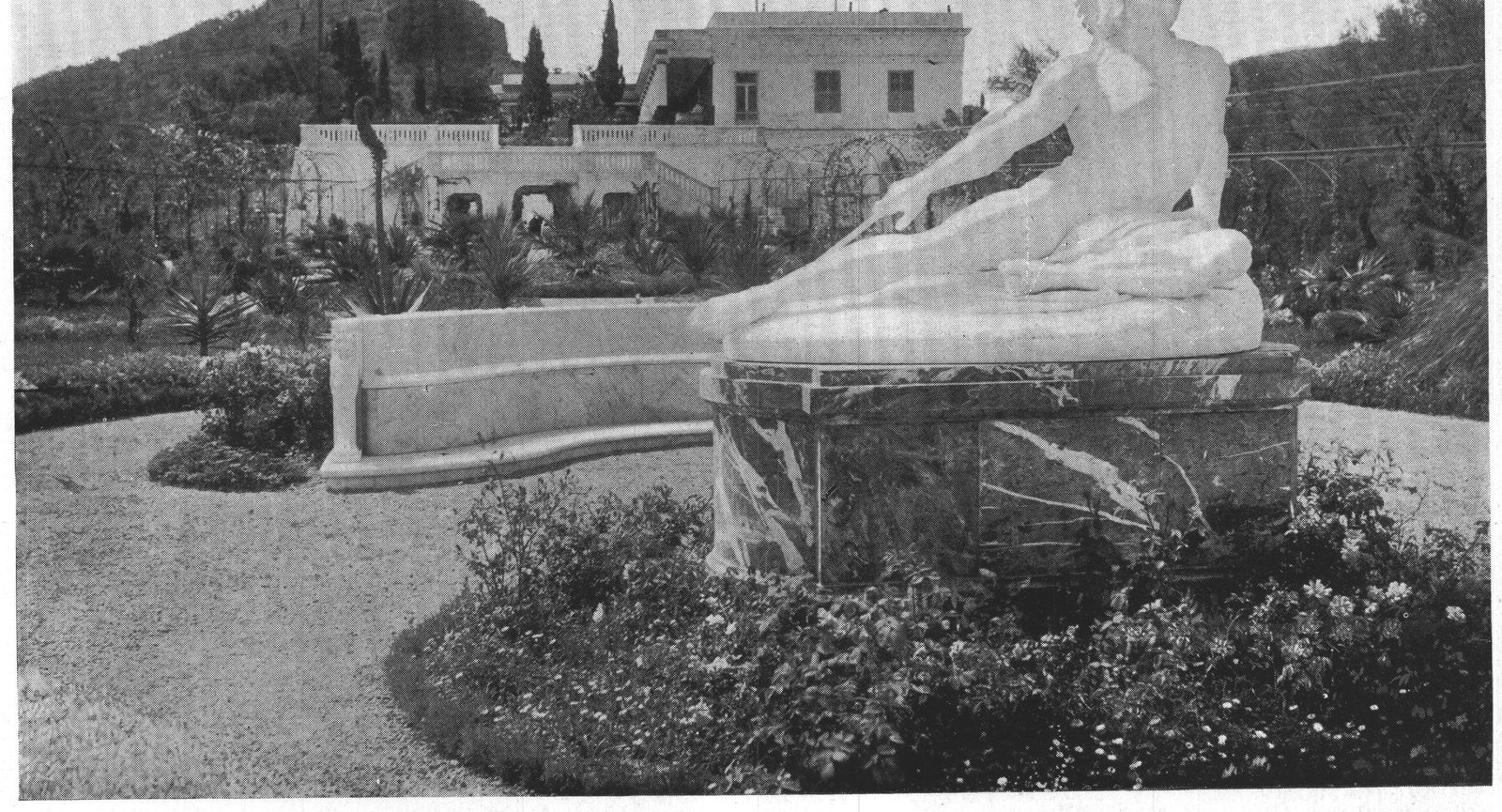
The formal arrangement of this terrace is worthy of a word of special mention. In the exact center and in a direct line south of the great statue at the northern limit is the statue of the coming midshipman, a little sailor lad in knickerbockers, jersey and tam-o'-shanter who sits upon the side of his diminutive bark intent upon the nautical chart laid open before him. About the base of the statue is clustered the finest collection of flowers in all the garden, and overtopping it is a splendid specimen of the magnolia tree.
Back of the statue at the extremity of the terrace and forming a part of the marble approach to the second garden above, is the grotto, one of the charming sights of the Achilleion, and certainly the most striking phenomenon of this altogether phenomenal spot. Its deep recesses of stucco, half hidden to-day beneath a heavy, clinging growth of vines, give no little promise from without of intricate windings and subterranean passages. The visitor, peering somewhat timidly into these cavernous openings, is startled at seeing in the distance a diminutive garden of great beauty and of equally great distinctness, catching in his line of vision the play of muscles in the back of a second sailor lad, the gentle waving of many palms, the tufted helmet of a fallen warrior, and beyond all these the blue of the sea, and hill rising upon hill in unbroken succession till lost in the clouds above. One's scattered faculties are neither quickly nor easily reassembled to the task of persuading the mental eye that it has merely seen in these mirrored depths the beautiful lower terrace of the Achilleion in reverse order; and the magical illusion is not dispelled until long after the palace has been left to its quiet watch on the mountainside.
A description of the second terrace must, of necessity, partake of the general nature of the foregoing, and yet there is everywhere that evidence of variety, coupled with symmetry, which does not escape the sensitive appreciation of the spectator, even though it may be found too subtle for expression in words. The two terraces have much in common, it is true, both being veritable palm gardens, and both are singularly free and open in design. It is noticeable that on the first terrace there has been a preference for the date palm, while on the second the phœnix flourishes in greater number, and there is here to be observed, possibly, a greater variety of shrubs. But the principal point of difference lies in the arrangement, and it is in this that the visitor finds greatest cause for admiration. Whereas the first terrace was laid out with its points of greatest interest at its extremities, the second is arranged about a real central figure, no less a personage than the winged Mercury, whose talaria as well as the tall pedestal upon which the statue rests are now hidden in a sphere of the inevitable bosso. In fact the agile god seems to have risen like Venus from the foam of the sea, except that the foam has been replaced by a great evergreen bubble. At its southeastern extremity the terrace opens upon a shaded avenue which winds about the hillside to the water's edge. We turn aside here, not with a view of making the descent and of inspecting the water works, the electric plant, and certain other mechanisms of the palace, but to glance at the splendid statue of Byron which has been set up close by this exit. It is altogether appropriate that this distinguished Englishman should find a place in the land he served and supported; and the statue depicts admirably that delicacy which is the ineffaceable heritage of this unique figure in literature. Greece also boasts another statue of the famous bard set up in a little province of the North, where tradition says he left his heart if not his body; but the statue of the Achilleion is the statue of the living not the dying Byron.
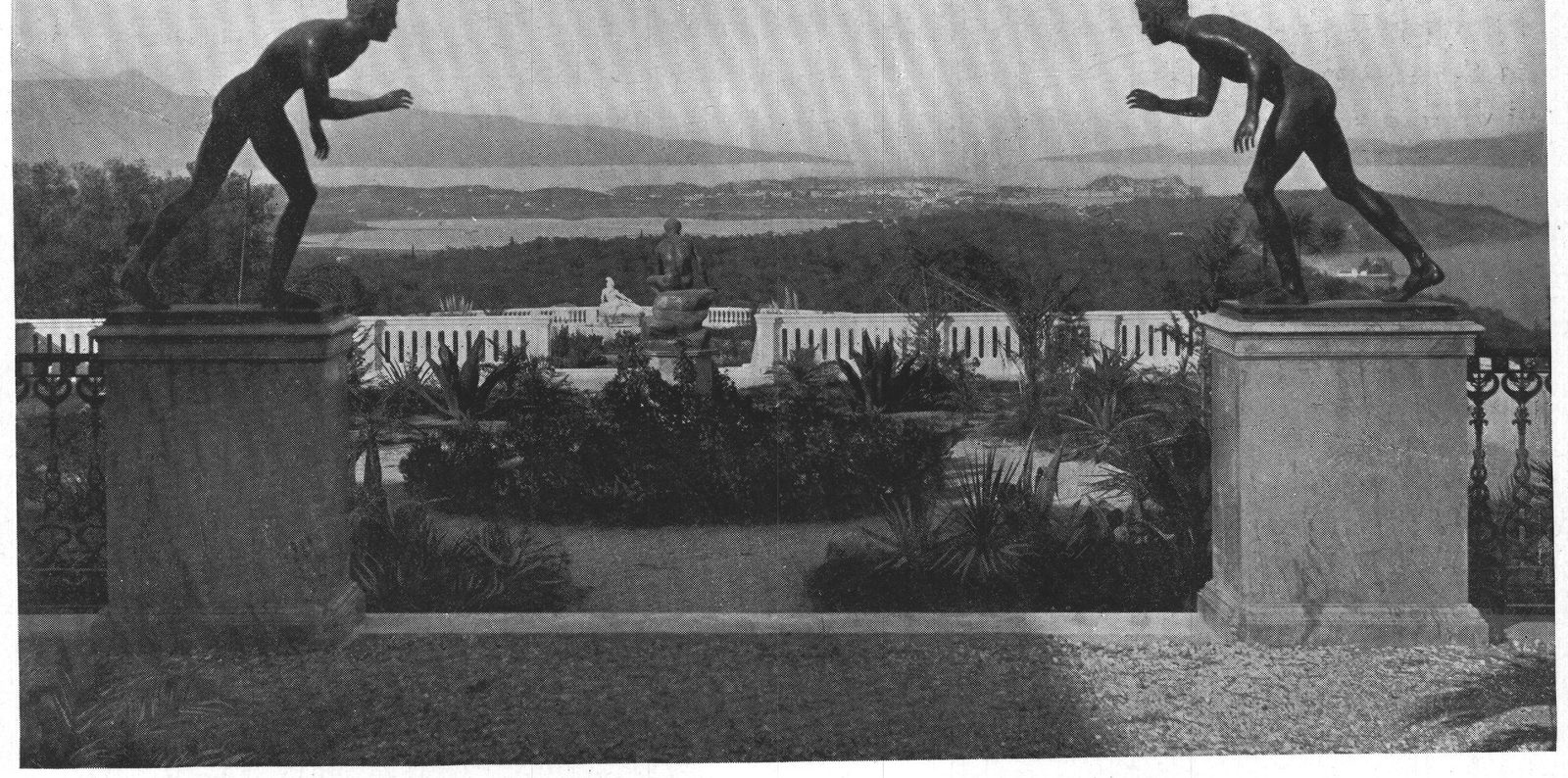
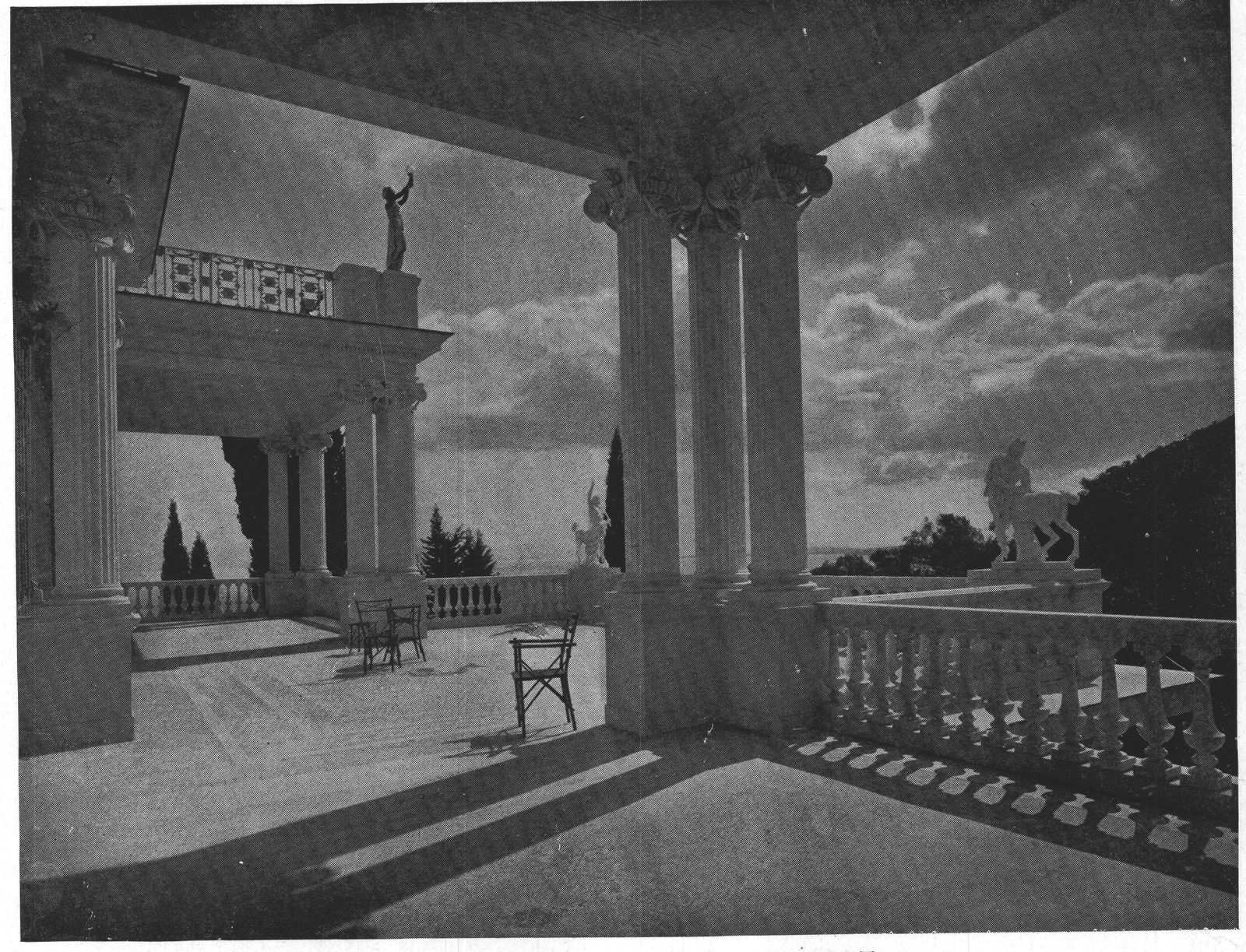
Passing between the nude bronze forms of the gladiators who stand guard at the entrance from the second to the third terrace, the visitor finds himself divided in opinion upon the excellencies of this last garden, and full of wonder at the difference which exists between it and the other two below it. One is not quite sure wherein this difference lies. There seems to be a relaxation in the somewhat rigid plan followed in the other gardens; walks have not been laid out in any exacting manner; palm-trees have given place to numerous cypresses which rise in alternating heights according to their peculiarity of growth and age; and the flowers which have played an insignificant and sorry part hitherto, here blossom out in great variety and beauty. Toward the center of the plot is placed a fountain in the figure of the Dolphin, after the original in the Museum at Naples, and to the rear of it is a pleasing statue of Bacchus. On the left or eastern side is found a counterpart of the beautiful semicircular seat of marble in the first terrace, with its tea-table of Indian granite, but without the capping of hedge which added a peculiar charm to the settle by the statue.
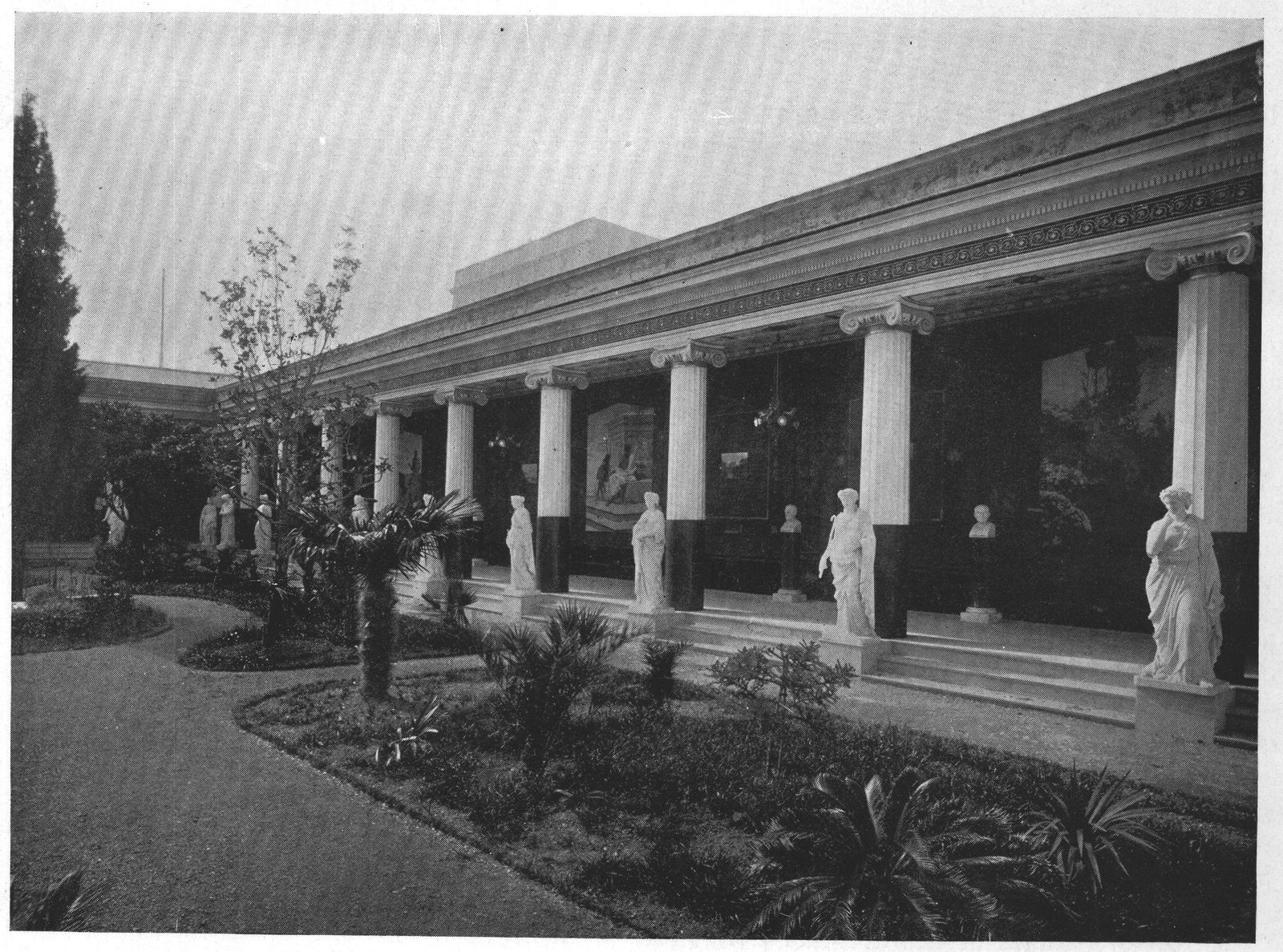
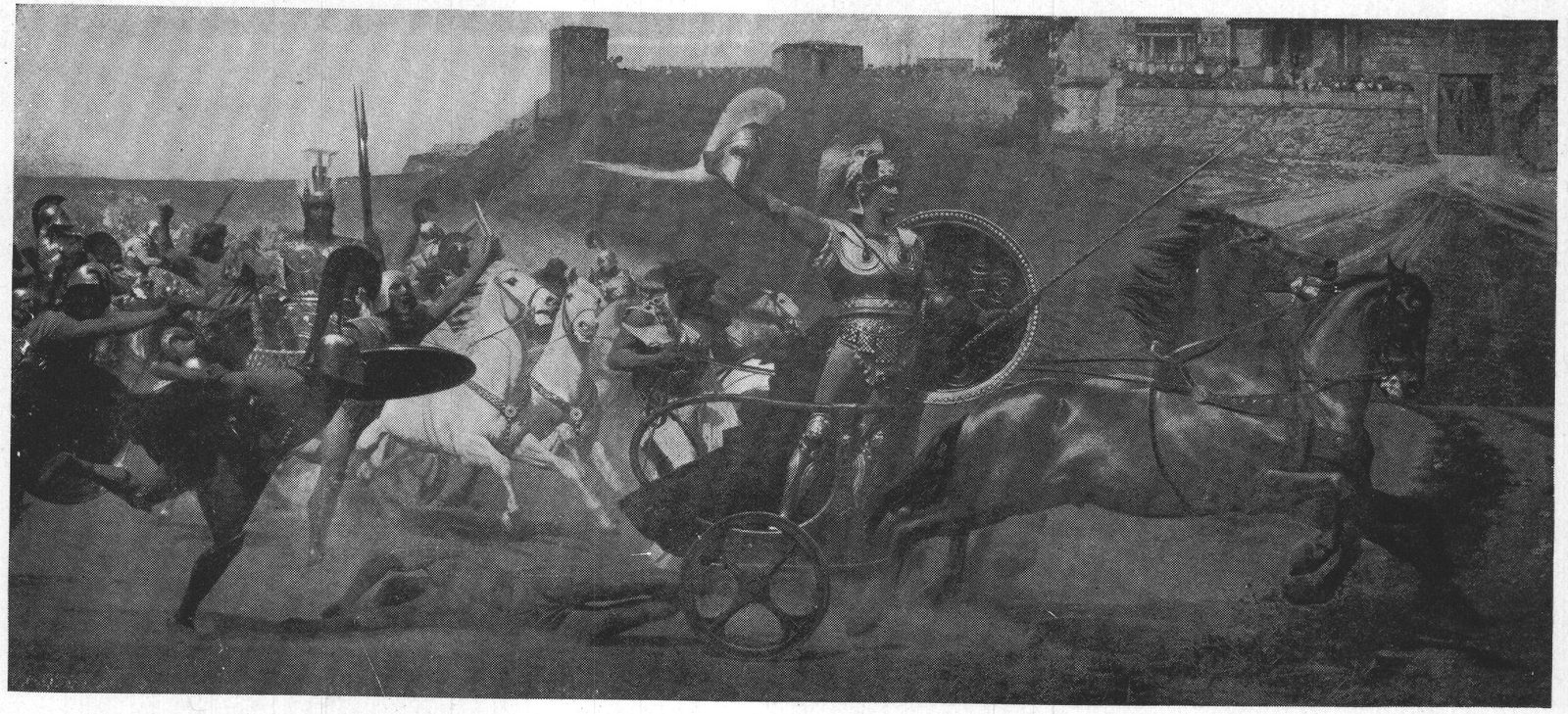
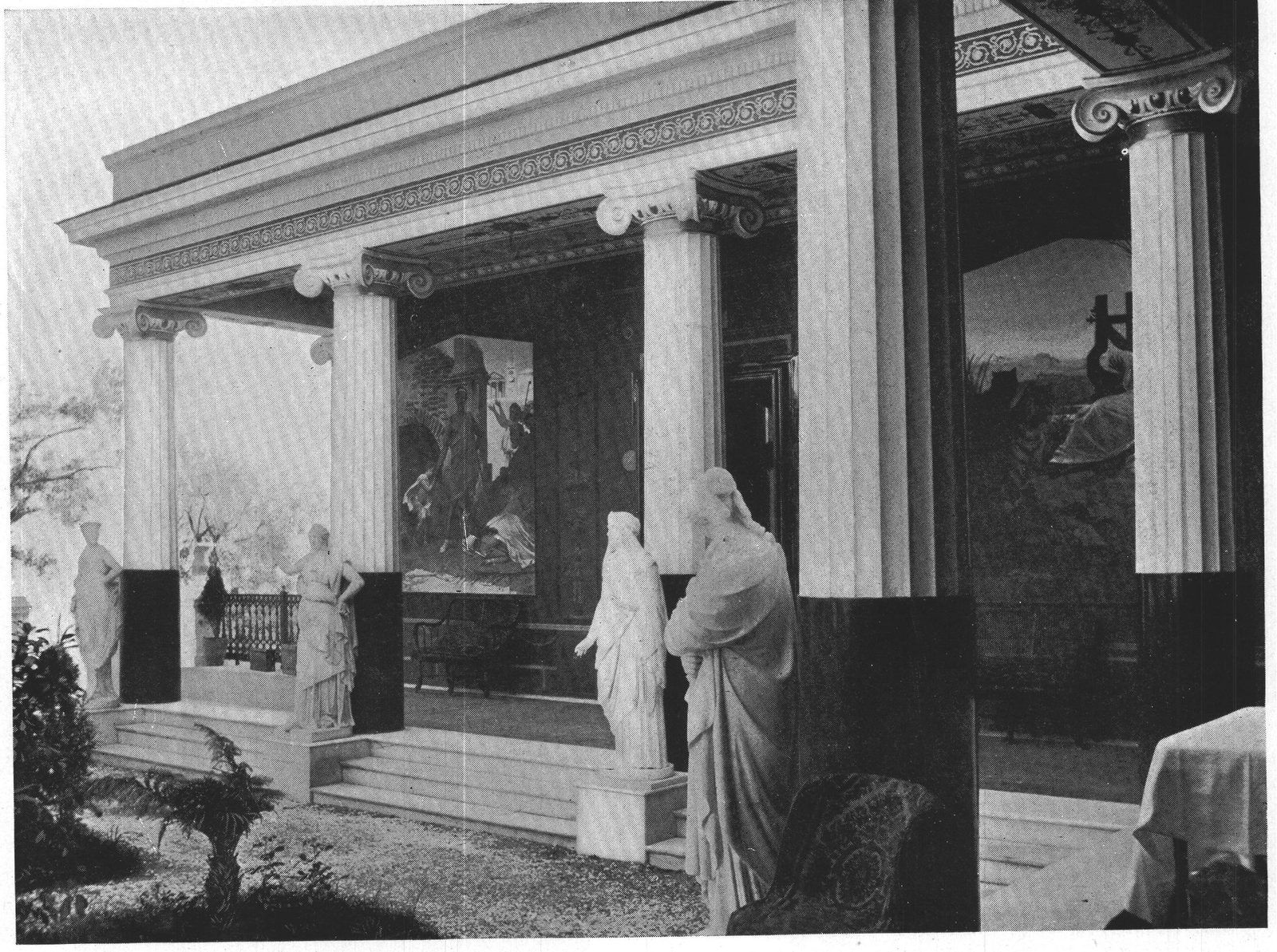
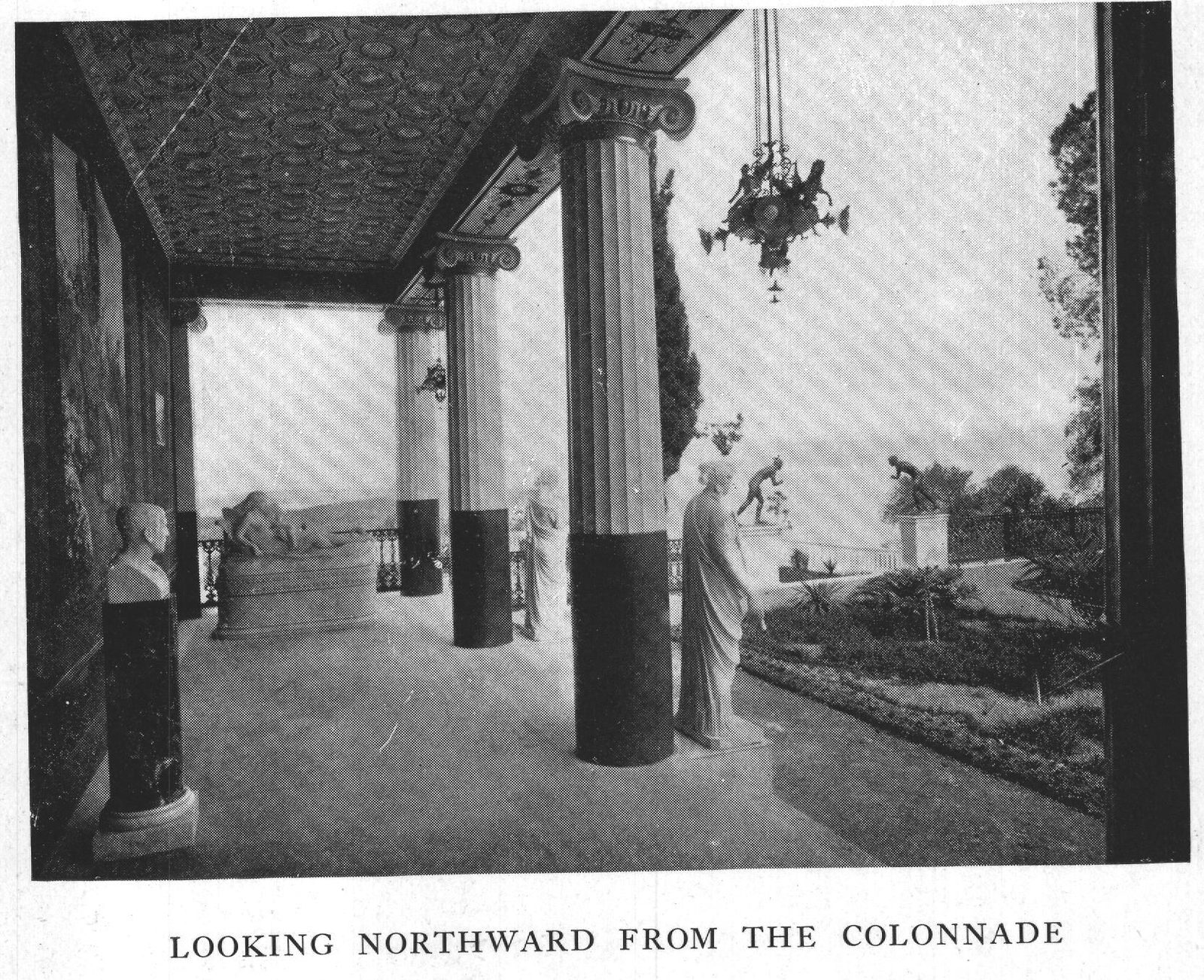
But the spectator is always conscious of the colonnade, which forms the boundary of the terrace on its western and southern sides. It is not easy to describe its points of chief interest, or to estimate the nature and extent of the influence which its classic and beautiful setting has upon the Achilleion as a whole. Beside each of its twelve Ionic columns stands a muse; and it is a relief to find these classic maidens taking up their abode on a level with humanity rather than upon some towering height, as if their lofty mountain origin precluded them from sharing the habitat of men. At the colonnade's northern entrance is a beautiful statue of Leda, mother of Helen, then in order come the busts of Posidonius, Demosthenes, Antisthenes, Zeno, and others of the patriarchs of classic ages,—eleven in all,—and at the southern terminus, more truly speaking, the eastern terminus, since the colonnade makes a turn at right angles, stands the twelfth and last, the bust of the immortal Shakespeare, the only Anglo-Saxon whose name has been enrolled in this Hall of Fame. Of equal interest with these classic names whose forms adorn the colonnade throughout its entire length within, as do the forms of the Muses without, are the mural paintings which decorate the spaces above them. Here at the northern terminus is found a splendid reproduction of the Homer of Gérard; then, in order, are the story of Orpheus and his enchanted lyre with which he charmed even the wild beasts of the forests; the gallant Perseus rescuing the fair Andromeda from the very jaws of the dragon at her feet; and a vivid representation of the somewhat fickle but altogether fearless Theseus who stands triumphant over the hideous Minotaur lying bleeding below him. One admires these painted stories of mythical days and deeds not only because of the art with which they have been chosen and executed, but because they are themes whose surroundings are such as to induce and compel admiration. One might almost say they are not entirely free from local coloring, for in the distance lies the mythical Phæacean ship which brought Odysseus on his way to Ithaca; a few hours' journey to the south is the home of the faithful Penelope who patiently awaited the return of her lord and master, while one can all but catch the rift in the mainland through which the mysterious, Plutonic Acheron finds its way into the sea. Again Achilles is recalled to us. Entering the palace from the eastern extremity of the colonnade, one is face to face with the heartrending but magnificent scene of the death of Hector—The Triumph of Achilles. It is a scene resplendent with the color of life and somber with the shadow of death, a scene that brings again to mind the greatness of the intellect which conceived it, no less than that which gave form to the conception. The mangled Hector, dragged relentlessly before the swimming eyes and amid the deafening cries of his helpless countrymen and friends, becomes to the spectator an object of sincerest pity, while the heartless victor is to him both wonderful and shameless. And turning from the scene, he seeks again the open air and, catching in the distance a sight of that same victor in the agony of death, he whispers to himself, "How are the mighty fallen," and the hate for the heartless victor triumphing over his fallen foe melts away to be replaced by commingled pity and admiration for the no longer conquering but conquered hero.
Silently the visitor steals from the spot, as yet unconscious of the thing or things which have impressed him most, but knowing only that whether he remembers in detail much or little, there has been indelibly impressed upon him somewhere a feeling of the elevating beauty and harmony of the Achilleion which neither the passing of the years nor of scenes still more beautiful can ever efface from his memory.