AMONGST the historic houses of England, Blenheim must rank highly. It was built by the English nation and bestowed as a reward for his military services on John Churchill, Duke of Marlborough, the hero of many fights, who did good service to his country in the days of "Good Queen Anne." In the grounds once stood another palace, that of Woodstock, a very famous house, the hunting-palace of the Kings of England.
Sarah, Duchess of Marlborough, doomed it to destruction because of her spite against the architect, Sir John Vanbrugh, who wished to restore it as a house for himself. Here Henry I. often came to stay in order to hunt in the neighboring forest of Wychwood, and kept a menagerie in the grounds of his hunting-lodge. It saw the rising of the storm between Henry II. and Archbishop Becket, who here bearded the King, and here was forced to sign the Constitutions of Clarendon, so obnoxious to ecclesiastics. Here too, was the famous maze associated with the tragedy of Fair Rosamund, the mistress, or, as some chroniclers seem to imply, the wife of Henry II. The story tells how Queen Eleanor found her way into her rival's chamber, and forced her to drink a poisoned cup of wine. Fair Rosamund's body was borne to Godstow and laid to rest in the graveyard of the good Sisters. The lovers of Tennyson's Becket will not need to be reminded of poor Rosamund; but in all probability she died peacefully at Godstow without the aid of a dagger or poisoned wine. At any rate, her well is still known at Woodstock, and she lives in legends which lack not romance. John, a king of whom we are not proud, was born at the old palace, and often hunted in the neighboring forests when he was not being hunted by his barons. Chaucer, too, is said to have been born here, but like Homer, seven places claim the honor of his birthplace. Woodstock frequently saw Edward III., and here his sons were born. Richard II. kept Christmas here in 1391, when a tournament was held in the park, which ended in tragedy, the youthful Earl of Pembroke being slain by John St. John, whose lance slipped and fatally pierced the Earl's body. Here too, one William Morises tried to assassinate Henry VIII. Woodstock palace was the prison of the Princess Elizabeth under the close gaolership of Sir Henry Bedingfield. It had been disused for some time, and was so ruinous that the gate-house was fitted up for her reception and hung with such stuffs as could be found. Her soldier-guard and attendants, who lived in the rambling, ruinous palace, grumbled sorely during the long cold and wet nights of a weary winter. The Princess liked not her captivity and envied a poor milkmaid who was "singing pleasantlie, and wished herselfe to be a milkmaid." One day she wrote some sad verses on a shutter with a piece of burnt wood, and on another day she inscribed with a diamond on her window-pane the words:
"Much suspected of me
Nothing proved can be
Quoth Elizabeth Prisoner."
She whiled away the time by studying her books, working embroidery and coquetting with astrology under the guidance of the celebrated Dr. Dee, past master of the art. She came here again on several occasions under happier circumstances, and repaired the dilapidations of the old palace. An island in the lake, called after her name, still preserves her memory. Sir Robert Cecil speaks ill of the old house in the times of James I. "The place is unwholesome," he writes, "all the house standeth upon springs. It is unsavoury, for there is no savour but of cows and pigs. It is uneaseful, for only the King and Queen with the privy chamber ladies, and some three or four of the Scotch Council, are lodged in the house, and neither chamberlain nor one English councillor have a room." Those who know Sir Walter Scott's Woodstock need not be reminded of the strange adventures of the Parliamentary Commissioners who took possession of the rambling old building, and of the pranks played upon them by "an adroit and humorous Royalist, named Joe Collins," who "summoned spirits from the vasty deep" and raised ghosts numerous enough to tax the energies of the Psychical Society, and at last frightened the commissioners away. It was a merry time for old Woodstock. But the ghosts have gone with the old house, which has given place to the lordly Blenheim, with which we are now mainly concerned.
On June 18th, 1705, less than a year after the battle was fought, from which the palace takes its name, the grateful nation began to rear this pile and to bestow upon the hero of many fights a gift of an estate of over 2000 acres. Lands in England were formerly held by many curious tenures, e. g., providing men-at-arms for the king's service, presenting a rose to the king whenever he passed through the manor, holding the king's head when he crossed the sea, etc. This custom of grand or petit sergeantry was revived when the nation gave this estate to the Duke, who, or his successors, was required on the anniversary of the day of the battle of Blenheim to render to the sovereign at Windsor "one standard or colours with three fleur-de-lis painted thereon, as an acquittance for all manner of rents, suits and services due to the Crown."
The house has been called with truth "the extravagant culmination of Palladian grandeur." Its cost was enormous. The sum of £300,000 was expended, of which the nation gave £240,000, the rest being supplied by the Duke and Duchess. The great Duke did not live long enough to inhabit his palace, and the Duchess, the famous Sarah Jennings, or la belle Jennings, the favorite and then the bitter opponent of Queen Anne, quarreled hopelessly with Vanbrugh. She thwarted him in every way, and actually refused him admittance to see his own work. The poor architect, cheated of his salary, was obliged to stand without the gates of Blenheim, and pass two uneasy nights at "the Bear" without a glimpse of his wonderful erection. Duchess Sarah was indeed a remarkable lady, headstrong, passionate, revengeful, and yet withal a faithful loving wife at a time when conjugal faithfulness was not a common virtue in the courts of the last Stuart monarchs. A writer who has carefully read the records of her time, and has formed a very fair and just estimate of the character and conduct of the Duchess, says that "he who shall study in detail the story of the building of Blenheim will arise from his delectable task with no small knowledge of the England that passed from the rule of the Stuarts to the dynasty of Hanover."
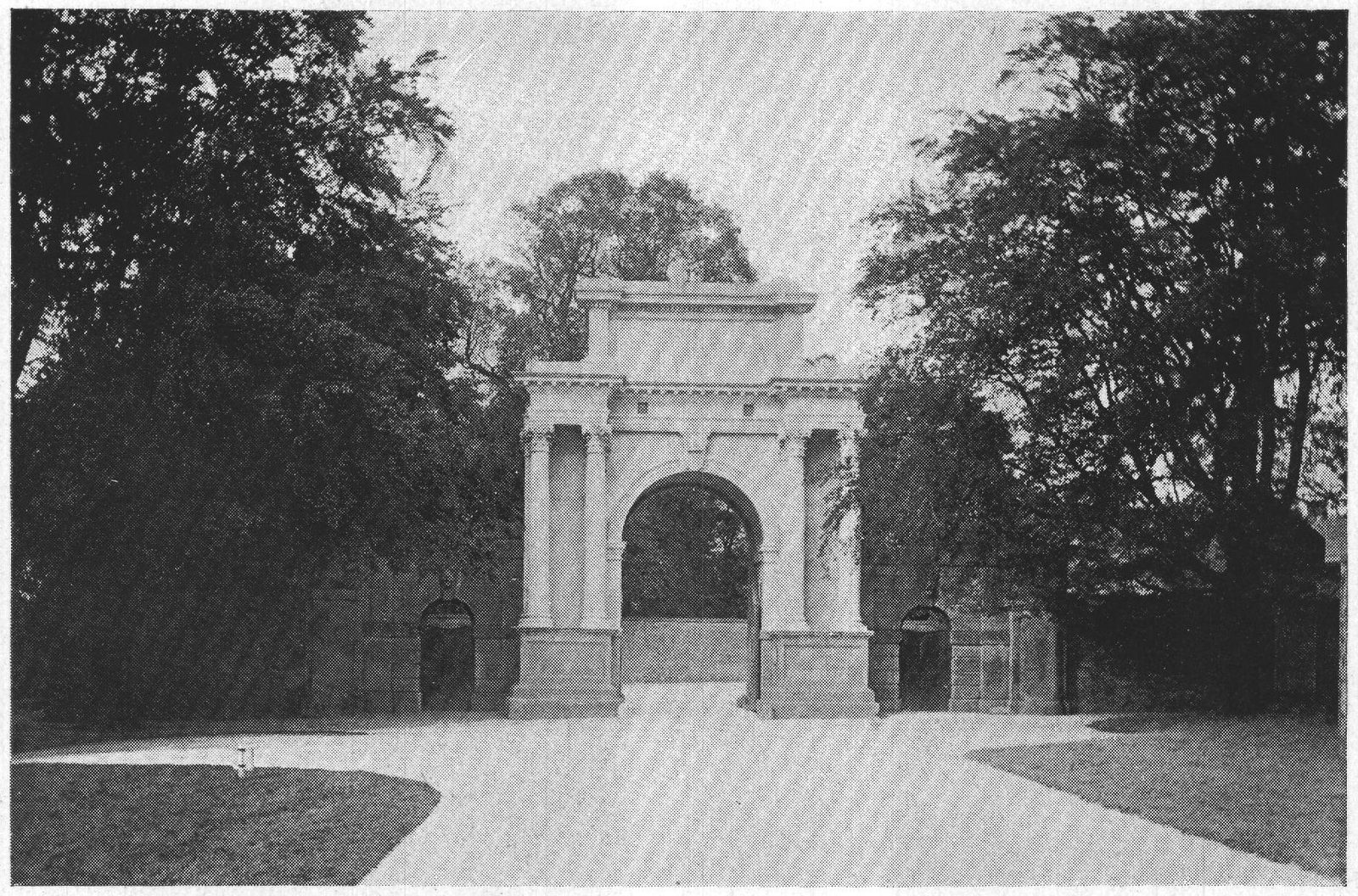
Leaving the old town of Woodstock, once famous for its gloves, we pass through the Triumphal Gate, which has a large central arch and two posterns with an entablature supported by double detached columns raised on pedestals. An inscription records that—"This gate was built in the year after the death of the most illustrious John, Duke of Marlborough, by order of Sarah, his most beloved wife, to whom he left the sole direction of many things that remained unfinished of this fabric. The services of this great man to his country, the pillar will tell you, which the Duchess has erected for a lasting monument of his glory and her affection towards him, 1723."
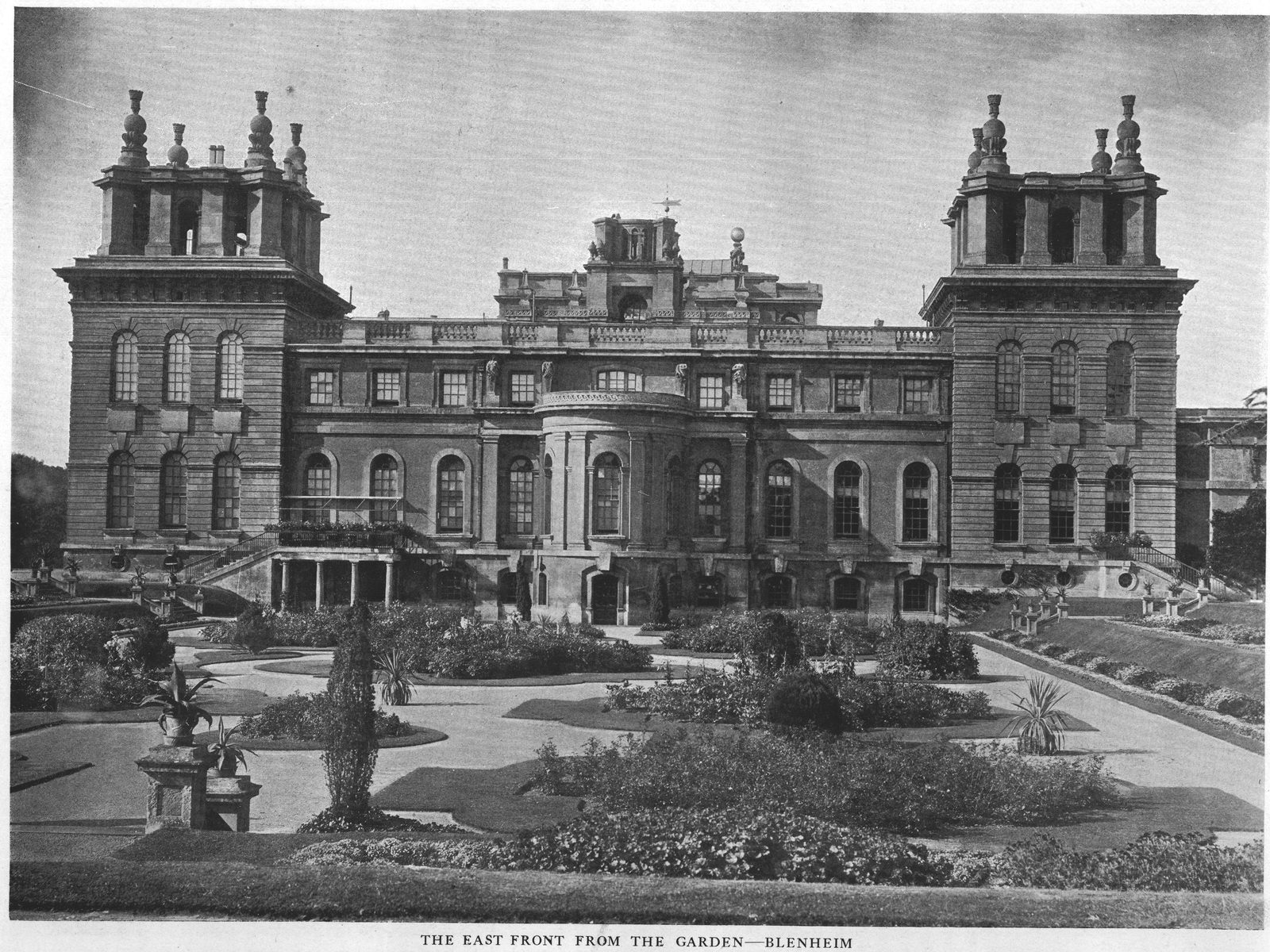
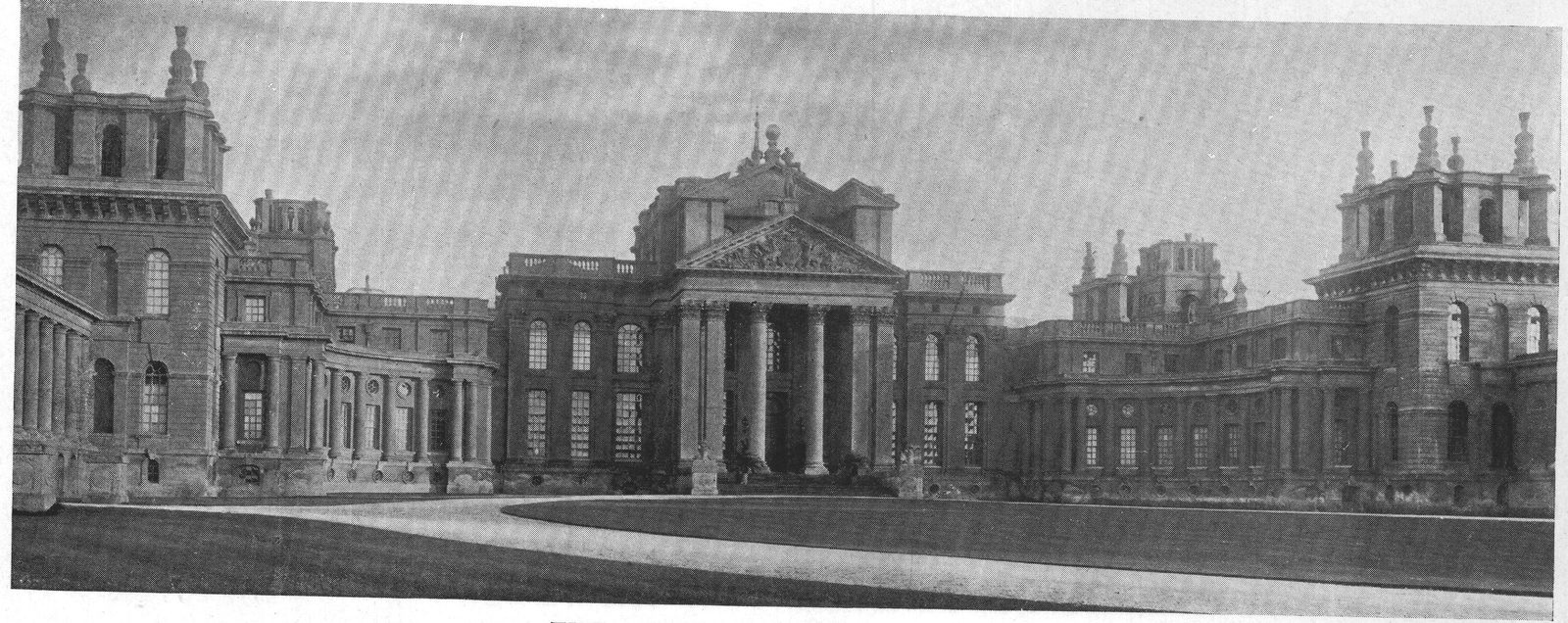
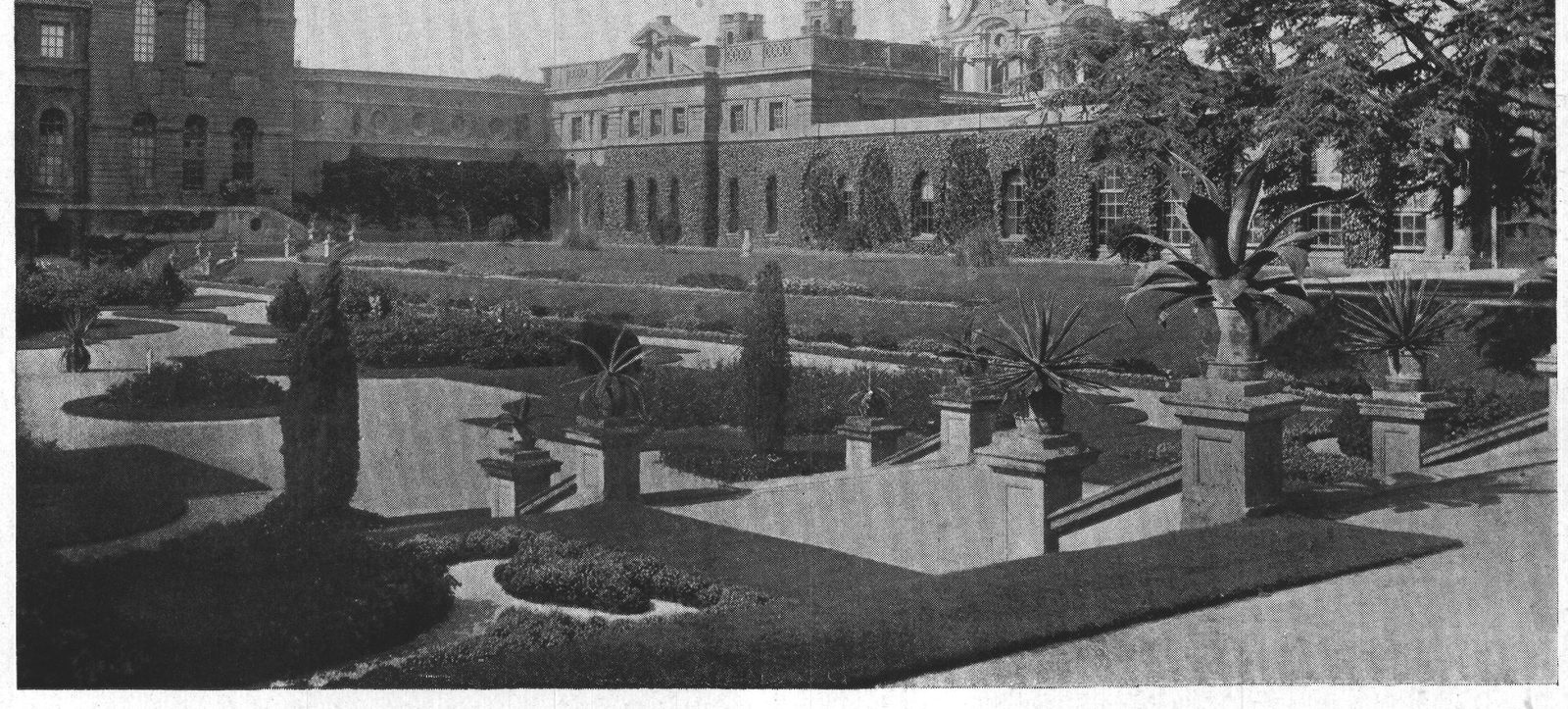
On entering the park by this gate a magnificent view of the noble house greets the eye. The architectural critic will not fail to perceive the remarkable vigor of design, however much he may scoff at the extravagance of Palladian grandeur. It possesses the usual regularity of plan. There is a great courtyard facing the principal building, and on each side two smaller courts, the kitchen and stable courts, surrounded by buildings. A grand vision of towers, colonnades, porticoes and exuberant variety of design greets us from whatever point of view we regard the palace. The principal front is 348 feet in length. It consists of a large central block with wings forming the smaller courts, and joined to the central block by arcades. We enter the palace through a noble gateway under a tower at the eastern end of the east courtyard. Above the archway appears the inscription: "Under the auspices of a munificent Sovereign this house was built for John, Duke of Marlborough, and his Duchess Sarah, by Sir J. Vanbrugh, between the years 1705–1722, and this royal manor of Woodstock, together with a grant of £240,000, towards the building of Blenheim, was given by Her Majesty Queen Anne, and confirmed by Act of Parliament (3 and 4 Anne C. 4) to the said John, Duke of Marlborough, and to his issue male and female, lineally descending." The ironwork of the gates records the arms and crests of the Duke and interlaced M. M., which signify his titles, Marlborough and Mindelheim. The latter refers to his title of Prince of Mindelheim in Suabia of the Holy Roman Empire. On each side of the gateway there are lodges, and surrounding the court are estate and domestic offices. Two sides are adorned with a piazza. Once there were here a theatre and the Titian gallery, the latter of which is replaced by a conservatory, and the former by an estate office. The Titian gallery contained a beautiful collection of paintings on leather which was destroyed by fire in 1861. Over the second archway leading to the principal front, is a clock tower, and passing onwards the grand north front of the palace appears in sight. Its detractors pronounce it heavy, but they cannot deny that the effect is imposing, and that the appearance is lightened by an exuberant variety of design, and a skilful combination of towers, colonnades, porticoes, and pyramided attics. The buildings are grouped round three sides of a square. On the fourth side there is a grand view of the park, and across the bridge rises amidst the trees, the Duke's Column. At the entrance of the palace there is a grand Corinthian portico, over which stands a statue of Minerva. On the tympanum appear the arms of the Duke with military emblems. Two small cannons which came from the battle-field of Blenheim, guard the entrance.
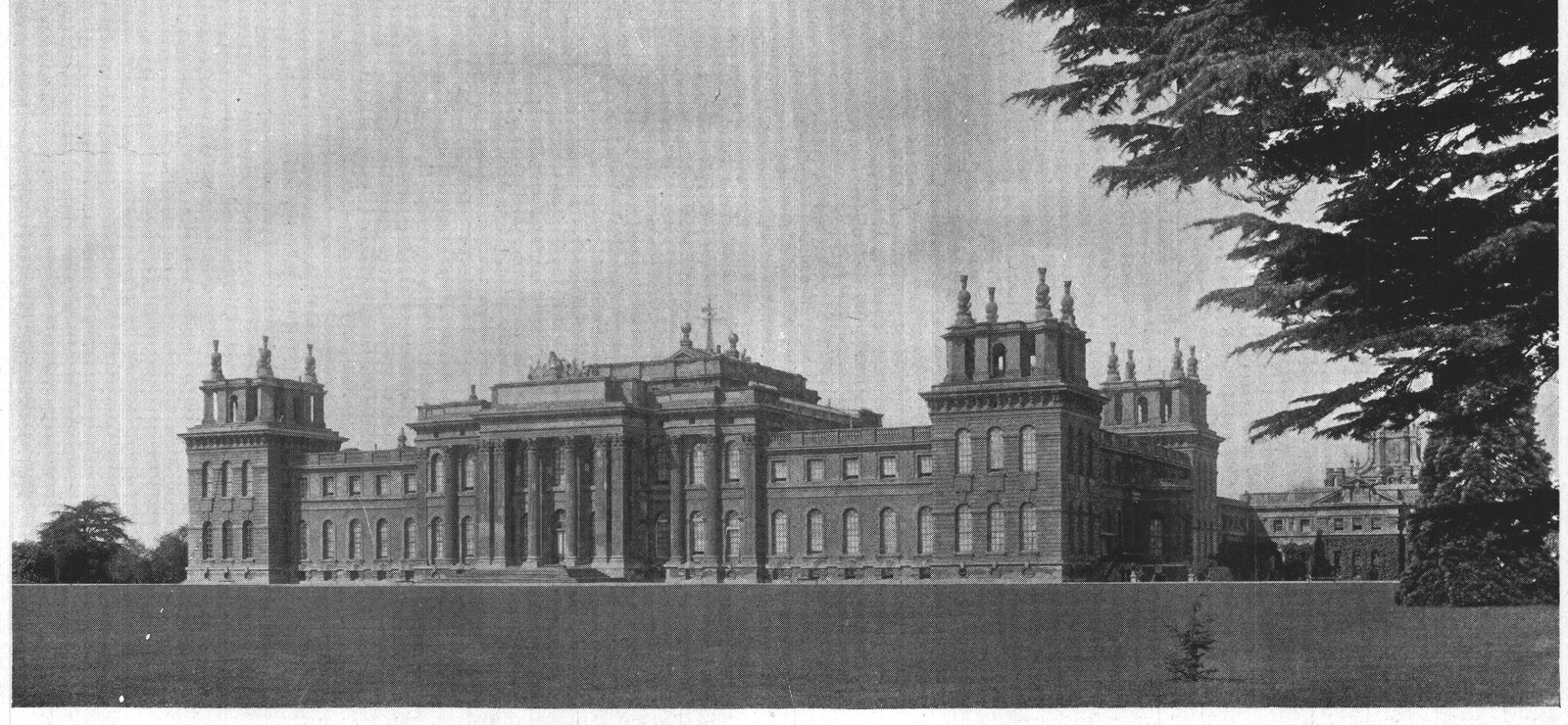
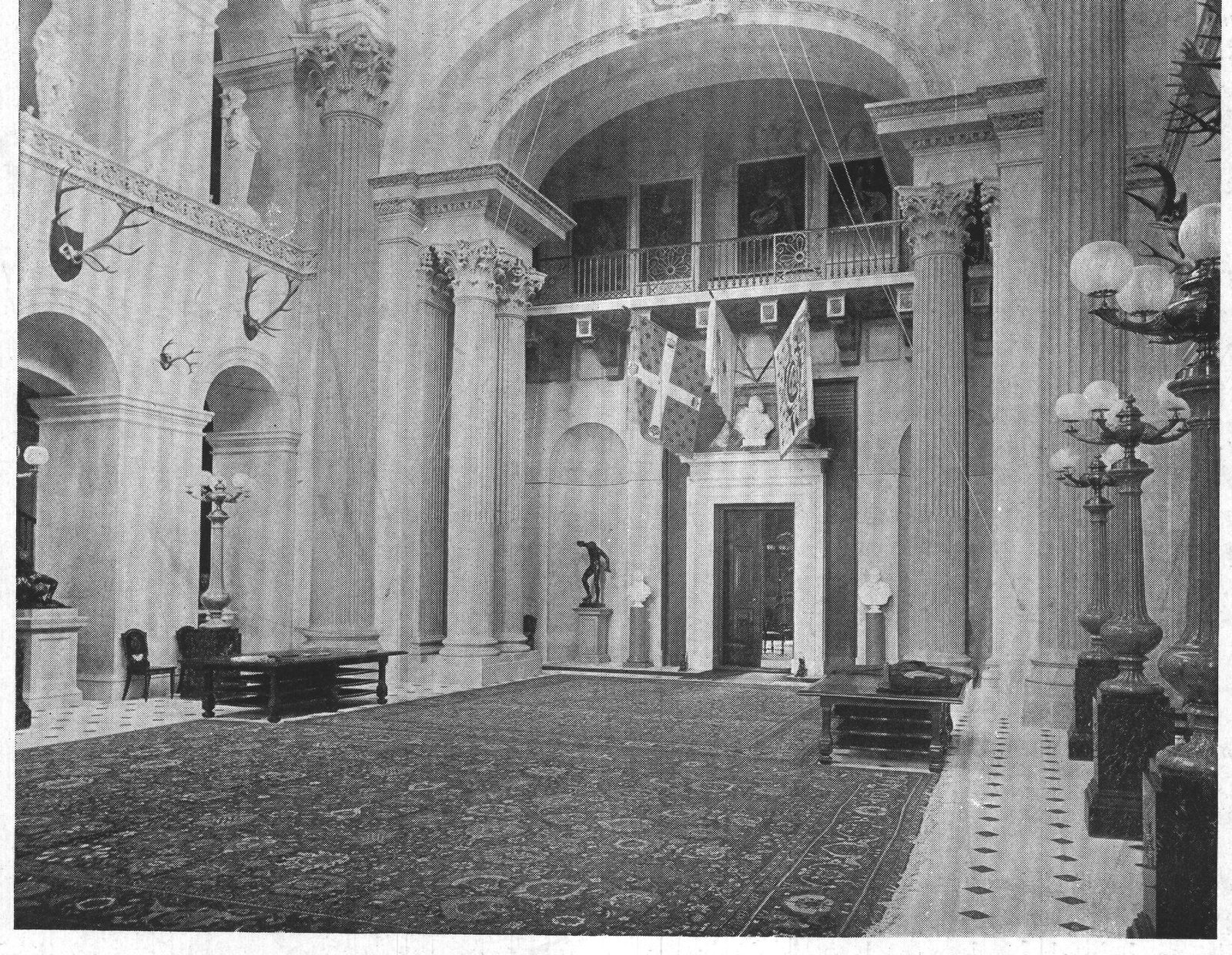
The south front is in five grand divisions; the center, containing the saloon, is entered by a Corinthian portico, crowned by a pedestal, bearing the inscription Europæ hæc vindex genio decora alta Britanno. A colossal bust of Louis XIV., taken from the gates of Tournay, surrounded by military emblems, surmounts the pedestal. The palace is entered from the principal or north front, and we find ourselves in the great hall, a noble chamber with a lofty ceiling supported by fluted Corinthian columns, between which smaller columns of the same order support an arched corridor leading to the saloon opposite to the entrance. The key of the main door is a copy of that formerly used to lock the gates of Warsaw.
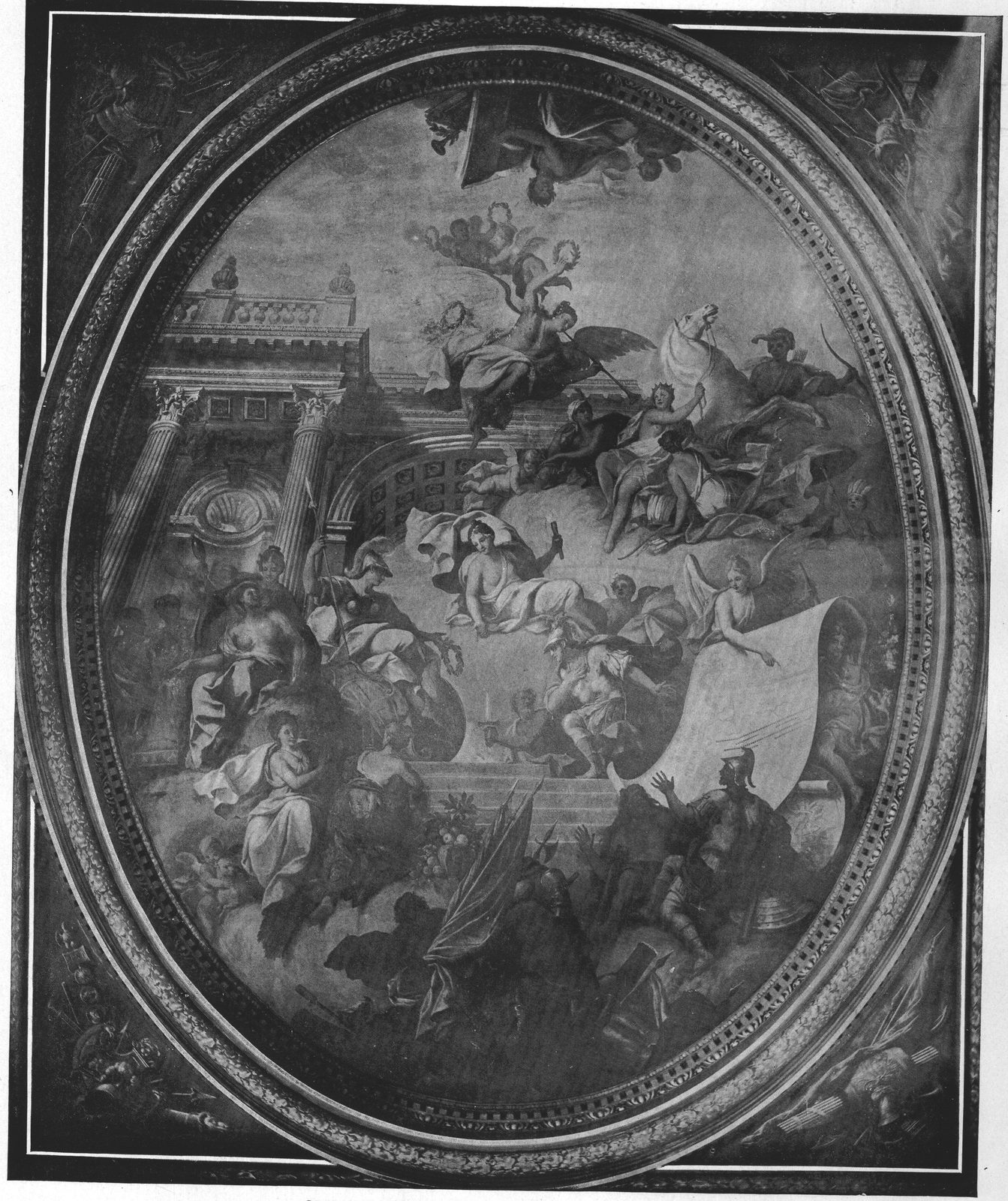
The ceiling of the hall was painted by Sir John Thornhill, and is a fine allegorical representation of Britannia crowning the great Duke after the battle of Blenheim. His bust by Rysbrach appears over a doorway with an inscription in Latin by Lord Bolingbroke. Some fine bronze statues, copies of the famous Florentine marble statues, and several other statues and busts adorn the hall. A few pictures are seen in the gallery above, portraits of Queen Anne, Prince George of Denmark (Kneller) and the Countess of Essex (Marc Geerards).
At the entrance of the ante-room to the drawing-room are the busts of the present Duke and Duchess by Story. The Duchess is an American by birth, a daughter of Mr. William K. Vanderbilt of New York. The ante-room contains a good collection of old Dresden china.
The green drawing-room is perhaps one of the most interesting chambers in the palace on account of the superb paintings which line its walls. There is the great masterpiece of Sir Joshua Reynolds, a picture of George Spencer, third Duke of Marlborough, and his family, which has been valued at £40,000. Kneller's picture of the first Duchess and Lady Fitzharding playing at cards, a portrait of the third Duke by Sir Joshua Reynolds, one of Sarah, Duchess of Marlborough, by Kneller. There are also other remarkable family portraits by Cosway, Romney and Reynolds.
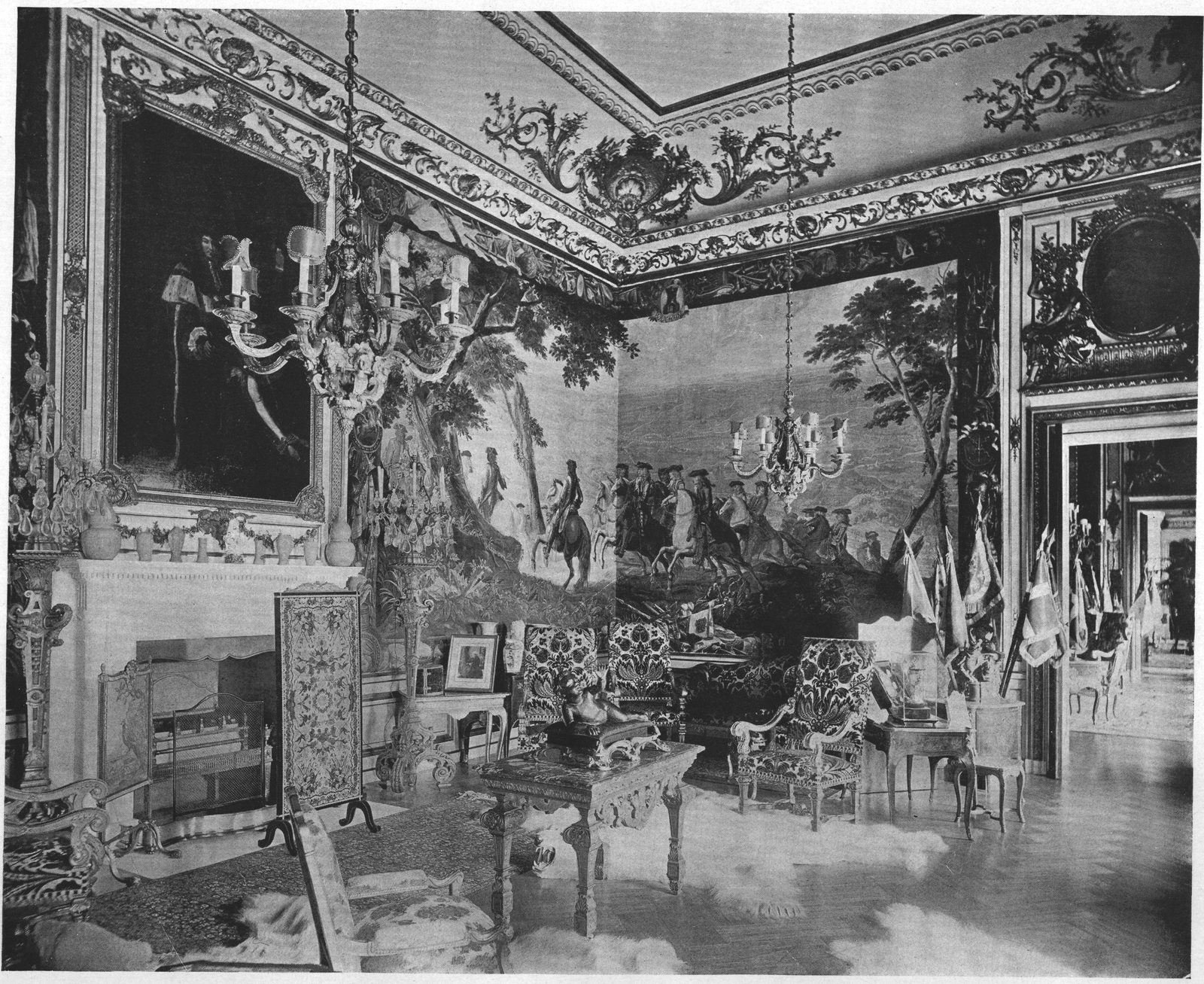
We pass into the next chamber, called the red drawing-room, or grand cabinet, the walls and furniture being adorned with red damask. Beautiful views of the park and of the Italian gardens are obtained from the windows of this room. The tapestries at Blenheim palace are remarkable. Many of them were copied from paintings of Le Brun, and represent battle scenes. In the suite of rooms through which we pass we notice some excellent paintings, Romney's portrait of Caroline, Duchess of Marlborough, and Kneller's portrait of the first Duke. Copies of the old banners taken at the battle of Blenheim are preserved here. The center of the chimneypiece in the great drawing-room is a fine alto-relievo in white marble, representing the marriage of Cupid and Psyche, copied from an antique of which Tryphon was the sculptor.
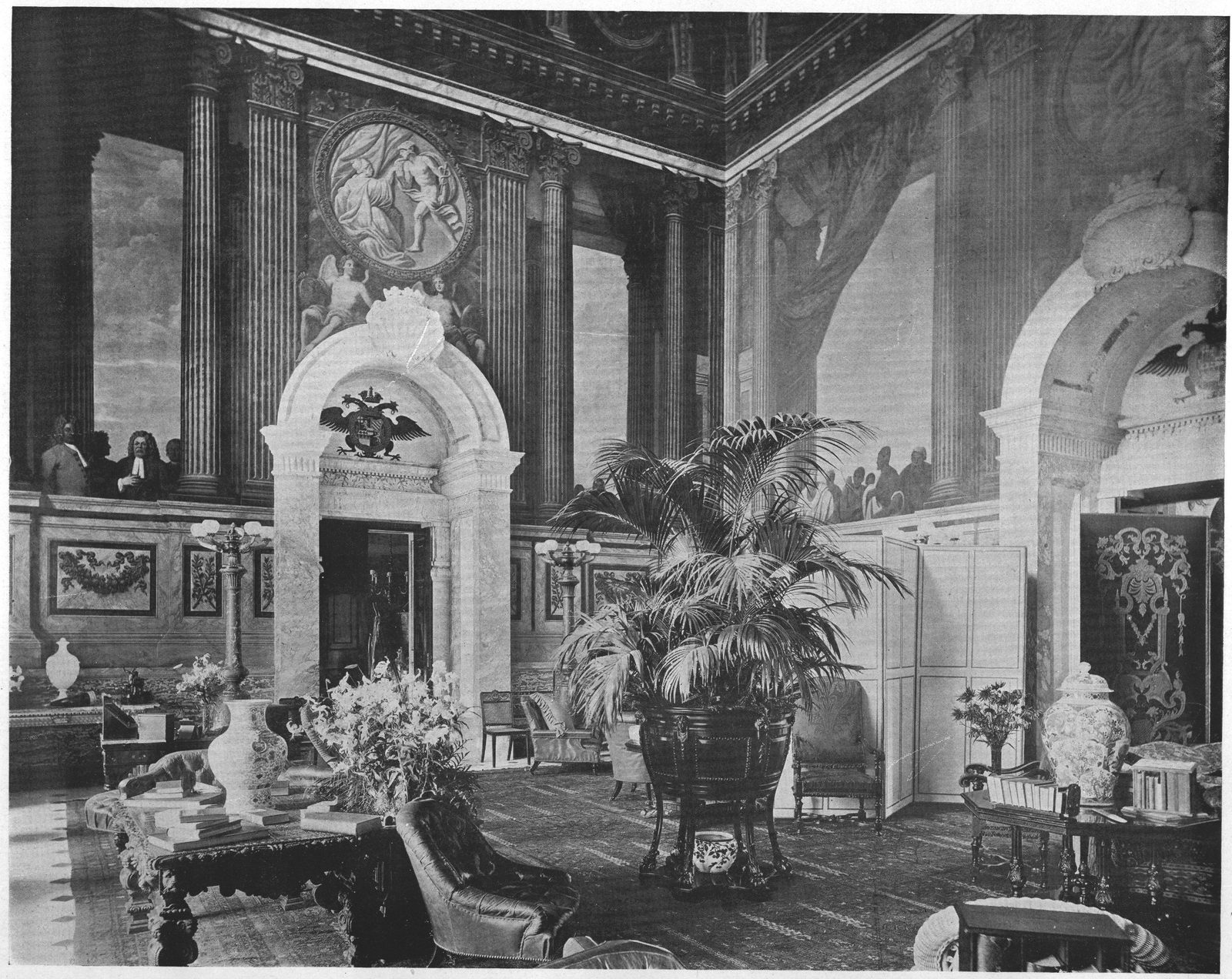
The saloon, always a prominent feature in a Palladian house, is a noble room, rising to the whole height of the building, in the same manner as, and communicating with, the great hall. Its base is marble, and the four door-cases are also of marble, consisting of pilasters, supporting an arch with shell keystones, within which is a smaller doorway, surmounted by the arms of the first Duke. The walls and ceiling are elaborately decorated, the painting being the work of La Guerre. The scheme of decoration includes a fine façade covering a raised gallery supported by fluted marble columns. The upper story is ornamented with stone statuary. Trophies of arms with groups of soldiers appear above, and below are groups of various nations, Scotch, Dutch, Swedish, Spanish, African and Chinese. On one side is the portrait of the artist, and near him that of Dean Jones, the chaplain of the Duchess Sarah. The ceiling is an allegorical painting of the career of the first Duke. We see him represented as a Roman conqueror driving his chariot over prostrate warriors. Mars and Minerva are fighting for him, and Time can scarcely keep pace with him. He is compared with Hercules fighting the dragon. But Peace stays his victorious career, while Truth, Plenty and Victory attend his progress, and Queen Anne watches her favorite. It is impossible to give in detail all the remarkable features of this elaborate scheme of decoration.
We pass to the State apartments. The tapestries are very fine and represent scenes in the career of the famous Duke, who ordered them to be made for him at Brussels. First we see the siege of Donavert, then that of Lisle, then the Duke is before Mons in Hainault. The march to Bouchain and the siege of that place, the Earl of Cadogan and his favorite mastiff, the siege of Oudenarde, and groups after the school of Teniers representing the horrors of war, are some of the scenes portrayed in this remarkable series of excellent tapestries. Some of the pictures in the State rooms are worthy of notice, especially a beautiful portrait of the present Duchess by Carolus Duran, Louis XIV. by an unknown artist, and Kneller's painting of the great Duke and General Armstrong, who are represented in the conduct of the siege of Bouchain.
The library is one of the finest rooms in Europe; it is 183 feet long and occupies the entire southwest front. It formerly contained the famous Sunderland library of 80,000 books, which were sold at Christie's a few years ago. The carving of the bookcases is said to be the work of Grinling Gibbons. Rysbrach's white marble statue of Queen Anne, who is represented in her coronation robes, stands at the upper end, and on the pedestal is this inscription: "To the memory of Queen Anne, under whose auspices John, Duke of Marlborough, conquered, and to whose munificence he and his posterity with gratitude owe the possession of Blenheim, A. D. 1726." Amongst the pictures are Van Dyck's Mary, Duchess of Richmond; George Villiers, Duke of Buckingham, by Mytens; Van Dyck's Lady Morton and Mrs. Killigrew, two famous beauties of the court of Charles II.; the Earl of Strafford by the same artist. Sargent's portrait of the present Duke and Duchess with their family is a fine and pleasing painting. Closterman's picture of the great Duke and Duchess has an historic interest. The poor artist was driven almost to distraction by the quarrelsome Duchess Sarah over this picture. The Duke wrote to Closterman: "It has given me more trouble to reconcile my wife and you than to win a battle." Vanloo's portrait of the second Duke and Duchess, that of the first Duke and Duchess by Kneller, Lely's Duchess of Portsmouth, Hudson's Earl of Sunderland, are some of the most striking paintings that arrest attention. A fine organ fills the lower end of this magnificent library. There are many other interesting paintings and busts, and some valuable documents, letters and dispatches of the great Duke which are preserved here. Although the present collection of pictures possesses many examples of great interest, it has only a tithe of the number of valuable paintings which formerly belonged to the family and formed a collection which both in extent and selectness was one of the finest in England. No private cabinet in Europe possessed such treasures of art. It was particularly rich in works by Rubens. A large number have been sold. Raffaelle's celebrated Madonna d'Ansidei, the gem of the collection, realized £70,000, and is now in the National Gallery.
One more chamber in the palace must be visited, the chapel, which contains a somewhat heavy and pompous marble monument by Rysbrach of the first Duke and Duchess, a monument of the seventh Duke (1822-1883) and a recent memorial of the brilliant but erratic statesman, Lord Randolph Churchill.
The architect was Sir John Vanbrugh, the conceiver of massively majestic effects, who escaped not the poet's satire conveyed in the epitaph:
"Under this stone, reader, survey
Dead Sir John Vanbrugh's house of clay.
Lie heavy on him, Earth, for he
Laid many a heavy load on thee."
Lord Lyttelton wrote enthusiastically of it in 1728:
"Parent of Arts, whose skilful hand first taught
This tow'ring Pile to rise, and form'd the Plan
With fair proportion; Architect divine
Minerva; Thee to my advent'rous Lyre
Assistant I invoke, that means to sing
'Bleinhemia,' Monument of British Fame,
Thy glorious work! For thou the lofty Tow'rs
Didst to his virtue raise, whom oft thy Shield
In peril guarded, and thy Wisdom steer'd
Through all the storms of war. Majestic in its strength
Stands the proud Dome, and speaks its great Design.
Hail, happy Chief, whose valour could deserve
Reward so glorious! Grateful Nation, hail,
Who paid his service with so rich a Meed!
Which most shall I admire, which worthiest praise,
The Hero, or the People? Not the Vale
Of Tempe fam'd in song, or Ida's grove
Such beauty boasts."
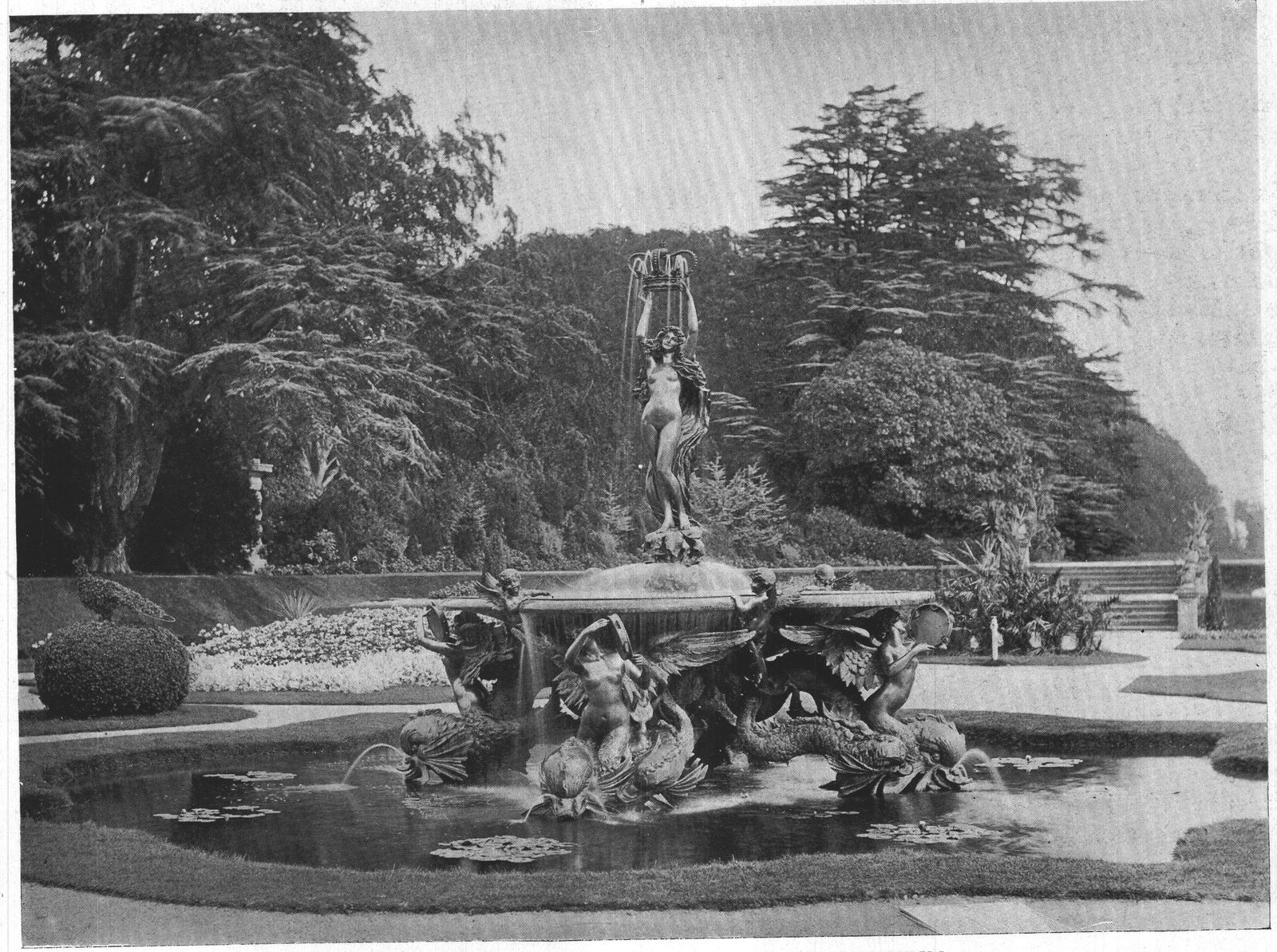
The gardens and park are no less famous than the palace. Wise, one of the race of early landscape gardeners, was the original designer, but his plans have happily been improved upon by his successors. The Italian garden, bounded on the north by the conservatory, with its graceful fountain and beautiful formal arrangement is most attractive. The pleasure grounds cover 300 acres, and have some splendid trees, deodars, Portugal laurel, cedar, copper beech and pine. There is the Temple of Health, erected to commemorate the recovery from illness of George III. in 1789, and the Ionic temple of Diana designed by Sir William Chambers, who also built the bridge which spans the lake. This noble bridge contains several chambers which were intended to be used as a summer residence. The lake is artificial, and was formed by "Capability" Brown by damming the little river Glyme. The groups of trees in the park were originally planted in groups, so as to form a plan of the battle of Blenheim, each group representing a battalion of troops. A prominent feature of the park is the column crowned by a colossal statue of the great Duke, and adorned with a record of his distinguished services to his country. "Rosamund's Well," the traditional rill in which the fair beauty bathed, and the high lodge, an old building once the residence of the ranger of the Royal Forest, are objects of interest that attract the curious.
As we leave the palace the rays of the setting sun shed a halo of glory on each tower and pinnacle of this wondrous house; the deer are browsing in the park beneath the shade of the ancestral trees; old oaks which have witnessed the hunting exploits of mediæval kings cast their shadows, and tell of the past glories of Woodstock.