THE country around Madrid, and in fact most of the central part of Spain is an immense wind-swept plateau, elevated some two thousand feet above the sea level. Vast plains extend in all directions, almost devoid of dwellings, and even of vegetation, save here and there the starveling wheat which barely hides the barren soil, and, occasionally, a few solitary trees which, scattered about on the horizon, relieve the monotony of the landscape. No traveler who has entered Madrid by daylight can help being impressed by these desolate fields, which stretch even to the city gates. Without the least hint that he is approaching a well-peopled capital, he is suddenly brought face to face with palace, dome and spire; the scene changes with magic rapidity. He leaves the arid plains; and lo! Madrid, on a low sloping hill, bursts upon his view. The customary suburbs of the modern city are here entirely lacking; and in this respect, perhaps, the Spanish capital stands unique and alone. Attractive as it proves on nearer acquaintance with its wonderful gallery, and scarcely less celebrated armory, its touch of royalty, and its alluring bull-fights, there is withal an air of despondency about the city. One soon wearies of the glare of the hot sun-baked streets, and yearns for an excursion into the world of woods and flowers, and to the coolness of refreshing brooks.
But Madrid, unlike its sister capitals—Paris or Rome—boasts of no Versailles nor Tivoli in its immediate neighborhood. It was when we were in search of some such spots as these, that we heard first of the once favorite summer palace of the court, with its gardens and streams, distant thirty miles at the village of Aranjuez. Eager for the adventure, but not with the most entire confidence as to what should be our reward, we prepared to leave the city the next morning. The hot and busy Puerto del Sol was willingly left behind, and we were off at an early hour, en route for the station. Why mention the inevitable delays? It is a Spanish railway; the phrase must cover a multitude of sins.
The day is a glorious one—a bright May freshness in the air, that which comes the world over with that delightful month. In these southern countries its exhilarating freshness is to be doubly appreciated, for here the spring lasts but a short time, fading away quickly into a dry and parching summer. We wind out leisurely through a country of undulating plains, with scarcely a tree or a dwelling in sight. Were it not for the brilliant fields of gorgeous poppies, that seem to crowd out the impoverished wheat, the mind might well grow melancholy at so dreary an outlook. Yet, even while we are oppressed by these rambling thoughts, or wondering whether there is aught better in store for us at our journey's end, suddenly we are conscious of a change, and we awaken from our reverie.
A welcome relief to the faithless travelers, there come to us as Heaven-sent accompaniments to the glorious sky and the balmy air, the song of rejoicing birds, and the breath of fragrant woods. We have passed suddenly from a barren parched land into a realm of verdure and flowers. Trees have appeared as if by magic, and we hear the cooling, refreshing sound of running waters. We have entered Aranjuez. Well may it be called an "oasis of flowers." They commence at the very station, not arranged niggardly as in typical railway beds, but grouped in solid masses, brilliant of color, poppies and roses huddled close together, as if fearing that by some mischance one of their number might be blown out on the desolate plain to die alone.
Unique Aranjuez! a town existing apparently as an humble companion to its gardens. There is little at first to suggest a village, yet we know the houses must be somewhere near, for the idlers have gathered about the station to greet the arriving train. The usual beggar is here, and one or two tumble-down hacks, but there is little need to engage a carriage, for already the shade of the glorious grove tells us that we are in the midst of the very gardens themselves. A vista through the trees reveals the distant palace, and we feel, at once, though in the very heart of Spain, that foreign influences have been at work to transform Aranjuez. Even the trees above our heads are not the characteristic Spanish trees. We are surrounded by the elms of an English park; about us is an air of Fontainebleau or Versailles; and we turn eagerly to inquire the history of this verdant spot.
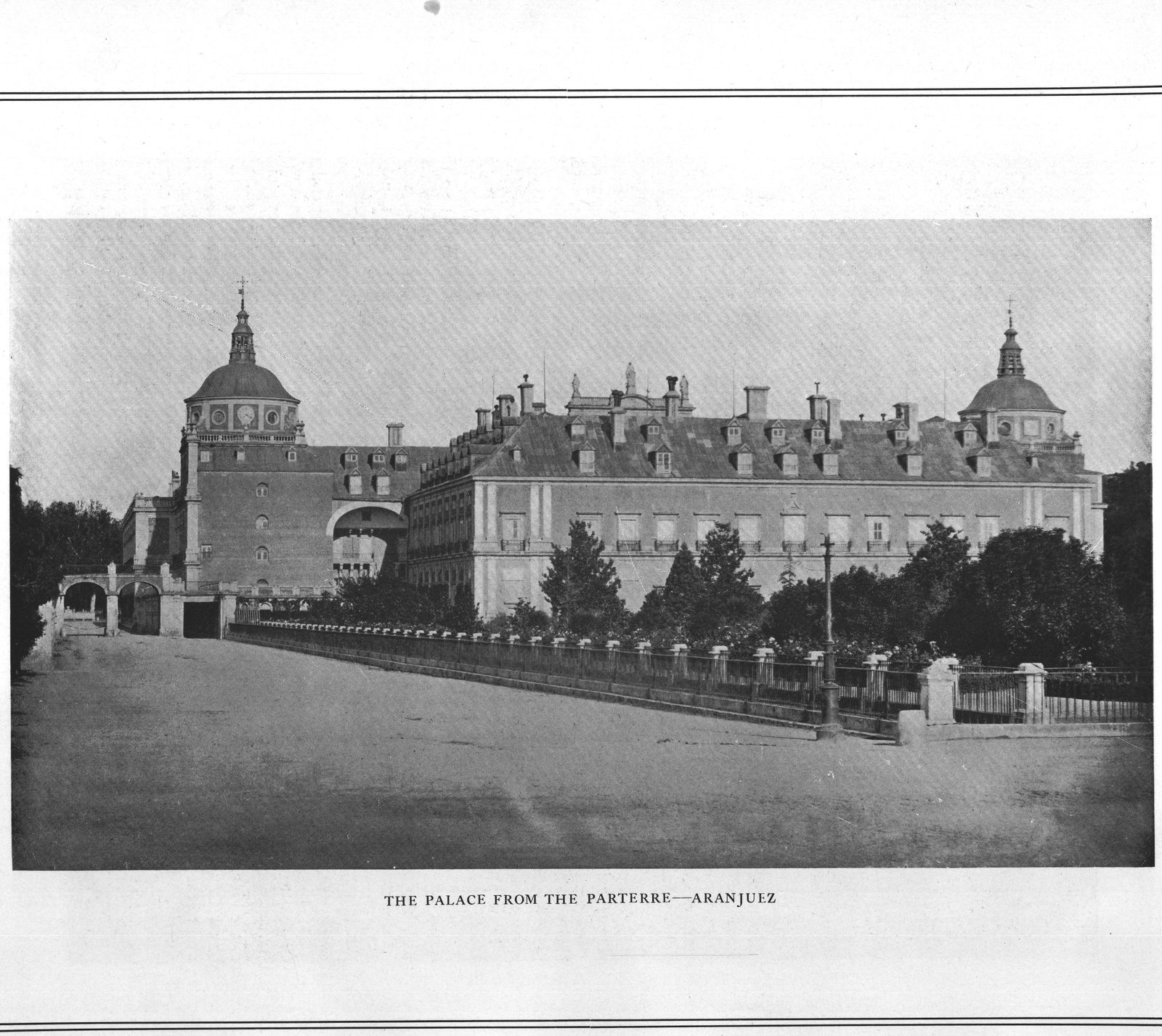
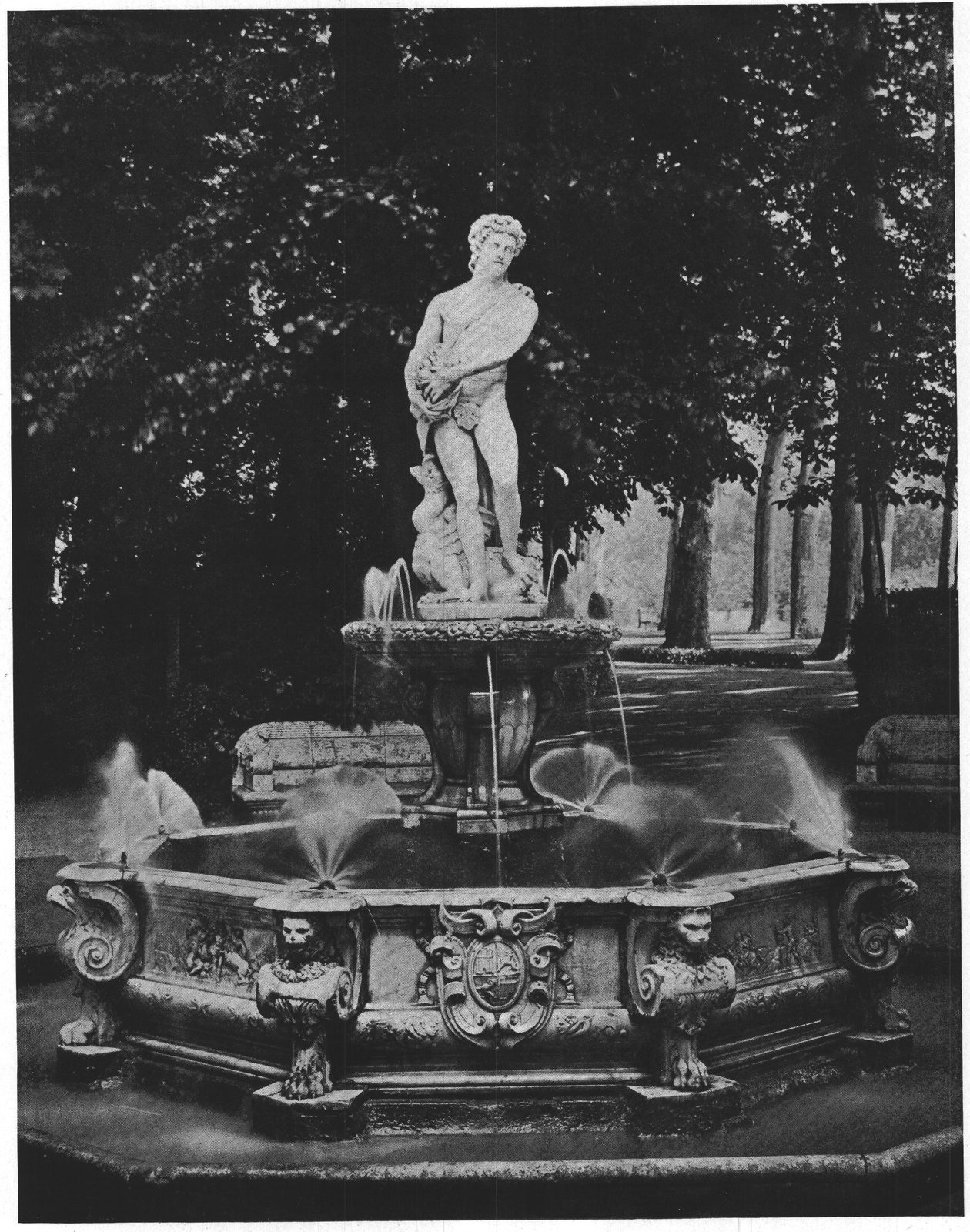
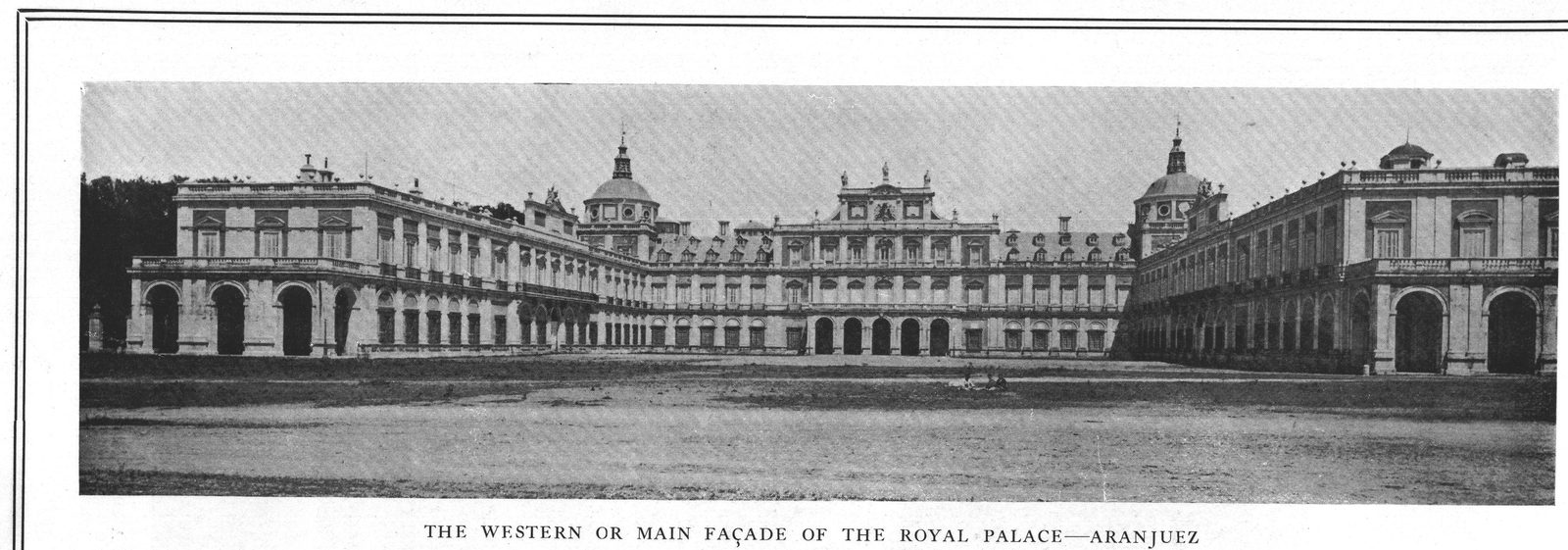
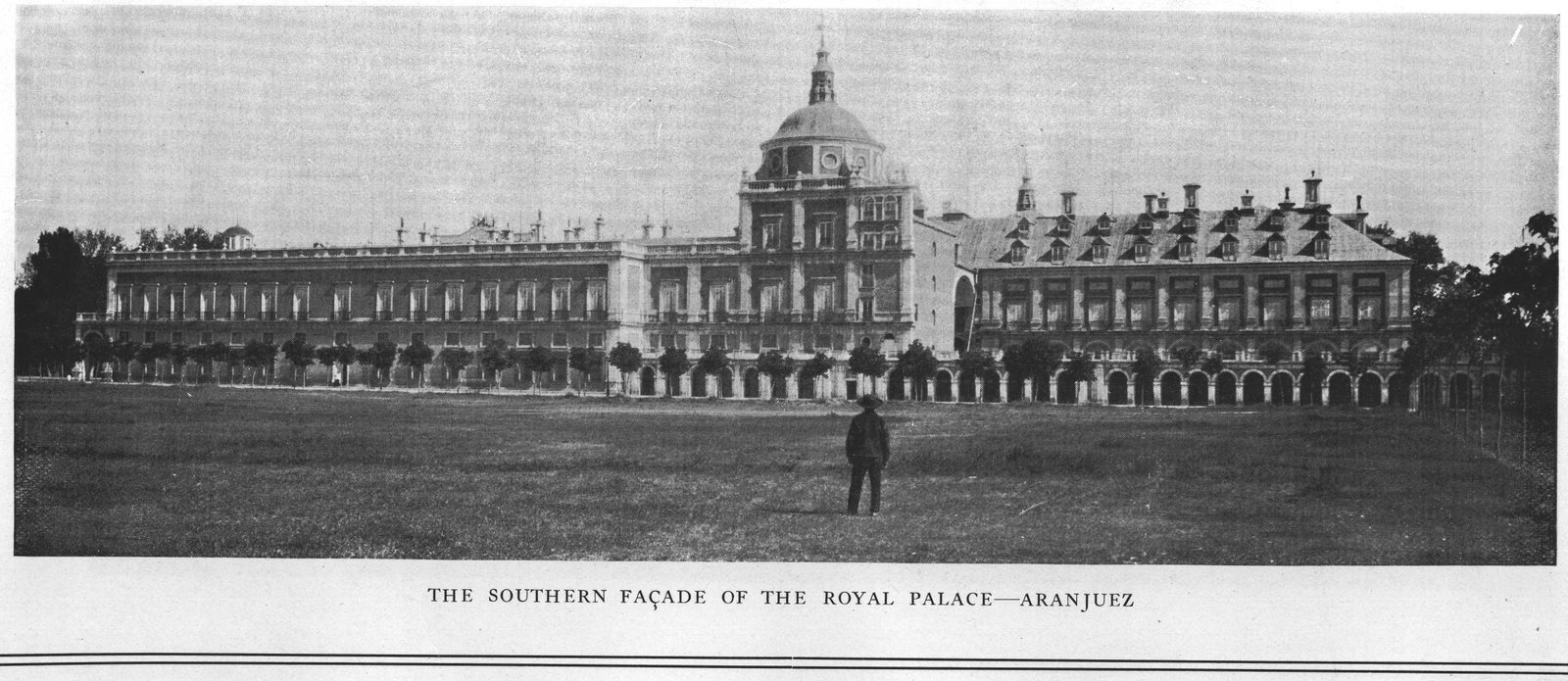
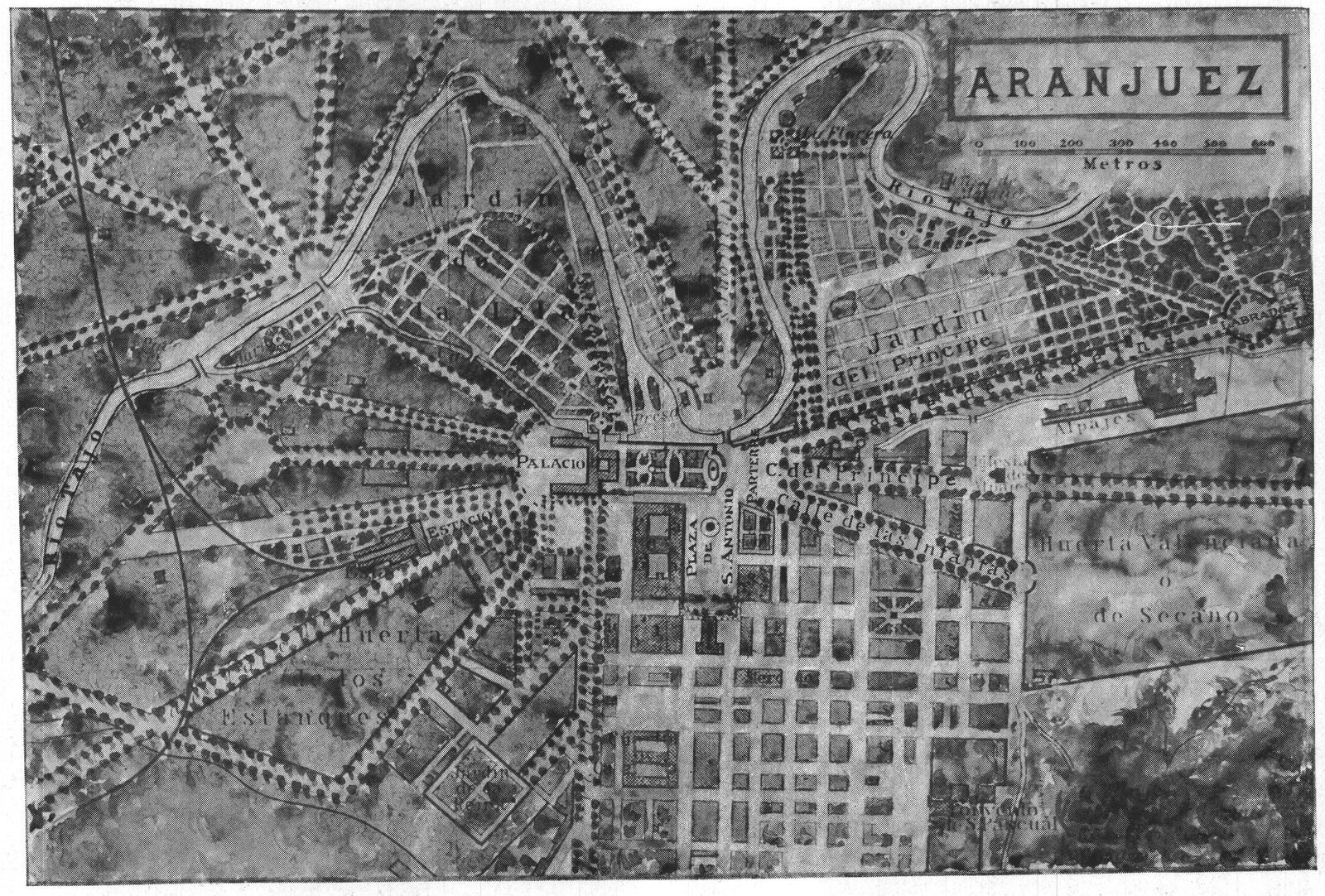
Far back in the fourteenth century, the wealthy and illustrious order of the Santiago, under the leadership of Lorenzo Suarez de Figueróa, founded here a monastery. Trees were planted, the olive and the vine cultivated, and the marshes at the junction of the Tagus and Jarama rivers were reclaimed and made to yield abundant crops. How different its aspect must then have been, without its groves, without its palaces, only the plain whitewashed ecclesiastical buildings, with their brilliantly tiled roofs, contrasting strongly with the deep blue of the southern sky!
When in the reign of Ferdinand and Isabella, the possessions of the Order of the Santiago were absorbed by the crown, the character of Aranjuez was suddenly changed, and it became a royal summer residence, furnishing a breathing spot not too distant from the capital, to which royalty might retreat and escape from the heat and glare of city streets, and the oppressive ceremonials of the court. Villas replaced cloisters, and gaily dressed courtiers and ladies pushed aside the cowled monks. The son of Ferdinand and Isabella, Charles V., in 1536 made it into a shooting villa, in which to while away a moment now and then, when he could escape from his almost constant wars. His son, Philip II., on his several visits to England, admiring the glorious elms of the northern island, caused many of them to be carried to Aranjuez and planted so as to surround his summer palaces, employing the architect Herrar, to construct additional buildings. Many of these, however, were ere long destroyed by fire, and Philip IV. swept away this part of the town, and commenced to rebuild it after the French styles; but with Spanish irresolution he did not complete his work, and it was left to be finished by his successors.
Great were the court gatherings now in this favored spot, and Aranjuez was the scene of many a fête. According to the journal kept by Lord Auckland, Ambassador to Charles III., the court and ministers drove in the principal avenues through the gardens every afternoon in landaus, each drawn by eight or ten mules, followed by four footmen. There was much shooting, hunting, and many balls, and frequent exhibitions of horsemanship, called parejas, where the princes and young nobles played the most prominent part in the presence of ten or twelve thousand spectators. The horses, to the sound of music, formed in various figures, resembling a very complicated dance. So had the panorama changed from conventual to court life, and from monastic to palatial architecture, until in the eighteenth century we find Aranjuez amid customs and surroundings largely borrowed from France—the country which at that time was setting the style for all European courts to follow.
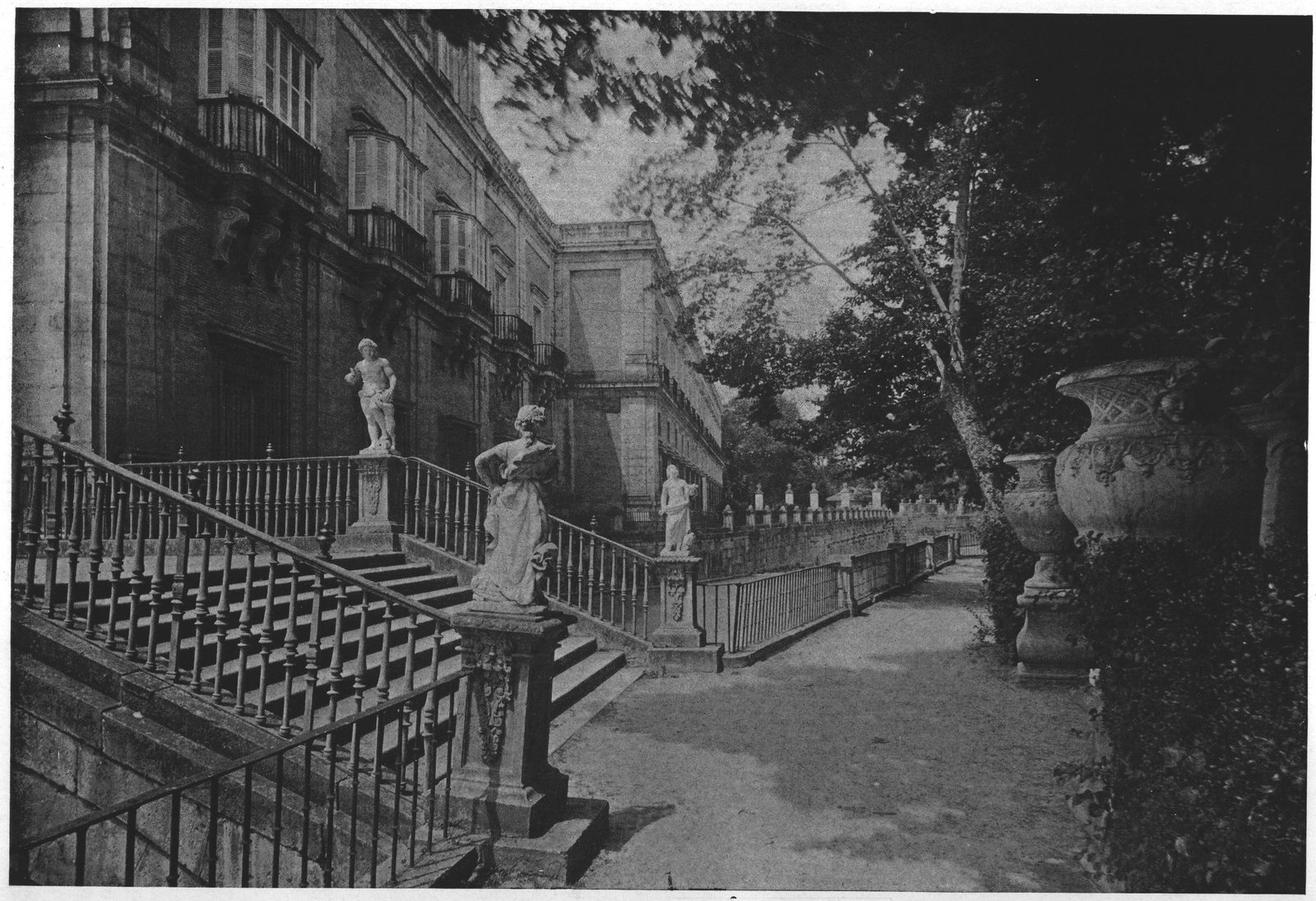
At this point, however, the scene ceased to shift; and in many of its features, the Aranjuez of to-day is the Aranjuez of a century ago; save that the court has fled, the fickle taste of Spanish Royalty now preferring La Granja as its place of ease. So it is likely to remain for the present, since the Spanish exchequer is now too depleted to allow of any large amounts being expended in altering it. Interesting as its history is, let us not delve too deeply into past records on this glorious day. We have come to see the gardens. Nature is alive about us, the birds are thick in the tree tops, calling to us to come and search for more satisfying treasures than the doings of bygone kings and queens. Before us stretches the great grove of splendid elms, arranged regularly, but with foliage so massive and beautiful that we readily overlook the checker-board planting. Let us follow one of these parallel avenues. No one forbids; the place partaking somewhat of the character of a large public common. Here and there a donkey—a remnant, doubtless, of the famous herds which were once raised here—grazes about at will, almost the only sign of animal life. Each vista seems to lead the eye to the palace, whose extensive façade and curiously placed domes at the meeting of the wings with the central portion, attracts our attention.
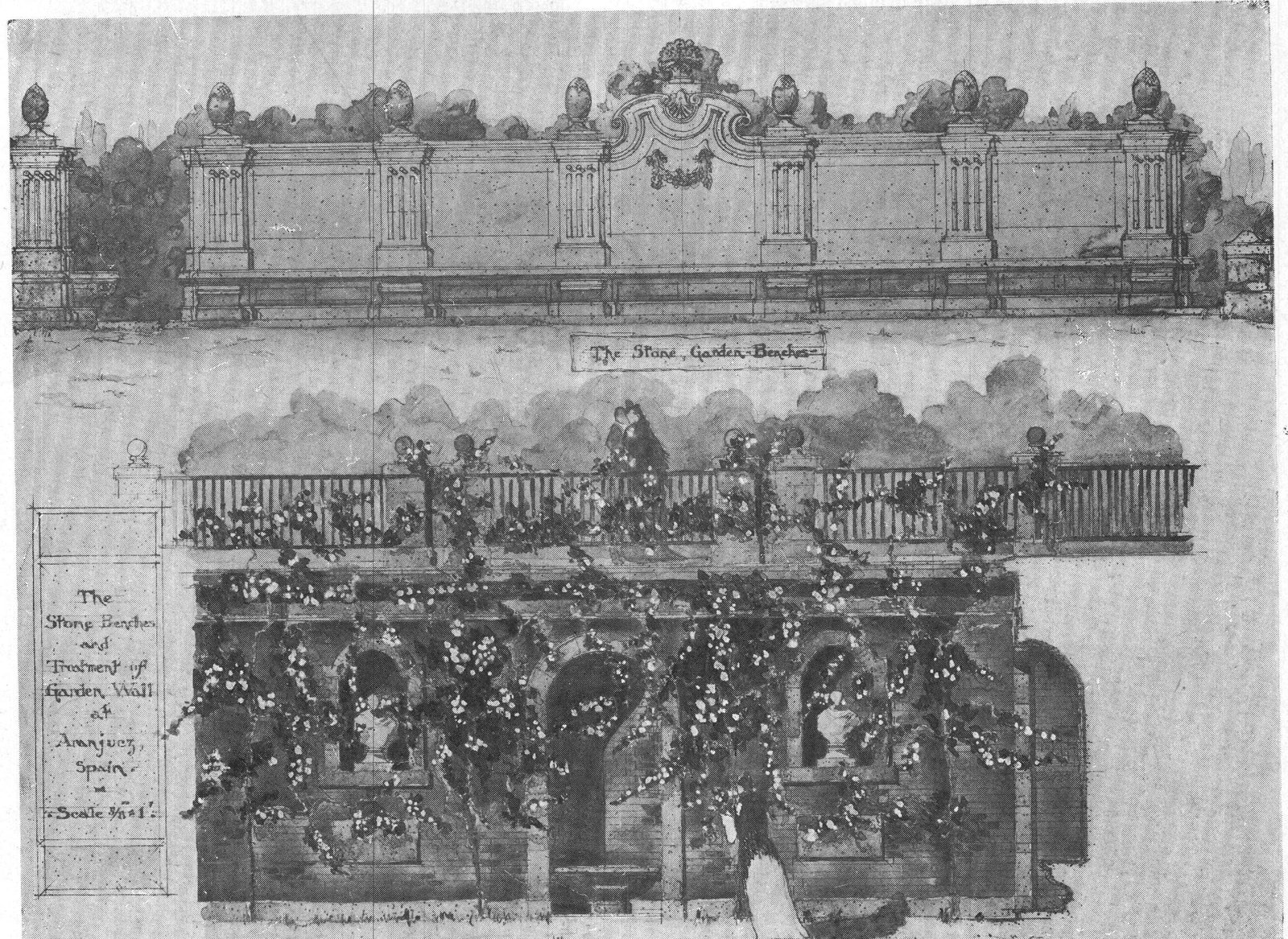
As we emerge from the woods a large oval grass parterre opens out before the palace. About its border are placed great garden seats of a rich yellow stone. These, some eight in number, and about thirty feet in length, are splendid in design, with high paneled backs, the central panel rising slightly in contour and supporting a well carved basket of fruit and flowers. Conforming to the shape of the parterre which they surround, we find the benches gently curved in plan. They furnish pleasant places in which to rest a moment and take in the charming situation of the palace before us, as it lies banked with deep woods on every side.
We are not satisfied with the façade of the building, however; the monotonous lines and closed blinds seem especially dull on this bright day, but entering, we find within some interesting rooms. Splendidly represented is Bosch, a painter of the beginning of the sixteenth century, almost unknown out of Spain, whose fantastic and allegorical subjects in the style of Brueghel were much praised by the authorities of his time. The cabinet is a treat for china fanciers, and is filled with the finest known specimens of Buen Retiro porcelain. The walls of the room are entirely covered with large plaques, representing high relief groups of Japanese figures, beautifully painted and modeled. The looking-glasses made at La Granja, add to the effect, the frames being composed of fruits and flowers carved in wood. This room was painted and modeled by Joseph Gricci, of Naples, one of the artists brought from Italy by Charles III., when he established at Madrid in 1759, the fabric of Buen Retiro, which had existed previously at the Neapolitan Palace of Capo di Monte. This porcelain is marked with the fleur-de-lis in colors of gold. The mirrors and the inlaid woodwork throughout the entire palace are especially fine.
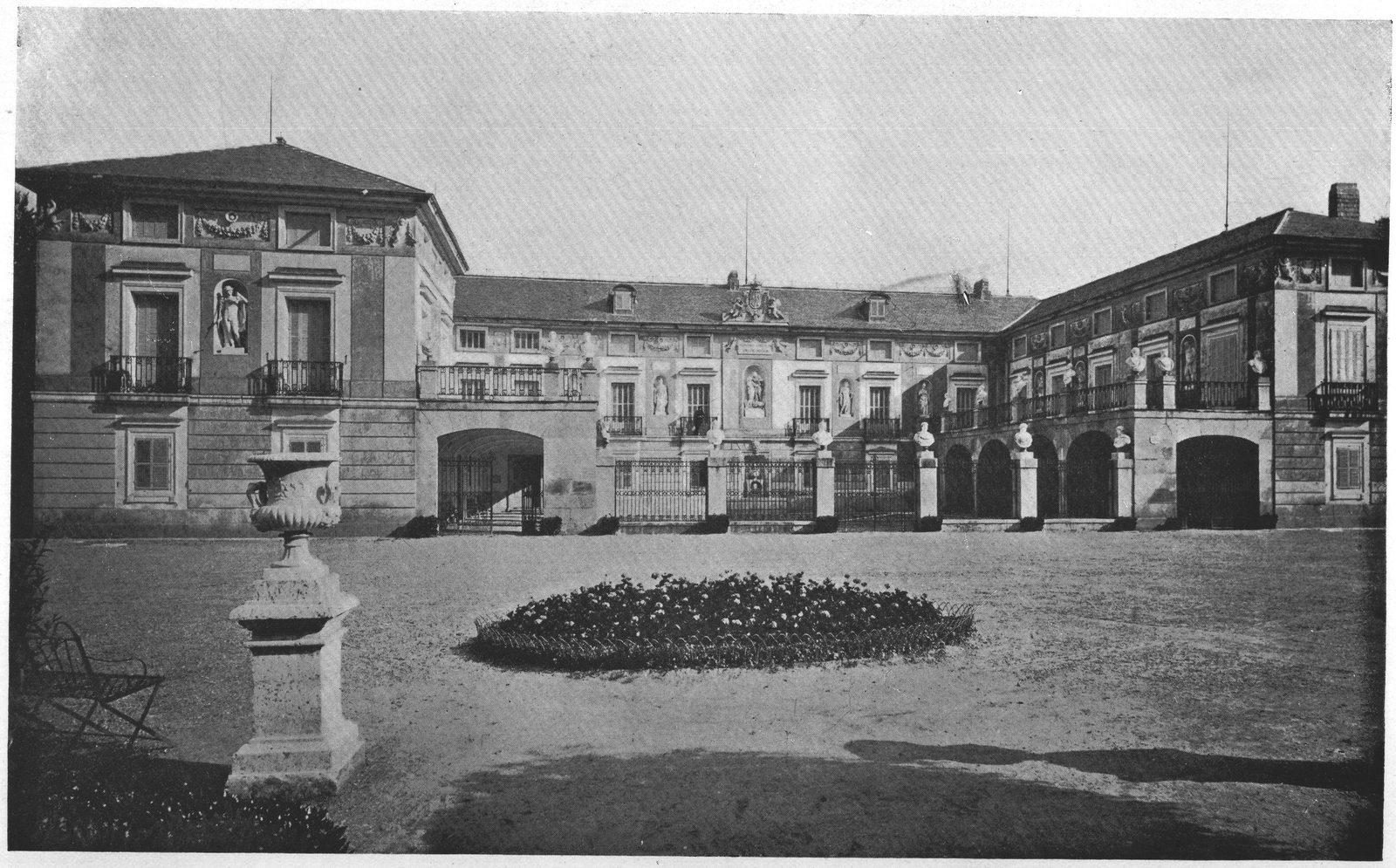
As we pass the windows we catch lovely glimpses of the parterre below, and behind the palace we see shady avenues of Oriental plane-trees and boiling cascades. The elms seems to thrive wonderfully under the combined influence of heat and moisture, and some are of enormous proportions. It has been said that in their branches all the nightingales of Spain collect, and well they might, for nowhere in that country could they find a more lovely singing gallery. To reach these gardens we must pass along beneath the small acacia-trees, which line the road at the side of the palace—between the long arcaded buildings, the abode of the officers of the estate—and the garden walls. The rear portion of the palace is of wholly different style, the sloping slate roofs with their double tiers of dormers showing the Dutch influence introduced into Aranjuez upon the return of Marquis Grimaldi from his Embassy to The Hague.
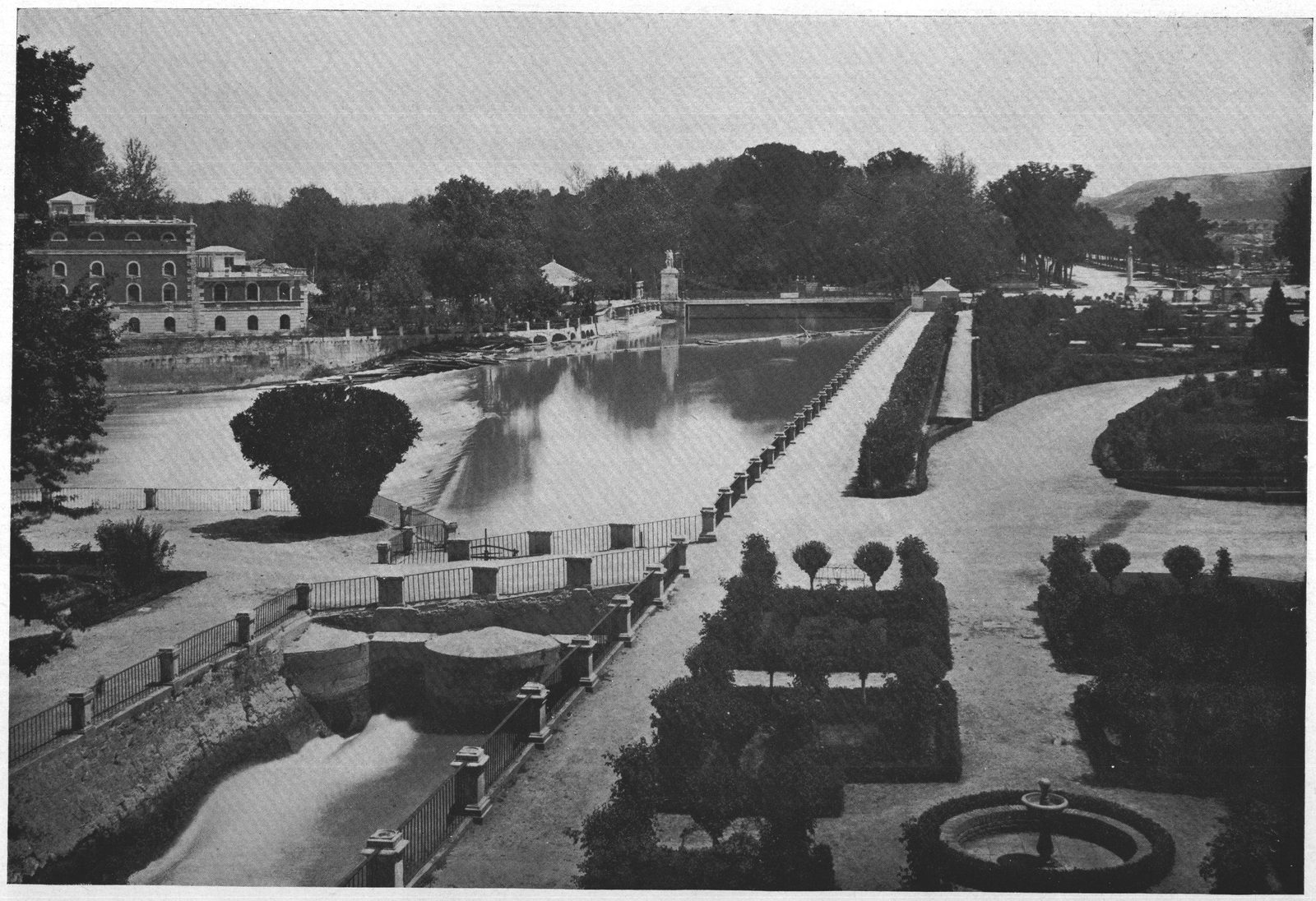
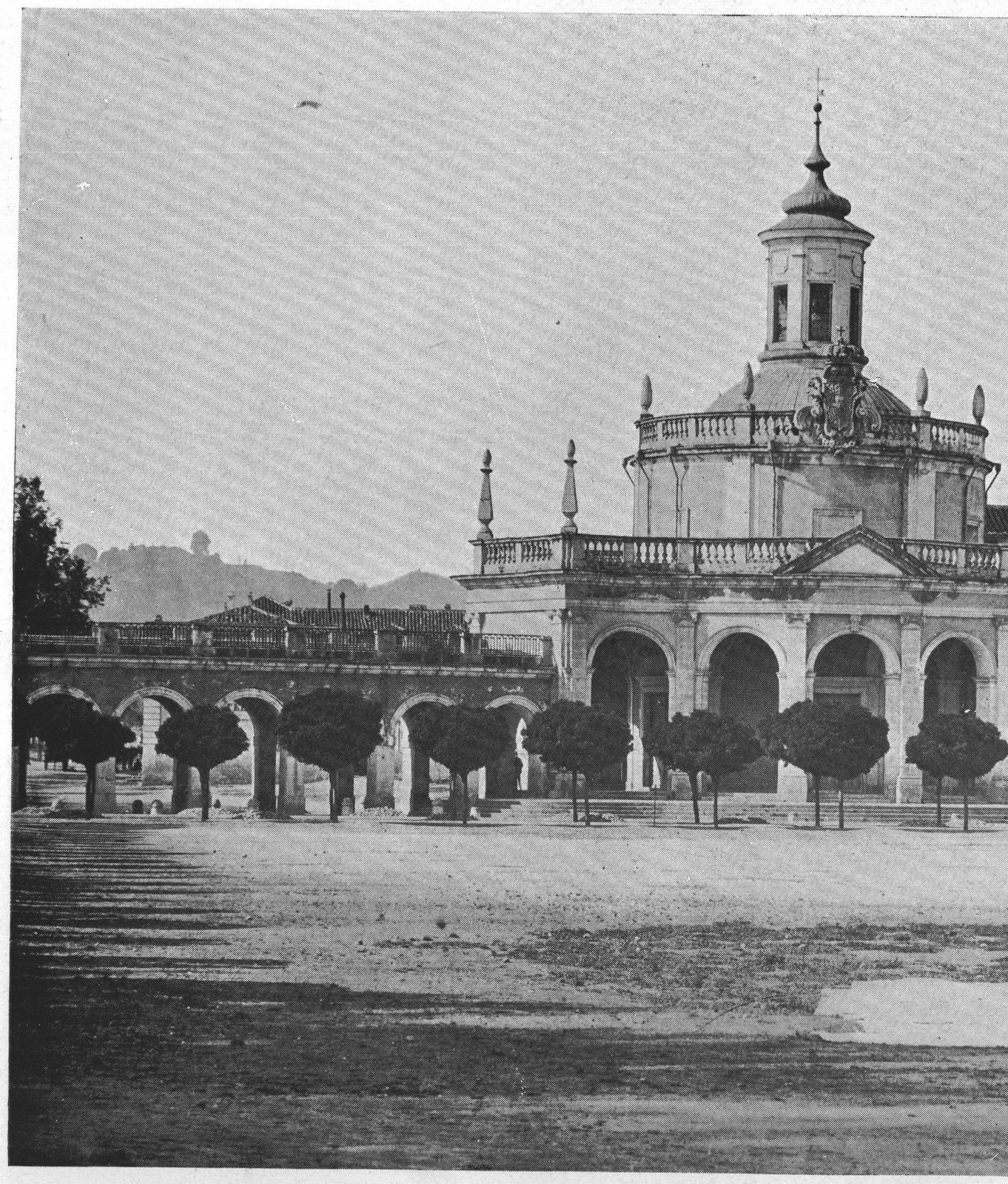
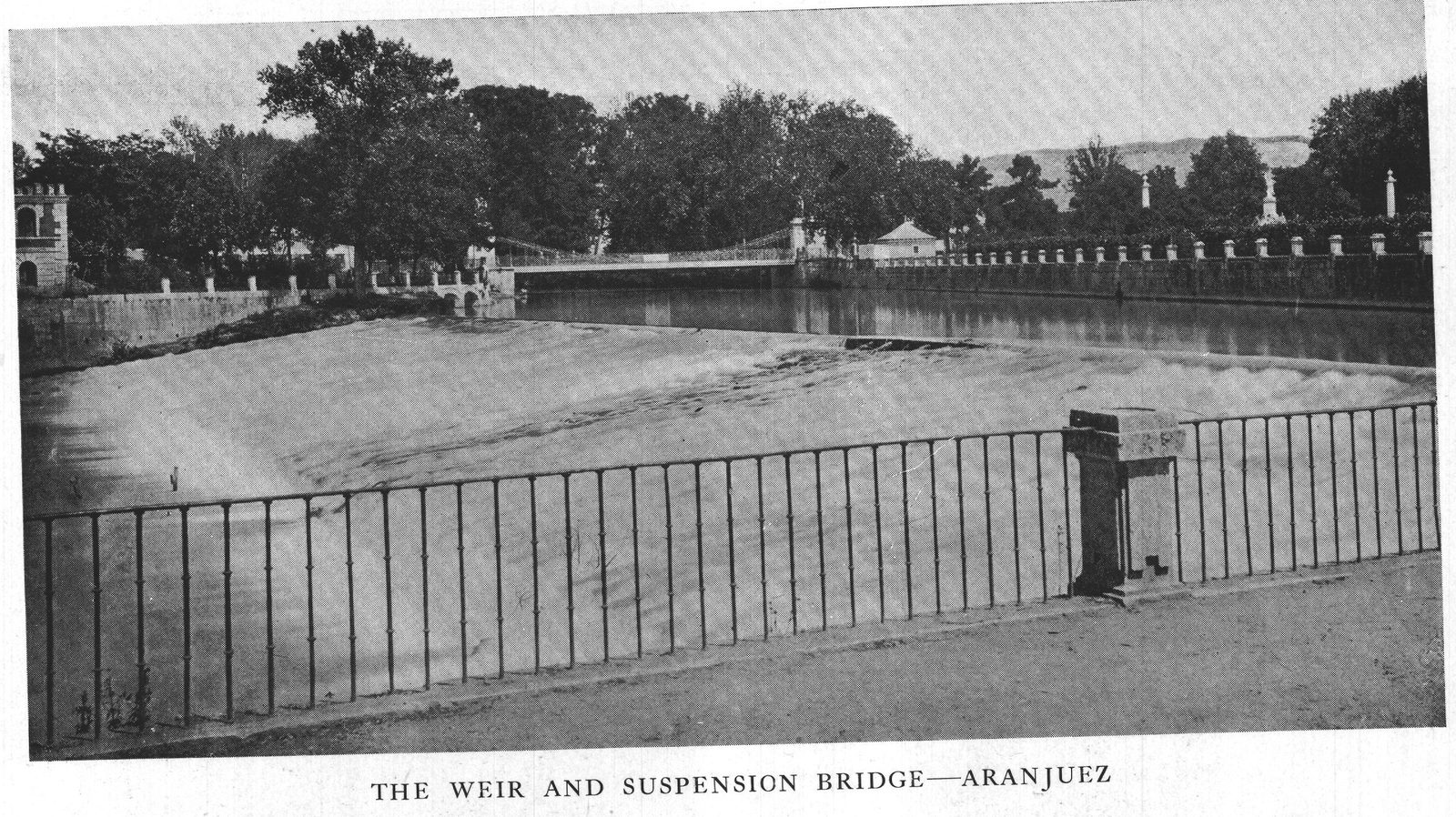
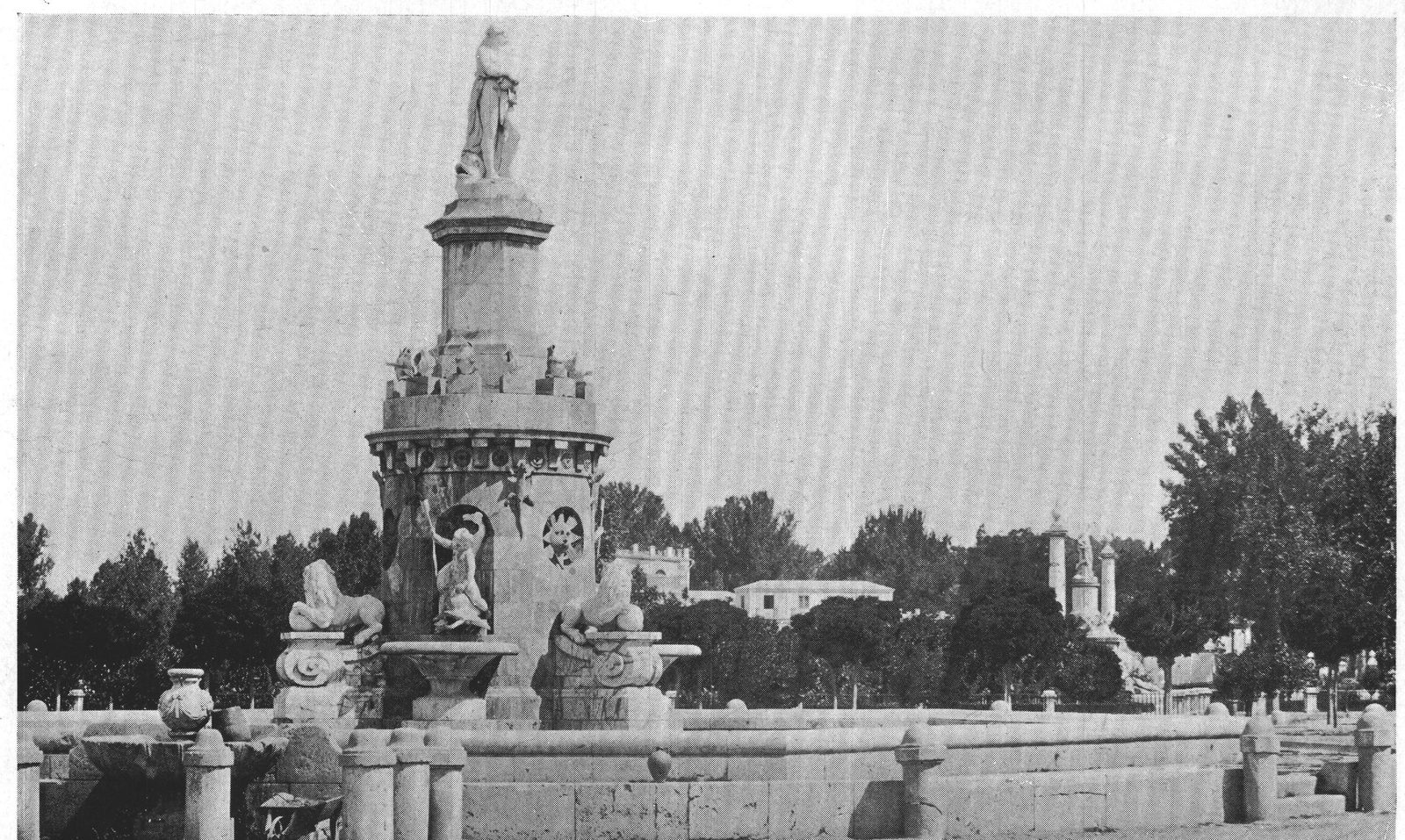
We now seem to be standing at the focal point of this royal village. Wide, shady avenues lead away in all directions, while near by we see the Convent Church of San Antonio, with its lanterned domes and covered arcades flanked with bushy acacias, which seem determined to look their best that they may not wholly give up their native town to the invasion of foreign trees. Between the arches and toward the ends of the avenues, we see the surrounding low hills whose barren slopes add emphasis to the verdure of Aranjuez. Fantastic fountains in the parterre behind the palace, indicate that water is not a scarcity here. In fact, beyond the parterre we see the winding river Tagus, and across a small suspension bridge, tastefully flanked with figure-capped pedestals and stone vases, is situated the one sign of commercial industry in the village—a substantial and very respectable looking flour-mill. Evidently the water power is put partly to industrial uses, and is not wholly absorbed in the ornamental function of supplying the fountains.
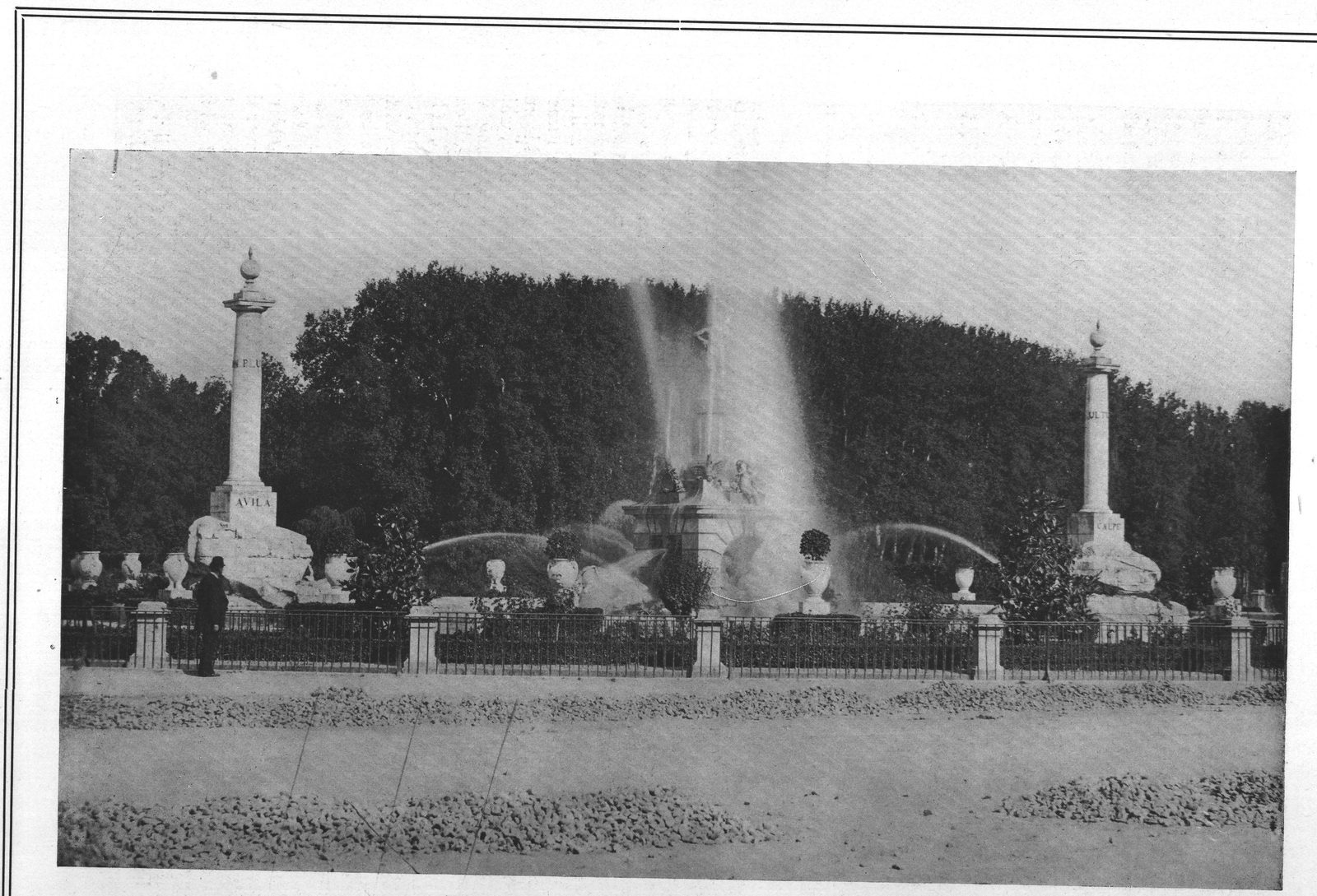
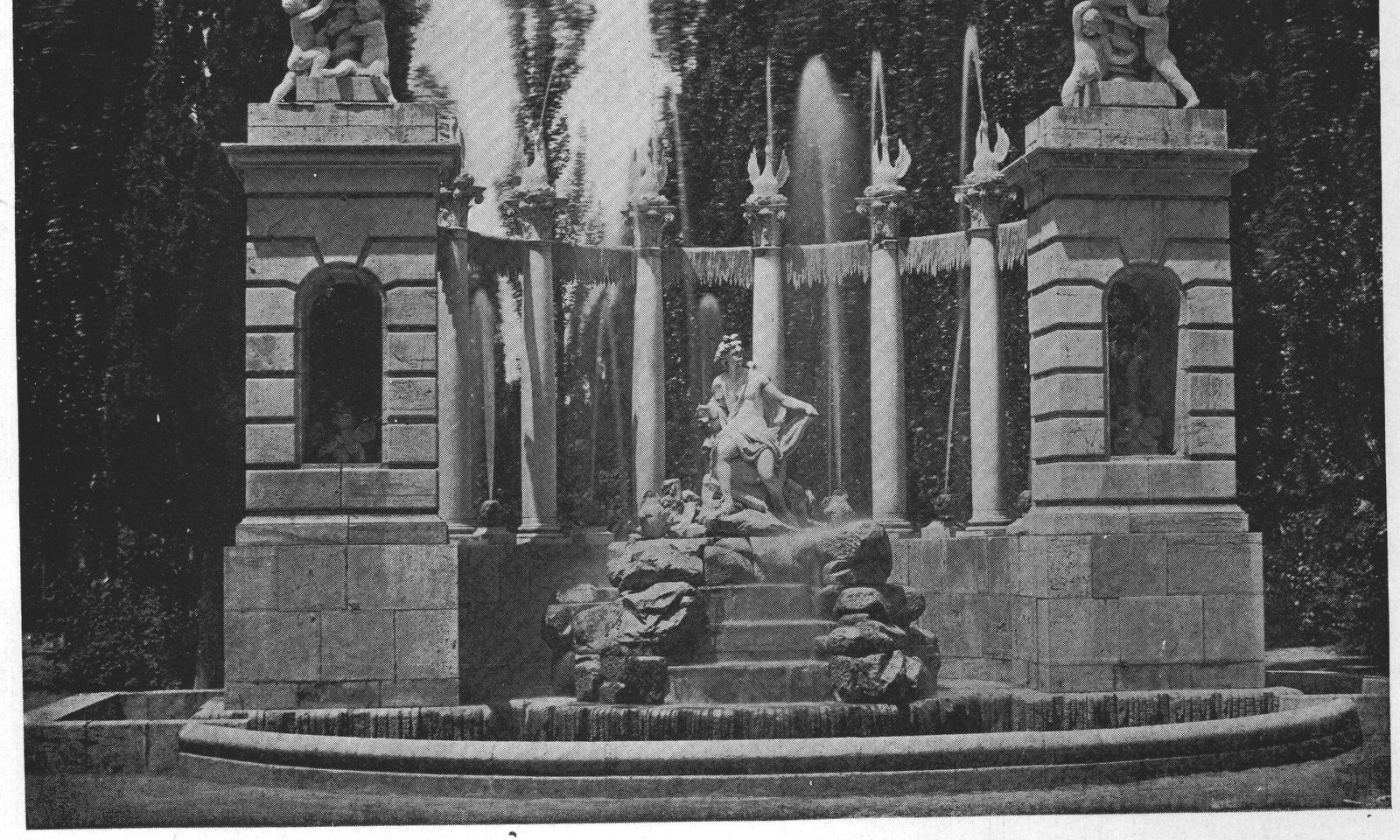
But standing here before the entrance to the palace garden, the delicious odor of the flowers comes to us; the gates are open, we are tempted to explore further, and we enter, passing the gay fountain with its commemorative columns on either side. Much as we have seen of delights, one little dreams of the treat that here greets the eye. Roses everywhere, roses of all kinds and varieties, growing high on a single stem, to burst out in a clustered mass at the top, or clambering over the walls a solid mass of bloom,—roses of a size to challenge measurement, for rarely does one see such splendid blooms.
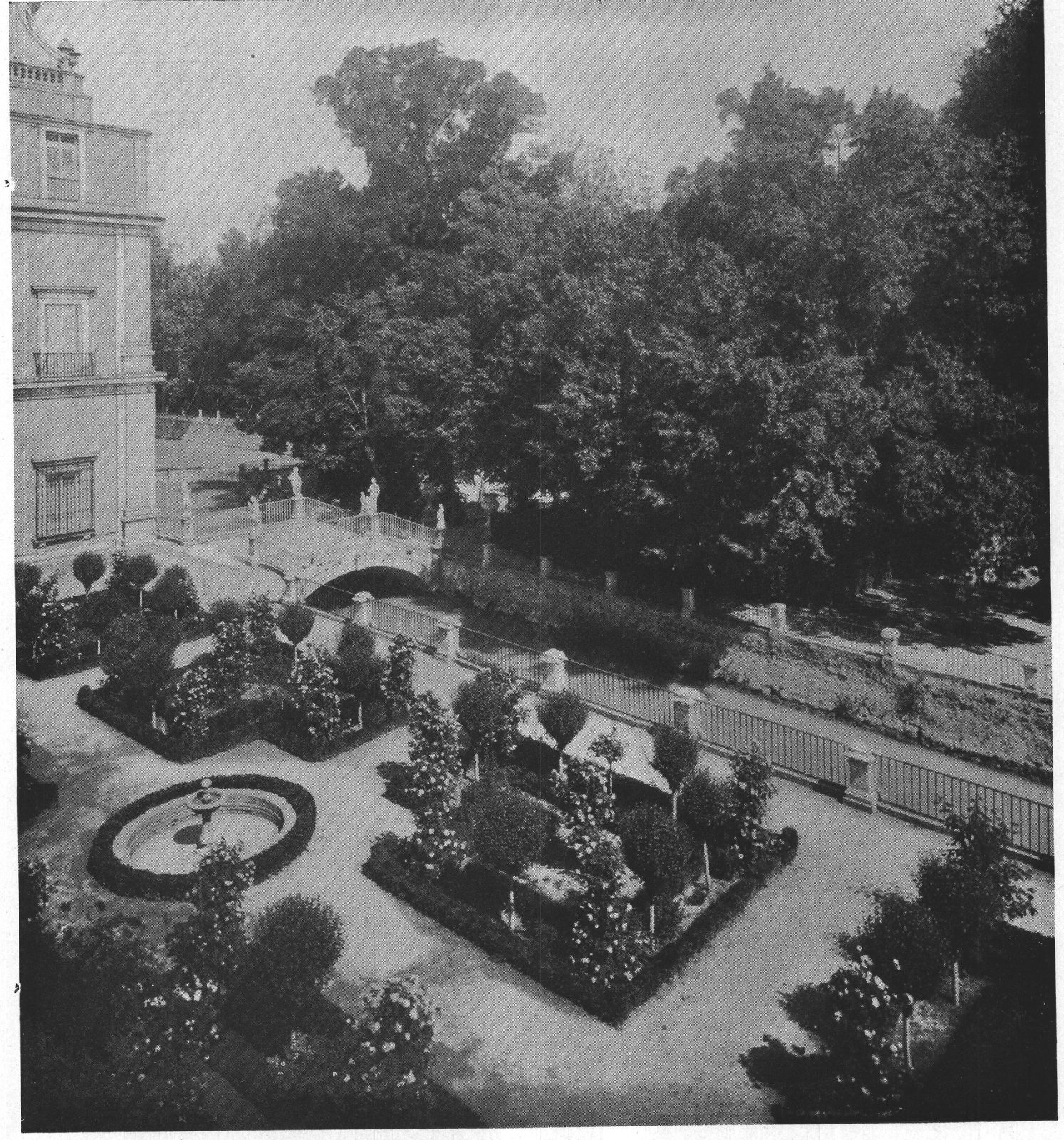
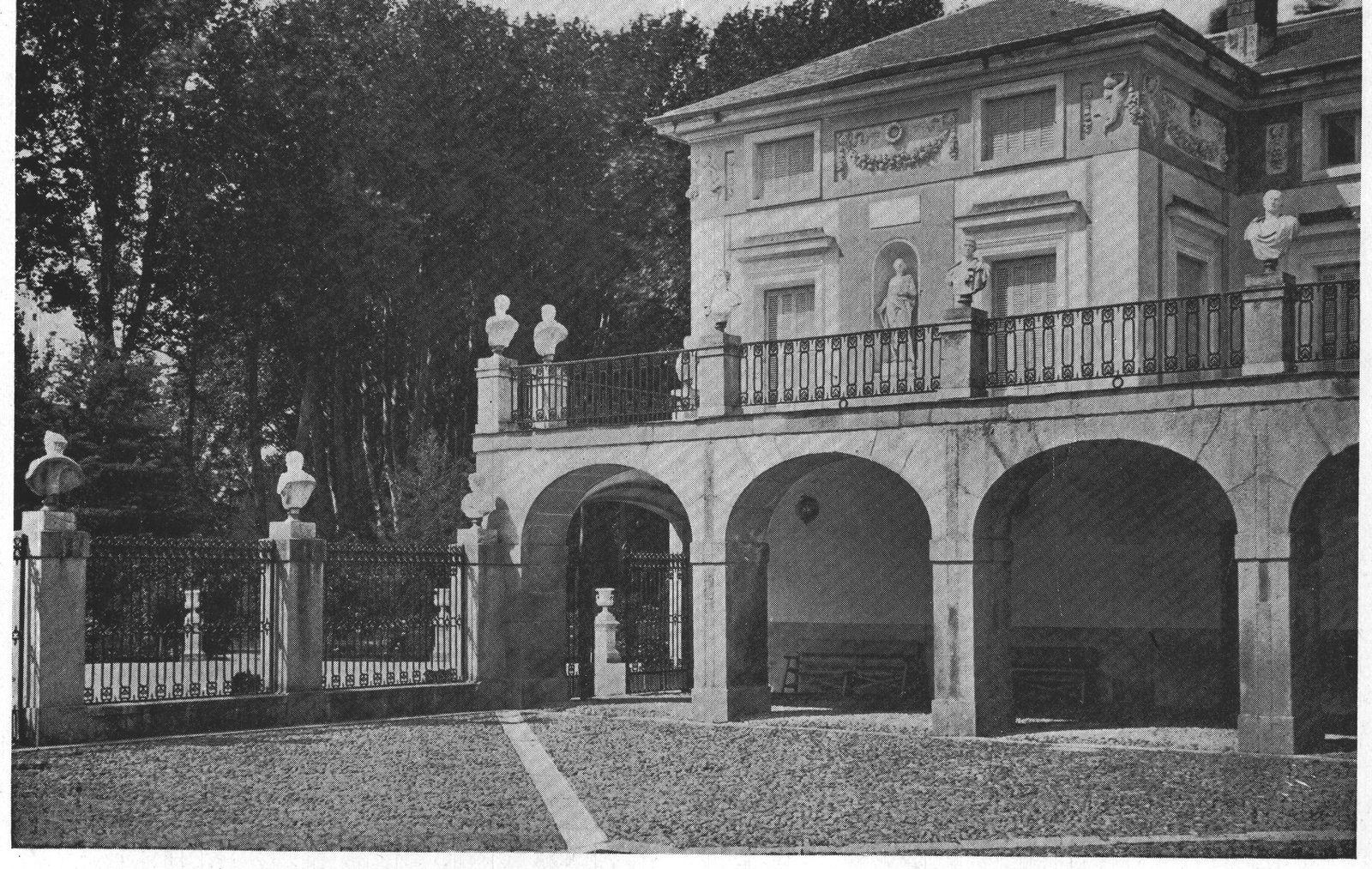
From an L-shaped wing of the palace, which serves as a barrier from the public road, along which we have approached the garden, a high wall extends for some distance. It is effectively treated, in brick with stone trimmings, and adorned with niches, containing stone seats. These niches alternate with smaller high-up recesses, in which busts have been placed. Surmounting the wall is an iron railing, forming a protection to the promenade, which leads from the second story of the windows of the palace. Over wall and railing climbs a white rambler rose, its heavily laden sprays hanging far out over the garden paths or crawling in behind some bust to form a delightful background of green and white against the deep rich red of the brick.
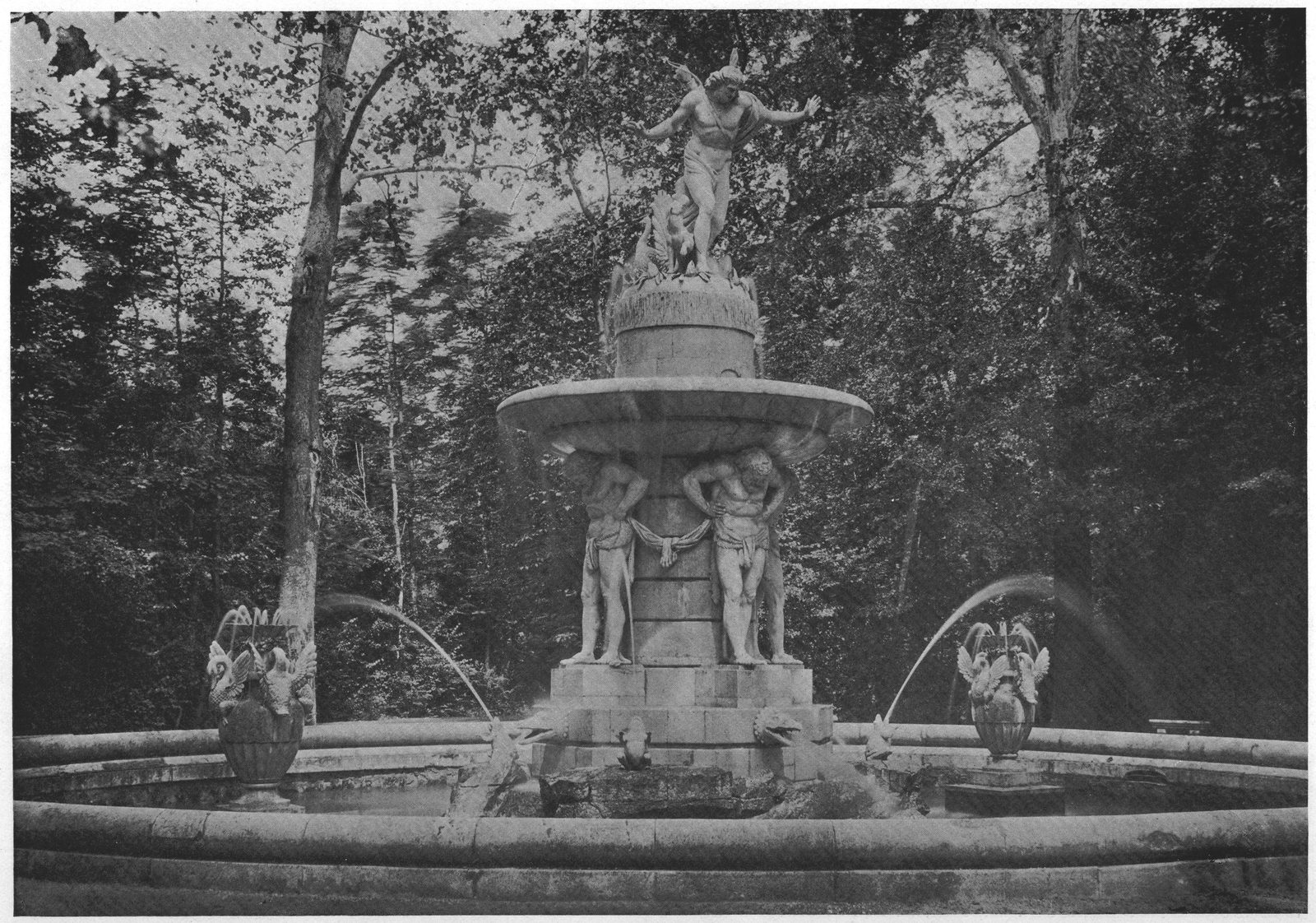
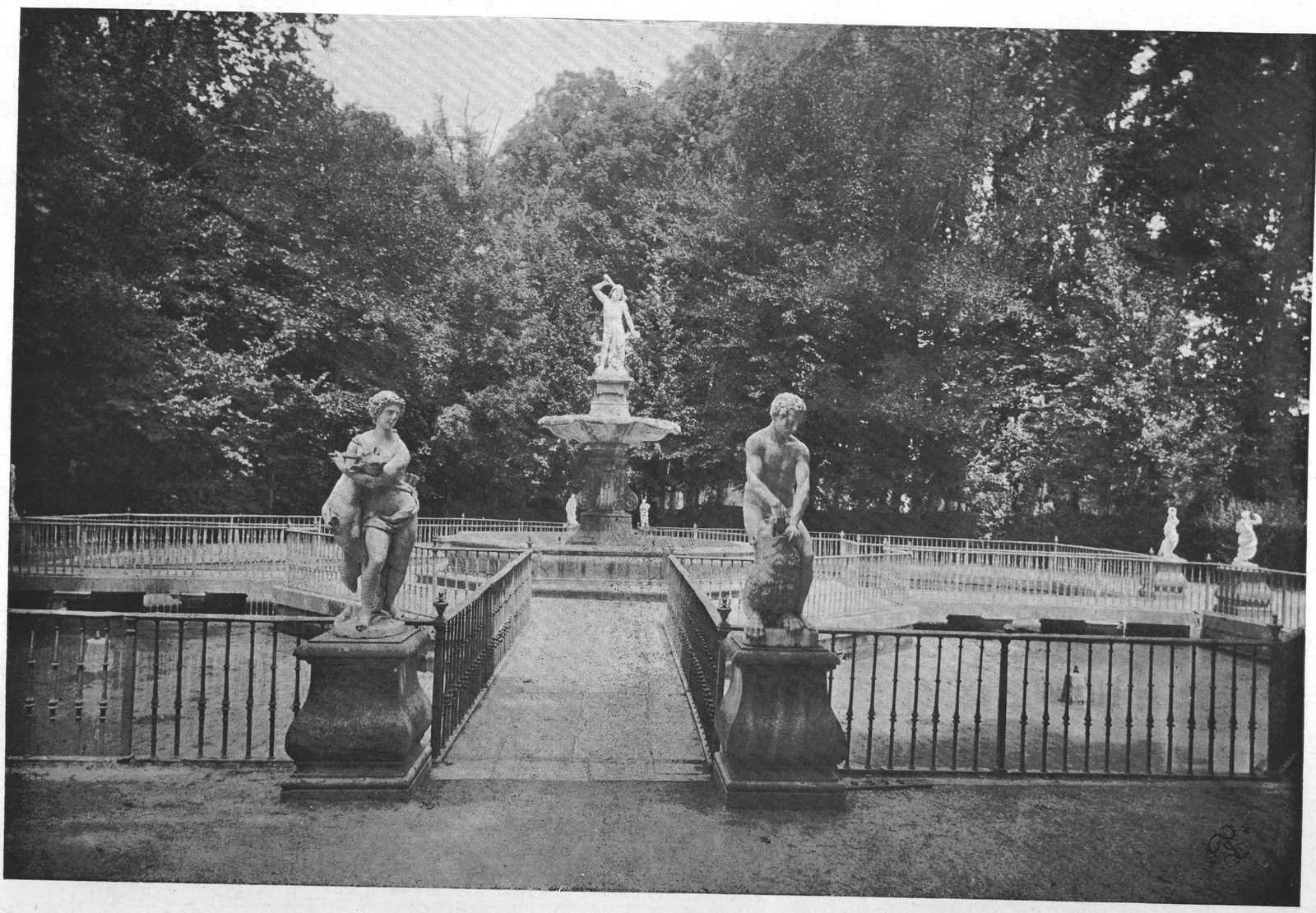
The flower beds are laid out formally, with small box-wood edgings, and, here and there, a corner box-tree or a fountain of a single jet in a center. Toward the north, one looks from the iron-railed wall directly down the river, which here takes a sharp turn and flows rapidly over a low weir and away amidst grassy islands. Above the weir, a flume carries a small stream, which, passing beneath the garden bridges, flows swiftly, boiling along beneath the palace windows, coursing through the woods and amongst the tall elms to rejoin the main river below the gardens. To this cool and shady part of the palace grounds is given the name of El Jardin de la Isla, or the Island Garden. Crossing the moat by one of the bridges, gay with its groups of statuary, we stand on this wooded island. Beyond the fountain we look down a splendid avenue of plane-trees. These giants, imported originally from France, are looked upon by the inhabitants with the same curiosity as a palm-tree is in more northerly climes, but that they have thrived much better than such exiled palms is shown by their healthy appearance after so many years.
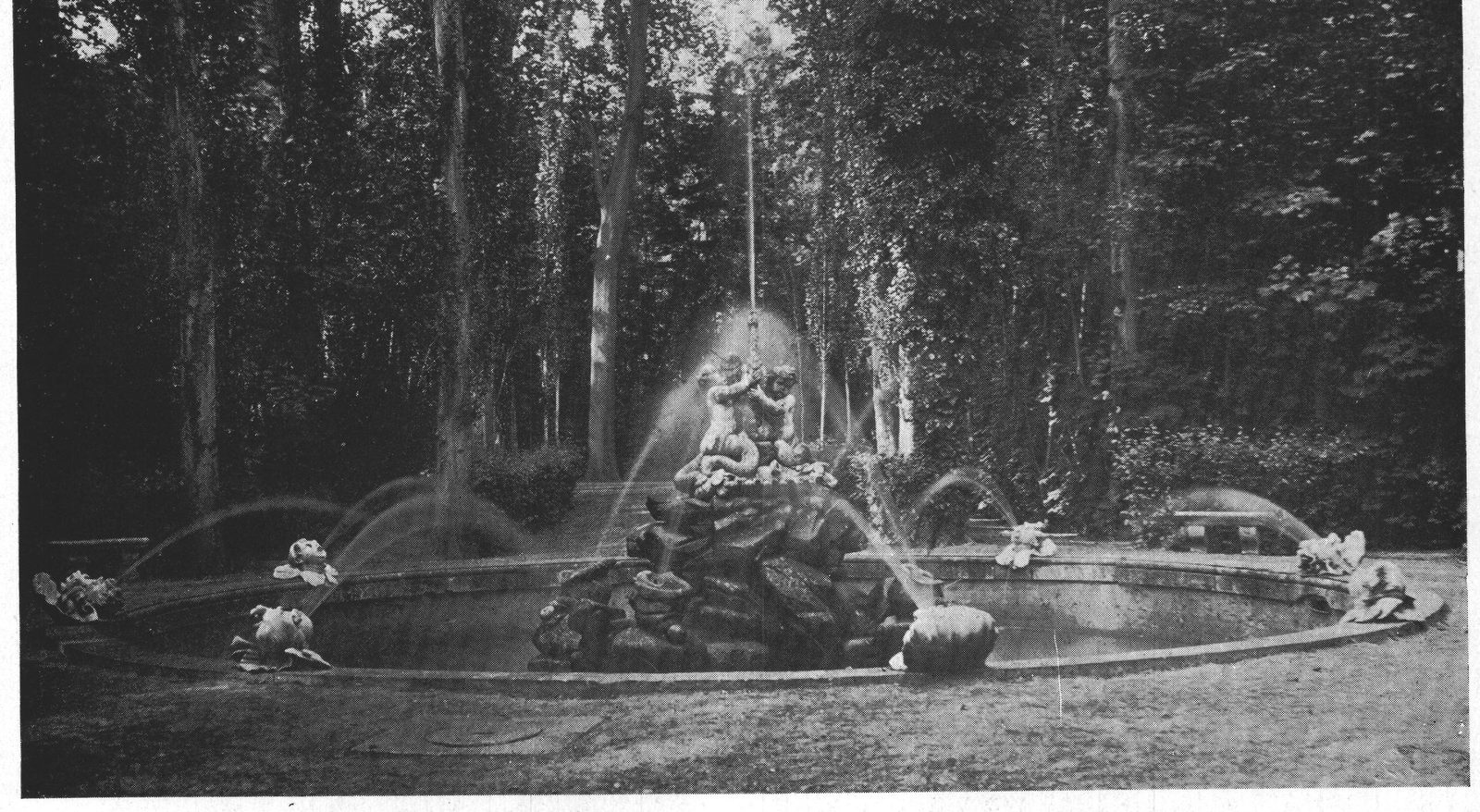
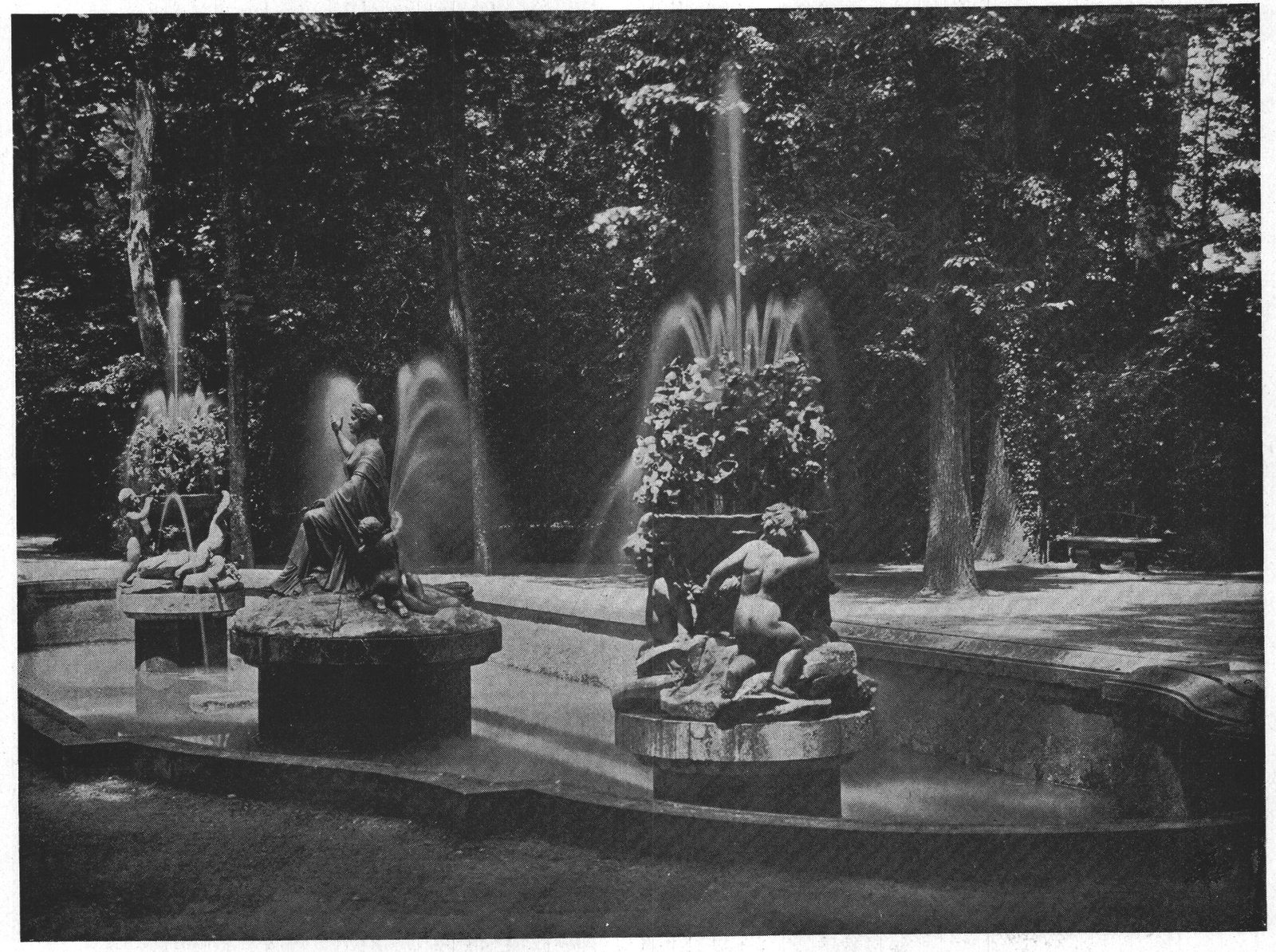
It would, indeed, be difficult to find a more pleasant walk than along this Salon de los Reyes Catolicos. Here from benches placed between the trees are afforded, on one hand, views up and down the wooded river-bank and away to the hills, while on the other side, inviting paths lead off into the cool depths of the grove. The hedges here have grown wild, and visitors are few, so that we wander with careless pleasure up and down the various walks amidst a mass of vines and bushes, the shrubbery, however, being kept within bounds by bordering beds. How shady and peaceful it all is! Now and then a statue or some old fountain, marks the meeting of principal paths, fountains differing in design, moss covered, cool and dripping, each junction of ways furnishing four equally pleasing paths to be followed out and explored, each certain to reveal another lovely spot on which to pause and while away a moment alone with the trees and the shrubbery to the soothing accompaniment of the birds and the distant waters.
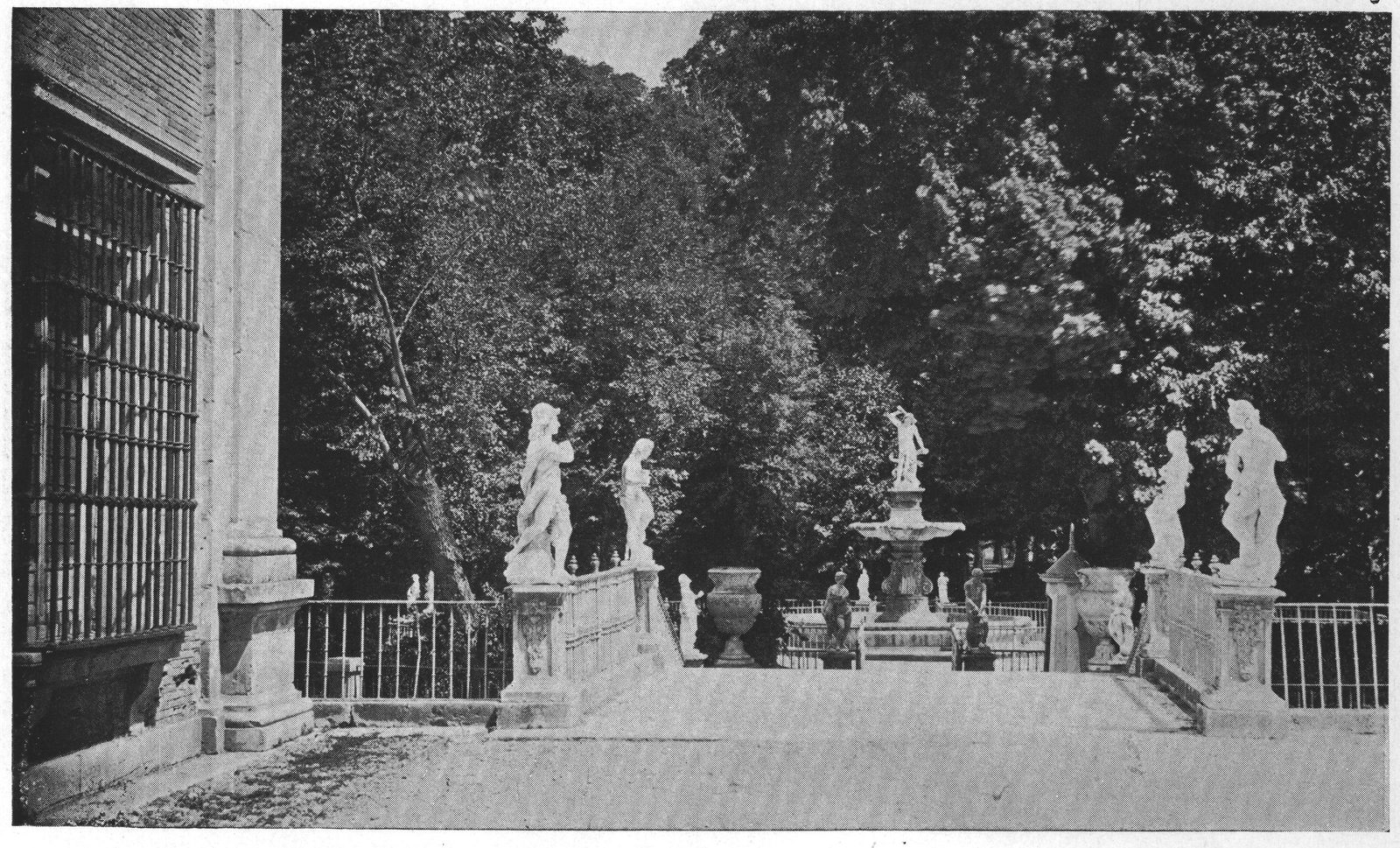
The reputed neglect of this Isla is one of its chief charms, rather than a cause for concern and discouragement, as the guide-books would have us believe. It is the charm that comes after man has done his work and departed, when Nature steps in again to reclaim her own, the same charm that is found to-day in the Villa d'Este, and the other apparently abandoned Italian gardens. What better could be done here than to leave this shrubbery to follow its own course, with now and then a judicious trimming, lest it become a mere tangled thicket? The paths are well cared for, and formed of large pebbles, bounded by flat oblong blocks of stone; they have the advantages of always remaining free from mud in situations where, at the driest season of the year, moisture must necessarily collect.
Leaving at last this quiet spot and retracing our steps through the rose garden, we are again in the open parterre with its fountains and converging avenues. That we are in royal domains is indicated by the names of the roads—Calle de las Infantas—Calle del Principe—Calle de la Reina. Following the latter along its shady paths for some distance we reach La Casa del Labrador or the Laborers' Cottage, the Petit Trianon of Aranjuez, again reminding us of the French ideas developed at Versailles, and here imitated by the Spanish Court.
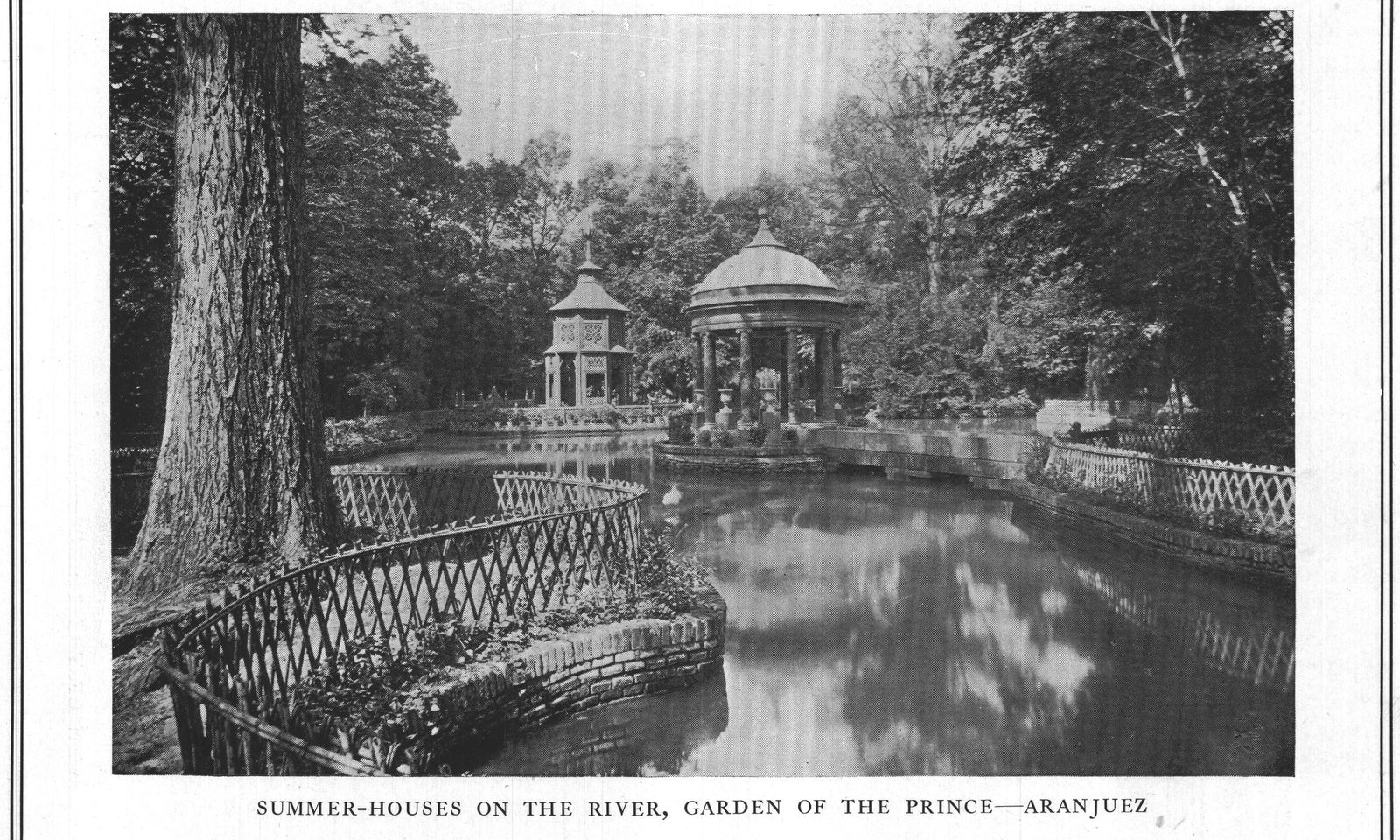
This royal plaything of the light monarch, Charles IV., is situated in a portion of the estate, separated from the palace gardens by the winding river, and known as the Jardin del Principe, or the Garden of the Prince. It is far more interesting—architecturally than the more extensive palace. It is richly fitted up with marble, tapestries, china, and platina-inlaid walls and doors.
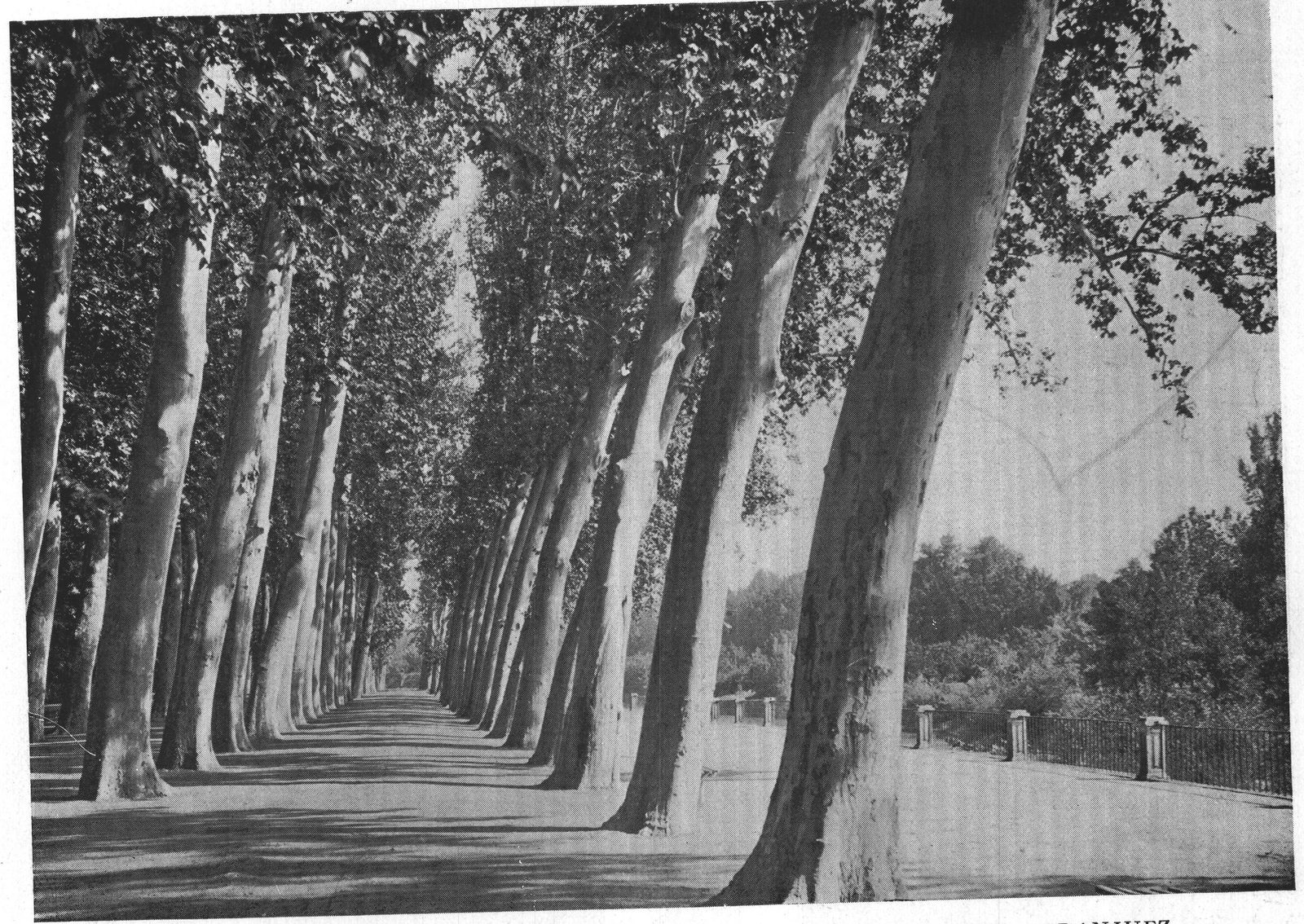
The immediate grounds are laid out as a Jardin Ingles, but, by far the most interesting part of these gardens is reached from the first gate, on the Calle de la Reina, near the suspension bridge. Straightway before us stretches a splendid avenue, a quarter of a mile in length, lined on either side with footpaths, and shaded by four rows of huge plane-trees. Permission from the guardian, which is granted for the asking, seems all that is necessary to allow us a full view of these splendid gardens. Our attention is called to a group of men stretched at full length on the grass, just outside the gates, some asleep, some idly talking or smoking: "another lot of idlers," we say; but when an hour later we recognize these same men working among the flowers, or gathering the luscious strawberries now at their best, we realize that these "idlers" are the gardeners. The midday heat is so great throughout Spain as to cause a general cessation of outdoor labor about noon, and we find that to our sleeping friends we are forced to give the credit for the neatness of the garden paths, the flower-beds, walks and vegetable patches.
But what is to be our reward at the end of this pleasant walk? That bright patch of sunshine at its extremity must bring forth some new pleasure, so we hurry along and are rejoiced to find another garden filled with roses, its name, La Florera, indicating fully its nature. It is difficult to describe our feelings, as we suddenly burst from the cooling shade of the trees upon the small open and lovely flower-garden. It is a little gem, entirely surrounded by a single stick trellis, a series of arches completely enclosing the square. Clambering over the arches is a mass of tiny white roses, now in the height of their bloom. Box hedges, trimmed low, border the beds, where sweet william, phlox and other brilliant flowers exhale delicious odors. The center-piece to this feast for the eye is a small oval pool, from which rises on the rocks a basket, filled with trailing vines and brilliant geraniums.
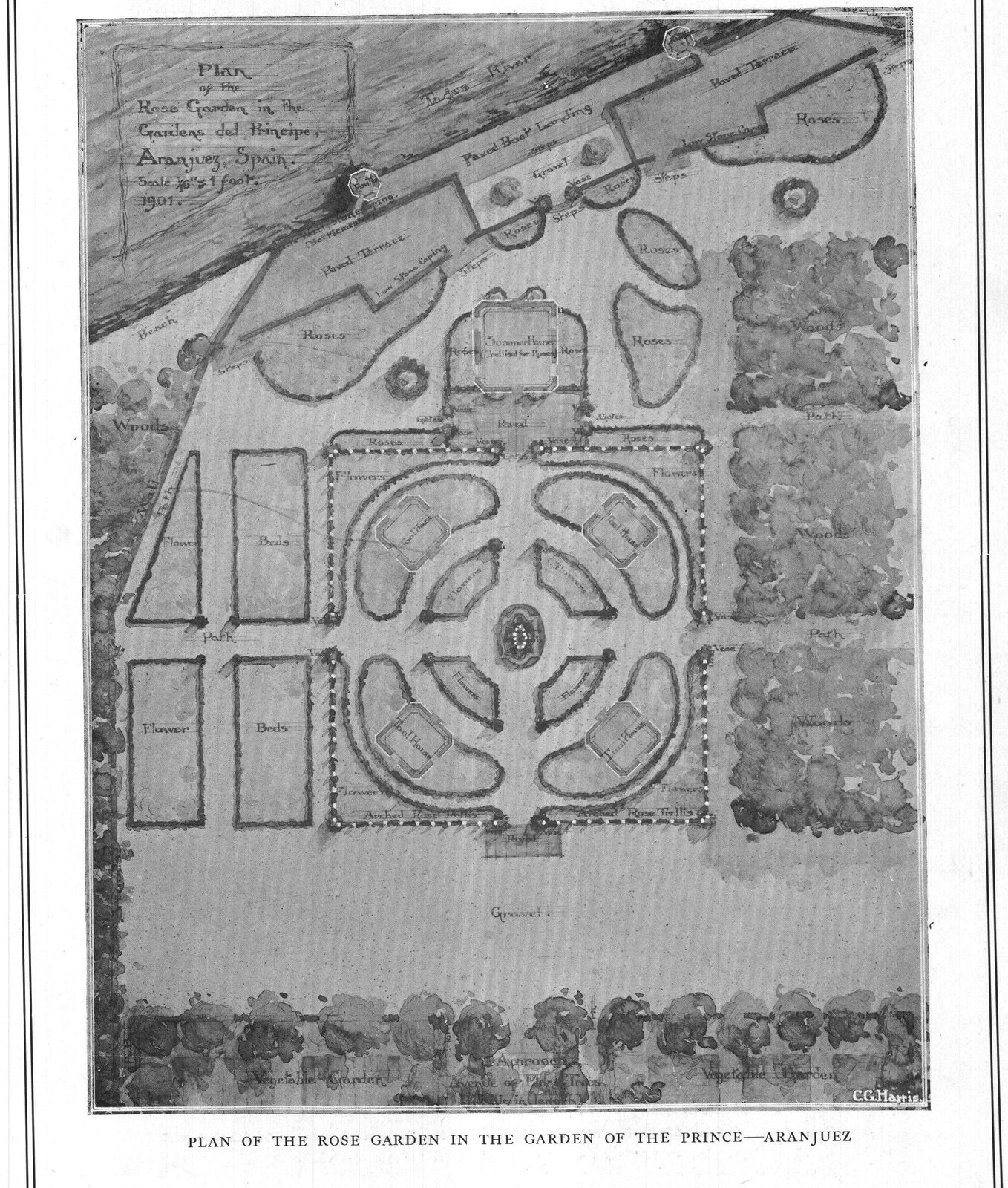
At each corner of the trellised enclosure facing the pool is a square gardener's house, roughcast in yellow plaster, covered with green latticing, over which more roses climb, even to the roof line. On the main axis of the avenue, and directly opposite the entrance to the square garden, is a somewhat larger house of the same construction. Save for the window spaces, its walls are a mass of wistaria, whose delicate lavender clusters hang luxuriantly from under the cornice. No doubt this house served as a small casino, a retreat from the heat of the sun or a sudden shower for the royal wanderers among the flowers. Before its door is a small paved fore-court, lying one step below the level of the garden, surrounded shoulder high by hedges and entered through wooden gates.
Perhaps the most original part of this lay-out is found just behind the casino. Here we have again reached the river in our wandering. A small embarking place leads up from the shore; and on both sides of it, reached by a few broad steps, are low coped terraces. These are paved with large flagstones, the wall toward the river rising waist high of brick, battlemented in stone, while two octagonal stone pavilions, dainty in design, afford vantage ground for views up and down the winding stream. Toward the garden the terrace walls are banked with a perfect sea of rose bushes. Beyond, in much the same way that one enjoys the view of a sunken garden, we glance from our slightly elevated terrace, through the trellised arches, upon the brilliant flowerbed. The surrounding green of the woods, the garden a sunny blaze of color in the foreground, the ripple of the river below us, together with the glory of the May day, combine to make a perfect not-to-be-forgotten picture. Up the stream stretch long winding avenues, cutting through the woods,—avenues that lead in and out, now bordering on the river bank, now piercing far back into the heart of what seems to be a boundless wooded park. Here, too, are attractive statues, well placed at the end of each vista; and each succeeding turn reveals moss-covered fountains, deep in the enclosure of the woods, which reflect in their dark bosoms the green foliage overhead. Here reigns a solitude emphasized by the life and gaiety which we have so recently seen amongst the flowers. Wandering thus pleasantly about, finding always something unexpected and refreshing in the quiet glades, we finally emerge from the woods to meet again the busier life in the garden, where the laborers pause in their work to eye the passing strangers. The day is drawing to a close, yet we feel as if we were but getting acquainted with Aranjuez, and we long to explore further and learn more of the charms of this rarely visited land.
The question will recur—why is this attractive garden spot so little known? Why, in these days when the interest in gardens has so greatly revived, and so many books are being written on the subject, do we read so little of the attractions of Aranjuez? These questions arose in our minds as we walked reluctantly to the station, and puzzled our brains as the train bore us slowly back over the plains to Madrid, and we left behind all but the memories of that ideal May day.
Perhaps there are several answers. In the first place, Central Spain is as yet far removed from the beaten track of European travel. Its railways are anything but convenient, and especially so should one depart from the chief lines. Again, the guide-books, as a rule, are enough to chill the marrow in the strongest bones. If taken alone, they would seem to make the trip to Aranjuez scarcely worth the while. They speak of gardens in great neglect and weedy; fountains dried up and unswept paths strewn with leaves; the general air of the place deserted and forlorn. One grows rather suspicious, however, as to whether the authors ever actually investigated for themselves, for the accounts in two guide-books are almost identical, word for word. Both conclude in the following pathetic manner: "And well may we exclaim with Schiller,—Die schönen Tage in Aranjuez sind nun zu Ende." From a historical point of view, no doubt this is true; but after days on the arid wastes and barren plains of the surrounding country, it comes as a relief to the traveler, to find again the green trees, to breathe the cool air from the woods, and to listen to the splash of the turbulent waters. Could Schiller but have been there on such a day as we had, could he have wandered as we did, along the shaded paths, among the fragrant flowers, surely then he would have written—"that glorious days in Aranjuez still exist for those who love Nature in one of her most attractive forms—the garden."