IN writing of the Villa Lante it is of Italy and her gardens I write. To write of Italy and her gardens is to touch of the spirit of all gardens. To write of gardens is to write of Nature and man: a pleasant task!
A garden, I take it, is a place where Nature and man come close together; where they join hands, as it were, to the greater pleasure of man, and I like to think, not to the displeasure of Nature. It is man's little domain, for him more specialized than the wild field; Nature focused, stilled, and gently cared for. Delight in Nature is universal; and every kind of man, of every grade of life, makes outward expression of this pleasure. The little wayside garden; the bright pots with their green festoons, reaching from some high tenement window; the stately gardens of palace and castle; the sweet, trim gardens of our ancestors; the Babylonian terraced gardens and the terraced hillside gardens of Italy; the classic garden of Greece and Rome; the flower-bordered pools of Spain and Persia; and the gardens of the far East, all attest man's love of flowers and grass and trees, his love of bright sunshine and cool shadow of pleasant odors and magic sounds.
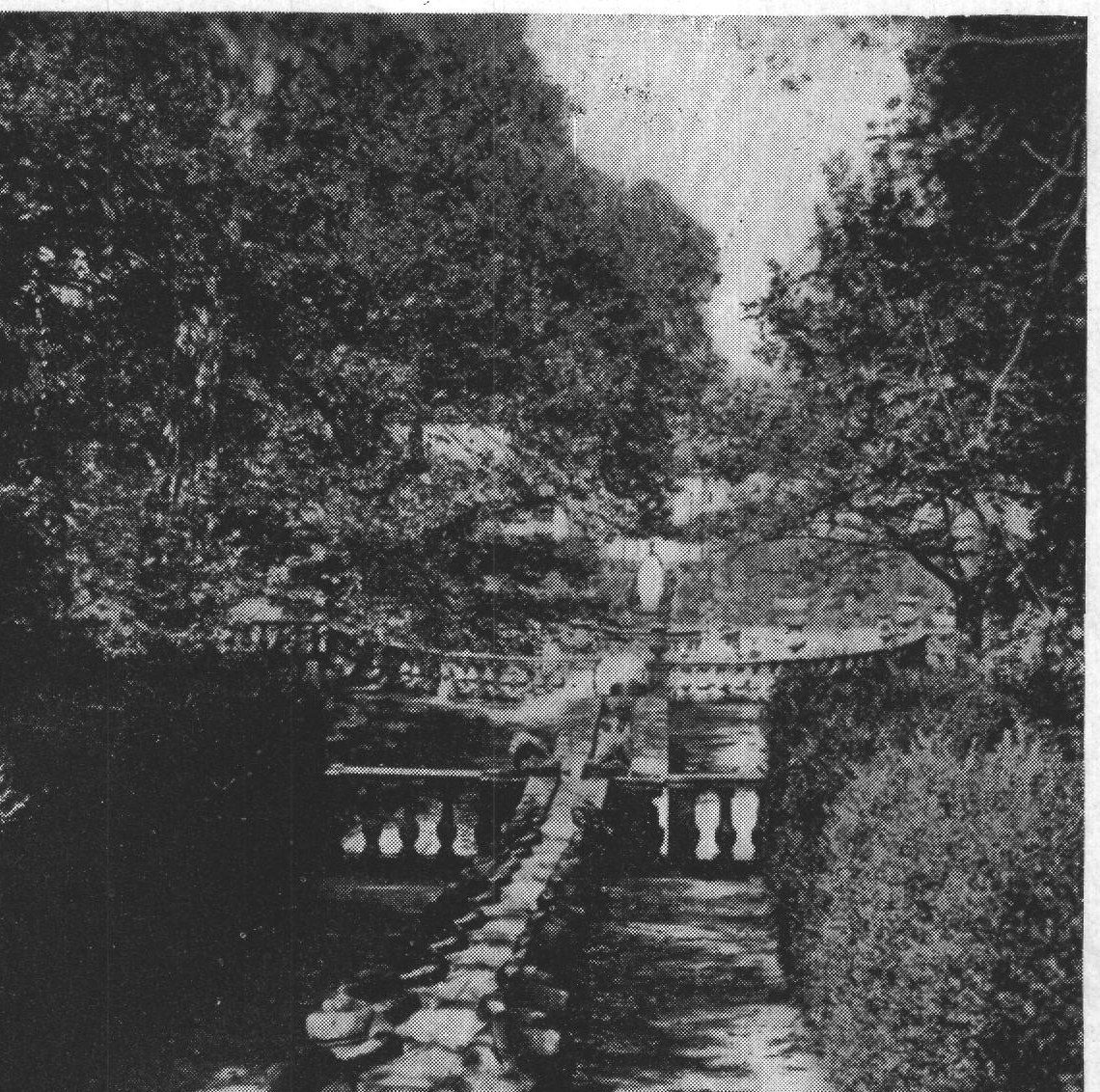
Our appreciation of Nature becomes all the more glorious, as we begin to realize how superbly superior she is to our efforts to imitate her. As we realize this more and more, comes an appreciation for those things artistic, which are, after all, man's creations and expressions, not Nature's, and not servile imitations of Nature. The two are so distinct. It is this dual something, then, that we shall find in the great gardens of the world, and the ones under consideration, the Italian, exemplify for us, perhaps better than any others that have ever been, that beautiful relation of Art and Nature, that joy of man's going out to meet Nature and Nature's willing desire to help his efforts.
If we recall the period of the fourteenth, fifteenth, and sixteenth centuries in Italy, we will remember it was a period of great intellectual development, as well as an age of much "civility and elegance." What a list of names is to be found here, from Dante to Michael Angelo! Men of great intelligence and understanding there were, men who could and did do marvelous things, not in one branch of art alone but in all. Painting beautiful frescoes, sculpturing wonderful marbles, building great churches and palaces, designing villas and gardens, each of these men comprehended not only his own special art but also that of others, and he was able to turn and work in it. Above all, they were ardent lovers of Nature. So when we turn to-day to the villa garden we find just what we should expect to find following upon those conditions: a highly refined, well-ordered artistic unit, a combining of all the best traditions of the past in garden art. We find man making a vantage spot from which to enjoy field and sky and wood and stream, and the bringing into this spot for his closer and more intimate contemplation of them, those smaller beloved things of forest and meadow that it is impossible to always go afield to enjoy; we also find this spot most admirably arranged for the convenience and realization of a highly refined and elegant life.
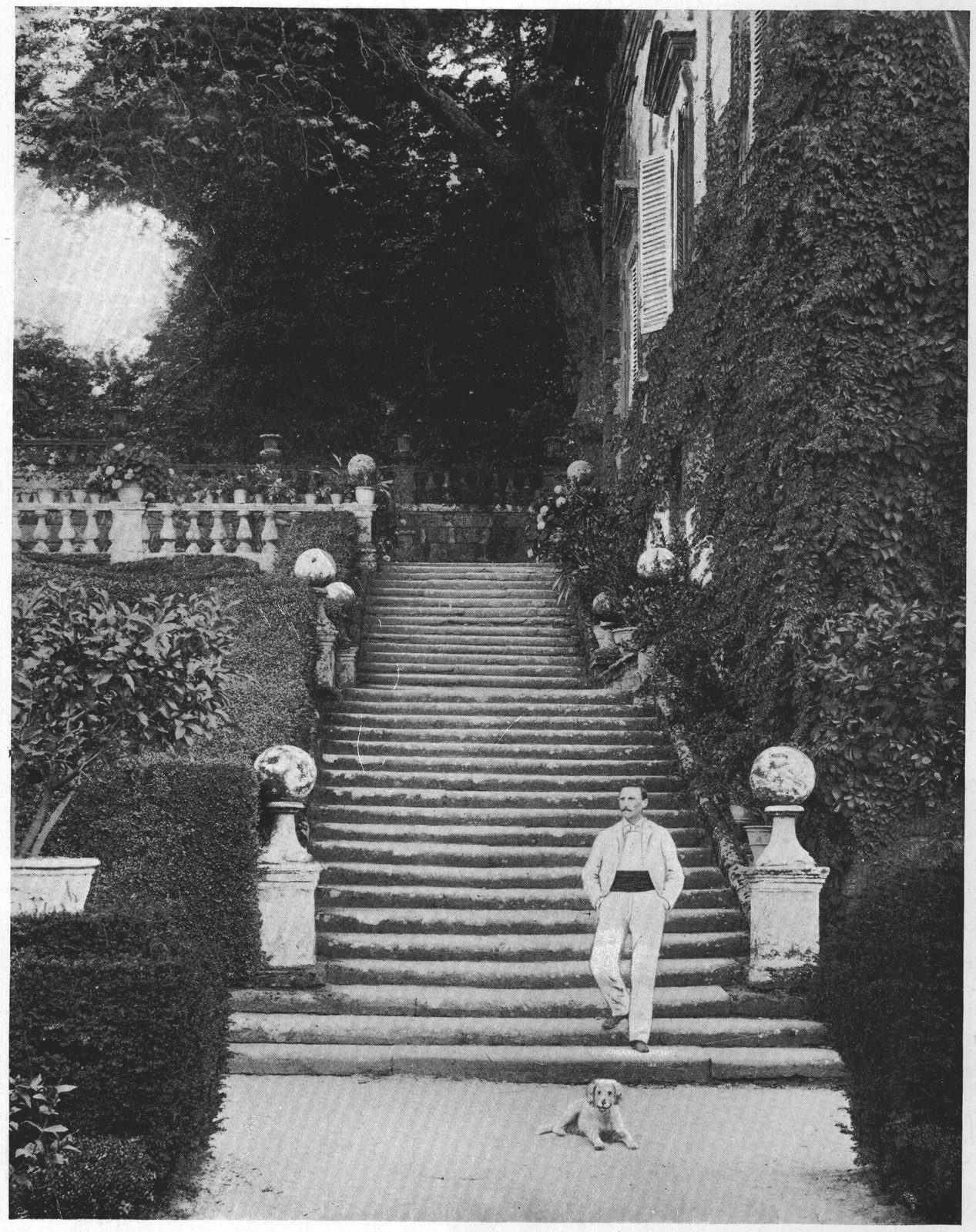
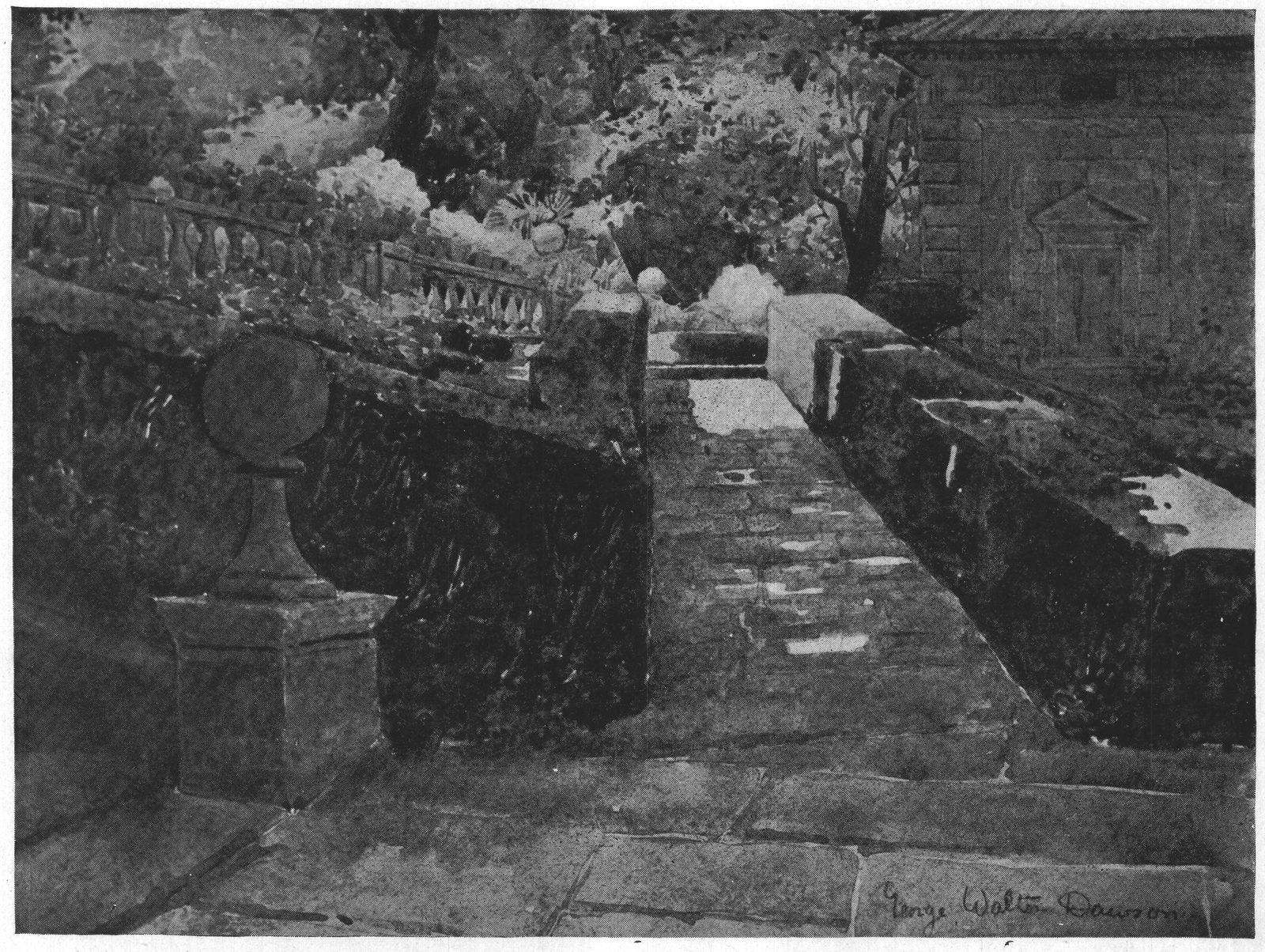
Because the gardens of the Villa Lante show to-day, perhaps, better than any other in all Italy, the spirit of the time that produced them, because they have come down to our time with fewest changes, because they have from generation to generation been so thoughtfully and lovingly cherished and cared for, and not allowed to perish, we select them to represent the truest spirit of Italian Renaissance gardens. There are others that strive for more effect; there are others that are larger; others that are more princely; but none are more charmingly beautiful, not another that represents more of a complete artistic unit supplying living memories to the mind's eye.
During most of its history, Lante has been the property of the bishops of Viterbo. Rafaello Sansoni Riario, a cardinal under Pope Sixtus IV., began the building of the villa in 1477. The Florentine, Niccolo Ridolfi, fifth cardinal bishop of Viterbo, carried the work on; but his successor, Gualtieri, gave it up on account of the expense and rented the buildings out. Another cardinal bishop, Giovanni Gambara, enriched the place with paintings by Antonio Tempesta, and in 1588 the cardinal Alessandro Damasceno Peretti or Montalto acquired possession of the villa and reserved it for the use of the popes and their relatives. He also built the casino and the water works and had the planting of the grounds completed at great cost. Pope Alexander VII. left it all to Duke Bommarzo-Lante of Erbpacht, whose family still retain possession of the property. Authorities differ as to the architect of Lante. Some declare the design to be Vignola's; others that the work was carried out at different times by several architects.
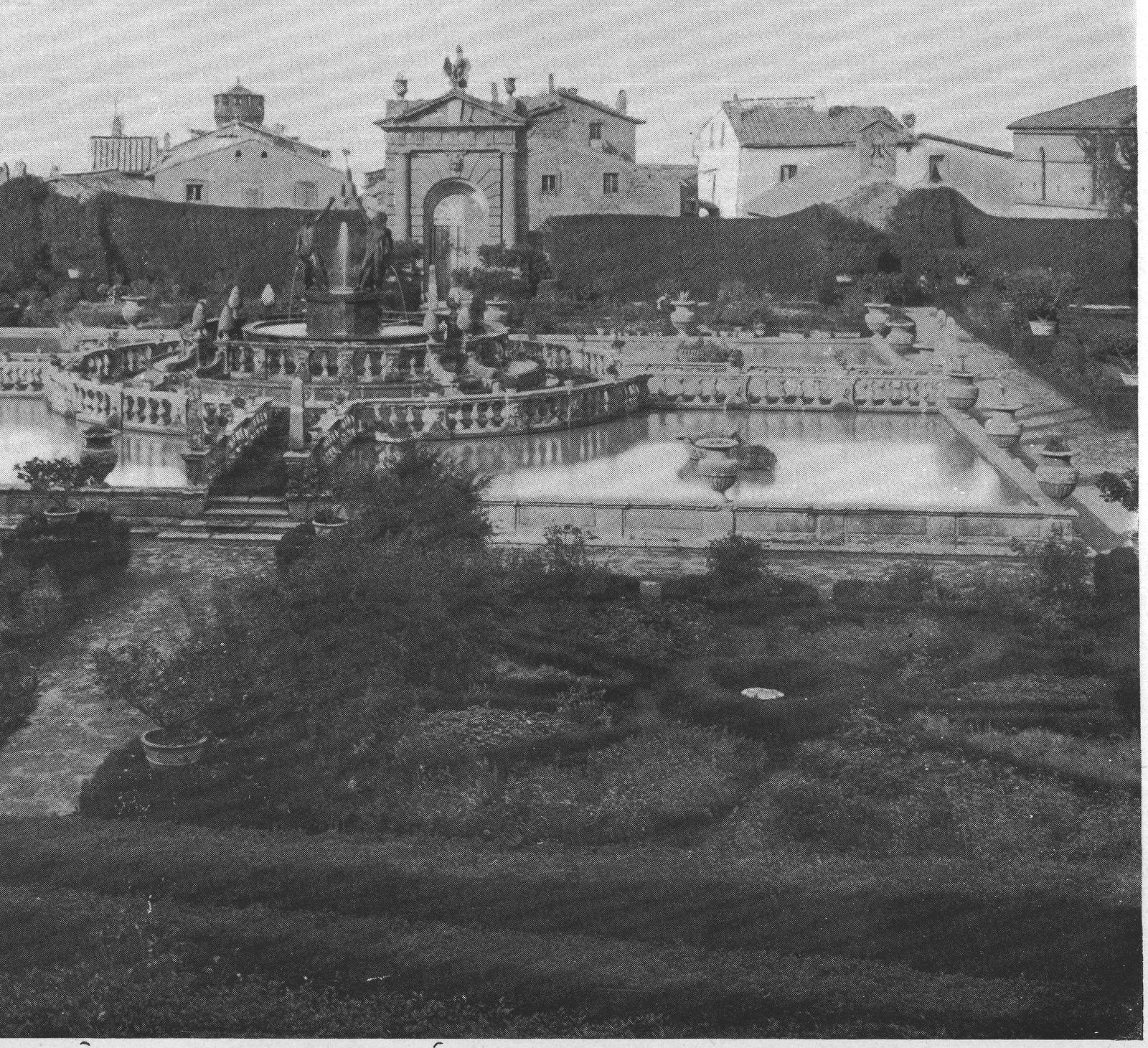
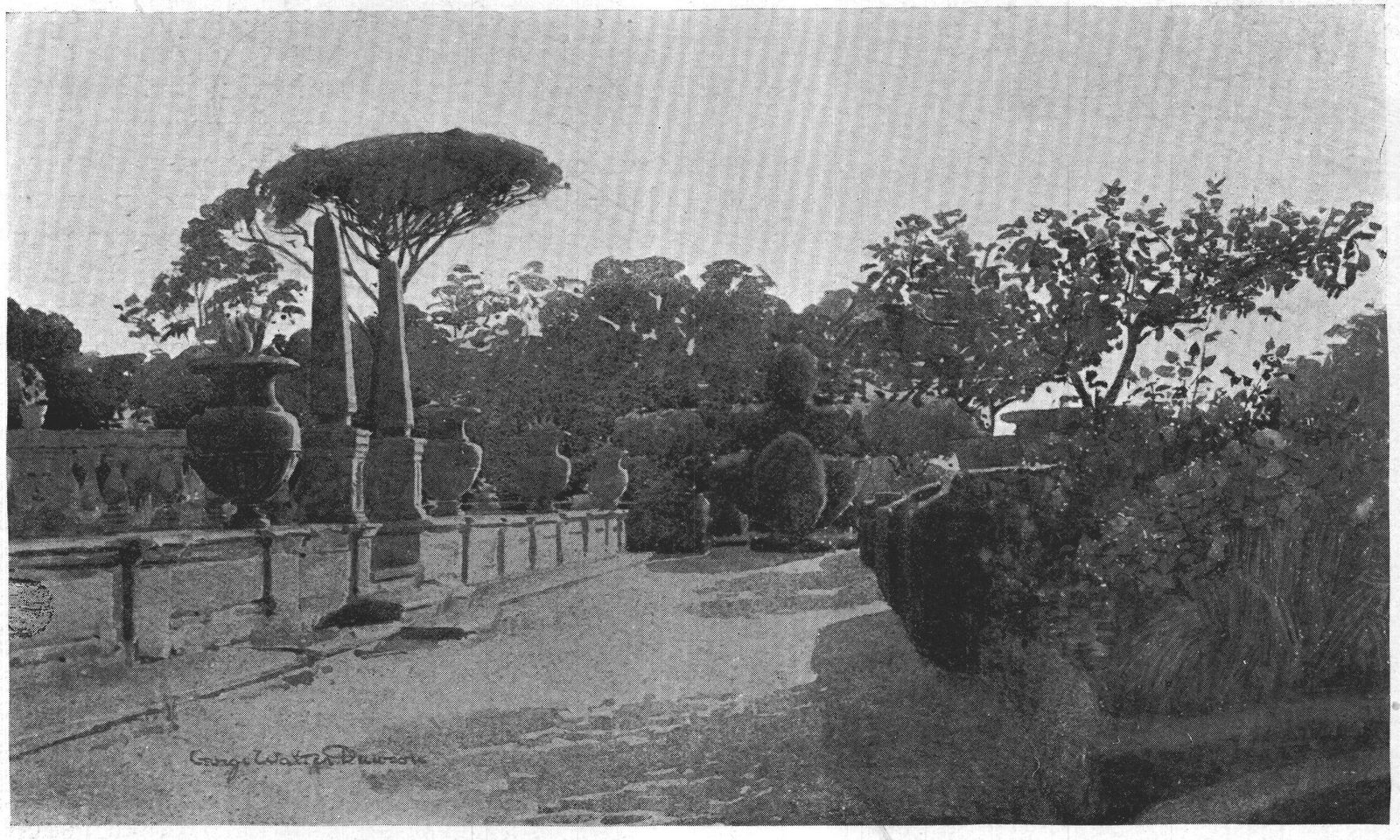
The villa is built into an oak grove on the northern slope of a gently rising hill, backed by greater and more rugged heights. The entrance, at the end of the principal street of the little town, opens directly on a flower garden, bright in the sunshine and lovely in its masses of bloom. Beside flower bed after flower bed one wanders about reveling in the beauty of the blooms and inhaling their fragrance, lingering perhaps a moment to watch the gold fish, to admire the group of statuary that rises above the large central pool and the garden. Then cool shadows and the sound of falling waters lure one on by way of stairs and ramps between box hedges, overhung with masses of old-fashioned roses, to the upper terraces. These are rich and varied in their character: sometimes open to the sun, sometimes planted with beautiful trees, giving delightful shade to walk in and from which to view as one wanders, the beauties of the parterred space just left below. Everywhere are fountains, either a series of jets or cascades, where are reflected niched walls and stairs and urns. But mere greenery, running water and these architectural ornaments are not all, for the shaded levels are heightened in color by great potted plants. Rhododendrons and azaleas, camellias and huge hydrangeas surround balustrades and border green alleys. One lingers and rests on old stone seats, listening to songs of birds and the ripple and splash of water, watching the golden patches of sunlight that sift through the interlacing branches and dance over lichen-covered walls, tree-trunks and columns entwined with vines.
Awakening from his reverie the visitor finds himself in a grove of oak-trees that surrounds the formal part of the villa. Here and there, usually where a path divides, is a fountain or basin recalling the more formal arrangement elsewhere, but nothing more, for this is really Nature's part. In these thick woods wild flowers and ferns cover the ground; ivy carpets it, clambering over banks and climbing not infrequently to the topmost branches of the oaks. Trickling in and out among the great roots of the trees are little streams, so overhung with delicate ferns that, but for the gentle murmur of the water one would come upon them unawares. Beyond all these superb trees and their water-courses and basins are outlying olive groves and vineyards and the wilder and more rugged hill slopes.
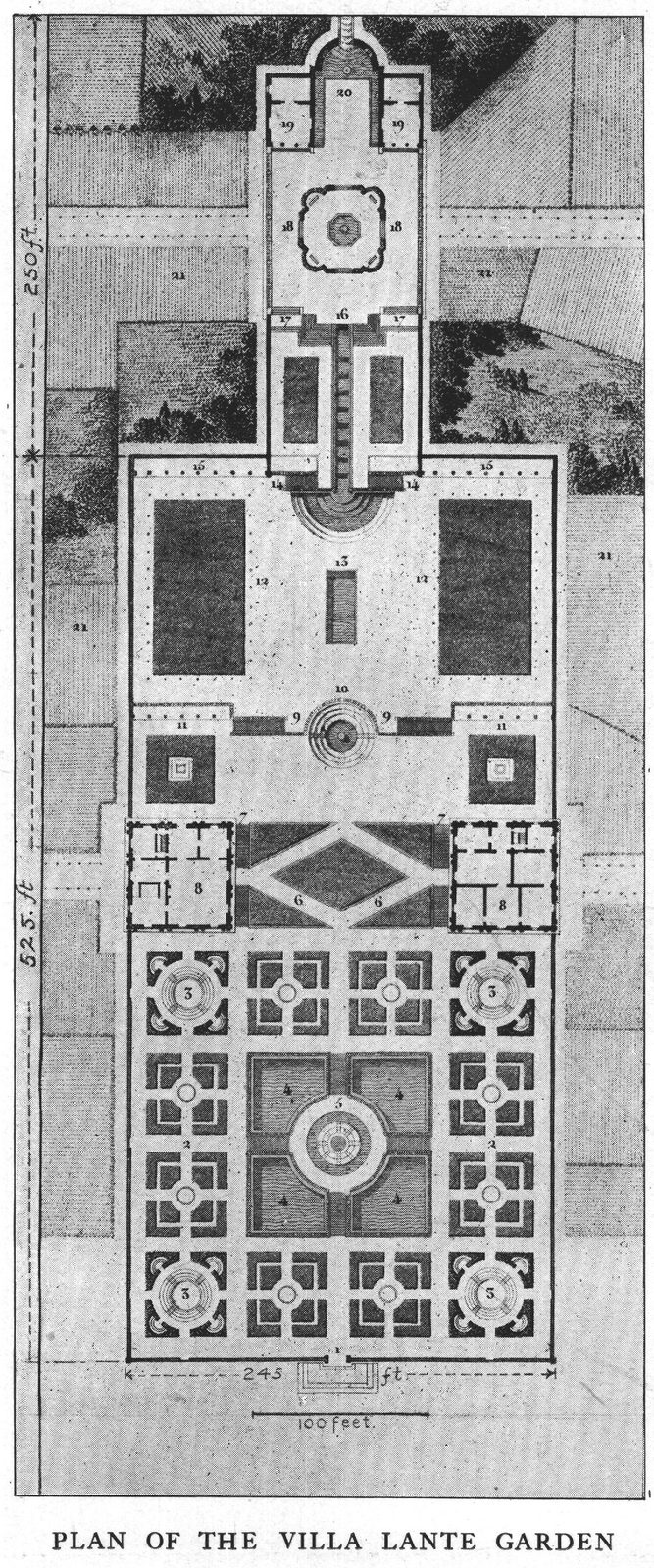
A study of the plan (page 58) will show much better the actual arrangement. The formal part, occupying something less than four acres, is divided into four levels, the upper one being about fifty feet above the lower. Of these divisions the lowest, which we shall call the first level, is much the largest. It contains the formal garden and occupies about one third the depth of the entire plan. This level is simply divided by cross paths into squares for flower beds, and at the end of it are built two houses or casinos, balanced on each side of an open central axis which extends from front to back of the entire scheme, and on or about which every feature of the plan is placed.
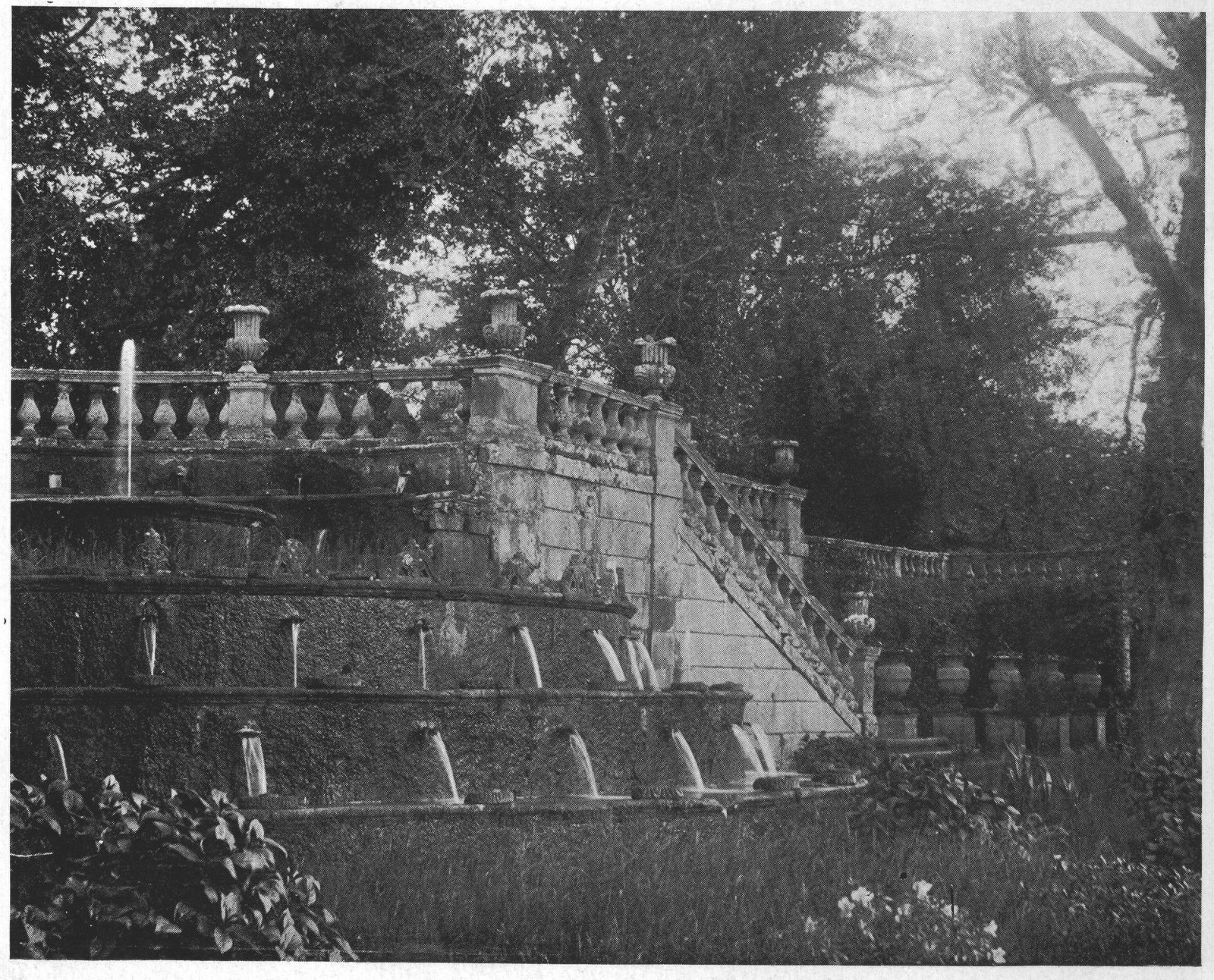
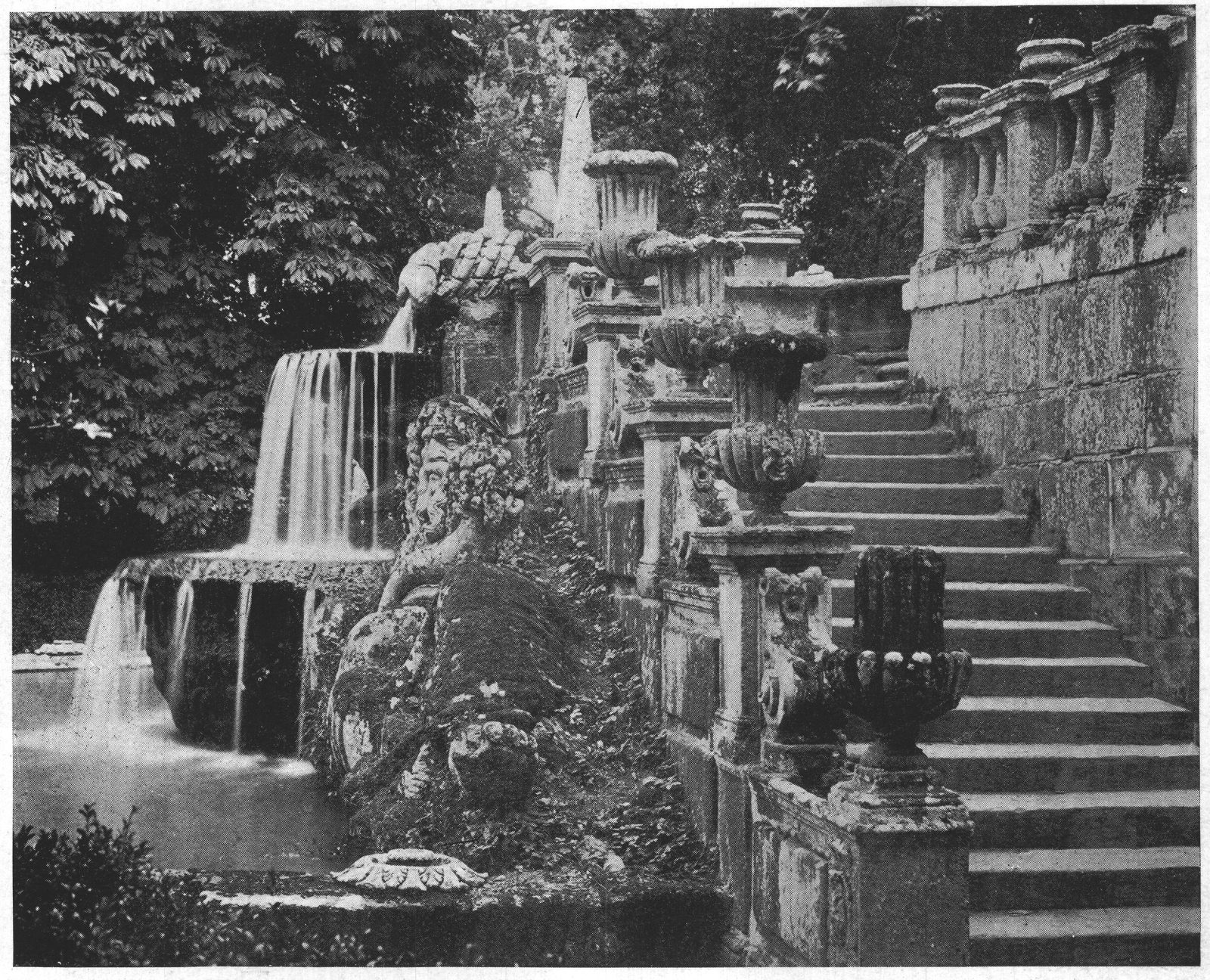
Between these two buildings extends a slope joining the first to the second level. The latter is a living-terrace, and here are the entrances to the houses. In the center is found a circular arrangement of fountains in four levels which is illustrated on page 56. From each side of this fountain, stairs at right angles to the main axis lead to the third level. This is much deeper than the second, and is rich in its arrangement of fountains and basins.
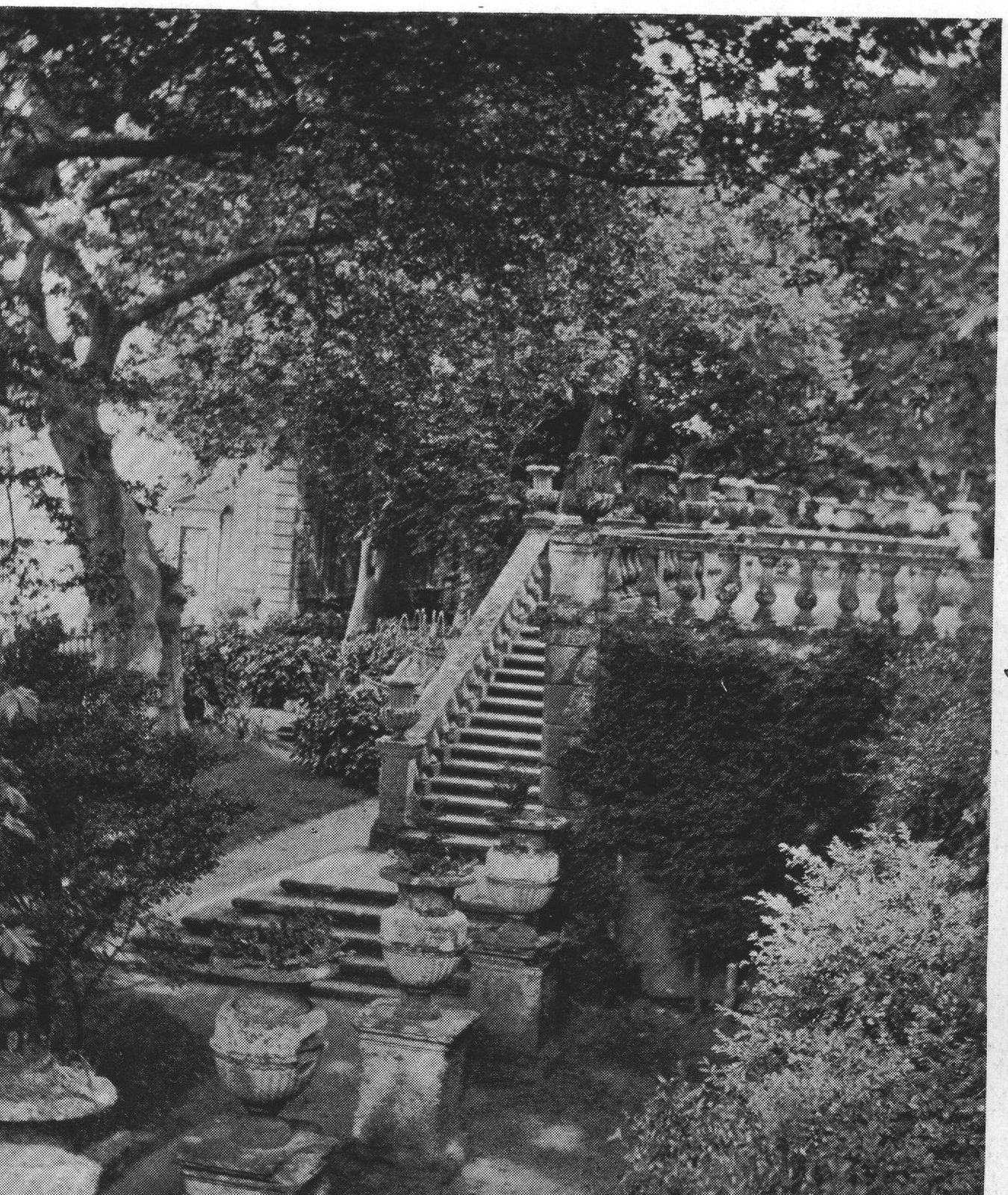
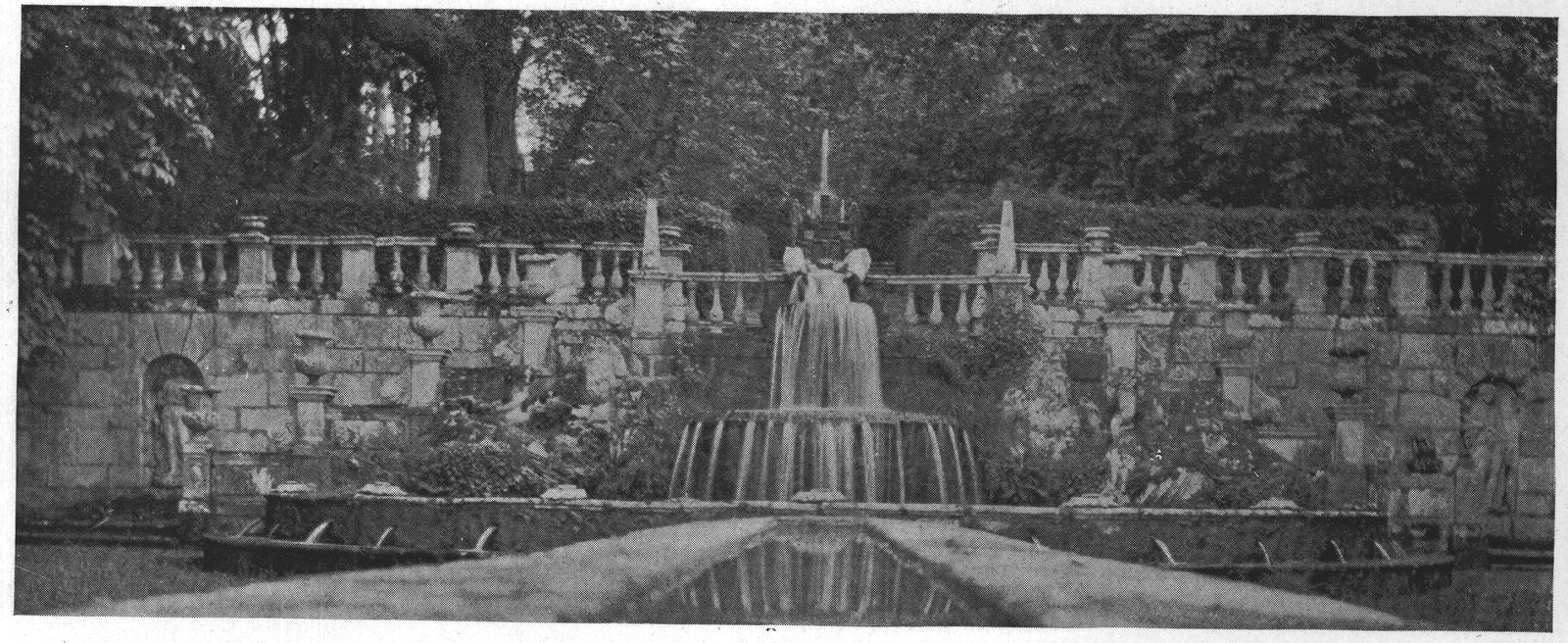
Other terrace stairs lead to the fourth level, which contracts in width, but which is longer again than the third. It is subdivided into three parts. First is a thickly planted grove with a green alley down its center, along the axis of which runs a stream. The middle division is occupied by an octagonal fountain of several levels. Surrounding it is a tall hedge, and overhanging it on each side are great trees. The third division of this level is occupied by two little garden pavilions, and between them is a cascade which supplies water for the many fountains.
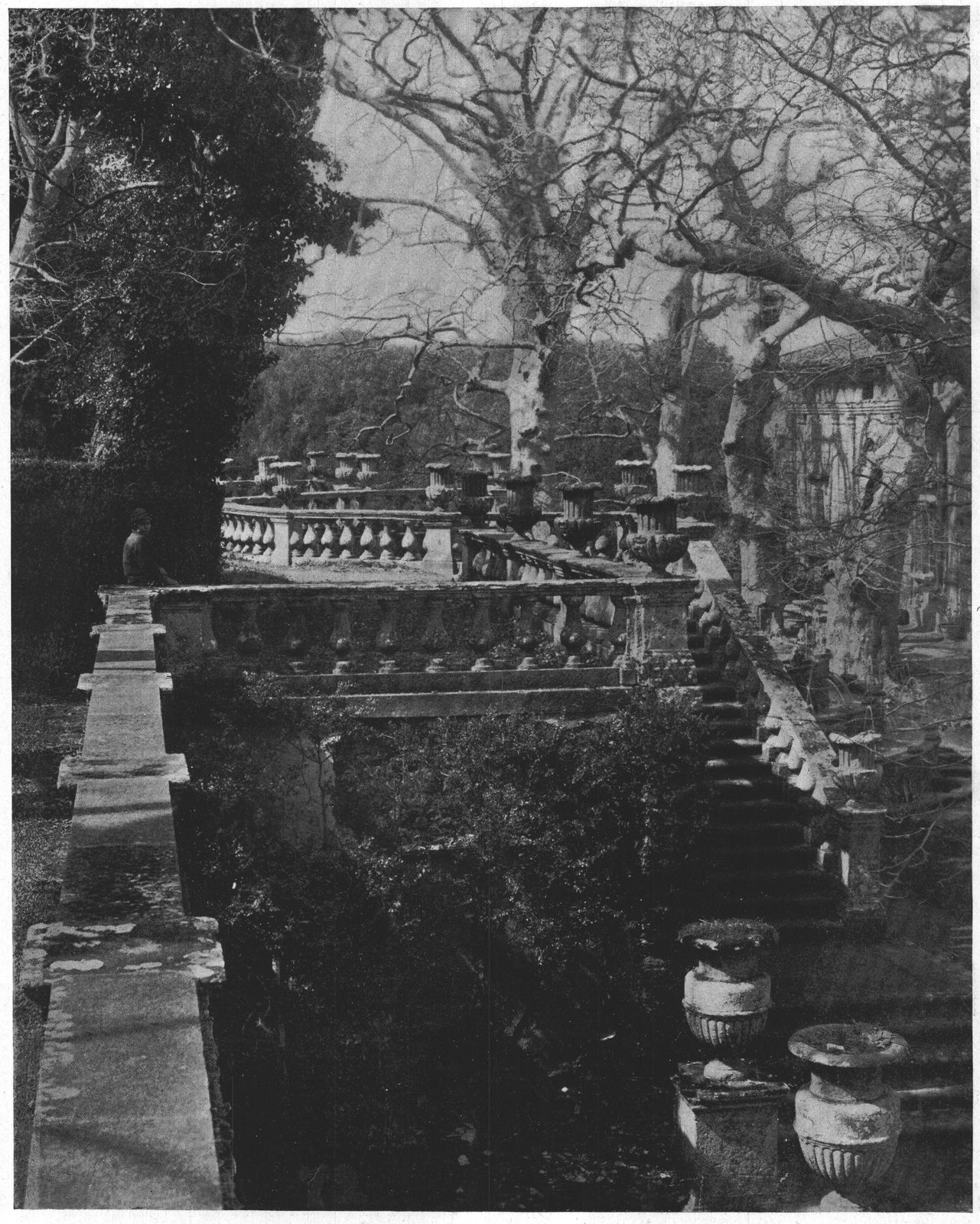
These are in general the features of this small villa. They are not many, but they are simple and all beautifully wrought into a whole in which not only is the scale of stairs and walls, of buildings and fountains, of balustrades and urns well conceived, but the scale of the plants and flowers and trees also. Trees balance columns, clipped yews and lemon trees balance urns and sculpture, box alleys are of calculated height and relation to the basins and walls. Flowers balance flowers, tall ones are never planted where low ones should be, and a low group never occupies the place of a group that should afford an emphasis in the design. Good taste has become a tradition and having been established, seems never to have gone astray.
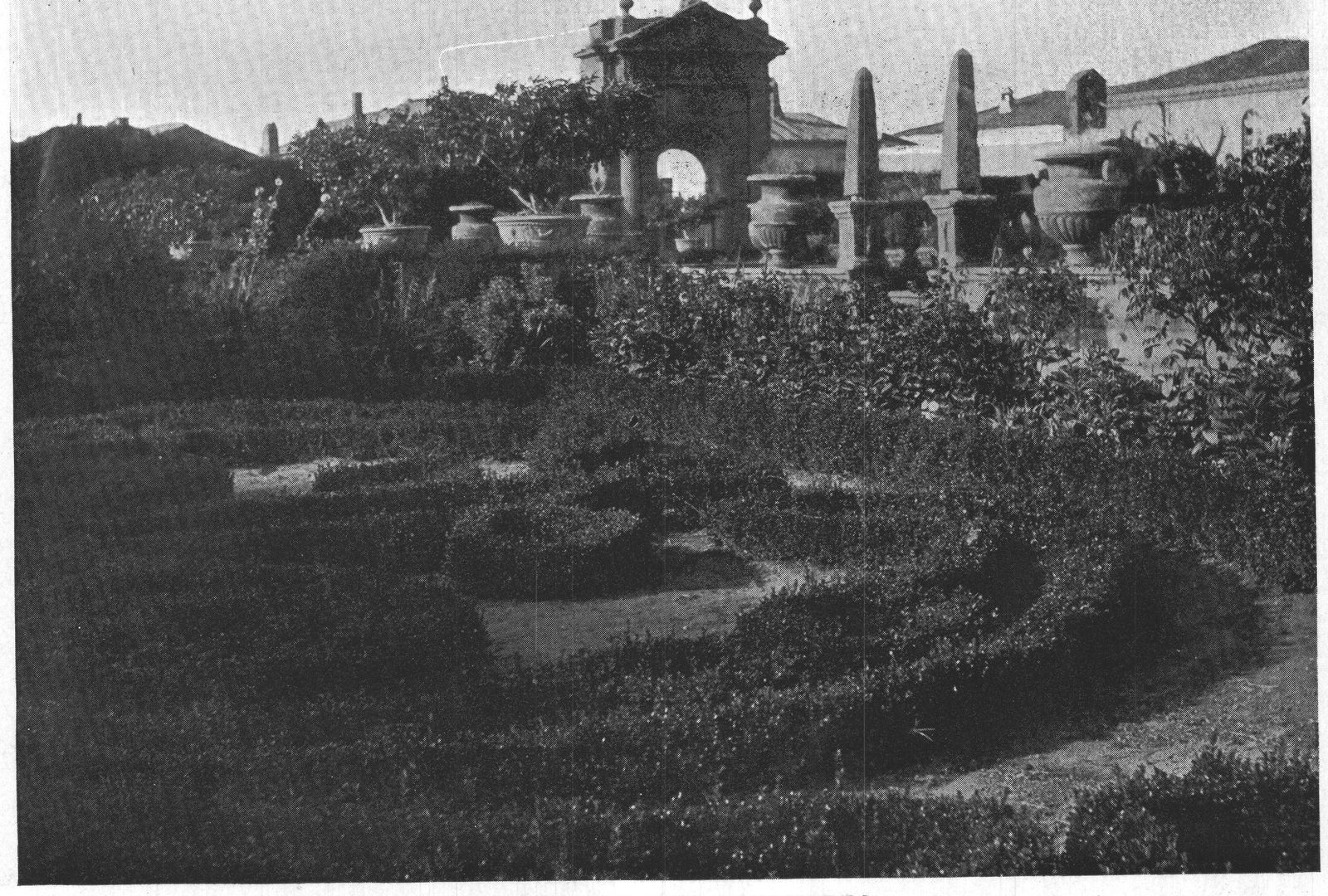
Not even in the more formal portion of the garden, the hardest place of all to attain harmony and accord is there anything that is seriously a false note. The planning and the planting aid each other. And this part is so very beautiful that it is worth while to devote a little more attention to it. It is a big square, in extent something less than an acre and a half, every part of which is open to the full light of the sun. Bounding its east and north sides runs a box hedge, some twelve to fourteen feet high. This hedge continues along the west side, but here it is low, giving an outlook over the plains. The south side is bounded by the buildings and terraces. All about the garden runs a broad path. Within this, the garden is divided by the paths running parallel to the central axis into three parts. The two long side divisions show a very wise disposition. They are filled with box and form, in spite of their rather elaborate designs, restful gardens of green, which make a splendid foil for the long beds of flowers that frame them.
Across the two ends of the central division are parterres of flowers, while the center of this division and the formal garden contains a fountain with fine architectural features giving a center to what might otherwise be a spotty design—a fault of so many gardens. It is this central pool, in fact, which is the distinguishing feature of the Lante garden. From midway of its sides it is crossed by four bridges, bordered by balustrades that meet in a circular path about the large fountain in the center. An arrangement of concentric basins terminates in an octagonal pedestal supporting a central feature of a fountain that crowns every view across the garden. It is a splendid group of four fine lads hewn in stone by a strong and sure hand. Lithe, graceful, athletic boys they are, beautifully poised, disposed in two groups, back to back, with four lions between them. Bathed as it has been, for generation upon generation by the gently falling streams of the fountains that play over them, the stone below has become as polished as metal and taken on a rich green and brown color like the bronze emblem of the Montalti Family the lads hold proudly high over their heads.
As for the flowers themselves, there are not as many, nor are they as varied as in many a garden I know in this country. They are for the most part old-fashioned varieties, all the more beautiful because proved and best loved by the owners. Here are the flowers of our ancestor's gardens: lilies and roses chiefly,—those two favorites of all ages. Of the lilies the stately white or Annunciation lily has been a favorite; and they seem as they stand there, in long rows with their tall and stately stems, and their crowns of shining white, the purest, most exquisite and most beautiful of all the flowers. But "side by side in equal right" with the lily are roses of many sorts and kinds, old-fashioned and new. The damask, velvet, and double Provence rose, the sweet musk rose, double and single, the double and single white rose seem to be all there, as are also many varieties of the sweet-smelling tea roses. The sweet brier is not missing, and many beautiful semi-double old-fashioned sorts stand about, while others clamber over buildings and walls; indeed every tint and color and kind seems present.
In spring the various bulbs, tulips, jonquils, narcissuses and lilies-of-the-valley are in bloom. Then later come the day-lilies. A special favorite seems to be a beautiful pale yellow one, as it grows under standard roses in great clumps and hangs over the box borders. Large clumps of the Tritoma are most happily placed with trimmed yews for backgrounds. There are peonies and columbines and fleur-de-lis, poppies, hollyhocks, marigolds, chrysanthemums, zinnias and dahlias, the tall-growing and low phloxes, pansies, petunias, geraniums and verbenas. Then there are such sweet smelling flowers as violets and mignonette, jasmines and heliotrope, sweet peas (a few only) and great clumps of lavender, clove pinks and gillyflower and thyme. All these flowers and more are in this sunlit garden. It is not a long list but quite enough to give a perpetual bloom; and they are flowers, after all, that one most cares for. Rarely have I seen flowers more effectively planted. In the small inner beds, always box-bordered, are the low growing flowers; in the long beds that enclose these are the tall standard roses and lilies and other tall growing varieties; and the yews rise as strong cones at important points to hold all together. Thus the garden stands a part in a well-ordered scheme.
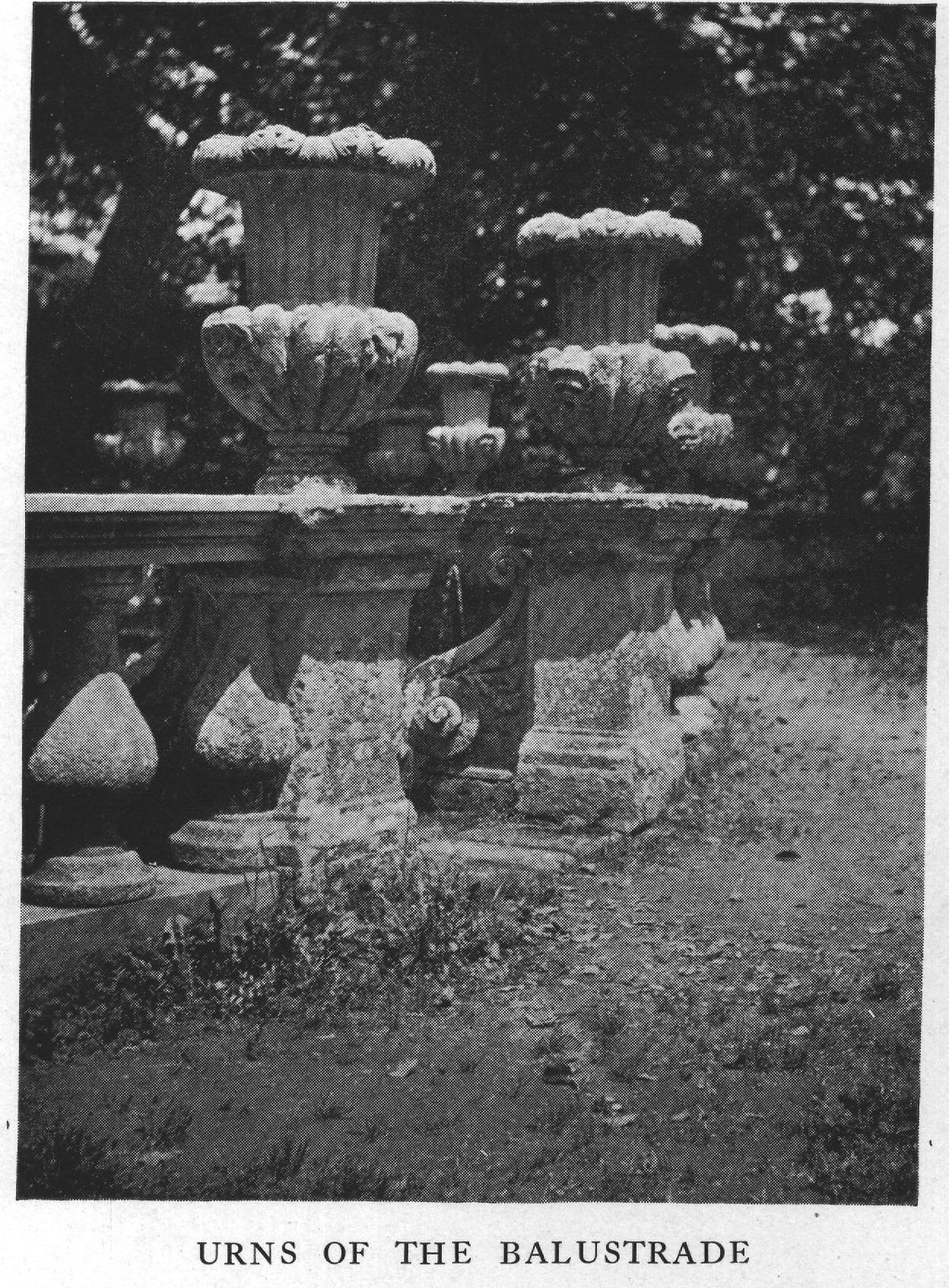
Lovers of flowers and trees, of sweet odors, of rippling and falling water, of balmy air and sunshine, will ever turn to it with joy. Lovers of trim, well-kept and well-ordered gardens will revel in it. Students, searching for that proper unity between Nature and Art, will find here an example than which no better exists, for Lante is an instance of how flowers and trees, garden walls, stairways and balustrades and urns, fountains, still and running streams can be combined into one intricate yet simple scheme to produce a beautiful unit. Nature happily leads the way to unity and dignity and order, to system and consistency. And they were wise in the ways of Nature, as in the ways of Art, those old garden builders and splendid artists, and they realized that they were not to try to imitate her, but to follow her in the way that she ever signifies, keeping in touch with her at the same time that they built for their own comfort and use. So Lante was conceived and built, and it yet remains an exquisitely complete and unified work, to be classed among the most complete of Italy's art treasures, to be thought of, so far as its unity is concerned, with such finished gems as Gozzolio's chapel, the Borgia apartments or Galla Placido's tomb.