Home › Expert Opinions › Expert Opinions: Norbert Levavasseur
Expert Opinions: Norbert Levavasseur
Synonymous Roses Some roses have acquired new names that seem to be an improvement; for example, Dutch Beauty in place of Veluwezoom. Another case is Mme. Norbert Levavasseur; when once planted and thoroughly domesticated, she answers to the name of Red Baby Rambler. But, if you wish to order Red Baby Rambler, remember there are nearly half a dozen roses so called; so, if you want to be certain, refer to the following list for guidance. Renaming a rose with intent to deceive has come to be regarded by rosarians as a crime. When a second name is adopted for the sake of euphony, the original name should be carried in parentheses. Gloire de Paris Maman Levavasseur Maman Levavasseur Mme. Norbert Levavasseur Anna de Diesbach H.P.
Baby Dorothy, Pink P.
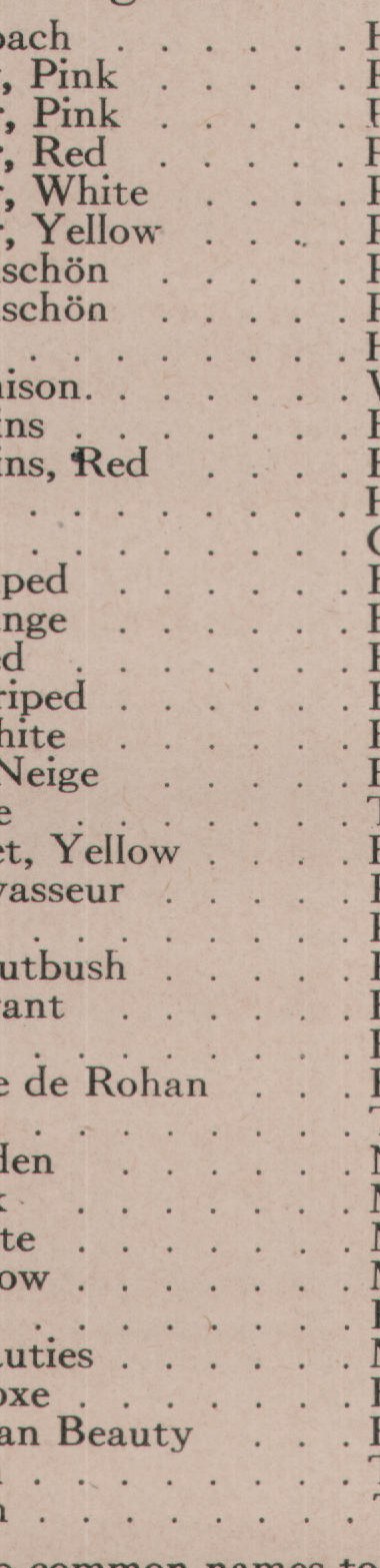
Baby Rambler, Pink P.
Baby Rambler, Red P.
Baby Rambler, White P.
Katharina Zeimet Baby Rambler, Yellow P.
Etoile de Mai Baby Tausendschön P.
Louise Walter Baby Tausendschön P.
Echo Ball of Snow.
H.P.
Perle des Blanches Dorothy Dennison.
W.
Lady Godiva Dorothy Perkins Dorothy Perkins, Red Dutch Beauty H.W.
Lady Gay H.W.
Excelsa H.T.
Veluwezoom Green Rose C.
Viridiflora Killarney, Striped Killarney, Orange H.T.
Spectacular H.T.
Duchess of Wellington La France, Red H.T.
Duchess of Albany La France, Striped H.T.
Mme. Angel Vayssett La France, White H.T.
Mlle. Aug. Guinoisseau La Reine des Neige H.P.
Frau Karl Druschki Magnolia Rose T.
Devoniensis Maman Cochet, Yellow H.T.
Mme. Derepas-Matrat Maman Levavasseur P.
Baby Dorothy Mignon P.
Mlle. Cecile Brunner Mrs. W. H. Cutbush P.
Mrs. Taft Mrs. W. J. Grant H.T.
Belle Siebrecht Prima Donna H.T.
Mme. P. Euler Prince Camille de Rohan H.P.
La Roseire Queen, The T.
Souv. de S. A. Prince Rambler, Golden N.
Alister Stella Gray Rambler, Pink Mult.
Euphrosine Rambler, White Mult.
Thalia Rambler, Yellow Mult.
Aglaia Sweetheart P.
Mlle. Cecile Brunner Thousand Beauties Mult.
Tausendschön Wm. R. Smith Wm. R. Smith Virginia R. Coxe White American Beauty N.B.-See also common names to rose species, foot of page 107. H.T.
Gruss an Teplitz H.P.
Frau Karl Druschki T.
Charles Dingee T.
Jeannette Heller THE FAMILY ROSA Analysis of Species It is doubtful if anyone will have come thus far in this little book, who is not, with the author, a real seeker after truth. Just as the story of man becomes doubly interesting as we trace back his development from the earlier types of man, so with the rose. A present-day Radiance or Rayon d'Or is a vastly more fascinating object of attention when one can go to another corner of the garden and point out to visitors the true progenitor of that race. Hybridizing deserves a complete chapter of its own. Right here let us study what has been done by the guiding hand of man. Family charts are a useful aid in pointing out relationships. A diagram may be more illuminating than many pages of description. There-. fore, as an introduction to the various best-known classes, pause a moment to survey* this analysis of species on the two following pages. This the author conceives to be a most helpful outline of the many, many families that make up this interesting race of flowers.
In this book there has not been room to describe the rose species. We would, however, call special attention to certain "types" which we have starred in the following list. Their place is not in a bed with the Teas or Hybrid Teas. Consider for example, Hugonis-that recent acquisition from China. In three seasons it will be 4 to 5 feet high and in bloom two weeks earlier than the early-blooming Harison's Yellow. And so with others: they are unique, hardy, vigorous. They need only to be fittingly placed to give to the garden a charm and distinction quite above the ordinary. *The following two pages are published here with permission and by courtesy of Longmans, Green & Co., New York., from their book, "Roses: Their History, Development, and Cultivation," by Rev. J. H. Pemberton (see page 105).
The reader will note how far removed from the original species are both the Tea and Hybrid Tea families, whereas, from many species there has been almost no development at all.