Home › Pruning Information › Selecting the Roses
Selecting the Roses
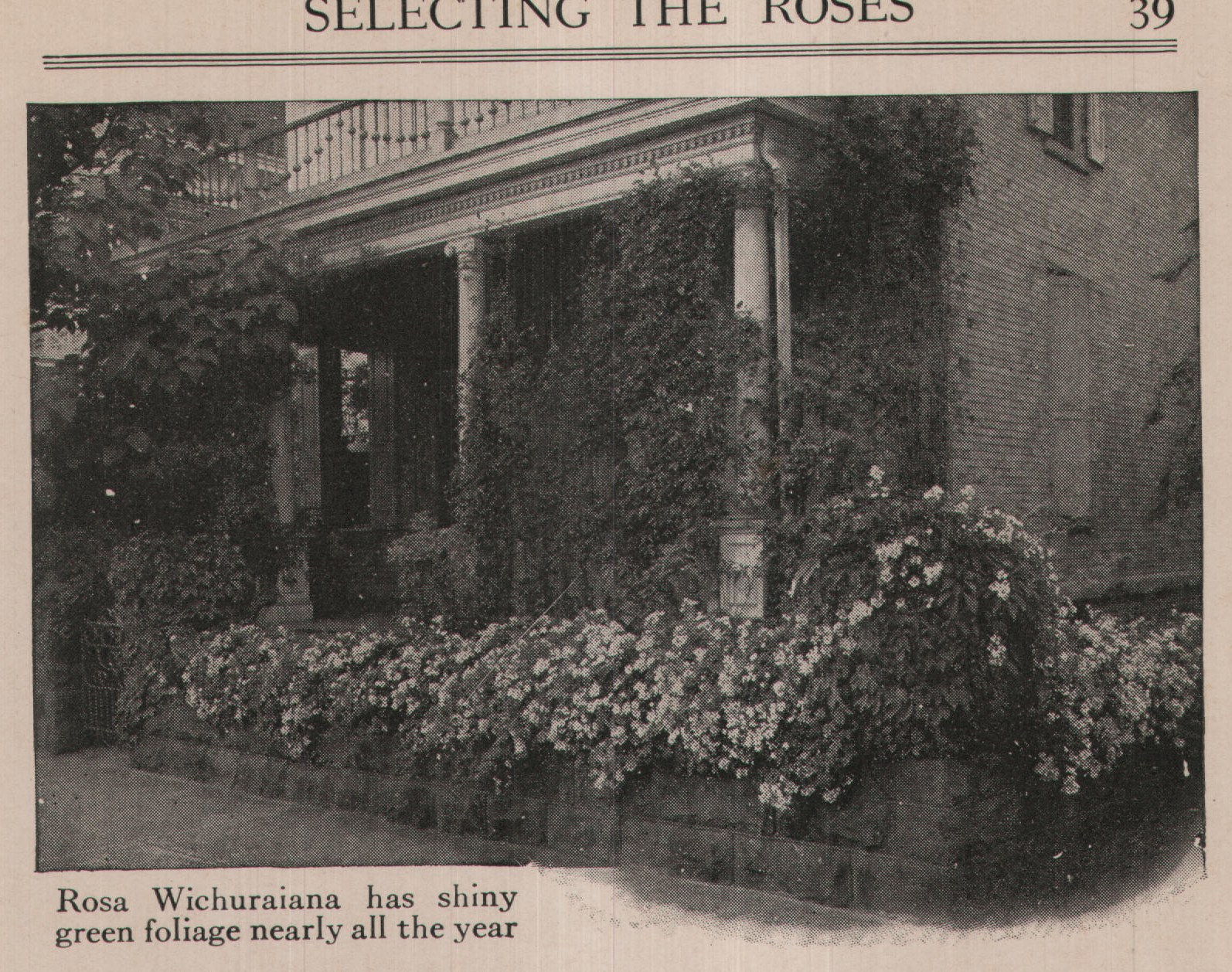
Rosa Wichuraiana has shiny green foliage nearly all the year the variety; (7) other noteworthy remarks. We have endeavored to avoid all exaggeration. After the name of the variety, the class to which it belongs is indicated by the following abbreviations:
T.-Tea SECTION I Bou.-Bourbon C.-China H.T.-Hybrid Tea P.-Polyantha T.P.-Tea Polyantha SECTION II N.-Noisettes C.T.-Climbing Tea C.H.T.-Climbing Hybrid Tea C.P.-Climbing Polyantha C.T.P.-Climbing Tea Polyantha SECTION III A.B. Austrian Briar.
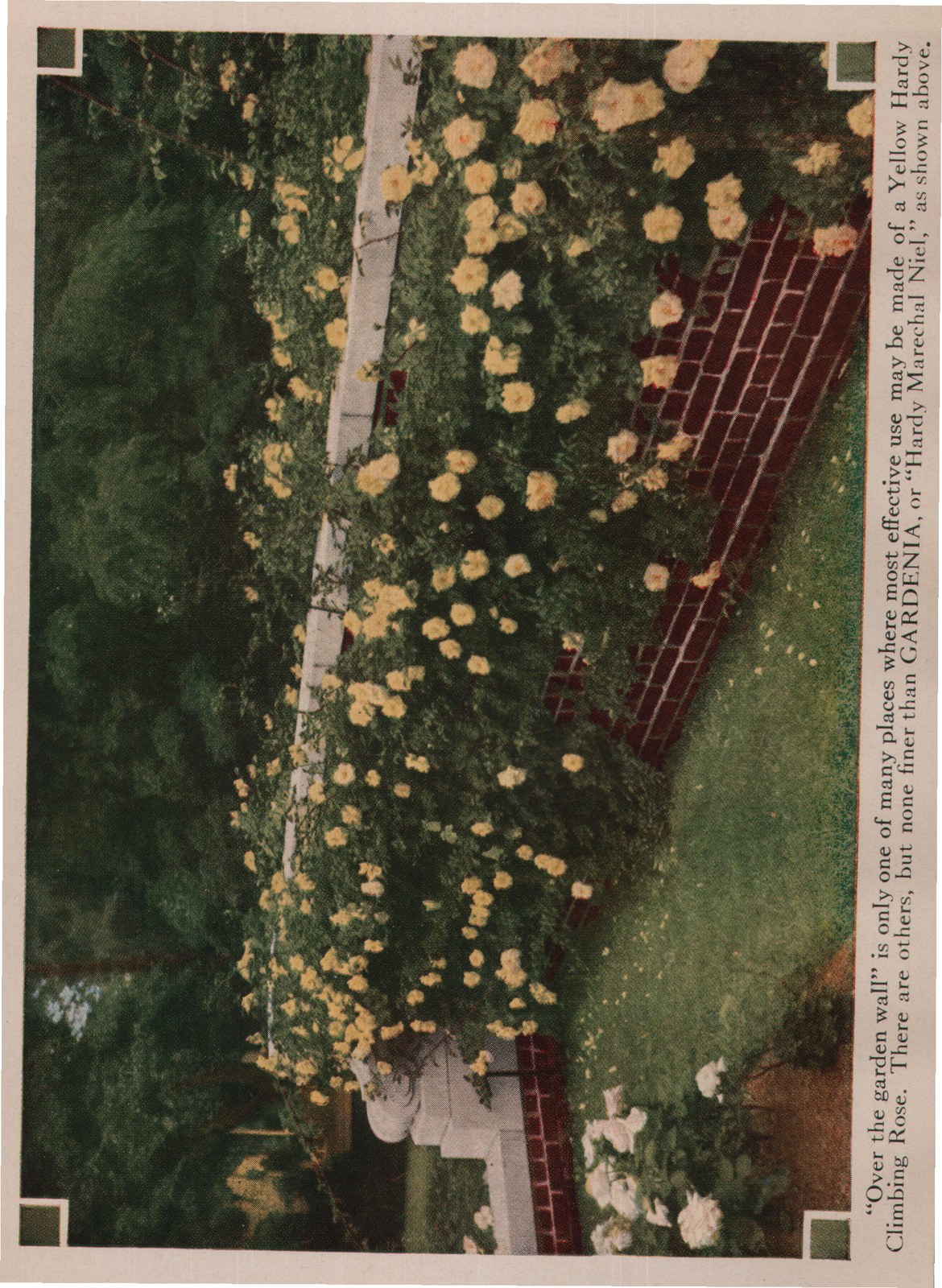
Per.- Pernetiana, or Hybrid Austrian Briar D.-Damask H.P.-Hybrid Perpetual M.-Moss Pr.-Provence R.-Rugosa and Hybrid Rugosa SECTION IV Mult.-Multiflora Bank. Banksian CI. M.-Climbing Moss S.B.-Sweetbriars W.-Wichuraiana and hybrids In addition to 162 leading roses listed on pages 43 to 62 inclusive, see also (pages 110 to 115) a list of the important roses in each class named above. "Over the garden wall" is only one of many places where most effective use may be made of a Yellow Hardy Climbing Rose. There are others, but none finer than GARDENIA, or "Hardy Marechal Niel," as shown above. It will be helpful to remember, when referring to the above four sections, that sections III and IV contain the hardiest roses. Roses in these classes will live out over winter in the latitude of Philadelphia without protection, although all roses in this and colder regions will be the better for protection. The classes in sections I and II require careful protection in a climate like this, especially the first ones named in each section, which are better suited for growing south of Washington, D. C., and in correspondingly mild climates.
As to bloom, sections I and II will bloom more or less throughout the growing season. Sections III and IV are mostly known as summer bloomers, and are in their greatest glory for only a few weeks in early summer. Some of the Hybrid Perpetuals and Hybrid Austrian Briars will also make an autumn showing.
The character of growth is indicated upon a scale arranged as follows: Weak, moderate, moderately vigorous, vigorous, very vigorous; "robust" indicates sturdy and bushy, but short growth. Climbers are described either as vigorous climbers, suitable for low pillar or trellis, or very vigorous, suitable for archways, pergolas, or high trellis.
Terms Used to Describe Appropriate Uses (Also key to descriptions on pages 43 to 62) GARDEN.-Recommended for general lawn or garden cultivation.
BEDDING, i. e., free-flowering and of rather compact growth-good for massing in beds, either several of a kind or with other bedding roses.
PILLAR. Excellent for training up to a low pillar, stake, or post.
ARCH. For covering an archway.
PERGOLA. For growing over a pergola.
WALL. Suitable for training up the face of a wall or side of a building.
CREEPING. Good for covering a bank, stumps, rocks, etc. TRELLIS. Grows well on a trellis or support.
BUSH.-Makes a good bush when planted alone and allowed to develop.
POT, or CUT-FLOWERS.-Those that have particularly long stems and other qualities that make them peculiarly fitted for cutting. Good also under glass.
BOUTONNIERE.-Well-formed buds and not so large but that it is appropriate for a buttonhole or corsage bouquet. EDGING.-Makes an excellent edging to a rose-bed or border, bed, or pathway.
HEDGE.-Adapted for making a hedge, either all one kind or with others.
TREE or STANDARD.-Kinds that do well in tree form, as illustrated on page 98.
Note also at the close of this chapter a section devoted to the best roses for each particular purpose in your garden. We feel that entire dependence may be placed upon these recommendations beginning page 64, based upon the information gained after many years' correspondence with patrons in all parts of the United States.
In a broader way the reader will surely find great interest in cultivating a more intimate acquaintance with this great rose family. Opportunity for further study of this subject is offered in the Analysis of Species and outline of different classes beginning on pages 108 and 110.
Following these sets for special purposes, and beginning on page 77, will be found recommendations of the varieties that eminent amateurs, or professionals, have found best adapted to each of eight different typical sections of our country.
But comparatively few people can actually plant more than a small proportion of any such extended list, and therefore we list on the pages immediately following a shorter list of the leading varieties from any of which it will be entirely safe to select. The reader may still have some failures, but they will serve as stepping stones of knowledge surely learned on which to build greater success.
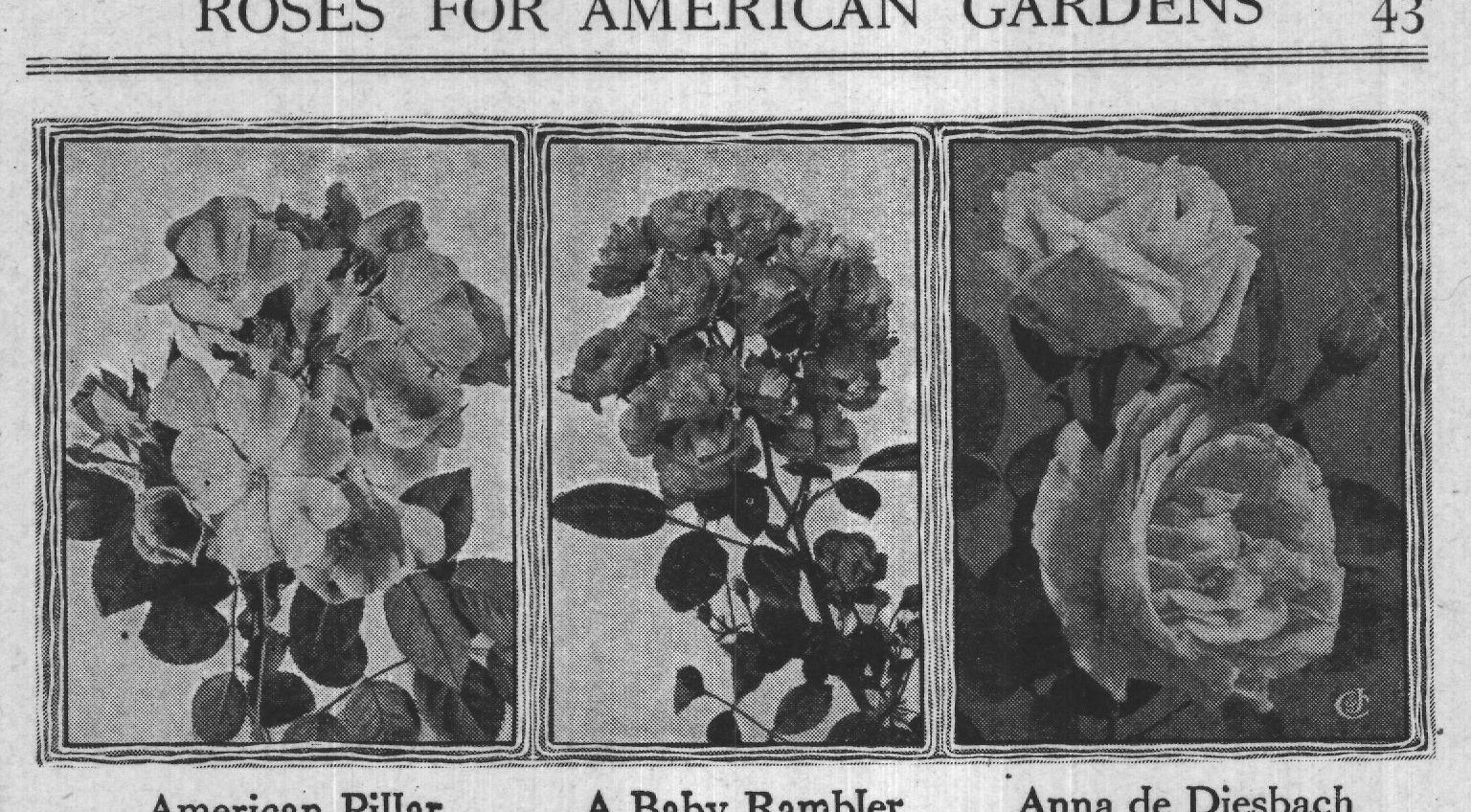
American Pillar See page 44 A Baby Rambler See page 44 Anna de Diesbach See page 44 One Hundred and Sixty-two Choice Roses Loving roses as we do; living among them and watching them closely and constantly, under all sorts of conditions; having before us reports upon roses from every country on earth to which our roses go, and knowing, too, the prizewinners and kinds that have pleased amateurs here and almost everywhere; watching the new roses as they "come out," testing all kinds and holding fast to those which are good,-out of an experience like that has come our choice of these 162 roses. See abbreviations for class, growth, purpose, and pruning, explained on pages 39 to 42. AGNES EMILY CARMAN. H.R. Flowers brilliant crimson, velvety; very fragrant. Hedge, bush. Perfectly hardy. Prune 5, 7+. ALBERIC BARBIER. H.W. Flowers in clusters, double, creamy white with canary-yellow center; fragrant. Leaves bronzy red in spring and glossy; almost evergreen, and not liable to be troubled with insects. Very vigorous. Pergola, arch, banks, etc. Prune 6, 7-. ALEXANDER HILL GRAY. T. Flowers deep lemon-yellow, which intensifies as the blooms develop; large, of deep substance and perfect formation. Gold Medal, N. R. S. Garden, bedding, cutflower. Prune 4. ALISTER STELLA GRAY (Golden Rambler). N. Flowers rich apricot-yellow, changing to white with yellow center; delightfully fragrant and constant in bloom. Moderately vigorous. Pillar, arch, trellis. Needs winter-protection. Prune 5, 7+.