Home › Introduction › Protecting the Roses: Method
Protecting the Roses: Method
Ex. Method to use to produce exhibition specimens or large flowers.
Q. Method to use to produce showy bushes or a quantity of flowers. "NOTE 1.-Pruning, therefore, is the art of improving the productive power, and the appearance of the plant. It consists of two distinct operations: (1) The removal of dead, weak, overcrowded, or otherwise useless shoots. Unripe wood which in the spring will usually be found to have discolored pith, caused by the winter frosts, should be cut clean away at the base of the shoot. (2) Pruning proper, the shortening of those shoots which are allowed to remain after the thinning-out process has been completed. "The most frequent errors made in pruning are (1) leaving too many shoots when thinning out; (2) pruning severely the shoots of varieties which require little, if any, shortening; (3) pruning lightly the varieties which require severe pruning; (4) leaving rose plants crowded with shoots and cutting these to a uniform length all over the plant in the same way that a hedge is clipped. t springs "In thinning out a shoot, it should be either cut clean away to the base of the plant, or to its starting-point on the older shoot from which it springs, as the case may be. When the plant has been pruned, the shoots should be left as nearly as possible equidistant from each other, and regularly arranged around it so that it presents a well-balanced appearance on all sides." -National Rose Society's Hand-Book on Pruning.
Copies of this valuable book may be purchased on application to Editor "How to Grow Roses," West Grove, Pa. Own-Root, and Budded or Grafted Roses Every rose-grower should learn the difference. In a budded or grafted rose, the top of a good flowering variety has been joined and made to grow upon the root of a "wild" rose. An own-root rose stands on its own feet, so that, if the top be winterkilled, the new growth from the root will bloom true as at first. Not so with the budded or grafted rose. If the top be killed, the "wild" root is worthless; throw it out.
As a general rule, for application over a broad area, the experience of many people in many different localities indicates a preference for own-root roses only in such varieties as will make vigorous growth.
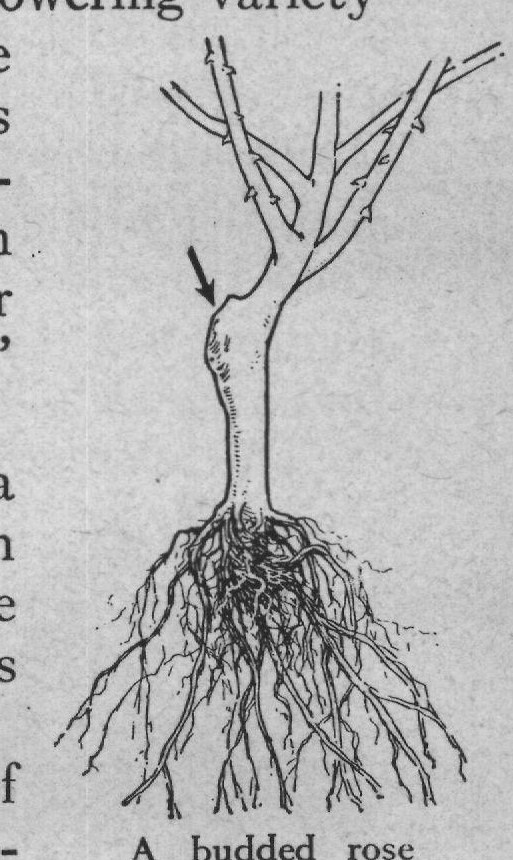
A budded rose may be distinguished from the own-root by knotformation of the former. See arrow.
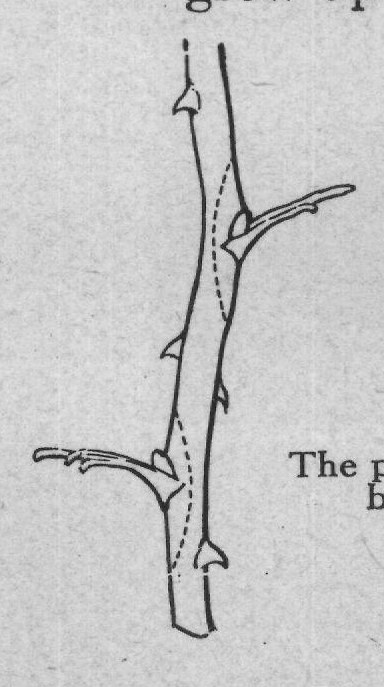
Some types, however, especially some of the Hybrid Teas, when on their own roots produce but poorly. In order to obtain vigorous growth and luxuriant bloom, such kinds are budded or grafted upon the stock of a stronggrowing rose. Multiflora, Canina, Manetti, and other stocks are used for this purpose. When planting own-root roses, set in the soil a trifle deeper than the stain of the soil on the stem indicates it grew before. When planting budded or grafted roses, set with the joint or union of top and root an inch below the surface of the soil, and watch for suckers. If there appears any growth originating below the union, dig away the soil and cut it off close up to the stem; otherwise it may grow up and crowd out the flower-bearing part of the plant. The process of budding Suckers show 7 or 9 leaflets.
The majority of roses grown and planted North are budded; South the reverse is true.
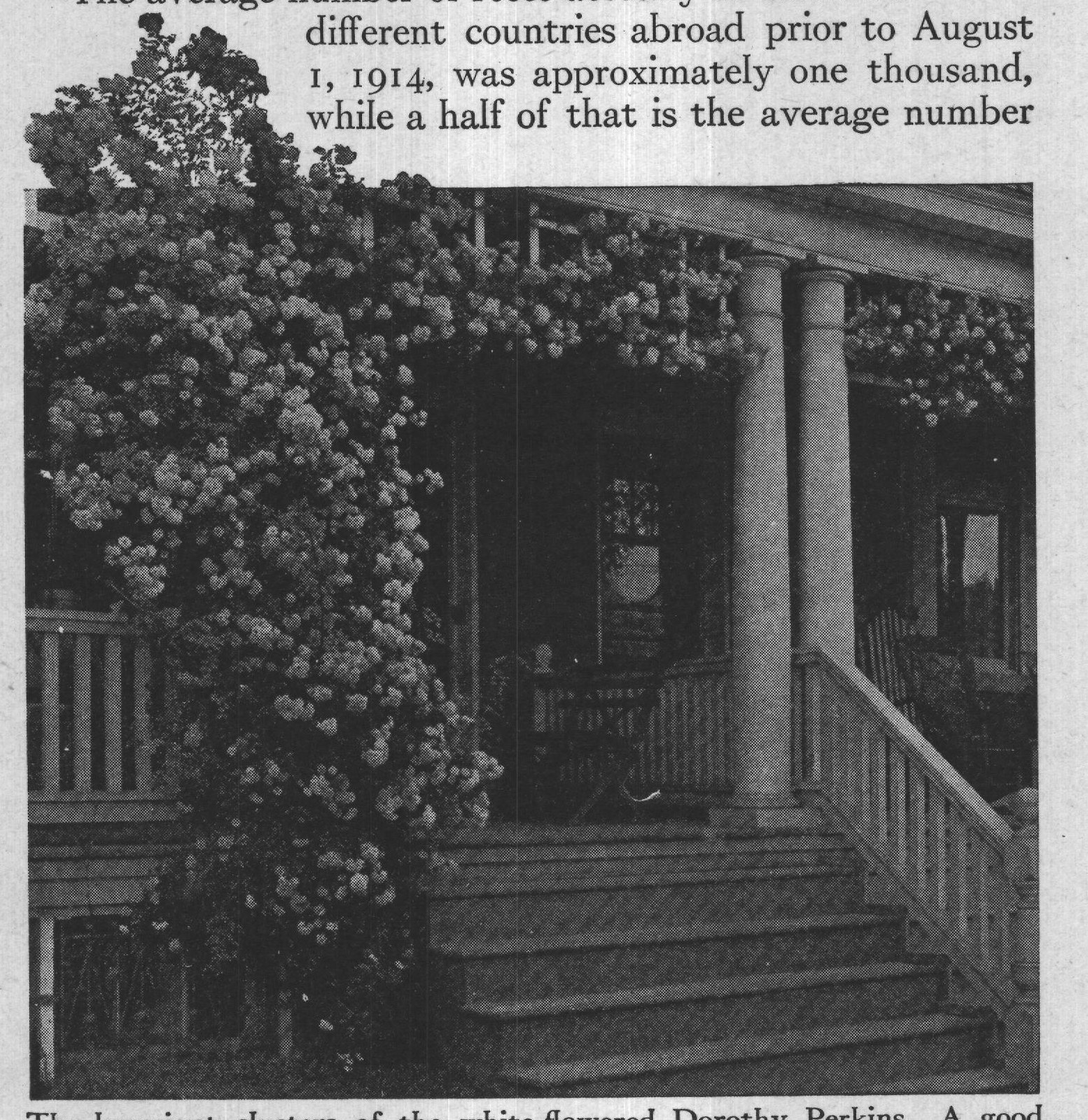
CHOOSING THE RIGHT KINDS 37 Selecting the Roses This is a vital matter. The most complete and authoritative list of roses in our possession shows 10,281 varieties. The most complete collection in any one plantation that has come under our observation we did not attempt to count. It is said to contain about six thousand varieties, including every known species and every variety now obtainable in the civilized world. (This garden, the Roseraie de L'Hay, will be found more fully described on page 98.) The average number of roses actually in commerce in the different countries abroad prior to August 1, 1914, was approximately one thousand, while a half of that is the average number The luxuriant clusters of the white-flowered Dorothy Perkins. A good example of the Wichuraiana family offered in America by the leading rose firms whose products can be relied upon as true to name.
When we recall that the average amateur must confine his selection to a much smaller number even than this, often a choice two dozen kinds, the paramount importance of a proper selection is quite apparent.
Dr. Liberty H. Bailey, formerly of Cornell University, and editor of that standard authority, "Cyclopedia of American Horticulture," says: "The success of the rose in this country is very largely a question of the selection of adaptable varieties."
Pemberton, in his excellent work on "Roses," says to beginners: "State your requirements to a friend who is an expert and leave the selection to him." This book would be a "friend" to every rose-grower,-how "expert" you must judge from its contents.
America is a big country, and allowances must be made for differences in soil, climate, and other conditions. Rules are offered for use and application by the reader to the conditions that obtain in his or her locality. If there arise conditions not herein covered, the author will be glad from his own experience to assist readers in solving their individual problems.
Where do you live? The answer to this question is the first key to the selection of the right roses. Some varieties will withstand severely cold winters from which other varieties would die. Do you want dwarf, bedding, pillar, or vigorous climbing roses? Would you prefer a great show for a month or more in the early summer, or a more or less continuous bloom throughout the autumn also? These various important characteristics will be mentioned in the descriptions of 162 roses on pages 43 to 62. The following explanations will enable you more fully to understand the terms used. We state after the name of each rose: (1) the class to which it belongs; (2) the color of the flower; (3) the character of the leaves, when it is particularly worthy of mention; (4) the character of growth (vigorous, moderate, etc.); (5) the purposes for which best suited; (6) the way to prune