Home › Plants for Florida › Plants for Florida: Yellow-flowering
Plants for Florida: Yellow-flowering
Acacia farnesiana Papinac +Allamanda nerifolia Yellow Allamanda Hydrangea opuloides otaksa Hydrangea Ixora rosea splendens (T) Rose-coloured Ixora Lagerstroemia indica Crape Myrtle Nerium oleander Savort Pink Oleander Punicea granatum Pomegranate Rhodomyrtus tomeniosus (T) Downy Myrtle + Rosa (on multiflora stock) Garden Roses Tamarix caspica Tamarisk Artobotrys odoratissimus False Ylang-Ylang + Bauhinia tomentosa (T) Yellow Mountain Ebony +Michelia fuscata Banana Shrub +Caesalpina pulcherrima flava Barbadoes Flower Fence +Cestrum aurantiacum (T) Yellow Cestrum Hamelia sphaerocarpa Scarlet Bush Ixora flore luteo (T) Yellow Ixora + Jasminum nudiflorum Naked-flowered Jasmine + Jasminum primulinum New Chinese Jasmine Thevetia nerlfolia Trumpet Flower Paritium tiliaceum Yellow Ernajagua Podachaenium eminens Mexican Shrub Daisy +Rosa (on multiflora stock) Garden Roses +Stenolobium stans sambucifolia Yellow-flowering Elder +Tecoma stans Yellow Elder d. Red flowers: + Acalypha hispida (T) Chenille Plant + Azalea indica Indian Azalea Caesalpina pulcherrima Barbadoes Flower Fence Callistemon lanceolatus Bottle-brush Calycanthus floridus Strawberry Shrub Euphorbia pulcherrima Poinsettia Hamelia erecta (T) Scarlet Bush e.
Purple and blue flowers: + Allamanda purpurea Purple Allamanda Asystasia bella Mackaya + Azalea indica Indian Azalea Bauhinia purpurea (T) Purple Mountain Ebony Callicarpa americana Beauty Fruit Ebony +Hibiscus rosa-sinensis Chinese Hibiscus Ixora coccinea (T) Scarlet Ixora Lagerstroemia indica Crape Myrtle Lawsonia rubra Red Flowering Henna Malvaviscus arboreus Turk's Cap Nerium oleander DeBrun Double Crimson Oleander +Roses (on multiflora stock) Garden Roses +Daedalacanthus nervosus (T) Blue Justicia Duranta repens Golden Dewdrop +Hibiscus rosa-sinensis Chinese Hibiscus Hydrangea opuloides otaksa Hydrangea Lagerestroemia indica Crape Myrtle +Plumbago capensis Blue Leadwort G. GROUND-COVER PLANTS. This list contains a group of vines which are interesting for ground cover in partially shaded situations. Most of these vines are evergreen in their habit of foliage and are of value for covering banks and other bare areas where it is desired to have another covering than grass.
Ferns (in moist shade) Ferns Gelsemium sempervirens Carolina Jasmine Hedera helix English Ivy Lonicera japonica halliana Japanese Honeysuckle Lonicera sempervirens Coral Honeysuckle Zebrina pendula Wandering Jew Zoysia matrella Manilla Grass Zoysia tenuifolia Mascarene Grass H. SHRUBS FOR SHADY CONDITIONS. The following is a group of shrubs most of which are evergreen in their foliage characteristics, and all of which are adapted for plantations in partial shade, either under large trees or on the north side of buildings where full sunlight is not available.
Azalea indica Indian Azalea Camellia japonica Japonica Hamelia erecta Scarlet Bush Hamelia sphaerocarpa Scarlet Bush Ligustrum amurense Amoor River Privet Ligustrum nepalense variegata Variegated Nepaul Privet Osmanthus fragrans Sweet Olive Severinia buxifolia Severino's Citrus I. HERBACEOUS PLANTS. This group includes plants many of which are semi-woody in character and which fundamentally are known as herbaceous stock. There is still a great opportunity to introduce a number of the northern types of herbaceous stock into the garden plantations of Florida. This list is compiled as a partial list of those which to date have been found to be of real interest and value. Many other plants may be added to this list in safety, but because of the lack of record of experiments conducted with their growth in this climate they have not been included.
The climate of middle and southern Florida has been aptly described by one horticulturist as that of a great out-of-door greenhouse. The climate is such that many of the flowering annuals so familiar to the gardens of the north prove failures when grown in the Florida garden. Such plants as the annual larkspur, snapdragon, China aster, sweet William, and baby's breath, producing such an abundance of cut flowers when grown in the north, are grown with little success in Florida. Nasturtiums, annual phlox, gaillardia, zinnias, and marigolds produce quantities of flowers. In the north such annuals are seeded in the latter part of April. Flowers are then produced early in July. In the Florida garden, if flowers are desired early in January, the nasturtium seeds are sown during the first week of September, alyssum seeds not later than November tenth, sweet peas in early September, and the other annuals, such as annual phlox, gaillardia, verbenas, annual carnation, and calendulas, are seeded not later than the first week in October. If flowers are wanted at an earlier date seeds should be sown proportionately earlier. The winter months are better for the growth of flowers. Very few persons in Florida attempt to grow annuals during the hot and usually dry months of summer.
It seems at first, to the garden lover from the north, that any of the northern garden flowers should grow vigorously in the Florida climate. Many keen disappointments await these persons. Those who have tried growing many kinds in an effort to obtain garden flower effects and flowers for table use have finally accepted, as the reliable types, the few that are starred in the following group: *Acalypha hispida Chenille Plant Agave Century Plant Ageratum Floss Flower *Alyssum (in variety) Madwort *Aster novae-angliae Climax Blue Hardy Aster Bambusa (in variety) Bamboo Chrysanthemum (north only) Chrysanthemum Clerodendron squamatum Chinese Tube-flower Codiaeum variegatum (in variety) Croton *Coreopsis tinctoria Tickseed Cyperus alternifolius Umbrella Plant *Dianthus caryophyllus Carnation Funkia (north only) Plantain Lily *Gaillardia grandiflora Blanket Flower Gynerium (north only) Pampas Grass Gypsophila paniculata Baby's Breath Hemerocallis (north only) Day Lily Hippeastrum Amaryllis Iris hexagona Florida Iris Lantana (T) Lantana Lilium henryi Yellow Lily Limnocharis humboldti Water Poppy Nelumbo American Lotus Nuphar Spatter-dock Nymphaea Water-lily *Phlox drummondi Drummond's Phlox Russelia juncea Fountain Plant *Zinnia elegans Zinnia *Tropaeolum majus Nasturtium *Verbena hybrida Verbena Vinca Periwinkle Viola Violet *Yucca filamentosa Adam's Needle J. PLANTS FOR SEASHORE PLANTING. Peculiar as it may seem, along the shores of the larger lakes, and along the seashore particularly, the group of plants which can be used is restricted to those plants which are particularly adapted to light, sandy soils and also to withstand the heavy storms, mostly in the nature of wind storms, to which such plants are often subjected. a.
Trees:
Casuarina equisetifolia Australian Pine Coccoloba unifera Shore Grape Eucalyptus citriodora Lemon Gum Ficus aurea Wild Rubber Gliricidia maculata Madre Plumeria (in variety) Frangipani Trees Ilex opaca American Holly Juniperus barbadensis Red Cedar Liquidambar styraciflua Sweet Gum Palms (in variety) Pithecolobium dulce Manila Tamarind b. Shrubs:
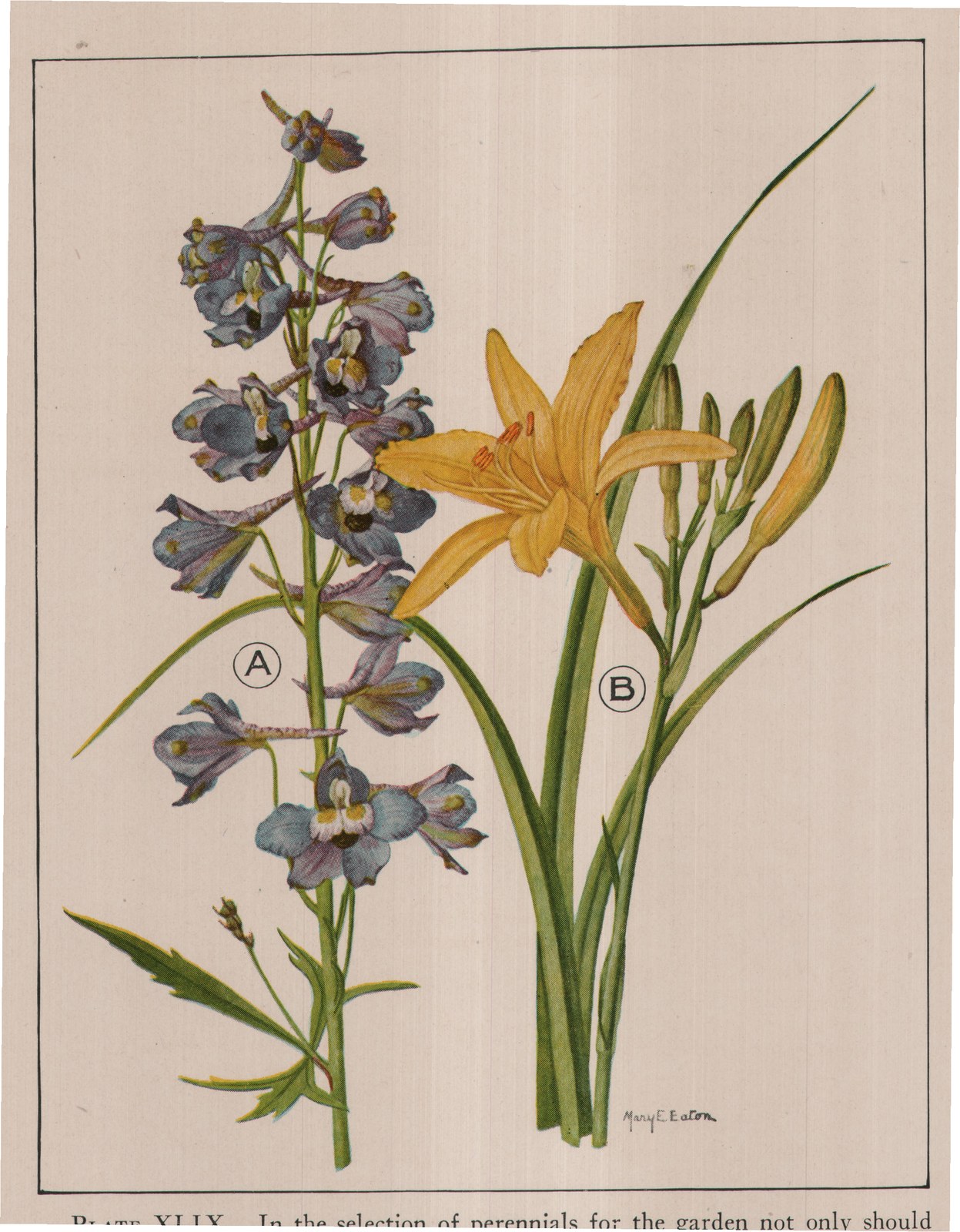
Acacia farnesiana Papinac Caesalpina pulcherrima Barbadoes Flower Fence Callistemon Bottle-brush Carissa acuminata Natal Plum Hibiscus rosa-sinensis Chinese Hibiscus Ixora (in variety) Ixora Lagerstroemia indica Crape Myrtle Myrica cerifera Bayberry Nerium oleander Oleander Pittosporum tobira Tobira Shrub Tamarix caspica Tamarisk Thevetia nereifolia Trumpet Flower A B Mary E. Eaton PLATE XLIX. In the selection of perennials for the garden not only should the possibilities of interesting colour combinations in the flower effects be observed, but also the possibilities for interesting texture of foliage. (A) larkspur; (B) lemon lily (commonly called day lily). (See page 231) c.
Vines:
Allamanda Allamanda Vine Bignonia unguis-cati Argentine Trumpet Vine Bougainvillea Paper Flower Clerodendron thompsonae Scarlet Clerodendron Cryptostegia madagascariensis Pink Madagascar Cryptostegia Solanum Tomatillo