Home › Plants for Heavy Formal Effects › Plants for Heavy Formal Effects: Japanese
Plants for Heavy Formal Effects: Japanese
There are many deciduous plants which, while not being adapted to topiary work, are adapted to close shearing to produce formal effects. Many experts do not realize that there are various species of the same genera which lend themselves much more effectively to close shearing in definite forms than other species of that genera. The Japanese privet is much more effective in the lower hedge of two to four feet, because of its tendency to "mat," than the Amoor River privet, which has a tendency to make long growths. All of the deciduous plants in these groups are comparatively slow in growing habit. They have a tendency to frequent branching and a further tendency to throw out new growths from dormant buds when the ends of the existing branches are removed.
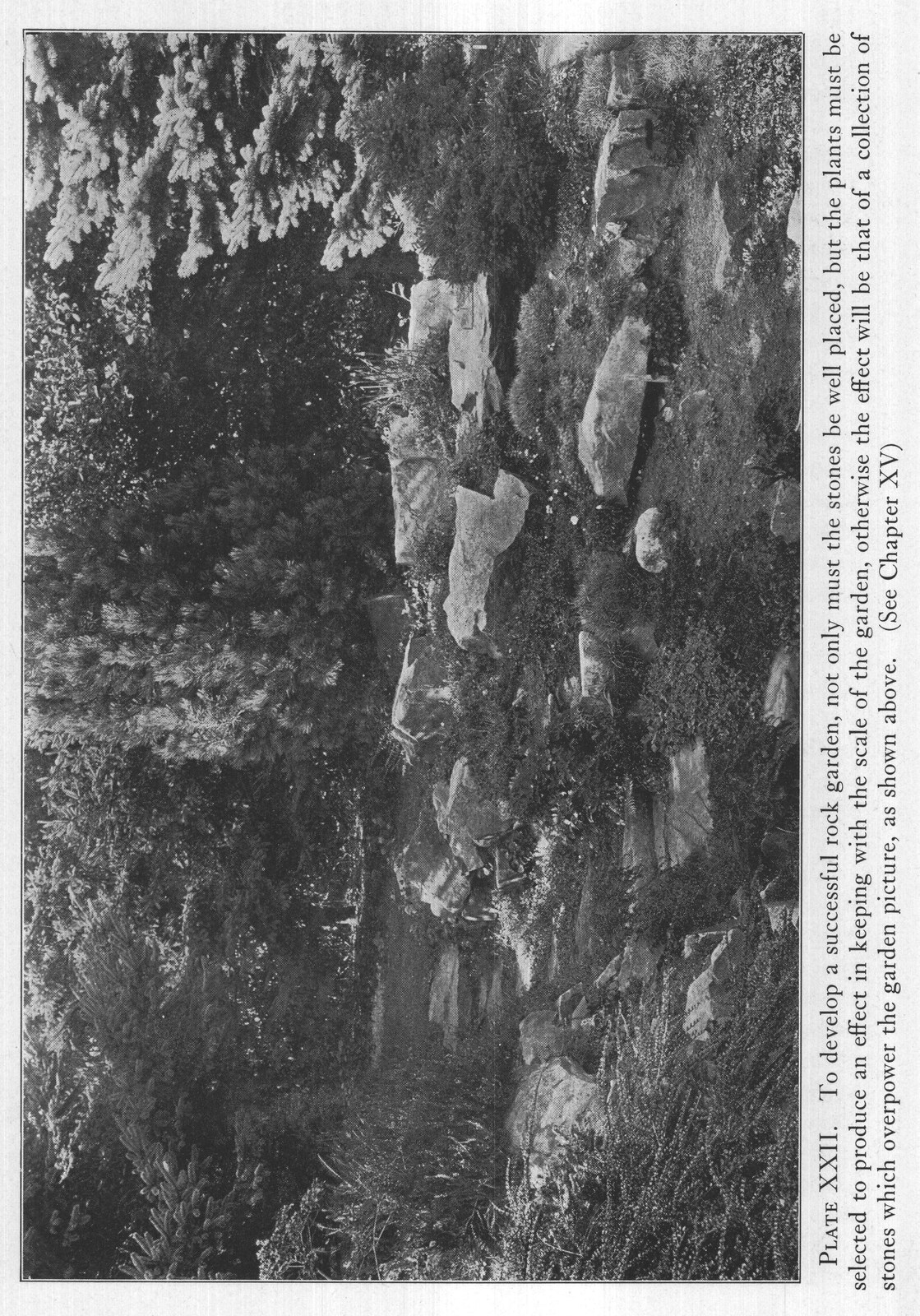
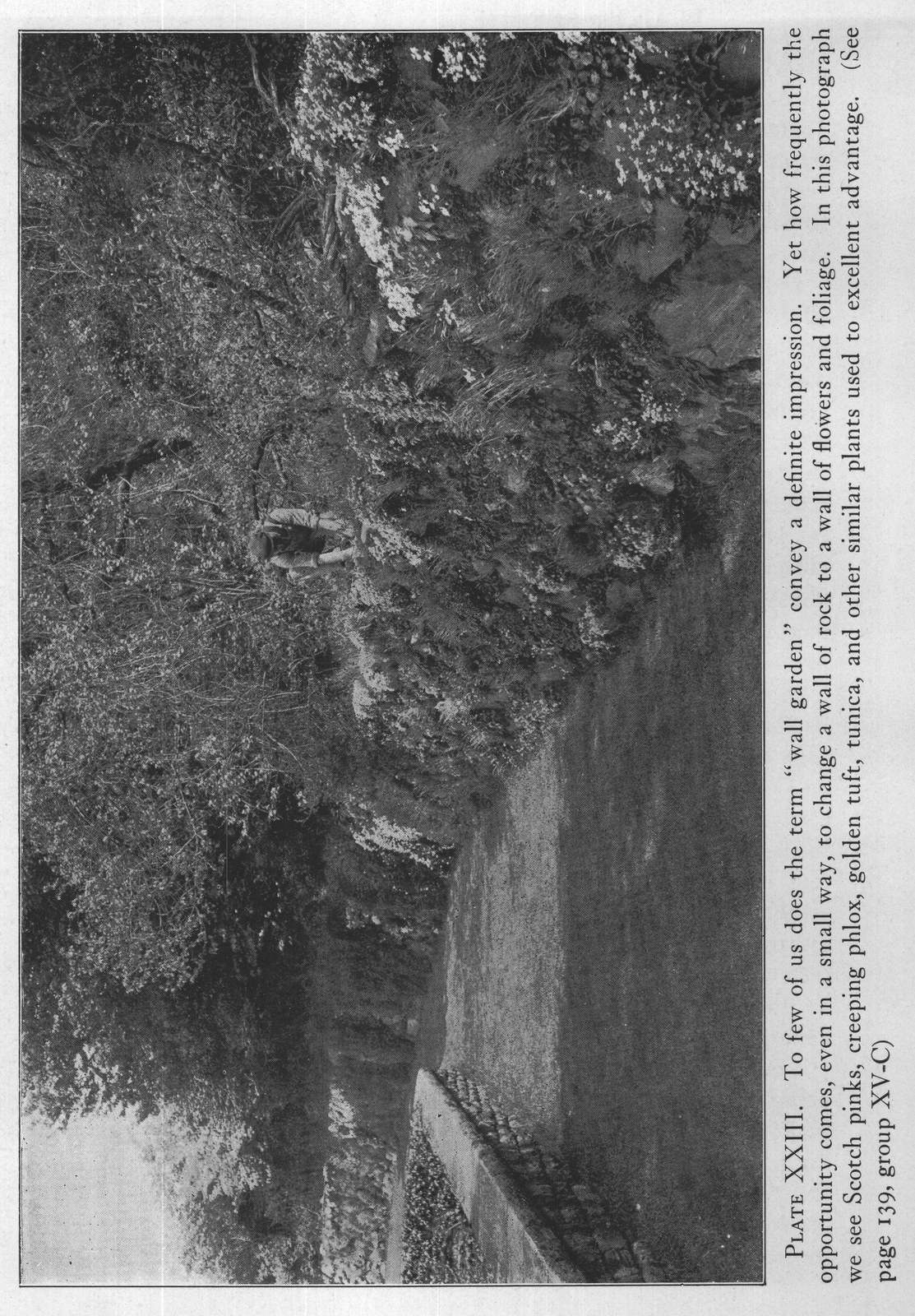
While there is a considerable list of plants which are adapted for PLATE XXII. To develop a successful rock garden, not only must the stones be well placed, but the plants must be selected to produce an effect in keeping with the scale of the garden, otherwise the effect will be that of a collection of stones which overpower the garden picture, as shown above. (See Chapter XV) selected to produce an effect in keeping with the scale of the garden, otherwise the effect will be that of a collection of stones which overpower the garden picture, as shown above. (See Chapter XV) PLATE XXIII. To few of us does the term "wall garden" convey a definite impression. Yet how frequently the opportunity comes, even in a small way, to change a wall of rock to a wall of flowers and foliage. In this photograph we see Scotch pinks, creeping phlox, golden tuft, tunica, and other similar plants used to excellent advantage. (See page 139, group XV-C) growing in tubs, as frequently seen, for accent points in a formal garden or on a terrace, the amateur should best confine himself to the Japanese laurel, the evergreen evonymus, the greenhouse hydrangea, pyramidal arborvitae, and the boxwood. Most of these should be transferred during the winter months, preferably to a cold cellar or to a cold house, and even those which are semi-hardy, if left out of doors, should be carefully boxed and protected.
Perhaps the most interesting groups of trees and shrubs for formal effects are those which are valuable for use in pleached allees. This feature in the design of large estates has not yet reached its height and will become more popular with the development of landscape design as applied to American estates and gardens. The plants of this group must be resistant to disease and insect pests and they must be able to thrive under conditions of severe pruning. The one most important requisite is that they shall be long lived and not easily broken by winter storms. The texture of branching must be close. To use for pleached allees trees, such as the birches, which are short lived and which always begin to deteriorate at a time when the allee should be most picturesque and at its height, is landscape folly. It takes years, five to eight years, to develop a pleached allee so that the tops will come together. To endeavour to hasten the growth of plants by excessive fertilization during the first two or three years will have a tendency to split the bark and to expose the trunks to severe injury from freezing and rotting. These plants should be of a spreading habit of growth as contrasted with the columnar habit of growth desired for open allees. While these specimens are planted at intervals of eighteen to twentyfour inches in rows, it often becomes necessary to interplant with the smaller specimens which will serve as fillers for the base. The normal distance between rows on either side of a pleached allee is six feet to eight feet. It is most advisable to train these plants to the pleached form by the use of iron pipe and wire. This can be done by a skilled gardener, by constant attention and the frequent use of pruning shears. Trees and shrubs for open allees must meet the one requirement of being close growing and columnar in their habit. An open allee may be developed with rapid-growing material as well as with slow-growing material, and the time required is less than two-thirds as long as the time required to develop a pleached allee of the same height. Six to ten years may be required to develop an open allee eight to ten feet in height. The scale of the allee, whether wide, with a tall border on either side, or narrow, with a lower border, governs the type of material which should be selected. Here again, with such plants as the thorns and elms, a larger specimen may be used with a high head, and the smaller specimens may be planted between and on either side to produce the mass of foliage at the bottom. An illustration of this is shown in plate No. XXVIII on Page 190. This interesting open allee of thorns and flowering dogwood is planted according to the following measurements. The distance between the middle line of each row of thorns is twenty-two feet s x inches. Each row was originally planted with high-headed thorns at a distance of four feet six inches apart in the row. Equally spaced at a distance approximating one foot six inches apart, small specimens two feet to three feet high were planted in a single row at a distance of one foot six inches on either side of the main row of thorns. These small thorns were for the purpose of producing a foliage effect beginning at the ground and extending into the higher heads of the larger thorns. The width between the rows of flowering dogwood is eight feet and the distance between each flowering dogwood plant in each row is eight feet. The width of the walk in this picture is four feet. It is very essential to use types which have a branching habit to the extreme base of the main trunk if a perfect open allee is desired.