Home › Plants for Hedges › Plants for Hedges (Thuja occidentalis)
Plants for Hedges (Thuja occidentalis)
Thuja occidentalis ellwangeriana Ellwanger's Arborvitae Thuja occidentalis globosa Globe Arborvitae Viburnum opulus nanum Dwarf Bush Cranberry C. WINDBREAKS AND SOLID SCREENS. Most of the trees and shrubs in this group are rapid growing and are entirely hardy under normal climatic conditions. They can be planted in close proximity to each other without injuring the individual specimens. This close planting, however, renders all the trees useless in future specimen planting. Acer ginnala Siberian Maple Acer negundo Box Elder Acer saccharinum pyramidale Pyramidal Silver Maple Acer tataricum Tartarian Maple Carpinus caroliniana American Hornbeam Picea (in variety) Larix leptolepsis Japanese Larch Spruce Pinus resinosa Red Pine Pinus strobus White Pine Populus (in variety) Poplar Fagus americana American Beech Rhamnus caroliniana Carolina Buckthorn Fagus sylvatica European Beech Juniperus virginiana Red Cedar Salix (in variety) Willow Tsuga canadensis Canadian Hemlock Larix europaea Tsuga caroliniana European Larch Carolina Hemlock D. FOR PRIVACY. These types are selected because of their ability to develop a compact, heavy foliage effect and most of these types retain their foliage during the late summer and early fall months. Acer saccharinum pyramidale Pyramidal Silver Maple (low-branched) Cornus mas Cornelian Cherry Elaeagnus angustifolia Russian Olive Fagus sylvatica European Beech Forsythia intermedia Hybrid Golden Bell Forsythia viridissima Dark Green Golden Bell Hibiscus syriacus Rose of Sharon Ligustrum (in variety) Privet Lonicera bella Zabel's Honeysuckle Lonicera maacki Late-blooming Honeysuckle Lonicera tatarica Tartarian Honeysuckle Rhamnus cathartica Common Buckthorn Spiraea vanhouttei Van Houtte's Bridal Wreath Syringa vulgaris Viburnum (in variety) Viburnum Common Lilac E. HEDGES FOR BLEAK EXPOSURES. These plants are hardy as far north as the Canadian northwest and will survive under extreme exposure. This group has been subdivided in order more clearly to differentiate between plants which should be used for their different characteristics under different exposures. a. Late foliage: b. Close shearing:
Syringa vulgaris (not variety alba) Common Lilac Berberis thunbergi Thunberg's Japanese Barberry Elaeagnus angustifolia Russian Olive Caragana arborescens Rhamnus cathartica Siberian Pea Shrub Common Buckthorn Caragana microphylla Dahurian Pea Shrub Shepherdia argentea Buffalo Berry Shepherdia canadensis (on lime) c.
Canadian Buffalo Berry Unsheared low hedges:
Berberis thunbergi Thunberg's Japanese Barberry d. Fruiting hedges:
Berberis thunbergi Thunberg's Japanese Barberry Crataegus (in variety) Thorn Hippophae rhamnoides Sea Buckthorn Rhamnus cathartica Common Buckthorn Spiraea vanhouttei Van Houtte's Bridal Wreath Rosa (in variety) Native Rose Rosa rugosa Japanese Rose Shepherdia argentea Buffalo Berry Shepherdia canadensis (on lime) Canadian Buffalo Berry Symphoricarpos (in variety) Snowberry e. Shady places:
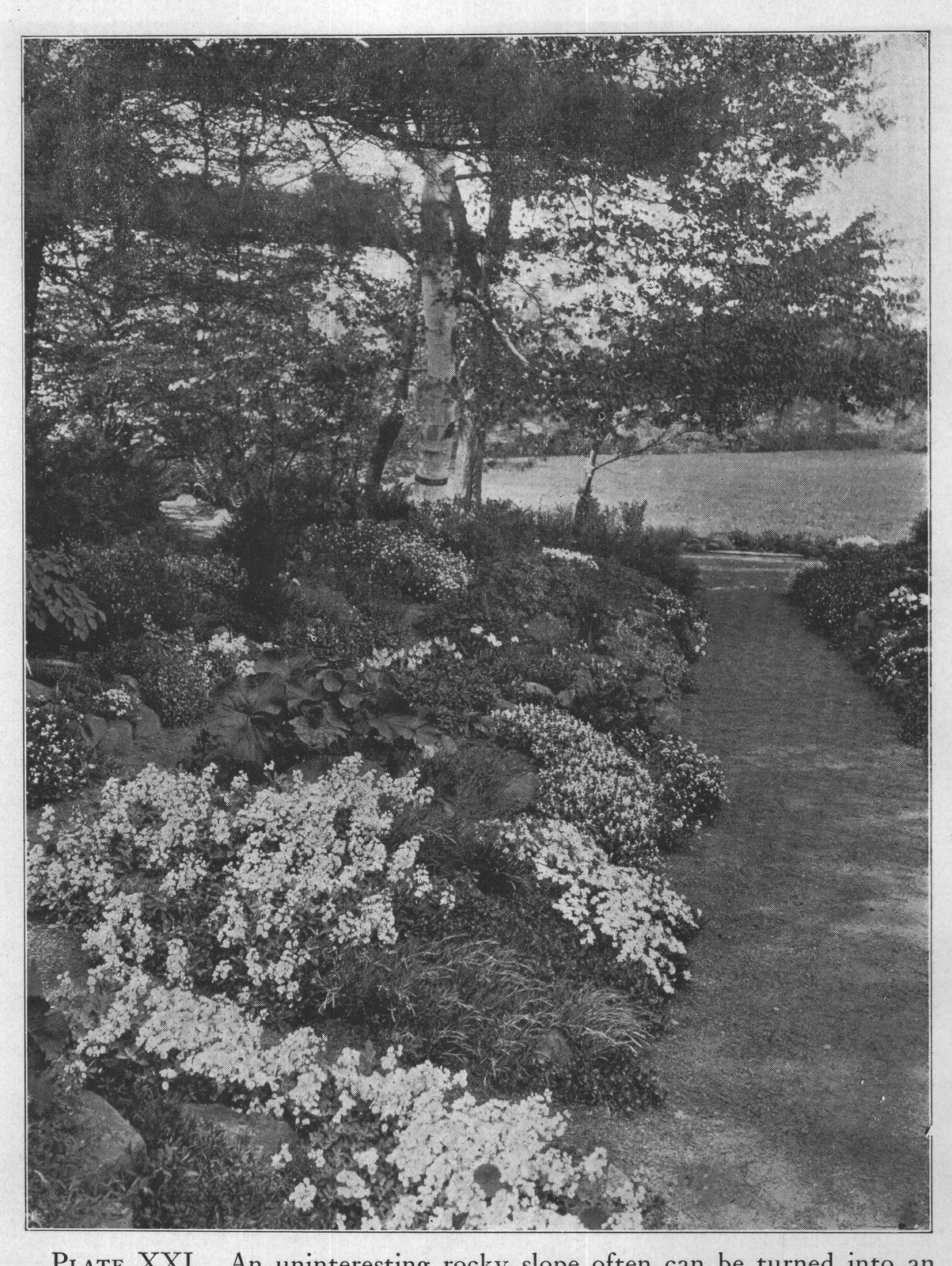
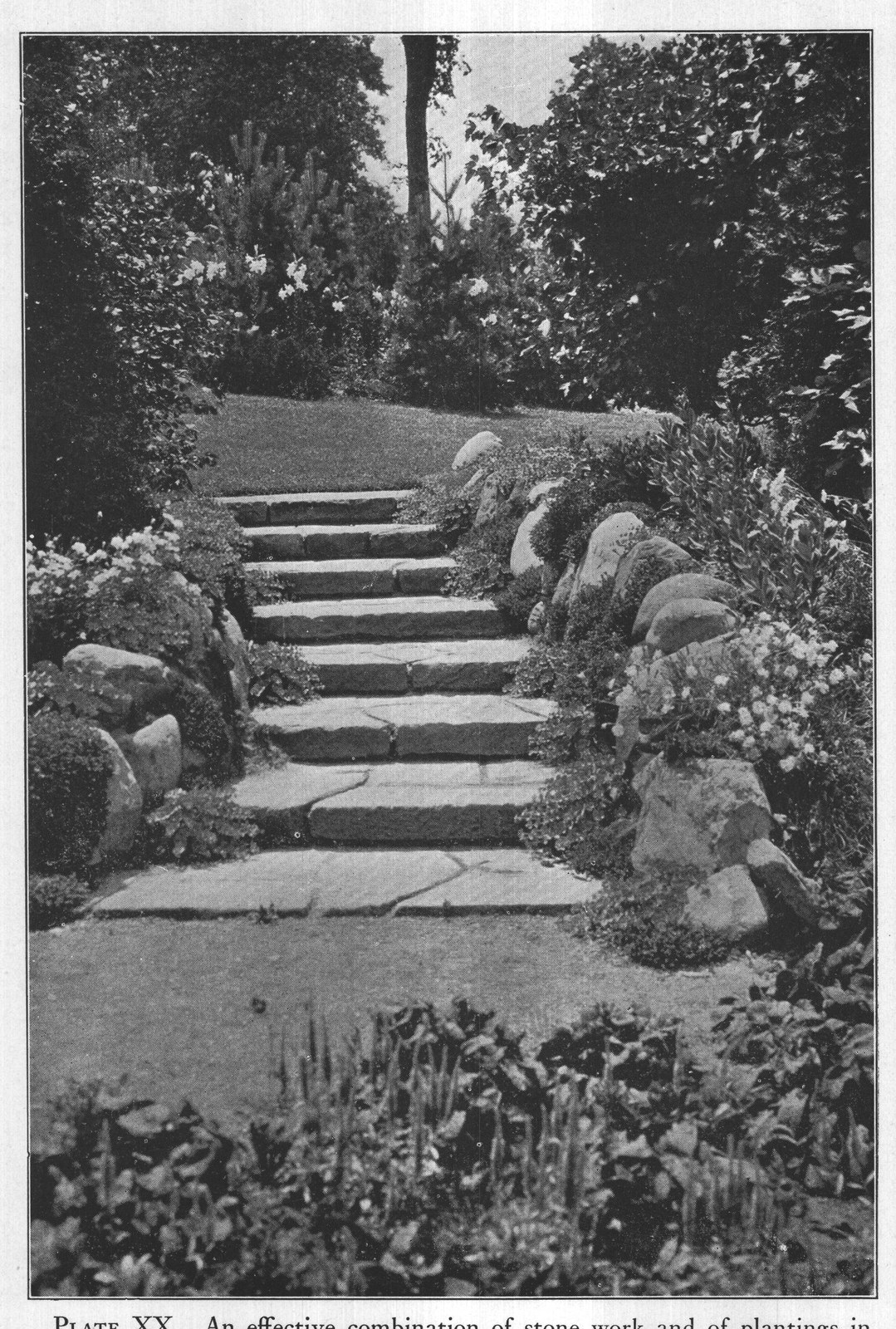
Acer saccharinum Silver Maple Crataegus monogyna English Hawthorn Lonicera xylosteum Fly Bush Honeysuckle Philadelphus coronarius Common Mock Orange Spiraea vanhouttei Van Houtte's Bridal Wreath Symphoricarpos racemosus Snowberry PLATE XX. An effective combination of stone work and of plantings in an informal lawn. Varieties of stonecrop, moss pinks and Scotch pinks lend charm to an otherwise uninteresting mass of stone. (See plate LIII, page 334, for lily planting shown in background of this picture.) (See page 139) PLATE XXI. An uninteresting rocky slope often can be turned into an attractive landscape feature through the careful selection and planting of plants adapted to light, sandy soils. This slope is covered with a grouping of hardy pinks, evergreen candy-tuft, saxifrage and tufted pansy. (See page 139)