Pruning
REASONS FOR PRUNING. The reasons for pruning are: (1) To secure a desired form or height of the plant; (2) To remove injured, diseased, or dead branches; (3) To renovate or rejuvenate old plants; (4) To maintain a balance between root growth and top growth (as shown in the operations of transplanting); (5) To encourage the production of an abundance of flowers; (6) To encourage the production of a few large flowers; (7) To improve or modify the natural form of the plant for some specific reason such as in topiary work and hedge work.
Pruning, however, is only a phase in the care of plants and must be accompanied by constant good cultivation, feeding, and management of plants. It is only through the process of intelligent pruning that shrubs especially can be maintained in a definite and natural condition of growth and also kept at a correct height to avoid in many instances the out-growing or over-powering of the design for which they were selected to become a part. Many incorrect ideas have become prevalent concerning the process of pruning, and the application of these incorrect methods often causes a slowing up or incorrect development not only in the growing habits of the shrubs but in the quality and the quantity of the flowers produced.
PRECAUTIONS TO OBSERVE. Pruning should be done only with a definite ideal and after arranging an intelligent program. No set rules can be offered. Climatic conditions may cause rules correct in one locality to prove valueless in another, and plants of the same species often vary in their habit of growth at different ages, and must be pruned accordingly. Pruning should be entrusted only to a careful workman. It is too common practice in pruning to have shrubs and trees with all the tips lightly snipped off with regularity; or to have trees with the main and lateral branches ruthlessly lopped PRUNING off. The natural habit of the plant should be known and this form preserved when removing any wood. This fact should always be kept in mind except in the case of shrubs or trees which are to be trained in artificial shapes.
RESULTS FROM PRUNING. Pruning always arrests but does not permanently change the natural habits and growth of a plant. It often causes the plant to assume temporarily another form than it would naturally assume. Pruned plants constantly struggle to return to their natural habit, and when pruning has been undertaken for a specific purpose it should be continued throughout the life of the plant so long as that purpose is desirable.
Root pruning tends to reduce wood production and hence to increase fruit and flower production. Top pruning favours wood production and thus more top is produced by the seemingly contrary process of cutting it off. In the case of transplanted stock tops are cut back to compensate for the roots that are lost in moving. Removal of excess top growth insures to the remaining parts of the plant more nourishment, with subsequent better development, and it also decreases the area of leaf surface and the consequent evaporation of stored-up moisture before the roots begin functioning in the new location. TOOLS AND WOUND DRESSINGS. Pruning shears, pruning knives, and hand saws are the best tools to use. Pole saws and hooks should be avoided as they leave ragged wounds, and pole pruners should be used only for small twigs. Never use double edge saws as they are more apt, in the hands of a careless workman, to injure the tree. A ladder will be required for the larger trees and a block and ropes for removing limbs that are near wires or that might injure property. For dressing wounds gas tar and liquid asphaltum have proven the most satisfactory. They hinder healing the least of the common dressings and are the most durable, adhesive, and antiseptic. Coal tar and pine tar seem to be injurious and white lead apparently has no injurious or antiseptic effect. Dressings give only physical protection and cannot hasten healing, which takes place through the activity of the plant itself.
TREES-TOP PRUNING. Street trees should be pruned so that branches will not interfere with pedestrians or vehicles. The roots of street trees are more confined than those of other trees and they require top pruning to balance with the root system. Pruning should aim to preserve the natural habit of the trees; but they should also be kept symmetrical in form. If the tops become too thick and exclude too much light they should be thinned out. Main laterals, however, must not be disturbed, but rather the shoots that spring from these main laterals should be removed.
Specimen trees on lawns require little pruning except to prevent bad crotches (which if left might cause splitting), to shorten branches which may affect the symmetry of the tree, to remove dead wood, and sometimes to remove (as in the case of maples and pin oaks) some of the finer interior branches in order to give more "character" to the tree. It is generally best to do the heavy cutting in winter, while the trees are dormant. Pruning in early spring or summer may cause the tree to "bleed," with a consequent check to the root system from the loss of food. This is especially true of maples. One advantage, however, of spring or summer trimming is that the tree will recover more quickly and start to heal the wound, which would be impossible during the winter season. If trees are pruned in winter the "shaping up" and removal of small pieces of dead wood should be done after the leaves appear at which time symmetry can be better judged and all dead branches can be more easily discovered. To assure the least possible injury from exposure to climatic conditions winter pruning, if necessary, should be delayed until the danger from the more severe winter conditions is past.
Broken and diseased limbs must always be removed, and secondary growth and suckers cut, to open the centre of the tree to the sun and air. When limbs are pruned they should be cut back to a bud that will grow outward.
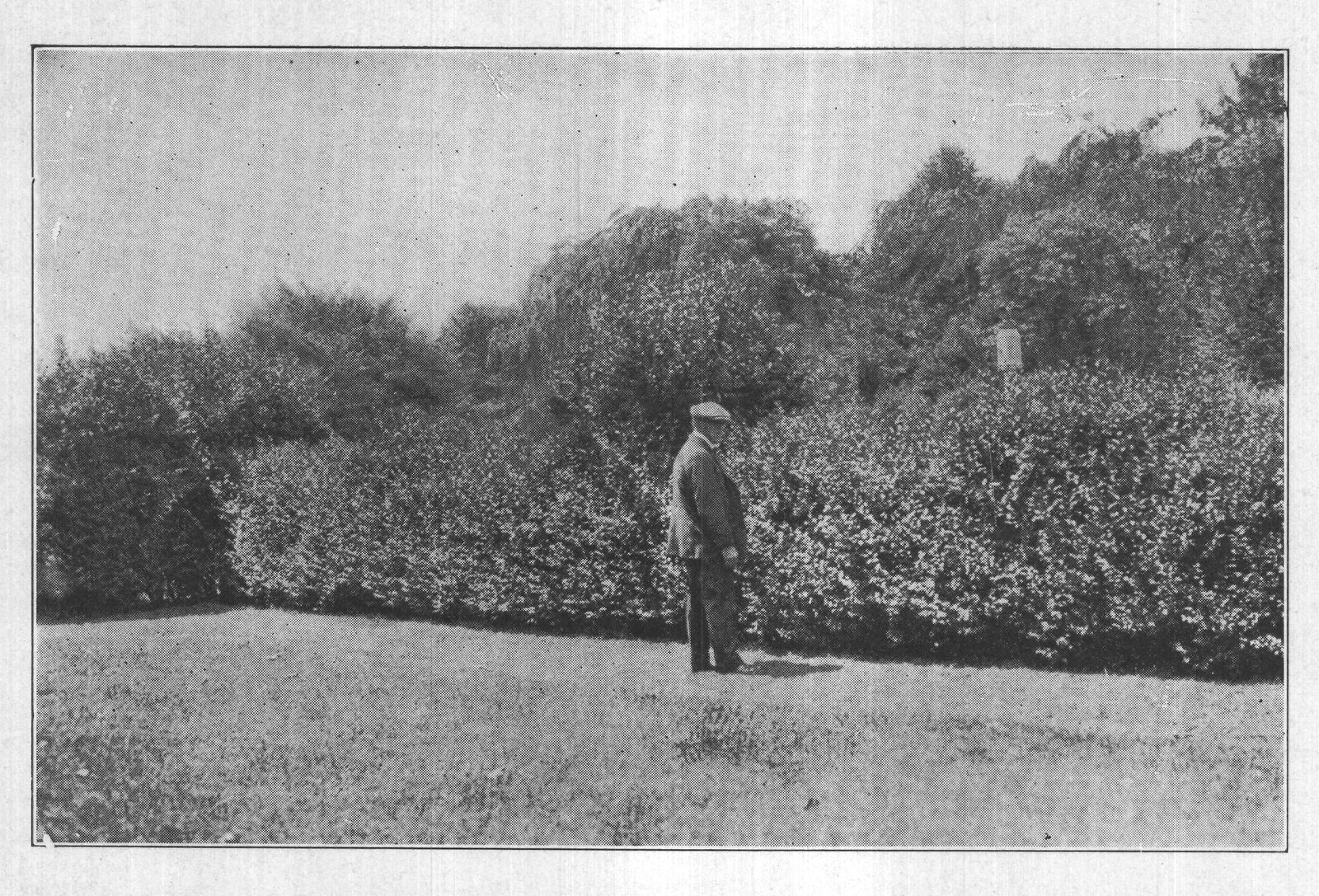
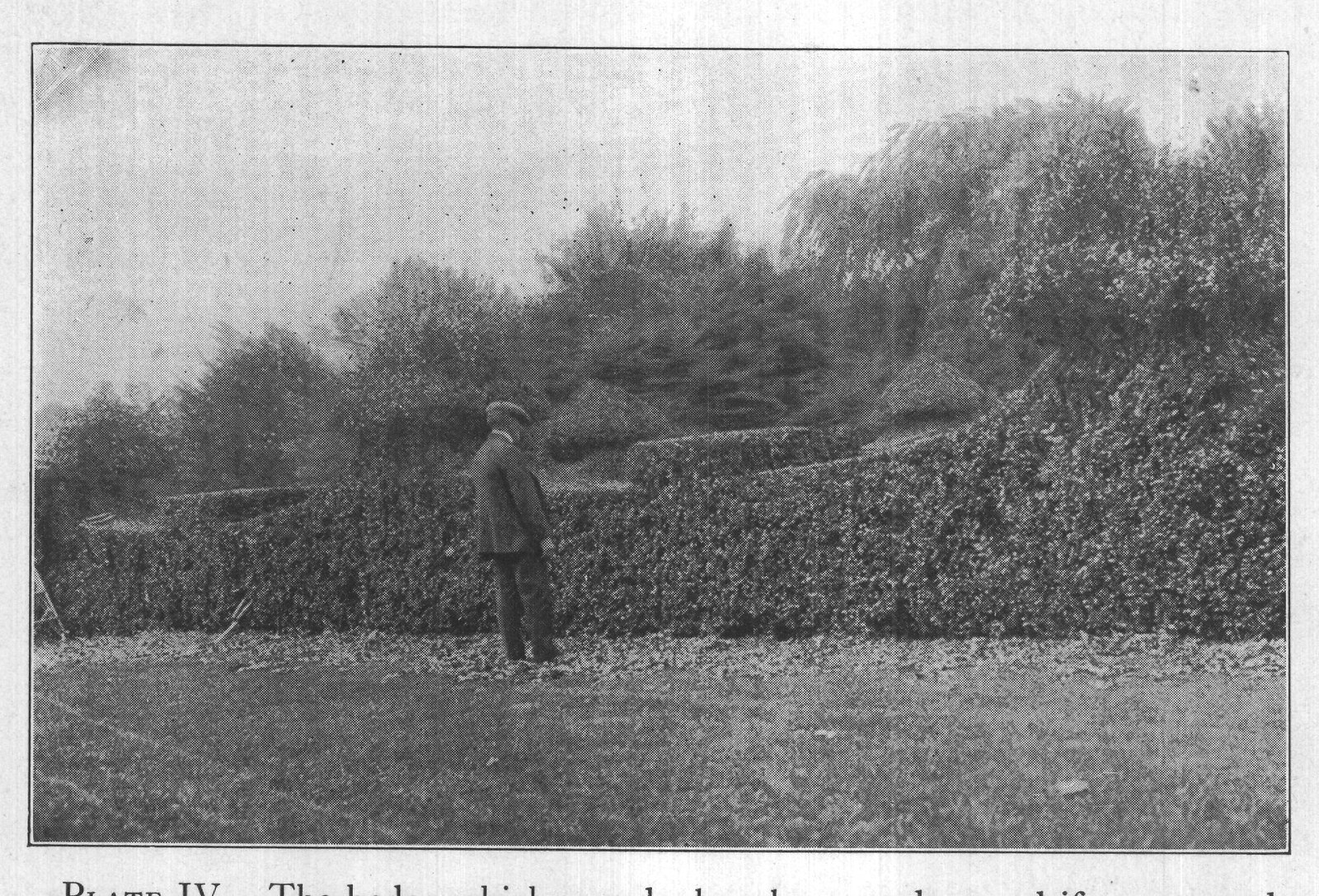
When larger branches are entirely removed, the cut should be made at the base of the branch and parallel to the tree trunk. No stump at all should be left, and care should first be taken to undercut amply on all heavy limbs so that when the cut on the upper side is completed the branch will not split the bark from the trunk. All other cuts, such as removing portions of branches, should be made perpendicular to the axis of the branch which is being shortened. The cut should always be clean, with no ragged edges left (See Plate V). Never cut back the leader on trees that are excurrent, such as oaks, PLATE IV. The hedge which may look unkept, and ragged if not pruned, will in the hands of the skilled gardener assume almost any degree of refined outline. These photographs show one of our most desirable hedge plants, the Japanese privet (Ligustrum ibota). (See Chapter III) PRUNING birches, spruces, and sugar maples. If the leader is killed it is often possible to train the best lateral available as a substitute. This may be done by binding the lateral to a pole and tying with raffia. If the tree is weakened or is dying, severe pruning will often aid in offsetting the trouble and may help the tree to recover its vigour. Many trees and shrubs, as poplars, soft maples, the tree of heaven, box elders, hydrangeas, and sumacs will stand very heavy pruning and recover rapidly. Oaks, elms, and flowering dogwoods should be pruned only as corrective measures and not to check growth. During the progress of construction work in the neighbourhood of fine trees or shrubs some protection should be afforded, either by the erection of a stout fence or a stout wooden framework. ROOT PRUNING. Root pruning serves to check the growth of a tree and to encourage lateral or secondary growth of the roots. When a plant has a slow or a weak-growing top grafted upon a vigorous root stock, root pruning is often used advantageously to stop too great a growth of the stock. Root pruning should be done before the weather becomes too cold in the fall. If this pruning is delayed till very late no start in healing the cuts will be made before spring, and meanwhile decay will set in. The process of root pruning to assist in the successful transplanting of trees is effected by excavating a narrow trench around the tree encircling a ball of earth (Usually six to eight feet in diameter) (See Plate VI-C-1) which can be handled with a tree machine. In this way one-half to two-thirds of the large roots are severed. The trench is filled with loam, and during the remainder of the growing season a mass of new fibrous roots form, which readily come to the aid of the tree when transplanted to its new location (See Planting and Transplanting, Page 42).
All trees should be top pruned when transplanted. This is done to offset the loss of root system by removing a portion of the top. A general rule is to remove four-fifths of the current year's growth and one-eighth of the older branches. Do not cut back main laterals or leaders so as to leave large stubs, for with such pruning the stubs will rot and spoil the tree.
Trees with ample fibrous roots, such as maples and elms, are easier to move successfully than trees with few roots, or with tap roots, such as magnolias, tulips, gums, and nut trees. It is therefore necessary to prune the tops more heavily on transplanted stock with sparse root systems. On all transplanted stock the roots should be pruned to remove diseased, dead, or bruised portions, In older plants tap roots may be shortened if the cutting is done judiciously. Many trees, especially older trees, are moved more safely in the winter if they are root pruned not later than the last of the previous July. In transplanting fine old specimens of beech and boxwood it is sometimes necessary, and always advisable, to root prune the trees for two seasons prior to the time of transplanting, in order to insure the greatest possible success.