Abutilon
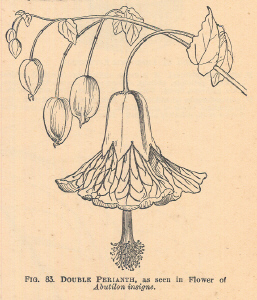
(Arabic name for a plant analogous to the Marsh mallow). ORD. Malvaceae. Very showy, decorative, and free-growing shrubs, both for the greenhouse and outside culture. Calyx naked, five-cleft, usually angular; style multifid at apex. The many beautiful hybrids of which now in cultivation, far supersede the true species. Cultivation: Few plants are more easily grown and worthy of liberal treatment than these. The best soil for them is equal parts turfy loam, peat, and leaf mould, with some gritty sand. They may either be grown in posts, or planted out; but in all cases thorough drainage is indispensable, as they require an abundance of water, and stagnancy must be guarded against. AT the end of May they may be planted outside, when they will flower profusely through the summer. In a free growing and flowering state they enjoy weak manure water. From the latter part of autumn till early spring they may be kept almost dry without injury, though in a warm conservatory some of the later struck plants will go on flowering throughout the greater part of the winter; or plants may be specially prepared for winter flowering. They are admirably adapted for forming standards of various heights, from 2ft. to 6ft. Some of the taller sorts are very useful for training under roof rafters. As pillar plants, too, very loosely trained, so as to allow the upper and side branches to droop to a considerable distance from the pillar, they are very effective. Propagation: They strike readily from cuttings made of the young wood, at almost any season; the best time, however, is early spring and September. Inserted in pots, in a compost of equal parts peat, leaf mould, loam, and sand, and placed in a temperature of from 65deg. To 70deg., they will then quickly root, and form good plants. Seeds may be sown in pans filled with soil as recommended for cuttings, and placed in a similar temperature. Those followed by a dagger are the best for training to pillars, roofs, &c.
A. Bedfordianum (Bedford's). fl. yellow and red. November. l. deeply-lobed. h. 15ft. Brazil, 1838.
A. Darvini (Darwin's). dagger* fl. bright orange, with darker veinings, fine cupped form. April. l. large, broad. J. 4ft. Brazil, 1871. A handsome species, of good habit equally suitable as a stove or greenhouse plant during winter, and for outdoor culture during summer months. There are a great number of garden hybrids from this.
A. globiflorum (globe-flowered). fl. solitary, large, globose, cream-coloured. November. l. on long stalks, cordate, serrate. h. 4ft. to 5ft Mauritius, 4825.
A. igneum (bright). Synonymous with A. insigne.
A. insigne (handsome-flowered).* fl. large purplish crimson, with dark venation, in axillary pendulous racemes; petals short, broad, much reflexed. Winter. l. large, cordate, thick, rugose Stem deep green, with short brown hairs. h. 6ft. New Grenada, 1851. SYN. A igneum.
A. megapotamicum (big river). dagger* fl. small, bell-shaped singularly beautiful, the sepals being dark red, petals pale yellow, and stamens dark brown. Autumn and winter. l. small, pointed. h. 3ft. Rio Grande, 1864. A free-flowering species, with a graceful drooping habit; the shoots should be well pressed in during spring. SYN. A vexillarium.
A. paeoniflorum (paeony-flowered). fl. pink, smaller than those of A. insigne, but very distinct. January. l. large, ovate. h. 6ft. Brazil, 1845.
A. pulchellum (pretty). dagger* fl. white, on few-flowered axillary racemes. July. l. cordate, unequally crenated, downy beneath. h. 8ft. Habit very branching. New Holland, 1824.
A. Striatum (striped).* fl. orange yellow, with a thick veining of blood-red, on long curving stalks. l. large, lobed, on long slender petioles, Brazil, 1837. A free grower, and makes an excellent greenhouse plant. In sheltered positions, in the south-west of England, this species proves to be almost hardy. It requires to be freely pinched. A very continuous bloomer.
A. Thompsoni (Thompson's). fl. striated yellow, large. Summer. l. small, vine-like, richly mottled with yellow and dark green. h. 3ft. or 4ft. habit very heat and erect.
A. venosum (veined). dagger* fl. orange, with red veins, very large, bell shaped, 3in. long; pedicels nearly 12in. long. July. l. large, deeply palmate. h. 10ft. This splendid species is distinguished by its unusually large flowers.
A. vexillarium (standard). Synonymous with A. megapotamicum.
A. vitifolium (vine-leaved).* fl. porcelain blue, large, cupped. May. l. cordate, five to seven lobed, assuming, towards the autumn, a five golden hue, h. 30ft. Chili, 1837. This fine shrub, or tree, is hardy in Ireland and the south of England, but should have a protection from frost. It is not a fast grower.
The following are some of the best varieties, which, although they do not include all the newest sorts, yet afford a good selection of first-rate kinds, which will give general satisfaction. They are arranged according to their respective colours. Those marked with a dagger are best for roofs and pillars.
Orange-flowered. AUREUM GLOBOSUM,* flowers deep orange, heavily red shaded, of medium size, with good form and substance; DARWINI MAJUS,* bright orange, deeply veined, extremely free, and of good form and size; FLEUR D'OR, dagger light orange, veined pale red, very free and dwarf; GRANDIFLORUM,* deep orange, red shaded, deeply veined with red, a robust, large-flowered variety LEO, flowers pale below, deeper above, red-veined, of medium size; PRINCE OF ORANGE, dagger* a strong grower, and very free.
Ornamental-foliaged. DARWINI TESSELATUM, dagger* foliage mottled with yellow, invaluable for sub-tropical bedding; SELLOWIANUN MARMORATUM,* very large maple-like foliage, heavily mottled with bright yellow, a most effective variety; THOMPSONI, leaves very freely blotched with yellow; VEXILLATIUM IGNEUM,* very free of good habit, prettily blotched. All these ornamental-foliaged varieties are invaluable for bedding purposes.
Purple-coloured. EMPEROR,* flowers large, rich purple magenta shaded, habit vigorous; LOUIS VAN HOUTTE, very free, rosy purple; PURPUREA,* deep purple shaded lake, very attractive; SOUVENIR DE ST. MAURICE, flowers medium size, very profuse; VIOLET QUEEN,* bright violet purple, very distinct and free.
Red and Crimson-flowered. BRILLIANT,* flowers of good form and substance, brilliant red inside, rather paler outside, dwarf and free; CRIMSON BANNER,* rich crimson, dwarf, very floriferous; FIRE KING,* bright red, orange shaded, veined with crimson; LUSTROUS,* brilliant red crimson, large, most profusely produced, habit dwarf; NE PLUS ULTRA,* intense crimson, of excellent form; SCARLET GEM,* flowers medium sized, brilliant scarlet, habit dwarf and free.
Rose-coloured. ADMIRATION, light pink, shaded salmon, of good form and shape; ANNA CROZY,* deep pink, lilac shade, veined white, very showy; CLOCHETTE,* deep rosy pink, with crimson veins, very dwarf and free; DELICATUM, pale salmon rose, with deeper veins, flowers very large; KING OF THE ROSES,* rich deep rose, of good size and substance, habit dwarf and very free; LADY OF THE LAKE,* flowers medium sized, rich pink; LOUIS MARIGNAC, pale pink, veined white, splendid habit, a charming variety; PRINCESS MARIE, dagger* flowers rich rosy lake, very profuse, of excellent form; ROSAEFLORUM,* pale salmon rose, veined with crimson.
White-flowered. BOULE DE NIECE, dagger* very fine pure white flowers, the best in its class; PURITY,* very free, of good habit, and pure white; SERAPH,* dwarf, and very floriferous.
Yellow-flowered. CANARY BIRD, dagger* similar in habit to Boule de Niege, bright primrose, very lovely; COURONNE D'OR,* bright yellow, of the finest form and substance, very bold foliage; GOLDEN GEM, rich canary yellow, extremely free, of dwarf habit; LEMOINET, dagger very large, lemon yellow, good substance; YELLOW PRINCE,* rich golden yellow, or medium size, very profuse.