Arum
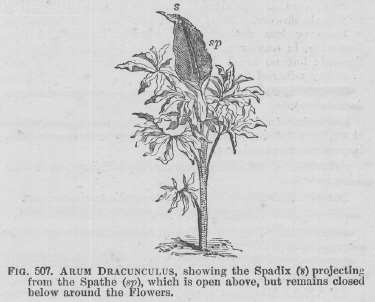
(formerly Aron; probably of Egyptian extraction). ORD. Aroideae (Araceae). A genus of ornamental or curious, hardy, greenhouse, or stove perennials, with thick rhizomes and pedate or hastate leaves. Spathe large, convolute; spadix naked and club-shaped at the top. They are all of easy culture, and the indoor species will thrive with such treatment as is given to Alocasias, Caladiums, &c. Rich soil is one of the first conditions of success. Like most plants grown for the beauty of their foliage, rapid and free growth is necessary. A compost of good rich loam, with a third of sweet manure, thoroughly rotted, or leaf mould, with some sharp sand, is very suitable. Plenty of moisture is necessary during the growing season, after which the tender kinds should be kept moderately dry, warm, and at rest during the winter. The hardy kinds may be left in the ground. Propagated by seeds or division of the roots-usually the latter. The best time to divide them is just as they commence their new growth, securing as many roots as possible to each division. Any rootless pieces should be placed in heat shortly after removal; this hastens the formation of roots and excites top growth. Arums are useful in sub-tropical gardening, and are otherwise interesting plants both for indoors and outside cultivation; and the hardy kinds are very suitable for naturalising in woodlands, &c. There are many other species besides those here described, but the following list comprises the best. Sub-sections of the genus will be found treated separately, such as Amorphophallus (which see), &c.
A bulbosum (bulbous). Synonymous with A. ternatum.
A. Dracontium (Green Dragon). fl., spadix subulate, longer than the oblong convolute green spathe. June. l. pedate, entire. h. 2ft. North America, 1759. Hardy.
A. Dracunculus (Common Dragon).* fl., spadix lanceolate, shorter than the ovate, flat, smooth, brown spathe. July. l. pedate, entire. h. 3ft. South Europe, 1548. Hardy. SYN. Dracunculus vulgaris.
A. indicum (Indian). See Colocasia indica.
A. italicum (Italian).* fl., spathe ventricose below, opening nearly flat and very broad above; apex often falling over very shortly after expansion, sometimes greenish yellow, at others nearly white; spadix yellowish or creamy white, club-shaped, about one-third as long as the spathe. Spring. l. appearing before winter, radical, triangular-hastate. h. 9in. to 2ft. Channel Islands and Cornwall, &c. Hardy.
A. i. marmorata (marbled).* l. marbled with yellow. A very pretty and effective hardy border plant.
A. maculatum (spotted). Lords and Ladies; Cuckoo Pint. fl., spathe ventricose below and above, constricted in the middle, with inflexed edges when open, spotted with dull purple; spadix usually purple, shorter than the spathe. Spring. l. vernal radical, hastate-sagittate, with deflexed lobes. h. 9in. Britain, &c. This species is admirably adapted for a corner in the wild garden.
A. Malyi (Maly's). fl. whitish. Montenegro, 1860.
A. Nickelli (Nickel's). Levant, 1859. A form of A. italicum.
A. orientale (eastern). fl. resembling those of A. maculatum. June. l. brownish, simple, ovate, slightly sagittate. h. 1ft. Tauria, 1820. Hardy.
A. palaestinum (Palestine).* fl., spathe 7in. to 11in. long, purplish blotched or spotted outside, rich velvety black inside and yellowish white at the base of the tube; spadix much shorter than the spathe; petiole usually rising 8in. or 9in. above the leaves. May. l. four or five, triangular-hastate, acute, from 6in. to 14in. long, and from 3 1/2in. to 7 1/2in. broad; petioles 12in. to 18in. long. Jeruslem, 1864. Tender.
A. pictum (painted). h. 2ft. Corsica, 1801. Hardy.
A. proboscideum (proboscis-like).* fl., spathe greenish purple, navicular, horizontal, terminated by a straight tail; scapes arising from among the petioles. May. l. radical, about four, cordate-elliptic, entire. h. 6in. South Europe, 1823. Hardy.
A. spectabile (showy). fl., spathe ovate-oblong, acuminate, dark purplish inside, longer than the purplish spadix. l. broadly hastate-sagittate. h. 1ft. Asia Minor. Half-hardy.
A. spirale (spiral). fl., spadix lanceolate, shorter than the oblong-lanceolate spirally twisted brown spathe. May. l. linear-lanceolate. Plant stemless. h. 1ft. China, 1816. Tender.
A. tenuifolium (narrow-leaved).* fl., spadix subulate, longer than the white lanceolate spathe. April. l. linear-lanceolate. Plant stemless. h. 1ft. South Europe, 1570. Hardy.
A. ternatum (three-leafleted). A synonym of Pinellia tuberifera.
A. variolatum (variegated). Dalmatia, 1859. Hardy.
A. venosum (veined). A synonym of Sauromatum guttatum.
A. Zelebori (Zelebor's). A form of A. maculatum.